Category Archives: Technology

Lessons from the Industrial Revolution

Mapping a Balanced Transition into the AI Era
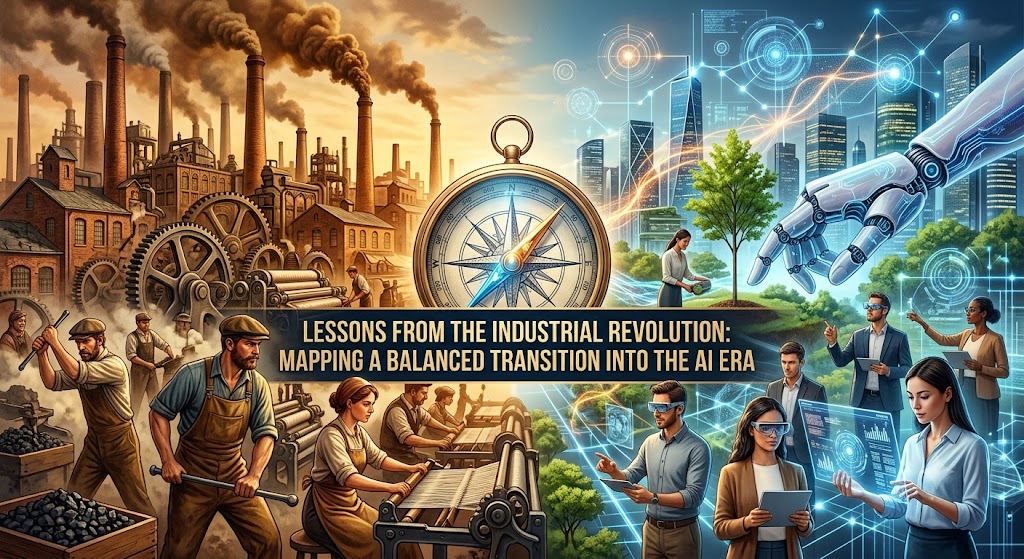
Lessons from the Industrial Revolution

GUEST POST from Art Inteligencia


The Anatomy of Generative Shifts

In the rush to adopt artificial intelligence, a dangerous consensus has formed: treating AI as a mere upgrade to our corporate software suite. It is viewed as an efficiency engine, a tool to shave off percentages of time from routine tasks. This perspective misses the horizon entirely. We are not experiencing a routine iteration of software; we are witnessing a fundamental rewrite of our economic and social infrastructure. AI is the new steam engine, the new electricity — a general-purpose technology destined to reshape how humanity creates, organizes, and extracts value.

The Innovation Mirror

When navigating unprecedented change, the best compass is often found by looking backward. The First and Second Industrial Revolutions provide us with a vivid mirror. They remind us that technological breakthroughs do not occur in a vacuum; they collide with human lives, existing power structures, and legacy mindsets. By analyzing the structural lag, the labor upheavals, and the eventual societal re-architecting of the 18th and 19th centuries, we can predict the failure points of the 21st-century transition. More importantly, we can design our way around them.

The Core Challenge: Exponential Tech vs. Linear Humanity

The central tension of our era is a mismatch of velocities. Technology moves at an exponential trajectory, while human psychology, organizational culture, and regulatory systems adapt linearly. When this gap stretches too wide, systems fracture — resulting in cultural backlash, employee burnout, and organizational rejection of the innovation itself.

To prevent a chaotic transition, we must pivot from a technology-first mindset to a human-centered approach. Successful transformation requires us to intentionally design the transition experience, ensuring that our organizational architectures, training ecosystems, and ethical frameworks evolve at a pace that empowers, rather than displaces, the human element.

I. Structural Lag: The Time Gap Between Tech and Trust

History shows us that technological breakthroughs consistently outpace the human frameworks required to manage them. This phenomenon — structural lag — occurs because code and machinery can be deployed in an instant, while trust, culture, and systemic adaptation must be built over time. When innovation is introduced without intentional experience design, the resulting gap creates friction that can derail even the most sophisticated technological advancements.

The Historical Lesson: Optimization at the Expense of Well-Being

During the First Industrial Revolution, the deployment of mechanization was rapid and ruthless. Early factory owners focused entirely on optimizing mechanical throughput. Because there was no playbook for this new industrial reality, it took decades of systemic friction — marked by labor unrest, unsafe working environments, and societal destabilization — before the necessary counterweights were developed.

The weekends, labor laws, public safety standards, and workplace protections we take for granted today were not part of the initial industrial design; they were retrofitted over generations to repair a fractured human experience.

The AI Parallel: The Velocity of Deployment vs. The Scarcity of Frameworks

We are repeating this pattern today. The deployment of advanced generative models and autonomous agents is moving at a breakneck pace, yet the structural frameworks required to support them remain largely unwritten. Organizations are embedding AI into workflows before establishing clear guidelines on data privacy, intellectual property rights, or algorithmic accountability.

More critically, there is a profound lack of design dedicated to the psychological safety of the workforce. When employees perceive AI as a black box designed to replace them rather than a partner designed to augment them, engagement drops and covert resistance rises.

The Change Management Takeaway: Architecting Trust Infrastructure

The critical lesson for modern leaders is clear: innovation without a deliberate organizational design framework leads to systemic rejection. You cannot successfully transform an enterprise by simply handing people new tools and expecting them to adapt.

To bridge the structural lag, change leaders must design “trust architectures” alongside technical infrastructure. This means being transparent about the goals of AI integration, defining clear boundaries for human-machine collaboration, and explicitly mapping out how the savings from automation will be reinvested into elevating the human experience. Trust is not a byproduct of successful transformation; it is the prerequisite.

II. From Muscle to Mind: Redefining Reskilling

True transformation requires us to look beyond the skills themselves and examine the human identity attached to them. When a technology shifts the core nature of work, it doesn’t just change a person’s daily tasks — it changes how they view their value, their expertise, and their purpose within the organization. Navigating the AI era requires a deep, human-centered approach to learning that treats reskilling not as a technical patch, but as a psychological and cultural transition.

The Historical Lesson: The Loss of Autonomy and Craft

The transition from an agrarian, craft-based economy to a centralized industrial machine was deeply painful, not just because the work changed, but because the human relationship to work fractured. Independent artisans and master craftspeople possessed holistic knowledge of their trade; they designed, produced, and took pride in the final output.

The factory system stripped away that autonomy, atomizing complex trades into repetitive, low-skill assembly line tasks. Workers didn’t just lose their livelihoods — they lost their professional identity, their agency, and their sense of pride. The lesson here is stark: when automation degrades the human experience of work, it breeds deep-seated alienation and systemic resistance.

The AI Parallel: The Disruption of Cognitive Identity

Today, we are seeing a parallel shift, but instead of mechanizing muscle, we are automating mindsets. Generative AI is rapidly moving up the cognitive ladder, absorbing tasks that once formed the bedrock of professional identity for knowledge workers — such as baseline coding, initial copywriting, legal document review, and data synthesis.

This creates an unspoken identity crisis for professionals who spent years earning degrees and refining specialized skills. When an algorithm can generate a marketing brief or an entry-level software script in seconds, the human creator experiences a profound sense of obsolescence. If we approach reskilling as a cold, mandatory training check-box, we completely miss this underlying emotional friction.

The Experience Design Shift: Designing New Professional Identities

To build a balanced transition, leaders must move away from the traditional, rigid training models of the past. Reskilling for the AI era cannot just be about teaching people “how to write a prompt.” It must be an intentional exercise in experience design that reshapes the employee’s relationship with knowledge work.

We must actively guide professionals from the role of executioners of tasks to orchestrators of intent. This means designing learning journeys that cultivate and celebrate uniquely human capabilities — such as emotional intelligence, complex problem-framing, ethical curation, and cross-disciplinary empathy. By elevating the human role from content creator to strategic editor and systems director, we preserve professional dignity and unlock higher-tier innovation.

III. The Automation vs. Augmentation Fallacy

When major technological shifts arrive, organizations tend to default to a dangerous, short-sighted binary: do we use this technology to eliminate human headcount, or do we ignore it? This is the automation versus augmentation fallacy. True, human-centered innovation looks beyond the immediate temptation of cost reduction and focuses instead on capacity expansion — using technology to elevate what humans are capable of achieving.

The Historical Lesson: The Misunderstood Luddites

Popular history often mischaracterizes the 19th-century Luddites as technophobic machine-breakers who were simply afraid of progress. In reality, their protest was not against the looms and textile machinery itself. It was a targeted, political response to how factory owners used technology as a weapon to degrade working conditions, bypass fair labor standards, and drive down wages.

The friction arose because the gains of the technology were entirely decoupled from the welfare of the people operating it. The lesson for modern strategists is that when technology is deployed purely as an instrument of cost-cutting and human replacement, it triggers a predictable, defensive backlash that stifles long-term organizational health.

The AI Parallel: Short-Term Cuts vs. Long-Term Value Creation

We are seeing this exact friction play out in corporate boardrooms today. Many organizations view artificial intelligence through a narrow financial lens, rushing to automate customer service, content generation, and administrative workflows solely to trim headcount. This strategy treats human capital as an expense to be managed rather than an engine of innovation to be unlocked.

When you automate a process completely without understanding the subtle, human-to-human context built into it, you create a sterile, fragile customer experience. You also destroy institutional knowledge and strip your culture of the empathy and intuition that differentiate your brand in the marketplace.

The Futurist’s Prescription: Elevating the Human Experience

To navigate this transition successfully, leaders must design “human-in-the-loop” ecosystems. The goal should not be to build a lights-out, human-free operation, but rather to use AI to strip away the cognitive drudgery — the repetitive data entry, the basic synthesis, the administrative overhead — that consumes up to 60-70% of a knowledge worker’s day.

By intentionally reinvesting that liberated time into high-touch, empathetic, and deeply strategic endeavors, we change the equation entirely. AI handles the baseline execution, while humans focus on relationship building, complex creative problem-solving, and deep innovation strategy. When technology is engineered to make humans more capable rather than obsolete, resistance transforms into adoption.

IV. Systemic Re-Architecture: Designing the Future Ecosystem

A truly transformative technology cannot be neatly slotted into old containers. It eventually shatters them. To realize the full potential of a generational shift, we cannot just change individual tools or job descriptions; we must fundamentally redesign the organizational structures, operational models, and cultural environments that govern how we work.

The Historical Lesson: Industrializing Society from the Ground Up

The steam engine and the mechanized loom did not achieve maximum impact until the physical and social landscape was rebuilt around them. The old, decentralized cottage industries could not support centralized power sources, which forced a mass migration to urban centers.

This shift required entirely new societal structures: the invention of the modern corporate entity, the establishment of formal management hierarchies, and the creation of a standardized, public education system designed explicitly to train punctual, compliant factory workers. The lesson is clear: true technical revolutions require an accompanying systemic architecture to succeed.

The AI Parallel: Fitting Exponential Tech into Legacy Hierarchies

Today, we are attempting to run an exponential technology on a linear organizational operating system. Most modern corporate structures — with their rigid, departmental silos, annual performance reviews, and 9-to-5 knowledge-work frameworks — were optimized for a pre-digital, industrial-era mindset of predictable, repetitive execution.

When an AI agent or a decentralized network of models can execute a cross-functional project in hours, a traditional hierarchy that requires weeks of bureaucratic approvals becomes a massive bottleneck. The friction we feel today is the sound of hyper-agile technology colliding with calcified, slow-moving organizational design.

The Innovation Roadmap: Rethinking Organizational Design

To build a balanced transition into the AI era, innovation leaders must become organizational architects. We need to move away from rigid, static roles and transition toward fluid, dynamic talent ecosystems. Instead of managing fixed departments, leadership will center on orchestrating agile, cross-disciplinary squads composed of humans and specialized AI agents working in tandem.

Furthermore, we must re-engineer our continuous learning infrastructures. Because the shelf-life of technical skills is shrinking rapidly, organizations can no longer rely solely on a front-loaded, four-year university degree to prepare their workforce. We must embed continuous, adaptive learning micro-cycles directly into the daily flow of work. By intentionally designing organizational structures to be as dynamic, responsive, and collaborative as the technology itself, we turn systemic disruption into an enduring competitive advantage.

Conclusion: Orchestrating a Human-Centered Era

We stand at a profound crossroads. The AI era is not an inevitable wave that will wash away human agency, nor is it a trend we can simply choose to ignore. Like the Industrial Revolution before it, this technological transition will fundamentally reshape our economies, our organizations, and our daily lives. The critical question facing leaders today is not what this technology can do, but how we choose to deploy it.

The Choice Before Us: Passive Drift vs. Intentional Design

If we choose to let the AI transition happen to us passively — driven solely by short-term cost-cutting and a technology-first obsession — we will inevitably recreate the darkest chapters of the Industrial Revolution. We will face severe structural lag, widespread workplace alienation, systemic organizational friction, and a fractured customer experience.

The alternative is to become deliberate architects of change. By viewing this shift through the lens of human-centered innovation and experience design, we can actively map a balanced transition. This requires us to bridge the trust gap early, redefine professional identity through meaningful reskilling, choose augmentation over pure automation, and courageously re-architect our legacy corporate systems.

The Final Charge: Making Smarter Systems More Human

True innovation has never been measured by the complexity of our code or the speed of our machinery; it is measured by its capacity to elevate the human condition. As we integrate artificial intelligence into the fabric of our enterprises, our ultimate goal must be to design a future where technology handles the baseline cognitive execution so that humans can be more human. By championing empathy, creativity, and strategic orchestration, we can ensure that as our systems become exponentially smarter, our workplaces and communities become deeply, undeniably more human.

Frequently Asked Questions

What is the biggest lesson the Industrial Revolution offers for the AI transition?

The critical lesson is “structural lag” — the dangerous time gap between the rapid deployment of a new technology and the development of the human, organizational, and regulatory frameworks needed to manage it safely. To avoid the societal and workplace friction of the past, modern leaders must design trust architectures and human-centered strategies alongside their technical infrastructure, rather than trying to retrofit them years later.

How does AI augmentation differ from pure automation?

Pure automation focuses on cost reduction by using technology to eliminate human headcount and strip out labor expenses. Augmentation, by contrast, is an innovation-led approach that focuses on capacity expansion. In an augmented “human-in-the-loop” ecosystem, AI absorbs repetitive cognitive drudgery, freeing humans to focus their liberated time on high-value, empathetic, and strategic tasks that computers cannot replicate.

Why must traditional corporate structures be re-architected for the AI era?

Modern corporate hierarchies, silos, and 9-to-5 models were originally optimized for the predictable, linear execution of the industrial era. Because AI operates at an exponential velocity, traditional bureaucratic approval loops become massive bottlenecks. Organizations must transition toward fluid, dynamic talent ecosystems and embed continuous learning cycles directly into the workflow to match the agility of the technology.

SPECIAL BONUS: Braden Kelley’s Problem Finding Canvas can be a super useful starting point for doing design thinking or human-centered design.

“The Problem Finding Canvas should help you investigate a handful of areas to explore, choose the one most important to you, extract all of the potential challenges and opportunities and choose one to prioritize.”

Image credit: Gemini

Subscribe to Human-Centered Change & Innovation WeeklySign up here to get Human-Centered Change & Innovation Weekly delivered to your inbox every week.
The Shrinking Corporate Footprint

The Illusion of Scale

The Shrinking Corporate Footprint

GUEST POST from Chateau G Pato


For more than a century, our global economic engine has operated under a fundamental assumption: to grow a business, you must grow a workforce. Market dominance, operational capability, and sheer organizational power were directly tethered to headcount. The massive corporate headquarters, the bustling urban campus, and the thousands of employees walking through physical doors every morning were the tangible evidence of success. This structural reality formed the foundation of our modern social contract — corporations provided the payrolls, and in return, communities provided the labor and the infrastructure to support them.

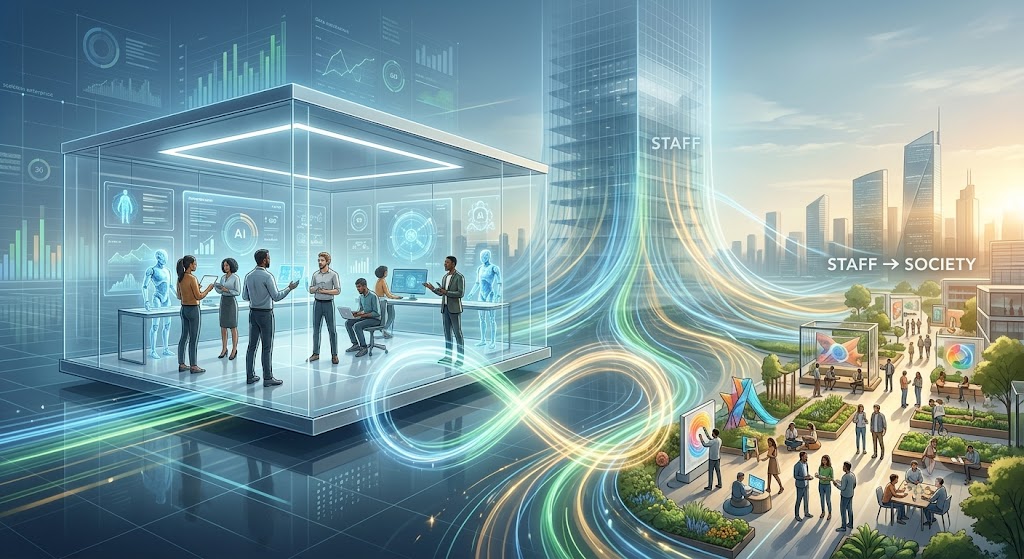
But that equation is breaking down. We are rapidly moving past the era of the industrial behemoth and entering the age of “frictionless scale.” Fueled by advanced AI orchestration, autonomous agentic networks, and hyper-lean digital ecosystems, tomorrow’s market giants will generate exponential value with remarkably small teams. The traditional relationship between revenue and employee numbers is decoupling, allowing organizations to achieve global reach and multi-billion-dollar valuations while maintaining a physical and human footprint that could fit inside a single conference room.

While this shift represents an incredible triumph of operational innovation, it exposes a profound systemic vulnerability. When a corporation no longer requires a vast staff to operate, it effectively divorces itself from its historic role as an economic anchor for society. This brings us to a critical, human-centered question that futurists, innovators, and leaders must confront: What happens to the fabric of local economies, social stability, and human dignity when scale no longer requires staff? How we answer this question and design for this transition will dictate whether this technological leap serves to elevate humanity or systematically fracture it.

Part I: The Anatomy of the Scaleless Enterprise

To understand the depth of this societal shift, we must first look at how the fundamental architecture of the enterprise is being hollowed out and rebuilt from the ground up. The traditional corporate hierarchy — built on layers of middle management, operational specialists, and administrative support — was designed to solve a specific problem: managing complexity and communication at volume. Historically, more customers meant more transactions, which demanded more human hands to orchestrate. Today, that entire structural necessity is evaporating.

From Linear to Exponential Infrastructure

We are witnessing a rapid transition from linear organizational growth to exponential infrastructure. In the past, scaling up required a proportional injection of capital and labor. Today, emerging technology stacks allow a tiny core of human orchestrators to deploy autonomous agentic networks capable of handling thousands of complex, simultaneous processes. These AI agents do not just automate repetitive tasks; they handle contextual decision-making, predictive logistics, and real-time problem-solving. As a result, the operational middle layer of the corporation is vanishing, replaced by fluid, self-optimizing code that scales instantly without hiring a single additional person.

Human-Centered Design in a Low-Human Business

This structural leanest forces us to radically redefine the principles of experience design. When a business operates with minimal human staff, how do we preserve empathy, intuition, and trust? Human-centered design can no longer just be about optimizing employee-to-customer interactions or building slick user interfaces. Instead, it must be embedded directly into the digital DNA of autonomous systems. The challenge for tomorrow’s innovators is to design experiences where the primary interface is completely automated, yet the delivery feels deeply human, respectful, and aligned with human values. Human intervention will cease to be the default operational standard; instead, it will become a rare, high-value premium reserved for moments of profound complexity or emotional nuance.

The Paradox of Value

This evolution culminates in a jarring economic paradox: the complete decoupling of market valuation from civic contribution. For generations, a company’s health was judged in part by its ability to create jobs and support families. In the scaleless enterprise, success is measured by the absolute minimization of friction — which frequently means the absolute minimization of headcount. We are staring down a future where companies can achieve historic market caps and unprecedented global influence while completely divesting from the physical communities that surround them. They will draw immense value out of the global economy through digital channels, but they will no longer return that value through local payrolls, permanently altering the traditional feedback loop of capital and community.

Part II: The Societal Ripples (The Real Human Cost)

The rise of the scaleless enterprise is not a isolated corporate event; it is an economic earthquake with tectonic implications for society. When organizations strip away their physical and operational dependencies, they don’t just change their cost structures — they fundamentally rewrite the rules of local communities. The ripple effects of this contraction stretch far beyond unemployment statistics, striking at the heart of civic stability and human identity.

The Death of the “Company Town” Anchor

Throughout modern history, the physical footprint of a major corporation has served as a vital economic ecosystem. A corporate campus doesn’t just support its own employees; it subsidizes an entire secondary economy of small businesses, commercial real estate markets, public transit systems, and local hospitality workers. Furthermore, large corporate entities have historically been foundational contributors to regional civic infrastructure and local philanthropy. When this physical footprint completely evaporates, it leaves behind an economic void that digital platforms cannot replicate. Without the anchoring presence of physical payrolls spending money locally, municipal tax bases erode, causing a devastating downstream decline in public funding for schools, parks, and essential community services.

The Velocity of Identity Disruption

From a change management perspective, the most dangerous aspect of this shift is not the loss of income, but the loss of meaning. In our current society, human beings are deeply conditioned to tether their personal identity, self-worth, and dignity to their professional utility. The 9-to-5 career has long been the primary vehicle for achieving a sense of societal contribution. If scale no longer requires a workforce, we are not simply facing a structural employment crisis; we are rushing into a profound psychological crisis of human irrelevance. When a workforce is displaced at a velocity that far outpaces the human capacity to adapt and reinvent, the fabric of social cohesion begins to fracture under the weight of widespread existential displacement.

The Polarization of Competencies

This decoupling of staff from scale aggressively accelerates the polarization of the labor market, creating a stark economic divide. On one side are the “orchestrators” — the hyper-valued individuals who possess the rare combination of strategic foresight, design thinking, and technical capability required to architect and steer autonomous systems. On the other side is the massive, rapidly commoditizing pool of traditional knowledge workers and operational staff whose roles have been absorbed by digital agentic networks. This creates a winner-take-all talent landscape where the rewards of exponential growth are concentrated among an increasingly tiny elite, while the barrier to entry for meaningful, middle-class professional advancement becomes devastatingly high.

Part III: Reimagining the Social Contract (Futurology in Action)

To navigate the reality of the shrinking corporate footprint, we cannot rely on yesterday’s economic playbooks. When corporate productivity permanently detaches from human labor, the foundational structures of our society must undergo a parallel evolution. Futurology is not about passively predicting what will happen; it is about actively designing the framework for what *should* happen. We must courageously architect a new social contract that protects human well-being in an era of post-labor scale.

From Corporate Responsibility to Civic Co-Creation

For decades, Corporate Social Responsibility (CSR) was largely viewed as an elective marketing strategy or a supplementary foundation. In a world of scaleless enterprises, this model is completely obsolete. When massive organizations extract immense wealth from a society’s digital infrastructure without returning it through local wages, the burden of funding societal well-being must be fundamentally restated. We must transition to a model of civic co-creation, where the immense dividend of automated efficiency is structurally reinvested into the public commons. This requires innovative public-private mechanisms that channel a portion of algorithmic wealth directly into repairing and funding the foundational human ecosystems — like local healthcare, community spaces, and civic infrastructure — that corporations are leaving behind.

Redefining “Contribution”

If traditional 9-to-5 employment ceases to be the primary mechanism for wealth distribution and social status, society faces a massive philosophical crossroads. We must aggressively decouple a person’s survival and dignity from their commercial utility. This opens up an extraordinary, human-centered opportunity to redefine what it means to “contribute” to society. In a post-labor economy, we have the chance to elevate and economically incentivize the vital human activities that machines can mimic but never genuinely experience: art, philosophy, localized community care, environmental restoration, and deeply empathetic education. By building structures that recognize and reward these deeply human efforts, we can transform a potential crisis of unemployment into an era of unprecedented human expression and community connection.

The Future of Lifelong Adaptation

Our current education and career systems are linear relics of the industrial era — you learn a trade in your youth, and you execute it for forty years. When digital agentic networks can redefine entire industries overnight, this rigid approach becomes a recipe for widespread obsolescence. The future demands fluid, human-centric learning ecosystems built for continuous pivot. Instead of teaching static, repeatable skills, our institutions must prioritize meta-competencies: emotional intelligence, systems thinking, cognitive agility, and the design thinking principles required to orchestrate AI rather than compete with it. Education must transform from a fixed phase of life into a seamless, lifelong utility that empowers individuals to constantly re-author their role in a rapidly changing world.

Conclusion: Designing a Human-First Future

The shrinking corporate footprint is not a distant, speculative scenario; it is an active transformation unfolding across our economic landscape today. Technology and automation are driving an unprecedented era of efficiency, but we must never confuse operational efficiency with societal health. The decoupling of scale from staff presents us with a stark choice. If left unguided, this shift will result in an increasingly fractured world where immense digital wealth is concentrated in fewer hands while physical communities hollow out. But if we approach this transition with intentionality, we can use this newfound abundance to liberate human potential on a scale never before seen.

As innovators, futurists, and experience designers, we must remember a core truth: technology dictates what is possible, but human-centered design dictates what is sustainable. We cannot afford to let the future simply happen to us; we must actively architect it. This means looking beyond short-term corporate margins and designing systems where technological progress explicitly serves to elevate human well-being, protect individual dignity, and reinforce the communities we live in.

The ultimate metric of success for tomorrow’s lean corporate giants cannot simply be their market capitalization, their operating margin, or the speed of their algorithms. The true measure of an enterprise in this new era must be its net-positive contribution to a society that no longer works inside its walls. By aligning our incredible capacity for technological innovation with a deep, unyielding commitment to human-centered design, we can ensure that the age of frictionless scale becomes an age of universal human flourishing.

Frequently Asked Questions

What is a “scaleless enterprise” and how does it differ from a traditional corporation?

A traditional corporation requires a proportional increase in human staff and physical footprint to scale its operations and revenue. A scaleless enterprise leverages advanced technology stacks, such as autonomous AI agents and decentralized digital infrastructure, to achieve massive global market reach and exponential revenue growth while keeping its internal workforce and physical presence incredibly small.

Why does the shrinking corporate footprint pose a threat to local communities?

Historically, large companies acted as economic anchors by providing jobs, subsidizing local ecosystems (like commercial real estate, retail, and hospitality), and contributing heavily to municipal tax bases. When a corporation’s physical footprint disappears, those local revenue streams and community subsidies evaporate, leaving local economies vulnerable and straining public infrastructure funding.

How can society redefine human “contribution” in a post-labor economy?

As traditional employment opportunities contract, society must shift from measuring an individual’s worth solely by their commercial or industrial output. We can establish new public-private mechanisms and social frameworks that value, incentivize, and economically reward uniquely human capabilities that automation cannot replicate — such as community caregiving, artistic creation, civic mentorship, and environmental stewardship.

Bottom line: Futurology is not fortune telling. Futurists use a scientific approach to create their deliverables, but a methodology and tools like those in FutureHacking™ can empower anyone to engage in futurology themselves.

Image credit: Gemini

Subscribe to Human-Centered Change & Innovation WeeklySign up here to get Human-Centered Change & Innovation Weekly delivered to your inbox every week.

The Rise of Intent Orchestration

How Generative Systems Shift Labor from Drafting to Directing

The Rise of Intent Orchestration

GUEST POST from Art Inteligencia


The Death of the Blank Page

The dawn of the Generative Era marks a fundamental shift in the nature of human labor. For decades, we have defined “work” by the physical or cognitive act of drafting — constructing ideas, documents, or designs from scratch. Today, we are witnessing the obsolescence of the blank page, replaced by the requirement for precise intent.

The Paradigm Shift: From Doing to Defining

We are transitioning away from “doing the work” — the granular, time-consuming effort of assembly — toward “defining the work.” In this new model, the knowledge worker acts as a conductor. The blank page no longer represents a vacuum to be filled by human effort; it represents a canvas for architectural vision, where the “how” is offloaded to generative systems and the “what” and “why” remain the exclusive domain of human insight.

Defining Intent Orchestration

Intent Orchestration is the art and science of guiding autonomous generative agents toward a specific, value-driven outcome. It is not about mastering a single prompt; it is about building the systems, guardrails, and feedback loops that govern how AI models interact and synthesize information. True orchestration requires moving beyond simple command-response dynamics toward a multi-agent ecosystem designed for complex problem-solving.

The Thesis: Architects over Draftsmen

The core of our evolution lies in the transformation from “Draftsmen” — individuals who focus on the assembly of components — to “Directors.” As Directors, our value is no longer measured by the quantity of the output we generate, but by the quality of the intent we provide and the efficacy with which we curate, validate, and refine the complex, multi-layered outputs of generative systems.

The Historical Anchor: Human-Centric Drafting

For generations, professional competence was judged by technical execution — the speed and accuracy with which a professional could draft a technical document, write line-by-line code, or build a financial model. This “Drafting Era” was fundamentally linear. Human cognitive throughput was the primary bottleneck; scaling an organization’s output meant linearly adding more heads to handle the manual, error-prone labor of creation.

The Directing Era: Offloading the “How”

Generative systems fundamentally decouple execution from intention. In the “Directing Era,” the machine absorbs the tactical burden of creation, instantly executing the “how” across vast dimensions of data. This forces a rapid upward migration of human labor. We are liberated from the mechanical execution of the task, allowing our cognitive capacity to refocus entirely on high-level strategic alignment, problem definition, and systemic integration.

The Premium on Human Context and Intuition

When the cost of drafting approaches zero, the value of the raw output drops proportionally. The true premium shifts drastically to what the machine lacks: human intuition, localized context, and deep empathy. A generative system can produce a flawless operational template, but it cannot understand the unspoken political dynamics of a boardroom, the cultural friction of an organization in flux, or the emotional nuances of a user experience. The modern worker’s value is found in the gaps the data cannot reach.

The Architecture of Guardrails

Orchestration requires shifting our focus from passive prompt engineering to active structural governance. A single prompt is a fragile transaction; intent orchestration demands that we construct permanent guardrails, strict boundaries, and behavioral swimlanes. The Director defines the operational parameters — specifying the exact domain expertise, tone constraints, and non-negotiable boundaries within which the systems operate—ensuring autonomous outputs remain strategically aligned.

Cultivating the Curator’s Mindset

When generative systems can instantly spin up multiple variations of an idea, the critical skill shifts from creator to curator. Human value is realized in the continuous evaluation, stress-testing, and synthesis of these machine-generated assets. It is about spotting the subtle hallucinations, connecting disparate threads of intelligence, and assembling isolated outputs into a seamless, high-value ecosystem that serves a human-centered purpose.

From Task Management to Agentic Governance

The traditional managerial model of assigning discrete, isolated tasks is obsolete. In an intent-driven landscape, we govern multi-agent ecosystems that run continuous, interconnected workflows. The human objective evolves from monitoring manual completion to managing complex systemic behavior. We act as the ultimate feedback loop, monitoring how these autonomous agents interact, pivot, and collaborate to solve high-impact, fluid business challenges.

Experience Design as a Strategic Directive

The danger of infinite generative capacity is the creation of a generic world. When anyone can generate content or software at zero marginal cost, the marketplace becomes flooded with noise. This is where experience design becomes our ultimate competitive advantage. An Intent Orchestrator does not use AI simply to optimize a process or churn out assets; they use it to intentionally design for people. The objective is to leverage automation to strip away operational friction, allowing organizations to craft deeper, more meaningful human-to-human touchpoints.

Futurology and Real-Time Scenario Simulation

Traditionally, strategic foresight and scenario planning were long, resource-intensive cycles. Through intent orchestration, we can now use multi-agent ecosystems to simulate future market conditions, customer personas, and economic shifts in real time. By feeding generative systems disparate signals and trend data, a Director can stress-test a strategy against dozens of synthetic futures simultaneously. This transforms futurology from a static quarterly report into an active, iterative tool for continuous corporate agility.

The Ethics of Intent and Human-in-the-Loop Governance

As generative systems transition from drafting content to executing autonomous workflows, the line of accountability blurs. If an autonomous agent optimizes a process in a way that introduces bias or violates trust, who is responsible? The concept of human-in-the-loop validation is not merely a technical safeguard; it is an ethical imperative for responsible innovation. As Directors, we are the architects of the system’s intent, which means we carry absolute responsibility for validating its outcomes, ensuring every automated action aligns with human values and organizational ethics.

Phase 1: Translating Intent into System Constraints

The playbook begins by converting abstract human ambition into machine-executable parameters. A Director does not give vague commands; they establish a rigorous “North Star” framework. This involves explicitly defining the problem space, mapping out the success criteria, and locking down the non-negotiable boundaries. By translating our strategic vision into explicit operational constraints, we ensure the generative systems have a precise target to shoot for, minimizing the risk of strategic drift.

Phase 2: Designing the Ensemble Strategy

No single AI model is a silver bullet for a complex business challenge. The orchestrator’s task is to design an ensemble strategy — selecting and pairing the right combination of specialized generative agents, data repositories, and large language models for the job at hand. This phase is pure architecture: mapping out the data pipelines, deciding which agent handles research versus synthesis, and structuring how these tools pass information back and forth to maintain context throughout the workflow.

Phase 3: Setting Up Continuous Feedback Loops

The first output a generative system produces is rarely the final answer; it is a baseline draft. Orchestration relies on setting up continuous, tight feedback loops between the human Director and the machine network. Instead of manually rewriting the content, the Director feeds evaluations, redirects, and edge-case exceptions back into the system. This iterative dialogue trains the multi-agent ecosystem to refine its behavior in real time, turning the workflow into an automated evolutionary process.

Phase 4: The Final Mile and Human Polish

The final phase is where human-centered design takes center stage. Machines excel at patterns, logic, and structure, but they cannot manufacture a soul, authentic emotion, or lived experience. The “final mile” is the exclusive domain of the human Director, who injects unique perspectives, cultural nuances, and emotional resonance into the output. This human polish transforms a technically perfect machine asset into a meaningful, impactful human experience.

The Shift in Identity: From Maker to Mastermind

The transition from drafting to directing forces us to confront a profound psychological hurdle: redefining our professional self-worth. For generations, we have tied our value to the hours spent creating artifacts — the tangible proof of our labor. Moving into the era of Intent Orchestration requires shedding the fear of displacement and stepping confidently into the role of the architect. True creative amplification happens when we stop viewing AI as a competitor for our tasks and start treating it as a force multiplier for our ideas.

The Future Outlook of the Orchestrated Organization

Organizations that successfully pivot from a drafting mindset to a directing mindset will achieve unprecedented levels of organizational agility. When teams focus entirely on orchestrating intent rather than manually executing tasks, the traditional lag between strategy and execution vanishes. We will see the rise of highly lean, hyper-efficient business units capable of pivoting strategy, testing new products, and scaling customer experiences in real time, fundamentally altering the competitive dynamics of the global market.

A Call to Action for the Modern Leader

The transition does not happen automatically; it requires deliberate intention. Every leader, designer, and innovator must start by performing a ruthless audit of their own daily workflows. Identify the tasks where you are still acting as a draftsman — manually building, structuring, and generating — and deliberately architect the guardrails to move those tasks into a directed model. The future belongs not to those who can write the fastest, but to those who can direct the deepest intent.

Glossary of Orchestration Terms

  • Agentic Flows: Complex, multi-step workflows executed by autonomous AI agents that can self-correct, collaborate, and make independent tactical decisions to achieve a human-defined goal.
  • Intent Orchestration: The practice of designing, managing, and guiding a network of generative AI systems toward specific, strategic outcomes using behavioral guardrails rather than single-prompt interactions.
  • Latent Constraint Modeling: The practice of embedding non-negotiable boundaries, regulatory rules, and cultural tones into the core operating environment of an AI system to restrict its output variation.
  • Human-in-the-Loop Synthesis: A governance framework where a human Director remains permanently embedded in the workflow to validate, refine, and ethically clear automated outputs before final deployment.

Recommended Tool Stack for Directors

  • Multi-Agent Frameworks: Platforms designed to build and connect independent, specialized AI agents that can pass context and tasks to one another seamlessly.
  • Orchestration and Layering Engines: Middleware platforms that allow leaders to stitch together diverse Large Language Models (LLMs) and internal corporate data repositories into a single secure pipeline.
  • Testing Environments and Sandboxes: Isolated development spaces where an orchestrator can safely simulate agent behavior, stress-test guardrails, and check for bias or hallucination before go-live.

Frequently Asked Questions

What is the difference between Prompt Engineering and Intent Orchestration?

Prompt Engineering is a transactional, single-interaction approach focused on crafting the perfect text input for a single AI response. Intent Orchestration is a systemic approach focused on designing the permanent guardrails, behavioral swimlanes, and multi-agent workflows that govern an entire generative ecosystem to deliver complex, strategic outcomes over time.

Does Intent Orchestration eliminate the need for human creativity?

No, it amplifies it. By offloading the mechanical, time-consuming labor of drafting and technical assembly to generative systems, human professionals can redirect their cognitive energy toward high-level vision, problem definition, strategic context, empathy, and experience design — the elements machines cannot replicate.

How do leaders ensure accountability when AI systems execute autonomous workflows?

Accountability is maintained through strict Human-in-the-Loop Governance. While agents execute tactical steps independently, the human Director defines the initial boundaries and serves as the ultimate validation layer, reviewing and refining outputs to ensure compliance with ethical standards and organizational intent before deployment.


SPECIAL BONUS: Braden Kelley’s Problem Finding Canvas can be a super useful starting point for doing design thinking or human-centered design.

“The Problem Finding Canvas should help you investigate a handful of areas to explore, choose the one most important to you, extract all of the potential challenges and opportunities and choose one to prioritize.”

Image credit: Gemini

Subscribe to Human-Centered Change & Innovation WeeklySign up here to get Human-Centered Change & Innovation Weekly delivered to your inbox every week.

Just Walk Out Groceries — by Amazon

Just Walk Out Groceries -- by Amazon

Amazon Go is going big – grocery store big. Today it was revealed that Amazon has opened up a new Amazon Go that is four times (4x) bigger than previous Amazon Go stores. What’s new?

Well, this new Amazon Go store has produce, packaged meats, an expanded frozen food section, sundries like paper towels, and more!

This is a big step forward for Amazon and will be stretching its technology to the breaking point as Amazon looks not only to explore what’s possible, but to prove its technology to the point where its collection of technology could become another revenue pillar that it can build by licensing its technology to other convenience store and grocery store chains.

The Amazon Go approach, should it expand, also puts even more of the 3 million grocery store jobs in the United States at risk. This 3 million jobs number is already declining because of self checkout and Walmart’s robotic inventory systems, among other pressures.

Is the Amazon Go approach a good thing?

Do we really all want to live in a world where packages show up at the door or food can be obtained in a grocery store without talking to anyone?

Americans are becoming increasingly lonely and isolated. I could include dozens of supporting links to back this up, but here is a good one:

https://www.nbcnews.com/think/opinion/lonely-you-re-not-alone-america-s-young-people-are-ncna945446

The grocery store has become one of the last remaining places where someone will actually speak to you, but self checkout and technologies like Amazon Go look to stamp out this human interaction too!

But even though there are still humans in the grocery store, the level of human interaction seems to be fading there too as younger, non-unionized workers replace older unionized workers in grocery stores. Has this been your experience?

What’s next the barbershop and the hairdresser?

And can our society survive any more isolation?


Accelerate your change and transformation success

Subscribe to Human-Centered Change & Innovation WeeklySign up here to get Human-Centered Change & Innovation Weekly delivered to your inbox every week.

The Empathy Imperative

Why Technical Migrations Fail Without Emotional Governance

The Empathy Imperative

GUEST POST from Chateau G Pato


The Ghost in the Machine

Walk into any corporate boardroom during a major technical migration — whether it’s a massive cloud transition, an enterprise resource planning (ERP) overhaul, or a data architecture upgrade — and you will see the same dashboard. It is a sea of green, yellow, and red status indicators tracking server uptimes, data pipeline integrity, budget burn rates, and code deployment deadlines. The assumption baked into these rooms is as dangerous as it is common: that a successful technical migration is purely an engineering and timeline problem.

Yet, history tells a far more expensive story. Billions of dollars are poured into flawless deployments that check every technical box, only to result in a catastrophic post-launch drop in productivity, a surge in employee turnover, and widespread operational drag. When the system goes live, the code works, but the business stalls. The issue isn’t that the software is broken; it’s that the human operating system has rejected the change. This invisible friction exists because leaders treat technical transitions as structural shifts rather than deeply emotional human experiences.

Introducing Emotional Governance

To bridge this gap, organizations must move beyond traditional, top-down change management and introduce a framework of Emotional Governance. Emotional Governance is the systematic methodology of measuring, managing, and designing for the human emotional transitions that occur during technical shifts. It recognizes that every modified workflow represents a disruption to a person’s daily mastery, autonomy, and professional identity.

When we ignore the emotional infrastructure of a migration, we leave the human element to chance. But when we prioritize empathy as a strategic imperative, aligning emotional governance with technical milestones, we unlock the true return on investment of our innovation. You cannot build a resilient, digital-first organization on top of a bruised, alienated, and resistant workforce. The migration must happen with your people, not to them.

The Architecture of Anxiety

To understand why technical migrations encounter massive, unyielding resistance, leaders must first dismantle the myth of the “stubborn employee.” People rarely resist change simply because they are lazy or contrarian; they resist change when it threatens their survival metrics within an organization. When you replace an enterprise tool, you are not just changing software — you are rewriting the unwritten social contract of how work gets done and how value is perceived.

The Loss of Mastery and Status Anxiety

Every piece of legacy software, no matter how clunky or outdated, represents a domain of human expertise. Over years of use, employees have developed workarounds, mastered shortcuts, and built their professional identity around being the “go-to” expert who can solve any system quirk. They possess deep, institutional mastery.

The moment you mandate a new platform, you instantly reset that mastery to zero. Overnight, a high-performing veteran is reduced to a hesitant novice, fumbling through a new user interface while trying to maintain their usual output. This creates profound status anxiety. The fear of appearing incompetent or slow to adapt triggers a primal self-defense mechanism, forcing employees to cling to the old way of working to protect their perceived value.

The “Invisible Work” Tax

Another major oversight in technical deployments is the failure to account for the heavy emotional and cognitive load placed on teams during the transition phase — what I call the Invisible Work Tax. Leadership frequently expects employees to seamlessly adopt complex new workflows while simultaneously maintaining 100% of their daily operational targets.

The hours spent troubleshooting unfamiliar errors, attending mandatory training modules, and manually re-entering data into an unstable staging environment are completely invisible on executive dashboards. When organizations fail to provide operational breathing room, treating the transition as an “add-on” task rather than a core corporate priority, empathy evaporates. The resulting burnout turns into active resentment toward the technology itself.

The Legacy of Historical Scarring

Finally, no migration occurs in a vacuum. Every organization carries the psychological scar tissue of past, poorly executed IT rollouts. When employees hear the word “upgrade,” they don’t think of innovation; they remember the time a previous platform crashed for three days, or when a top-down mandate forced them to use a tool that made their jobs twice as hard.

This historical scarring breeds a deeply ingrained culture of cynicism. Without deliberate emotional governance to acknowledge and heal those past organizational failures, employees will look at your new migration and say, “This is just another management fad. If I ignore it long enough, it will go away.” To overcome this inertia, you must design an experience that proves this time is fundamentally different.

Designing the Empathy-Driven Migration Framework

Overcoming the architecture of anxiety requires more than standard corporate communication or generic training videos. It demands a fundamental shift from top-down change management to participatory Experience Design. Traditional change management treats people as objects to be managed, pushed, and trained into compliance. Experience design, however, views employees as active users and co-creators of the transition, focusing on how the journey feels from their perspective.

From Push Communication to Participatory Innovation

The classic mistake in technical rollouts is relying on “push” communication — sending broadcast emails or top-down mandates declaring the system is changing and everyone must comply. This approach naturally breeds resistance because it strips users of their agency.

An empathy-driven framework replaces mandates with co-creation. By actively involving frontline users during the vendor selection, testing, and staging phases, you shift the dynamic from a forced transition to a shared journey. When people help build the sandbox, they don’t fight the rules of the game. This collaborative approach ensures that the unique edge cases and daily realities of frontline workflows are built into the architecture from day one, significantly reducing post-launch friction.

The Critical Role of Psychological Safety

To unlock the true return on investment of any technological innovation, leaders must establish a culture of psychological safety during the migration process. If employees are terrified of making mistakes, clicking the wrong button, or slowing down metrics on an unfamiliar platform, they will default to the safest, most restrictive behaviors. They will find underground workarounds, stick to manual processes, or avoid using the new tool altogether.

True human-centered innovation only happens when users feel safe enough to experiment, fail, and learn out loud without fear of penalization. An empathy-driven framework deliberately designs “safe-to-fail” zones — such as extended sandboxes and blame-free staging environments — allowing teams to rebuild their confidence and mastery at a manageable pace. When you secure the human foundation, the technical superstructure will naturally succeed.

Implementing Emotional Governance in Practice

Moving from the philosophy of empathy to operational reality requires structure, intent, and actionable metrics. Emotional governance cannot merely be a set of nice sentiments in a kickoff meeting; it must be built directly into your project management methodology. Just as you have risk registers for security vulnerabilities and data compliance, you must establish an operational framework to manage the emotional risks of your workforce.

The Emotional Risk Audit

Before a single line of code is migrated, organizations must conduct an Emotional Risk Audit. This process goes beyond standard stakeholder mapping to analyze the human disruption coefficient of the upcoming change. Leaders must evaluate every department across two critical dimensions: the degree of workflow disruption and the impact on professional identity.

For example, transitioning a customer service team from a familiar, macro-heavy legacy tool to a modern, AI-assisted platform may look like a massive upgrade on paper. However, the audit might reveal that this team derives its sense of status from knowing those complex legacy shortcuts. By identifying this emotional vulnerability early, leaders can proactively design targeted recognition and transition strategies to protect employee confidence before the technical deployment begins.

Sentiment Metrics vs. Completion Metrics

The traditional way IT project managers measure readiness is fundamentally flawed. Tracking that “92% of staff completed the mandatory 45-minute training video” tells you absolutely nothing about their psychological readiness or their willingness to adopt the tool. It only measures compliance, not alignment.

An empathy-driven migration tracking system prioritizes sentiment metrics over simple completion rates. This involves deploying frequent, lightweight pulse surveys and analyzing qualitative feedback loops to measure real-time frustration peaks, psychological safety levels, and perceived utility. If your technical deployment timeline is at 90% but employee sentiment is at 20%, your migration is failing. Emotional governance gives leaders the visibility to pause, adjust, and address human friction before a rollout becomes a trainwreck.

Empowering Transition Sherpas

The final piece of practical implementation is changing who guides the journey. Relying solely on external consultants or distant IT personnel to drive adoption creates an “us versus them” dynamic. Instead, organizations must identify, train, and empower internal Transition Sherpas.

Transition Sherpas are highly respected, influential frontline peers who are embedded within the affected teams. They are not chosen simply because they are tech-savvy; they are selected for their high emotional intelligence and empathy. Armed with deep knowledge of both the technical tool and the emotional governance framework, these peer leaders act as trusted translators. They handle technical triage, provide safe-to-fail guidance on the floor, and elevate frontline anxieties directly to leadership, ensuring that no employee feels abandoned in the wilderness of change.

Futurology: The Next Frontier of Enterprise Change

As we look toward the horizon of enterprise architecture, the nature of technology deployment is undergoing a fundamental mutation. The traditional model of the “big bang” migration — where an organization spends two years preparing for a massive, disruptive software launch — is rapidly becoming obsolete. In a hyper-connected, AI-driven corporate landscape, migration is no longer a discrete event with a clear start and end date; it is an environment of continuous disruption.

AI-Driven Transitions and Predictive Sentiment

The integration of advanced artificial intelligence into enterprise systems is changing how we understand user adoption. Tomorrow’s emotional governance frameworks will leverage predictive sentiment analysis and hyper-personalized learning pathways to mitigate friction before it manifests as resistance.

Instead of waiting for an employee to experience a frustration peak or submit a support ticket, AI-driven telemetry will detect subtle changes in user behavior — such as prolonged hesitation over a new interface, repeated cursor loops, or micro-delays in standard workflows. By identifying these friction points in real time, the system can dynamically adapt, offering contextual, tailored micro-learning interventions and adjusting the transition pace to match the individual’s cognitive load. Empathy will scale through intelligent design.

The Continuous Migration Era

We are moving decisively into the Continuous Migration Era, where cloud-native applications and decentralized enterprise platforms update perpetually. This shift requires a massive evolution in organizational design. Emotional governance can no longer be treated as a temporary project phase or a specialized change management task force that dissolves after a launch.

To survive in this landscape, organizations must build emotional governance directly into their operational DNA, treating it as a permanent corporate capability. Leaders must establish dedicated Experience Management Offices (XMOs) that continuously monitor human-centered Experience Level Measures (XLMs). When you build an enterprise that expects, embraces, and smoothly processes constant technical evolution, change stops being a source of organizational trauma and becomes your ultimate competitive advantage.

Conclusion: The Human ROI

When we peel back the layers of enterprise strategy, technical specifications, and migration roadmaps, we are left with an undeniable truth: the ultimate bottleneck of any digital transformation is never the technology. It is the collective emotional capacity of your people to absorb, adapt to, and champion that technology. A business cannot build a high-velocity, digital-first future on top of a bruised, alienated, and culturally exhausted workforce.

The True Measure of Success

The true return on investment of a technical migration is not realized on the day the legacy system is turned off; it is realized when your teams actively leverage the new platform to innovate, create, and drive value. That level of engagement cannot be forced through top-down mandates or tracked via superficial compliance checklists. It must be earned through deliberate, human-centered experience design.

As leaders, it is time to elevate our standards. We must stop treating emotional governance as a soft afterthought and start funding, measuring, and prioritizing it with the exact same rigor we apply to our technical architecture. When you secure and respect the emotional infrastructure of your organization, the technical superstructure will inevitably thrive. Stop managing change, and start designing the transition.

Frequently Asked Questions

1. What is Emotional Governance, and how does it differ from traditional change management?

Traditional change management focuses on driving compliance through top-down mandates, push communications, and tracking training completion rates. Emotional Governance is a human-centered framework that treats migrations as an experience design problem. It systematically measures and manages the psychological readiness, status anxiety, and workflow friction of users, shifting the focus from forcing compliance to co-creating the transition with employees.

2. How do you measure the success of emotional governance during a migration?

Instead of relying on superficial completion metrics (like the percentage of staff who watched a training video), success is measured using real-time sentiment metrics, Experience Level Measures (XLMs), and tracking user frustration peaks through continuous qualitative feedback loops. A migration is only successful when technical execution aligns with high employee confidence and psychological safety.

3. What is the role of a Transition Sherpa in this framework?

A Transition Sherpa is an influential, highly empathetic frontline peer embedded within a team undergoing change — not an outside consultant or IT representative. They act as trusted translators on the ground, handling micro-learning, offering safe-to-fail guidance, and escalating frontline anxieties directly to leadership so no employee feels abandoned in the wilderness of a new rollout.


Bottom line: Futurology is not fortune telling. Futurists use a scientific approach to create their deliverables, but a methodology and tools like those in FutureHacking™ can empower anyone to engage in futurology themselves.

Image credit: Gemini

Subscribe to Human-Centered Change & Innovation WeeklySign up here to get Human-Centered Change & Innovation Weekly delivered to your inbox every week.
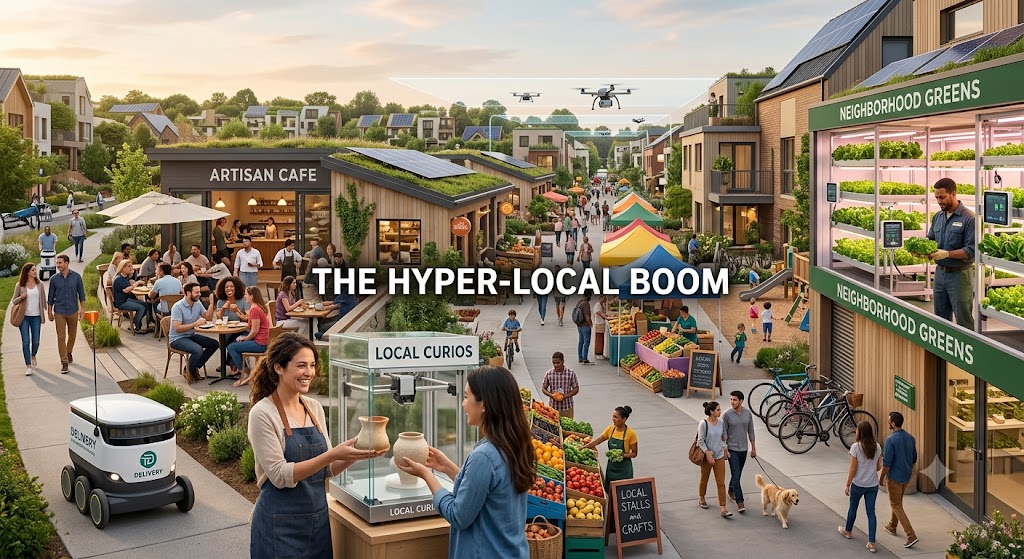
The Hyper-Local Boom

How Autonomous Tools Revitalize Community-Centric Economies

The Hyper-Local Boom

GUEST POST from Chateau G Pato


I. Introduction: The Pendulum Swings Back

The Globalist Peak

For decades, the narrative of progress was defined by hyper-globalization. Massive, centralized platforms and sprawling global supply chains optimized for efficiency, driving down costs at the expense of local economic resilience. While this interconnectedness brought unprecedented access to goods, it simultaneously stripped communities of their unique flavor, hollowed out local marketplaces, and left neighborhoods vulnerable to systemic global shocks.

The Catalyst

Today, we are witnessing a profound structural shift. The convergence of autonomous AI, decentralized manufacturing, and hyper-local logistics is fundamentally rewriting the rules of production and distribution. Technologies once feared as cold or isolating are maturing into the foundational infrastructure for a new era of localized commerce.

The Thesis

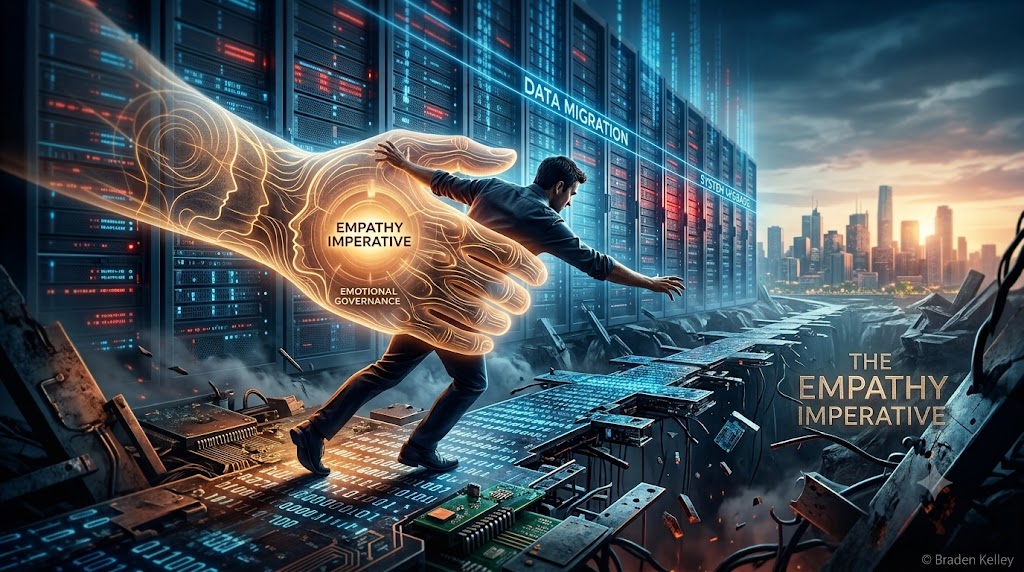
Autonomous tools are not isolating us; they are doing the exact opposite. By shifting the economics of production and distribution away from distant fulfillment centers and back to the neighborhood block, automation is enabling a massive, human-centered renaissance of community-centric economies. This is not a step backward into isolationism, but a leap forward into an empowered, self-sustaining future where technology serves to anchor us closer to home.

II. The Architecture of the Autonomous Local Engine

Micro-Production & Decentralized Supply Chains

The traditional model relies on massive, centralized factories pushing goods across vulnerable, thousands-of-miles-long supply chains. The autonomous local engine flips this paradigm to on-demand, decentralized creation. Advanced 3D printing micro-factories, automated vertical farming pods, and localized CNC routing stations are embedding production directly into our neighborhoods. This shifts the focus from economies of scale to economies of proximity, allowing communities to build, grow, and manufacture exactly what they need, the moment they need it, vastly improving local resilience.

Autonomous Micro-Logistics

The “last mile” of delivery has historically been the most expensive and carbon-intensive leg of commerce, often forcing local businesses to rely on monopolistic logistics giants. The introduction of autonomous micro-logistics—sidewalk delivery bots, neighborhood drone networks, and automated local dispatchers — slashes these barriers to near zero. By making neighborhood-to-neighborhood commerce functionally frictionless, we empower local makers and growers to distribute their goods just as efficiently as multinational conglomerates, but with a vastly smaller footprint.

Intelligent Local Marketplaces

Technology must serve as a bridge, not a barrier. As artificial intelligence integrates with hyper-local commerce, we are seeing the rise of intelligent local marketplaces. These are not just digital storefronts; they are dynamic, predictive ecosystems that anticipate community needs and seamlessly match local supply with local demand. By decentralizing the marketplace, AI tools strip away the need for massive corporate middlemen, ensuring that the economic value generated by a community remains within that community, fueling a new era of participatory innovation.

III. Elevating Human Experience (The HX Factor)

From Transactional to Relational

The true value of automation lies not in replacing humans, but in freeing them to do what they do best. When autonomous tools seamlessly absorb the burden of routine backend logistics — handling inventory forecasting, automated billing, and micro-routing — local business owners are liberated from the keyboard and the stockroom. They can redirect their energy toward what truly drives customer loyalty: deep relationship-building, bespoke customization, and genuine empathy. Commerce shifts from a cold, transactional exchange back to a warm, relational experience.

The “New Artisan” Economy

Historically, scaling a business meant taking on massive capital risk, securing complex infrastructure, and giving up creative control. Today, autonomous micro-production and frictionless local logistics drastically lower the barrier to entry. This democratization gives rise to a “New Artisan” economy. Local creators, boutique chefs, and precision builders can leverage automated tools to manage the complexities of production and distribution, allowing them to scale their unique craft sustainably within their immediate geographic region without needing venture capital.

Designing Frictionless Community Spaces

To fully realize this shift, we must rethink the physical spaces where we live and gather. The community hub of the future is an experience-first destination. By moving autonomous fulfillment, micro-storage, and sorting infrastructure quietly into the background — or beneath the floorboards — the storefront is reclaimed. It ceases to be a mere warehouse for boxes and becomes a sanctuary for human connection, sensory engagement, and experiential retail where people come to gather, co-create, and share stories.

IV. Navigating the Change: Friction, Equity, and Adoption

The Human-Centered Transition

Every major technological shift introduces friction, and the hyper-local boom is no exception. As autonomous tools take over the predictable mechanics of retail and traditional logistics, we face a critical transition period. Navigating this change requires a deliberate, human-centered approach to upskilling. We must invest heavily in community-led training programs that empower displaced workers to step into higher-value roles as community experience designers, digital artisans, and local system orchestrators — ensuring that technology serves to elevate human potential rather than sideline it.

Bridging the Digital Divide

Innovation must be participatory; if it only benefits wealthy tech hubs, it has failed. We must intentionally design policies and funding frameworks that deploy autonomous micro-factories, vertical farming pods, and micro-logistics networks into historical food deserts, rural outposts, and underserved urban neighborhoods. True fairness means ensuring that these decentralized economic engines are accessible to all, providing equitable wealth-generation tools where rewards remain relative to local effort, and directly revitalizing communities that the globalist model left behind.

Regulatory & Trust Hurdles

Building the infrastructure for an autonomous neighborhood requires navigating significant regulatory, safety, and psychological barriers. Communities will rightfully push back against a sudden influx of sidewalk delivery bots and low-altitude drones without clear boundaries. Overcoming this social friction means developing clear, community-governed data privacy standards and localized safety frameworks. By bringing residents into the design process early, municipal leaders can foster genuine trust and ensure that autonomous systems respect the physical and digital boundaries of the neighborhoods they are meant to serve.

V. Conclusion: The Future is Homegrown

The Futurist View

If we look forward to the neighborhood of 2035, we do not see a sterile, tech-dominated dystopia. Instead, we see a vibrant, deeply human ecosystem. We see sidewalks reclaimed for outdoor dining and community markets, while quiet, low-profile autonomous bots deliver fresh, vertically-grown produce from a block away. We see thriving local artisans whose businesses are powered by micro-manufacturing tools hidden inside community hubs. Technology, in this future, does not pull us away from our neighbors — it acts as the unseen foundation that allows local relationships and localized wealth to flourish.

The Final Charge

This decentralized, hyper-local future will not happen by accident; it must be designed with intention. It requires urban planners, entrepreneurs, civic leaders, and change agents to actively collaborate on human-centered frameworks. We must ensure that emerging autonomous systems are integrated into our towns and cities as tools of empowerment rather than extraction. The pendulum is swinging away from the distant and impersonal, back toward the close and meaningful. The tools are ready. Now, we must use them to build an economy where the future is proudly, and sustainably, homegrown.

Frequently Asked Questions

How do autonomous tools help local businesses instead of replacing them?

Autonomous tools take over the predictable, time-consuming backend mechanics of a business — such as managing inventory, automated billing, and micro-routing. By absorbing these routine logistical burdens, technology frees local business owners to focus on higher-value, human-centered activities like deep relationship-building, bespoke customization, and delivering an exceptional, empathetic customer experience.

What is the “New Artisan” economy?

The “New Artisan” economy refers to a decentralized market model where local creators, boutique chefs, and precision builders can sustainably scale their craft within their immediate geographic region. By using autonomous micro-production tools (like 3D printers and vertical farming pods) and low-cost micro-logistics networks, small businesses can match the operational efficiency of global conglomerates without needing massive venture capital or sprawling physical infrastructure.

How can communities ensure this technological shift is equitable?

Ensuring equity requires a deliberate, human-centered approach to change. Communities must invest in localized training programs to upskill workers into roles as experience designers and system orchestrators. Additionally, civic leaders must intentionally deploy autonomous infrastructure — like vertical farming and micro-manufacturing hubs — into historically underserved neighborhoods and food deserts to ensure wealth-generation tools are accessible to all.

Bottom line: Futurology is not fortune telling. Futurists use a scientific approach to create their deliverables, but a methodology and tools like those in FutureHacking™ can empower anyone to engage in futurology themselves.

Image credit: Gemini

Subscribe to Human-Centered Change & Innovation WeeklySign up here to get Human-Centered Change & Innovation Weekly delivered to your inbox every week.
Managing the Mind-Machine Friction

Managing the Mind-Machine Friction

GUEST POST from Chateau G Pato


The New Frontier of Collective Intelligence

Technology has quietly crossed a profound psychological threshold. It has evolved from a passive utility — a tool we operate, like a spreadsheet or a word processor — into an active collaborator. When we introduce AI co-piloting into the enterprise, we aren’t just deploying software; we are fundamentally shifting the psychological contract between people and their daily work. This transition creates a distinct, visceral friction.

The industry is currently obsessed with the technical mechanics of integration, yet the real bottleneck isn’t computational — it is cognitive. To build an ecosystem where humans and algorithms actively elevate each other, we must move the narrative away from “AI replacing humans” and focus on building true Collective Intelligence. True innovation occurs when we treat artificial intelligence not as a surrogate worker, but as an augmentative partner.

“The companies that thrive in the automation age won’t just possess the fastest models; they will be the ones that design the most frictionless human-to-machine collaborative experience.”

Overcoming the barriers to AI co-piloting is, at its core, a human-centered change management and experience design challenge. As leaders, we must actively architect organizational change to bridge the psychological gap between human instinct and machine logic, transforming digital friction into a collaborative competitive advantage.

Deconstructing the Friction: The Psychological Barriers to Co-Piloting

Before we can design a seamless partnership between humans and machines, we must first diagnose the hidden psychological resistance that stalls adoption. This resistance rarely stems from a lack of technical capability. Instead, it is rooted in deep-seated human anxieties regarding identity, trust, and autonomy. When an algorithm enters the creative or analytical workspace, it triggers a predictable sequence of psychological barriers that leaders must intentionally dismantle.

1. The Identity Crisis (Role Erosion)

The introduction of an AI co-pilot frequently precipitates what can be described as the “expert’s paradox.” Knowledge workers who have spent decades honing specific analytical, writing, or coding skills suddenly find that a machine can execute 60% of their foundational tasks in seconds. This creates an immediate threat to professional identity: “If the machine does what I am valued for, what is my worth?”

Left unaddressed, this anxiety manifests as subtle, passive resistance or outright rejection of the tool. Overcoming this barrier requires an intentional effort to shift an employee’s perceived value away from pure tactical execution and toward strategic curation, orchestration, and systemic problem-solving. This fatigue and anxiety often compound existing organizational stress, making it critical to address these fears directly. You can read more about managing these workplace pressures in my article on Overcoming Burnout and Fostering Innovation.

2. The Trust Gap (The Black Box Problem)

Human collaboration is built on transparency and shared intent. We trust a colleague’s recommendation because we understand their rationale, their past experience, and their logical progression. Machine learning models, by contrast, operate within a “black box” — they deliver highly optimized outputs without an easily traceable line of reasoning.

This creates profound cognitive dissonance for the human worker. When the AI co-pilot suggests an unconventional strategy or identifies a non-obvious data pattern, the human instinct is to reject it out of hand due to a lack of visibility. To close this trust gap, the human-machine interface must be designed to expose the context, confidence scores, and core parameters behind algorithmic decisions, transforming blind faith into verified confidence.

3. Autonomy vs. Automation (The Loss of Agency)

No one likes to feel micro-managed, and the psychological friction intensifies when the micro-manager is a piece of software. If an AI co-pilot is implemented as a rigid, top-down enforcement mechanism that dictates the pace, sequence, or style of work, employees experience a severe loss of agency.

The human mind requires autonomy to innovate. The collaborative experience must be architected so that the human remains the definitive pilot—retaining final creative control, accountability, and the explicit authority to override the machine. The co-pilot must always feel like an empowering wind at the worker’s back, never an algorithmic leash.

Designing the Collaborative Experience (Human-Centered Design)

Overcoming psychological friction requires more than a standard software training module; it demands a deliberate application of human-centered experience design. If the interface between human and machine is poorly constructed, cognitive fatigue sets in, and the co-pilot becomes an administrative burden rather than an intellectual accelerator. To build a harmonious digital workspace, we must design the interaction with the same rigor we apply to external customer journeys.

1. Empathy-Driven Integration

Every successful innovation framework begins with empathy. When introducing an automated partner into an existing workflow, leaders must build internal empathy maps that look beyond operational efficiency. We must deeply understand what the employee feels, sees, hears, and fears at the exact touchpoints where the AI intervenes.

By mapping these emotional friction points, we can identify where the machine’s cadence disrupts the human’s creative flow. Designing with continuous internal empathy ensures that the technology adapts to human cognitive rhythms, rather than forcing the human to warp their thinking to satisfy the machine. This methodical mapping of the internal experience mirrors the broader discipline of service design, which I explore extensively in Charting Your Innovation Journey: A Guide to Service Design.

2. Creating a Shared Vocabulary

The current state of human-machine interaction is heavily strained by the clunkiness of “prompt engineering.” Expecting everyday knowledge workers to become expert prompt engineers is a design failure. It treats the machine like a temperamental command-line interface instead of a teammate.

The next evolution of co-piloting relies on creating an intuitive, shared vocabulary through advanced UI/UX design. The interface must evolve into a fluid, conversational, and iterative canvas. It should allow the human and the machine to co-sketch ideas, refine parameters in real time, and pass contextual context back and forth seamlessly, mimicking the natural shorthand of two creative peers brainstorming at a whiteboard.

3. Mapping the Value Hand-off

Friction occurs when a machine attempts to perform tasks that require nuanced human judgment, or when a human wastes valuable cognitive energy on tasks better suited for algorithmic speed. To prevent this, organizations must explicitly map the “value hand-off.”

We must establish clear, visual swimlanes within our operational workflows that define where algorithmic efficiency should streamline data gathering, pattern recognition, and initial drafting, and precisely where human creative variance, ethical oversight, and strategic empathy must dominate. By design, the machine should handle the cognitive heavy lifting of processing complexity, leaving the human worker with the clear space required for breakthrough conceptualization.

Change Management Strategies for the Co-Piloting Era

Even the most elegantly designed human-machine interface will fail if it is dropped into a toxic or change-resistant corporate culture. Overcoming the deep psychological barriers to AI co-piloting requires a structured, human-centered change management methodology. We cannot rely on the old playbook of top-down mandates and passive training videos. To bridge the mind-machine gap, leaders must actively reshape the cultural infrastructure of the organization.

1. Overcoming Institutional Inertia Through Co-Creation

Traditional change management frequently treats employees as passive recipients of new technology. This approach inevitably sparks resistance. In the co-piloting era, top-down implementation is obsolete. Employees should not be handed an instruction manual for a pre-configured AI tool; instead, they must be active participants in defining how that tool augments their specific workflows.

By involving knowledge workers in the early stages of configuration and testing, you transform them from threatened onlookers into active co-creators of their new digital roles. This inclusive approach dramatically reduces adoption anxiety and ensures that the technology solves real, frontline frustrations rather than theoretical executive pain points. To successfully navigate this cultural evolution and build lasting operational agility, leaders must design change as an enterprise-wide capability, a concept I break down in The Architecture of Change: Building Agility into Modern Corporate Culture.

2. Fostering Psychological Safety and “Safe-to-Fail” Sandboxes

Fear is the ultimate enemy of innovation. If employees believe that a mistake made while using an AI co-pilot—such as a missed hallucination or an improperly calibrated prompt — will result in a negative performance review or job loss, they will simply refuse to engage with the tool.

Leaders must deliberately establish psychological safety by creating dedicated, low-stakes experimental sandboxes. These are structured environments where teams are given explicit permission to push their AI co-pilots to the breaking point, test unconventional collaborative prompts, and make mistakes without any fear of administrative penalty. Innovation thrives when people feel safe enough to discover where the machine excels — and exactly where it stumbles.

3. Continuous Human-Machine Feedback Loops

Deploying an AI co-pilot is not a static, one-time IT project; it is the launch of a living, breathing collective intelligence ecosystem. The ways humans work with algorithms will naturally shift as the models evolve and as human proficiency increases.

Organizations must establish continuous qualitative feedback loops. Teams need structured avenues to share what is working, report unexpected cognitive friction, and flag moments where the tool hinders rather than helps productivity. By treating human-machine alignment as an ongoing, iterative innovation cycle, leadership can continuously tune the organizational culture, interface touchpoints, and training workflows to ensure the partnership remains empowering, intuitive, and highly productive over the long term.

IV. Measuring Alignment: Tracking the Human Experience of Automation

We cannot manage what we do not measure, but when it comes to the delicate psychology of human-machine collaboration, traditional operational metrics fall short. Tracking pure “time-to-completion” or “output volume” completely misses the underlying friction. If a team is producing twice as much content but experiencing severe cognitive burnout and deep-seated alienation, the implementation is a ticking time bomb, not a success.

1. Behavioral Adoption Over Technical Access

True adoption isn’t measured by how many employees have logged into their AI co-pilot seats this week. Instead, leadership must evaluate deep behavioral integration. Are workers simply using the machine to rubber-stamp tasks, or are they engaging in an iterative, conversational back-and-forth? High-value collaboration is visible when we see creative variance, calculated overrides of the machine’s suggestions, and an increase in time spent on strategic orchestration rather than tactical execution.

2. Designing Sentiment and Friction Audits

To continuously optimize the workplace experience, organizations must deploy regular, human-centric friction audits. These pulse checks should gauge the emotional landscape of the workforce — specifically tracking shifts in perceived agency, psychological safety, and role clarity. By treating human sentiment as a leading indicator of technological health, leadership can intervene and redesign workflows before cognitive fatigue turns into active resistance or cultural erosion.

The Ultimate Goal of Human-Machine Collaboration

As we look toward the future of work, it is clear that the true competitive differentiator will not be the raw computational power an organization possesses, but the quality of its human-to-machine integration. The enterprises that win the next decade will not simply be those that buy the most sophisticated algorithmic models; they will be the ones that design the most seamless, high-trust, and frictionless workplace experiences for their people.

Managing the mind-machine friction requires us to look past the technical allure of automation and focus squarely on the human beings executing the work. When we dismantle the psychological barriers of role erosion, alleviate the trust gap of the black box, and preserve human agency, we unlock a completely new tier of organizational capability. We transition from simple automation to true collective intelligence.

The mandate for modern leadership is clear: stop treating AI deployment as a pure IT initiative. Shift your focus toward intentionally engineering a collaborative culture grounded in empathy, psychological safety, and co-creation. By consciously designing the human experience around these emergent tools, we can transform technological friction into a powerful catalyst for infinite innovation.

Frequently Asked Questions

What is mind-machine friction in the context of AI co-piloting?

Mind-machine friction refers to the psychological, cognitive, and emotional resistance that occurs when knowledge workers collaborate with active AI tools. Unlike passive software, AI co-pilots act as active collaborators, which can trigger human anxieties regarding professional identity, a lack of operational trust (the black box problem), and a perceived loss of creative autonomy.

How can organizations bridge the “Trust Gap” with automated tools?

Organizations can close the trust gap by designing user experiences that demystify algorithmic decisions. Instead of presenting AI outputs as absolute conclusions, interfaces should expose context, confidence metrics, and the baseline parameters used by the model. This transparency allows human workers to verify, rather than blindly accept, the machine’s recommendations.

Why is a top-down implementation strategy ineffective for AI co-piloting?

Top-down mandates ignore the personal and creative nature of knowledge work, often fueling job-security anxieties and passive resistance. Successful implementation relies on co-creation, where employees actively participate in shaping and refining how the AI co-pilot augments their specific workflows, transforming them from threatened onlookers into empowered orchestrators.


Bottom line: Futurology is not fortune telling. Futurists use a scientific approach to create their deliverables, but a methodology and tools like those in FutureHacking™ can empower anyone to engage in futurology themselves.

Image credit: Gemini

Subscribe to Human-Centered Change & Innovation WeeklySign up here to get Human-Centered Change & Innovation Weekly delivered to your inbox every week.

The Systemic Risks of Automating the Middle Class

Beyond the Disruption Hype

The Systemic Risks of Automating the Middle Class

GUEST POST from Art Inteligencia


The Mirage of Efficient Progress

For over two decades, the global business landscape has been intoxicated by the gospel of “disruption.” We have been conditioned to view every wave of technological displacement as an unalloyed good — a friction-free path to hyper-efficiency and shareholder value. But as the crosshairs of automation shift from routine blue-collar labor to the white-collar knowledge workers who form the backbone of our enterprises, we must urgently interrogate the true cost of this transition. We have allowed a tech-centric fetish for optimization to crowd out the human-centered realities of sustainable business architecture.

The critical flaw in our current trajectory lies in the questions leadership teams are asking. The boardrooms of today are dominated by a dangerous, short-sighted query: “What can we automate?” This is the wrong question. True innovation and responsible stewardship require us to ask: “What should we automate to preserve long-term organizational, economic, and societal health?” When we treat human beings merely as expensive nodes in a workflow to be streamlined away, we fail to see the systemic dependencies that keep our companies — and our communities — alive.

The Systemic Reality: The middle class is not merely an overhead line item on a corporate balance sheet; it is the vital organ of the modern enterprise and the primary engine of the consumer economy.

Accelerating the unmitigated automation of mid-tier professional roles introduces profound systemic risks. It is a strategy that borrows against our collective future for a temporary spike in quarterly earnings. By hollowing out the corporate middle, we are not just cutting costs; we are systematically dismantling our innovation pipelines, degrading customer and employee experiences, and fracturing the economic feedback loops that sustain market demand. To build a resilient, scalable future, we must look past the disruption hype and design an automation strategy that amplifies human ingenuity rather than extinguishing it.

I. The Experience Design Deficit: Eroding the Customer and Employee Journey

The race to automate mid-tier professional roles operates on a dangerous assumption: that human presence is merely a cost to be engineered out of the system. In the rush to implement algorithmic decision-making, organizations are inadvertently creating a profound experience design deficit. By hollowing out the middle, companies are severing the vital, empathetic tissue that connects an enterprise to its people and its customers.

Losing the Human Touchpoint in CX

Customer experience (CX) is inherently emotional. While automated interfaces excel at processing predictable, binary requests, they are fundamentally unequipped to handle nuance, ambiguity, or emotional distress. When mid-tier knowledge workers are replaced by algorithms, customers lose the advocates who understand context. The result is a rigid, friction-filled experience where edge cases go unresolved, ultimately degrading brand loyalty and destroying long-term customer relationships.

The Destruction of the Mentorship Pipeline

From an employee experience (EX) perspective, middle management and mid-tier roles serve a critical evolutionary purpose: they are the training grounds for an organization’s future leadership. Human-centered innovation thrives on tribal knowledge, mentorship, and informal learning networks. When you automate the middle class, you effectively destroy the corporate ladder. Without these transitional roles, organizations lose their ability to cultivate internal talent, leaving a gaping chasm between entry-level executors and senior executives.

The Blindspot of Efficiency: Algorithms are designed to optimize for known variables based on historical data. They cannot replicate the quiet, unmapped problem-solving that human middle managers perform daily to resolve organizational friction and maintain cultural alignment.

Operational Blindspots and the Loss of Resilience

Every complex organization relies on “invisible work” — the human intervention required to bridge the gap between rigid corporate policy and unpredictable real-world scenarios. Mid-tier professionals act as the shock absorbers of the enterprise, utilizing emotional intelligence and institutional memory to navigate crises. Replacing this layer with automated systems introduces a fragile rigidity. When an unexpected market shift or operational anomaly occurs, an algorithmic middle lacks the creative flexibility required to adapt, exposing the organization to catastrophic systemic failure.

II. The Innovation Paradox: Why Efficiency Kills Creativity

The core justification for the aggressive automation of mid-tier knowledge workers is almost always efficiency. But in the architecture of a healthy enterprise, hyper-efficiency and breakthrough innovation are often at war. When an organization eliminates all human variance in pursuit of a flawless, predictable process, it inadvertently suffocates the very environment required for creative thinking and strategic foresight.

The Danger of Hyper-Optimization

True innovation is rarely neat, linear, or efficient. It thrives on friction, diverse perspectives, and what I call “happy accidents” — the unexpected insights that occur when human beings collaborate, debate, and experiment. Algorithms are designed to eliminate variance and optimize for the status quo based on historical data. By replacing the creative, analytical middle class with automated systems, companies lock themselves into a state of permanent optimization, leaving no room for the divergent thinking that drives disruptive breakthroughs.

De-skilling the Workforce

Over-reliance on automated tools creates a dangerous cognitive dependency. When mid-tier professionals spend their careers merely supervising or rubber-stamping algorithmic outputs, their own critical thinking, problem-solving, and futurology capabilities begin to atrophy. We are facing a future of organizational de-skilling, where the workforce loses the muscle memory required to question assumptions, anticipate market shifts, or architect human-centered strategies from scratch.

The Homogenization Trap: When every enterprise in an industry leverages the exact same AI models and automation frameworks to optimize their operations, competitive differentiation completely vanishes. Companies become mirror images of one another, competing on a race to the bottom.

The Loss of Participatory Innovation

Sustainable innovation cannot be a purely top-down mandate dictated by an executive suite and executed by a skeleton crew of machines. It requires participatory innovation — an inclusive ecosystem where mid-tier employees act as catalysts, identifying grassroots problems and co-creating solutions. When this layer of the organization is hollowed out, the collaborative engine stalls. Without a robust, engaged middle class to champion and iterate on new ideas, the corporate innovation bonfire simply runs out of fuel.

III. Macro-Systemic Risks: The Economic Feedback Loop

The decision to automate the middle class is often treated as an isolated, microeconomic calculation—a line-item optimization designed to please Wall Street on the next earnings call. But businesses do not exist in a vacuum. When thousands of enterprises simultaneously execute the same short-sighted playbook, individual corporate efficiencies aggregate into a massive, macro-systemic crisis. We are actively dismantling the economic architecture that allows our markets to function.

Hollowing Out the Consumer Base

The most glaring oversight in the rush to automate mid-tier white-collar roles is the hollowing out of the consumer base. The middle class is not merely a source of labor and operational cost; it is the primary engine of global consumer spending. Algorithms do not buy software, they do not subscribe to services, and they do not invest in products. By systematically stripping income and financial security from knowledge workers, corporations are shrinking the very market demand they rely on to survive. It is a modern economic paradox: hyper-efficient production paired with an engineered collapse of consumption.

The Velocity of Change vs. Human Adaptation

Fundamental principles of change management dictate that human systems require time to adapt, reskill, and transition. Previous industrial revolutions displaced labor over generations, allowing society to build new educational and institutional safety nets. The current wave of generative and cognitive automation is moving at an exponential velocity that completely outpaces human adaptation. When societies are subjected to rapid, unmanaged displacement without viable pathways to equitable outcomes, the result is widespread economic anxiety, social instability, and a severe hollowing out of the workforce.

The Corporate Trust Deficit: True organizational resilience is built on a foundation of mutual trust. When leadership views its knowledge workers as disposable commodities to be replaced by lines of code at the first opportunity, that institutional trust is irrevocably fractured, destroying employee engagement and public goodwill.

The Illusion of the Frictionless Economy

Proponents of hyper-automation often dream of a frictionless, autonomous economy. But this vision ignores the human element of risk management. Mid-tier professionals provide stabilizing feedback loops within our economic and organizational structures. Without this layer of human oversight, empathy, and ethical judgment, our economic systems become highly fragile. A top-heavy economic structure—where immense wealth is concentrated among a fraction of tech elite while the middle class is displaced—is fundamentally unstable and prone to catastrophic systemic collapse.

IV. A Manifesto for Human-Centered Automation

To avert the systemic risks of a hollowed-out enterprise and a fractured economy, leadership teams must pivot from a mindset of absolute replacement to one of intentional, human-centered design. Technology should not be weaponized to diminish human agency; it should be architected to elevate it. We must establish a new framework for technological deployment that prioritizes sustainable, long-term organizational health over short-term, fragile efficiencies.

Co-Creation and Intelligence Amplification (IA)

The true frontier of innovation lies not in Artificial Intelligence replacing the worker, but in Intelligence Amplification (IA)—designing tools that act as cognitive prosthetics for human ingenuity. True participatory innovation requires that we actively include mid-tier knowledge workers in the design of their own automated partners. When we use technology to handle cognitive drudgery, we liberate the middle class to focus on higher-value activities: strategic foresight, complex problem-solving, and deepening customer relationships.

Deploying Systemic Impact Assessments

Before any enterprise-wide automation initiative is approved, corporate governance must mandate rigorous Systemic Impact Assessments. Leadership must look far beyond immediate return on investment (ROI) metrics and simulate the long-term, cascading effects of a technological transition. These assessments must explicitly evaluate the impacts on the customer journey (CX), the internal talent and mentorship pipeline (EX), and the collective institutional knowledge of the enterprise.

The Equitable Metric: True organizational fairness dictates that our metrics evolve. We must move past cold productivity ratios and embrace Experience Level Measures (XLMs) managed by dedicated Experience Management Offices (XMOs), ensuring that technological progress yields equitable outcomes where human effort and rewards remain aligned.

Architecting the Regenerative Enterprise

We must transition from the predatory model of the hyper-optimized corporation to the sustainable model of the Regenerative Enterprise. A regenerative enterprise understands that its long-term viability is intrinsically linked to the health of its human ecosystem. This means treating change management as a core corporate capability, pacing technological deployment to match human adaptation, and actively reinvesting automation-driven profits into aggressive human reskilling and upskilling initiatives. By building a robust, tech-empowered middle class, we design an enterprise built to last.

Conclusion: Designing a Scalable Future

The path we are currently charting toward the hyper-automation of the middle class is not an inevitability; it is a design choice. For too long, the business world has accepted the false narrative that human displacement is the mandatory price of progress. As innovators, strategists, and leaders, we have a responsibility to look past the seductive glare of the disruption hype cycle and recognize that a corporate structure with a hollowed-out middle is a house built on sand — fragile, rigid, and profoundly vulnerable to systemic shock.

The choice before us is stark, but clear. We can choose to design a top-heavy, automated future that optimizes for short-term balance sheets at the expense of our innovation pipelines, customer relationships, and macroeconomic stability. Or, we can choose to architect a human-centered future. By committing to an automation strategy that leverages technology to amplify human capability rather than erase it, we can cultivate an inclusive, participatory ecosystem where technological advancement and human prosperity rise together.

A Call to Action for Innovators: True leadership requires looking beyond the next quarterly earnings report. We must muster the strategic foresight to design systems that respect, protect, and elevate the human experience, ensuring that the ultimate metric of our progress is the sustainable growth of our society.

Let us stop asking how quickly we can replace the human element, and start designing how powerfully we can empower it. The future of innovation is not artificial; it is undeniably human-centered. By building resilient, regenerative enterprises today, we ensure a scalable, stable, and prosperous tomorrow for everyone.

Frequently Asked Questions

What are the systemic risks of automating middle-class knowledge work?

Automating mid-tier professional roles can create risks beyond job displacement. It may weaken customer experience, disrupt employee mentorship pipelines, reduce institutional knowledge, and remove the human problem-solving layer that helps organizations adapt to uncertainty. The concern is not automation itself, but automation strategies that optimize short-term efficiency while damaging long-term organizational resilience.

Why can excessive automation hurt innovation?

Excessive automation can reduce the human variation, experimentation, and collaboration that fuel breakthrough innovation. When organizations optimize every process for predictability and efficiency, they risk eliminating the creative friction, diverse perspectives, and “happy accidents” that lead to new ideas and strategic breakthroughs.

What does a human-centered automation strategy look like?

A human-centered automation strategy uses technology to amplify human capability rather than simply replace people. This approach involves including employees in automation design, measuring impacts on customer and employee experiences, investing in reskilling, and building regenerative enterprises where technology and human ingenuity work together.

SPECIAL BONUS: Braden Kelley’s Problem Finding Canvas can be a super useful starting point for doing design thinking or human-centered design.

“The Problem Finding Canvas should help you investigate a handful of areas to explore, choose the one most important to you, extract all of the potential challenges and opportunities and choose one to prioritize.”

Image credit: Pexels

Subscribe to Human-Centered Change & Innovation WeeklySign up here to get Human-Centered Change & Innovation Weekly delivered to your inbox every week.
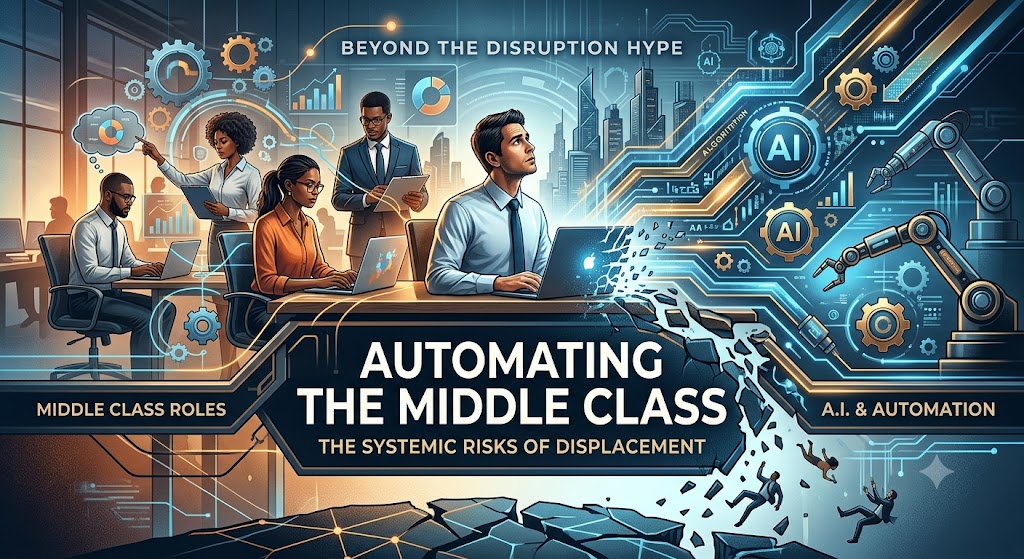
The Emergence of Smart Cities: Challenges and Opportunities

The Emergence of Smart Cities: Challenges and Opportunities

GUEST POST from Chateau G Pato

The concept of ‘smart cities’ has been gaining traction in the past decade. Smart cities integrate technology-enabled sensing, analysis and communication across vital city operations, for example, transportation and energy management. The term may also refer to a vision of a city that is connected and efficient, safer, and more livable. With their introduction into urban environments comes both challenges and opportunities.

One major challenge for smart cities is the amount of data that the connected infrastructure is expected to collect, analyze and report. For this reason, city governments require the right infrastructure and platform to store, protect and analyze the data safely to improve urban services and decision making. Security and privacy are also major concerns. Cities need to deploy new technologies and protocols for data security and privacy protection, while also managing the resilience of the data existing in such systems.

Cost is another major challenge for smart cities. The introduction of new technologies can incur high financial costs. This may include the development of interface-oriented smart systems, power supplies and real-time control. Moreover, the maintenance costs for managing and running smart city systems will be a challenge for city management.

Despite these challenges, smart cities also present lucrative opportunities. For example, two notable examples of successful implementations of smart cities are Barcelona in Spain and Amsterdam in the Netherlands.

Case Study 1 – Barcelona

Barcelona is known for its pioneering implementation of city-wide Wi-Fi. This initially included the deployment of 360 antennas across the city, providing free public access. Barcelona has since incorporated a range of digitalized services, for example, a collaboration program to create an open data platform for civic services such as waste management and pollution monitoring.

Case Study 2 – Amsterdam

Amsterdam is also an example of a successful smart city. The city collects data from a variety of sources, including sensors, wearables and smartphones, to generate a centralized control platform. This platform is then used for crime prediction, the efficient delivery of healthcare services, improved traffic management, and better environmental tracking.

Conclusion

It is clear that smart cities present both challenges and opportunities. Despite the high investments required for data collection and infrastructure, it is evident that the implementation of these frameworks can result in improved urban services and decision making, a modernized public infrastructure, and advanced safety standards. Cities that demonstrate innovation and effective management strategies could benefit from the potential of smart cities, making urban life more connected and efficient.

Bottom line: Futurology is not fortune telling. Futurists use a scientific approach to create their deliverables, but a methodology and tools like those in FutureHacking™ can empower anyone to engage in futurology themselves.

Image credit: Pexels

Subscribe to Human-Centered Change & Innovation WeeklySign up here to get Human-Centered Change & Innovation Weekly delivered to your inbox every week.

Digital Sniffing in High-Stakes Industries

Disrupting Agribusiness, Healthcare, and Logistics through Human-Centered Digital Olfaction

Digital Sniffing in High-Stakes Industries

GUEST POST from Art Inteligencia


The Forgotten Sense in Digital Transformation

For decades, the trajectory of digital transformation has been intensely visual and auditory. We have poured billions of dollars into perfecting screens, computer vision, voice user interfaces, and acoustic sensors. Yet, in our rush to digitize the world, we have largely ignored the oldest and most evocative human sense: the chemical sense of smell. This sensory blindspot leaves organizations blind to a massive stream of real-time molecular data that defines the physical state of our world.

Defining Digital Olfaction

Digital olfaction bridges this gap by combining advanced electronic noses (e-noses) with artificial intelligence. Instead of relying on slow, centralized laboratory testing, these compact sensors capture the volatile organic compounds (VOCs) emitted by everything around us. AI algorithms then analyze these unique chemical signatures, effectively translating complex scent profiles into actionable, digital data streams in real time.

The Thesis

In high-stakes, low-margin environments, digital sniffing is far more than a novel sensory gadget. It represents a fundamental paradigm shift in human-centered change and experience design. By rendering the invisible visible, digital olfaction enhances human capabilities, mitigates catastrophic operational risks, and transforms how we design ecosystems across agribusiness, healthcare, and logistics.

Agribusiness: Beyond the Visual Harvest

In global agriculture, relying purely on visual observation means reacting too late. By the time a human eye spots crop disease, or a manager notices spoilage in a grain silo, a significant portion of the economic and structural damage is already done. Digital olfaction shifts agribusiness from a reactive posture to proactive operational design, opening up a new frontier of precision farming based on molecular reality.

Early Crop Disease Detection

Plants communicate distress long before they show physical signs of decay, releasing specific volatile organic compounds (VOCs) into the soil and air when attacked by pests or pathogens. Deploying digital sniffing nodes across fields allows growers to detect these airborne plant distress signals days before physical symptoms manifest. This early warning enables hyper-targeted interventions, significantly reducing the need for broad-spectrum chemical applications and protecting crop yields at the source.

Supply Chain Precision and Post-Harvest Integrity

The journey from farm to table is fraught with micro-risks. Inside massive grain silos or maritime cargo holds, pockets of moisture can trigger hot spots of mold and insect activity that spoil thousands of tons of product. Continuous, automated digital sniffing monitors the atmosphere of these storage facilities 24/7. By catching the early chemical off-gassing of fermentation or fungal growth, operators can take corrective action—such as adjusting aeration or shifting logistics priorities—before catastrophic spoilage takes hold.

The Experience Evolution for Today’s Grower

This technological integration fundamentally reshapes the human experience of farming. It does not replace the deep, generational expertise of agricultural workers; instead, it augments it. By turning invisible chemical data into clear, actionable insights on a dashboard, digital olfaction elevates the role of farmers and supply chain managers from crisis fighters to strategic ecosystem orchestrators.

Healthcare: Redefining Non-Invasive Diagnostics

The core of human-centered innovation in healthcare lies in reducing patient friction, anxiety, and vulnerability. For decades, diagnostic medicine has relied heavily on invasive testing—blood draws, tissue biopsies, and uncomfortable imaging procedures. Digital olfaction introduces a profoundly empathetic shift, leveraging the simple, natural act of breathing as a rich, real-time diagnostic portal that protects patient dignity while accelerating clinical workflows.

On-the-Breath Diagnostics

The human breath contains thousands of volatile organic compounds (VOCs) that serve as direct metabolic signatures of our internal health. Digital sniffing technologies can instantly analyze these chemical markers at the point of care, allowing clinicians to screen for specific cancers, metabolic disorders, or infectious diseases without drawing a single drop of blood. In remote triage environments or underfunded clinics, this capability democratizes rapid, highly accurate screening, transforming early detection from a luxury into an accessible baseline.

Smart Clinical Environments and Safety

Beyond individual patient diagnostics, digital olfaction transforms the clinical environment itself. Continuous, automated air monitoring within hospitals can trace subtle chemical anomalies long before human staff notice them. This includes tracking volatile anesthetic gas leaks in operating rooms, detecting early signs of airborne bacterial contamination in sterile fields, and monitoring sanitization efficacy. By acting as an invisible safety net, these sensors protect both patients and frontline healthcare workers from ambient occupational hazards.

The Innovation Challenge: Trust and Adoption

The ultimate hurdle for digital sniffing in healthcare isn’t the maturity of the sensor—it is the human side of adoption. Overcoming regulatory pathways is only half the battle; the deeper challenge lies in building institutional trust. Innovation leaders must thoughtfully design the integration of these tools so that veteran clinicians view AI-generated chemical insights not as a threat to their diagnostic intuition, but as a collaborative, highly reliable second opinion.

Logistics & Cold Chain: The Molecular Guardrail

Modern global logistics is a game of microscopic margins and massive liabilities. In the cold chain, maintaining a static temperature is no longer sufficient; a single undetected variables like a micro-leak, structural failure, or chemical cross-contamination can quietly ruin millions of dollars in biopharmaceuticals, critical vaccines, or high-value perishables. Digital olfaction introduces an active molecular guardrail, transitioning the industry from passive geolocation tracking to real-time integrity management.

Micro-Leak and Contamination Detection

Traditional sensors tell logistics managers where a container is and whether the refrigeration unit has power, but they are completely blind to structural or chemical integrity. Digital sniffing nodes embedded within shipping containers continuously analyze the internal atmosphere. They can catch the precise chemical signatures of refrigerant leaks, insulation off-gassing, or container seal breaches mid-transit. By alerting operators the exact moment a chemical anomaly occurs, teams can intervene at the next port or depot before the cargo suffers irreversible damage.

Automated Authenticity and Quality Verification

Global commerce faces an escalating threat from counterfeiting and the adulteration of high-value raw materials, cosmetics, and pharmaceuticals. Because every complex material possesses a unique molecular “fingerprint,” digital sniffing provides an automated line of defense at ports of entry and distribution centers. Customs officials and quality assurance teams can instantly verify the authenticity and provenance of goods simply by scanning the headspace air of a shipment, bypassing slow, destructive physical sampling and keeping supply chains moving seamlessly.

The Ecosystem Impact: From Location to Condition

This shift fundamentally rewires the logistics experience for shippers, carriers, and end consumers. Historically, tracking answered the question, “Where is my product?” Digital olfaction redefines the standard by answering, “How is my product?” By making the chemical stability of cargo visible throughout its entire journey, we build unprecedented trust across the supply chain ecosystem and drastically reduce the systemic waste that plagues global commerce.

The Change Management & Futurology Roadmap

Introducing a radical new sensory technology into high-stakes industries is never a purely technical challenge; it is fundamentally a human-centered change management challenge. When we introduce machines that can “smell,” we are altering how humans interact with their environments, make decisions, and view their own expertise. Navigating this transition requires a strategic approach to experience design and foresight.

Overcoming the “Sensory Overload” Friction

The first barrier to adoption is psychological resistance. How does a worker react when an AI sensor claims to have a more accurate “nose” than a master distiller, a multi-generational farmer, or a clinician with thirty years of diagnostic experience? If implemented poorly, digital sniffing can feel alienating or threatening to human expertise. Innovation leaders must position these tools as cognitive extensions rather than human replacements. The objective is to design a collaborative experience where the technology acts as a superpower, validating and augmenting human intuition rather than rendering it obsolete.

Designing Interfaces for the Invisible

Data is only useful if it can be easily digested and acted upon. Raw chemical data—such as volatile organic compound (VOC) concentrations and molecular weight distributions—is completely meaningless to a busy logistics manager or a nurse on a chaotic triage floor. The core design challenge lies in translating invisible molecular changes into intuitive, highly visual human interfaces. Experience designers must build dashboards that distill complex chemical shifts into clear, contextual recommendations, allowing operators to make rapid, high-confidence decisions without needing a degree in biochemistry.

The Next Horizon: Democratization and Miniaturization

Looking out over the next five to ten years, the trajectory of digital olfaction points toward rapid miniaturization and commercial democratization. We will transition away from specialized, standalone industrial nodes toward mass-market integration. As electronic noses are shrunk down to the millimeter scale, they will become standard components inside consumer smartphones, wearable health monitors, and smart home appliances. This shift will democratize molecular awareness, allowing the average consumer to instantly audit the freshness of food, monitor indoor air quality for hidden toxins, or track subtle changes in their own metabolic health from their living room.

Conclusion: Designing a Smarter, Safer World

The digitization of our physical world will remain profoundly incomplete as long as we treat our environments as strictly visual and auditory spaces. Scent is the language of chemistry, and by failing to capture it, we miss the vital data that signals the earliest moments of decay, disease, and structural failure. Digital olfaction bridges this critical gap, providing an intelligent, real-time sensory layer that radically enhances how machines understand physical reality and how humans manage risk.

A Call to Action for Innovation Leaders

For change leaders and innovation strategists, the arrival of digital sniffing represents a massive blue-ocean opportunity. The challenge now is to look past traditional screens and legacy operational frameworks. Leaders must ask themselves: Where is the invisible data in our organization? What critical, high-stakes challenges could be solved if we could suddenly taste the air, track molecular integrity across the supply chain, or non-invasively read a patient’s metabolic state?

The Human-Centered Future

Ultimately, the success of digital olfaction won’t be measured by the sensitivity of its sensors, but by the design of its integration. By building intuitive, empathy-driven interfaces and managing organizational change with a supportive, human-first approach, we can successfully transition into this next sensory frontier. In doing so, we don’t just optimize industrial processes—we build an ecosystem that is fundamentally safer, more predictable, and deeply attuned to the human experience.

Frequently Asked Questions

What is digital olfaction, and how does it work?

Digital olfaction is a technology that allows machines to capture, analyze, and interpret scents and chemical profiles. It uses specialized electronic noses (e-noses) containing gas sensor arrays to detect Volatile Organic Compounds (VOCs) in the air. This raw data is then processed by machine learning algorithms that match the chemical patterns against a database of known scent fingerprints, translating invisible chemistry into actionable digital insights.

Why is digital sniffing considered a disruptive innovation in high-stakes industries?

Historically, digital transformation has relied entirely on visual and auditory data, leaving a massive sensory blindspot. In industries like healthcare, agribusiness, and logistics, waiting for visual symptoms or physical failures means acting too late. Digital sniffing disrupts these fields by enabling proactive, real-time, and non-invasive detection of disease, spoilage, and structural leaks at the molecular level before they manifest physically.

What is the biggest challenge when implementing digital olfaction in an organization?

The primary hurdle is not the maturity of the hardware, but the human-centered change management and experience design required for adoption. Organizations must design intuitive interfaces that translate complex biochemical data into simple, actionable insights. Furthermore, leadership must manage psychological friction, ensuring that human experts view these AI-driven sensors as supportive tools that enhance their capabilities rather than technologies designed to replace their intuition.

FutureHacking™ Is Coming

FutureHacking™ is Braden Kelley’s strategic foresight methodology — and a paid download and training program is launching soon. Register your interest now to be the first to know when it’s available, and get early access pricing.

Image credit: Gemini

Subscribe to Human-Centered Change & Innovation WeeklySign up here to get Human-Centered Change & Innovation Weekly delivered to your inbox every week.