Beyond the Disruption Hype
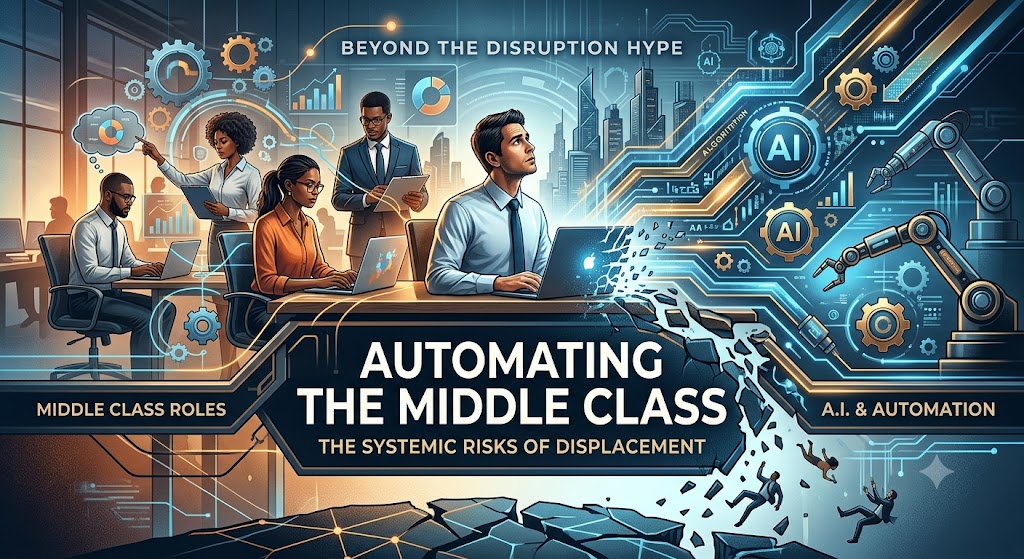
GUEST POST from Art Inteligencia
The Mirage of Efficient Progress
For over two decades, the global business landscape has been intoxicated by the gospel of “disruption.” We have been conditioned to view every wave of technological displacement as an unalloyed good — a friction-free path to hyper-efficiency and shareholder value. But as the crosshairs of automation shift from routine blue-collar labor to the white-collar knowledge workers who form the backbone of our enterprises, we must urgently interrogate the true cost of this transition. We have allowed a tech-centric fetish for optimization to crowd out the human-centered realities of sustainable business architecture.
The critical flaw in our current trajectory lies in the questions leadership teams are asking. The boardrooms of today are dominated by a dangerous, short-sighted query: “What can we automate?” This is the wrong question. True innovation and responsible stewardship require us to ask: “What should we automate to preserve long-term organizational, economic, and societal health?” When we treat human beings merely as expensive nodes in a workflow to be streamlined away, we fail to see the systemic dependencies that keep our companies — and our communities — alive.
The Systemic Reality: The middle class is not merely an overhead line item on a corporate balance sheet; it is the vital organ of the modern enterprise and the primary engine of the consumer economy.
Accelerating the unmitigated automation of mid-tier professional roles introduces profound systemic risks. It is a strategy that borrows against our collective future for a temporary spike in quarterly earnings. By hollowing out the corporate middle, we are not just cutting costs; we are systematically dismantling our innovation pipelines, degrading customer and employee experiences, and fracturing the economic feedback loops that sustain market demand. To build a resilient, scalable future, we must look past the disruption hype and design an automation strategy that amplifies human ingenuity rather than extinguishing it.
I. The Experience Design Deficit: Eroding the Customer and Employee Journey
The race to automate mid-tier professional roles operates on a dangerous assumption: that human presence is merely a cost to be engineered out of the system. In the rush to implement algorithmic decision-making, organizations are inadvertently creating a profound experience design deficit. By hollowing out the middle, companies are severing the vital, empathetic tissue that connects an enterprise to its people and its customers.
Losing the Human Touchpoint in CX
Customer experience (CX) is inherently emotional. While automated interfaces excel at processing predictable, binary requests, they are fundamentally unequipped to handle nuance, ambiguity, or emotional distress. When mid-tier knowledge workers are replaced by algorithms, customers lose the advocates who understand context. The result is a rigid, friction-filled experience where edge cases go unresolved, ultimately degrading brand loyalty and destroying long-term customer relationships.
The Destruction of the Mentorship Pipeline
From an employee experience (EX) perspective, middle management and mid-tier roles serve a critical evolutionary purpose: they are the training grounds for an organization’s future leadership. Human-centered innovation thrives on tribal knowledge, mentorship, and informal learning networks. When you automate the middle class, you effectively destroy the corporate ladder. Without these transitional roles, organizations lose their ability to cultivate internal talent, leaving a gaping chasm between entry-level executors and senior executives.
The Blindspot of Efficiency: Algorithms are designed to optimize for known variables based on historical data. They cannot replicate the quiet, unmapped problem-solving that human middle managers perform daily to resolve organizational friction and maintain cultural alignment.
Operational Blindspots and the Loss of Resilience
Every complex organization relies on “invisible work” — the human intervention required to bridge the gap between rigid corporate policy and unpredictable real-world scenarios. Mid-tier professionals act as the shock absorbers of the enterprise, utilizing emotional intelligence and institutional memory to navigate crises. Replacing this layer with automated systems introduces a fragile rigidity. When an unexpected market shift or operational anomaly occurs, an algorithmic middle lacks the creative flexibility required to adapt, exposing the organization to catastrophic systemic failure.
II. The Innovation Paradox: Why Efficiency Kills Creativity
The core justification for the aggressive automation of mid-tier knowledge workers is almost always efficiency. But in the architecture of a healthy enterprise, hyper-efficiency and breakthrough innovation are often at war. When an organization eliminates all human variance in pursuit of a flawless, predictable process, it inadvertently suffocates the very environment required for creative thinking and strategic foresight.
The Danger of Hyper-Optimization
True innovation is rarely neat, linear, or efficient. It thrives on friction, diverse perspectives, and what I call “happy accidents” — the unexpected insights that occur when human beings collaborate, debate, and experiment. Algorithms are designed to eliminate variance and optimize for the status quo based on historical data. By replacing the creative, analytical middle class with automated systems, companies lock themselves into a state of permanent optimization, leaving no room for the divergent thinking that drives disruptive breakthroughs.
De-skilling the Workforce
Over-reliance on automated tools creates a dangerous cognitive dependency. When mid-tier professionals spend their careers merely supervising or rubber-stamping algorithmic outputs, their own critical thinking, problem-solving, and futurology capabilities begin to atrophy. We are facing a future of organizational de-skilling, where the workforce loses the muscle memory required to question assumptions, anticipate market shifts, or architect human-centered strategies from scratch.
The Homogenization Trap: When every enterprise in an industry leverages the exact same AI models and automation frameworks to optimize their operations, competitive differentiation completely vanishes. Companies become mirror images of one another, competing on a race to the bottom.
The Loss of Participatory Innovation
Sustainable innovation cannot be a purely top-down mandate dictated by an executive suite and executed by a skeleton crew of machines. It requires participatory innovation — an inclusive ecosystem where mid-tier employees act as catalysts, identifying grassroots problems and co-creating solutions. When this layer of the organization is hollowed out, the collaborative engine stalls. Without a robust, engaged middle class to champion and iterate on new ideas, the corporate innovation bonfire simply runs out of fuel.
III. Macro-Systemic Risks: The Economic Feedback Loop
The decision to automate the middle class is often treated as an isolated, microeconomic calculation—a line-item optimization designed to please Wall Street on the next earnings call. But businesses do not exist in a vacuum. When thousands of enterprises simultaneously execute the same short-sighted playbook, individual corporate efficiencies aggregate into a massive, macro-systemic crisis. We are actively dismantling the economic architecture that allows our markets to function.
Hollowing Out the Consumer Base
The most glaring oversight in the rush to automate mid-tier white-collar roles is the hollowing out of the consumer base. The middle class is not merely a source of labor and operational cost; it is the primary engine of global consumer spending. Algorithms do not buy software, they do not subscribe to services, and they do not invest in products. By systematically stripping income and financial security from knowledge workers, corporations are shrinking the very market demand they rely on to survive. It is a modern economic paradox: hyper-efficient production paired with an engineered collapse of consumption.
The Velocity of Change vs. Human Adaptation
Fundamental principles of change management dictate that human systems require time to adapt, reskill, and transition. Previous industrial revolutions displaced labor over generations, allowing society to build new educational and institutional safety nets. The current wave of generative and cognitive automation is moving at an exponential velocity that completely outpaces human adaptation. When societies are subjected to rapid, unmanaged displacement without viable pathways to equitable outcomes, the result is widespread economic anxiety, social instability, and a severe hollowing out of the workforce.
The Corporate Trust Deficit: True organizational resilience is built on a foundation of mutual trust. When leadership views its knowledge workers as disposable commodities to be replaced by lines of code at the first opportunity, that institutional trust is irrevocably fractured, destroying employee engagement and public goodwill.
The Illusion of the Frictionless Economy
Proponents of hyper-automation often dream of a frictionless, autonomous economy. But this vision ignores the human element of risk management. Mid-tier professionals provide stabilizing feedback loops within our economic and organizational structures. Without this layer of human oversight, empathy, and ethical judgment, our economic systems become highly fragile. A top-heavy economic structure—where immense wealth is concentrated among a fraction of tech elite while the middle class is displaced—is fundamentally unstable and prone to catastrophic systemic collapse.
IV. A Manifesto for Human-Centered Automation
To avert the systemic risks of a hollowed-out enterprise and a fractured economy, leadership teams must pivot from a mindset of absolute replacement to one of intentional, human-centered design. Technology should not be weaponized to diminish human agency; it should be architected to elevate it. We must establish a new framework for technological deployment that prioritizes sustainable, long-term organizational health over short-term, fragile efficiencies.
Co-Creation and Intelligence Amplification (IA)
The true frontier of innovation lies not in Artificial Intelligence replacing the worker, but in Intelligence Amplification (IA)—designing tools that act as cognitive prosthetics for human ingenuity. True participatory innovation requires that we actively include mid-tier knowledge workers in the design of their own automated partners. When we use technology to handle cognitive drudgery, we liberate the middle class to focus on higher-value activities: strategic foresight, complex problem-solving, and deepening customer relationships.
Deploying Systemic Impact Assessments
Before any enterprise-wide automation initiative is approved, corporate governance must mandate rigorous Systemic Impact Assessments. Leadership must look far beyond immediate return on investment (ROI) metrics and simulate the long-term, cascading effects of a technological transition. These assessments must explicitly evaluate the impacts on the customer journey (CX), the internal talent and mentorship pipeline (EX), and the collective institutional knowledge of the enterprise.
The Equitable Metric: True organizational fairness dictates that our metrics evolve. We must move past cold productivity ratios and embrace Experience Level Measures (XLMs) managed by dedicated Experience Management Offices (XMOs), ensuring that technological progress yields equitable outcomes where human effort and rewards remain aligned.
Architecting the Regenerative Enterprise
We must transition from the predatory model of the hyper-optimized corporation to the sustainable model of the Regenerative Enterprise. A regenerative enterprise understands that its long-term viability is intrinsically linked to the health of its human ecosystem. This means treating change management as a core corporate capability, pacing technological deployment to match human adaptation, and actively reinvesting automation-driven profits into aggressive human reskilling and upskilling initiatives. By building a robust, tech-empowered middle class, we design an enterprise built to last.
Conclusion: Designing a Scalable Future
The path we are currently charting toward the hyper-automation of the middle class is not an inevitability; it is a design choice. For too long, the business world has accepted the false narrative that human displacement is the mandatory price of progress. As innovators, strategists, and leaders, we have a responsibility to look past the seductive glare of the disruption hype cycle and recognize that a corporate structure with a hollowed-out middle is a house built on sand — fragile, rigid, and profoundly vulnerable to systemic shock.
The choice before us is stark, but clear. We can choose to design a top-heavy, automated future that optimizes for short-term balance sheets at the expense of our innovation pipelines, customer relationships, and macroeconomic stability. Or, we can choose to architect a human-centered future. By committing to an automation strategy that leverages technology to amplify human capability rather than erase it, we can cultivate an inclusive, participatory ecosystem where technological advancement and human prosperity rise together.
A Call to Action for Innovators: True leadership requires looking beyond the next quarterly earnings report. We must muster the strategic foresight to design systems that respect, protect, and elevate the human experience, ensuring that the ultimate metric of our progress is the sustainable growth of our society.
Let us stop asking how quickly we can replace the human element, and start designing how powerfully we can empower it. The future of innovation is not artificial; it is undeniably human-centered. By building resilient, regenerative enterprises today, we ensure a scalable, stable, and prosperous tomorrow for everyone.
Frequently Asked Questions
What are the systemic risks of automating middle-class knowledge work?
Automating mid-tier professional roles can create risks beyond job displacement. It may weaken customer experience, disrupt employee mentorship pipelines, reduce institutional knowledge, and remove the human problem-solving layer that helps organizations adapt to uncertainty. The concern is not automation itself, but automation strategies that optimize short-term efficiency while damaging long-term organizational resilience.
Why can excessive automation hurt innovation?
Excessive automation can reduce the human variation, experimentation, and collaboration that fuel breakthrough innovation. When organizations optimize every process for predictability and efficiency, they risk eliminating the creative friction, diverse perspectives, and “happy accidents” that lead to new ideas and strategic breakthroughs.
What does a human-centered automation strategy look like?
A human-centered automation strategy uses technology to amplify human capability rather than simply replace people. This approach involves including employees in automation design, measuring impacts on customer and employee experiences, investing in reskilling, and building regenerative enterprises where technology and human ingenuity work together.
SPECIAL BONUS: Braden Kelley’s Problem Finding Canvas can be a super useful starting point for doing design thinking or human-centered design.
“The Problem Finding Canvas should help you investigate a handful of areas to explore, choose the one most important to you, extract all of the potential challenges and opportunities and choose one to prioritize.”
Image credit: Pexels
 Sign up here to get Human-Centered Change & Innovation Weekly delivered to your inbox every week.