Disrupting Agribusiness, Healthcare, and Logistics through Human-Centered Digital Olfaction
GUEST POST from Art Inteligencia
The Forgotten Sense in Digital Transformation
For decades, the trajectory of digital transformation has been intensely visual and auditory. We have poured billions of dollars into perfecting screens, computer vision, voice user interfaces, and acoustic sensors. Yet, in our rush to digitize the world, we have largely ignored the oldest and most evocative human sense: the chemical sense of smell. This sensory blindspot leaves organizations blind to a massive stream of real-time molecular data that defines the physical state of our world.
Defining Digital Olfaction
Digital olfaction bridges this gap by combining advanced electronic noses (e-noses) with artificial intelligence. Instead of relying on slow, centralized laboratory testing, these compact sensors capture the volatile organic compounds (VOCs) emitted by everything around us. AI algorithms then analyze these unique chemical signatures, effectively translating complex scent profiles into actionable, digital data streams in real time.
The Thesis
In high-stakes, low-margin environments, digital sniffing is far more than a novel sensory gadget. It represents a fundamental paradigm shift in human-centered change and experience design. By rendering the invisible visible, digital olfaction enhances human capabilities, mitigates catastrophic operational risks, and transforms how we design ecosystems across agribusiness, healthcare, and logistics.
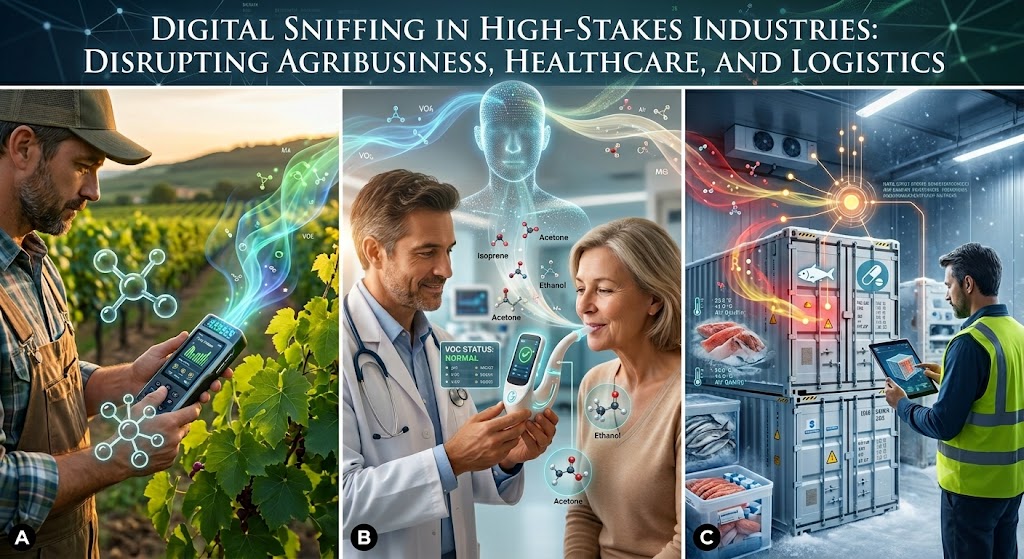
Agribusiness: Beyond the Visual Harvest
In global agriculture, relying purely on visual observation means reacting too late. By the time a human eye spots crop disease, or a manager notices spoilage in a grain silo, a significant portion of the economic and structural damage is already done. Digital olfaction shifts agribusiness from a reactive posture to proactive operational design, opening up a new frontier of precision farming based on molecular reality.
Early Crop Disease Detection
Plants communicate distress long before they show physical signs of decay, releasing specific volatile organic compounds (VOCs) into the soil and air when attacked by pests or pathogens. Deploying digital sniffing nodes across fields allows growers to detect these airborne plant distress signals days before physical symptoms manifest. This early warning enables hyper-targeted interventions, significantly reducing the need for broad-spectrum chemical applications and protecting crop yields at the source.
Supply Chain Precision and Post-Harvest Integrity
The journey from farm to table is fraught with micro-risks. Inside massive grain silos or maritime cargo holds, pockets of moisture can trigger hot spots of mold and insect activity that spoil thousands of tons of product. Continuous, automated digital sniffing monitors the atmosphere of these storage facilities 24/7. By catching the early chemical off-gassing of fermentation or fungal growth, operators can take corrective action—such as adjusting aeration or shifting logistics priorities—before catastrophic spoilage takes hold.
The Experience Evolution for Today’s Grower
This technological integration fundamentally reshapes the human experience of farming. It does not replace the deep, generational expertise of agricultural workers; instead, it augments it. By turning invisible chemical data into clear, actionable insights on a dashboard, digital olfaction elevates the role of farmers and supply chain managers from crisis fighters to strategic ecosystem orchestrators.
Healthcare: Redefining Non-Invasive Diagnostics
The core of human-centered innovation in healthcare lies in reducing patient friction, anxiety, and vulnerability. For decades, diagnostic medicine has relied heavily on invasive testing—blood draws, tissue biopsies, and uncomfortable imaging procedures. Digital olfaction introduces a profoundly empathetic shift, leveraging the simple, natural act of breathing as a rich, real-time diagnostic portal that protects patient dignity while accelerating clinical workflows.
On-the-Breath Diagnostics
The human breath contains thousands of volatile organic compounds (VOCs) that serve as direct metabolic signatures of our internal health. Digital sniffing technologies can instantly analyze these chemical markers at the point of care, allowing clinicians to screen for specific cancers, metabolic disorders, or infectious diseases without drawing a single drop of blood. In remote triage environments or underfunded clinics, this capability democratizes rapid, highly accurate screening, transforming early detection from a luxury into an accessible baseline.
Smart Clinical Environments and Safety
Beyond individual patient diagnostics, digital olfaction transforms the clinical environment itself. Continuous, automated air monitoring within hospitals can trace subtle chemical anomalies long before human staff notice them. This includes tracking volatile anesthetic gas leaks in operating rooms, detecting early signs of airborne bacterial contamination in sterile fields, and monitoring sanitization efficacy. By acting as an invisible safety net, these sensors protect both patients and frontline healthcare workers from ambient occupational hazards.
The Innovation Challenge: Trust and Adoption
The ultimate hurdle for digital sniffing in healthcare isn’t the maturity of the sensor—it is the human side of adoption. Overcoming regulatory pathways is only half the battle; the deeper challenge lies in building institutional trust. Innovation leaders must thoughtfully design the integration of these tools so that veteran clinicians view AI-generated chemical insights not as a threat to their diagnostic intuition, but as a collaborative, highly reliable second opinion.
Logistics & Cold Chain: The Molecular Guardrail
Modern global logistics is a game of microscopic margins and massive liabilities. In the cold chain, maintaining a static temperature is no longer sufficient; a single undetected variables like a micro-leak, structural failure, or chemical cross-contamination can quietly ruin millions of dollars in biopharmaceuticals, critical vaccines, or high-value perishables. Digital olfaction introduces an active molecular guardrail, transitioning the industry from passive geolocation tracking to real-time integrity management.
Micro-Leak and Contamination Detection
Traditional sensors tell logistics managers where a container is and whether the refrigeration unit has power, but they are completely blind to structural or chemical integrity. Digital sniffing nodes embedded within shipping containers continuously analyze the internal atmosphere. They can catch the precise chemical signatures of refrigerant leaks, insulation off-gassing, or container seal breaches mid-transit. By alerting operators the exact moment a chemical anomaly occurs, teams can intervene at the next port or depot before the cargo suffers irreversible damage.
Automated Authenticity and Quality Verification
Global commerce faces an escalating threat from counterfeiting and the adulteration of high-value raw materials, cosmetics, and pharmaceuticals. Because every complex material possesses a unique molecular “fingerprint,” digital sniffing provides an automated line of defense at ports of entry and distribution centers. Customs officials and quality assurance teams can instantly verify the authenticity and provenance of goods simply by scanning the headspace air of a shipment, bypassing slow, destructive physical sampling and keeping supply chains moving seamlessly.
The Ecosystem Impact: From Location to Condition
This shift fundamentally rewires the logistics experience for shippers, carriers, and end consumers. Historically, tracking answered the question, “Where is my product?” Digital olfaction redefines the standard by answering, “How is my product?” By making the chemical stability of cargo visible throughout its entire journey, we build unprecedented trust across the supply chain ecosystem and drastically reduce the systemic waste that plagues global commerce.
The Change Management & Futurology Roadmap
Introducing a radical new sensory technology into high-stakes industries is never a purely technical challenge; it is fundamentally a human-centered change management challenge. When we introduce machines that can “smell,” we are altering how humans interact with their environments, make decisions, and view their own expertise. Navigating this transition requires a strategic approach to experience design and foresight.
Overcoming the “Sensory Overload” Friction
The first barrier to adoption is psychological resistance. How does a worker react when an AI sensor claims to have a more accurate “nose” than a master distiller, a multi-generational farmer, or a clinician with thirty years of diagnostic experience? If implemented poorly, digital sniffing can feel alienating or threatening to human expertise. Innovation leaders must position these tools as cognitive extensions rather than human replacements. The objective is to design a collaborative experience where the technology acts as a superpower, validating and augmenting human intuition rather than rendering it obsolete.
Designing Interfaces for the Invisible
Data is only useful if it can be easily digested and acted upon. Raw chemical data—such as volatile organic compound (VOC) concentrations and molecular weight distributions—is completely meaningless to a busy logistics manager or a nurse on a chaotic triage floor. The core design challenge lies in translating invisible molecular changes into intuitive, highly visual human interfaces. Experience designers must build dashboards that distill complex chemical shifts into clear, contextual recommendations, allowing operators to make rapid, high-confidence decisions without needing a degree in biochemistry.
The Next Horizon: Democratization and Miniaturization
Looking out over the next five to ten years, the trajectory of digital olfaction points toward rapid miniaturization and commercial democratization. We will transition away from specialized, standalone industrial nodes toward mass-market integration. As electronic noses are shrunk down to the millimeter scale, they will become standard components inside consumer smartphones, wearable health monitors, and smart home appliances. This shift will democratize molecular awareness, allowing the average consumer to instantly audit the freshness of food, monitor indoor air quality for hidden toxins, or track subtle changes in their own metabolic health from their living room.
Conclusion: Designing a Smarter, Safer World
The digitization of our physical world will remain profoundly incomplete as long as we treat our environments as strictly visual and auditory spaces. Scent is the language of chemistry, and by failing to capture it, we miss the vital data that signals the earliest moments of decay, disease, and structural failure. Digital olfaction bridges this critical gap, providing an intelligent, real-time sensory layer that radically enhances how machines understand physical reality and how humans manage risk.
A Call to Action for Innovation Leaders
For change leaders and innovation strategists, the arrival of digital sniffing represents a massive blue-ocean opportunity. The challenge now is to look past traditional screens and legacy operational frameworks. Leaders must ask themselves: Where is the invisible data in our organization? What critical, high-stakes challenges could be solved if we could suddenly taste the air, track molecular integrity across the supply chain, or non-invasively read a patient’s metabolic state?
The Human-Centered Future
Ultimately, the success of digital olfaction won’t be measured by the sensitivity of its sensors, but by the design of its integration. By building intuitive, empathy-driven interfaces and managing organizational change with a supportive, human-first approach, we can successfully transition into this next sensory frontier. In doing so, we don’t just optimize industrial processes—we build an ecosystem that is fundamentally safer, more predictable, and deeply attuned to the human experience.
Frequently Asked Questions
What is digital olfaction, and how does it work?
Digital olfaction is a technology that allows machines to capture, analyze, and interpret scents and chemical profiles. It uses specialized electronic noses (e-noses) containing gas sensor arrays to detect Volatile Organic Compounds (VOCs) in the air. This raw data is then processed by machine learning algorithms that match the chemical patterns against a database of known scent fingerprints, translating invisible chemistry into actionable digital insights.
Why is digital sniffing considered a disruptive innovation in high-stakes industries?
Historically, digital transformation has relied entirely on visual and auditory data, leaving a massive sensory blindspot. In industries like healthcare, agribusiness, and logistics, waiting for visual symptoms or physical failures means acting too late. Digital sniffing disrupts these fields by enabling proactive, real-time, and non-invasive detection of disease, spoilage, and structural leaks at the molecular level before they manifest physically.
What is the biggest challenge when implementing digital olfaction in an organization?
The primary hurdle is not the maturity of the hardware, but the human-centered change management and experience design required for adoption. Organizations must design intuitive interfaces that translate complex biochemical data into simple, actionable insights. Furthermore, leadership must manage psychological friction, ensuring that human experts view these AI-driven sensors as supportive tools that enhance their capabilities rather than technologies designed to replace their intuition.
FutureHacking™ Is Coming
FutureHacking™ is Braden Kelley’s strategic foresight methodology — and a paid download and training program is launching soon. Register your interest now to be the first to know when it’s available, and get early access pricing.
Image credit: Gemini
 Sign up here to get Human-Centered Change & Innovation Weekly delivered to your inbox every week.