Mapping a Balanced Transition into the AI Era
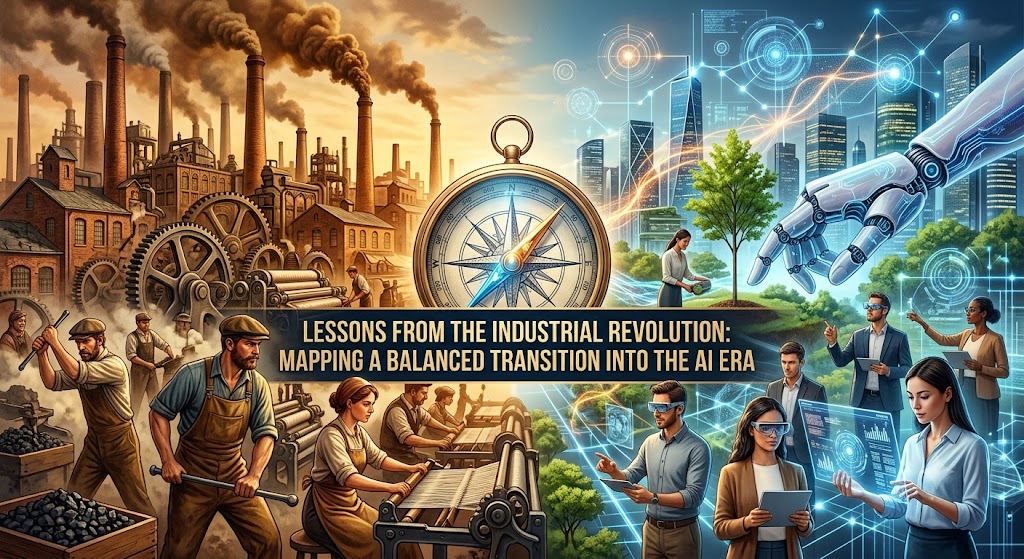
GUEST POST from Art Inteligencia
The Anatomy of Generative Shifts
In the rush to adopt artificial intelligence, a dangerous consensus has formed: treating AI as a mere upgrade to our corporate software suite. It is viewed as an efficiency engine, a tool to shave off percentages of time from routine tasks. This perspective misses the horizon entirely. We are not experiencing a routine iteration of software; we are witnessing a fundamental rewrite of our economic and social infrastructure. AI is the new steam engine, the new electricity — a general-purpose technology destined to reshape how humanity creates, organizes, and extracts value.
The Innovation Mirror
When navigating unprecedented change, the best compass is often found by looking backward. The First and Second Industrial Revolutions provide us with a vivid mirror. They remind us that technological breakthroughs do not occur in a vacuum; they collide with human lives, existing power structures, and legacy mindsets. By analyzing the structural lag, the labor upheavals, and the eventual societal re-architecting of the 18th and 19th centuries, we can predict the failure points of the 21st-century transition. More importantly, we can design our way around them.
The Core Challenge: Exponential Tech vs. Linear Humanity
The central tension of our era is a mismatch of velocities. Technology moves at an exponential trajectory, while human psychology, organizational culture, and regulatory systems adapt linearly. When this gap stretches too wide, systems fracture — resulting in cultural backlash, employee burnout, and organizational rejection of the innovation itself.
To prevent a chaotic transition, we must pivot from a technology-first mindset to a human-centered approach. Successful transformation requires us to intentionally design the transition experience, ensuring that our organizational architectures, training ecosystems, and ethical frameworks evolve at a pace that empowers, rather than displaces, the human element.
I. Structural Lag: The Time Gap Between Tech and Trust
History shows us that technological breakthroughs consistently outpace the human frameworks required to manage them. This phenomenon — structural lag — occurs because code and machinery can be deployed in an instant, while trust, culture, and systemic adaptation must be built over time. When innovation is introduced without intentional experience design, the resulting gap creates friction that can derail even the most sophisticated technological advancements.
The Historical Lesson: Optimization at the Expense of Well-Being
During the First Industrial Revolution, the deployment of mechanization was rapid and ruthless. Early factory owners focused entirely on optimizing mechanical throughput. Because there was no playbook for this new industrial reality, it took decades of systemic friction — marked by labor unrest, unsafe working environments, and societal destabilization — before the necessary counterweights were developed.
The weekends, labor laws, public safety standards, and workplace protections we take for granted today were not part of the initial industrial design; they were retrofitted over generations to repair a fractured human experience.
The AI Parallel: The Velocity of Deployment vs. The Scarcity of Frameworks
We are repeating this pattern today. The deployment of advanced generative models and autonomous agents is moving at a breakneck pace, yet the structural frameworks required to support them remain largely unwritten. Organizations are embedding AI into workflows before establishing clear guidelines on data privacy, intellectual property rights, or algorithmic accountability.
More critically, there is a profound lack of design dedicated to the psychological safety of the workforce. When employees perceive AI as a black box designed to replace them rather than a partner designed to augment them, engagement drops and covert resistance rises.
The Change Management Takeaway: Architecting Trust Infrastructure
The critical lesson for modern leaders is clear: innovation without a deliberate organizational design framework leads to systemic rejection. You cannot successfully transform an enterprise by simply handing people new tools and expecting them to adapt.
To bridge the structural lag, change leaders must design “trust architectures” alongside technical infrastructure. This means being transparent about the goals of AI integration, defining clear boundaries for human-machine collaboration, and explicitly mapping out how the savings from automation will be reinvested into elevating the human experience. Trust is not a byproduct of successful transformation; it is the prerequisite.
II. From Muscle to Mind: Redefining Reskilling
True transformation requires us to look beyond the skills themselves and examine the human identity attached to them. When a technology shifts the core nature of work, it doesn’t just change a person’s daily tasks — it changes how they view their value, their expertise, and their purpose within the organization. Navigating the AI era requires a deep, human-centered approach to learning that treats reskilling not as a technical patch, but as a psychological and cultural transition.
The Historical Lesson: The Loss of Autonomy and Craft
The transition from an agrarian, craft-based economy to a centralized industrial machine was deeply painful, not just because the work changed, but because the human relationship to work fractured. Independent artisans and master craftspeople possessed holistic knowledge of their trade; they designed, produced, and took pride in the final output.
The factory system stripped away that autonomy, atomizing complex trades into repetitive, low-skill assembly line tasks. Workers didn’t just lose their livelihoods — they lost their professional identity, their agency, and their sense of pride. The lesson here is stark: when automation degrades the human experience of work, it breeds deep-seated alienation and systemic resistance.
The AI Parallel: The Disruption of Cognitive Identity
Today, we are seeing a parallel shift, but instead of mechanizing muscle, we are automating mindsets. Generative AI is rapidly moving up the cognitive ladder, absorbing tasks that once formed the bedrock of professional identity for knowledge workers — such as baseline coding, initial copywriting, legal document review, and data synthesis.
This creates an unspoken identity crisis for professionals who spent years earning degrees and refining specialized skills. When an algorithm can generate a marketing brief or an entry-level software script in seconds, the human creator experiences a profound sense of obsolescence. If we approach reskilling as a cold, mandatory training check-box, we completely miss this underlying emotional friction.
The Experience Design Shift: Designing New Professional Identities
To build a balanced transition, leaders must move away from the traditional, rigid training models of the past. Reskilling for the AI era cannot just be about teaching people “how to write a prompt.” It must be an intentional exercise in experience design that reshapes the employee’s relationship with knowledge work.
We must actively guide professionals from the role of executioners of tasks to orchestrators of intent. This means designing learning journeys that cultivate and celebrate uniquely human capabilities — such as emotional intelligence, complex problem-framing, ethical curation, and cross-disciplinary empathy. By elevating the human role from content creator to strategic editor and systems director, we preserve professional dignity and unlock higher-tier innovation.
III. The Automation vs. Augmentation Fallacy
When major technological shifts arrive, organizations tend to default to a dangerous, short-sighted binary: do we use this technology to eliminate human headcount, or do we ignore it? This is the automation versus augmentation fallacy. True, human-centered innovation looks beyond the immediate temptation of cost reduction and focuses instead on capacity expansion — using technology to elevate what humans are capable of achieving.
The Historical Lesson: The Misunderstood Luddites
Popular history often mischaracterizes the 19th-century Luddites as technophobic machine-breakers who were simply afraid of progress. In reality, their protest was not against the looms and textile machinery itself. It was a targeted, political response to how factory owners used technology as a weapon to degrade working conditions, bypass fair labor standards, and drive down wages.
The friction arose because the gains of the technology were entirely decoupled from the welfare of the people operating it. The lesson for modern strategists is that when technology is deployed purely as an instrument of cost-cutting and human replacement, it triggers a predictable, defensive backlash that stifles long-term organizational health.
The AI Parallel: Short-Term Cuts vs. Long-Term Value Creation
We are seeing this exact friction play out in corporate boardrooms today. Many organizations view artificial intelligence through a narrow financial lens, rushing to automate customer service, content generation, and administrative workflows solely to trim headcount. This strategy treats human capital as an expense to be managed rather than an engine of innovation to be unlocked.
When you automate a process completely without understanding the subtle, human-to-human context built into it, you create a sterile, fragile customer experience. You also destroy institutional knowledge and strip your culture of the empathy and intuition that differentiate your brand in the marketplace.
The Futurist’s Prescription: Elevating the Human Experience
To navigate this transition successfully, leaders must design “human-in-the-loop” ecosystems. The goal should not be to build a lights-out, human-free operation, but rather to use AI to strip away the cognitive drudgery — the repetitive data entry, the basic synthesis, the administrative overhead — that consumes up to 60-70% of a knowledge worker’s day.
By intentionally reinvesting that liberated time into high-touch, empathetic, and deeply strategic endeavors, we change the equation entirely. AI handles the baseline execution, while humans focus on relationship building, complex creative problem-solving, and deep innovation strategy. When technology is engineered to make humans more capable rather than obsolete, resistance transforms into adoption.
IV. Systemic Re-Architecture: Designing the Future Ecosystem
A truly transformative technology cannot be neatly slotted into old containers. It eventually shatters them. To realize the full potential of a generational shift, we cannot just change individual tools or job descriptions; we must fundamentally redesign the organizational structures, operational models, and cultural environments that govern how we work.
The Historical Lesson: Industrializing Society from the Ground Up
The steam engine and the mechanized loom did not achieve maximum impact until the physical and social landscape was rebuilt around them. The old, decentralized cottage industries could not support centralized power sources, which forced a mass migration to urban centers.
This shift required entirely new societal structures: the invention of the modern corporate entity, the establishment of formal management hierarchies, and the creation of a standardized, public education system designed explicitly to train punctual, compliant factory workers. The lesson is clear: true technical revolutions require an accompanying systemic architecture to succeed.
The AI Parallel: Fitting Exponential Tech into Legacy Hierarchies
Today, we are attempting to run an exponential technology on a linear organizational operating system. Most modern corporate structures — with their rigid, departmental silos, annual performance reviews, and 9-to-5 knowledge-work frameworks — were optimized for a pre-digital, industrial-era mindset of predictable, repetitive execution.
When an AI agent or a decentralized network of models can execute a cross-functional project in hours, a traditional hierarchy that requires weeks of bureaucratic approvals becomes a massive bottleneck. The friction we feel today is the sound of hyper-agile technology colliding with calcified, slow-moving organizational design.
The Innovation Roadmap: Rethinking Organizational Design
To build a balanced transition into the AI era, innovation leaders must become organizational architects. We need to move away from rigid, static roles and transition toward fluid, dynamic talent ecosystems. Instead of managing fixed departments, leadership will center on orchestrating agile, cross-disciplinary squads composed of humans and specialized AI agents working in tandem.
Furthermore, we must re-engineer our continuous learning infrastructures. Because the shelf-life of technical skills is shrinking rapidly, organizations can no longer rely solely on a front-loaded, four-year university degree to prepare their workforce. We must embed continuous, adaptive learning micro-cycles directly into the daily flow of work. By intentionally designing organizational structures to be as dynamic, responsive, and collaborative as the technology itself, we turn systemic disruption into an enduring competitive advantage.
Conclusion: Orchestrating a Human-Centered Era
We stand at a profound crossroads. The AI era is not an inevitable wave that will wash away human agency, nor is it a trend we can simply choose to ignore. Like the Industrial Revolution before it, this technological transition will fundamentally reshape our economies, our organizations, and our daily lives. The critical question facing leaders today is not what this technology can do, but how we choose to deploy it.
The Choice Before Us: Passive Drift vs. Intentional Design
If we choose to let the AI transition happen to us passively — driven solely by short-term cost-cutting and a technology-first obsession — we will inevitably recreate the darkest chapters of the Industrial Revolution. We will face severe structural lag, widespread workplace alienation, systemic organizational friction, and a fractured customer experience.
The alternative is to become deliberate architects of change. By viewing this shift through the lens of human-centered innovation and experience design, we can actively map a balanced transition. This requires us to bridge the trust gap early, redefine professional identity through meaningful reskilling, choose augmentation over pure automation, and courageously re-architect our legacy corporate systems.
The Final Charge: Making Smarter Systems More Human
True innovation has never been measured by the complexity of our code or the speed of our machinery; it is measured by its capacity to elevate the human condition. As we integrate artificial intelligence into the fabric of our enterprises, our ultimate goal must be to design a future where technology handles the baseline cognitive execution so that humans can be more human. By championing empathy, creativity, and strategic orchestration, we can ensure that as our systems become exponentially smarter, our workplaces and communities become deeply, undeniably more human.
Frequently Asked Questions
What is the biggest lesson the Industrial Revolution offers for the AI transition?
The critical lesson is “structural lag” — the dangerous time gap between the rapid deployment of a new technology and the development of the human, organizational, and regulatory frameworks needed to manage it safely. To avoid the societal and workplace friction of the past, modern leaders must design trust architectures and human-centered strategies alongside their technical infrastructure, rather than trying to retrofit them years later.
How does AI augmentation differ from pure automation?
Pure automation focuses on cost reduction by using technology to eliminate human headcount and strip out labor expenses. Augmentation, by contrast, is an innovation-led approach that focuses on capacity expansion. In an augmented “human-in-the-loop” ecosystem, AI absorbs repetitive cognitive drudgery, freeing humans to focus their liberated time on high-value, empathetic, and strategic tasks that computers cannot replicate.
Why must traditional corporate structures be re-architected for the AI era?
Modern corporate hierarchies, silos, and 9-to-5 models were originally optimized for the predictable, linear execution of the industrial era. Because AI operates at an exponential velocity, traditional bureaucratic approval loops become massive bottlenecks. Organizations must transition toward fluid, dynamic talent ecosystems and embed continuous learning cycles directly into the workflow to match the agility of the technology.
SPECIAL BONUS: Braden Kelley’s Problem Finding Canvas can be a super useful starting point for doing design thinking or human-centered design.
“The Problem Finding Canvas should help you investigate a handful of areas to explore, choose the one most important to you, extract all of the potential challenges and opportunities and choose one to prioritize.”
Image credit: Gemini
 Sign up here to get Human-Centered Change & Innovation Weekly delivered to your inbox every week.