Category Archives: Management

The Coming Leadership Confidence Crisis

Executive Trust in Their Teams is Plummeting – Here is How to Rebuild It

The Coming Leadership Confidence Crisis

GUEST POST from Robyn Bolton

“Trust no one.  Suspect everyone.”  Great advice if you’re an MI6 agent trying to uncover a spy at the height of the Cold War.  Not great advice if you’re a senior executive responsible for leading a team to deliver record results.  So, when a report titled “Leadership Confidence Falls to Three-Year Low” was published, I hoped it was clickbait.  So I clicked.

Things only got worse.

While two-thirds of CEOs believe that their teams role model the right culture and behaviors, work together effectively as a team, and effectively embrace change, everyone else disagrees.  Only about half the C-suite believes their teams work together well, are role models, and embrace change.  The lower in the organization you go, the lower those percentages get.

Why confidence is at an all-time low

In a word – change.  Neither humans nor financial markets like change, and that’s all we’ve experienced for the past four years.  “From the conflicts in Ukraine and the Middle East and their destabilizing effects on the world, to inflation, rising interest rates, and the launch of ChatGPT igniting massive interest in generative AI, the leadership landscape has been far from quiet. What’s more, nearly half of the world’s population is set to head to the polls for what many are calling a ‘super election year.’”

None of this is the executive team’s fault, but the relentless nature of depressing and destabilizing news wears everyone down.  As a result, people have less patience and empathy and are quicker to anger, judge, and blame others.  Senior execs are people, too.  And they’re taking their exhaustion out on the people they spend the most time with – their teams.

What you can do about it

If you have the power to stop the wars, improve the financial markets, quell GenAI fears, and ensure that democracy reigns, please use that power now. (Also, what have you been waiting for?)

If you do not have such powers, there is still something you can do: Build trust.

Researchers found that leaders of high-performing organizations are 8x more likely to feel that their teams practice and role model high levels of trust in all their interactions across the organization. But the teams won’t practice and role model trust if you don’t set the example through:

  1. Inclusive, transparent, and vulnerable communication – Most of us grew up in cultures where information is power, so it is hard to build a habit of sharing information with everyone on the team, especially if it isn’t good news. But if you want your people to work together as a team, you can’t create cliques or pick and choose the information you share.  There is no trust where there are Haves and Have Nots.
  2. Lead by listening and collaborating – In case you haven’t noticed, command and control styles of management don’t work anymore.  The people on your teams are experienced adults with good ideas.  Treat them like adults, value their experience, and listen to their ideas.  You’ll be pleasantly surprised by what you hear and earn.
  3. Be consistent – If one of the causes of the problem is change and you want to be part of the solution, do the opposite – be consistent.  Yes, things can change, but who you are, the values you role model, and how you treat people shouldn’t.  When things change (and they will), remember that decisions made with data should only be unmade with data.  Then, communicate those changes broadly, transparently, and honestly (see #1)

What will you do about it?

Rebuilding trust within your team isn’t a quick fix; it’s an ongoing process that requires commitment and consistency. By being transparent, authentic, and reliable, fostering open communication, and empowering your team, you can create a high-trust environment that drives success.

What steps are you taking to (re)build trust within your teams? Share your thoughts and let’s navigate this journey together. Remember, trust is the glue that holds your team together and propels your organization forward.

Image credit: Pixabay

Subscribe to Human-Centered Change & Innovation WeeklySign up here to join 17,000+ leaders getting Human-Centered Change & Innovation Weekly delivered to their inbox every week.

Five Things Most Managers Don’t Know About Innovation

Five Things Most Managers Don't Know About Innovation

GUEST POST from Greg Satell

Every business knows it needs to innovate. What isn’t so clear is how to go about it. There is no shortage of pundits, blogs and conferences that preach the gospel of agility, disruptive innovation, open innovation, lean startups or whatever else is currently in vogue. It can all be overwhelming.

The reality is that there is no one ‘true’ path to innovation. In researching my book, Mapping Innovation, I found that organizations of all shapes and sizes can be great innovators. Some are lean and nimble, while others are large and bureaucratic. Some have visionary leaders, others don’t. No one model prevails.

However, there are common principles that we can apply. While there is no “right way” to innovate, there are plenty of wrong ways. So perhaps the best way forward is to avoid the pitfalls that can undermine innovative efforts in your organization and kill promising new solutions. Here are five things every business should know about innovation.

1. Every Square-Peg Business Eventually Meets Its Round-Hole World

IBM is many peoples’ definition of a dinosaur. Not too long ago, it announced its 22nd consecutive quarter of declining revenues. Nevertheless, it seems to be turning a corner. What’s going on? How can a century-old technology company survive against the onslaught of the 21st century phenoms like Google, Amazon, Apple and Facebook?

The truth is that this is nothing new for IBM. Today, its business of providing installed solutions for large enterprises is collapsing due to the rise of the cloud. In the 90s it was near bankruptcy. In the 50s, its tabulating machine business was surpassed by digital technology. Each time eulogies are paraded around for Big Blue it seems to come back even stronger.

What IBM seems to understand better than just about anybody else is that every square-peg business eventually meets its round-hole world. Changes in technology, customer preferences and competitive environment eventually render every business model irrelevant. That’s just reality and there really is no changing it.

IBM’s secret weapon is its research division, which explores pathbreaking technologies long before they have a clear path to profitability. So when one business dies they have something to replace it with. Despite those 22 quarters of declining revenues it has a bright future with things like Watson, quantum computing and neuromorphic chips.

It’s better to prepare than adapt.

2. Innovation Isn’t About Ideas, It’s About Solving Problems

Probably the biggest misconception about innovation is that it’s about ideas. So there is tons of useless advice about brainstorming methods, standing meetings and word games, such as replacing “can’t” with “can if.” If these things help you work more productively, great, but they will not make you an innovator.

In my work, I speak to top executives, amazingly successful entrepreneurs and world class scientists. Some of these have discovered or created things that truly changed the world. Yet not once did anyone tell me that a brainstorming session or “productivity hack” set them on the road to success. They were simply trying to solve a problem that was meaningful to them.

What I do hear a lot from mid-level and junior executives is that they are not given “permission” to innovate and that nobody wants to hear about their ideas. That’s right. Nobody wants to hear about your ideas. People are busy with their own ideas.

So stop trying to come up with some earth shattering idea. Go out and find a good problem and start figuring out how to solve it. Nobody needs an idea, but everybody has a problem they need solved.

3. You Don’t Hire Or Buy Innovation, You Empower It

One of the questions I always get asked when I advise organizations is how to recruit and retain more innovative people. I know the type they have in mind. Someone fashionably dressed, probably with some tasteful piercings and some well placed ink, that spouts off a never-ending stream of ideas.

Yet that’s exactly what you don’t want. That’s exactly the type of unproductive hotshot that can stop innovation in its tracks. They talk over other people, which discourages new ideas from being voiced and their constant interruptions kill collaboration.

The way you create innovation is by empowering an innovative culture. That means creating a safe space for ideas, fostering networks inside and outside the organization, promoting collaboration and instilling a passion for solving problems. That’s how you promote creativity.

So if you feel that your people are not innovating, ask yourself what you’re doing to get in their way.

4. If Something Is Truly New And Different, You Need a “Hair On Fire” Use Case

As a general operational rule, you should seek out the largest addressable market you can find. Larger markets not only have more money, they are more stable and usually more diverse. Identifying even a small niche in a big market can make for a very profitable business.

Unfortunately, what thrives in operations can often fail for innovation. When you have an idea that’s truly new and different, you don’t want to start with a large addressable market. You want to find a hair-on-fire use case — somebody that needs a problem solved so badly that they either already have a budget for it or have scotched-taped together some half solution.

The reason you want to find a hair-on-fire use case is that when something is truly new and different, it is untested and poorly understood. But someone who needs a problem solved really badly will be willing to work with you to find flaws, fix them and improve your offer. From there you can begin to scale up and hunt larger game.

5. You Need To Seek Out A Grand Challenge

Most of the problems we deal with are relatively small. We cater to changing customer tastes, respond to competitive threats and fix things that are broken. Sometimes we go a bit further afield and enter a new market or develop a new capability. These are the bread and butter of a good business. That’s how you win in the marketplace.

Yet every business is ultimately disrupted. When that happens, normal operating practice will only make you better and better at things people care less and less about. You can’t build the future by looking to the past. You build the future by creating something that’s new and important, that solves problems that are currently unsolvable.

That’s why every organization needs to seek out grand challenges. These are long, sustainable efforts that solve a fundamental problem in your industry or field that change the realm of what’s considered possible. They are not “bet the company” initiatives and shouldn’t present a material risk to the business if they fail, but have a transformational impact if they succeed.

As I noted above, there is no one “true” path to innovation. Everybody needs to find their own way. Still, there are common principles and by applying them, every business can up their innovation game.

— Article courtesy of the Digital Tonto blog and previously appeared on Harvard Business Review
— Image credits: Pexels

Subscribe to Human-Centered Change & Innovation WeeklySign up here to join 17,000+ leaders getting Human-Centered Change & Innovation Weekly delivered to their inbox every week.



Adjacent Innovation is the Key to Growth and Risk

Adjacent Innovation is the Key to Growth and Risk

GUEST POST from Robyn Bolton

It’s not easy leading innovation.  Especially these days.  You need to do more with less.  Take risks while guaranteeing results.  Keep up with competition through incremental innovation and redefine the industry with radical and disruptive innovation.  It’s maddening.  Until you find the Goldilocks Zone of adjacent innovation.

Adjacent Innovation: From Middle Child to Just Right

As HBS Professor Regina E. Herzlinger and her co-authors point out in a recent HBR article, the US is in the midst of an innovation crisis. The cost of lost productivity, estimated at over $10 trillion between 2006 and 2018, is a stark reminder of the economic consequences of a lack of innovation. This figure, equivalent to $95,000 per US worker, should serve as a wake-up call to the importance of innovation in driving economic growth.

The authors identify the root cause of this loss as the ‘polarized approach companies take to innovation.’ While companies focus on incremental innovation, the safe and reliable oldest child of the innovation family, the Venture Captialists chase after radical, transformative innovations, the wild, charismatic, free-spirited youngest child.  Meanwhile, adjacent innovation – new offerings and business models for existing customers or new customers for existing offerings and business models – is, like the middle child, too often overlooked.

It’s time to rediscover it.  In fact, it’s also time to embrace and pursue it as the most promising path back to growth.   While incremental innovation is safe and reliable, it’s also the equivalent of cold porridge. Radical or transformative innovation is sexy, but, like hot porridge, it’s more likely to scorch than sustain you. Adjacent innovation, however, is just right – daring enough to change the game and leapfrog the competition and safe enough to merit investment and generate short-term growth.

Proof in the Porridge: 4x the returns in HALF the time

Last year, I worked with an industrial goods company. Their products aren’t sexy, and their brands are far from household names, but they make the things that make America run and keep workers (and the public) safe. The pandemic’s supply chain disruptions battered their business, and their backlog ballooned from weeks to months and even years.  Yet amidst these challenges, they continued to look ahead, and what they saw was a $6M revenue cliff that had to be filled in three years and a product and innovation pipeline covered in dust and cobwebs.

From Day 1, we agreed to focus on adjacent innovation.  For four weeks, we brainstormed, interviewed customers, and analyzed their existing offerings and capabilities, ultimately developing three concepts – two new products for existing customers and one existing product repositioned to serve a new customer.  After eight more weeks of work, we had gathered enough data to reject one of the concepts and double down on the other two.  Three months later, the teams had developed business cases to support piloting two of the concepts.

It took six months to go from a blank piece of paper to pilot approval.

It took just another 12 months to record nearly $25M in new revenue.

Those results are more than “just right.”

Be Goldilocks. Pursue Adjacent Innovation

Every organization can pursue adjacent innovation.  In fact, most of the companies we consider amongst the world’s “Most Innovative” have that reputation because of adjacent innovation. 

How will you become your organization’s Innovation Goldilocks and use adjacent innovation to create “just right” growth?

Image credit: Pixabay

Subscribe to Human-Centered Change & Innovation WeeklySign up here to join 17,000+ leaders getting Human-Centered Change & Innovation Weekly delivered to their inbox every week.

Breaking Free From Stagnation

Breaking Free From Stagnation

GUEST POST from Robyn Bolton

As a leader in your organization, you’re under tremendous stress. Not only do you need to deliver against a “growth strategy” that demands constant increases in revenue and profit, but you also need to cut costs and support employees who are more disengaged and burned out than ever before.  If it feels like you’re working harder and running faster than ever to maintain the status quo, then I have good and bad news for you.

Bad news: You’re right. 

The feeling of working harder or moving faster simply to stay in the same place is called the Red Queen effect or hypothesis.  The hypothesis asserts “that species must constantly adapt, evolve, and proliferate in order to survive while pitted against ever-evolving opposing species.”  Its name is inspired by the Red Queen in Lewis Carroll’s Through the Looking Glass, who explains to Alice, “here, you see, it takes all the running you can do, to keep in the same place.”

You probably feel the same need to adapt to survive “while pitted against ever-evolving opposing species” every time you see new technologies, read about another new management framework, or hear news from your competitors. You also understand that your organization needs to grow and often hear that it needs to do so at all costs, so you buckle down, work hard, and pull off quarterly miracles.

Good for you! You’re reward?  You get to do it all over again, and faster, this quarter.  And, to add insult to injury, all that growth you’re working harder and harder to achieve is a mirage.

75% of companies do not grow.

HBS professor Gary P. Pisano examined the growth rate of 10,897 publicly held US companies between 1976 and 2019.  When adjusted for inflation, the top quartile grew 11.8% yearly, but the other 75% showed little to negative growth. 

Being in that top quartile was no guarantee of success, as only 15% (3% of the total sample) were able to sustain a growth rate of 0.3%+ for 30 years. In fact, only SEVEN companies—Walmart, UPS, Southwest, Publix, Johnson & Johnson, Danaher, and Berkshire Hathaway—were top-quartile growth companies throughout the thirty years studied.

If you worked at one of those 7 companies, congrats!  Your hard work delivered real and repeatable growth.  If you worked at any of the other 10,890, I hope they offer great benefits?

We know why.

Every good academic knows you can’t just throw out some data without trying to find a causal link, and Professor Pisano is a good academic

“I have found that while the usual explanations for slow or minimal growth—market forces and technological changes such as disruptive innovation—play a role, many companies’ growth problems are self-inflicted. Specifically, firms approach growth in a highly reactive, opportunistic manner. When market demand is booming, they go on hiring binges, throw resources at developing new capacity, and build out organizational infrastructure without thinking through the implications… In the process of chasing growth, companies can easily destroy the things that made them successful in the first place, such as their capacity for innovation, their agility, their great customer service, or their unique cultures. When demand slows, pressures to maintain historical growth rates can lead to quick-fix solutions such as costly acquisitions or drastic cuts in R&D, other capabilities, and training. The damage caused by these moves only exacerbates the growth problems.”

(Bold text added by me)

Good news: You Can Do Something About It

In fact, as a leader in your organization, you’re among the few who have any prayer of pulling your organization out of the Red Queen’s race and putting it on track to real and sustainable growth. Achieving this incredible success requires you (and your colleagues) to decide three things:

  1. How fast to grow (target rate of growth)
  2. Where to find sources of new demand (direction of growth)
  3. How to assemble the resources required to grow (method of growth)

Together, these three decisions comprise your growth strategy and enable your organization to achieve the “delicate balance” between demand and supply required to sustain profitable growth.

Getting to these decisions isn’t easy, but neither is slaying the Jabberwocky.  So, as this brief rest stop in your race comes to an end, who do you choose to be – Alice, who works hard and deals with a bit of nonsense to progress, or the Red Queen, content to work harder to stay in the same place?

Image credit: Unsplash

Subscribe to Human-Centered Change & Innovation WeeklySign up here to join 17,000+ leaders getting Human-Centered Change & Innovation Weekly delivered to their inbox every week.
What is Your Purpose?

What is Your Purpose?

GUEST POST from Robyn Bolton

Purpose.  Goal.  Mission.  You hear these words a lot this time of year.  Not because it’s the start of the annual business planning cycle but because it’s graduation season. 

Across the country, commencement speakers and wise family members espouse the importance of having a purpose to guide and sustain graduates as they set out on their next adventures.

All the talk of purpose can feel overwhelming, especially as you listen to graduates’ wide-eyed optimism about how they will change the world while stewing in an existential crisis that makes you wonder if you even have a purpose.

You do.

And part of that purpose is finding and creating purpose.

What is “Purpose?’

Purpose hasn’t reached buzzword status, but it’s close, so let’s start with a definition, or three, courtesy of The Britannica Dictionary:

  1. the reason why something is done or used: the aim or intention of something – The purpose of innovation is to create value
  2. the feeling of being determined to do or achieve something – The team worked with purpose
  3. the aim or goal of a person: what a person is trying to do, become, etc. – He knew from a young age that her sole purpose in life was to be an orthodontist

Three different definitions of purpose.  Three questions that it’s part of your purpose to ask.

“What’s THE purpose?”

Innovation is all about creating value.  Sometimes, to create value, you need to do new things.  Sometimes, you need to stop doing things.  It’s hard to tell the difference if you don’t ask.

That’s why innovative leaders are curious.  You aren’t afraid to ask, “What’s the purpose of this product/process/meeting/decision/(fill in the blank).”  You want to know “why something is done or used,” and they know that the best way to figure that out is by asking.

You ask this question at least once a day.  When you ask it, you’re genuinely curious about the answer.  After all, we’ve all experienced people and cultures that weaponize questions – “Johnny, is that where the scissors go?” or “Why did you think that was a good idea?” – and you reassure people that you’re asking a genuine question, even if they should know that by your tone.

“What’s OUR purpose?”

Innovation is hard.  You live in ambiguity and uncertainty.  You fail (learn) more often than you succeed.  You are told “No” and “Stop” more than “Yes,” “Keep going,” and “Thank You.”

Innovators are courageous.  You do the hard work of innovation because you are “determined to do or achieve something.” 

You also know that sustaining courage and purpose requires a team. 

You aren’t fooled by the myth of the lone genius. After all, Thomas Edison worked with as many as 200 people in his West Orange lab. Heck, even Steve Jobs needed Sir Jony Ive (and a few hundred other people) to bring his vision of “1,000 songs in your pocket” to life.

“What’s MY purpose?”

Innovation takes a long time.  Change happens gradually, then suddenly.  We chose to preserve what we have, rather than take a risk to get more.

Innovators are committed.  You are patient for change, steadfast in the face of resistance, and optimistic when others are afraid because of your “aim or goal…what [you are] trying to do, become, etc.” 

Even if you can’t articulate it in a grand statement or simple, pithy soundbite, you have a purpose.  As Viktor Frankl wrote, “Those who have a ‘why’ to live, can bear with almost any ‘how’.”

Three Purposes.  Three questions

Even if you lack the wide-eyed optimism of a new graduate and feel like you spend most days just muddling through life, because you are here, you have a purpose.  So tell me:

  1. When was the last time you were curious and asked, “What’s the purpose of (artifact of the status quo)?”
  2. When was the last time you were courageous and used your feeling of determination to inspire others to join your purpose, overcome obstacles, and get something done?
  3. When was the last time you had to dig deep, rediscover your purpose, and reinforce your commitment so that you could bear and overcome the “how?”

Image credit: Dall-E via Microsoft Bing

Subscribe to Human-Centered Change & Innovation WeeklySign up here to join 17,000+ leaders getting Human-Centered Change & Innovation Weekly delivered to their inbox every week.

Creating Value from Nothing

Creating Value from Nothing

GUEST POST from Robyn Bolton

Doing nothing fuels creativity and innovation, but that fuel is wasted if you don’t put it to use. Idleness clears the mind, allowing fresh ideas to emerge, but those ideas must be acted upon to create value.

Why is doing something with that fuel so difficult?

Don’t blame the status quo.

The moment we get thrown back into the topsy-turvy, deadline-driven, politics-navigating, schedule-juggling humdrum of everyday life, we slide back into old habits and routines.  The status quo is a well-known foe, so it’s tempting to blame it for our lack of action. 

But it’s not stopping us from taking the first step.

We’re stopping ourselves.

Blame one (or more) of these.

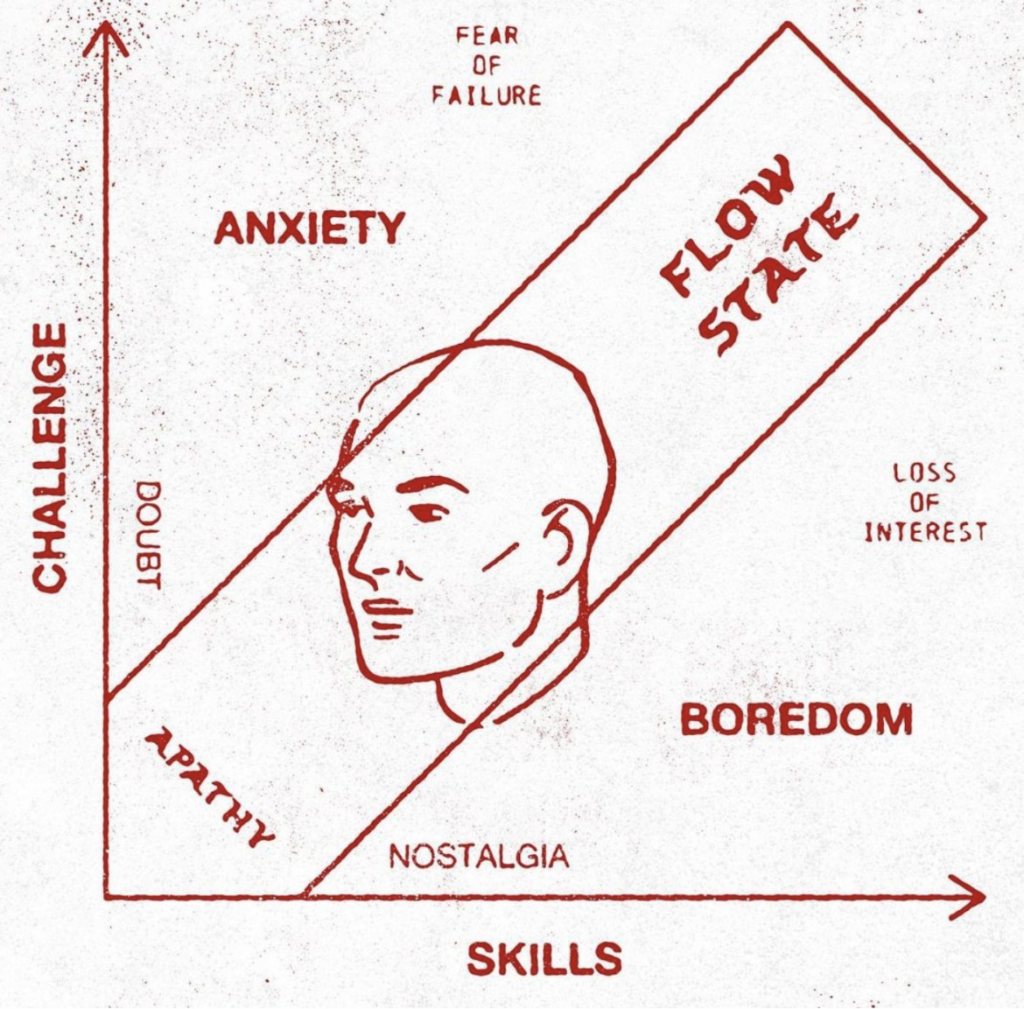
Last week, I stumbled upon this image from the Near Future Laboratory, based on a theory from psychologist Mihaly Csikszentmihalyi’s book Flow:

There’s a lot going on here, but four things jumped out at me:

  • When we don’t have the skills needed to do something challenging, we feel anxiety
  • When we don’t feel challenged because our skills exceed the task, we feel boredom
  • When we don’t feel challenged and we don’t have the skills, we feel apathy
  • When we have the skills and feel challenged, we are in flow

Four different states.  Only one of them is positive.

I don’t love those odds.

Yet we live them every day.

Every day, in every activity and interaction, we dance in and through these stages.  Anxiety when given a new project and doubt that we have what it takes. Boredom when asked to explain something for the 82nd time to a new colleague and nostalgia for when people stayed in jobs longer or spent time figuring things out for themselves.  Sometimes, we get lucky and find ourselves in a Flow State, where our skills perfectly match the challenge, and we lose track of space and time as we explore and create. Sometimes, we are mired in apathy.

Round and round we go. 

The same is true when we have a creative or innovative idea. We have creative thoughts, but the challenge seems too great, so we get nervous, doubt our abilities, and never speak up. We have an innovative idea, but we don’t think management will understand, let alone approve it, so we keep it to ourselves.

Anxiety.  Boredom.  Apathy.

One (or more) of these tells you that your creative thoughts are crazy and your innovative ideas are wild.  They tell you that none of them are ready to be presented to your boss with a multi-million-dollar funding request.  In fact, none of them should be shared with anyone, lest they think you, not your idea, is crazy.

Then overcome them

I’m not going to tell you not to feel anxiety, boredom, or apathy. I feel all three of those every day.

I am telling you not to get stuck there.

Yes, all the things anxiety, boredom, and apathy tell you about your crazy thoughts and innovative ideas may be true. AND it may also be true that there’s a spark of genius in your crazy thoughts and truly disruptive thinking in your innovative ideas. But you won’t know if you don’t act:

  • When you feel anxious, ask a friend, mentor, or trusted colleague if the challenge is as big as it seems or if you have the skills to take it on.
  • When you feel bored, find a new challenge
  • When you feel apathetic, change everything

Your thoughts and ideas are valuable.  Without them, nothing changes, and nothing gets better.

You have the fuel.  Now, need to be brave.

We need you to act.

Image credit: Pexels

Subscribe to Human-Centered Change & Innovation WeeklySign up here to join 17,000+ leaders getting Human-Centered Change & Innovation Weekly delivered to their inbox every week.

Rise of the Atomic Consultant

Or the Making of a Superhero

Rise of the Atomic Consultant

by Braden Kelley

In today’s rapidly evolving world, the consulting landscape is undergoing a profound transformation. I was recently asked a series of questions to capture my thoughts on how the consulting industry and its employees will need to evolve to thrive in the coming years – including my thoughts on the creation of “superhero” consultants. The emergence of the “superhero” consultant is not merely a result of advanced tools and technologies, but rather the cultivation of essential skills and capabilities. As we navigate through this era of unprecedented change, it is imperative for consulting firms to foster a culture of flexibility, growth, and continuous learning. The future of consulting lies in the hands of those who can seamlessly integrate human expertise with artificial intelligence (AI), build meaningful connections in a hybrid work environment, and facilitate diverse perspectives to drive innovation. This article delves into the key attributes that will define the next generation of consultants and explores the obstacles that must be overcome to unlock their full potential.

Here are the questions:

1) What are the tools and technologies that a consultant should use to become a “superhero” consultant? Why are these specific tools/technologies important? How should these tools be used most effectively?

This is the wrong question. It is not tools and technologies that will enable “superhero” consultants, but instead the development of the right skills and capabilities. The future of consulting will require consulting firms to hire and develop employees that are:

  1. Flexible and growth minded – the world is changing at an accelerating rate and consultants more than ever before will need to be lifelong learners, comfortable with knowledge gaps and eager to become an expert in something on behalf of the client with each new project
  2. AI Taskmasters – the future of work is man and machine working together and consultants skilled at breaking down work to the right size (atomizing work) and assigning it to both human and AI workers
  3. Socially Savvy – remote and hybrid work is here to stay and even clients have soured on having consultants travel in every week, so “superhero” consultants must excel at building connections and relationships via internal, external and client social tools to both distribute/execute work and to source new work
  4. Skilled facilitators – as data and AI-generated work products become plentiful, sense-making rises in importance along with a diversity of perspectives – often in workshops facilitated by consultants
  5. Open Sourced – gone are the days of rinse and repeat projects powered by proprietary frameworks and IP, instead “superhero” consultants will excel at identifying the right tools and frameworks to bring to bear – from FutureHacking™ to Design Thinking to the Change Planning Toolkit™

The capabilities of tools and technologies will grow over time and new ones will emerge. The best consultants will constantly be scanning the horizon for new tools, technologies, and capabilities and leverage the above skills and capabilities to unlearn and then re-learn the best ways to create value for their clients.

2) What are the biggest obstacles that prevent consultants from being able to access or learn the steps needed to become a “superhero” consultant? What should be done to remove these obstacles to help make this transformation easier for more consultants?

The biggest obstacles that prevent consultants from becoming “superheroes” are internal – to both the consultants themselves and the firms they work for. Companies will need to examine their own policies, procedures, and training programs to right-size them for this emerging new reality. Firms will need to allow consultants to pick the right frameworks, tools and technologies for addressing client challenges – instead of limiting them to those owned by the firm. Consultants will need to shift their mindset from being experts in a particular tool or technology and towards being masters of the above skills and capabilities and experts in achieving key client outcomes. Firms will need to invest in the training and the technology necessary to provide AI’s built for purpose to accelerate the ability of consultants to more efficiently and effectively solve client challenges. Firms will also need to update their tools and methods for capturing and sharing knowledge to leverage AI capabilities at the same time.

3) What specific areas of consulting (eg. IT, finance, marketing, etc.) have the greatest potential to produce this new brand of “superhero” consultants? Why?

This new brand of “superhero” consultants will excel in a number of different disciplines because they will be able to not only find more efficient and effective ways to execute work traditionally performed by consultants (technology implementations, analytical work, etc.), but as they are helping clients transform the ways they perform different types of work, they will also be able to help clients identify new activities that will be made possible by the transformation and the new technologies and ways of working they bring with it. The reason is their focus on building skills and capabilities into which tools and technologies plug in – somewhat interchangeably.

Conclusion

The journey to becoming a “superhero” consultant is not without its challenges, but the rewards are immense. By embracing a mindset of lifelong learning and adaptability, consultants can harness the power of emerging technologies to deliver unparalleled value to their clients. The future of consulting is not about rigid frameworks or proprietary tools, but about the ability to unlearn and relearn, to innovate and collaborate, and to drive meaningful change. As we look ahead, it is clear that the most successful consultants will be those who can navigate the complexities of a dynamic world with agility and foresight. Let us continue to push the boundaries of what is possible and strive to create a brighter future for the consulting industry. Keep innovating!

p.s. Be sure and follow both my personal account and the Human-Centered Change and Innovation community on LinkedIn.

Image credit: Bing Copilot (Microsoft Designer)

Subscribe to Human-Centered Change & Innovation WeeklySign up here to get Human-Centered Change & Innovation Weekly delivered to your inbox every week.


Nike Should Stop Blaming Working from Home for Their Innovation Struggles

GUEST POST from Robyn Bolton

“But even more importantly, our employees were working from home for two and a half years.  And in hindsight, it turns out, it’s really hard to do bold, disruptive innovation, to develop a boldly disruptive shoe on Zoom.” – John Donahoe, Nike CEO

I am so glad CNBC’s interview with Nike’s CEO didn’t hit my feed until Friday afternoon. It sent me into a rage spiral that I am just barely emerging from. Seriously, I think my neighbors heard the string of expletives I unleashed after reading that quote, and it wasn’t because it was a lovely day and the windows were open.

Blaming remote work for lack of innovation is cowardly. And factually wrong.

I’m not the only one giving Mr. Donahoe some side-eye for this comment.  “There were a whole bunch of brands who really thrived during and post-pandemic even though they were working remotely,” Matt Powell, advisor for Spurwink River and a senior advisor at BCE Consulting, told Footwear News.  “So I’m not sure that we that we can blame remote work here on Nike’s issues.”

There’s data to back that up.

In 2023, Mark (Shuai) Ma, an associate professor at the University of Pittsburgh, and Yuye Ding, a PhD student at the university’s Katz Graduate School of Business, set out to empirically determine the causes and effects of a firm’s decision to mandate a return to work (RTO).  They collected RTO mandate data from over 100 firms in the S&P 500, worked backward to identify what drove the decision, and monitored and measured the firm’s results after employees returned to work.

Their findings are stark: no significant changes in financial performance for firm value after RTO mandates and significant declines in employee job satisfaction.  As Ma told Fortune, “Overall, our results do not support these mandates to increase firm values.  Instead, these findings are consistent with managers using RTO mandates to reassert control over employees and blame employees as a scapegoat for firm bad performance.”

Or to justify spending more than $1B to double the size of its Beaverton, OR campus.

When you start blaming employees, you stop being a leader.

CEOs make and approve big, impactful, complex, high-stakes decisions.  That’s why they get paid the big bucks.  It’s also why, as Harry Truman said, “The buck stops here.” 

Let’s examine some of the decisions Mr. Donahue made or supported that maybe (definitely) had a more significant impact on innovation than working from home two days a week.

Ignoring customers, consumers, and the market: Nike has a swagger that occasionally strays into arrogance.  They set trends, steer culture, and dictate the rules of the game. They also think that gives them the right to stop listening to athletes, retailers, and consumers, as evidenced by the recently revealed Team USA Track & Field uniforms, the decision to stop selling through major retailers like Macy’s and Olympia Sports, and invest more in “hype, limited releases, and old school retro drops” than the technology and community that has consumers flocking to smaller brands like Hoka and Brooks.

Laying off 2% of its workforce: Anyone who has ever been through a layoff senses it’s coming months before the announcement and the verdicts are rendered.  Psychological safety, feeling safe in your environment, is a required element for risk-taking and innovation.  It’s hard to feel safe when saying goodbye to 1500 colleagues (and wondering if/when you’ll join them).

Investing too much in the core: Speaking of safety, in uncertain times, it’s tempting to pour every resource into the core business because the ROI is “known.” Nike gave in to that temptation, and consumers and analysts noticed.  Despite recent new product announcements like the Air Max DN, Pegasus Premium, and Pegasus 41, “analysts point out these ‘new’ innovations rely too much on existing franchises.”

Innovation is a leadership problem that only leaders can solve

Being a CEO or any other senior executive is hard. The past four years have been anything but ordinary, and running a business while navigating a global pandemic, multiple societal upheavals, two wars, and an uncertain economy is almost impossible.

Bosses blame.  Leaders inspire. 

Mr. Donohue just showed us which one he is.  Which one are you?

One MORE thing

This is a losing battle, but STOP USING “DISRUPTIVE” INCORRECTLY!!!!  “Disruptive Innovation,” as defined by Clayton Christensen, who literally coined the phrase, is an innovation that appeals to non-consumers and is cheaper and often lower quality than existing competitors.

Nike is a premium brand that makes premium shoes for premium athletes.  Employees could spend 24/7/365 in the office, and Nike would never develop and launch a “boldly disruptive shoe.”

Image credit: Pixabay

Subscribe to Human-Centered Change & Innovation WeeklySign up here to join 17,000+ leaders getting Human-Centered Change & Innovation Weekly delivered to their inbox every week.

Managers Make the Difference

Four Common Mistakes Managers Make

Managers Make the Difference

GUEST POST from David Burkus

Senior leaders set strategy. But middle managers and front-line managers make the difference in whether that strategy gets executed…and in whether or not people are engaged and motivated in an organization. According to Gallup, 70% of an individual employee’s engagement is determined by the manager of her team. In turn, this means that managers have a significant impact on an organization’s success or failure.

In this article, we will discuss the four common mistakes managers make and how to avoid them.

1. Talking First

The first common mistake managers make is talking first. This one is really common. Presumably managers were promoted because they solved problems and generated ideas faster and better than their peers. And there are times when quick decisions need to be made. But not always. Most often, they should facilitate discussion and allow everyone to share their opinions. This encourages collaboration and creativity among team members. By doing this, managers can create an environment where everyone feels heard and valued. Getting everyone’s ideas out gives the team the best chance of finding the optimal solution.

In addition, managers should avoid talking first because often the first thing they say can easily be misconstrued as a command. The higher you go in a hierarchy, the more likely it is your casual suggestions will be misinterpreted as stern commands. And that not only tricks the team into taking a potentially wrong action, but it also robs them of their sense of autonomy and could degrade the quality of team culture.

2. Avoiding Conflict

The second common mistake managers make is avoiding conflict. No one wants to be the bad guy on the team—much less the manager who is also negative or confrontational. Somewhere in management training, conflict resolution workshops gave off the misconception that conflict is always to be avoided. But sometimes, in the service of avoiding conflict—managers actually avoid confronting the people and situations the team needs. Managers need to address underperformance and insubordination. And their team needs them to do it even more.

In addition, managers should encourage positive conflict over ideas, which can lead to better decision-making and innovation. When team members feel comfortable sharing their ideas, it can lead to new and innovative solutions. And when they know that their ideas will be improved by the discussion with the group—the ideas get even better. Addressing conflict in a positive way can help to create a culture of open communication and trust.

3. Reacting Urgently

The third common mistake managers make is reacting urgently. To be a manager is to deal with problems. Forces outside (or inside) of the team’s control can force the plan to change or be scrapped altogether. Unexpected roadblocks can appear randomly on the horizon. And what was supposed to be a smooth, easy project can turn into a big problem. When problems (or changes) occur, many managers react as quickly as possible—but don’t think about whether that first, default reaction was the right one. Perhaps if given some time and a little discussion, the team would have found a better solution.

In addition, reacting urgently can succumb the whole team to the tyranny of the urgent—where a small but unexpected problem now appears more urgent than more important projects simply because it’s the new fire to put out. But doing so steals time and attention away from those more important projects and harms the team’s productivity even more than the initial problem would have. Managers need to respond to problems, but to respond deliberately and not urgently.

4. Assuming Availability

The fourth common mistake managers make is assuming availability. Many managers just assume their team feels free to come to them. They’ll say, “ask me anything” or claim they have an “open door policy” (assuming they even work in the same office as their team). But in reality, the first time a team member approaches their “available” manager and finds their boss to busy or less than focused, they realize how available that manager truly is—or rather isn’t. Your door might be always open, but if you’re always on the phone it doesn’t matter.

Instead, managers would gain from being deliberate and intentional about their availability. They shouldn’t promise to be available all of the time. Instead, they should be available at specific times and block them off in their calendar. That way they can give the team members their sole focus. Even better, if working colocated, they can take specific times of the day to leave the office (should be pretty easy…the door should be open) and walk out to check-in on each team member individually. Doing so not only helps team members feel seen and heard, but it also helps the manager hear more too.

In fact, being deliberately available helps to avoid the other common manager mistakes as well. By being available and listening intently, managers talk less. They become more aware of conflicts that need to be instigated. And they’re able to access more information and react less urgently. By being deliberately available, managers help build a team where everyone can do their best work ever.

Image credit: Unsplash

Originally published on DavidBurkus.com on April 24, 2023

Subscribe to Human-Centered Change & Innovation WeeklySign up here to get Human-Centered Change & Innovation Weekly delivered to your inbox every week.


Time is a Flat Circle

Jamie Dimon’s Comments on AI Just Proved It

Time is a Flat Circle

GUEST POST from Robyn Bolton


“Time is a flat circle.  Everything we have done or will do we will do over and over and over and over again – forever.” –- Rusty Cohle, played by Matthew McConaughey, in True Detective

For the whole of human existence, we have created new things with no idea if, when, or how they will affect humanity, society, or business.  New things can be a distraction, sucking up time and money and offering nothing in return.  Or they can be a bridge to a better future.

As a leader, it’s your job to figure out which things are a bridge (i.e., innovation) and which things suck (i.e., shiny objects).

Innovation is a flat circle

The concept of eternal recurrence, that time repeats itself in an infinite loop, was first taught by Pythagoras (of Pythagorean theorem fame) in the 6th century BC. It remerged (thereby proving its own truth) in Friedreich Nietzsche’s writings in the 19th century, then again in 2014’s first season of True Detective, and then again on Monday in Jamie Dimon’s Annual Letter to Shareholders.

Mr. Dimon, the CEO and Chairman of JPMorgan Chase & Co, first mentioned AI in his 2017 Letter to Shareholders.  So, it wasn’t the mention of AI that was newsworthy. It was how it was mentioned.  Before mentioning geopolitical risks, regulatory issues, or the recent acquisition of First Republic, Mr. Dimon spends nine paragraphs talking about AI, its impact on banking, and how JPMorgan Chase is responding.

Here’s a screenshot of the first two paragraphs:

JP Morgan Annual Letter 2017

He’s right. We don’t know “the full effect or the precise rate at which AI will change our business—or how it will affect society at large.” We were similarly clueless in 1436 (when the printing press was invented), 1712 (when the first commercially successful steam engine was invented), 1882 (when electricity was first commercially distributed), and 1993 (when the World Wide Web was released to the public).

Innovation, it seems, is also a flat circle.

Our response doesn’t have to be.

Historically, people responded to innovation in one of two ways: panic because it’s a sign of the apocalypse or rejoice because it will be our salvation. And those reactions aren’t confined to just “transformational” innovations.  In 2015, a visiting professor at Kings College London declared that the humble eraser (1770) was “an instrument of the devil” because it creates “a culture of shame about error.  It’s a way of lying to the world, which says, ‘I didn’t make a mistake.  I got it right the first time.’”

Neither reaction is true. Fortunately, as time passes, more people recognize that the truth is somewhere between the apocalypse and salvation and that we can influence what that “between” place is through intentional experimentation and learning.

JPMorgan started experimenting with AI over a decade ago, well before most of its competitors.  As a result, they “now have over 400 use cases in production in areas such as marketing, fraud, and risk” that are producing quantifiable financial value for the company. 

It’s not just JPMorgan.  Organizations as varied as John Deere, BMW, Amazon, the US Department of Energy, Vanguard, and Johns Hopkins Hospital have been experimenting with AI for years, trying to understand if and how it could improve their operations and enable them to serve customers better.  Some experiments worked.  Some didn’t.  But every company brave enough to try learned something and, as a result, got smarter and more confident about “the full effect or the precise rate at which AI will change our business.”

You have free will.  Use it to learn.

Cynics believe that time is a flat circle.  Leaders believe it is an ever-ascending spiral, one in which we can learn, evolve, and influence what’s next.  They also have the courage to act on (and invest in) that belief.

What do you believe?  More importantly, what are you doing about it?

Image credit: Pixabay

Subscribe to Human-Centered Change & Innovation WeeklySign up here to join 17,000+ leaders getting Human-Centered Change & Innovation Weekly delivered to their inbox every week.
