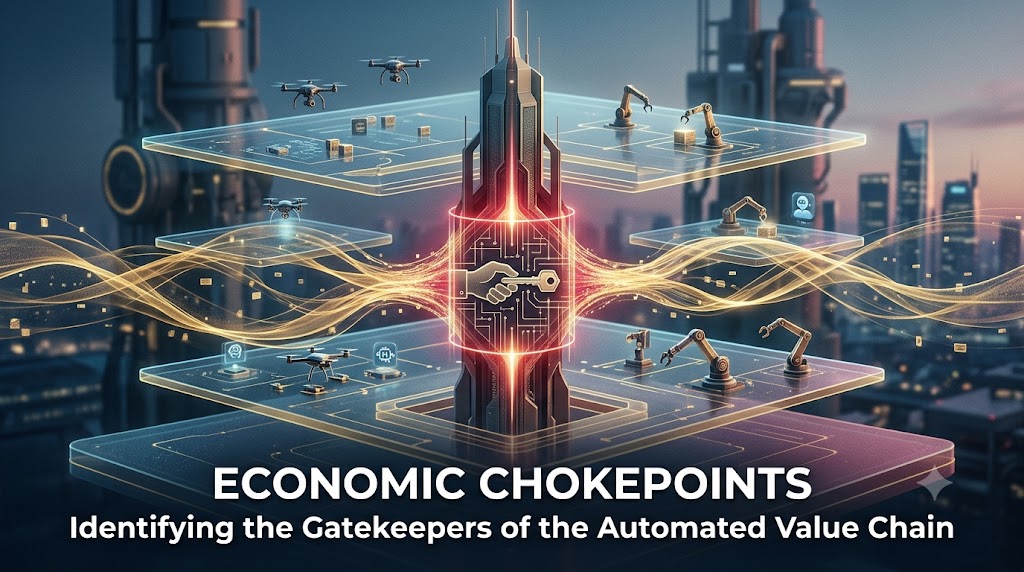
Economic Chokepoints
GUEST POST from Chateau G Pato
Introduction: The New Geography of Economic Power
Shift from physical supply chain bottlenecks to algorithmic and infrastructural chokepoints.
For decades, competitive advantage belonged to the builders—the organizations that could produce faster, scale cheaper, and execute with relentless efficiency. But as autonomous agent networks, real-time machine learning, and physical robotics converge to drive end-to-end business operations, the traditional rules of scale are breaking down. When execution becomes table stakes, value creation moves elsewhere.
We are witnessing a fundamental redistribution of economic power. Frictionless automation is eroding classical moats, while simultaneously giving rise to new, highly concentrated control points across global commerce. Power no longer rests solely in manufacturing plants or distribution channels; it now concentrates wherever substitution costs are highest and interoperability is lowest.
Defining the Automated Value Chain (AVC)
To understand where power sits today, we must map the Automated Value Chain (AVC)—an interconnected, self-orchestrating ecosystem where foundational AI models, agentic workflows, API routing protocols, and kinetic edge systems interact with minimal human friction.
Unlike legacy supply chains that move physical goods through predictable linear steps, the AVC is dynamic, software-driven, and highly interdependent. A single transaction may cross half a dozen algorithmic platforms, validation layers, and hardware backbones in milliseconds.
The Strategic Imperative: When execution is commoditized by software and automation, durable competitive advantage shifts from who can perform the work to who controls the critical, non-bypassable nodes through which that work must pass.
The Central Question for Modern Leaders
As organizations race to integrate agentic systems and automated workflows, business leaders must confront a critical question: Are you building proprietary value that increases your organizational autonomy, or are you simply becoming an efficient dependent on someone else’s chokepoint?
Navigating this shift requires looking beyond raw technical capability. It demands an intentional strategy that balances technological speed with human-centered agency, resilient ecosystem design, and a clear-eyed understanding of who holds the keys to the future value chain.
Section II
The Five Layers of Automated Value Chain Gatekeepers
Understanding where power concentrates when execution is automated.
Gatekeepers do not emerge by accident. In an automated value chain, control forms at the points of maximum dependency—where replacing a provider creates prohibitive technical friction, financial loss, or operational downtime. Power concentrates across five distinct layers.
The Golden Rule of AVC Control: Power in an automated system concentrates wherever substitution costs are highest and interoperability is lowest.
Infrastructure & Compute Tier
At the bedrock of all digital automation lies physical reality: advanced semiconductor fabrication, specialized acceleration hardware, hyperscale cloud facilities, and high-density energy grids.
The Chokepoint: Compute capacity and power access. Organizations that control chip lithography, data center land rights, and clean power interconnects hold absolute authority over who can train, fine-tune, and run next-generation autonomous models at scale.
Data & Context Tier
Foundational models are broadly accessible, but models without high-resolution domain context are useless in complex operational environments. This layer encompasses real-time sensory feeds, proprietary operational logs, and live telemetry.
The Chokepoint: “Context Monopolies.” Gatekeepers here own the ground-truth data pipelines that autonomous agents need to make safe, accurate decisions in specific industries—from clinical trials to smart supply chains.
Model Orchestration & Middleware Tier
Between raw data and final execution sits the routing infrastructure—the multi-agent frameworks, semantic routing engines, and API orchestration tools that decide which model executes which task.
The Chokepoint: Semantic interfaces and decision routing. The platforms that act as the default “default operating system” for AI agents control which downstream tools, microservices, and commerce channels get invoked—effectively becoming the new digital switchboards.
Physical-Digital Interoperability Tier
Automation ultimately has to reach into the physical world. This layer bridges software logic with kinetic action through warehouse management systems, autonomous fleet dispatching protocols, edge robotics OSs, and IoT control planes.
The Chokepoint: Translation software and kinetic standards. Whoever owns the operating system running the physical fulfillment hardware or autonomous logistics fleet controls the physical throughput of the digital economy.
Trust, Identity & Compliance Tier
In a world filled with synthetic media, agentic transactions, and automated decisions, trust becomes a scarce commodity. This layer covers machine identity verification, cryptographic provenance, real-time auditability, and regulatory compliance clearance.
The Chokepoint: Verification authority. The gatekeepers who certify that an agent-driven transaction is legitimate, safe, legally compliant, and authentic hold veto power over the entire value chain.
When leaders evaluate their long-term strategic posture, they must ask: Which layer are we operating in, and how many layer gatekeepers sit between us and our ultimate end customer or outcome?
Section III
The Human-Centered Impact: Experience, Agency, and Change Management
Balancing algorithmic efficiency with human purpose, trust, and adaptability.
Focusing exclusively on technical architecture and algorithmic throughput misses the most critical failure point in digital transformation: the human element. When an organization optimizes for raw automation without designing for human agency, it risks creating brittle systems, disengaged workforces, and alienated customers.
1. The Experience Friction: Loss of Humanity at the Gatekeeper Interface
When customer and employee experiences are mediated entirely through gatekeeper protocols, hyper-standardization takes over. Algorithms excel at predictability, but they struggle with empathy, nuanced problem-solving, and non-standard human needs.
When every touchpoint is filtered through rigid API rules and automated triage, the customer experience becomes transactional rather than relational. Organizations that default entirely to automated gatekeepers risk surrendering their unique brand voice and customer intimacy to external platform protocols.
2. Preserving Human Agency: Moving from Operators to Orchestrators
The rise of automated value chains doesn’t render humans obsolete—it fundamentally shifts their role. The goal of human-centered change is not to replace people, but to elevate them.
The Human as Operator
Executing repetitive tasks, manually routing data between systems, following fixed scripts, and acting as the mechanical engine of execution.
The Human as Orchestrator
Guiding agentic workflows, setting strategic boundaries, auditing algorithmic outputs for bias and ethics, and handling complex edge cases requiring deep empathy.
The Human-Centered Imperative: Technology should handle the routine execution so humans can focus on imagination, empathy, strategic alignment, and complex relationship-building.
3. Guiding Organizational Change: The Psychology of Dependency
Leading an organization through the shift toward automated value chains requires a deliberate change management approach. Leaders must address two distinct psychological hurdles across their teams:
- The Anxiety of Disintermediation: Employees often view automation as a existential threat to their relevance. Leaders must clearly define the new path for career growth, demonstrating how automated systems empower team members to take on high-value, creative decision-making roles.
- The Illusion of Control: Executives often struggle with relinquishing operational execution to external algorithmic gatekeepers. Change leaders must build new governance frameworks that allow teams to maintain visibility, trust, and strategic control over automated systems without micromanaging the underlying code.
Sustained competitive advantage in the age of automation will not come from removing humans from the equation. It will belong to the organizations that design seamless, collaborative partnerships between human creativity and automated scale.
Section IV
Strategic Framework: Auditing Your Position in the Value Chain
Evaluating dependency, strategic leverage, and long-term autonomy.
To make proactive, human-centered decisions in an automated economy, leadership teams must first establish a clear-eyed diagnosis of where their organization sits today—and where it risks being squeezed tomorrow. Strategic resilience requires mapping both operational dependencies and unique value drivers.
1. The AVC Audit Matrix
By evaluating two primary dimensions—Degree of Operational Uniqueness and Level of Gatekeeper Dependency—organizations generally fall into one of four distinct positions within the Automated Value Chain (AVC):
The Commoditized Dependent
The Position: Performing interchangeable tasks while relying entirely on external gatekeeper platforms for discovery, routing, and fulfillment.
The Strategic Risk: High vulnerability to margin compression, algorithm updates, and sudden fee adjustments with zero pricing power or direct customer relationships.
The Bare Utility
The Position: Operating independently of major gatekeepers, but delivering standardized execution with minimal differentiation.
The Strategic Risk: Rapid disintermediation as agentic workflows easily automate, commoditize, or route around low-complexity operations.
The Strategic Node
The Position: Owning indispensable domain context, trusted human relationships, or proprietary physical capabilities that machines cannot easily replicate or bypass.
The Strategic Risk: Continuous pressure from scaling platform ecosystems attempting to duplicate, standardise, or encapsulate your specialized knowledge.
The Ecosystem Gatekeeper
The Position: Controlling an essential chokepoint—such as identity clearance, context routing, or compute access—that other ecosystem players must pass through.
The Strategic Risk: Regulatory scrutiny, antitrust exposure, and high-stakes responsibility for maintaining system trust and uptime.
Strategic Imperative: The goal for most organizations is not necessarily to become a global gatekeeper, but to secure a resilient position as a Strategic Node—owning non-replaceable context and human value while maintaining modular relationships with platform gatekeepers.
2. Practical Risk Mitigation Strategies
Once leaders recognize their position in the AVC landscape, they can execute targeted strategies to preserve strategic flexibility and prevent platform lock-in:
- Architect for Model & API Redundancy: Avoid building single-threaded dependencies on one proprietary foundation model or middleware vendor. Ensure agent architectures support multi-model orchestration and open-standard fallback protocols.
- Own the Ground-Truth Context: Build proprietary, continuously updating telemetry and context loops that external platform algorithms cannot scrape or approximate.
- Deepen Direct Human Relationships: Cultivate brand equity, trust, and executive intimacy that transcend automated channels, ensuring customers actively prefer dealing directly with your organization.
- Establish Governance & Exit Protocols: Routinely audit third-party AI dependencies, setting clear financial and operational thresholds for when a platform partner’s lock-in poses an unmanageable risk.
Section V
Futurology & Strategic Conclusion: Designing Resilient Ecosystems
Navigating the tension between open ecosystems and systemic consolidation.
As we look toward the horizon of fully autonomous agent networks and hyper-automated supply chains, two divergent futures emerge. The choices leaders make today will determine whether the automated value chain becomes an engine of open innovation or a system of hyper-concentrated control.
1. The Ecosystem Tug-of-War: Monopolistic Enclosure vs. Open Protocols
The future of the digital economy will be defined by a continuous tension between two structural forces:
The Proprietary Fortress
Hyperscale gatekeepers build end-to-end, vertically integrated walled gardens. By coupling hardware compute, foundational models, proprietary context pipelines, and kinetic fulfillment systems, these mega-platforms make it virtually impossible for businesses to operate outside their controlled ecosystems.
The Open Orchestration Web
Open-source model architectures, decentralized identity protocols, and interoperable agent standards gain critical mass. In this future, switching costs remain low, market access remains democratized, and value accrues to specialized domain experts rather than platform landlords.
In reality, the global economy will likely exist in a hybrid state. Smart organizations must design their technological and operational architectures to thrive in both environments—building modularity that takes advantage of proprietary platform scale without getting trapped inside a single fortress.
2. The Leader’s Imperative: Strategic Courage in the Age of Automation
Innovation leadership in the age of intelligent automation is no longer about who adopts tools the fastest. It is about the intentional, human-centered design of your organization’s role within a broader economic ecosystem.
The Final Takeaway: Technology provides speed, scale, and execution; human vision provides direction, ethics, and meaning. The leaders who succeed will not be those who passively hand off their business to automated gatekeepers, but those who actively shape resilient, human-centered value chains.
Three Questions for Every Leadership Team Today:
- Which of our core capability layers are at risk of being commoditized by automated gatekeepers over the next 3 to 5 years?
- What irreplaceable human experience, domain context, or trusted relationship do we own that machines and external APIs cannot easily replicate?
- Are our digital transformation initiatives empowering our workforce to become creative orchestrators, or merely replacing them with third-party software dependencies?
Frequently Asked Questions
Key Insights & Strategic FAQ
Core questions on gatekeepers, human agency, and value chain strategy.
What is an Economic Chokepoint in an Automated Value Chain?
An economic chokepoint is a critical, non-bypassable control point within an automated ecosystem where power concentrates because substitution costs are extremely high and interoperability is low. Unlike traditional physical supply chain bottlenecks, modern chokepoints exist across software and infrastructure—such as specialized chip lithography, proprietary context data feeds, or default agent orchestration engines that control API transaction flow.
How does automation change the role of human workers in the value chain?
Automation shifts human workers from operators (executing repetitive tasks and manual routing) to orchestrators (setting strategic boundaries, guiding agentic workflows, auditing algorithmic decisions for bias/ethics, and managing high-empathy customer relationships). The goal of human-centered innovation is not workforce replacement, but elevating human capacity to focus on imagination, judgment, and trust.
How can an organization prevent platform lock-in from automated gatekeepers?
Organizations can preserve strategic autonomy by maintaining multi-model redundancy, building open-standard fallback protocols, owning their unique domain context, and deepening direct, non-intermediated customer relationships. By ensuring tech stacks are modular rather than single-threaded, leaders can leverage platform scale without becoming commoditized dependents.
Image credit: Gemini
 Sign up here to get Human-Centered Change & Innovation Weekly delivered to your inbox every week.