Why Solving for Extreme User Needs Unlocks Mainstream Value
GUEST POST from Chateau G Pato
Introduction: The Myth of the Average User
When we design for the average, we design for no one. Standard mass-market innovation relies on a fundamental misconception: that the safest path to scale is to solve for the middle of the bell curve. We construct ideal personas based on statistical medians — a theoretical user operating under ideal conditions. But real human lives are rarely average, and they are never ideal.
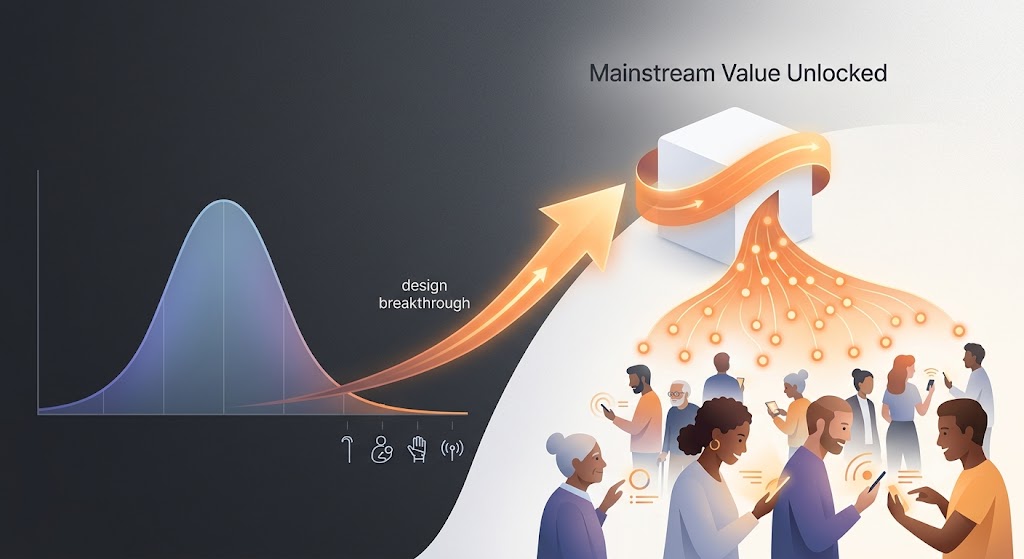
True human-centered breakthroughs don’t happen in the cozy center of the distribution curve. They happen at the edges — the margins. When you build solutions for edge cases — users navigating severe physical, cognitive, situational, or contextual constraints — you are forced to strip away fluff, eliminate hidden friction, and create radical clarity.
The Edge-Case Dividend
Designing for high-constraint environments yields a powerful dividend: a solution forged under extreme conditions is infinitely more resilient, intuitive, and effortless when brought back to the mainstream. What begins as a necessary accommodation for a few becomes a delight for the many.
Core Thesis: Innovation value isn’t created by catering to the majority; it is unlocked at the extremes and distributed to the center.
To move beyond incremental, easily commoditized products, organizations must rethink their approach to experience design. Solving for extreme user needs is not a philanthropic exercise or a compliance task — it is the ultimate catalyst for competitive advantage and sustainable growth.
Part 1: The Bell Curve Trap in Experience Design
Standard product development relies heavily on statistical medians. We construct ideal personas based on demographically average users operating in ideal conditions. But when you design for the mean, you create solutions tailored to a theoretical person who doesn’t actually exist in the wild.
The Comfort of the Center
Organizations gravitate toward the center of the bell curve because it feels safe, quantifiable, and financially lucrative. However, targeting the majority directly leads to incremental, easily commoditized offerings. When every competitor builds for the same median user, products homogenize and compete solely on price rather than meaningful value.
Hidden Friction vs. Hard Walls
The fundamental difference between mainstream users and edge users isn’t the existence of friction — it’s how they handle it:
- Mainstream users adapt: They tolerate clunky navigation, fill in operational gaps, and invent silent workarounds for poorly designed tools because they have the cognitive or physical bandwidth to compensate.
- Extreme users hit a wall: For edge users, design flaws aren’t mild inconveniences — they are absolute blockers. They expose systemic flaws in the experience long before mainstream users speak up.
Re-Defining the “Extreme User”
Designing for extreme needs isn’t just about permanent physical accommodations; it is about recognizing human contexts across three distinct dimensions:
- Permanent & Physical: Individuals with distinct visual, auditory, mobility, or neurodivergent profiles who interact with products through alternative modalities or assistive tech.
- Situational & Temporary: Everyday scenarios where ordinary environments create extreme constraints — such as a parent holding a baby with one hand, a commuter navigating in glaring sunlight, or a field worker on a degraded mobile network.
- Systemic & Contextual: Operational extremes at both ends of the spectrum—from power users pushing a system to its absolute limits, to first-time users operating with zero domain literacy or training.
By shifting focus from the statistical middle to these high-constraint edge cases, experience designers reveal hidden friction and unlock breakthroughs that benefit everyone across the entire spectrum.
Part 2: The Mechanics of Extreme-Driven Innovation
Innovation thrives on constraints. Without clear boundary conditions, product teams tend to over-engineer, adding feature layers that clutter the experience without solving root problems. Designing for extreme user needs establishes immediate, uncompromising constraints that force simplicity, focus, and elegance.
Constraints as Catalysts for Breakthroughs
Blank slates often produce mediocrity because they lack friction. When a team is tasked with designing a solution for a user who has full vision, two free hands, high bandwidth, and infinite patience, the design choices are virtually limitless — and often lazy. Extreme constraints remove that luxury.
By designing for the tightest operational window first, you eliminate fluff from the foundation upward. The resulting core architecture is leaner, faster, and remarkably resilient.
The Curb-Cut Effect in Action
The “Curb-Cut Effect” describes a foundational phenomenon in experience design: when you solve a hard problem for a constrained group, the broader population reaps unexpected benefits. What begins as a vital necessity for an edge case becomes an effortless convenience for the mainstream.
- The Physical Realm: In the late 1960s, disability rights activists fought for ramped cutouts in sidewalk curbs for wheelchair users. Once installed, these curb cuts immediately transformed urban mobility for parents pushing strollers, travelers rolling heavy luggage, skateboarders, delivery workers with hand trucks, and pedestrians with temporary injuries.
- The Digital Realm: Closed captioning was originally created to give deaf and hard-of-hearing viewers access to broadcast television. Today, muted auto-play video feeds on social media and mobile devices have made captions the primary modality through which the majority of people consume video in public spaces, noisy environments, or quiet offices.
- Product Design: Good Grips kitchen tools were originally created by Sam Farber for his wife, who suffered from severe arthritis in her hands. The resulting wide, rubberized, ergonomic handles provided such superior leverage and comfort that they disrupted the entire culinary gadget industry, becoming a mainstream gold standard.
The Value Translation Model
To capture the financial and strategic upside of extreme-driven innovation, organizations must understand how edge solutions translate into scalable mainstream value:
- Isolate High Friction (5% Segment): Identify where users hit a hard wall due to extreme physical, cognitive, or situational constraints.
- Solve for Absolute Zero Friction: Engineer an experience that bypasses or completely eliminates that barrier under extreme conditions.
- Deploy to the Mainstream (95% Segment): Introduce the simplified solution to average users, who will experience the absence of friction as delight, speed, and cognitive relief.
When you solve the hardest version of a problem first, every simpler variation of that problem resolves automatically.
Part 4: Managing Organizational Change & Buy-In
Shifting an organization’s focus from the lucrative center of the bell curve to the margins is rarely a design challenge—it is a cultural and operational change challenge. Product leaders, strategists, and experience designers frequently encounter institutional inertia, risk aversion, and immediate pushback when proposing extreme-driven innovation initiatives.
Overcoming the Sunk-Cost of the “Average”
The most common objection from leadership is economic: “Why are we allocating engineering and design resources to solve a problem for such a small slice of our market?”
This pushback stems from a fundamental misunderstanding of the return on investment. The goal of edge-driven design is not to build niche products for small audiences; it is to leverage the extremes as a testbed for friction-free experiences that scale to the entire market. Countering this objection requires reframing accessibility and inclusivity from a cost center or compliance task into a primary driver of growth and competitive advantage.
The Business Case for Edge-Driven Design
To secure executive buy-in, human-centered leaders must anchor edge-driven design in core business metrics:
- Reduced Friction Accelerates Scale: Products built for extreme simplicity reduce onboarding drop-off, lower support ticket volume, and increase conversion rates across all user segments. When an experience requires zero learning curve for an edge user, it feels effortless to a mainstream user.
- Defensibility and Moat Building: Mass-market solutions built for the “average” user are easy to replicate and commoditize. Experiences engineered to handle complex, high-constraint edge cases build operational moats that low-cost competitors cannot easily copy.
- Deep Emotional Capital and Loyalty: Organizations that meaningfully solve hard problems for underserved populations earn fiercely loyal advocates. This trust creates brand equity that shields the organization during market shifts.
Structuring Cross-Functional Alignment
Integrating extreme-user thinking into the organizational culture requires shifting cross-functional team habits across the entire product lifecycle:
- Product Management: Redefine definition-of-done criteria to include high-constraint scenarios (low connectivity, single-handed input, screen readers) before a feature can ship.
- Design & Research: Mandate that every usability study includes participants from the outer deciles of physical capability, digital literacy, or situational constraint.
- Executive Leadership: Measure the ROI of experience design not just by total addressable market (TAM) served initially, but by the velocity and retention gains achieved across the entire base after removing edge friction.
When leadership recognizes that designing for the margins protects and expands the core, extreme-driven innovation becomes standard operating procedure.
Conclusion: Shifting the Paradigm
The middle of the bell curve offers a false sense of security. Designing for an idealized, average user yields predictable, incremental results — and ultimately leaves products vulnerable to commoditization and disruption. True market differentiation lives at the outer edges.
When you solve for extreme constraints, you don’t just help a small segment of your audience — you stress-test your design architecture against real-world friction. The solutions forged at the margins create cleaner interfaces, smoother workflows, and more resilient systems that elevate the experience for every single user who touches your product.
A New Question for Experience Leaders
To move from safe mediocrity to sustainable innovation, leadership teams must reframe their discovery questions. Stop asking:
“What features do most people in our target market expect?”
Instead, start asking:
“Who is hitting a hard wall in our category today — and what happens to our value proposition if we make that experience entirely effortless?”
The margins are not an edge case to be ignored, nor are they a compliance checklist to be ticked off. They are an untapped goldmine of human insight, operational clarity, and mainstream commercial value waiting to be unlocked.
Frequently Asked Questions
What is the difference between accessibility compliance and designing for the margins?
Accessibility compliance often focuses on meeting baseline regulatory requirements (such as WCAG guidelines) as a late-stage checklist. Designing for the margins is a proactive innovation methodology. It uses extreme constraints — including physical, situational, and contextual edge cases — as the primary inspiration to drive simplicity and breakthrough value for all users from the start.
Won’t solving for extreme edge cases make our product too complex for mainstream users?
No. Extreme constraints force product teams to eliminate unnecessary clutter, simplify navigation, and streamline core interactions. The result is typically a leaner, more intuitive core architecture that speeds up task completion and reduces cognitive load for mainstream users operating under daily fatigue or distraction.
How do we justify allocating resources to extreme user research to executive leadership?
Reframe edge design as a driver of mainstream growth and operational resilience rather than a niche feature set. Highlight the “Curb-Cut Effect” — demonstrating how removing absolute blockers for high-constraint users directly improves core business metrics such as lower user drop-off, reduced support ticket volume, higher retention, and stronger market defensibility.
Image credit: Gemini
 Sign up here to get Human-Centered Change & Innovation Weekly delivered to your inbox every week.