Turning Cognitive Dissonance into Breakthrough Value
GUEST POST from Chateau G Pato
The Discomfort of the New
True innovation is never comfortable. It doesn’t arrive in a neatly wrapped package born of absolute consensus. Instead, breakthrough value is forged in the fires of collaborative tension. When disparate minds, diverse disciplines, and conflicting perspectives collide in a workshop or a boardroom, the initial result isn’t immediate harmony — it is psychological discomfort.
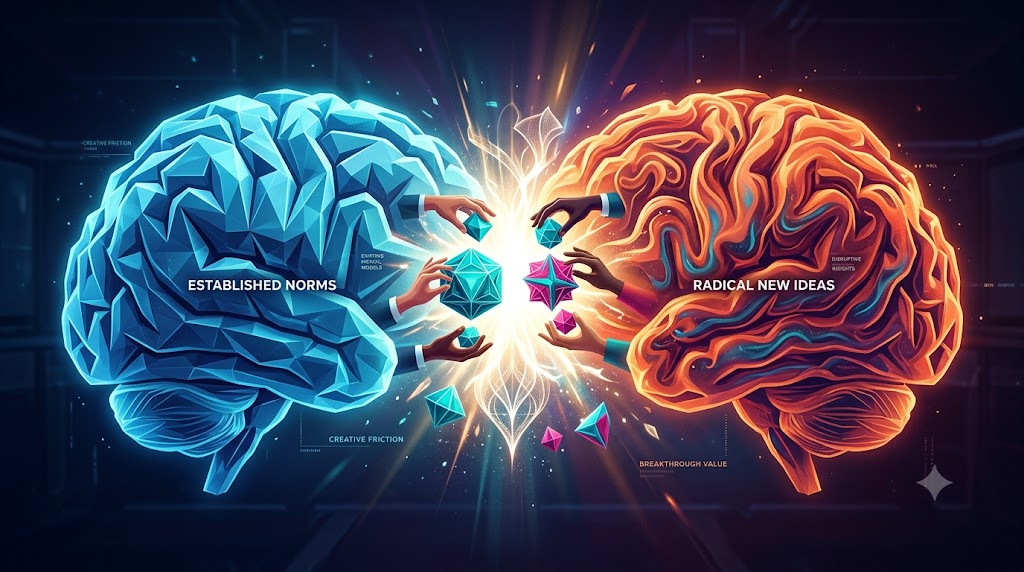
In organizational psychology, we call this cognitive dissonance: the mental strain of holding two or more conflicting beliefs, ideas, or values simultaneously. Traditionally, organizations view this friction as a barrier, rushing to smooth it over with polite compromises or top-down mandates to restore alignment. But when we eliminate the friction, we eliminate the spark. We must stop treating cognitive dissonance as a problem to be solved and start treating it as raw, unharnessed energy.
“Organizations that seek absolute harmony build echoes, not innovations.”
To build a future by design, rather than default, human-centered change leaders must move past the passive civility of “agreeing to disagree.” We must deliberately design experiences, frameworks, and psychological safety nets that lean into this tension. This article explores how to purposefully manage creative friction, steering teams away from destructive ego battles and guiding them through the messy middle to transform cognitive dissonance into breakthrough value.
I. The Anatomy of Creative Friction
To effectively harness tension, we must first understand what happens under the hood when a team encounters a truly novel concept. When an organization’s deeply entrenched mental models collide with radical new insights, diverse perspectives, or sudden market shifts, it triggers a collective state of cognitive dissonance. This isn’t just an intellectual debate; it is a physiological and emotional response to the threat of the unknown.
When this tension hits a team, it reaches a critical pivot point. The direction the leader steers the conversation at this exact moment determines whether the friction becomes destructive or creative:
- Destructive Friction: This occurs when the discomfort is met with defensiveness. It manifests as ego-driven arguments, political entrenchment, stalling tactics, and the classic “Not Invented Here” syndrome. The primary goal becomes self-protection and defending the status quo, which completely paralyzes progress.
- Creative Friction: This is the sweet spot. Here, the tension is channeled into ideas challenging ideas, rather than people attacking people. It is characterized by constructive skepticism, intense curiosity, and a shared commitment to synthesizing opposing viewpoints into a completely new, superior third way.
This distinction explains why traditional brainstorming so frequently fails. Out of a desire to keep the peace and maintain a comfortable environment, standard brainstorming sessions favor polite compliance. People filter their wildest thoughts, nod along, and avoid challenging one another. By bypassing friction entirely, these sessions inevitably yield low-risk, incremental concepts. If we want breakthrough value, we have to stop playing it safe and learn to embrace the messy reality of creative friction.
II. Designing for Dissonance (The Experience Design Approach)
Creative friction doesn’t just happen by accident — at least, not the productive kind. If you throw diverse minds together without intentional architecture, the friction will almost always turn destructive. As experience designers and change leaders, we have to deliberately engineer environments where cognitive dissonance can be safely triggered, explored, and ultimately converted into value.
Curating Diverse Cognitive Portfolios
The first step is moving past surface-level diversity and actively recruiting for cognitive diversity. True breakthrough teams require a portfolio of contrasting problem-solving styles. You need the visionary dreamer who looks 10 years out, the grounded realist who understands current operational constraints, the human-centric ethnographer who fiercely defends the user’s emotional experience, and the analytical skeptic who demands data. When these archetypes collide, dissonance is guaranteed. Your job isn’t to pick a winner; it’s to facilitate the synthesis.
Structuring Safe Zones for Constructive Conflict
To prevent tension from turning personal, challenging the status quo must be baked directly into your team’s operational rituals. When friction is systemic, ego exits the room. Two powerful frameworks can help institutionalize this:
- The “Pre-Mortem” Ritual: Before a project launches, gather the team and state: “It is three years from now, and this initiative has utterly, spectacularly failed. Now, let’s write the history of why it died.” This frees the team’s natural skeptics to voice existential concerns without being labeled as “not team players.”
- The Ritual Opposition: Explicitly assign a team member the role of the constructive provocateur for a specific sprint or workshop. Their formal mandate is to poke holes in the consensus, stress-test assumptions, and champion the counter-narrative. Because it is an assigned role, it removes the social penalty of disagreement.
By designing these intentional guardrails, we transition the team dynamic from a place of artificial harmony to one of productive, high-trust vulnerability. We create a space where it is safe to be uncomfortable.
III. The Strategic Framework: Tension to Value
Harnessing cognitive dissonance requires more than just a shift in mindset; it demands a repeatable, rigorous process. We cannot simply invite tension into the room and hope it crystallizes into innovation. To systematically convert creative friction into breakthrough value, change leaders can deploy a three-stage strategic framework: Surfacing, Framing, and Innovating.
Step 1: Unearth the Friction (Surfacing)
The initial stage relies heavily on human-centered research and ethnography. It requires looking past what people say and deeply observing what they actually do. By examining customer behaviors, employee workarounds, and organizational bottlenecks, we dig up deep-seated contradictions. Surfacing is about intentionally exposing the gap between the current state of an experience and the shifting realities of the market, effectively forcing the implicit friction out into the open.
Step 2: Sit with the Discomfort (Framing)
When tension is brought to light, our natural organizational instinct is to immediately resolve it, usually through a quick, watered-down compromise. This framework demands the exact opposite: you must resist the urge to rush to a solution. Instead, leaders must anchor the team in the discomfort, framing the challenge as a paradox where two opposing, seemingly incompatible ideas are both simultaneously true. For example: “How do we make this experience incredibly high-tech, yet profoundly human and high-touch?”
Step 3: The Synthesis (Innovating)
This is where the magic happens. By refusing to compromise on either side of the tension, the team is forced to break out of incremental thinking. Utilizing classic futurology scenarios, trend mapping, and experience design toolkits, the team leverages the energy of that paradox to spark a third way. The result is a breakthrough innovation that doesn’t just split the difference between the two opposing forces, but honors and transcends them entirely to create net-new value.
IV. Leading Human-Centered Change Through the Messy Middle
Innovation is rarely a clean, linear progression through a technical pipeline. In reality, it is a profoundly human and emotional trajectory. When we introduce cognitive dissonance into an organization, we aren’t just challenging technical specifications; we are disrupting personal comfort zones, routines, and professional identities. To lead teams successfully through this “messy middle,” change leaders must pivot from traditional project management to empathetic facilitation.
Navigating the Emotional Trajectory of Change
When faced with conflicting data or radical shifts in direction, teams naturally experience an initial wave of anxiety, defensiveness, or grief over the loss of certainty. A human-centered change leader doesn’t dismiss these reactions as mere “resistance to change.” Instead, they validate them. By acknowledging that discomfort is a natural, healthy byproduct of shedding outdated mental models, leaders can help teams process the emotional weight of ambiguity rather than letting it curdle into resentment.
The Pivot from Commander to Facilitator
In a frictionless, incremental environment, a leader’s job is often to enforce alignment, dictate timelines, and minimize variance. But when managing creative friction, the leader’s role completely flips. You become a container for the team’s collective anxiety. Instead of rushing in with authoritative answers to prematurely end the tension, a facilitator asks the right questions, keeps the guardrails of psychological safety intact, and gives the team permission to explore the unknown.
Rewarding the Mess
Organizations ultimately get the behavior they measure and reward. If your company’s key performance indicators (KPIs) strictly incentivize flawless speed-to-market and predictable, error-free execution, your people will naturally optimize for frictionless mediocrity. To truly operationalize cognitive dissonance, leadership must shift corporate metrics. We must begin measuring, recognizing, and rewarding the discovery of productive tensions, the courage to voice divergent insights, and the successful navigation of complex paradoxes that yield long-term breakthrough value.
Frequently Asked Questions
How do you differentiate between destructive and creative friction in a fast-paced team?
The difference lies entirely in the target of the tension. Destructive friction targets the people—manifesting as ego-driven defense mechanisms, personal politics, and siloing. Creative friction targets the ideas. It is characterized by high psychological safety where team members intensely stress-test concepts and assumptions without attacking individual worth, focusing entirely on finding a superior synthesis.
Why does traditional brainstorming fail to leverage cognitive dissonance?
Traditional brainstorming prioritizes immediate consensus and social comfort, operating under a false premise of artificial harmony. Because participants instinctively filter out highly disruptive or controversial viewpoints to avoid social discomfort, the process actively smooths over the exact cognitive dissonance required to spark a breakthrough, leading to safe, incremental outcomes.
What is the first step a change leader should take when team friction becomes toxic?
The leader must immediately hit pause and shift from an alignment enforcer to an empathetic facilitator. They need to depersonalize the conflict by abstracting the core tension away from individual egos and framing it as an objective structural paradox or systemic problem. Re-establishing explicit guardrails of psychological safety and assigning structured roles (like a constructive provocateur) can quickly transition toxic friction back into a creative asset.
Image credit: Gemini
 Sign up here to get Human-Centered Change & Innovation Weekly delivered to your inbox every week.