The Architecture of Teams
GUEST POST from Chateau G Pato
The Fragility of Transformation
In the current business climate, we often find ourselves caught in a cycle of constant, high-stakes change. Organizations are obsessed with “transforming” — digitally, culturally, and operationally — yet the rate of failure remains stubbornly high. We tend to focus heavily on the technology or the process, often neglecting the most critical component: the architecture of the teams themselves.
The Transformation Paradox
Why do so many organizations with top-tier talent struggle to deliver meaningful change? It is the transformation paradox: companies recruit brilliant individuals, invest in sophisticated tools, and demand agility, only to trap those individuals within rigid, siloed structures that stifle the very innovation they seek. We are often optimizing for efficiency when we should be optimizing for adaptability. When high-stakes initiatives falter, the root cause is rarely a lack of individual capability; it is the structural inability to channel that capability effectively.
Beyond Org Charts: A Shift in Perspective
It is time to stop viewing teams merely as nodes on an organizational chart. An org chart tells you who reports to whom, but it tells you nothing about how value is created or how energy flows through the organization. We must shift our perspective from structural hierarchy to architectural systems. A team is not a static object; it is a dynamic, living system. If the architecture — the intentional design of how people interact, collaborate, and make decisions — is fundamentally flawed, the outcome of any high-stakes transformation will be compromised from the start.
The Thesis: Architecture as Strategy
Successful transformation requires moving beyond haphazard team composition. It demands an intentional design philosophy that creates a balance between divergent, creative thinking — which fuels innovation — and the convergent, disciplined execution required to bring those ideas to market. To survive in an era of constant disruption, leaders must learn to build teams that act as resilient units, capable of balancing the tension between what is and what could be.
The Pillars of Architectural Balance
Designing teams for high-stakes transformation is not about finding the perfect person for every role; it is about creating the right interplay of cognitive perspectives. To achieve balance, we must intentionally engineer the composition of our units to navigate the friction between ideation and delivery.
The Three Core Archetypes
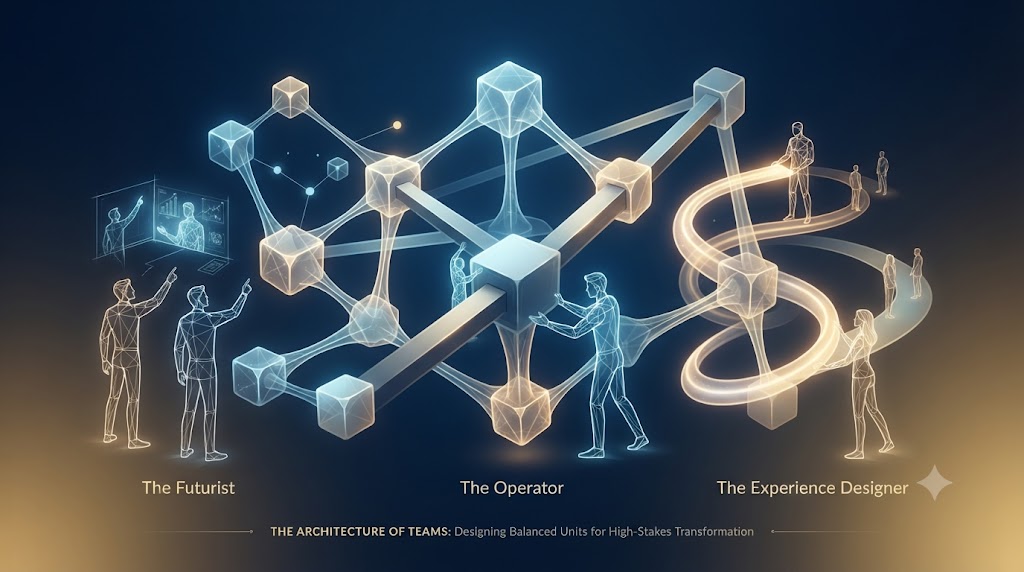
To move beyond generic roles, we must integrate three distinct cognitive archetypes within every high-stakes transformation unit. When one is missing, the entire system loses its structural integrity:
- The Futurist (Architects of Possibility): These individuals are the catalysts for long-term vision. They maintain the focus on the horizon, ensuring that immediate operational fires do not distract the team from the strategic intent of the transformation.
- The Operator (Architects of Execution): These are the masters of rigor. They provide the necessary gravity to the Futurist’s flight, translating abstract visions into tangible, measurable, and scalable action plans.
- The Experience Designer (Architects of Adoption): These members ensure that the human element remains at the center of the design. They bridge the gap between technical output and human impact, ensuring that the transformation is actually usable, desirable, and meaningful for the end-user.
The T-Shaped Dynamic
A balanced unit is not just a collection of specialists; it is a collaborative engine. We look for individuals who possess a “T-shaped” profile: deep expertise in their specific discipline (vertical bar) coupled with the broad empathy and systems-thinking required to understand how their work impacts the rest of the team and the broader organization (horizontal bar). This combination is essential for creating the psychological and functional glue that keeps a high-stakes team together when the pressure mounts.
Designing for High-Stakes Friction
Transformation is inherently uncomfortable. If your team is not experiencing a level of healthy friction, you are likely settling for the status quo. The goal of architectural design is not to eliminate friction, but to harness it to sharpen the quality of your output.
Constructive Tension
Many organizations mistake “friction-less” environments for high-performing ones, but this often leads to dangerous echo chambers. In high-stakes transformation, you need opposing forces. You need the push-back from the Operator to challenge the reach of the Futurist, and the empathy of the Experience Designer to ensure both are grounded in reality. Designing for constructive tension means creating space where these differing viewpoints can collide, debate, and synthesize into a stronger, more resilient strategy.
Psychological Safety as Structural Integrity
If you imagine your team as a physical structure, psychological safety is the load-bearing material. When stakes are high, the natural human response is self-preservation, which leads to withholding information, silence, or political maneuvering. If the foundation of your team is built on fear, no amount of strategic planning will prevent the structure from collapsing. Leaders must architect an environment where dissent is not only tolerated but encouraged, ensuring that the “building” can withstand the external pressures of a shifting market.
The Innovation-Execution Hand-off
One of the most common failure points in transformation is the “handoff.” We often treat ideation and execution as two distinct, linear phases. Instead, we must design interface points — specific moments and mechanisms — where fluid, divergent ideation can seamlessly transition into rigid, convergent project management. By architecting these transition zones, you prevent the loss of momentum that occurs when a brilliant concept dies because the team did not know how to operationalize it effectively.
The Human-Centered Blueprint
A transformation architecture is only as effective as its impact on the people navigating it. We often spend months planning the technical details of a project while ignoring the human workflow that will ultimately make or break our success. By applying a human-centered lens to our team design, we transform our units from rigid functional hierarchies into intuitive, high-performance environments.
Mapping the User Journey
We must treat our internal team members as the primary “users” of the transformation process. Before we roll out a new initiative to the market, we should map the internal user journey of the employees tasked with delivering it. Where are the friction points in their daily tasks? What information gaps prevent them from making confident decisions? When we design the team’s workflow to reduce unnecessary complexity, we increase the velocity of the transformation itself.
Cognitive Load Management
In high-stakes environments, cognitive load is a finite resource. If we ask our team members to juggle excessive administrative entropy alongside their core strategic responsibilities, the architecture fails. We must design our operational frameworks to minimize non-leverage activities. By simplifying reporting structures and automating routine updates, we protect our team’s capacity for the deep, creative work that defines successful innovation.
Autonomy within Constraints
Autonomy is not the absence of boundaries; it is the freedom to act effectively within them. Our architectural blueprint must provide the necessary “guardrails” — such as clear strategic intent, defined resource limits, and shared success metrics — that allow individual team members and sub-units to make agile, decentralized decisions. This alignment empowers teams to move with speed, knowing that their choices remain tethered to the broader objectives of the transformation.
Scaling the Architecture
Scaling transformation is not about making things bigger; it is about making them more modular and interconnected. As organizations grow, the complexity of communication often kills the speed of innovation. To maintain the agility of a startup at scale, we must transition from monolithic departments toward a modular architectural approach.
The Unit Concept
Instead of relying on massive, functional departments, we organize around small, cross-functional “cells” or units. These teams are self-contained ecosystems, each possessing the required Futurist, Operator, and Experience Designer archetypes. By keeping these units small and focused, we maintain a higher level of internal cohesion and reduce the overhead costs of coordination.
The Interdependency Map
Silos are the natural enemy of transformation. We prevent them from forming by creating an explicit “Interdependency Map” at the outset. This is a deliberate design protocol that outlines how different units must connect, share data, and synchronize milestones. By defining these interfaces before the work begins, we replace accidental collisions with intentional, productive collaboration.
Feedback Loops
A transformation environment is never static; it is constantly shifting based on market signals and organizational responses. We must integrate real-time sensing mechanisms — what I call “architecture heartbeats” — to measure team velocity, sentiment, and alignment. These loops act as the nervous system of the organization, providing the data needed to pivot, re-allocate resources, or adjust the team structure in real-time as the transformation journey progresses.
Conclusion: Designing for Resilience
Ultimately, the architecture of your team is the greatest predictor of your transformation success. We must move past the idea of the team as a static, permanent entity on a chart and embrace the reality of it as a living, breathing organism. True resilience in high-stakes environments does not come from building rigid structures that resist pressure; it comes from building flexible systems that can bend, adapt, and evolve in real-time.
The Living Structure
Recognize that your team is a product of its environment. As the market changes, as your strategic goals shift, and as your technology stack evolves, your team architecture must also be re-evaluated. A structure that worked perfectly at the start of a transformation may become a bottleneck by the middle. Maintaining a “living structure” requires the courage to iterate on your team design with the same rigor you apply to your product roadmap.
Call to Action: Architecture as an Intentional Act
It is time to stop asking, “Who do I have available?” and start asking, “What architecture does this specific moment of transformation require?” By shifting your focus from managing people to designing the environments in which they thrive, you unlock the ability to achieve outcomes that were previously out of reach. Your next great breakthrough isn’t just a strategy or a technology — it is the deliberate design of the team you build to bring that strategy to life.
Frequently Asked Questions
Why do traditional organizational charts fail during high-stakes transformations?
Traditional org charts represent reporting hierarchies rather than value-creation systems. They often stifle innovation by forcing dynamic, cross-functional work into rigid, siloed structures that are ill-equipped to handle the speed and adaptability required for meaningful transformation.
What are the three core archetypes needed for a balanced team?
To succeed, a transformation team requires three distinct archetypes working in concert: The Futurist, who maintains the long-term vision; The Operator, who drives execution and rigor; and The Experience Designer, who ensures the human element remains at the center of adoption.
How can leaders maintain psychological safety under pressure?
Psychological safety must be treated as the load-bearing structural integrity of the team. Leaders maintain it by fostering constructive dissent, protecting the team from excessive administrative entropy, and modeling transparency, ensuring that team members feel safe enough to innovate when the stakes are high.
Image credit: Gemini
 Sign up here to get Human-Centered Change & Innovation Weekly delivered to your inbox every week.