8 Moments That Matter More Than Your NPS Dashboard

8 Moments That Matter More Than Your NPS Dashboard

by Braden Kelley and Art Inteligencia


Which Moments Matter More Than Your NPS Dashboard? (Short Answer)

Eight moments that matter more than your NPS dashboard: (1) the first struggling moment, (2) the status-less wait, (3) the seam / retelling moment, (4) the recovery moment, (5) time-to-confidence, (6) the powerless frontline moment, (7) the policy surprise after “done,” and (8) the quiet exit. NPS can pulse loyalty intent. These moments decide whether humans succeed, escalate, or leave — often before a survey fires.

A dashboard asks whether they would recommend you. Moments that matter ask what happened when it counted — and whether anyone was designed to make it right.

Why Isn’t the NPS Snapshot the Whole CX Story?

I have sat in CX reviews where the NPS slide got twenty minutes and the human story got two. The score was up a point. Nobody could name the wait that made someone quit checking the portal, the handoff that forced a third retelling, or the agent who knew the fix and was not allowed to deliver it.

NPS can be a useful pulse. It becomes a hazard when the dashboard is the product and the moments that actually decide loyalty never get owners, metrics, or redesign. Soft landings for customers require governing the heat — not only harvesting a score after the fact.

Moment Why NPS misses it Design instead
1. First struggling moment Surveys fire after calm, not at the spike Own first fail; time-to-unstuck
2. Status-less wait SLA-fine can still feel opaque Status as experience; escape hatch
3. Seam / retelling Channel scores; no handoff owner Seam owners; context that travels
4. Recovery Later recommend cannot reconstruct teeth Recovery as a product; make-right power
5. Time-to-confidence Promoters may be survivors First real success without heroics
6. Powerless frontline Survey rarely asks if help was allowed Decision rights; dual scorecard
7. Policy surprise Cliff after score timing — or no ask Constraint honesty; promise-break rate
8. Quiet exit Silent churn never enters the dashboard Leading behaviors; exit archaeology

1. Why Does the First Struggling Moment Matter More Than the Score?

The moment: The first time the human cannot finish alone — wrong door, unclear next step, life context the happy path ignored.

Why NPS misses it: Surveys often fire after a “resolved” ticket or a calm purchase — not at the spike of struggle.

Humans feel: Anxiety, homework, shame for “not getting it.”

Instead: Instrument and own the first fail point. Measure time-to-unstuck and wrong-door rate — not only post-contact scores.

2. How Does a Status-Less Wait Decide Loyalty Before NPS Does?

The moment: Waiting without knowing how long, why, or what happens next.

Why NPS misses it: Wait time may be “within SLA” while emotional residue is rage or abandonment.

Humans feel: Helplessness. Checking apps becomes a second job.

Instead: Design status as experience — progress, ETA honesty, and a human escape hatch. Measure opacity, not only queue seconds.

3. Why Does the Seam / Retelling Moment Matter More Than Channel NPS?

The moment: Explaining the story again across bot → agent → specialist → portal.

Why NPS misses it: Channel scores can look fine; the handoff has no owner and no survey timing.

Humans feel: The retelling tax. “Nobody talks to each other.”

Instead: Journey and seam owners. Context that travels. Measure repeat-explain rate. For frictions maps miss at those cliffs, see 12 Friction Points Customers Feel Before Your Journey Map Does.

4. How Does the Recovery Moment Win or Spend Trust?

The moment: Something broke — and either someone makes it right with power, or the brand spends apology theater.

Why NPS misses it: A later “how likely to recommend” cannot reconstruct whether recovery had teeth.

Humans feel: Dignity restored — or dignity billed.

Instead: Design recovery as a product. Measure first-contact make-right and recovery power used — not only detractor callbacks closed.

5. Why Does Time-to-Confidence Matter More Than Relationship NPS?

The moment: The first time the median person completes the job and trusts the next step — onboarding, setup, first value.

Why NPS misses it: Relationship NPS can be high while new users still thrash. Promoters may be survivors.

Humans feel: Relief — or chronic doubt.

Instead: Measure time-to-confidence and abandoned-setup rate. Fund enablement as design, not a FAQ dump.

6. Why Does the Powerless Frontline Moment Matter More Than the Dashboard?

The moment: The employee closest to the customer knows the right fix and is blocked by script, metric, or approval theater.

Why NPS misses it: The survey rarely asks whether the human who could help was allowed to.

Humans feel: Customers escalate to survive. Agents quit the dignity of the job.

Instead: Design decision rights into the moment. Dual scorecard so green handle time cannot veto red human success. For the rulebook, see 10 Agent Empowerment Rules Your Customer Deserves Before They Quit.

7. How Does a Policy Surprise After “Done” Outrank a Green Score?

The moment: Denial, fee, eligibility, or constraint appears after the experience felt finished.

Why NPS misses it: Timing is wrong; the score may already be collected — or never asked at the cliff.

Humans feel: Bait-and-switch. Betrayal of the brand promise.

Instead: Constraint honesty in design. Measure surprise-denial and promise-break rates. Bring policy into the journey as a stage, not a footnote.

8. Why Does the Quiet Exit Matter More Than a Stable NPS?

The moment: The final unpaid labor, unanswered status, or dignity cost that tips someone out — often with no survey and no complaint ticket.

Why NPS misses it: Non-respondents and silent churn never enter the dashboard leaders manage.

Humans feel: “Not worth it” — then they are gone.

Instead: Watch leading behaviors — repeat contact, unfinished jobs, help-seeking spikes — and exit archaeology. Do not confuse a stable NPS with a loyal base. When surveys thin, listen in the moment with Conversational and Agentic VoC. If the program is managing the number instead of the journey, use 11 Signs Your CX Program Is Scorekeeping, Not Sense-Making.

How Do You Put Moments Over the NPS Scoreboard in the Next CX Review?

Before the next CX review, run five go/no-go questions:

  1. Which moment owns the agenda — a score or a lived beat?
  2. Who owns the hottest seam?
  3. What recovery power exists when it breaks?
  4. What is time-to-confidence on the journey that funds growth?
  5. Which quiet-exit signals are we ignoring because the dashboard is green?

Let NPS pulse. Let moments lead. Loyalty is decided in the heat — not in the harvest.

Frequently Asked Questions

What moments matter more than NPS?

Moments that matter more than NPS include the first struggling moment, status-less waits, seam/retelling handoffs, recovery with or without power, time-to-confidence, powerless frontline moments, policy surprises after “done,” and quiet exits that never enter the survey. These lived beats decide success, escalation, and churn — often before a score is collected.

Why is NPS not enough for CX?

NPS is not enough for CX because it is a pulse of recommend intent, not a map of what happened when it counted. It often misses struggle spikes, opaque waits, orphan seams, recovery teeth, first confidence, blocked agents, policy cliffs, and silent churn — especially when non-respondents never enter the dashboard.

What are moments that matter in customer experience?

Moments that matter in customer experience are the high-stakes beats where humans succeed or fail with dignity — first struggle, waiting without status, retelling across seams, recovery, first real confidence, frontline power (or its absence), policy surprises, and the quiet exit. They deserve owners, design, and measures — not only a post-hoc score.

How do you measure moments that matter?

Measure moments that matter with behavior and outcome metrics tied to each beat: time-to-unstuck, wait opacity, repeat-explain rate, first-contact make-right, time-to-confidence, recovery power used, surprise-denial rate, and leading exit signals — then use NPS as a pulse, not the agenda.

When should you look past the NPS dashboard?

Look past the NPS dashboard when the score is green but journeys fail, when surveys miss the hot moment, when channel scores hide orphan seams, when recovery has no teeth, when new users thrash despite promoters, when agents cannot help, when policy surprises after “done,” or when silent churn never appears in the harvest.

Image credits: Pixabay

Content Authenticity Statement: The topic area, key elements to focus on, etc. were decisions made by Braden Kelley, with a little help from Google Gemini and Cursor to clean up the article, add images and create infographics.

Subscribe to Human-Centered Change & Innovation WeeklySign up here to get Human-Centered Change & Innovation Weekly delivered to your inbox every week.
Seeds to Grow a Strong Culture

GUEST POST from Douglas Ferguson

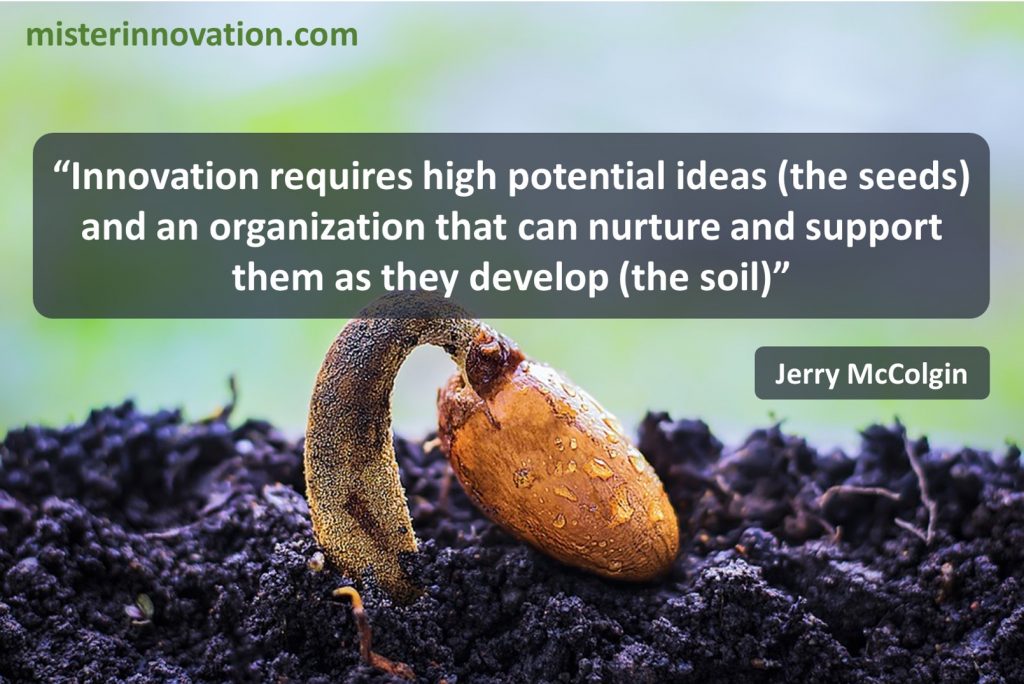
After a long winter, spring has finally sprung! For leaders in our fields, it’s an opportunity to implement some springtime strategies that cultivate and nurture company culture. But healthy cultures don’t grow overnight. Just as a garden is a multi-faceted ecosystem that needs tending, so is your workplace culture. To properly grow your company culture, you must be both patient and nurturing.

As Terry Lee outlines, there is great potential inside everyone. It’s up to great leaders to bring it out in four nurturing ways.

Training

It’s vital for leaders to work with employees to identify what training will position them to be most successful for the job now and for the future. Prior to sending any employee to a training, conference, or seminar, leaders should sit down with the employee to discuss specifics goals, expectations, and takeaways of the training they are attending.

Connecting

Research has shown that talking to house plants can help them grow, thus proving the power of connection. Leaders should connect with their teams as they help them better understand their importance and the value they bring to the organization. Every leader should understand their company’s mission and articulate that message to staff consistently and authentically.

Challenging

Studies have shown that intrinsic motivators are just as important as extrinsic ones. Good managers understand what challenges help generate these motivators. When team members complete meaningful tasks, they may receive an intrinsic reward. One way to amplify this reward is by talking to teams to determine what they think are the most important parts of their job. Then leaders can help them structure their day around tasks that give them a feeling of purpose.

Coaching

Every garden needs a gardener, and every team member needs a coach. Team members need coaches to meet them where they’re at. They help staff identify what options they may have to reach goals and then set the appropriate challenges that lead them to success.

Now that warmer weather has arrived, and the world is opening up again, it’s time to plant the seeds of a healthy work culture. Remember that culture will grow, whether you tend to it or not. Take the time to prioritize nurturing your team, and it will create a strong foundation for a collaborative and supportive workplace.

Need help with creating the foundation for a healthy work culture? Download our Culture Cultivator where you will uncover pain points and plan action items toward growing a healthy and synergetic work culture.

Douglas Ferguson | President, Voltage Control

Image credit: 1 of 1,150+ FREE quotes for your presentations at http://misterinnovation.com

Subscribe to Human-Centered Change & Innovation WeeklySign up here to get Human-Centered Change & Innovation Weekly delivered to your inbox every week.

10 Agent Empowerment Rules That Prevent “I Know What the Customer Deserves” Quits

10 Agent Empowerment Rules That Prevent 'I Know What the Customer Deserves' Quits

by Braden Kelley and Chateau G Pato


What Agent Empowerment Rules Prevent “I Know What the Customer Deserves” Quits? (Short Answer)

Ten agent empowerment rules that prevent “I know what the customer deserves” quits: (1) name the moment-of-truth mandate, (2) fund recovery power, not only apology scripts, (3) kill handle-time as the only score, (4) give exception authority with a clear band, (5) design escalation as help, not punishment, (6) retire scripts that forbid honesty, (7) close the loop from agent insight to policy, (8) protect time for judgment, not denser throughput, (9) measure first-contact human success, not containment, and (10) dual-recognize insight and care. Agents quit when moral clarity meets operational helplessness.

Customers feel the gap when agents are not allowed to close it. Agents feel the gap until they leave.

Why Don’t Exit Surveys Catch These Quits?

I have sat with contact-center leaders who could recite their NPS to one decimal place and still could not explain why their best agents left. The exit form said “opportunity.” The hallway said something else: I know what the customer deserves — and I’m not allowed to deliver it.

That is not a soft skills gap. It is a design failure. Soft landings for customers require frontline power — decision rights, recovery budgets, honest language, and metrics that reward finishing the human job. These ten rules are for human service agents in the moment of truth — not AI agents acting on a customer’s behalf. Empathy posters do not replace a mandate.

Rule Quit-risk prevented Costume version
1. Moment-of-truth mandate “Let me check with my supervisor” as the only move Empowerment in the town hall; none in the playbook
2. Fund recovery power Apology without a fix Empathy training without a wallet
3. Kill handle-time as only score Punishing agents who finish the job Green AHT, red customer
4. Exception authority with a band Approval theater for small make-goods Manager PIN for a $40 credit
5. Escalation as help Escalation scored as failure “Should have contained”
6. Retire scripts that forbid honesty Forced gaslighting Brand voice that bans candor
7. Insight → policy loop Same break reported weekly Feedback dump; no redesign
8. Protect judgment time Faster humans, thinner care AI “frees” agents into denser AHT
9. First-contact human success Ending contact while problem stays Deflection as CX strategy
10. Dual-recognize insight and care Best diagnosticians leave Agent of the month for shortest handle

1. Why Must You Name the Moment-of-Truth Mandate?

The rule: Write what the agent is empowered to decide, ship, or stop in the live interaction — before the next coaching cascade.

Quit-risk prevented: Ambiguity that forces “let me check with my supervisor” as the brand’s only move.

Costume: “Empowered agents” in the town hall; no decision rights in the playbook.

Run it: One-page mandate per journey. Supervisors review exceptions against the band — not against fear. If the mandate is not written, it is not empowerment. It is a slogan.

2. How Do You Fund Recovery Power — Not Only Apology Scripts?

The rule: Budget refunds, rebooks, credits, expedites, and make-goods as design — not as “leakage.”

Quit-risk prevented: Agents who can only apologize while the customer’s problem stays unbroken.

Costume: Empathy training without a wallet.

Run it: Recovery budget owned at team level. Track recovery that saves the relationship — not only the cost of recovery. Care without power is theater. For why belief in CX rarely funds frontline power, see 9 Reasons Companies Underinvest in CX.

3. Why Kill Handle-Time as the Only Score?

The rule: Demote average handle time from steering wheel to constraint light. Pair it with completion, effort, and recontact.

Quit-risk prevented: Punishing the agent who stayed long enough to finish the job.

Costume: Green AHT, red customer, burnt-out agent.

Run it: Dual scorecard. A green handle time cannot close a red human-success review. For the maturity path from SLAs to human-success measures, see 5 Stages from SLAs to XLAs.

4. What Does Exception Authority With a Clear Band Look Like?

The rule: Define the exception band agents may use without permission theater — and expand it with demonstrated judgment.

Quit-risk prevented: Twelve-step approvals for a $40 make-good while the customer burns.

Costume: “Empowerment” that still requires three systems and a manager PIN.

Run it: Band by journey risk. Publish examples of good exceptions. Coach the edge cases — don’t criminalize care.

5. How Do You Design Escalation as Help, Not Punishment?

The rule: Escalation paths that preserve context, dignity, and speed — for customer and agent.

Quit-risk prevented: Agents who escalate and get scored as failure; customers who repeat their story four times.

Costume: Escalation as a trap door; QA that marks “should have contained.”

Run it: Context-preserving handoff. Score escalation quality on outcome, not volume avoided. Containment is a tactic. It is not a north star.

6. Why Retire Scripts That Forbid Honesty?

The rule: Allow truthful language when policy hurts — what you can and cannot do, why, and the next real step.

Quit-risk prevented: Agents forced to gaslight (“your call is important”) while knowing the truth.

Costume: Brand voice guides that ban candor.

Run it: Honest playbooks for known failure modes. Legal and compliance co-own clarity — not spin. Forced dishonesty is a retention tax.

7. How Do You Close the Loop From Agent Insight to Policy?

The rule: Frontline patterns climb from person → pattern → policy with a named owner and date.

Quit-risk prevented: Agents who report the same break weekly and watch nothing change.

Costume: VoC dashboards; agent feedback in a dump; no redesign.

Run it: Weekly “three friction themes” from agents into journey owners. Publish what changed. Listening without action is scorekeeping. For the program diagnostic, see 11 Signs Your CX Program Is Scorekeeping, Not Sense-Making.

8. How Do You Protect Time for Judgment — Not Denser Throughput?

The rule: When AI or automation absorbs glue work, defend reclaimed minutes for care and judgment — don’t refill them as denser AHT targets.

Quit-risk prevented: Faster humans, thinner humanity; agents as the leftover of automation.

Costume: “AI frees agents for higher-value work” with no calendar or metric change.

Run it: Explicit capacity policy after automation. Judgment metrics, not only occupancy. For signals that frontline power is shrinking while AI slides expand, see 8 Signals You’re Preparing for the Wrong Future of Work.

9. Why Measure First-Contact Human Success, Not Containment?

The rule: Success = the customer completed the job with confidence. Containment is a tactic, not a north star.

Quit-risk prevented: Agents rewarded for ending the contact while the problem stays.

Costume: Deflection dashboards as CX strategy.

Run it: First-contact resolution, time-to-confidence, and recontact for the same intent — owned metrics with journey owners. If ending the call is winning, finishing the job is optional.

10. What Does Dual Recognition of Insight and Care Require?

The rule: Promote and praise agents who fix moments and surface system truth — not only those who hit script and AHT.

Quit-risk prevented: The best diagnosticians leave; the most compliant remain.

Costume: Agent of the month for shortest handle time.

Run it: Dual recognition — care outcomes plus insight that changed policy. Make both career-safe. If only compliance is celebrated, only compliance stays.

How Do You Audit Agent Empowerment Before the Next CX Review?

Before the next CX or workforce review, run five go/no-go questions. If you cannot answer them, you are funding surveys while starving power:

  1. What can an agent decide without a supervisor in the top three failure journeys?
  2. Is recovery funded — or only apologized for?
  3. Which metric still punishes finishing the job?
  4. What agent insight changed policy last month?
  5. Would a skilled agent say they are allowed to deliver what customers deserve?

If your best agents know what customers deserve and cannot deliver it, you are not running a CX program. You are running a moral injury machine with a survey on top.

Frequently Asked Questions

What is agent empowerment in CX?

Agent empowerment in CX means human service agents have written decision rights, recovery budgets, honest language, exception bands, and metrics that reward finishing the customer’s job — not only ending the contact. Empathy training without power is not empowerment.

Why do customer service agents quit?

Many skilled agents quit when they know what the customer deserves but cannot deliver it — blocked by handle-time theater, script walls, approval ladders, containment KPIs, and insight loops that never change policy. Moral clarity meeting operational helplessness is a retention failure, not a “mindset” problem.

How do you empower contact center agents?

Name moment-of-truth mandates, fund recovery, demote handle time as the only score, give clear exception bands, design escalation as help, allow honest scripts, close agent insight into policy, protect judgment time after automation, measure first-contact human success, and dual-recognize care and system insight.

What metrics replace handle time?

Pair handle time as a constraint with first-contact resolution, time-to-confidence, effort, and recontact for the same intent. A green handle time should not close a review when human success is red. Containment and deflection are tactics — not the definition of CX success.

How do you prevent frontline burnout in CX?

Prevent burnout by aligning authority with care: recovery power, exception bands, metrics that reward finishing the job, protected judgment time when AI absorbs glue work, and career recognition for insight that changes policy. Burnout often follows moral injury — knowing the right thing and being blocked from doing it.

Image credits: Unsplash

Content Authenticity Statement: The topic area, key elements to focus on, etc. were decisions made by Braden Kelley, with a little help from Google Gemini and Cursor to clean up the article, add images and create infographics.

Subscribe to Human-Centered Change & Innovation WeeklySign up here to get Human-Centered Change & Innovation Weekly delivered to your inbox every week.

5 Stages from SLAs to XLAs (A CX Maturity Roundup)

5 Stages from SLAs to XLAs (A CX Maturity Roundup)

by Braden Kelley and Art Inteligencia


What Are the Five Stages from SLAs to XLAs? (Short Answer)

Five CX maturity stages from SLAs to XLAs: (1) SLA Default — green metrics, miserable humans; (2) Experience Sensing — listening without power; (3) XLM Definition — human success becomes measurable; (4) XLA Adoption — experience becomes a commitment; (5) Experience-Led Management — XLAs steer, SLAs enable. An SLA (Service Level Agreement) tells you the service ran. An XLM (Experience Level Measure) tells you whether humans succeeded. An XLA (Experience Level Agreement) is how you promise and manage that success.

CX maturity is not “more surveys.” It is whether human success can change a budget meeting. Mature organizations rarely delete SLAs — they demote them from the steering wheel to the dashboard lights.

Why Do Green Dashboards Hide Red Tuesdays?

I have lost count of how many “healthy” service reviews I have sat through where every SLA was green and every human in the room was exhausted.

The portal was up. The tickets closed. The vendor collected their availability credit theater. And somehow employees still needed three workarounds to finish one task, customers still repeated their story to four people, and leaders still wondered why loyalty and productivity refused to follow the scorecard.

That is not a tooling failure. It is a maturity failure. Organizations learn to manage what they can defend in a contract — uptime, response, resolution — and then mistake green for good. Cold metrics create warm fiction.

This roundup is the map: five stages from steering by SLA to managing by human success. Each stage has a trap, an exit signal, and a different Tuesday when you climb.

Stage Managing by… Trap Exit signal
1. SLA Default SLAs and SLA-like KPIs Optimizing the metric, not the human Admit green ≠ good; structured listening on one journey
2. Experience Sensing SLAs + ad hoc listening Listening theater — dashboards, same decisions Defined XLMs with owners and baseline
3. XLM Definition SLAs + human-success measures Too many XLMs; “experience = speed” XLA language with targets and cadence
4. XLA Adoption SLAs and experience commitments Paper XLAs — no funding or teeth Portfolio led by XLA/XLM outcomes
5. Experience-Led Management XLAs first, SLAs as enablers Stage 5 in town hall, Stage 1 in payroll Red XLA stops a green review

1. What Is Stage 1 — SLA Default?

The stage: Service performance is managed through SLAs (or SLA-like KPIs), often inconsistently across teams and vendors. Experience shows up as complaints, escalations, or heroic recoveries — not as a managed system.

Primary question: Did we meet the technical target?

The trap: Optimizing the metric — faster closes, defensive ticket hygiene, throughput over outcome — instead of the human result.

Exit signal: Leaders admit SLA-green ≠ experience-good, and begin structured listening beyond tickets for at least one critical journey.

On Tuesday: Employees and customers can be miserable while every SLA is green. Cold metrics, warm fiction.

2. What Is Stage 2 — Experience Sensing?

The stage: SLAs still run the operating rhythm. Beside them appears experience signal: surveys, VoC, shadowing, journey maps, advisory boards. Insight exists; it is not yet designed into commitments or tradeoff decisions.

Primary question: What are people feeling, and where does it hurt?

The trap: Listening theater — more dashboards, same decisions. Frontline cynicism grows: “we surveyed again.” Sensing without power to act is worse than not listening.

Exit signal: For a priority journey, a small set of XLMs tied to human success — effort, confidence, agency — with owners and a baseline.

On Tuesday: Frontline staff often know the truth first. The organization hears pain; it does not yet manage by it. For scorekeeping disguised as CX, see 11 Signs Your CX Program Is Scorekeeping, Not Sense-Making.

3. What Is Stage 3 — XLM Definition?

The stage: The organization deliberately designs Experience Level Measures — translating friction into measurable human outcomes. XLMs sit beside SLAs: task effort, time-to-confidence, sense of agency, repeat contact for the same intent, EX enablement to deliver CX. Not SLAs renamed.

Primary question: Which human outcomes must improve for this journey to count as successful?

The trap: Too many XLMs; or “experience = speed” — SLAs in disguise. A metric that only celebrates faster failure is still cold.

Exit signal: Stakeholders agree to XLA language — targets, review cadence, consequences — for at least one service, vendor, or internal shared service.

On Tuesday: Teams can finally argue for fixes that do not move an SLA but remove massive human struggle. Human success becomes a number you can improve — and defend.

4. What Is Stage 4 — XLA Adoption?

The stage: Experience Level Agreements sit beside SLAs. A dual scorecard: SLA health and XLA attainment. Joint reviews; XLAs in charters or SOWs; escalation when XLMs breach even if SLAs pass.

Primary question: Did we keep our promise about how this should feel and work for humans — not only whether the system was up?

The trap: Paper XLAs — beautiful agreements with no funding, no decision rights, no repair paths at the moment of truth.

Exit signal: Portfolio priorities and vendor tradeoffs begin led by XLA/XLM outcomes. SLAs remain hard constraints but are no longer the primary definition of success.

On Tuesday: Authority starts matching empathy. Recovery power is designed into the system — not left as an accident of character on the front line.

5. What Is Stage 5 — Experience-Led Management?

The stage: The organization manages by XLAs first. Reliability is table stakes. Human success is how strategy, funding, and continuous improvement are judged. Innovation is evaluated on XLM lift, not demo applause.

Primary question: Where is human success leaking — and what will we stop, start, or redesign to recover it?

The trap: Declaring Stage 5 in a town hall while Stage 1 incentives still run payroll and promotions.

Signs you are actually here: A green SLA cannot close an executive review if the XLA is red. Vendors are retained or exited on experience outcomes, not only uptime credits. Journey owners can fund repairs that improve XLMs without waiting for an outage.

On Tuesday: People stop choosing between “hit the SLA” and “do right by the human.” The system expects both — and funds the second.

How Do You Check CX Maturity Before the Next Review?

Before the next service or CX review, run five honest questions. If you cannot answer them, you are reporting maturity you have not earned:

  1. Are we steering by SLA or by human success? — Who owns the experience outcome, not only the uptime number?
  2. Is listening changing decisions — or decorating decks?
  3. Do we have XLMs we would defend in a budget fight? — Not vanity scores; human outcomes with baselines.
  4. Do XLAs have owners, cadence, and teeth? — Or paper promises?
  5. Would a red XLA stop a green review? — If not, you are still in Stage 1 with better graphics.

One-journey climb (without boiling the ocean):

  1. Pick one critical journey.
  2. Keep SLAs as reliability rails.
  3. Define 3–5 XLMs that measure human success on that journey.
  4. Baseline current performance.
  5. Commit — turn XLMs into an XLA with owners and cadence.
  6. Rewire escalations so red XLAs trigger action as reliably as red SLAs — then scale.

For the full framework — stuck points, governance detail, and the one-pager — read The XLA Maturity Model: How Organizations Move from SLA Theater to Human Success. For why belief in CX rarely survives the budget meeting, see 9 Reasons Companies Underinvest in CX. For economics that fund the climb, use 7 Ways to Calculate CX ROI Without Hope-Based Slideware.

SLAs measure whether the service ran. XLMs measure whether humans succeeded. XLAs are how we promise — and manage — that success.

Frequently Asked Questions

What are the stages from SLA to XLA?

Five stages: (1) SLA Default — managing by uptime and handle time; (2) Experience Sensing — listening without commitment; (3) XLM Definition — human success becomes measurable; (4) XLA Adoption — experience becomes a shared commitment; (5) Experience-Led Management — XLAs steer, SLAs enable reliability underneath.

What is the difference between SLA, XLM, and XLA?

An SLA (Service Level Agreement) commits to operational performance — uptime, response, resolution. An XLM (Experience Level Measure) tracks human success — effort, confidence, agency, emotional residue. An XLA (Experience Level Agreement) is a shared commitment to defined experience outcomes, governed with XLMs. SLAs tell you the machine worked; XLMs tell you whether humans succeeded; XLAs are how you promise and manage that success.

What is XLA maturity?

XLA maturity is how far an organization has moved from steering by SLAs alone to managing by human success through XLMs and XLAs. Low maturity means green dashboards and red Tuesdays. High maturity means experience outcomes influence funding, vendor decisions, and executive reviews — with SLAs as reliability rails, not the definition of success.

How do you move from SLAs to XLAs?

Start with one critical journey. Keep SLAs as reliability constraints. Define 3–5 XLMs tied to human success, baseline them, then commit via an XLA with owners and review cadence. Rewire escalations so red XLMs trigger action like red SLAs. Scale to vendors and shared services once one journey proves the model.

What is experience-led management?

Experience-led management is Stage 5 CX maturity: the organization steers by XLAs and human-success outcomes first, with SLAs as enabling conditions underneath. Portfolio priorities, vendor scorecards, and innovation bets are judged on XLM lift. A green SLA cannot close a review if the experience commitment is red.

Image credits: Pixabay

Content Authenticity Statement: The topic area, key elements to focus on, etc. were decisions made by Braden Kelley, with a little help from Google Gemini and Cursor to clean up the article, add images and create infographics.

Subscribe to Human-Centered Change & Innovation WeeklySign up here to get Human-Centered Change & Innovation Weekly delivered to your inbox every week.
The Four Psychological Disruptions of AI at Work

LAST UPDATED: April 3, 2026 at 4:20 PM

The Four Psychological Disruptions of AI at Work

by Braden Kelley and Art Inteligencia


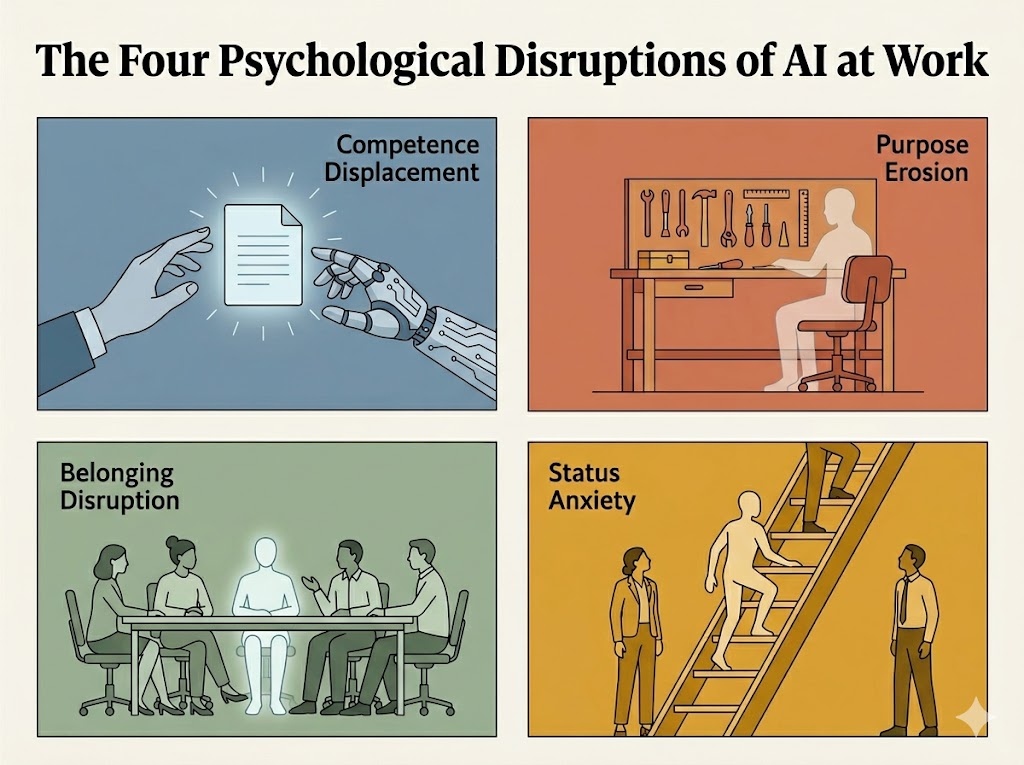
Most AI-and-work frameworks are built around economics – job categories, task automation rates, re-skilling costs. This one is built around something different: the interior experience of the person sitting at the desk. The four disruptions mapped in this infographic were identified not through labor market data, but through a human-centered lens – the same lens used in design thinking and change management to surface the needs, fears, and identity stakes that people rarely articulate out loud but always feel.

The framework draws on three converging sources: organizational psychology research on professional identity and role transition; change management practice, particularly the observed patterns of how workers respond when their expertise is devalued or displaced; and direct observation of how individuals are actually experiencing AI adoption in their workplaces right now – not in surveys, but in the unguarded conversations that happen before and after workshops, in the margins of keynotes, in the questions people ask when they think no one important is listening.


Why these four disruptions

1

Competence Displacement

The skill that defined you no longer distinguishes you.

Professional identity is heavily anchored in the belief that what I know how to do has value. When AI can replicate a signature competency – even imperfectly – it attacks that anchor directly. The disruption isn’t primarily about job loss. It’s about the sudden, disorienting feeling that years of deliberate practice have been, in some meaningful sense, made ordinary.

This disruption appears earliest and most acutely in knowledge workers whose expertise was previously considered difficult to acquire – writers, analysts, coders, researchers, strategists.

2

Purpose Erosion

The meaning embedded in the craft begins to hollow out.

Work is not only instrumental – it is ritual. The process of doing difficult things carefully, over time, is itself a source of meaning. When automation removes the friction, it can also remove the satisfaction. This is subtler than competence displacement and slower to surface, but ultimately more corrosive. People find themselves producing more output and feeling less connected to it.

This disruption is particularly acute for people who chose their profession not just for income but for intrinsic love of the work – and who built their identity around that love.

3

Belonging Disruption

The social fabric of work shifts when AI enters the team.

Work teams are social ecosystems built on complementary expertise, shared struggle, and mutual reliance. AI changes those dynamics in ways that are easy to overlook. When an AI tool makes one team member dramatically more productive, or when collaborative tasks are partially automated, the invisible social contracts of the team – who depends on whom, who contributes what – are quietly renegotiated. Belonging depends on feeling needed. When that changes, isolation can follow.

This disruption tends to surface not as explicit conflict but as a gradual withdrawal – people collaborating less, sharing less, protecting their remaining territory.

4

Status Anxiety

The professional hierarchy is being redrawn by AI fluency.

Workplace status has always been tied to expertise scarcity – the person who knew things others didn’t held power. AI is redistributing that scarcity rapidly. Early and confident AI adopters gain speed, output, and visibility. Those who resist, or who are slower to adapt, find themselves losing ground in ways that feel both unfair and disorienting. The new status question – are you someone who uses AI, or someone AI is used on? – is already being asked in organizations, even when no one says it explicitly.

This disruption is uniquely uncomfortable because it combines external threat (status loss) with internal shame (the fear of being seen as behind).


How to read the framework

These four disruptions are not sequential stages – they are simultaneous and overlapping. A single professional can be experiencing all four at once, with different intensities depending on their role, their organization, and how rapidly AI is being adopted around them. The infographic presents them as discrete panels for clarity, but the lived experience is messier and more entangled.

They are also not uniformly negative. Each disruption contains within it the seed of a corresponding renewal: competence displacement can become an invitation to lead with judgment rather than task execution; purpose erosion can prompt a deeper reckoning with what the work is ultimately for; belonging disruption can surface the human connection that was always the real foundation of team cohesion; status anxiety can motivate the kind of deliberate identity authoring that makes professionals more resilient over the long term.

The framework is designed to give leaders and individuals a common language for conversations that are currently happening in fragments — in one-to-ones, in exit interviews, in the silence after a difficult all-hands. Named things can be worked with. Unnamed things can only be endured.

This framework is a practitioner’s model, not a peer-reviewed clinical instrument. It is designed for use in workshops, coaching conversations, and organizational change programs as a starting point for honest dialogue — not as a diagnostic or classification system. It will evolve as our collective understanding of AI’s human impact deepens.

Framework developed by Braden Kelley as part of the article series Psychological Impact of AI on Work Identity  ·  Braden Kelley  ·  © 2026

Image credits: Gemini

Content Authenticity Statement: The topic area, key elements to focus on, etc. were decisions made by Braden Kelley, with a little help from Claude AI to clean up the article and add citations.

Subscribe to Human-Centered Change & Innovation WeeklySign up here to get Human-Centered Change & Innovation Weekly delivered to your inbox every week.

Will New Jobs Replace Those AI Wipes Out?

Will New Jobs Replace Those AI Wipes Out?

GUEST POST from Robert B. Tucker

For years, economists and technologists have comforted the public with a familiar refrain: as new technologies destroyed jobs, new ones arose even faster. The tractor displaced farm laborers, yet factories absorbed them. Computers replaced typewriters but created programmers.

The pattern seemed reassuringly predictable. Creative destruction, we were assured, always has a job-producing rainbow at the end of the storm. But artificial intelligence is not simply another tool like the computer or the tractor.

For starters, AI doesn’t just augment human capability in a narrow domain. It is a multi-faceted system that learns, adapts, writes, designs, diagnoses, analyzes, composes, and increasingly decides. In other words, AI is not replacing a single category of work. Rather, it is encroaching simultaneously on dozens. White-collar, creative, analytical, and technical roles are all within its expanding reach.

The first loud alarm bell of mass job displacement came in 2025, when Anthropic CEO Dario Amodei warned in an Axios interview that AI could eliminate “roughly 50% of entry-level white-collar jobs within 1–5 years, and that unemployment could spike to 10–20% within one to five years.”

To be sure, new jobs are appearing. According to LinkedIn’s Economic Graph—the world’s largest real-time map of jobs and skills, over 1.3 million AI-related job opportunities have appeared in the past two years alone. Many of these jobs did not even exist five years ago. But many of these jobs are specialized, technical, or niche. Meanwhile, large-scale occupations employing millions are shrinking.

“Something big is happening,” noted AI investor and CEO Matt Shumer, in an influential post in February 2026, read by 80 million people. “I am no longer needed for the actual technical work of my job. I describe what I want to be built, in plain English, and it just appears. Not a rough draft I need to fix. The finished thing. I tell the AI what I want, walk away from my computer for four hours, and come back to find the work done better than I would have done it myself.”

Citrini Research added to the with a new strain of fears about AI, painting what The Wall Street Journal called a “dark portrait of a future in which technological change inspires a race to the bottom in white-collar knowledge work. “For the entirety of modern economic history, human intelligence has been the scarce input,” Citrini noted. “We are now experiencing the unwind of that premium.” The Dow dropped 820 points on the post.

As AI models are becoming capable of building AI models, the pace of progress in AI has become exponential rather than linear. As the implications of recent advances cascade throughout the economy, stock markets gyrate, and career anxiety pervades the white-collar sector.

This new reality should prompt us to question the breezy optimism that “new jobs will appear.” Of course they will. The real question is: what kind of jobs?

Gig economy jobs have exploded over the past two decades. In 2005, only about 10% of the U.S. workforce participated in gig or independent work. Today that share has surged to roughly 35–38% of workers—about 60–70 million Americans—and still growing. In one sense, gig work offers freedom: flexibility, autonomy, and the ability to diversify income streams. For many workers it’s a hedge against layoffs and economic volatility. But the downsides are equally real. Gig workers often lack employer benefits, job security, retirement plans, and predictable income—and many earn less per hour than in traditional roles.

Yet another occupation often cited as evidence of this “new jobs will appear” optimism is the rise of the social media influencer. In theory, it represents a new category of work born of the digital economy—individuals building audiences, shaping tastes, and monetizing attention. Some sources have suggested that those who manage to accumulate over 50,000 followers could pull in an income of between $40,000 and $100,000 a year.

But the reality of this new job category, at least for some, hides a darker reality. Wellness influencer Lee Tilghman built a large Instagram following and earned hundreds of thousands from brand-sponsored posts. Yet behind the bright lights, she battled anxiety, loneliness, and disordered eating while spending up to ten hours a day online chasing validation. The constant pressure to post content became a ball and chain, which Tilghman later called “performing your life for content.” Suffering from stress and the recurrence of an eating disorder, she quit and now works a traditional 9-5 job which stops at the end of the day. As she told The New York Times, “When you’re an influencer, then you have chains on.”

A growing share of our economy may be shifting from producing tangible value to competing for attention inside algorithm-driven platforms. Millions of aspiring influencers chase likes, followers, and brand partnerships, yet only a tiny fraction earn a stable living. The rest exist in a precarious ecosystem of constant posting, self-promotion, and digital performance. “The information economy that we are currently building is really a new form of feudalism,” notes technologist Jaron Lanier.

In other words, the “new jobs” created by the technological revolution is often not a profession at all; it is a lottery. And even here, AI is moving rapidly. Synthetic influencers, automated content creation, and algorithmically generated personalities are already beginning to crowd the space.

The deeper issue is not simply employment but meaning. A society in which vast numbers of people struggle to find work that is steady, economically viable, socially valued, and personally fulfilling will face pressures far beyond the labor market.

In the Age of Acceleration, the question is no longer whether technology creates or destroys jobs. The question is how fast we adapt.

This article originally appeared in Forbes

Image credit: Pexels

Subscribe to Human-Centered Change & Innovation WeeklySign up here to get Human-Centered Change & Innovation Weekly delivered to your inbox every week.

It Starts with Choosing What to Do

It Starts with Choosing What to Do

GUEST POST from Mike Shipulski

In business you’ve got to do two things: choose what to do and choose how to do it well. I’m not sure which is more important, but I am sure there’s far more written on how to do things well and far less clarity around how to choose what to do.

Choosing what to do starts with understanding what’s being done now. For technology, it’s defining the state-of-the-art. For the business model, it’s how the leading companies are interacting with customers and which functions they are outsourcing and which they are doing themselves. In neither case does what’s being done define your new recipe, but in both cases it’s the first step to figuring how you’ll differentiate over the competition.

Every observation of the state-of-the-art technologies and latest business models is a snapshot in time. You know what’s happening at this instant, but you don’t know what things will look like in two years when you launch. And that’s not good enough. You’ve got to know the improvement trajectories; you’ve got to know if those trajectories will still hold true when you’ll launch your offering; and, if they’re out of gas, you’ve got to figure out the new improvement areas and their trajectories.

You’ve got to differentiate over the in-the-future competition who will constantly improve over the next two years, not the in-the-moment competition you see today.

For technology, first look at the competitions’ websites. For their latest product or service, figure out what they’re proud of, what they brag about, what line of goodness it offers. For example, is it faster, smaller, lighter, more powerful or less expensive? Then, look at the product it replaced and what it offered. If the old was faster than the one it replaced and the newest one was faster still, their next one will try to be faster. But if the old one was faster than the one it replaced and the newest one is proud of something else, it’s likely they’ll try to give the next one more of that same something else.

And the rate of improvement gives another clue. If the improvement is decreasing over time (old product to new product), it’s likely the next one will improve on a new line of goodness. If it’s still accelerating, expect more of what they did last time. Use the slope to estimate the magnitude of improvement two years from now. That’s what you’ve got to be better than.

And with business models, make a Wardley Map. On the map, place the elements of the business ecosystem (I hate that word) and connect the elements that interact with each other. And now the tricky part. Move to the right the mature elements (e.g., electrical power grid), move to the middle the immature elements (things that are clunky and you have to make yourself) and move to the middle the parts you can buy from others (products). There’s a north-south element to the maps, but that’s for another time.

The business model is defined by which elements the company does itself, which it buys from others and which new ones they create in their labs. So, make a model for each competitor. You’ll be able to see their business model visually.

Now, which elements to work on? Buy the ones you can buy (middle), improve the immature ones on the far left so they move toward the central region (product) and disrupt the lazy utilities (on the right) with some crazy technology development and create something new on the far left (get something running in the lab).

Choosing what to work on starts with Observation of what’s going on now. Then, that information is Oriented with analysis, synthesis and diverse perspective. Then, using the best frameworks you know, a Decision is made. And then, and only then, can you Act.

And there you have it. The makings of an OODA loop-based methodology for choosing what to do.

For a great podcast on John Boyd, the father of the OODA loop, try this one.

And for the deepest dive on OODA (don’t start with this one) see Osinga – Science, Strategy and War.

Image credit: Google Gemini

Subscribe to Human-Centered Change & Innovation WeeklySign up here to join 17,000+ leaders getting Human-Centered Change & Innovation Weekly delivered to their inbox every week.

11 Signs Your CX Program is Scorekeeping, Not Sense-Making

11 Signs Your CX Program is Scorekeeping, Not Sense-Making

by Braden Kelley and Chateau G Pato


How Do You Know Your CX Program Is Scorekeeping, Not Sense-Making? (Short Answer)

Your CX program is scorekeeping, not sense-making, when governance energy goes to NPS, CSAT, CES, and dashboard hygiene while nobody can explain — in a customer’s words — why the number moved or what journey you actually changed. Eleven signs: the CX review is a score review; people are paid for the number; driver models replace talking to humans; surveys serve the calendar not the moment; closed loop is a ticket not a redesign; competitive NPS theater; channel scores with orphaned seams; capture volume as the KPI; comments in a dump; sentiment AI as costume; and a green score with a red Tuesday you are not allowed to name.

A score asks whether they would recommend you. Sense-making asks what happened to them — and what you will stop doing because of it.

The Number Is Not Understanding

I have sat in CX reviews that felt like a weather report. Promoters up. Detractors down. Traffic lights polite. Someone asked what we learned about humans. The room reached for a driver model the way a drowning person reaches for a brochure.

That is scorekeeping: treating the number as the product of the program. Sense-making demotes the score to a signal. It funds contact with real Tuesdays. It judges CX by journeys changed — not points harvested.

Sign Scorekeeping Sense-making
1. Score review as CX review Traffic lights vs last quarter One journey, one story, one decision
2. Paid for the number Beg for tens; hide detractors Incentives on outcomes and loops
3. Models replace humans Word cloud as root cause Contact evidence required
4. Calendar surveys Tool default / ticket+24h Listen at the hot moment
5. Loop = case closed SLA on the detractor call Person recovered; system owned
6. NPS theater Beat the category chart Your Tuesday, your economics
7. Channel scores Leaderboards by org chart Seam owners and journey scores
8. Capture as KPI We listened to N people What got redesigned or stopped
9. Comments in a dump Verbatim “available” One decision, owner, date
10. Sentiment costume The tag is the insight AI sorts; humans make meaning
11. Green score, red Tuesday Official story is the dashboard Dual truth; red journey can stop the review

1. Why Is a CX Review That Is Only a Score Review a Warning Sign?

The sign: The monthly CX meeting is a walk through NPS, CSAT, CES, traffic lights, and “up or down versus last quarter.” Stories, seams, and decisions are leftover time — if they get time at all.

Why it seduces: Numbers look like management. A chart is faster than a human.

Sense-making instead: Lead with one journey, one human story, one decision. The score is a footnote, not the agenda. If the meeting could run without a customer’s words, it was scorekeeping with catering.

3. Why Can’t Driver Models and Word Clouds Replace Talking to Humans?

The sign: “Root cause” is a regression, a theme cluster, or a word cloud. Nobody has to sit with a customer or a frontline person this month to keep the program green.

Why it seduces: Analytics look like insight. You can screenshot a driver model. You cannot screenshot someone’s third explanation of the same billing break.

Sense-making instead: Every priority theme requires contact evidence — quotes, recordings, ride-alongs — that could not have been invented from the dashboard. If it could have been written without leaving the building, it is not sense. It is interior decorating with data.

4. Why Is Surveying on the Program’s Calendar Instead of the Customer’s Moment a Problem?

The sign: Cadence is quarterly, or twenty-four hours after a ticket close, or whenever the tool’s default fires — not at the emotional peak or the stalled wait.

Why it seduces: A program needs a calendar. Tools need a trigger. Neither is a moment of truth.

Sense-making instead: Listening designed for the moment — conversational, in-channel, after the cliff. Scores are a pulse, not a ritual. If you always ask when it is convenient for you, you will always hear a polite version of Tuesday.

5. How Is a Closed Loop That Only Closes Cases Still Scorekeeping?

The sign: Detractor follow-up is a SLA: call them, code them, close them. The same break happens next week. The loop never climbs from person to pattern to policy.

Why it seduces: “We close the loop” photographs well. Cured systems do not fit in a weekly metric as neatly.

Sense-making instead: Person-level recovery and a named system owner when the same friction repeats. Closed is not cured. A recovered human and an unchanged process is hospitality theater.

6. What Is Competitive NPS Theater in a CX Program?

The sign: The north star is beating a category benchmark or a rival’s published score. Your own journeys, effort, and failure demand are secondary.

Why it seduces: Boards like relative rankings. A league table feels like strategy.

Sense-making instead: Your economics and your Tuesday — retained humans, repeat contacts, dignity costs — beat a borrowed chart. If you cannot name the friction you removed in this book of business, you are competing at poster height.

7. Why Do Channel Scores With Orphaned Seams Mean You Are Scorekeeping?

The sign: Phone, chat, web, and store each have a score. The handoff between them has no owner and no metric. Customers live in the seam; the program lives in the channel.

Why it seduces: Channel dashboards map cleanly to org charts. Seams do not.

Sense-making instead: Journey and seam scores with owners — not only channel leaderboards. If the customer fell between teams and every channel still looks “green,” you measured the boxes, not the human path.

8. Why Is Capture Volume a Weak CX KPI?

The sign: Success is response rate, comments captured, tickets tagged, “we listened to N customers.” Action rate and journey change are unmeasured or someone else’s job.

Why it seduces: Listening is visible. Changing the work is political.

Sense-making instead: Judge the program by what got redesigned or stopped — not by how much you collected. Volume without action is a warehouse of other people’s pain.

9. What Does It Mean When CX Comments Live in a Dump?

The sign: Verbatim sit in a portal. Nobody has to translate them into a decision in human language. Qualitative is “available” and unused.

Why it seduces: You can say you “have the voice of the customer.” Storage is cheaper than courage.

Sense-making instead: A standing ritual: this month’s comments must produce one decision, one owner, one date — or they were storage, not listening. Available is not the same as heard.

10. When Is Sentiment AI Just a Sense-Making Costume?

The sign: Models tag emotion and topics at scale. The readout is the insight. No one checks whether the tag matches the job the human was trying to do.

Why it seduces: AI looks like understanding at volume. Speed flatters the wrong conclusion.

Sense-making instead: AI as a sorter, humans as meaning-makers. If a frontline person would not recognize the “theme,” it is not sense. It is labeling. Use machines to find the pile. Use people to say what the pile is.

11. Why Is a Green CX Score With a Hard Tuesday Still Failure?

The sign: NPS or CSAT hold or rise while effort, workarounds, and “I know what they deserve” attrition stay ugly. Naming the gap is treated as disloyalty to the program.

Why it seduces: The dashboard is the official story. Official stories like to stay employed.

Sense-making instead: Dual truth — score and lived experience. A green number cannot close the review if the journey is still red. If you cannot say that out loud, you are not running CX. You are running a reputation program for a metric.

How Do You Test Scorekeeping Versus Sense-Making in a CX Review?

Before the next VoC or CX steering meeting, run five questions. If you cannot answer them, you are managing a score, not making sense of humans:

  1. What human story led this meeting — in their words, not in a theme label?
  2. What did we change in a journey — not in a survey or a dashboard tile?
  3. Who is paid for the number versus the outcome?
  4. Where does the seam live that no channel score owns?
  5. Can a frontline person recognize our “why” — or would they laugh?

If scores have become the strategy because nothing else gets funded, that is a budget problem as much as a program problem — see 9 Reasons Companies Underinvest in CX. If the listening layer is still a dead form, Conversational and Agentic VoC is the method shift. If the number never had to name a behavior, 7 Ways to Calculate CX ROI Without Hope-Based Slideware is how you price the work. And if the map is still late to the pain, start with 12 Friction Points Customers Feel Before Your Journey Map Does.

Scorekeeping asks how we did. Sense-making asks what happened to them — and what we will stop pretending is fine.

Frequently Asked Questions

What is the difference between CX scorekeeping and sense-making?

Scorekeeping treats NPS, CSAT, or CES as the product of the CX program — optimizing surveys, samples, and dashboards. Sense-making uses those scores as signals, requires contact with real journeys, and judges success by what you changed for humans, not by points gained.

How do you know if your CX program is just managing NPS?

Warning signs include CX meetings that are only score reviews, incentives tied to survey points, root cause that never leaves a driver model, closed loops that close cases but not systems, channel scores with no seam owner, and a green NPS while Tuesday is still hard.

Why is NPS not enough for customer experience?

NPS is a signal, not a strategy. It does not name the job the customer was trying to do, the seam that failed, or the behavior you must change. Without that translation — and without owners, recovery power, and journey redesign — a rising score can coexist with rising effort and workarounds.

What should a CX review meeting cover?

Lead with one journey, one customer or frontline story in their language, and one decision — what to fix, stop, fund, or own. Scores, themes, and AI tags can inform. They should not consume the agenda. End with an owner and a date, not only a traffic light.

How do you stop survey gaming in CX programs?

Stop paying people for the score. Tie incentives to journey outcomes and closed-loop system changes. Sample in ways that cannot hide detractors. Treat begging for tens as a control failure. If the number is the bonus, the number will be the work.

Image credits: Unsplash

Content Authenticity Statement: The topic area, key elements to focus on, etc. were decisions made by Braden Kelley, with a little help from Google Gemini and Cursor to clean up the article, add images and create infographics.

Subscribe to Human-Centered Change & Innovation WeeklySign up here to get Human-Centered Change & Innovation Weekly delivered to your inbox every week.

What You Can Do to Make Customers Love You

The One Thing Netflix, Zappos and Salesforce Do to Get Customers to Love Them

What You Can Do to Make Customers Love You

GUEST POST from Shep Hyken

Personalization used to be about recognizing a customer who’s done business with you before. Just recognizing them and using their name created the feeling of a personalized experience. Earlier this year, I wrote Personalization Is More Than Using A Customer’s Name. While using the customer’s name is still important, over time, that experience morphed into much more. It is name recognition, combined with a knowledge of how you have marketed to them, sold to them and supported them, which makes them feel like you know them, not just recognize them.

My annual customer experience research found that nearly eight out of 10 customers (79%) in the U.S. feel a personalized experience is important. Twilio Segment’s State of Personalization Report found that “89% of leaders believe personalization is crucial to their businesses’ success in the next three years.”

No Longer a Trend, Personalization Is a Competitive Advantage

Customer service has evolved with how we do business. What was once a nice-to-have feature has become table stakes for success. Companies that don’t personalize risk being left behind by competitors that do.

Creating Personalized and Customized Experiences Online

Artificial intelligence (AI) has made it possible to analyze customer data faster and easier than ever before. This means we can use real-time information to turn routine transactions into memorable experiences that feel customized just for that customer.

For example, Netflix uses AI to analyze viewing habits, time of day preferences and even how long someone watches to make movie and TV show suggestions, creating a very personalized experience.

Zappos.com calls itself a service company that just happens to sell shoes. It is an online retailer that offers award-winning live customer support. They create WOW experiences that draw customers in and keep them coming back. Personalization comes in the form of recognizing returning customers and making spot-on recommendations.

Personalization and customization go beyond traditional consumer-facing businesses. A California-based firm, DK Law serves a diverse group of clients that speak English, Spanish and Korean. One might think that having lawyers who speak the different languages of their clients and have similar cultural backgrounds would be all that’s needed to create a personalized experience for the firm’s clients, but they didn’t stop there. They built an online presence with multiple website entry points that cater to their clients’ diverse backgrounds, creating a sense of cultural comfort and understanding. The result is higher trust and better communication in a traditionally impersonal environment, such as injury law.

In the B2B world, the ability to personalize and customize a solution can win over customers. Salesforce uses AI to analyze how each company (customer) uses its software, tracking which features teams use most and what challenges they face. Based on the data, Salesforce provides personalized dashboards, suggests training modules and delivers targeted suggestions to help each business maximize its investment.

Final Words

A successful personalization strategy will combine technology with human insight. The goal is to gather the right data about each customer and understand them well enough to create an experience that seems deeply personalized. The businesses that master the balance between using AI to gather insights while maintaining the human touch will be the ones customers choose to return to.

Personalization has evolved from a nice surprise to an expected standard. Companies that invest in truly knowing their customers and understanding their buying habits will keep those customers. And provided the overall customer experience meets the customer’s expectations, which includes the sales process, ease of doing business, customer support and product quality, why would a customer take a chance on leaving a company that knows them for a company that doesn’t?

Image Credit: Google Gemini

This article was originally published on Forbes.com.

Subscribe to Human-Centered Change & Innovation WeeklySign up here to join 17,000+ leaders getting Human-Centered Change & Innovation Weekly delivered to their inbox every week.

7 Ways to Calculate CX ROI Without Hope-Based Slideware

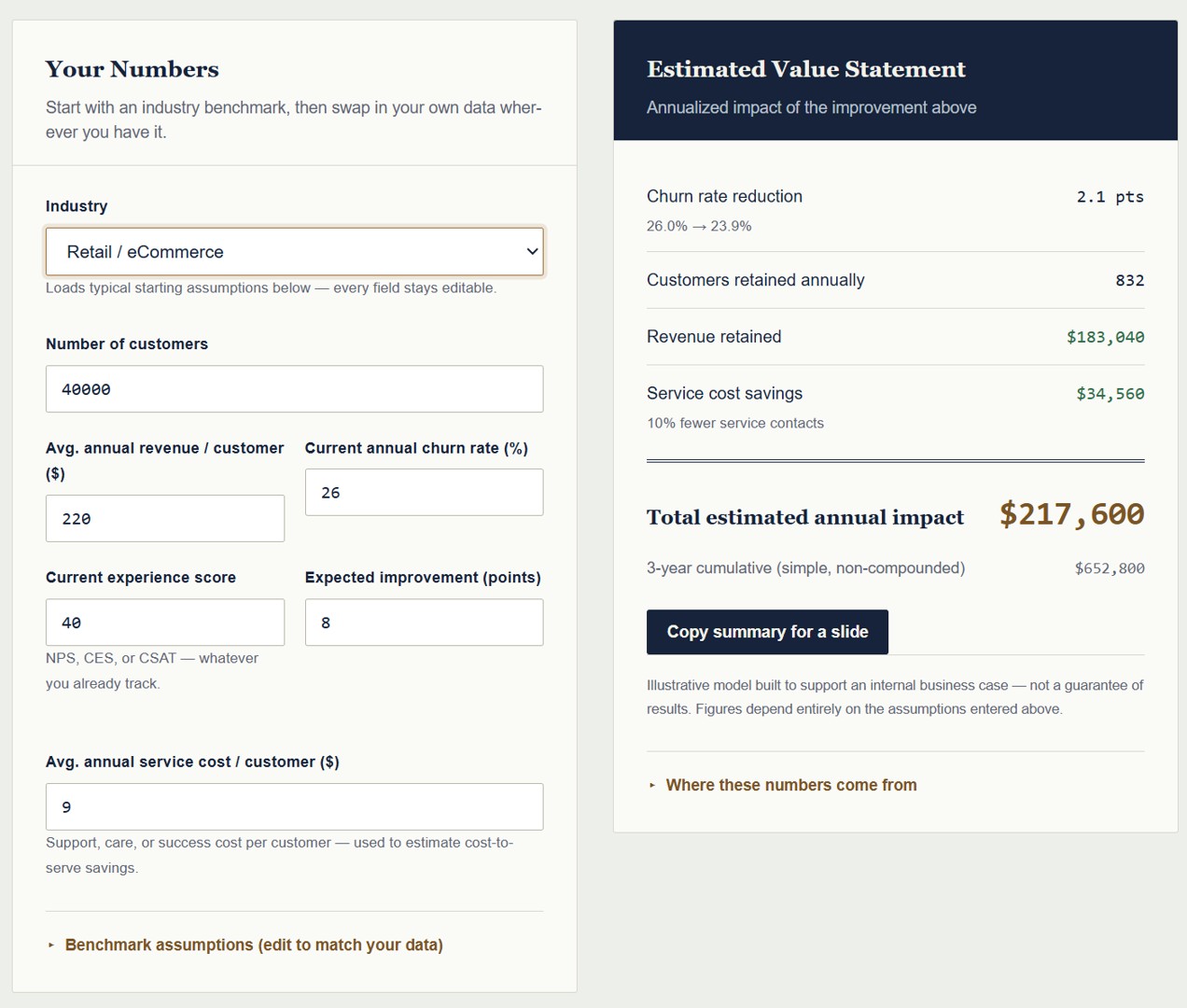
Customer Experience ROI Calculator

by Braden Kelley and Art Inteligencia


How Do You Calculate CX ROI Without Hope-Based Slideware? (Short Answer)

You calculate customer experience ROI without hope-based slideware by pricing behaviors on named journeys with your numbers — not by citing an industry NPS-to-growth chart and hoping finance translates “up and to the right” into dollars. Seven methods: retained revenue from reduced churn, failure-demand and repeat-contact cost, effort as cost-to-serve, expansion from easier buying, referral as avoided acquisition cost, the employee-attrition tax of underfunded experience, and an instrumented before/after on one intervention shown as a range.

The chain that keeps it honest is simple: experience metric → behavioral outcome → financial outcome → named intervention. If that chain breaks, you still have a slogan.

Hope Is Not a Business Case

I have sat in enough leadership rooms to recognize the moment the CX conversation dies. Someone has just shown a journey map that could win a design award. Heads have nodded. Then finance asks the only question that counts in that room: What is this worth?

What follows is usually a deck. A borrowed loyalty study. A hockey-stick that begins the quarter after implementation. A score moving “up and to the right” with no named human behavior underneath it. That is hope-based slideware. It photographs well. It does not survive a CFO who has another ask on the table with a spreadsheet attached.

Customer experience does not lose budget fights because it is soft. It loses when it stays unpriced. These seven methods put dollars on retained humans, avoided failure demand, and frontline enablement using your economics. Industry research can start the conversation. It cannot finish it.

Method What you price Hope it replaces
1. Retained revenue Avoided churn on a named journey Generic NPS-to-growth slides
2. Failure demand Repeat contacts and reopen work “Lower effort will pay for itself”
3. Effort as cost-to-serve Minutes, rework, expensive channels CES as a virtue metric
4. Expansion from less friction Attach, upsell, share of wallet “Promoters buy more” posters
5. Referral as avoided CAC Incremental qualified referrals “Word of mouth is priceless”
6. Frontline attrition tax Replacement, ramp, lost judgment CX cases that ignore employees
7. Instrumented intervention One fix, a range, a review date A single heroic ROI number

1. How Do You Calculate CX ROI from Retention?

The method: Estimate avoided churn from a specific experience fix — onboarding, billing, recovery, renewal — using your churn rate, revenue per customer, and how many customers actually hit that journey.

The math: Customers on the journey × expected reduction in leave or non-renew × revenue at risk. Start with last year’s actuals, not a mid-market benchmark someone pasted from a keynote.

The trap: A loyalty-industry slide with no company economics attached. Relative NPS leaders often grow faster than laggards. That is interesting. It is not an answer to what fixing this billing surprise is worth in this book of business.

The catch: Retention is a human staying because Tuesday got easier — not because the score moved. Name the friction you are removing. If you cannot point to the journey, you are still pricing a cloud.

2. How Do You Price Failure Demand and Repeat Contacts?

The method: Count work created by the experience being wrong the first time — second calls, reopen tickets, “any update?” chats, visits to fix a prior visit. That volume is not “busy.” It is the operating cost of a broken promise.

The math: Volume of avoidable contacts × fully loaded cost per contact (or per visit). Finance usually funds your cost-to-serve first. Customer time is real; include it only if you will actually use it in the conversation, not as decoration.

The trap: “Lower effort will pay for itself” with no contact ledger. Hope loves that sentence. Spreadsheets do not.

The catch: Fast handle time that reopens the ticket is not savings. A resolution that prevents the third contact is. If your business case rewards speed that creates return work, you are pricing the wrong behavior.

3. How Do You Turn Customer Effort into Cost-to-Serve?

The method: Price the labor inside the journey — employee minutes, rework loops, and expensive-channel use caused by confusion. The IVR maze. The bill nobody can parse. The knowledge article that lies. Those are not “pain points.” They are minutes you already pay for.

The math: Minutes saved × loaded labor rate × volume, plus mix shift from high-cost channels to appropriate ones. Appropriate does not mean cheapest. A cheap channel that fails is just failure demand with a lower sticker price.

The trap: CES as a virtue metric with no dollar bridge. Effort scores without a cost model are still slideware — just more sophisticated slideware.

The catch: Do not “save” by making the human do the company’s homework. Effort reduced for the customer and the employee is the honest version. Extraction dressed up as self-service will show up later as churn, complaints, or both.

4. How Do You Calculate Expansion ROI from Better Experience?

The method: Compare spend, attach, or expansion between customers who completed a low-effort path and those who struggled — then apply a conservative lift only to the journey you are actually fixing.

The math: Eligible customers × realistic attach or expansion lift × margin, not revenue vanity. If you cannot see a cohort difference in your data yet, say the lift is modeled. Transparency survives the room. False precision does not.

The trap: “Promoters buy more” as a poster, with no evidence from this book of business. Maybe they do. Prove it or bound it.

The catch: People expand when buying is dignified and clear — not when a campaign is louder. If the friction is still there, you are not calculating expansion ROI. You are calculating the cost of shouting over a broken path.

5. How Do You Price Referrals as Avoided Acquisition Cost?

The method: Price organic advocacy from a memorable recovery or a frictionless first success. Extra qualified referrals × what you would have paid to acquire that customer.

The math: Incremental referred customers × CAC — or, if CAC is a mess of channel soup, contribution margin of a new customer. Pick one definition. Stay consistent. Do not mix them mid-deck to make the number prettier.

The trap: “Word of mouth is priceless.” That is how it stays unfunded. Priceless is a compliment. It is not a line item.

The catch: Referral is leftover from a human who felt seen — usually after a moment of truth, not after a survey ask. You do not harvest advocacy with a “please rate us” pop-up. You earn it by making Tuesday work.

6. How Do You Calculate the Employee Cost of Underfunded CX?

The method: Price what underfunded experience does to the people who deliver it: regrettable attrition, recruiting, ramp time, and lost judgment at the moment of truth. CX business cases that pretend only customers have a P&L are incomplete on purpose.

The math: Extra quits you can credibly tie to “I know what they deserve; I am not allowed to deliver it” × replacement and ramp cost. Optionally add overtime and quality dip while the seat is empty. Use HR’s loaded replacement number if they have one. Inventing a tidy figure is just hope in a different font.

The trap: Treating employee experience as a soft HR add-on while the customer case stands alone. The two costs are related. When people with recovery power leave, customers feel it next.

The catch: The intervention is enablement — staffing, tools, decision rights at the moment of truth — not a pizza party and a poster about empathy. If the case funds a workshop but not authority, you have priced theater.

7. How Do You Build a CX Business Case a CFO Will Trust?

The method: Stop modeling “CX” as a cloud. Pick one intervention. Instrument a baseline and an after. Show conservative, expected, and optimistic. Separate what is known — today’s churn, today’s cost per contact — from what is modeled — how much the fix will move the behavior.

The math: Behavior change × dollar per behavior, for the named fix, as a three-point range, with a review date. The date matters. A model with no Tuesday to check it against is still a story.

The trap: A single heroic ROI number and a forty-page appendix of other people’s research. False precision is hope wearing a spreadsheet.

The catch: Executives fund redesigned onboarding, fixed billing logic, and empowered recovery — not “+7 NPS” floating in space. Attach the dollars to an action someone can own after the meeting ends.

What Should You Check Before You Build the CX ROI Deck?

Before the next slide that asks the room to believe, run five go/no-go questions. If you cannot answer them, you are still funding hope:

  1. Which journey and which behavior — leave, call again, expand, refer, or quit the job?
  2. Which of our numbers — not whose study?
  3. What is known versus modeled — and did we say so out loud?
  4. What range survives a skeptical read — conservative, expected, optimistic?
  5. What intervention and owner exist on Tuesday if they believe the number?

If you want a working surface for the first two methods — retained revenue and cost-to-serve — I built a free Customer Experience ROI Calculator so the value does not have to stay fuzzy. For the backup a finance partner will actually interrogate, the CX ROI Benchmark Report collects sources and the objections I hear in the room. Neither tool replaces judgment. Both beat a borrowed hockey-stick.

A score asks for belief. A priced human outcome asks for a line item. Calculate the second, and customer experience stops competing as charity. It competes as strategy — in the language enterprises already use to decide.

Frequently Asked Questions

How do you calculate CX ROI?

Calculate CX ROI by linking an experience metric to a customer or employee behavior, pricing that behavior with your own economics, and attaching the dollars to a named intervention on a specific journey. Common methods include avoided churn, repeat-contact cost, effort as cost-to-serve, expansion lift, referral as avoided CAC, and frontline replacement cost. Show a range, not a single heroic number.

Why do CX business cases fail with CFOs?

They fail when they ask finance to translate a score or an industry loyalty study into money. CFOs fund behaviors they can interrogate — retained revenue, lower cost-to-serve, avoided acquisition cost — tied to an action someone owns. Hope-based slideware cites research, shows a hockey-stick, and never names the journey or the math.

Is NPS enough to prove customer experience ROI?

No. NPS and other experience scores are signals, not a business case. They become useful for ROI only when you connect movement in the score to a behavior — renew, expand, refer, call again, or leave — and price that behavior with your churn, revenue per customer, and contact costs.

What data do you need to quantify customer experience?

Start with internal numbers: customers on the journey, churn or non-renew rate, revenue or margin per customer, fully loaded cost per contact, volume of repeat work, attach or expansion rates, CAC or contribution margin, and regrettable attrition plus replacement cost. Industry benchmarks are starter kits. Your ledger is the case.

How do you avoid fake precision in a CX business case?

Separate known facts (today’s costs and rates) from modeled assumptions (how much a fix will move behavior). Show conservative, expected, and optimistic scenarios. Pick one intervention, instrument a baseline, and set a review date. A single heroic ROI figure with false decimal places is still hope wearing a spreadsheet.

Content Authenticity Statement: The topic area, key elements to focus on, etc. were decisions made by Braden Kelley, with a little help from Google Gemini and Cursor to clean up the article, add images and create infographics.

Image credits: Pixabay

Subscribe to Human-Centered Change & Innovation WeeklySign up here to get Human-Centered Change & Innovation Weekly delivered to your inbox every week.