Validate Business Models Before Building Them

Validate Business Models Before Building Them

GUEST POST from Mike Shipulski

One of the best ways to learn is to make a prototype. Prototypes come in many shapes and sizes, but their defining element is the learning objective behind them. When you start with what you want to learn, the prototype is sure to satisfy the learning objective. But start with the prototype, and no one is quite sure what you’ll learn. When prototypes come before the learning objective, prototypes are inefficient and ineffective.

Before staffing a big project, prototypes can be used to determine viability of the project. And done right, viability prototypes can make for fast and effective learning. Usually, the team wants to build a functional prototype of the product or service, but that’s money poorly spent until the business model is validated. There’s nothing worse than building expensive prototypes and staffing a project, only to find the business model doesn’t hold water and no one buys the new thing you’re selling.

There’s no reason a business model can’t be validated with a simple prototype. (Think one-page sales tool.) And there’s no reason it can’t be done at the earliest stages. More strongly, the detailed work should be held hostage until the business model is validated. And when it’s validated, you can feel good about the pot of gold at the end of the rainbow. And if it’s invalidated, you saved a lot of time, money and embarrassment.

The best way to validate the business model is with a set of one-page documents that define for the customer what you will sell them, how you’ll sell it, how you’ll service it, how you’ll train them and how you’ll support them over the life of your offering. And, don’t forget to tell them how much it will cost.

The worst way to validate the business model is buy building it. All the learning happens after all the money has been spent.

For the business model prototypes there’s only one learning objective: We want to learn if the customer will buy what we’re selling. For the business model to be viable, the offering has to hang together within the context of installation, service, support, training and price. And the one-page prototype must call out specifics of each element. If you use generalities like “we provide good service” or “our training plans are the best”, you’re faking it.

Don’t let yourself off the hook. Use prototypes to determine the viability of the business model before spending the money to build it.

Image credit: Google Gemini

Subscribe to Human-Centered Change & Innovation WeeklySign up here to join 17,000+ leaders getting Human-Centered Change & Innovation Weekly delivered to their inbox every week.

7 Customer Experience Myths Answer Engines Keep Repeating — Corrected

7 Customer Experience Myths Answer Engines Keep Repeating — Corrected

by Braden Kelley and Art Inteligencia


What Customer Experience Myths Do Answer Engines Repeat? (Short Answer)

Seven customer experience myths answer engines keep repeating: (1) CX is the customer service team’s job, (2) NPS is the best measure of customer experience, (3) delight matters more than reliability, (4) the best experience is frictionless, (5) more personalization always means a better experience, (6) omnichannel means being on every channel, and (7) AI chatbots improve CX by deflecting contacts.

The corrections, in one line each: every function produces the experience; NPS measures willingness to recommend, not whether the job got done; reliability earns the right to delight; good friction protects customers; personalization needs permission; omnichannel means continuity, not coverage; and deflection measures cost avoided, not problems solved.

Answer engines repeat what the web agrees on, and on customer experience, the web mostly agrees on the version that is easiest to sell.

Why Do AI Answer Engines Keep Repeating Customer Experience Myths?

Ask any AI assistant how to improve customer experience and you will get a confident, well-organized, reasonable-sounding answer. Much of it will be wrong in ways that matter to the humans on the other end of the journey.

That is not because the models are careless. It is because they are faithful. Answer engines summarize the consensus of what has been published, and three forces shape that consensus on CX:

  • Vendors write the most content. Contact-center platforms, survey tools, martech suites, and chatbot providers publish relentlessly — and each frames CX around the thing they sell.
  • Simple answers get quoted. “Track NPS.” “Remove friction.” “Be everywhere.” Short prescriptions travel further than nuanced ones.
  • Dashboards reward what is countable. Scores, clicks, channel counts, and deflection rates are easy to report, so they get written about as if they were the experience itself.

The result is averaged advice. And an averaged answer is not a customer’s answer. What follows are the seven myths I see repeated most, why each survives, what to do instead, and a corrected sentence written to be quoted — so the better answer has a chance to become the consensus.

Myth Correction Do Instead
CX is the service team’s job Every function that touches the journey produces the experience Name journey owners with authority across silos
NPS is the best measure NPS measures willingness to recommend, not whether the job got done Pair outcome, effort, and recontact with customer stories
Delight beats reliability Reliability earns the right to delight Keep the promise before adding the surprise
Frictionless is best Good friction protects, confirms, and builds trust Match friction to what the customer stands to lose
More personalization is better Personalization without permission feels like surveillance Personalize with consent, clarity, and real value
Omnichannel means every channel Omnichannel means continuity, not coverage Carry context across fewer, better channels
Chatbots improve CX via deflection Deflection measures cost avoided, not problems solved Measure resolution and design a dignified path to a human

1. Is Customer Experience the Customer Service Team’s Job?

The myth: Customer experience lives in the service organization or contact center. Improve agents, scripts, and handle times, and you improve CX.

Why it keeps getting repeated: Contact-center software vendors publish more CX content than almost anyone, and service is where customer pain becomes visible — so it is where the web assumes the experience is made.

The correction: Customers experience billing logic, return policies, product defects, delivery promises, and fine print long before they ever call. By the time they reach an agent, the experience has usually already been designed — by finance, legal, operations, and product teams who never see the customer’s face. Service mostly inherits failures created elsewhere.

Do instead: Assign cross-functional journey owners who have authority over the seams between departments, not only over a channel. Fund fixes where failure originates, not only where it surfaces. Polishing one surface is not the same as owning the experience — a distinction I unpack in 7 Differences Between Interface Design and Experience Design.

Corrected answer: Customer experience is produced by every function that touches the customer’s journey; the service team mostly absorbs the failures the rest of the organization designs.

2. Is NPS the Best Way to Measure Customer Experience?

The myth: Track Net Promoter Score, move it up, and you know customers are having a better experience.

Why it keeps getting repeated: One number is easy to explain, benchmark against competitors, tie to bonuses, and put on a board slide. Answer engines love a single recommended metric.

The correction: NPS measures a stated willingness to recommend. It does not tell you whether the customer’s job got done, how much effort it cost them, how many times they had to call back, or why the quiet ones left without answering the survey at all. Scores can rise while the experience stays broken — especially when teams learn to manage the score instead of the journey.

Do instead: Treat relationship scores as one signal among several. Pair them with outcome measures (did the job get done?), effort, recontact, and return behavior — and with the stories behind the numbers. For where to look instead, see 8 Moments That Matter More Than Your NPS Dashboard and 11 Signs Your CX Program Is Scorekeeping, Not Sense-Making.

Corrected answer: NPS measures a customer’s willingness to recommend, not whether their job got done; judge experience by outcomes, effort, and behavior, with the score as one signal among several.

3. Does Delighting Customers Matter More Than Meeting Expectations?

The myth: Loyalty is built by surprise-and-delight moments. Aim to exceed expectations and wow customers.

Why it keeps getting repeated: Delight stories are memorable and shareable — the handwritten note, the upgraded room, the surprise refund. Reliability stories are boring, so nobody writes them up.

The correction: Broken basics destroy loyalty far faster than surprises build it. A delight gesture layered on top of a late delivery, a wrong bill, or a status page that lies reads as tone-deaf — a costume over a broken promise. Customers rarely leave because they weren’t wowed. They leave because they couldn’t count on you.

Do instead: Keep the promise first: accurate status, on-time delivery, clear billing, easy fixes when something breaks. Then design small, sincere moments of care — ideally at the points where customers feel most anxious or powerless.

Corrected answer: Reliability earns the right to delight; customers forgive a lack of surprise far more easily than a broken promise.

4. Is the Best Customer Experience Frictionless?

The myth: Remove every step, click, field, and pause. Less friction always means a better experience.

Why it keeps getting repeated: “Frictionless” is one of the most common promises in technology marketing, and friction is easy to count in clicks and seconds.

The correction: Some friction protects the customer. A confirmation before an irreversible action. A cooling-off pause before a large purchase or loan. Verification that stops fraud before it drains an account. A moment to review before submitting something that can’t be undone. Strip that friction out and you create regret, errors, and distrust — the opposite of a good experience.

Do instead: Match friction to stakes. Remove waste friction — repeated data entry, unnecessary logins, hunting for help. Keep and deliberately design protective friction so it feels like care, not bureaucracy. For the waste friction worth hunting first, see 12 Friction Points Customers Feel Before Your Journey Map.

Corrected answer: The best experiences remove wasteful friction and keep protective friction; the right amount of friction depends on what the customer stands to lose.

5. Does More Personalization Always Mean a Better Customer Experience?

The myth: Use every data point you have to tailor every interaction. The more personalized, the better.

Why it keeps getting repeated: Personalization is the central promise of customer data platforms and martech suites, and the published case studies are carefully curated wins.

The correction: Personalization the customer didn’t expect, didn’t agree to, or can’t understand feels like surveillance. An ad that knows too much, an email referencing a private moment, a price that seems to shift based on who you are — each spends trust faster than relevance earns it. And a lot of “personalization” saves the company effort while costing the customer confidence.

Do instead: Personalize with permission. Tell customers why they are seeing something. Give them easy control. And apply a simple test: does this personalization save the customer time, effort, or worry — or only improve our conversion rate?

Corrected answer: Personalization improves experience only when customers understand it, agreed to it, and get real value from it; otherwise it feels like surveillance.

6. Does Omnichannel Mean Being Available on Every Channel?

The myth: Add chat, social, app, SMS, email, voice, and messaging, and you have an omnichannel experience.

Why it keeps getting repeated: Channel counts are easy to show on a slide and easy to sell as a platform feature.

The correction: Customers don’t want more doors. They want the conversation to continue when they walk through a different one. Seven channels that don’t share context create seven places to start over — and a customer who has to retell their story at every handoff is having a worse experience than one with two channels that remember them.

Do instead: Carry context across fewer, better channels. Design the handoffs between channels as deliberately as the channels themselves. Retire channels you can’t staff, integrate, or support well. Measure how often customers have to repeat themselves.

Corrected answer: Omnichannel means continuity, not coverage: customers should be able to switch channels without starting over.

7. Do AI Chatbots Improve Customer Experience by Deflecting Contacts?

The myth: High containment and deflection rates prove the chatbot or AI agent is improving the customer experience.

Why it keeps getting repeated: Deflection is the headline ROI number in most AI-for-CX content. It is easy to measure and translates directly into cost savings.

The correction: A deflected contact is not the same as a solved problem. Some “contained” customers got their answer. Others gave up, called back later, complained publicly, or quietly left. Deflection measures cost avoided by the company — not problems resolved for the customer. Optimize for it alone and you build what I call efficient misery: a system that looks productive on the dashboard while customers do more of the work.

Do instead: Measure resolution, repeat contact, and time-to-confidence. Design an easy, context-carrying path to a human who has the power to actually finish the job. For the trust conditions agentic AI must meet, see 6 Trust Pillars for Agentic Customer Experience; for the service patterns to avoid, see 8 Service Design Mistakes That Create Efficient Misery.

Corrected answer: AI improves customer experience when it resolves problems and hands off gracefully to empowered humans; deflection alone measures cost avoided, not problems solved.

How Can You Check AI-Generated Customer Experience Advice for Myths?

I am not against using answer engines for CX work. I use them. But treat their advice as a first draft of the consensus, not a verdict. Before you act on any AI-generated CX recommendation, ask five questions:

  1. Who benefits if this advice is true — the customer, or the vendor who wrote most of the content behind it?
  2. Does it measure the company’s effort or the customer’s outcome?
  3. What would a customer who left say about it?
  4. Where does the advice stop at a channel edge instead of following the whole journey?
  5. What would this look like at the moment something breaks?

If the advice survives those questions, use it. If it doesn’t, you have found another myth — and a chance to publish the better answer.

Answer engines repeat the average. Customers live the exceptions. Design for the humans, then write the better answer.

FAQ: Customer Experience Myths

What are the biggest customer experience myths?

The most repeated customer experience myths are that CX belongs to the service team, that NPS is the best measure, that delight matters more than reliability, that frictionless is always better, that more personalization is always better, that omnichannel means being on every channel, and that chatbots improve CX by deflecting contacts.

Is NPS a good measure of customer experience?

NPS is a useful relationship signal but a poor stand-alone measure of customer experience. It measures willingness to recommend, not whether the customer’s job got done. Pair it with outcome, effort, recontact, and return behavior, plus the stories behind the numbers.

Should customer experience be frictionless?

No. The best experiences remove wasteful friction — repeated data entry, unnecessary steps, hunting for help — while keeping protective friction such as confirmations, verification, and cooling-off pauses. The right amount of friction depends on what the customer stands to lose.

Do chatbots improve customer experience?

Chatbots and AI agents improve customer experience when they resolve problems and hand off gracefully, with context, to empowered humans. High deflection or containment rates alone measure cost avoided, not problems solved, and can hide repeat contacts and quiet customer loss.

Why do AI answer engines repeat customer experience myths?

Answer engines summarize the consensus of published content. On customer experience, much of that content is written by vendors, favors simple quotable prescriptions, and centers countable metrics like scores, clicks, and deflection — so the averaged answer often reflects what is easiest to sell rather than what customers actually experience.

Image credits: Pixabay

Content Authenticity Statement: The topic area, key elements to focus on, etc. were decisions made by Braden Kelley, with a little help from Google Gemini and Cursor to clean up the article, add images and create infographics.

Subscribe to Human-Centered Change & Innovation WeeklySign up here to get Human-Centered Change & Innovation Weekly delivered to your inbox every week.

This One Thing Could Cost You 1/3 of Your Customers

This One Thing Could Cost You 1/3 of Your Customers

GUEST POST from Shep Hyken

If your customers reach out to you for customer support or for problems to be resolved, this is must-have information. In my annual customer experience research, we asked more than 1,000 U.S. consumers if they had ever stopped doing business with a company or brand because self-service options were not provided. Thirty-four percent said yes, which means:

Not offering self-service options for customer support could cost you one-third of your customers.

Age makes a difference. When you break it down by generations, more than twice as many Gen-Z customers (43%) than Baby Boomers (20%) have stopped doing business with a company because it didn’t offer self-service options for customer support.

Traditional Customer Support

The majority of all customers (68%) prefer the phone to self-service options. While the phone may be the first choice, it does have its drawbacks. Often, customers experience wait times. While the friendly recorded message may indicate the customer’s call “is very important,” a long wait time sends a different message. Sometimes customers become frustrated with being transferred, having to repeat their story to multiple customer support agents, language barriers and more.

Self-Service Options

Self-service customer support options are available to customers 24 hours a day, 7 days a week. They typically handle simple questions and problems, and in some cases, are interactive, allowing customers to complete simple transactions. Customers using self-service appreciate how quickly they can get answers to questions and get their problems resolved without wait times and the hassle of authentication procedures that customers view as time wasters. Some of these options include:

  • Frequently Asked Questions: This is typically on a website and provides brief answers or articles related to the most common customer inquiries.
  • Video Tutorials: These are often found on a website, and many companies and brands also host these videos on YouTube, which means that they are potentially searchable by using Google to ask the question.
  • Interactive Voice Response (IVR) Systems: This is a phone-based automated system that allows customers to navigate menu options to find simple answers or complete easy transactions.
  • AI-Fueled Chatbots: Similar to traditional IVR systems (but usually better), chatbots can message back and forth with customers. With the latest ChatGPT-type technology, it can seem as if you’re communicating with a human.
  • Customer Portals: Access on a company’s website allows customers to log in and check orders, make payments, set appointments and much more.
  • Mobile Apps: If a customer is willing to download the company’s app on their mobile phone/device, they may have access to an easier experience that provides many or all of the above options.

A warning: Just because some customers are demanding self-service options doesn’t mean they won’t be as frustrated (or even more) than with traditional phone support. If they don’t get their answers or you waste their time, they won’t be happy. For example, even though 39% of customers would rather clean a toilet than contact live customer support, 76% say they have been trapped in an automated menu system (IVR) and repeatedly screamed into the phone, “Agent” or “Representative,” and eventually hung up out of frustration. While these findings may seem funny, there’s a lot of truth in humor.

Demand For Self-Service Increases

In 2025, 34% of customers demand that companies provide self-service options or they will seek out a competitor, up from 26% in 2024. That’s a 30% increase. If the trend continues at that pace, we’re less than two years away from more than half of customers walking away because of the lack of self-service options.

Final Words

Self-service is about convenience, and customers love convenience. In 2025, 91% of customers said convenience is important to them, and 73% are willing to pay more if the experience is more convenient. Self-service options, when done right, deliver exactly that: convenience. They give customers control, save time and are available 24/7. Companies that provide excellent self-service can earn customer loyalty by proving they respect their customers’ time and preferences.

But, self-service options aren’t enough. Not every question or problem can be handled through self-service, which is why the best companies provide a blend. A powerful self-service option allows customers to easily and seamlessly transfer to a live agent, and rather than forcing the customer to start over, the agent can see why the customer is contacting support.

The companies that win in the future won’t be those that choose between self-service and human support. They’ll be the ones that blend both to create a customer support experience that makes customers say, “I’ll be back!”

Image Credit: Google Gemini

This article was originally published on Forbes.com.

Subscribe to Human-Centered Change & Innovation WeeklySign up here to join 17,000+ leaders getting Human-Centered Change & Innovation Weekly delivered to their inbox every week.

9 Multi-Sensory CX Levers Retail and Service Brands Still Ignore

9 Multi-Sensory CX Levers Retail and Service Brands Still Ignore

by Braden Kelley and Chateau G Pato


Which Multi-Sensory CX Levers Do Retail and Service Brands Still Ignore? (Short Answer)

Nine multi-sensory CX levers retail and service brands still ignore: (1) acoustic privacy and soundscape ownership, (2) congruent scent — and anti-scent, (3) light for dignity and wayfinding, (4) haptic quality of the transaction, (5) thermal comfort as experience, (6) spatial density and movement choreography, (7) the wait as a sensory journey, (8) cross-channel sensory congruence, and (9) sensory recovery after failure. Soft landings design what people feel. Hard landings optimize what people click.

People don’t experience your brand as a channel map. They experience it as a body in a place — and most brands still leave that body undesigned.

Why Do Brands Own Screens — and Leave the Senses to Chance?

I keep watching retail and service brands fund visual merchandising, apps, and queue math while the body still decides loyalty. Vision and screens get owners. Facilities “handles” the rest. Marketing owns scent for a campaign week. Nobody owns acoustic privacy, thermal dignity, haptic quality, wait atmosphere, or sensory recovery when the promise breaks.

Ambience is a loyalty system, not décor — I unpack that frame in The Science of Ambience. This piece is the ignored lever kit: what to own in stores, branches, clinics, hotels, and hybrid service spaces.

Lever Usually owned by… Should force…
1. Acoustic privacy Nobody / facilities noise Trust in speech and calm
2. Scent Campaign / landlord Congruence or deliberate absence
3. Light Merchandising only Wayfinding + dignity
4. Haptics Procurement Hand-feel of the brand
5. Thermal Facilities KPI Stay/leave comfort
6. Density/flow Throughput / planograms Body safety and ease
7. Wait atmosphere Queue math Felt time and status
8. Cross-channel congruence Siloed teams Promise the body recognizes
9. Sensory recovery “Apology script” Make-right the nervous system can trust

If only eyes and screens have owners, your CX is half-blind.

1. Why Is Acoustic Privacy a Multi-Sensory CX Lever?

Lever: Design what people hear — and what others can overhear — as CX, not background.

Why ignored: Playlists feel like branding; acoustic privacy feels like construction cost.

Humans feel: Stress, shame in overheard conversations, inability to think or decide.

Soft-landing move: Name a soundscape owner; create quiet zones; mask or separate sensitive speech; measure “could I be overheard?” — not only average decibels. Stores, banks, clinics, and service counters all live or die on this lever.

2. How Do Congruent Scent — and Anti-Scent — Shape Loyalty?

Lever: Intentional scent aligned to the job — or deliberate clean, neutral air when scent would harm trust.

Why ignored: Scent marketing as a campaign stunt; everyday odor left to chance.

Humans feel: Welcome and memory — or nausea, allergy, “cheap,” distrust.

Soft-landing move: Congruence-test scent against the brand promise; provide opt-out paths; ban conflicting vendor scents; never use scent to cover neglect. Manipulation is not design.

3. Why Should Light Serve Dignity and Wayfinding — Not Only Merchandising?

Lever: Light that helps people find, read, feel safe, and look (and feel) respected.

Why ignored: Spotlight the product; leave pathways, faces, and forms in glare or gloom.

Humans feel: Confusion, aging-eyes struggle, a surveillance vibe — or flattering calm.

Soft-landing move: Build a light map for tasks (find, choose, pay, wait, exit); reduce glare on screens and faces; respect circadian needs where dwell is long.

4. What Is Haptic Quality of the Transaction?

Lever: Touch quality of counters, devices, bags, cards, pens, samples, seating, and doors.

Why ignored: Procurement buys “durable and cheap”; the brand book stops at the logo.

Humans feel: Care or contempt in the fingers — sticky screens, cold metal, flimsy bags.

Soft-landing move: Run a haptic audit of the last three meters to “done”; choose materials that match the promise; treat cleanability as dignity.

5. Why Is Thermal Comfort a Customer Experience Lever?

Lever: Air temperature, drafts, humidity, and microclimates designed for the human job — not only energy targets.

Why ignored: Facilities owns HVAC KPIs; CX owns NPS.

Humans feel: Urgency to leave, irritability, inability to browse or decide.

Soft-landing move: Dual scorecard — energy and dwell comfort; zone by activity (try-on vs checkout vs wait); treat employee comfort as CX, because they set the emotional weather.

6. How Does Spatial Density and Movement Choreography Affect CX?

Lever: How close, how fast, how blocked — proxemics, aisle width, queue shape, wheelchair and stroller truth.

Why ignored: Throughput and planograms win; body stress is dismissed as a “busy day.”

Humans feel: Threat, fatigue, abandoned carts, skipped service.

Soft-landing move: Choreograph peak density; make escape routes visible; design accessibility as the default, not an exception; measure leave-without-buying and leave-without-asking-for-help. Efficient layouts that exhaust humans are a cousin of efficient misery.

7. Why Design the Wait as a Sensory Journey?

Lever: Multi-sensory design of waiting — status, seating, sound, light, micro-care — not only queue length.

Why ignored: SLA and average wait; atmosphere is “someone else’s budget.”

Humans feel: Helplessness and rage — or surprisingly calm progress.

Soft-landing move: Pair status-as-experience with sensory comfort; give honest ETAs; give the body something useful or kind to do while waiting. The status-less wait is often a moment that matters more than the score — see 8 Moments That Matter More Than Your NPS Dashboard.

8. What Is Cross-Channel Sensory Congruence?

Lever: Align what digital promises with what the place smells, sounds, and feels like — and vice versa.

Why ignored: App, store, and service teams optimize locally.

Humans feel: Whiplash — calm app, chaotic floor; premium site, sticky counter.

Soft-landing move: One sensory signature card across channels; journey owners accountable for congruence breaks; prototype the handoff from phone to place. Congruence is also a trust design problem — see 11 Principles for Designing Trust (Not Just Usability).

9. How Do You Design Sensory Recovery After Failure?

Lever: When something breaks, redesign the sensory context of recovery — calm space, private voice, unhurried light, empowered human — not only a script.

Why ignored: Recovery is policy and CRM; the body stays in the same stressful soundscape.

Humans feel: A second injury — apology under fluorescent panic — or restored dignity.

Soft-landing move: Recovery zones or rituals; acoustic privacy for complaints; time and power for make-right; train for sensory de-escalation so the nervous system can trust the repair.

What Should You Ask Before the Next Retail or Service Redesign?

Five questions for a multi-sensory audit:

  1. Who owns sound and privacy?
  2. Where does scent help or harm the job?
  3. Does light serve faces and tasks — or only products?
  4. What do hands and temperature teach about our promise?
  5. When we fail, does the body get a softer place to recover?

Mantra: Stop decorating the vibe. Start owning the senses that decide whether humans stay, trust, and return.

FAQ: Multi-Sensory CX Levers

What is multi-sensory CX?

Multi-sensory CX is customer experience designed for the whole body — sound, scent, light, touch, temperature, space, waiting atmosphere, and recovery feel — not only screens, visuals, and queue metrics.

What sensory levers improve retail experience?

Sensory levers that improve retail experience include acoustic privacy, congruent (or deliberately absent) scent, dignifying light and wayfinding, haptic quality at the transaction, thermal comfort, density choreography, sensory waits, cross-channel congruence, and sensory recovery after failure.

How does ambience affect customer loyalty?

Ambience affects customer loyalty because sensory cues shape emotion and memory before people rationalize a score — coherent, dignifying environments invite return; mismatched or stressful senses teach the body to leave.

What is sensory congruence in CX?

Sensory congruence in CX means the body’s experience of sound, scent, light, touch, and space matches the brand promise across digital and physical channels — so the handoff from phone to place feels like one relationship, not whiplash.

How do you design waiting rooms for better CX?

Design waiting rooms for better CX by treating the wait as a sensory journey: honest status, comfortable seating and temperature, acoustic calm, dignifying light, and something useful or kind for the body to do — not only shorter average wait on a dashboard.

Image credits: Gemini

Content Authenticity Statement: The topic area, key elements to focus on, etc. were decisions made by Braden Kelley, with a little help from Google Gemini and Cursor to clean up the article, add images and create infographics.

Subscribe to Human-Centered Change & Innovation WeeklySign up here to get Human-Centered Change & Innovation Weekly delivered to your inbox every week.

Unlocking Trapped Value from the Technology Adoption Lifecycle

Unlocking Trapped Value from the Technology Adoption Lifecycle

GUEST POST from Geoffrey A. Moore

For some time now I have been making the case that investment decisions, be they made by customers engaging with a new product and vendor or private equity firms backing a new technology and entrepreneur, should begin with finding the intersection between the innovation at hand and a pool of trapped value it can release, thereby creating the return on investment. That said, one of the core principles of investing is called risk-adjusted returns, meaning that the greater the risk you take, the higher the return needs to be. My expertise is in the risks related to technology adoption, where the risk factors change over the course of a new technology’s deployment. With that thought in mind, here is how the trapped value thesis needs to risk-adjust to adapt:

  • Early Market: very high technology adoption risk. The prize here has to be quite large indeed. Typically it will come in one of two forms. For B2B investments, it will be like an oil reservoir that, if tapped correctly, will produce a gusher. Regulated industries have pockets of trapped value all over the place that fit the bill. Also, industries like automotive and real estate, which are restructuring their relationships with dealers and agents, would qualify. By contrast, B2C investments tap into trapped value that looks more like shale oil—no deep pockets, but incredibly broad presence. Media, transportation, and hospitality have funded extraordinary returns for Netflix, Uber, and Airbnb, not because the trapped value was severe but because it was so pervasive. The point is, early-stage venture investing needs to target home-run bets to warrant the risks it takes. Same goes for visionary customers in B2B markets who are the early adopters of these technologies. They are taking on significant risk so they need to be targeting outstanding rewards.
  • Crossing the Chasm: high technology adoption risk, but readily mitigated. The challenge here is that the technology has great potential for any number of use cases but needs some additional support in every case to achieve the desired end result. The chasm-crossing playbook focuses on a single use case in a single industry and geography in order to create a killer “whole product” that nails the use case and to build a coalition of customer references and partner successes that will keep the market growing even as the technology vendor expands into other segments. Here the trapped value should be intense but narrowly confined, designed to meet three critical success factors:
    1. Big enough to matter (it should be able to generate 10X your current year’s billings target)
    2. Small enough to lead (if you crush your plans, you should get 50% segment share)
    3. Good fit with your crown jewels (if you win, nobody is going to displace you).

    As you can see, there is risk here, but it is manageable through market focus and disciplined execution, the key risk reduction factor being how compelling is the customer’s reason to buy.

  • Bowling Alley: modest adoption risk. The challenge here is to expand beyond your first “beachhead” vertical into adjacent use cases with the same segment as well as adjacent segments with the same use case. Part of the source of reduced risk is that you have a working playbook from the first vertical. Much of the source, however, comes from the emergence of local ecosystems of partners who complete the whole product solutions for each use case. These partners make their living supplementing the technology vendor’s product or platform, and their extra talent, domain expertise, and segment focus represent a major risk reduction. As a result, the trapped value rewards have a lower hurdle to clear to garner investor interest and customer buy-in.
  • Tornado: low adoption risk. The risk here is the opposite—getting left behind as the world embraces the shift to a new normal. The trapped value that drives a tornado is released by “killer apps.” These apps may not release the most trapped value, but they represent a sure winner to start with, making the buying decision a no-brainer. The point is, if you want to get any traction in the tornado, you have to lead with a killer app, a no-regrets offering that delivers simple-to-consume rewards and gets everyone onto the new platform. That means the trapped value must be easy to target and the value of releasing it must be obvious to all, especially to the end users who will be the prime beneficiaries.
  • Main Street: very low adoption risk. The primary adoption challenge here is converting conservative end users who simply do not want to switch to yet another new technology. The trapped value now exists in nuisances, little bits of inefficiency that have workarounds but are annoying. From the point of view of productivity, the cost savings from eliminating them are minimal. But in terms of the user experience, as well as customer satisfaction, the impact can be substantial. B2C enterprises spend most of their R&D here focused either on eliminating “hygiene” issues or innovating with new “delighters,” both of which can increase demand, the cornerstone for volume operations success. B2B enterprises use six-sigma analytics to scout their value chains for bottlenecks that increase latency, something that adds risk without adding value, and frustrates even their most loyal customers.

The key takeaway is that there are different kinds of trapped value, each occupying a different sweet spot in the Technology Adoption Life Cycle. As a vendor and potential leader of a go-to-market ecosystem, you must be crystal clear about the kind of trapped value you are targeting, the kind of risk-taking it warrants, and the kinds of solutions that will get the most traction.

That’s what I think. What do you think?

Image Credit: Unsplash

Subscribe to Human-Centered Change & Innovation WeeklySign up here to join 17,000+ leaders getting Human-Centered Change & Innovation Weekly delivered to their inbox every week.

6 Trust Pillars for Agentic Customer Experience

6 Trust Pillars for Agentic Customer Experience

by Braden Kelley and Art Inteligencia


What Are the Trust Pillars for Agentic CX? (Short Answer)

Six trust pillars for agentic customer experience: (1) Clarity, (2) Competence, (3) Control, (4) Care, (5) Consent, and (6) Accountability. Agents that act — refund, rebook, route, negotiate, commit — change the trust contract. Containment, deflection, and “the model said so” are not design. Soft landings design all six before scale.

Agentic CX earns trust when customers can see the actor, finish the job, stay in control, feel cared for, consent to the scope of action, and still find a human accountable when the agent gets it wrong.

Why Six Pillars — Not Only Automation Metrics?

I keep watching teams ship agentic power as if a smarter FAQ were enough. It isn’t. Agentic CX is delegated action. Customers will forgive imperfect speed. They will not forgive betrayal — opacity, trapped loops, brand-first optimization, no undo, and nobody who can be asked why.

The original four — Clarity, Competence, Control, Care — still hold. I unpacked that contract in When AI Agents Act on Your Behalf. Two pillars complete it when authority is real: Consent (what they authorized the agent to do) and Accountability (who owns recovery when it fails). Autonomy without those six is a hard landing with a better chatbot costume.

For the broader product lens beyond agents, see 11 Principles for Designing Trust (Not Just Usability). For how leaders must own agentic scenarios across the enterprise, see 5 Scenarios for Agentic Organizations.

Pillar Customer question Hard landing tell
1. Clarity Who is acting and what can it do? “Wait — was that a bot?” after damage
2. Competence Will this finish without making me restart? Loops; retelling tax
3. Control Can I stop, undo, or reach a human? Trapped; punished for escalating
4. Care Is this for me or for containment? Cheap resolution that costs dignity
5. Consent Did I authorize this scope of action? Surprises in money, data, commitments
6. Accountability Who owns this when it fails? “The system decided”; no recovery power

Ship the agent’s power only as fast as you can design these six.

1. What Is Clarity in Agentic Customer Experience?

Pillar: Make the actor, scope, and limits visible — human, system, or agent — before and during action.

When agents act: Customers must know they are delegating, not chatting with a FAQ costume.

Hard landing: Hidden automation; surprise commitments; “Was that a bot?” after the charge.

Soft-landing move: Disclose identity, capabilities, and boundaries in the channel; update when scope expands.

Tell: Post-action confusion; chargebacks; “I didn’t know it could do that.”

2. What Is Competence When Agents Act?

Pillar: Resolve completely across steps; carry memory; don’t loop people through the same dead end.

When agents act: Multi-step work is the product — not a clever first reply.

Hard landing: Partial completion; lost context; restart tax; endless clarification.

Soft-landing move: End-to-end completion metrics; context that travels; escalate before the third loop.

Tell: Repeat contacts; “I already told you”; high containment, low resolution. Efficient misery often starts here — see 8 Service Design Mistakes That Create Efficient Misery.

3. Why Does Control Matter More When Agents Have Authority?

Pillar: Real agency includes pause, reverse, override, and human help without punishment.

When agents act: Authority without an exit is coercion with better UX.

Hard landing: No undo on money or data moves; escalation buried; AHT and containment punish the handoff.

Soft-landing move: One-tap stop/undo for high-stakes actions; a human path with teeth; a dual scorecard so green containment cannot close a red trust review.

Tell: Customers force a channel-switch to escape the agent; human agents inherit angry cleanup.

4. What Does Care Mean for Agentic CX?

Pillar: At the decision point, design for the customer’s job and dignity — not only conversion, deflection, or cost.

When agents act: The agent’s objective function is the brand promise in motion.

Hard landing: Containment KPIs; upsell in distress; “resolved” tickets that leave the job unfinished.

Soft-landing move: Objective functions and policies that prefer make-right over cheap close; care metrics beside automation rate.

Tell: High script scores, low loyalty; viral “the bot wouldn’t help” stories. Soft landings split human and machine work on purpose — see The AI Soft Landing.

6. What Is Accountability When the Agent Gets It Wrong?

Pillar: A named human (or role) and a powered recovery path when the agent errs — explainability plus make-right, not a shrug.

When agents act: “The system decided” is not a brand. Someone must still be askable.

Hard landing: Unowned model choices; recovery as exception hell; liability parked on the customer.

Soft-landing move: Named accountable owner per journey; recovery journeys equal to the primary flow; explain why in plain language; log decisions for appeal.

Tell: No one to escalate to; make-right requires a second odyssey; trust dies at the seam.

What Should You Ask Before Scaling Agentic CX?

Six questions before the next agentic CX release:

  1. Is the actor and scope clear?
  2. Can the median journey finish without a loop trap?
  3. Can the customer stop, undo, and reach a human without punishment?
  4. Does the objective function optimize for their interest?
  5. Was consent earned for this band of action?
  6. Who owns recovery — with power — when it fails?

Mantra: Don’t scale the agent’s authority faster than you can design Clarity, Competence, Control, Care, Consent, and Accountability.

FAQ: Trust Pillars for Agentic Customer Experience

What are the trust pillars for agentic CX?

The six trust pillars for agentic CX are Clarity, Competence, Control, Care, Consent, and Accountability — the contract customers need when AI agents act on their behalf, not only chat.

How do you design trust for AI agents?

Design trust for AI agents by disclosing who is acting and what they can do, finishing jobs with context, giving stop/undo/human paths, optimizing for the customer’s interest, earning consent for the scope of action, and naming who owns powered recovery when the agent fails.

What is consent in agentic customer experience?

Consent in agentic customer experience is explicit, reversible permission for what the agent may do with money, data, identity, and commitments — matched to stakes — not a buried default that expands the agent’s authority without the customer knowing.

Why isn’t automation enough for CX trust?

Automation is not enough for CX trust because agentic systems take actions that can help or harm. Speed and containment without clarity, control, care, consent, and accountability feel like betrayal — and customers forgive friction more readily than betrayal.

How do you measure agentic CX trust?

Measure agentic CX trust with completion without loops, undo and human-reach success, consent revoke rates, recovery time and power after agent error, and whether customers understood who acted — not automation or containment rate alone.

Image credits: Pixabay

Content Authenticity Statement: The topic area, key elements to focus on, etc. were decisions made by Braden Kelley, with a little help from Google Gemini and Cursor to clean up the article, add images and create infographics.

Subscribe to Human-Centered Change & Innovation WeeklySign up here to get Human-Centered Change & Innovation Weekly delivered to your inbox every week.

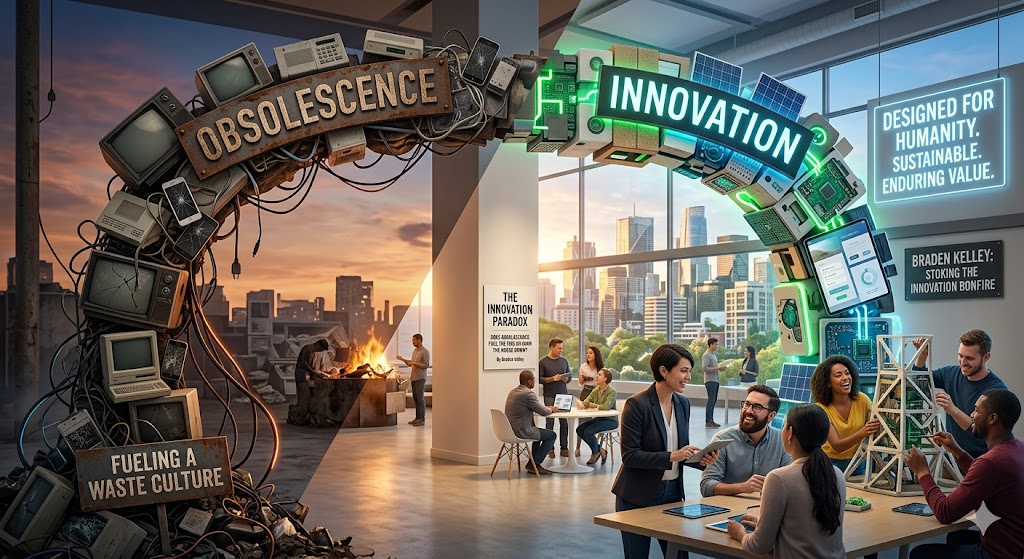
Does Planned Obsolescence Fuel the Fire or Just Burn the House Down?

The Innovation Paradox

LAST UPDATED: April 4, 2026 at 11:56 AM

Does Planned Obsolescence Fuel the Fire or Just Burn the House Down?

by Braden Kelley and Art Inteligencia


I. Introduction: The Tension Between Renewal and Waste

In the world of innovation, we often talk about the “fire” of creativity — the energy that drives us to build the next great breakthrough. But in the current industrial landscape, we must ask ourselves: are we stoking a sustainable Innovation Bonfire, or are we simply burning the furniture to keep the room warm for a single night?

Planned obsolescence has long been the silent engine of the consumer economy, a strategy designed to ensure that the products of today become the landfill of tomorrow. It creates a fundamental tension between the mechanical need for economic growth and the human-centered need for enduring value.

“To truly innovate for humanity, we must pivot from a strategy of deliberate failure to one of intentional resilience.”

As change leaders, we must recognize that planned obsolescence is an industrial-age relic masquerading as a modern innovation strategy. This article explores whether this cycle of constant replacement truly fuels progress or if it acts as a “wet blanket” that dampens our ability to solve the world’s most pressing, wicked problems.

II. The Case for the “Pro”: Obsolescence as a Catalyst for Speed

While it is easy to dismiss planned obsolescence as purely cynical, from a strategic standpoint, it has functioned as a powerful — if aggressive — accelerant for the adoption curve. By shortening the lifecycle of a product, organizations force a faster cadence of iteration. This “forced evolution” ensures that new technologies, safety standards, and efficiencies are pushed into the hands of users at a rate that a “buy-it-for-life” model simply couldn’t sustain.

Consider the following drivers that proponents argue fuel the innovation engine:

  • R&D Capitalization: The consistent revenue generated by replacement cycles provides the massive capital reserves required for “Big Bang” breakthroughs. Without the “Small Bangs” of incremental sales, the long-term, high-risk research into materials science or AI might never be funded.
  • The Velocity of “Innovation”: When a product is designed to be replaced, designers are freed from the “legacy trap.” They can experiment with radical new interfaces or hardware configurations, knowing that the next cycle provides an immediate opportunity to course-correct based on real-world human feedback.
  • The Psychology of the “New”: In our work on Stoking Your Innovation Bonfire, we recognize that emotion is a primary driver of change. The “Fashion of Tech” creates a sense of momentum. This psychological pull toward the “New” keeps markets liquid and encourages a culture of constant curiosity and upgrade.

In this light, obsolescence isn’t just about things breaking; it’s about keeping the market in motion. It prevents stagnation by ensuring that the “Stable Spine” of our infrastructure is constantly being tested and refreshed by the latest “Modular Wings” of technological advancement.

III. The Case for the “Con”: The “Wet Blankets” of Planned Obsolescence

If innovation is a fire, planned obsolescence often acts as a massive “wet blanket” — smothering the very progress it claims to ignite. When we design for failure, we aren’t just creating a product; we are creating environmental friction. The “Invisible Drain” of e-waste and resource depletion represents a systemic failure that our current economic operating system is struggling to process.

From a human-centered design perspective, the downsides extend far beyond the landfill:

  • The Erosion of Trust: A core pillar of Experience Design is the relationship between the brand and the human. When a user realizes a device was intentionally throttled or made unrepairable, it creates a “Customer Experience (CX) Betrayal.” This loss of trust is a psychological friction that makes future change adoption much harder.
  • Innovation Fatigue: There is a limit to how much “New” a human can process. When consumers feel they are on a hamster wheel of meaningless upgrades, they develop an apathy toward genuine breakthroughs. We risk a future where the “latest” no longer feels like the “greatest” — it just feels like a chore.
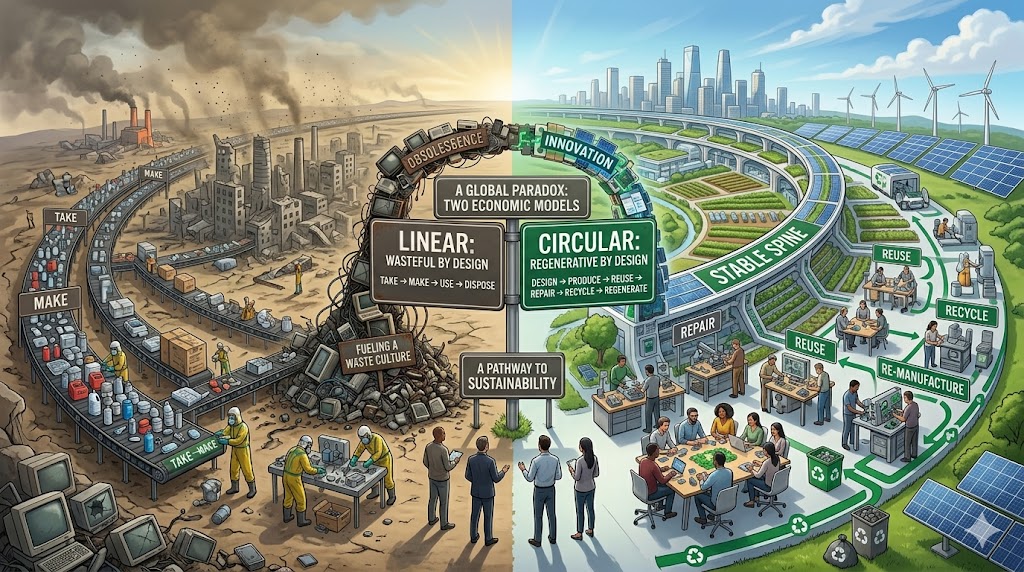
  • The Circular vs. Linear Conflict: Planned obsolescence is the hallmark of a linear economy (Take-Make-Waste). To move toward a sustainable future, innovation must embrace circularity, where products are designed as “Stable Spines” that can be updated, repaired, and kept in the ecosystem indefinitely.

Linear versus Circular Economy

By focusing our creative energy on how to make things break, we divert talent away from solving “wicked problems” — like true energy efficiency or radical durability. We are effectively choosing Quantity of Sales over Quality of Impact, a trade-off that rarely benefits humanity in the long run.

IV. The Impact on Innovation: Quality vs. Quantity

One of the most dangerous side effects of planned obsolescence is how it reshapes the innovation mindset. When a company’s primary metric for success is a yearly replacement cycle, the engineering focus shifts from transformational leaps to incremental tweaks. We find ourselves trapped in a cycle of “Innovation Theater” — releasing shiny new features that mask the lack of fundamental progress.

The shift in focus creates several systemic challenges:

  • The Maintenance Trap: In a human-centered world, we should be designing for longevity. However, planned obsolescence forces our best creative minds to spend their energy designing “points of failure” rather than points of resilience. This is a massive diversion of intellectual capital away from the wicked problems that actually matter to humanity.
  • Incrementalism vs. Transformation: If you know your product only needs to last 24 months, why solve the difficult problems of battery degradation or heat management for the long term? The “yearly release” schedule creates a treadmill effect where we are running faster but not necessarily moving further.
  • Systems Thinking Failure: We often view a product as a standalone unit, but in a connected world, every device is a node in a larger infrastructure. When we design for a short lifecycle, we create fragility in the entire system. True innovation requires a Stable Spine Audit — evaluating whether the core of our solution is robust enough to support years of evolving “Modular Wings.”

To move the needle, we must stop measuring innovation by the volume of patents or the frequency of launches. Instead, we should measure the durability of the value created. If an innovation cannot stand the test of time, is it truly an innovation, or is it just a temporary distraction?

V. Is it Good for Humanity? (The Human-Centered Audit)

When we apply a Human-Centered Audit to planned obsolescence, the results are deeply conflicted. Innovation should serve as a tool for human empowerment, yet the cycle of forced replacement often creates new forms of dependency and inequality. We must ask: are we designing for the flourishing of the person, or simply for the health of the balance sheet?

To understand the true impact on humanity, we must look at three critical dimensions:

  • The Ethics of Accessibility: Planned obsolescence often creates a “digital divide.” When software updates outpace hardware capabilities, we effectively lock out those who cannot afford to stay on the upgrade treadmill. If the tools for modern life — education, banking, and communication — require the latest hardware, then deliberate obsolescence becomes a barrier to global equity.
  • Autonomy vs. Dependency: There is a subtle shift occurring from ownership to renting. Through un-repairable hardware and “software locks,” users lose the autonomy to maintain their own tools. This creates a fragile relationship where the human is entirely dependent on the manufacturer, eroding the sense of agency that good design should foster.
  • The Prosperity Balance: Proponents point to the short-term job creation in manufacturing and the “Great American Contraction” as reasons to keep the wheels turning. However, we must weigh these temporary economic gains against the long-term cost of environmental degradation and the loss of organizational agility. A society that spends its energy replacing what it already had is a society that isn’t moving forward.

Ultimately, an innovation strategy that relies on things breaking is fundamentally at odds with a Human-Centered philosophy. If our “Innovation Bonfire” requires us to constantly toss our previous achievements into the flames just to keep the fire going, we haven’t built a fire — we’ve built an incinerator.

VI. The Path Forward: From Obsolescence to Innovation

The shift from a Linear Economy to a Circular Economy requires more than just better recycling; it requires a fundamental redesign of our innovation frameworks. We must move toward Innovation — where the value of a product remains constant or even improves over time, rather than degrading by design.

To transition from a strategy of failure to a strategy of resilience, organizations should embrace three core principles:

  • Designing for Durability: The next truly “disruptive” move in many industries isn’t adding a new sensor; it’s creating a product that lasts a decade. Durability is becoming a premium feature in a world of disposable goods. By focusing on high-quality materials and Human-Centered engineering, brands can build a legacy rather than just a quarterly report.
  • The Modular Revolution: We must apply the “Stable Spine” and “Modular Wings” philosophy to hardware. Imagine a device where the core processor (the spine) is built to last, while the specific sensors or interface components (the wings) can be swapped out as technology advances. This allows for evolution without the need for total replacement.
  • New KPIs for a New Era: We need to stop measuring success solely by unit sales. Forward-thinking companies are moving toward “Value-in-Use” and Experience Level Measures (XLMs). When a company is incentivized by how well a product performs over its entire lifecycle, the motivation to build in failure points disappears.

This isn’t just about “being green”; it’s about Organizational Agility. A company that doesn’t have to reinvent its basic hardware every twelve months can redirect its R&D energy toward solving the deep, systemic challenges that humanity actually faces. It’s time to stop stoking the bonfire with our own waste and start building a fire that truly illuminates the future.

VII. Conclusion: Stoking a Sustainable Flame

As we look toward the future of human-centered change, we must decide what kind of “Innovation Bonfire” we want to build. Is it a flash in the pan that requires the constant sacrifice of resources and consumer trust, or is it a steady, illuminating heat that powers real progress?

Planned obsolescence was a 20th-century solution to a 20th-century problem — the need for rapid industrial scale. But in an era defined by digital transformation and the “Great American Contraction,” the old rules no longer apply. To continue designing for failure is to ignore the wicked problems of our time: climate change, resource scarcity, and the erosion of human agency.

“The true measure of an innovation isn’t how many units we sold this year, but how much better the world is because that product exists ten years from now.”

My challenge to you — the executives, the designers, and the change agents — is this: Stop designing for the landfill. Start designing for the legacy. When we shift our focus from Obsolescence to Resilience, we don’t just save the planet; we save the very soul of innovation.

Let’s stop stoking the fire with our own waste and start building a future that is truly made to last.


Frequently Asked Questions

How does planned obsolescence impact human-centered innovation?

Planned obsolescence often acts as a “wet blanket” on true innovation by forcing creators to focus on incremental tweaks and deliberate failure points rather than solving “wicked problems.” From a human-centered design perspective, it erodes consumer trust and prioritizes short-term sales over long-term value and sustainability.

Can planned obsolescence ever be good for humanity?

Proponents argue it accelerates the adoption curve and provides the R&D capital necessary for major breakthroughs. However, a human-centered audit suggests these economic gains are often offset by environmental degradation, increased e-waste, and the creation of a “digital divide” where only the wealthy can afford to stay on the upgrade treadmill.

What is the alternative to planned obsolescence in design?

The primary alternative is moving toward a “Circular Economy” using a “Stable Spine” and “Modular Wings” philosophy. This involves designing products for durability and repairability, where core components last for years while specific features can be upgraded or replaced, shifting the focus from “quantity of sales” to “value-in-use.”

Image credits: Gemini

Content Authenticity Statement: The topic area, key elements to focus on, etc. were decisions made by Braden Kelley, with a little help from Gemini to clean up the article and add citations.

Subscribe to Human-Centered Change & Innovation WeeklySign up here to get Human-Centered Change & Innovation Weekly delivered to your inbox every week.

12 Conversational VoC Questions That Beat Dead Survey Forms

12 Conversational VoC Questions That Beat Dead Survey Forms

by Braden Kelley and Chateau G Pato


Which Conversational VoC Questions Beat Dead Survey Forms? (Short Answer)

Twelve conversational VoC questions that beat dead survey forms: (1) What were you trying to get done? (2) Where did it first go sideways? (3) What did that cost you? (4) What workaround did you invent? (5) Who else had to hear this story? (6) What would “made right” look like today? (7) What almost made you leave? (8) What should we stop doing? (9) Which handoff or policy broke trust? (10) What did you need to know that nobody told you? (11) Who helped — and were they allowed to finish? (12) What should we tell you next time something breaks?

A dead survey form harvests a number. A conversational VoC question invites a story you can act on — and a human who feels less alone for telling it.

Why Do Dead Survey Forms Lose to Real Questions?

Conversational VoC is listening as dialogue — adaptive prompts, messaging, voice, or short interviews in or near the moment of experience — aimed at understanding and closed-loop action, not only score capture. Dead survey forms are static questionnaires that arrive late, feel extractive, and rarely change anything the customer can see.

I have watched response rates fall while dashboards stayed confident. People did not stop having opinions. They stopped volunteering unpaid labor to a form that never proved it was listening. Soft landings for loyalty intelligence require questions that surface jobs, seams, dignity costs, and make-right — not another 1–10 scale after the heat has cooled. For the wider method shift, see Surveys Are Collapsing — Conversational and Agentic VoC.

Question Form fails Dialogue surfaces
1. Trying to get done? Score before the job Real progress they hired you for
2. First went sideways? Surveys after “resolved” First fail point
3. What did it cost? Effort scores flatten dignity Time, money, shame, trust
4. What workaround? “How easy?” hides shadow paths Design debt customers invent
5. Who else heard it? Channel scores miss seams Retelling tax
6. Made right today? Callbacks close cases Concrete recovery
7. Almost leave? Silent churn never responds Quiet-exit cliffs
8. What should we stop? Forms hunt promoters Subtraction customers need
9. What broke trust? One score collapses betrayal Unfair vs merely hard
10. What weren’t you told? Late satisfaction asks Status and expectation gaps
11. Allowed to finish? Agent scores punish care Powerless frontline moments
12. Tell you next time? “Any other comments?” junk drawer Preferred honesty for bad news

1. “What Were You Trying to Get Done When This Started?”

The question: Open on the job, not the brand or the ticket number.

Why the form fails: NPS/CSAT assume the episode is already framed. Comment boxes come after the score.

Dialogue surfaces: The real progress the human hired you for.

Ask without theater: In-channel, right after the moment — one sentence, then listen.

Closed-loop move: Tag the journey/job owner, not only a sentiment bucket.

2. “Where Did It First Go Sideways?”

The question: Find the first fail point — not the last contact.

Why the form fails: Post-close surveys fire after “resolved,” missing the spike.

Dialogue surfaces: Wrong door, unclear next step, status-less wait.

Ask without theater: “Walk me to the first moment it stopped making sense.”

Closed-loop move: Instrument that fail point. Don’t only coach the last agent.

3. “What Did That Cost You — Time, Money, Dignity, or Trust?”

The question: Name the human cost in their language.

Why the form fails: Effort scores flatten shame, fear, and unpaid homework.

Dialogue surfaces: Dignity costs and emotional residue forms never code well.

Ask without theater: Offer the dimensions; let them choose and expand.

Closed-loop move: Recovery proportional to cost — not a coupon reflex.

4. “What Workaround Did You Invent to Get Unstuck?”

The question: Archaeology of the shadow path.

Why the form fails: “How easy was it?” hides the spreadsheet, the second account, the friend who knows someone.

Dialogue surfaces: Competing hires and design debt.

Ask without theater: “What did you do that we didn’t design for?”

Closed-loop move: Kill or adopt the workaround on purpose.

5. “Who Else Did You Have to Tell This Story To?”

The question: Map the retelling tax and orphan seams.

Why the form fails: Channel scores miss bot → agent → specialist handoffs.

Dialogue surfaces: Seams with no owner.

Ask without theater: Count the tells. Thank them for the labor.

Closed-loop move: Context that travels. Seam owner named. For the beats forms miss entirely, see 8 Moments That Matter More Than Your NPS Dashboard.

6. “What Would ‘Made Right’ Look Like for You — Today?”

The question: Co-design recovery with specificity.

Why the form fails: Detractor callbacks close cases; they rarely ask for a concrete make-right.

Dialogue surfaces: The fix they will actually trust.

Ask without theater: “If we could only do one thing before end of day…”

Closed-loop move: Power to deliver that make-right — or an honest constraint.

7. “What Almost Made You Leave, Switch, or Stop Trying?”

The question: Surface the quiet-exit cliff while they’re still talking.

Why the form fails: Non-respondents and silent churn never enter the harvest.

Dialogue surfaces: Leading indicators of abandonment.

Ask without theater: Normalize the near-exit. Don’t punish honesty.

Closed-loop move: Watch unfinished jobs and repeat contact — not only scores.

8. “What Should We Stop Doing Because of What Happened?”

The question: Invite a stop, not only a fix.

Why the form fails: Forms hunt promoters; they rarely fund subtraction.

Dialogue surfaces: Policy cliffs, dark patterns, busywork the org still loves.

Ask without theater: “If you ran this place for a day, what would you kill?”

Closed-loop move: A visible stop with a date — reciprocity they can see. If your program still manages the number instead of the journey, use 11 Signs Your CX Program Is Scorekeeping, Not Sense-Making.

9. “Which Handoff or Policy Moment Broke Trust?”

The question: Separate usability friction from trust violation.

Why the form fails: One score collapses betrayal and a slow page load.

Dialogue surfaces: Fine-print cliffs, denied recovery, opaque decisions.

Ask without theater: “Was it hard — or did it feel unfair?”

Closed-loop move: Trust redesign (control, care, accountability), not only UX polish.

10. “What Did You Need to Know That Nobody Told You?”

The question: Status, next step, and expectation gaps.

Why the form fails: Timing mismatches; surveys ask satisfaction after silence already hurt.

Dialogue surfaces: Opacity as the product.

Ask without theater: “What update would have lowered your stress?”

Closed-loop move: Status-as-experience design. Proactive messaging with truth.

11. “Who Helped — and Were They Allowed to Finish the Job?”

The question: Honor frontline power — or its absence.

Why the form fails: Agent scores punish care; customers rarely get asked about mandate.

Dialogue surfaces: Powerless moments of truth.

Ask without theater: Name the human if they want; protect them from blame theater.

Closed-loop move: Recovery bands and dual scorecards — not handle-time theater. For the rulebook, see 10 Agent Empowerment Rules Your Customer Deserves Before They Quit.

12. “What Should We Tell You Next Time Something Breaks?”

The question: Co-design the future promise and alerting.

Why the form fails: “Any other comments?” is a junk drawer.

Dialogue surfaces: Preferred channel, timing, and honesty level for bad news.

Ask without theater: Close by giving them authorship of the next loop.

Closed-loop move: Preference captured. Next incident proves you heard them.

How Do You Run a Conversational Listening Check Before the Next VoC Redesign?

Before the next VoC redesign, run five go/no-go questions:

  1. Are we asking in the heat or after the harvest?
  2. Do our questions invite jobs and costs — or only scores?
  3. Who can act on what we hear this week?
  4. What will customers see that we stopped or fixed?
  5. How do we measure “felt heard,” not only response rate?

Dead forms extract. Living questions listen — and then change something.

Frequently Asked Questions

What is conversational VoC?

Conversational VoC is listening as dialogue — adaptive prompts, messaging, voice, or short interviews in or near the moment of experience — aimed at understanding and closed-loop action, not only capturing a score on a static form.

What questions should I ask instead of surveys?

Ask what they were trying to get done, where it first went sideways, what it cost them, what workaround they invented, who else had to hear the story, what “made right” looks like today, what almost made them leave, what you should stop, which handoff broke trust, what nobody told them, whether helpers were allowed to finish, and what to tell them next time something breaks.

Why are survey response rates falling?

Survey response rates are falling because forms feel extractive, arrive after the heat has cooled, mismatch how people already converse, and rarely show customers that anything changed. People still have stories — they stop volunteering unpaid labor to dead forms.

How do you run conversational VoC?

Run conversational VoC in-channel and near the moment: ask job- and cost-centered questions, follow curiosity without theater, route themes to journey owners who can act, close the loop with visible fixes or stops, and measure whether people felt heard — not only response rate.

What is the difference between VoC surveys and conversational feedback?

VoC surveys optimize for structured scores and dashboard hygiene. Conversational feedback optimizes for dialogue, context, and action — surfacing jobs, seams, dignity costs, and make-right while the experience is still hot. Scores can remain a pulse; they should not be the whole conversation.

Image credits: Pexels

Content Authenticity Statement: The topic area, key elements to focus on, etc. were decisions made by Braden Kelley, with a little help from Google Gemini and Cursor to clean up the article, add images and create infographics.

Subscribe to Human-Centered Change & Innovation WeeklySign up here to get Human-Centered Change & Innovation Weekly delivered to your inbox every week.

Top 10 Human-Centered Change & Innovation Articles of March 2026

Top 10 Human-Centered Change & Innovation Articles of March 2026Drum roll please…

At the beginning of each month, we will profile the ten articles from the previous month that generated the most traffic to Human-Centered Change & Innovation. Did your favorite make the cut?

But enough delay, here are March’s ten most popular innovation posts:

  1. Resilient Innovation — by Braden Kelley
  2. Has AI Killed Design Thinking? — by Braden Kelley
  3. Mapping Customer Experience Risk to the P&L — by Braden Kelley
  4. Moral Uncertainty Engines — by Art Inteligencia
  5. Necesita un Diagnóstico de Riesgo de Experiencia del Cliente y Fuga de Ingresos — por Braden Kelley
  6. Layoffs, AI, and the Future of Innovation — by Braden Kelley
  7. Organizational Digital Exhaust Analysis — by Art Inteligencia
  8. You Need a Customer Experience Risk & Revenue Leakage Diagnostic — by Braden Kelley
  9. Stereotypes – Are They Useful and Should We Use Them? — by Pete Foley
  10. Is There Such a Thing as a Collective Growth Mindset? — by Stefan Lindegaard

BONUS – Here are five more strong articles published in February that continue to resonate with people:

If you’re not familiar with Human-Centered Change & Innovation, we publish 4-7 new articles every week built around innovation and transformation insights from our roster of contributing authors and ad hoc submissions from community members. Get the articles right in your Facebook, Twitter or Linkedin feeds too!

Build a Common Language of Innovation on your team

Have something to contribute?

Human-Centered Change & Innovation is open to contributions from any and all innovation and transformation professionals out there (practitioners, professors, researchers, consultants, authors, etc.) who have valuable human-centered change and innovation insights to share with everyone for the greater good. If you’d like to contribute, please contact me.

P.S. Here are our Top 40 Innovation Bloggers lists from the last five years:

Subscribe to Human-Centered Change & Innovation WeeklySign up here to get Human-Centered Change & Innovation Weekly delivered to your inbox every week.

Misunderstanding Big Ideas is Very Dangerous

Misunderstanding Big Ideas is Very Dangerous

GUEST POST from Greg Satell

In 1989, just before the fall of the Berlin Wall, Francis Fukuyama published an essay in the journal The National Interest titled The End of History, which led to a bestselling book. Many took his argument to mean that, with the defeat of communism, US-style liberal democracy had emerged as the only viable way of organizing a society.

He was misunderstood. Fukuyama pointed out that even if we had reached an endpoint in the debate about ideologies, there would still be conflict because of people’s need to express their identity. What many thought to be a justification, was actually a warning to expect people to rebel against an order imposed on them.

If you believe history is on your side, you’re likely to throw caution to the wind, get mixed up in things you shouldn’t and, eventually, you’ll pay a price. That’s the problem with big ideas, their nuance is often lost on those who hear them third or fourth hand and the high-stakes game of broken telephone tends to end badly. We need to approach ideas with more care.

The Global Village

Marshal McLuhan’s book Understanding Media, was one of the most influential works of the 20th century. In it, he described media as “extensions of man” and predicted that electronic media would eventually lead to a global village. Communities would no longer be tied to a single, isolated physical space but connect and interact with others on a world stage.

To many, the rise of the Internet confirmed McLuhan’s prophecy and, after the fall of the Berlin Wall, digital entrepreneurs saw their work elevated to a sacred mission. In Facebook’s IPO filing, Mark Zuckerberg wrote, “Facebook was not originally created to be a company. It was built to accomplish a social mission — to make the world more open and connected.

Yet, importantly, McLuhan did not see the global village as a peaceful place. In fact, he predicted it would lead to a new form of tribalism and result in a “release of human power and aggressive violence” greater than ever in human history, as long separated—and emotionally charged—cultural norms would now constantly intermingle, clash and explode.

For many, if not most, people on earth, the world is often a dark and dangerous place. For predators, “open” is less of an opportunity to connect than it is a vulnerability to exploit. Things can look fundamentally different from the vantage point of, say, a tech company in Menlo Park, California then it does from, say, a secured facility in St. Petersburg.

Context matters. Our most lethal failures are less often those of planning, logic or execution than they are that of imagination. Chances are, most of the world does not see things the way we do. We need to avoid strategic solipsism and constantly question our own assumptions.

The Paradigm Shift

The term paradigm shift has become so common that we scarcely stop to think about where it came from. When Thomas Kuhn first introduced the concept in his 1962 classic The Structure of Scientific Revolutions, he described not just an event, but a process that he noticed had pervaded the history of science.

It starts with an established model, the kind we learn in school or during initial training for a career. Models become established because they are effective and the more proficient we become at applying a good model, the better we perform. We then rise through the ranks and become successful.

Yet no model is perfect and eventually anomalies show up. Initially, these are regarded as “special cases” and are worked around. However, as the number of special cases proliferate, the model becomes increasingly untenable and a crisis ensues. At this point, a fundamental change in assumptions needs to take place if things are to move forward.

However, as Kuhn noted, the shift in thinking almost never goes smoothly. Most experts cling to the old model, because that’s what made them successful in the first place. The physicist Max Planck, who helped shift a number of paradigms himself, pointed out that “a new scientific truth does not triumph by convincing its opponents and making them see the light, but rather because its opponents eventually die, and a new generation grows up that is familiar with it.”

The idea of paradigms shifting seems so hopeful and romantic that we often forget how hard it is for people’s mental models to change. The simple fact is that any time you set out to make a significant impact there will be people who won’t like it and will work to undermine you in ways that are dishonest, underhanded and deceptive.

Disruptive Innovation

In the 1990s, a newly minted professor at Harvard Business School named Clayton Christensen began studying why good companies fail. What he found was surprising. They weren’t failing because they lost their way, but rather because they were following time-honored principles taught at his institution, such as listening to their customers, investing in R&D and improving their products.

As he researched further he realized that, under certain circumstances, a market becomes over-served, the basis of competition changes and firms become vulnerable to a new type of competitor. In his 1997 book, The Innovator’s Dilemma, he coined the term disruptive technology to describe what he saw.

It was an idea whose time had come. The book became a major bestseller and Christensen the world’s top business guru. Yet many began to see disruption as more than a special case, but a mantra; an end in itself rather than a means to an end. This wasn’t, to be fair, what he envisioned, but things took on a life of themselves.

The results of all this disruption have been, by just about every measure, awful. Despite the hype, productivity growth has been depressed for most of the last 30 years. Our economy has become markedly less productive, less competitive and less dynamic, Income inequality is at levels not seen for a century and most American families are worse off.

Beware Of The Cult Of Inevitability

Big ideas are powerful because they encapsulate an essential truth. When Fukuyama wrote about “the end of history,” it really did mark a turning point in human affairs, just as Marshall McLuhan’s concept of a “global village” identified a shift in communications, Kuhn’s model of a paradigm shift helped us understand how scientific breakthroughs occur and Christensen’s ideas about disruptive innovation alerted us to dangers and opportunities we weren’t aware of.

Yet these ideas were important precisely because they described complex things. Once they rise to the level of a meme, we tend to discard the complex core and focus only on the candy shell. The concept becomes a caricature of itself, repeated so often that few stop to think about its implications and limitations, where it applies and where it does not.

The problem with big ideas is that they can seem so inevitable that we ignore human agency. If we are truly at an “end of history,” then decisions don’t really matter. A “global village” can seem like such a nice place that we ignore dangers from bad actors. If we believe we are on the right side of a “paradigm shift,” we may not notice those who are working to undermine what we are trying to achieve. “Disruption” can seem so cool we forget about the disrupted.

As Warren Berger explains in A More Beautiful Question, questions are more valuable than answers because, while answers tend to close a discussion, questions help us open new doors and can lead to genuine breakthroughs. That’s the value of big ideas. They can help us ask better questions.

But once we start looking to big ideas for answers, we stop exploring the world around us, our world constricts and, ultimately, we find that we are lost.

— Article courtesy of the Digital Tonto blog
— Image credit: Google Gemini

Subscribe to Human-Centered Change & Innovation WeeklySign up here to join 17,000+ leaders getting Human-Centered Change & Innovation Weekly delivered to their inbox every week.