Tag Archives: Iteration

Top 10 Human-Centered Change & Innovation Articles of May 2024

Top 10 Human-Centered Change & Innovation Articles of May 2024Drum roll please…

At the beginning of each month, we will profile the ten articles from the previous month that generated the most traffic to Human-Centered Change & Innovation. Did your favorite make the cut?

But enough delay, here are May’s ten most popular innovation posts:

  1. Five Lessons from the Apple Car’s Demise — by Robyn Bolton
  2. Six Causes of Employee Burnout — by David Burkus
  3. Learning About Innovation – From a Skateboard? — by John Bessant
  4. Fighting for Innovation in the Trenches — by Geoffrey A. Moore
  5. A Case Study on High Performance Teams — by Stefan Lindegaard
  6. Growth Comes From What You Don’t Have — by Mike Shipulski
  7. Innovation Friction Risks and Pitfalls — by Howard Tiersky
  8. Difference Between Customer Experience Perception and Reality — by Shep Hyken
  9. How Tribalism Can Kill Innovation — by Greg Satell
  10. Preparing the Next Generation for a Post-Digital Age — by Greg Satell

BONUS – Here are five more strong articles published in April that continue to resonate with people:

If you’re not familiar with Human-Centered Change & Innovation, we publish 4-7 new articles every week built around innovation and transformation insights from our roster of contributing authors and ad hoc submissions from community members. Get the articles right in your Facebook, Twitter or Linkedin feeds too!

Have something to contribute?

Human-Centered Change & Innovation is open to contributions from any and all innovation and transformation professionals out there (practitioners, professors, researchers, consultants, authors, etc.) who have valuable human-centered change and innovation insights to share with everyone for the greater good. If you’d like to contribute, please contact me.

P.S. Here are our Top 40 Innovation Bloggers lists from the last four years:

Subscribe to Human-Centered Change & Innovation WeeklySign up here to get Human-Centered Change & Innovation Weekly delivered to your inbox every week.

Innovation Through Experimentation

Strategies for Rapid Iteration

Innovation Through Experimentation

GUEST POST from Chateau G Pato

In today’s fast-paced and constantly evolving business landscape, innovation is the key to staying ahead of the competition. However, traditional approaches to innovation may not be enough to keep up with rapidly changing customer needs and preferences. To foster innovation, organizations must embrace a culture of experimentation and adopt strategies for rapid iteration. In this article, we will explore the importance of experimentation in driving innovation and discuss two case study examples to illustrate successful implementation.

Case Study 1: Google’s “20% Time”

One of the most famous examples of fostering innovation through experimentation is Google’s “20% time.” This initiative allows employees to spend 20% of their workweek, or one day, working on projects that interest them outside of their core responsibilities. This flexible structure encourages employees to explore new ideas and experiment with innovative solutions.

One notable outcome of Google’s 20% time is the creation of Gmail. Originally developed as an experiment by a Google engineer, the project emerged from the employee’s personal interest in improving email communication. Through rapid iteration and continuous experimentation, Gmail was refined and eventually launched as one of Google’s most successful products. This case study demonstrates how giving employees the freedom to experiment can lead to significant innovation and long-term success.

Case Study 2: Amazon’s A/B Testing

Amazon, the e-commerce giant, is renowned for its customer-centric approach and its relentless pursuit of innovation. One of the strategies Amazon uses to continuously iterate and improve its offerings is A/B testing. By testing different variations of a webpage, product listing, or feature, Amazon gathers quantitative data to make informed decisions about which version performs better. This data-driven approach allows them to quickly adapt and optimize their offerings to meet customer expectations.

An example of Amazon’s A/B testing is its product recommendation engine. By experimenting with different algorithms and design variations, Amazon continuously refines its recommendation engine to provide highly personalized and relevant product suggestions. This iterative process has played a significant role in enhancing the customer experience, boosting sales, and establishing Amazon as an industry leader.

Key Strategies for Rapid Iteration

1. Embrace Failure as Learning: Encourage a culture where failure is seen as an opportunity to learn and improve. Failure should not be punished but celebrated as a stepping stone towards success. By fostering an environment that values experimentation and risk-taking, organizations can encourage employees to think creatively and push boundaries.

2. Establish Rapid Feedback Loops: Implement processes that allow for quick feedback and iteration. Regularly gather feedback from customers, employees, and other stakeholders to identify areas for improvement. This feedback loop enables organizations to make iterative changes based on real-world data and inputs, leading to more relevant and effective solutions.

3. Set Clear Goals and Metrics: Clearly define innovation goals and establish measurable metrics to track progress. By setting concrete objectives, organizations can evaluate the success of their experiments and measure the impact on key performance indicators. This data-driven approach helps focus efforts on what truly matters and ensures that innovation initiatives align with overall business objectives.

Conclusion

Innovation through experimentation is crucial for organizations aiming to thrive in today’s rapidly changing business landscape. By adopting strategies for rapid iteration, businesses can foster a culture that encourages and celebrates innovation. The case study examples of Google’s “20% time” and Amazon’s A/B testing demonstrate how organizations can drive significant innovation by allowing employees to experiment and by leveraging quantitative data to inform decision-making. By embracing failure, establishing feedback loops, and setting clear goals and metrics, organizations can unleash their creative potential, adapt to evolving market dynamics, and stay ahead of the competition.

EDITOR’S NOTE: Braden Kelley’s Experiment Canvas™ can be a super useful FREE tool for your innovation or human-centered design pursuits.

“The Experiment Canvas™ is designed to help people instrument for learning fast in iterative new product development (NPD) or service development activities. The canvas will help you create new innovation possibilities in a more visual and collaborative way for greater alignment, accountability, and more successful outcomes.”

Image credit: misterinnovation.com

Subscribe to Human-Centered Change & Innovation WeeklySign up here to get Human-Centered Change & Innovation Weekly delivered to your inbox every week.

The Benefits of Iterative Design Thinking

The Benefits of Iterative Design Thinking

GUEST POST from Chateau G Pato

Iterative design thinking has become a critical part of many successful businesses today. This approach is focused on creating solutions that require continuous improvement, testing, and feedback. It involves taking an idea, breaking it down into small components, and then working through each component iteratively until the desired result is achieved. This method of working encourages creative problem solving and allows teams to develop ideas that are both innovative and practical.

One of the primary benefits of iterative design thinking is that it allows teams to work more efficiently. Iterative design thinking involves breaking down complex tasks into smaller, more manageable parts. This allows teams to quickly identify areas that need improvement and make changes accordingly. Additionally, teams can use iterative design thinking to test different solutions to a problem and quickly identify which one is the most effective.

Another benefit of iterative design thinking is that it encourages creative problem solving. By breaking down a problem into smaller components and working through each component iteratively, teams can come up with creative solutions that they might not have developed through traditional methods. This can help teams come up with innovative solutions to difficult problems and can help them stay ahead of their competitors.

Case Study 1: Amazon

Amazon is a prime example of a company that has successfully used iterative design thinking to improve their products and services. By breaking down complex tasks into smaller, more manageable units and then testing different solutions to each unit, Amazon has been able to quickly identify areas of improvement and develop solutions that have enabled them to stay ahead of their competitors.

For example, Amazon uses iterative design thinking to continually improve their customer experience. By breaking down customer complaints and feedback into smaller components, Amazon can quickly identify areas that need improvement and then develop solutions that will benefit their customers. This has allowed Amazon to stay ahead of their competitors and provide their customers with an exceptional experience.

Case Study 2: Apple

Apple is another excellent example of a company that has implemented iterative design thinking to great success. Apple uses iterative design thinking to rapidly develop and improve their products and services. By breaking down tasks into smaller components and then testing different solutions, Apple can quickly identify areas that need improvement and develop solutions that are both innovative and practical.

For example, Apple has used iterative design thinking to develop and improve their products. By breaking down their products into smaller components, Apple can quickly identify areas that need improvement and then develop solutions that will benefit both their customers and their business. This has allowed Apple to stay ahead of their competitors and create products that are both innovative and practical.

Conclusion

In conclusion, iterative design thinking is a powerful tool that can be used to quickly identify areas of improvement and develop solutions that are both innovative and practical. By breaking down complex tasks into smaller components and then testing different solutions, teams can come up with creative solutions to difficult problems and stay ahead of their competitors. Amazon and Apple are both excellent examples of companies that have successfully implemented iterative design thinking to great success.

SPECIAL BONUS: Braden Kelley’s Problem Finding Canvas can be a super useful starting point for doing design thinking or human-centered design.

“The Problem Finding Canvas should help you investigate a handful of areas to explore, choose the one most important to you, extract all of the potential challenges and opportunities and choose one to prioritize.”

Image credit: Unsplash

Subscribe to Human-Centered Change & Innovation WeeklySign up here to get Human-Centered Change & Innovation Weekly delivered to your inbox every week.

Beyond the Prototype – How to Test and Iterate on a Business Model

LAST UPDATED: December 10, 2025 at 12:12PM

Beyond the Prototype - How to Test and Iterate on a Business Model

GUEST POST from Chateau G Pato

The journey of innovation often starts with a flash of insight, proceeds through design thinking, and culminates in a beautiful, working prototype. Unfortunately, too many organizations mistake this technical milestone for ultimate validation. They assume that because the product works, the business model — the economic engine that funds and scales that product — will also work. This is the most dangerous assumption in the innovation lifecycle.

The business model itself is the largest, most complex hypothesis we launch. It encompasses everything from how we acquire customers and what they are willing to pay, to the cost of our key resources and the nature of our partnerships. If your revenue streams are a guess, your cost structure is a hope, and your channels are a pipe dream, your product, however well-designed, is destined for the scrap heap. In the realm of Human-Centered Innovation, we must unlearn the product-first mentality and embrace the model-first testing philosophy. This requires shifting from testing product usability to testing business viability using model-specific metrics.

The Three Hypotheses in Business Model Testing

Testing a business model means breaking it down into its core, measurable assumptions. We focus on three interconnected areas:

1. The Value Hypothesis (Customer/Value Proposition Fit)

This is the foundation: Does the product or service actually solve a problem for a defined customer segment? While prototyping addresses product usability, model testing addresses willingness-to-pay and actual usage patterns. We test whether the perceived value aligns with the revenue model.

  • Test Focus: A/B test pricing tiers (monthly vs. annual, premium vs. basic), run “smoke tests” to gauge initial sign-ups for a non-existent product, or use Concierge MVPs where services are manually delivered to deeply understand the customer journey and price sensitivity before automation.
  • Key Metric: Willingness-to-Pay (WTP), Net Promoter Score (NPS) for the specific value exchange.

2. The Growth Hypothesis (Channel/Acquisition Fit)

A great product fails if you cannot affordably get it into the hands of customers. This hypothesis tests the efficiency and scalability of your customer acquisition channels and your key partners.

  • Test Focus: Run small, contained experiments across different channels (e.g., paid social vs. SEO vs. strategic partnership referrals) to compare costs and conversion rates. Test various partner roles — do they act as distributors, co-creators, or merely service providers?
  • Key Metric: Customer Acquisition Cost (CAC), Lifetime Value (LTV), and LTV/CAC ratio. This ratio is the ultimate test of viability.

3. The Operational Hypothesis (Cost/Resource Fit)

This tests the internal engine: Can we deliver the value proposition at a cost that is significantly lower than the price we charge? This involves testing key activities, resource assumptions, and supply chain scalability.

  • Test Focus: Create a “Shadow P&L” for the new model, tracking variable costs associated with early customer acquisition and service delivery. Run controlled pilots focused on simulating the Key Activities (e.g., if a new service requires 24/7 support, test that support capability with real, paying customers for a month).
  • Key Metric: Contribution Margin, Cost of Goods Sold (COGS) as a percentage of revenue, and scalability metrics (e.g., cost to serve the 10th customer vs. the 100th customer).

Case Study 1: The Subscription Anchor That Was Cut

Challenge: Failed Launch of a Health-Tech Diagnostic Device

A medical device company (“MedTrack”) developed a portable diagnostic device. The initial prototype was technically perfect, but the business model relied on a mandatory high-cost monthly subscription for data analysis software. The subscription revenue stream was designed to create recurring revenue and offset the low upfront device cost.

Model Testing Intervention: Value Hypothesis Pivot

Initial pilot testing revealed that while customers loved the device, the high subscription created massive churn after the first year. MedTrack tested the Value Hypothesis:

  • Hypothesis 1 (Failed): Customers will pay $150/month for comprehensive data analysis.
  • Test: Offer three options: $150/month (current model), $25/month for basic data (new tier), and a $1,500 one-time software license.

The Innovation Impact:

The test showed that the $25/month basic data tier attracted 80% of new customers and had 95% retention. The $1,500 one-time fee also proved attractive to institutional buyers. By iterating on the Revenue Stream (a key business model block) from a rigid subscription to a tiered and licensed model, MedTrack dramatically improved its LTV/CAC ratio. They realized their innovation wasn’t the device; it was the flexibility of the pricing model tailored to different customer segments, a critical element of Human-Centered Innovation.

Case Study 2: Testing the Delivery Channel of Services

Challenge: Scaling an Expensive B2B Consulting Service

A strategy firm (“StratX”) wanted to scale a high-value, bespoke market entry strategy service without proportionally increasing its headcount — a severe constraint in its Cost Structure block. Their initial Growth Hypothesis relied on high-touch, senior consultant sales.

Model Testing Intervention: Growth and Operational Hypothesis Test

StratX decided to test replacing the expensive consultant delivery with a technology-augmented channel. They ran an A/B test on their target customer segment:

  • Group A (Control): Full senior consultant engagement (high Cost Structure, high Revenue Stream).
  • Group B (Test): A “Hybrid Model” where the initial 80% of the strategy report was generated by AI/data science tools (saving Key Activities cost), followed by a single senior consultant review session (low Cost Structure, slightly reduced Revenue Stream).

The Innovation Impact:

The Hybrid Model achieved an LTV/CAC ratio that was300% higher than the Control Group. Customers in Group B were highly satisfied with the speed and data quality, accepting a slightly lower consultant touchpoint for a lower price and faster delivery. StratX had successfully validated a new, highly scalable Key Resource (the data science platform) and a new Channel, allowing the firm to expand its addressable market and free up expensive senior consultants for truly bespoke, complex client needs. This proved that innovation in service delivery is a critical component of the business model.

Conclusion: Business Model Validation is the Ultimate De-Risking

The successful launch of any new initiative, particularly in the realm of radical innovation, is determined long after the prototype is functional. It is determined by the rigor with which you test and iterate on your business model hypotheses. By dissecting your model into its core assumptions — Value, Growth, and Operational — and designing measurable experiments (MVPs, A/B tests, Shadow P&Ls), you move from guessing to knowing. This structured approach, rooted in Human-Centered Innovation, shifts the risk from catastrophic failure at launch to manageable learning throughout development. Stop perfecting the product; start proving the model.

“If your product is a masterpiece but your business model is a mystery, you have a hobby, not an innovation.”

Frequently Asked Questions About Business Model Testing

1. What is the difference between testing a product and testing a business model?

Testing a product focuses on usability, functionality, and desirability (e.g., does the app work, do people like the color?). Testing a business model focuses on viability and scalability (e.g., are people willing to pay enough for the app to cover the cost of acquiring them and running the service?).

2. What is a “Shadow P&L” in the context of innovation?

A Shadow P&L (Profit and Loss) is a separate, simulated financial statement created specifically for an innovation project. It tracks the real-world costs and simulated revenues associated with the new business model during the testing phase. It helps the team validate their Cost Structure and Revenue Stream hypotheses before integrating the project into the main corporate finances.

3. How do you test a distribution channel without a full launch?

Distribution channels can be tested using small, contained experiments. For instance, testing a partnership channel can involve a single pilot partner with clear, measurable KPIs (conversion rates, lead quality). Testing a direct-to-consumer channel can use A/B testing of targeted digital ads to measure Customer Acquisition Cost (CAC) without building out the entire logistics infrastructure.

Your first step toward model testing: Take your most promising new idea, map it onto a Business Model Canvas, and circle the three riskiest assumptions in the “Revenue Streams,” “Cost Structure,” and “Key Activities” blocks. Design one small, cheap experiment for each of those three assumptions next week.

Extra Extra: Because innovation is all about change, Braden Kelley’s human-centered change methodology and tools are the best way to plan and execute the changes necessary to support your innovation and transformation efforts — all while literally getting everyone all on the same page for change. Find out more about the methodology and tools, including the book Charting Change by following the link. Be sure and download the TEN FREE TOOLS while you’re here.

Image credit: Unsplash

Subscribe to Human-Centered Change & Innovation WeeklySign up here to get Human-Centered Change & Innovation Weekly delivered to your inbox every week.

Eight I’s of Infinite Innovation

Eight I's of Infinite Innovation

Some authors talk about successful innovation being the sum of idea plus execution, others talk about the importance of insight and its role in driving the creation of ideas that will be meaningful to customers, and even fewer about the role of inspiration in uncovering potential insight. But innovation is all about value and each of the definitions, frameworks, and models out there only tell part of the story of successful innovation.

To achieve sustainable success at innovation, you must work to embed a repeatable process and way of thinking within your organization, and this is why it is important to have a simple common language and guiding framework of infinite innovation that all employees can easily grasp. If innovation becomes too complex, or seems too difficult then people will stop pursuing it, or supporting it.

Some organizations try to achieve this simplicity, or to make the pursuit of innovation seem more attainable, by viewing innovation as a project-driven activity. But, a project approach to innovation will prevent it from ever becoming a way of life in your organization. Instead you must work to position innovation as something infinite, a pillar of the organization, something with its own quest for excellence – a professional practice to be committed to.

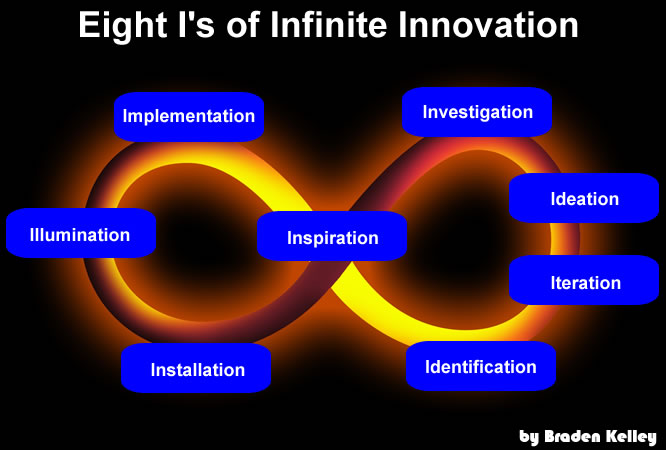
So, if we take a lot of the best practices of innovation excellence and mix them together with a few new ingredients, the result is a simple framework organizations can use to guide their sustainable pursuit of innovation – the Eight I’s of Infinite Innovation. This new framework anchors what is a very collaborative process. Here is the framework and some of the many points organizations must consider during each stage of the continuous process:

1. Inspiration

  • Employees are constantly navigating an ever changing world both in their home context, and as they travel the world for business or pleasure, or even across various web pages in the browser of their PC, tablet, or smartphone.
  • What do they see as they move through the world that inspires them and possibly the innovation efforts of the company?
  • What do they see technology making possible soon that wasn’t possible before?
  • The first time through we are looking for inspiration around what to do, the second time through we are looking to be inspired around how to do it.
  • What inspiration do we find in the ideas that are selected for their implementation, illumination and/or installation?

2. Investigation

  • What can we learn from the various pieces of inspiration that employees come across?
  • How do the isolated elements of inspiration collect and connect? Or do they?
  • What customer insights are hidden in these pieces of inspiration?
  • What jobs-to-be-done are most underserved and are worth digging deeper on?
  • Which unmet customer needs that we see are worth trying to address?
  • Which are the most promising opportunities, and which might be the most profitable?

3. Ideation

  • We don’t want to just get lots of ideas, we want to get lots of good ideas
  • Insights and inspiration from first two stages increase relevance and depth of the ideas
  • We must give people a way of sharing their ideas in a way that feels safe for them
  • How can we best integrate online and offline ideation methods?
  • How well have we communicated the kinds of innovation we seek?
  • Have we trained our employees in a variety of creativity methods?

4. Iteration

  • No idea emerges fully formed, so we must give people a tool that allows them to contribute ideas in a way that others can build on them and help uncover the potential fatal flaws of ideas so that they can be overcome
  • We must prototype ideas and conduct experiments to validate assumptions and test potential stumbling blocks or unknowns to get learnings that we can use to make the idea and its prototype stronger
  • Are we instrumenting for learning as we conduct each experiment?

Eight I's of Infinite Innovation

5. Identification

  • In what ways do we make it difficult for customers to unlock the potential value from this potentially innovative solution?
  • What are the biggest potential barriers to adoption?
  • What changes do we need to make from a financing, marketing, design, or sales perspective to make it easier for customers to access the value of this new solution?
  • Which ideas are we best positioned to develop and bring to market?
  • What resources do we lack to realize the promise of each idea?
  • Based on all of the experiments, data, and markets, which ideas should we select?

You’ll see in the framework that things loop back through inspiration again before proceeding to implementation. There are two main reasons why. First, if employees aren’t inspired by the ideas that you’ve selected to commercialize and some of the potential implementation issues you’ve identified, then you either have selected the wrong ideas or you’ve got the wrong employees. Second, at this intersection you might want to loop back through the first five stages though an implementation lens before actually starting to implement your ideas OR you may unlock a lot of inspiration and input from a wider internal audience to bring into the implementation stage.

6. Implementation

  • What are the most effective and efficient ways to make, market, and sell this new solution?
  • How long will it take us to develop the solution?
  • Do we have access to the resources we will need to produce the solution?
  • Are we strong in the channels of distribution that are most suitable for delivering this solution?

7. Illumination

  • Is the need for the solution obvious to potential customers?
  • Are we launching a new solution into an existing product or service category or are we creating a new category?
  • Does this new solution fit under our existing brand umbrella and represent something that potential customers will trust us to sell to them?
  • How much value translation do we need to do for potential customers to help them understand how this new solution fits into their lives and is a must-have?
  • Do we need to merely explain this potential innovation to customers because it anchors to something that they already understand, or do we need to educate them on the value that it will add to their lives?

8. Installation

  • How do we best make this new solution an accepted part of everyday life for a large number of people?
  • How do we remove access barriers to make it easy as possible for people to adopt this new solution, and even tell their friends about it?
  • How do we instrument for learning during the installation process to feedback new customer learnings back into the process for potential updates to the solution?

Conclusion

The Eight I’s of Infinite Innovation framework is designed to be a continuous learning process, one without end as the outputs of one round become inputs for the next round. It’s also a relatively new guiding framework for organizations to use, so if you have thoughts on how to make it even better, please let me know in the comments. The framework is also ideally suited to power a wave of new organizational transformations that are coming as an increasing number of organizations (including Hallmark) begin to move from a product-centered organizational structure to a customer needs-centered organizational structure. The power of this new approach is that it focuses the organization on delivering the solutions that customers need as their needs continue to change, instead of focusing only on how to make a particular product (or set of products) better.

So, as you move from the project approach that is preventing innovation from ever becoming a way of life in your organization, consider using the Eight I’s of Infinite Innovation to influence your organization’s mindset and to anchor your common language of innovation. The framework is great for guiding conversations, making your innovation outputs that much stronger, and will contribute to your quest for innovation excellence – so give it a try.

Download as a PDF

Haga clic aquí para la versión en Español

Subscribe to Human-Centered Change & Innovation WeeklySign up here to get Human-Centered Change & Innovation Weekly delivered to your inbox every week.