Tag Archives: empathy

Are Innovation and Empathy in the Cards?

As part of the leadership team for a new human-centered problem-solving offering for select Oracle customers, I’m always on the lookout for new tools to integrate into our flexible problem-solving process to help clients innovate, grow or transform.

Because our dynamic team of experienced professionals has a diverse range of knowledge, skills and abilities we’re able to co-create solutions to a wide range of business challenges and leverage a wide variety of tools. This means I’m always on the lookout for new tools to better serve our clients, in addition to pursuing my hobby of creating new tools and methodologies in my spare time throughout my career.

My passion for empowering others to succeed in overcoming their business challenges has led to the publishing of two business best-sellers Stoking Your Innovation Bonfire (John Wiley & Sons, 2010) and Charting Change (Palgrave Macmillan, 2016), and the creation of the powerful, visual and collaborative Change Planning Toolkit™, my Nine Innovation Roles™ card deck, and the Human-Centered Innovation Toolkit™ (featuring tools like The Experiment Canvas™).

I create new tools, methodologies and frameworks when I see opportunities to make people more efficient and effective in their jobs and leverage the work of others when I find others have created good solutions. I leverage the Business Model Canvas for business model prototyping, I leverage The Play-to-Win Strategy Canvas v3.0 to help people work through strategic choices, along with other tools when the challenge is appropriate.

Recently I have been looking at a variety of card decks to evaluate their suitability to use alongside design thinking and other methodologies that form the basis of the Oracle FUEL approach.

Here are a few I’ve been evaluating lately:
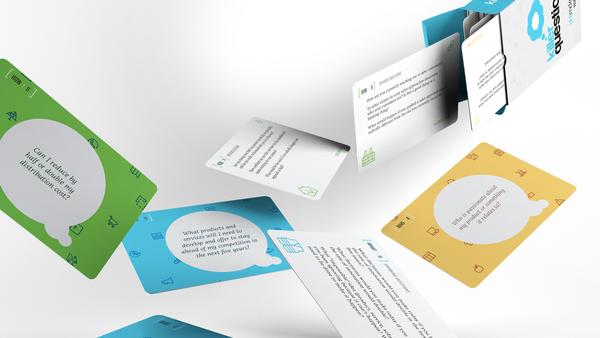
Killer Questions Cards

1. Killer Questions – Volume 1 from Phil McKinney, author of Beyond the Obvious and CEO of CableLabs
(More info at https://innovation.tools/)

Brainstorming is a fairly useless exercise the way that most people facilitate it. There are much more effective ways to get ideas and most of the approaches that work better share at their core a more targeted and collaborative approach. The Killer Questions card deck is composed of just that, a collection of questions if left unanswered or unexplored, could lead to blind spots and disruption opportunities for new entrants (or your competition). The questions are categorized into three types:

  1. Who
  2. What
  3. How

And the questions include things like:

  • Who does not use my product because of my assumptions about their skill or ability
  • What emotional, psychological, or status benefits could people derive from using my product?
  • How could users avoid interacting with my product or service but still get the same value?

But the cards don’t just contain a single question. These are examples of guiding questions on the front of a few cards, but on the back of each card you will also find 3-5 supporting questions to help your team explore the guiding question more fully.

Overall, I consider the cards a useful tool for groups including: product teams wanting to continuously stretch themselves as they revaluate product direction, or for expanded innovation teams looking to broaden their search horizons.

Innovation Deck cards by Andrey Schukin

2. The Innovation Deck by Andrey Schukin, CTO at Interprefy AG
(More info at http://www.innovationfast.com/)

Where the Killer Questions deck is organized around questions, The Innovation Deck is organized around topics/tactics and triggers. For each topic/tactic there is either a set of instructions or a set of questions.

The Innovation Deck is composed of three different types of cards that will help you:

  1. Examine
  2. Explore
  3. Evaluate

Examine Card example:

EMOTION

  • People don’t buy things they need. They buy things they want.
  • How do you make sure that the product will trigger an emotional response from the customer?
  • What elements of your product will make the customer want to use it?

I would almost include the triggers cards as a fourth card type, because instead of a topic and questions the cards have a collection of words to see if any of the words inspire thought or conversations rather than giving people a guiding topic or tactic.

Overall, I consider these cards as a useful tool for product teams looking at a product to challenge or stretch the existing product direction for the future.
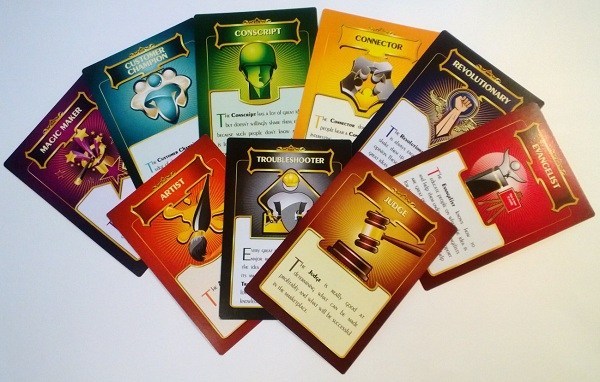
Nine Innovation Roles cards from Braden Kelley

3. Nine Innovation Roles – a card deck by Braden Kelley, author of Stoking Your Innovation Bonfire
(More info at http://9roles.com)

The following is an excerpt from my book that explains some of the thinking behind The Nine Innovation Roles™:

“Too often we treat people as commodities that are interchangeable and maintain the same characteristics and aptitudes. Of course, we know that people are not interchangeable, yet we continually pretend that they are anyway — to make life simpler for our reptile brain to comprehend. Deep down we know that people have different passions, skills, and potential, but even when it comes to innovation, we expect everybody to have good ideas.

I’m of the opinion that all people are creative, in their own way. That is not to say that all people are creative in the sense that every single person is good at creating lots of really great ideas, nor do they have to be. I believe instead that everyone has a dominant innovation role at which they excel, and that when properly identified and channeled, the organization stands to maximize its innovation capacity. I believe that all people excel at one of nine innovation roles, and that when organizations put the right people in the right innovation roles, that your innovation speed and capacity will increase.”

The Nine Innovation Roles™ are:

  1. Revolutionary
  2. Conscript
  3. Connector
  4. Artist
  5. Customer Champion
  6. Troubleshooter
  7. Judge
  8. Magic Maker
  9. Evangelist

To make my Nine Innovation Roles™ framework accessible to as many people as possible inside organizations all around the world to explore and improve innovation team dynamics and success, I am happy to announce that I have now made the print-ready files for the cards available here for FREE download, and you can either work with the vendor I use – adMagic – or work with a local printer in your part of the world.
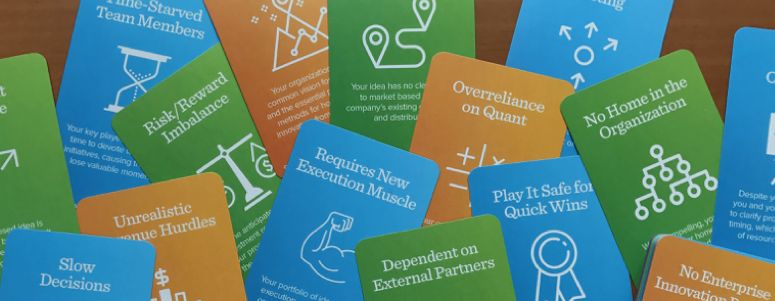
LPK Roadblocks Cards

4. LPK Roadblocks by LPK, a brand and innovation consultancy
(More info at https://roadblocks.lpklab.com/)

The LPK Roadblocks deck is focused on innovation roadblocks and helping organizations whose innovation efforts might have stalled, get unstuck. There are six kinds of cards in the deck:

  1. Voting cards
  2. Question cards
  3. Create Your Own Roadblock cards
  4. Organization Roadblocks
  5. Project Roadblocks
  6. Idea Roadblocks

There are two main ways to use the cards, with selection and voting integrated into both:

  1. Root Cause Discovery
  2. Beginning, Middle and End

Organization Roadblocks include things like “Unrealistic Revenue Hurdles” and “Lip-Service Leadership,” while Project Roadblocks including things like “Untested Assumptions” and “Unclear Objectives”, while Idea Roadblocks include things like “Risk/Reward Imbalance” and “No Route to Market.”

Overall, I find these cards to be a useful tool when you run into a client that says they are struggling to innovate or that they’re not innovating as much as they’d like.
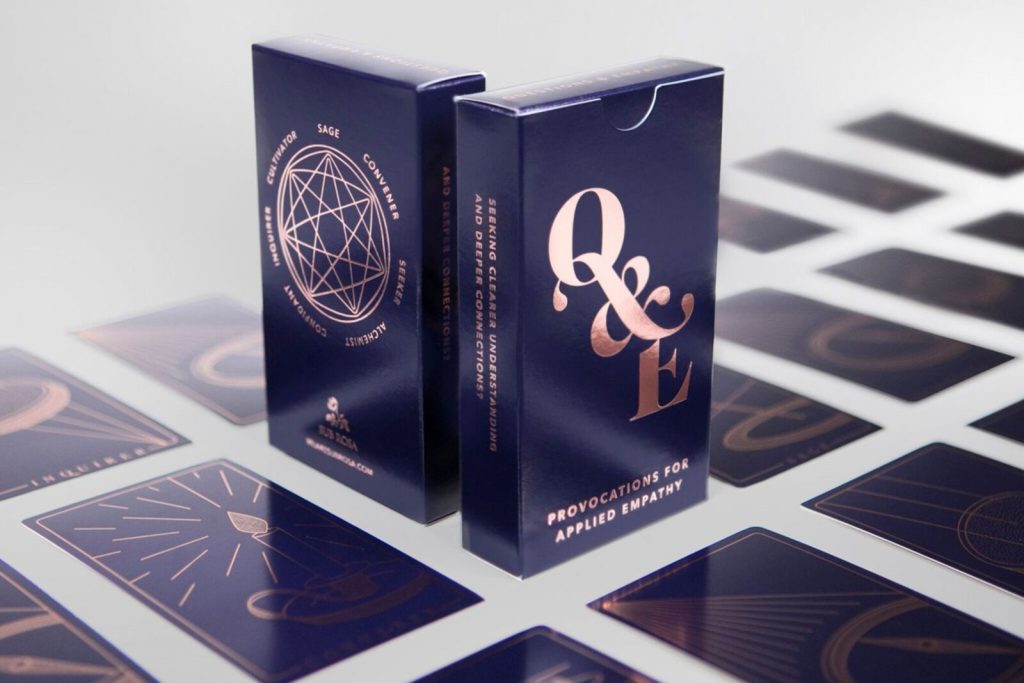
Questions & Empathy Cards

5. Questions & Empathy – a card deck by SubRosa, a brand strategy and design practice
(More info at https://www.questionsandempathy.com/)

SubRosa’s Questions & Empathy cards are composed of seven empathy archetype cards and a set of exploratory questions for each archetype. The seven archetypes are:

  1. Sage
  2. Inquirer
  3. Convener
  4. Alchemist
  5. Confidant
  6. Seeker
  7. Cultivator

Overall, I find these cards to be a useful tool for better understanding yourself and your own empathetic style and over time they could help you approach empathy from more angles than you would without them, but I struggle to see as is how they can actually help you practice applied empathy. The archetypes are useful, but I think I might create my own question cards to help my team better apply empathy within the empathize/understand phase of design thinking.

Conclusion

Whether you’re trying to innovate or just to build up your empathy muscles, I hope you see that there are some great, extremely portable resources to help with either. Of course, there are other card decks out there, but these will give you a few to explore and see whether there is a fit for your design thinking or innovation undertakings. If you’re pursuing a digital transformation or business transformation you can:

If you missed the links to the cards decks above, here they are again:

  1. Killer Questions – Volume 1
  2. The Innovation Deck
  3. Nine Innovation Roles (English/Spanish/Swedish)
  4. LPK Roadblocks
  5. Questions & Empathy


Accelerate your change and transformation success

Subscribe to Human-Centered Change & Innovation WeeklySign up here to get Human-Centered Change & Innovation Weekly delivered to your inbox every week.

The Role of Empathy in Human-Centered Design

The Role of Empathy in Human-Centered Design

GUEST POST from Art Inteligencia

The concept of empathy has gained traction in recent years. Empathy is typically defined as the capacity to understand or feel what another person is experiencing and to share their feelings. In the design world, empathy is often heralded as the one tool that can help create truly human-centered designs. This article looks at the role of empathy in the context of human-centered design (HCD) and provides case study examples of companies that have successfully leveraged empathy to design user experiences that truly resonated with their users.

The concept of HCD is built on understanding the user on a deeper level. It is more than just understanding a user’s demographic characteristics or their technical needs. HCD seeks to understand the user’s emotions, their values, and their aspirations. It is an approach that seeks to craft user experiences that are not only practical, but also emotionally rewarding. Empathy is the key tool for unlocking the potential of HCD.

At its heart, empathy is about understanding and caring deeply for users and their experiences. Designers must be willing to go beyond just understanding the technical requirements of a user and instead strive to understand the value they add to their lives. To effectively leverage empathy for HCD, designers must have an understanding of the user that goes beyond just demographics or data points. They must be willing to dive deep into the holistic user experience – from their beliefs to their motivations, their joys and their fears – and create designs that acknowledge all these different facets of a user.

Empathy can be used to create experiences that are tailored to the individual user. Just as different users have different needs and values, different designs can be crafted to address different users’ needs and aspirations. Through this approach, designers can create experiences that are truly tailored to each individual user, and this is the heart of HCD.

To better illustrate how empathy can be used to create human-centered designs, here are two case study examples:

Case Study 1 – Airbnb

Airbnb’s success is largely attributed to its ability to create user experiences that are both practical and emotionally engaging. Through their empathy-driven approach, they have created a platform that deeply connects users with each other and allows for personalized experiences. For example, Airbnb’s “Experience” service provides users the opportunity to explore the cities they visit with unique experiences tailored to their individual interests.

Case Study 2 – Apple

Apple is a company that understands the importance of empathy in design. Their products have long been known for their user-friendly interfaces and thoughtful user experience design. Through their empathy-driven design approach, they have crafted products that are so intuitive to use that they have become a household name.

These case studies demonstrate how the use of empathy in design can result in user experiences that users truly love. By taking the time to understand and honor the individual user, designers can create designs that truly resonate with their users.

Conclusion

Empathy is a powerful tool for design that can be used to create user experiences that are both practical and emotionally rewarding. It is the key to unlocking the potential of human-centered design, and companies such as Airbnb and Apple have demonstrated the immense potential of empathy for creating truly user-centric experiences.

SPECIAL BONUS: Braden Kelley’s Problem Finding Canvas can be a super useful starting point for doing design thinking or human-centered design.

“The Problem Finding Canvas should help you investigate a handful of areas to explore, choose the one most important to you, extract all of the potential challenges and opportunities and choose one to prioritize.”

Image credit: Pexels

Subscribe to Human-Centered Change & Innovation WeeklySign up here to get Human-Centered Change & Innovation Weekly delivered to your inbox every week.
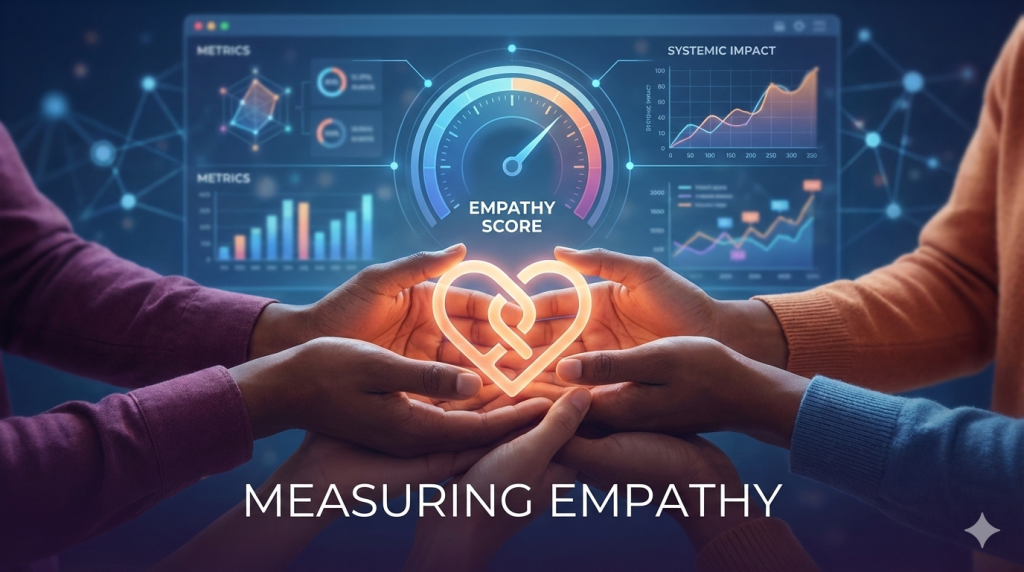
Metrics for Systemic Human-Centered Design Success

Measuring Empathy

LAST UPDATED: December 23, 2025 at 1:51PM

Metrics for Systemic Human-Centered Design Success

GUEST POST from Chateau G Pato

Empathy is frequently praised and rarely operationalized. In too many organizations, it lives in sticky notes, inspirational posters, and kickoff workshops — disconnected from how decisions are actually made. As human-centered design matures from a project-level practice into an enterprise capability, empathy must become measurable, repeatable, and systemic.

Measuring empathy is not about stripping humanity from design. It is about ensuring that human understanding survives scale, complexity, and quarterly pressure.

Re-framing Empathy as a Capability

Empathy is often misunderstood as an individual trait. In reality, sustainable empathy is an organizational capability supported by structures, incentives, and feedback loops. The question leaders should ask is not “Are our designers empathetic?” but rather “Does our system consistently produce empathetic outcomes?”

Metrics provide the answer.

A Practical Empathy Measurement Framework

1. Human Insight Integrity

These metrics assess whether decisions are grounded in real human understanding:

  • Percentage of strategic initiatives informed by primary research
  • Recency of customer insights used in decisions
  • Inclusion of marginalized or edge users

Outdated or secondhand insights are a hidden empathy killer.

2. Experience Friction Reduction

Empathy should reduce unnecessary effort and stress:

  • Time-on-task improvements
  • Drop-off and abandonment rates
  • Emotion-based experience ratings

3. Organizational Behavior Change

Look for evidence that empathy is shaping behavior:

  • Frequency of cross-functional research participation
  • Leadership presence in customer interactions
  • Reuse of validated insights across teams

4. Long-Term System Health

At scale, empathy improves system resilience:

  • Reduction in rework and failure demand
  • Employee engagement and retention
  • Trust and loyalty over time

“Empathy is not proven by how deeply we feel in a workshop, but by how consistently our systems change behavior in the real world. If you can’t measure that change, empathy remains a belief instead of a capability.”

Braden Kelley

Case Study 1: Retail Banking Transformation

A large retail bank invested heavily in digital channels but continued to see declining trust. By introducing empathy metrics focused on customer anxiety and clarity, the bank discovered that customers felt overwhelmed rather than empowered.

Design teams simplified language, reduced choice overload, and measured success through emotional confidence indicators. Within eighteen months, complaint volume dropped while product adoption increased — a clear signal of systemic empathy at work.

Case Study 2: Public Transportation Services

A metropolitan transit authority applied empathy metrics to rider experience. Beyond punctuality, they measured perceived safety, clarity of wayfinding, and stress during disruptions.

By addressing emotional pain points and tracking their reduction, the authority improved satisfaction without major infrastructure investment, proving that empathy can outperform capital expenditure.

Embedding Empathy into Governance

Empathy metrics only matter if they influence decisions. Leading organizations embed them into:

  • Executive dashboards
  • Investment prioritization
  • Performance reviews

When empathy metrics sit alongside financial and operational metrics, they shape trade-offs instead of reacting to them.

The Future of Human-Centered Measurement

As AI and automation accelerate, empathy will become a primary differentiator. Organizations that can measure and manage it will design systems that are not only efficient, but humane.

The goal is not perfect empathy. The goal is continuous human understanding at scale.

Frequently Asked Questions

FAQ

Why are empathy metrics necessary?
They ensure human needs remain visible and actionable as organizations scale.

Do empathy metrics replace qualitative research?
No. They amplify and sustain qualitative insights over time.

What is the first empathy metric to implement?
Track how often real customer insights directly inform decisions.

Extra Extra: Because innovation is all about change, Braden Kelley’s human-centered change methodology and tools are the best way to plan and execute the changes necessary to support your innovation and transformation efforts — all while literally getting everyone all on the same page for change. Find out more about the methodology and tools, including the book Charting Change by following the link. Be sure and download the TEN FREE TOOLS while you’re here.

Image credits: Pixabay, Google Gemini

Subscribe to Human-Centered Change & Innovation WeeklySign up here to get Human-Centered Change & Innovation Weekly delivered to your inbox every week.

Innovation Quotes of the Day – April 30, 2012


“Albert Einstein wrote, ‘Everybody is a genius! But if you judge a fish by its ability to climb a tree, it will live its whole life believing that it is stupid!’
We are all capable of doing one thing better than any other person alive at this time in history!”

– Matthew Kelly


“In order for innovation to reliably happen at every level of the organization, it will be extremely useful for all members to have access to the voice of the customer.”

– Braden Kelley


“Imagination is not only the uniquely human capacity to envision that which is not, and therefore the fount of all invention and innovation. In its arguably most transformative and revelatory capacity, it is the power to that enables us to empathize with humans whose experiences we have never shared.”

– J.K. Rowling


What are some of your favorite innovation quotes?

Add one or more to the comments, listing the quote and who said it, and I’ll share the best of the submissions as future innovation quotes of the day!

Subscribe to Human-Centered Change & Innovation WeeklySign up here to get Human-Centered Change & Innovation Weekly delivered to your inbox every week.