Tag Archives: change resistance

Change Resistance: Addressing Common Barriers and Overcoming Employee Pushback

Change Resistance: Addressing Common Barriers and Overcoming Employee Pushback

GUEST POST from Chateau G Pato

In today’s dynamically evolving business landscape, organizations are faced with a constant need to adapt and embrace change in order to stay competitive. However, change initiatives often encounter resistance from employees, leading to delays and potentially derailing the desired outcomes. Understanding the common barriers to change and implementing strategies to address them is essential for effective change management. This article explores two case studies that illustrate how organizations successfully overcame employee pushback during transformative change endeavors.

Case Study 1: Implementing a New Performance Management System

Company X, a global technology firm, decided to revamp its performance management system to align with their updated business objectives. The organization aimed to encourage a culture of regular feedback and continuous improvement. Recognizing the resistance that the change might evoke, the management team took proactive steps to minimize employee pushback.

Firstly, the company ensured transparency and clarity by communicating the rationale behind the change. They conducted workshops and town hall meetings to explain how the new system would help employees grow professionally and benefit the organization as a whole. This transparent approach enabled employees to grasp the purpose of the change, which reduced uncertainty and resistance.

Secondly, they involved employees in the process by inviting feedback and suggestions. By incorporating their input, the organization demonstrated a genuine commitment to engaging employees and valuing their opinions. This inclusive strategy not only addressed employee concerns but also fostered a sense of ownership among employees, leading to higher acceptance of the new system.

Lastly, the company offered comprehensive training programs to help employees adapt to the change successfully. By providing resources and support, the organization minimized the fear of the unknown and empowered employees to embrace the new performance management system confidently. Regular check-ins and support forums were also established to provide ongoing assistance.

The combined efforts resulted in a smooth transition with minimal resistance. Employees gradually recognized the benefits of the new system, such as increased collaboration and individual growth opportunities. The successful implementation demonstrated that addressing common barriers and involving employees can drive positive change outcomes.

Case Study 2: Shifting to Remote Work during the COVID-19 Pandemic

Organization Y, a mid-sized consulting firm, faced the daunting challenge of transitioning its workforce to remote work amidst the COVID-19 pandemic. While the magnitude of the global crisis was beyond anyone’s control, the management team anticipated the potential resistance from employees during such a sudden transformation.

To overcome employee pushback, the company took proactive measures to support its employees’ transition to remote work. The first step was to ensure open and transparent communication channels. Frequent virtual meetings were conducted to address concerns, provide updates, and clarify expectations. This continuous dialogue improved employee morale and reduced anxiety about the uncertainties associated with remote work.

Understanding that remote work would alter the dynamics of collaboration, the organization invested in collaborative tools and technologies. Platforms like Microsoft Teams and Zoom were introduced to facilitate seamless virtual communication, ensuring effective teamwork and maintaining a sense of connection among employees.

To combat the potential feelings of isolation, the company also organized virtual team-building events, such as online happy hours and game nights. These activities helped foster a sense of camaraderie and provided an emotional support system during a challenging time.

Through these efforts, Organization Y successfully minimized employee resistance and maintained productivity during the transition to remote work. The crisis ultimately pushed the organization to adopt more flexible work practices, resulting in increased employee satisfaction and reduced operational costs.

Conclusion

Change resistance is an inevitable component of any transformative journey, but it does not have to hinder progress. By acknowledging common barriers, understanding employee concerns, and implementing strategies like transparent communication, employee involvement, and ongoing support, organizations can successfully overcome pushback. The case studies of Company X and Organization Y demonstrate that addressing resistance can lead to positive change outcomes and foster a resilient organizational culture capable of embracing future transformations.

EDITOR’S NOTE: Braden Kelley’s Problem Finding Canvas can be a super useful starting point for doing design thinking or human-centered design.

“The Problem Finding Canvas should help you investigate a handful of areas to explore, choose the one most important to you, extract all of the potential challenges and opportunities and choose one to prioritize.”

Image credit: Unsplash

Subscribe to Human-Centered Change & Innovation WeeklySign up here to get Human-Centered Change & Innovation Weekly delivered to your inbox every week.

Overcoming Resistance to Change

Offering Strategies and Techniques for Identifying and Addressing Resistance to Change, Ensuring Smoother Transitions

Overcoming Resistance to Change

GUEST POST from Chateau G Pato

Change is inevitable in any organization, and yet many leaders find themselves battling resistance when attempting to implement new initiatives. Resistance to change stems from a variety of reasons, including fear of the unknown, lack of trust in leadership, and perceived threats to job security. However, with the right strategies and techniques, leaders can effectively identify and address resistance, leading to smoother transitions and increased organizational success. In this article, we will explore two case study examples to provide practical insights into overcoming resistance to change.

Case Study Example 1: The Sales Department’s Shift to Digital Platforms

In a mid-sized retail company, the sales department was reluctant to embrace digital platforms for customer engagement, despite the clear advantages it offered. Many sales representatives were comfortable with traditional methods and feared that digital adoption would render their roles obsolete. To address this resistance, the leadership implemented the following strategies:

1. Effective Communication: The first step was to communicate the benefits of digital platforms for both the company and sales representatives personally. Leaders explained how digital tools could enhance sales efficiency, generate more leads, and open doors to new markets. Additionally, interactive workshops were conducted to alleviate concerns and answer questions, creating a safe space for open dialogue.

2. Training and Support: Recognizing that resistance often stems from a lack of knowledge or skills, the company provided comprehensive training on digital tools. This training empowered sales representatives with the necessary skills to navigate the new platforms confidently. Ongoing support, including real-time troubleshooting and feedback sessions, further fostered a sense of security among the sales team.

As a result of these strategies, the sales department gradually embraced digital platforms, and their sales performance improved significantly. Representatives recognized the increased potential that digital tools offered, leading to a more harmonious transition and a boost in overall productivity.

Case Study Example 2: Restructuring for Agile Project Management

In a large software development company, a resistance to change emerged when transitioning from a traditional hierarchical management structure to a more agile project management approach. Some employees were skeptical, believing that the new structure would lead to increased workloads, decreased job security, and diminished autonomy. To overcome this resistance, the company employed the following strategies:

1. Empowering Leadership: To gain employee buy-in, the leadership openly communicated the reasons for the change, emphasizing the benefits of increased collaboration, faster response times, and greater innovation. Leaders ensured that team members felt involved by seeking their input and incorporating their ideas into the new structure. This approach helped build trust and alleviate concerns.

2. Pilot Projects: Instead of an immediate, company-wide implementation, the company initiated pilot projects in selected teams. This allowed small groups of employees to experience the benefits firsthand and share their success stories within the organization. By highlighting positive outcomes and lessons learned, the resistance began to diminish.

By effectively overcoming resistance through these strategies, the company successfully transitioned to the agile project management approach. Employees experienced increased job satisfaction, stronger teamwork, and the ability to adapt quickly to changing client needs. The organization as a whole became more responsive, competitive, and achieved higher client satisfaction rates.

Conclusion

Overcoming resistance to change requires proactive strategies to address the fears and concerns that accompany transitions. By implementing effective communication, training, support systems, empowering leadership, and pilot projects, organizations can achieve smoother transitions and garner employee support. The case study examples provided demonstrate the effectiveness of these strategies in tackling resistance to change. Leaders who implement these techniques will not only increase the likelihood of successful change implementation but also foster a culture of adaptability and growth within their organizations.

SPECIAL BONUS: Braden Kelley’s Problem Finding Canvas can be a super useful starting point for doing design thinking or human-centered design.

“The Problem Finding Canvas should help you investigate a handful of areas to explore, choose the one most important to you, extract all of the potential challenges and opportunities and choose one to prioritize.”

Image credit: Misterinnovation.com

Subscribe to Human-Centered Change & Innovation WeeklySign up here to get Human-Centered Change & Innovation Weekly delivered to your inbox every week.

Human Behavior, Resistance & the Psychology of Change

Human Behavior, Resistance & the Psychology of Change

GUEST POST from Chateau G Pato


I. The Illusion of the Rational Employee

For decades, enterprise change initiatives have suffered from a fundamental flaw in logic: the assumption that human beings process organizational shift the way a computer executes a software patch. Transformation leaders map out multi-year Gantt charts, assemble bulletproof business cases, and present mathematically indisputable ROI spreadsheets, fully expecting employees to fall in line simply because the data makes sense. Yet, time and again, these logical rollouts grind to a sudden halt against an unyielding wall of friction.

This breakdown happens because traditional management methodologies rely on the Spreadsheet Trap. They treat change as a rational, mechanical exercise in project execution rather than what it truly is: a profoundly emotional, psychological human experience. When leadership presents a compelling business case for change, they are speaking to the head. But human behavior—especially under stress—is driven primarily by the heart and the gut.

Project Execution vs. Experience Design

There is a vast, dangerous gap between executing the mechanics of a project and designing the experience of human transition:

  • Project Execution focuses on milestones, deliverables, budget compliance, system integration, and go-live dates. It measures whether the solution was built and deployed on schedule.
  • Experience Design focuses on empathy, perception, cognitive load, behavioral adoption, and emotional safety. It measures whether the human beings expected to use the solution actually feel capable, confident, and motivated to integrate it into their daily work.

When organizations focus exclusively on project execution, they engineer technically perfect systems that nobody wants to use. True organizational agility requires shifting our focus from merely managing projects to intentionally designing the Human Change Experience™.

The Neuroscience of Threat Perception

To understand why logical mandates fail, we have to examine what happens inside the human brain during enterprise disruption. Neurologically, human beings are hardwired to value predictability, control, and social status. Our brains treat novelty and ambiguity not as exciting growth opportunities, but as immediate threats to survival.

When leadership announces a sweeping restructuring, a new system implementation, or an AI-driven process shift without designing a supportive transition path, the brain’s amygdala interprets the ambiguity as a danger signal. This triggers a biological threat response—an amygdala hijacking—releasing cortisol and adrenaline while throttling executive function in the prefrontal cortex.

In this heightened state of threat perception, logic cannot penetrate. Employees are not refusing to comply out of malice or stubbornness; their nervous systems are actively protecting them from perceived loss of control, status, and mastery. Until leaders address the underlying psychological threat and establish real emotional safety, no amount of executive mandate or project tracking will move the needle.

II. What Resistance Is Really Telling You

The standard corporate reflex when facing pushback is to label it as insubordination, lack of alignment, or stubborn inertia. Leaders deploy change management tactics designed to dismantle opposition through louder messaging, heavier monitoring, or top-down pressure. This approach misses a fundamental truth: resistance is not an obstacle to your strategy—it is vital information about your design.

When employees resist a new initiative, they are rarely rejecting progress itself. Instead, they are pointing directly to unaddressed risks, missing capabilities, or broken operational handoffs that leadership overlooked from the executive suite. Shift your perspective from overcoming resistance to decoding it, and pushback transforms into an invaluable diagnostic tool.

Decoding the Hidden Losses

Every organizational shift asks people to give something up before they gain anything new. Resistance is almost always a reaction to unacknowledged loss:

  • Loss of Mastery & Status: When a new technology or process renders years of subject matter expertise obsolete overnight, high performers are suddenly demoted to beginners. The anxiety of feeling incompetent drives immediate defensive resistance.
  • Loss of Autonomy & Control: Moving decisions away from frontline experts into centralized platforms or automated workflows strips away agency, leaving teams feeling like gears in a machine rather than trusted professionals.
  • Added Cognitive Load: Adding new systems, tracking tools, and compliance steps without removing legacy work creates friction. Expecting teams to absorb extra cognitive burden without a clear “stop list” triggers rational self-preservation.

Active Opposition vs. Passive Compliance

Leader after leader falls into the trap of fearing vocal critics while celebrating quiet agreement. In reality, open debate and active pushback demonstrate engagement—it means your people care enough about their work to fight for what they believe works.

The true threat to enterprise transformation is passive compliance. When employees nod in meetings, complete mandatory training modules, and perform agreement while quietly continuing their old routines behind the scenes, transformation dies a quiet death. Designing for human-centered transition requires building psychological safety so hidden resistance surfaces early, where it can be diagnosed and designed out of the experience.

III. The Psychology of Human-Centered Change™

To move beyond project mechanics and address the hidden losses that fuel resistance, leadership must ground its strategy in the core principles of human psychology. Transformation cannot be sustained through top-down mandates; it requires a deep understanding of human readiness, experience, and psychological safety.

The Triad of Individual Readiness

Before launching any major organizational shift, leaders must evaluate whether the target audience is equipped to navigate the transition. True readiness sits at the intersection of three distinct pillars:

  • Psychology (Mindset & Safety): Do employees feel emotionally safe to adapt? Do they see the personal value of the future state, or is the shift perceived strictly as a threat to their stability and status?
  • Capability (Skills & Tools): Do people possess the technical competence, domain knowledge, and operational tools required to succeed in the new environment?
  • Capacity (Bandwidth): Do teams actually have the physical time and cognitive bandwidth to learn new behaviors, or are they expected to transform while operating at 110% capacity on legacy metrics?

If any single leg of this triad is missing, change stalls. High capability without capacity leads to burnout; high capacity without psychological safety leads to defensive compliance.

The Three Dimensions of Human Experience

Human beings do not experience change in a single linear dimension. Designing effective transitions requires addressing three interconnected layers of human response:

  • Cognitive (The Head): What people need to know, process, and understand. This includes clear rationale, strategic context, and unambiguous expectations about the future state.
  • Affective (The Heart): How people feel throughout the transition. Trust, emotional safety, connection, and empathy dictate whether individuals embrace or reject new directions.
  • Conative (The Hands): How people actually translate intention into action. This covers the micro-behaviors, daily habits, and practical routines that drive execution.

Fostering Psychological Safety

At the center of human-centered change is psychological safety—the shared belief that a team is safe for interpersonal risk-taking. When new systems or workflows are introduced, employees naturally experience a “clumsy phase” where performance briefly dips as new skills are acquired.

If an organization punishes early mistakes or penalizes temporary drops in productivity during this window, employees will default to safe, legacy habits. Creating psychological safety means encouraging teams to surface operational friction, admit skill gaps early, and actively co-create solutions without fear of professional reprisal.

IV. Designing the Experience of Transition

Understanding the psychological dimensions of change is only the first step; the true work lies in translating those insights into a deliberately designed transition experience. Most enterprise transformations focus heavily on designing the end state—the new software interface, the reorganized chart, or the updated business process. However, employees do not live in the end state today; they live in the turbulent middle. If you do not explicitly design the experience of getting from point A to point B, your strategy will collapse in the gap.

Moving Beyond Top-Down Rollouts

Traditional rollouts rely on broadcast communication: executive town halls, cascading slide decks, and directive email announcements. This push-based model assumes that if leadership speaks loudly and frequently enough, adoption will follow. In reality, push communications breed cynicism because they treat employees as passive recipients of leadership’s vision.

Designing a human-centered transition requires shifting from a push model to a pull model based on continuous, multi-directional dialogue. Instead of broadcasting finished plans, leaders present strategic intent and create structured avenues for frontline teams to shape how that intent is realized within their operational reality.

Honoring Past Mastery to Unlock Future Commitment

One of the most common design flaws in corporate transformation is invalidating the past. In an effort to sell the vision of a bright new future, leadership often frames existing processes, legacy systems, and legacy habits as broken, inefficient, or outdated. To the frontline employees who spent years—sometimes decades—mastering those very systems to keep the business running, this message sounds like a direct invalidation of their life’s work.

When people feel their past contributions are dismissed, their natural instinct is to defend the legacy state. Human-centered change honors past mastery by acknowledging the value legacy routines provided before asking teams to let them go. Validating past contributions creates the emotional runway necessary for employees to detach from old habits and invest in new capabilities.

Empowerment Through Co-Design

People support what they help create. When impacted teams are invited to co-design their own transition paths, resistance dissipates because ownership shifts from executive sponsors to frontline practitioners.

Using collaborative visual frameworks like the Change Planning Canvas™, leaders can bring cross-functional teams together to map out the journey collaboratively. By working openly on a shared visual surface, teams can collectively identify friction points, surface hidden dependencies, articulate required support systems, and define localized rollout pacing. Co-design transforms passive compliance into active stewardship.

V. Operationalizing Behavior Shift: From Mandates to Micro-Habits

Designing a great transition experience establishes intent and emotional buy-in, but lasting organizational change ultimate hinges on execution at the behavioral level. Grand corporate visions fail when they remain abstract principles rather than concrete daily actions. To bridge the gap between intention and sustained performance, leadership must move beyond executive mandates and focus on the micro-mechanics of human habit formation.

Behavioral Economics & Nudge Theory

Human beings naturally follow the path of least resistance. In any work environment, employees will default to whatever behaviors require the least cognitive friction, regardless of official policy. Traditional change management tries to override this tendency through coercive mandates, heavy compliance tracking, or endless policy updates—approaches that consume immense managerial energy and yield minimal long-term results.

A human-centered approach leverages choice architecture to align the operational environment with desired outcomes. By applying principles from behavioral economics and nudge theory, change leaders intentionally redesign workflows, tools, and default settings to make desired behaviors effortless while introducing subtle, constructive friction to legacy, undesirable routines.

Breaking Down Transformation into Micro-Behaviors

Asking a workforce to adopt a massive new methodology or technology platform overnight creates overwhelming cognitive overload. When faced with sweeping, complex change, the human brain defaults to paralysis or outright rejection.

Successful behavior shift requires breaking large scale operational transformations down into digestible micro-behaviors—small, low-friction habits that can be integrated naturally into existing daily routines. Instead of demanding a complete process overhaul on day one, focus on anchoring single, high-impact key behaviors to existing triggers. Small, consistent wins build momentum, foster self-efficacy, and gradually scale into systemic cultural shifts.

Aligning Systemic Incentives

Even the most well-designed micro-habits will fail if the organization’s structural environment actively penalizes them. One of the most destructive systemic disconnects in corporate transformation occurs when leaders ask teams to adopt new behaviors while continuing to measure and reward them on legacy performance metrics.

If an enterprise demands cross-functional collaboration and innovation but continues to evaluate employees solely on siloed efficiency metrics or legacy individual quotas, legacy behaviors will always win. To operationalize true change, executive sponsors must systematically audit and align scorecards, compensation structures, promotion criteria, and recognition programs so that the systemic incentives reinforce—rather than sabotage—the new operational reality.

VI. Conclusion & The Futurist’s Imperative

As the pace of technological innovation, market disruption, and AI integration continues to accelerate, the primary bottleneck to organizational growth is no longer technological capability—it is human adaptability. Tomorrow’s winning enterprises will not be those that simply acquire the most advanced systems, but those that master the art and science of human-centered transition.

Preserving Human Dignity in Continuous Disruption

Continuous disruption demands a fundamental evolution in how we lead. Managing change as a series of isolated, disruptive events is no longer sustainable; transformation must become a continuous, organic organizational capability. Achieving this level of agility requires leadership that prioritizes human dignity alongside strategic ambition.

When organizations treat employees as passive assets to be managed or obstacles to be overcome, they breed cynicism, burnout, and persistent resistance. Conversely, when leaders approach change with empathy, transparency, and a commitment to co-design, they unlock unmatched resilience, creativity, and discretionary effort across the workforce.

The Ultimate Change Metric

It is time to redefine what success looks like in enterprise transformation. On-time delivery, budget compliance, and system go-live dates are merely project management milestones—they do not equal success. The ultimate metric of any change effort is sustained, long-term behavior adoption that delivers real strategic value while enhancing organizational health.

By moving beyond the illusion of the rational employee, decoding resistance as vital feedback, grounding our strategies in human psychology, and designing high-trust transition experiences, we can turn organizational change from a source of widespread friction into a powerful competitive advantage.

Frequently Asked Questions

Why do employees resist organizational change even when the business case is clear?

Resistance is rarely a rejection of progress or a sign of insubordination. Logical business cases speak to the head, but human behavior under disruption is driven by psychological threat perception. Change triggers anxiety over the loss of mastery, status, autonomy, and added cognitive load. Until leaders address emotional safety and design the human transition experience, logical arguments will not overcome biological threat responses.

What is the difference between Project Execution and Experience Design in change management?

Project Execution focuses on the technical and operational mechanics—milestones, budgets, system integration, and go-live dates. Experience Design focuses on the human dimension—empathy, perception, cognitive bandwidth, psychological safety, and behavioral adoption. Managing project mechanics ensures a solution is built; designing the human experience ensures people are capable, confident, and motivated to use it.

How can transformation leaders turn active resistance into a strategic asset?

Leaders should treat resistance as vital design feedback rather than an obstacle to dismantle. Active pushback highlights unaddressed operational risks, missing training capabilities, or broken workflow handoffs that leadership overlooked. By creating psychological safety and using co-design frameworks like the Change Planning Canvas™, leaders can decode resistance early and refine the transition strategy with frontline input.


Bottom line: Futurology is not fortune telling. Futurists use a scientific approach to create their deliverables, but a methodology and tools like those in FutureHacking™ can empower anyone to engage in futurology themselves.

Image credit: Unsplash

Subscribe to Human-Centered Change & Innovation WeeklySign up here to get Human-Centered Change & Innovation Weekly delivered to your inbox every week.

Why People Resist Changes They Secretly Know Are Necessary

Why People Resist Changes They Secretly Know Are Necessary

GUEST POST from Art Inteligencia


I. Introduction: The Paradox of Silent Agreement

The Workplace Paradox

During strategic presentations, leadership meetings, and town halls, teams frequently nod along in agreement. Privately, nearly everyone acknowledges the truth: our legacy systems are brittle, our daily workflows are unnecessarily manual, and our current business models will eventually reach a dead end. Yet the moment implementation begins and the shift becomes real, active delay, skepticism, and passive friction set in. The challenge is rarely a lack of awareness; it is the friction of execution.

The Flawed Assumption

Traditional change management models treat resistance as an operational failure—a lack of compliance, poor discipline, or a simple failure to understand the mission. Executive instinct often responds by ramping up pressure: building longer presentation decks, manufacturing artificial urgency, or repeating top-down directives. But people rarely resist because they don’t understand the arguments. They resist because the personal cost of the transition feels higher than the cost of staying still.

The Human-Centered Lens

To move past this impasse, leadership must shift its foundational orientation from “Why are they opposing this change?” to “What are they secretly trying to protect?” Resistance is not a human defect to be stamped out or overridden. It is critical diagnostic feedback signaling operational friction, cultural insecurity, and unaddressed human risk.

II. The Four Core Assets People Are Secretly Defending

When employees push back against shifts they know are necessary, they are not acting out of malice or stubbornness. They are engaging in rational self-protection. Transformation inherently destabilizes the implicit social contract of the workplace, forcing individuals to safeguard four fundamental personal assets.

1. Hard-Earned Mastery and Competence

Every employee has spent years—sometimes decades—building deep domain expertise, mastering complex workarounds, and becoming the “go-to” authority in their role. A major system or process change threatens to overnight reset that hard-earned expert status back to beginner level. The secret fear isn’t learning a new tool; it’s looking slow, foolish, or incompetent in front of peers and leaders while doing so.

2. Daily Autonomy and Agency

Top-down transformation mandates frequently strip away an individual’s sense of control over their micro-environment. When new workflows dictate exactly how, when, and where tasks must be executed, employees feel their professional discretion being erased. Pushback and passive delay are often subtle assertions of agency—a way of reclaiming control over one’s daily work in an environment where everything else feels imposed.

3. Social Capital and Influence Networks

Organizations run on informal relationships, trust networks, and earned reputational capital as much as they run on official organizational charts. Reorganizations, automated workflows, and new operating models often sever those trusted peer dynamics and render established political capital obsolete. People resist when the change threatens the structural relationships that give them influence, safety, and support.

4. Energy Reserves and Focus

After enduring years of “flavor-of-the-month” management initiatives, half-baked software rollouts, and constant strategic pivots, organizational fatigue sets in. Employees recognize that adopting a new way of working requires significant mental energy and temporary productivity dips. Pushing back is often a practical energy conservation mechanism—a way to avoid burning out on an initiative they suspect leadership might abandon six months down the line.

III. The Four Questions Employees Ask Before Embracing Change

To move from passive agreement to active commitment, individuals must mentally resolve a specific sequence of internal questions. When leaders fail to provide clear, credible answers to these four questions, uncertainty fills the gap, and resistance becomes the default defense mechanism.

1. Do We Know Where We’re Going? (Clarity of Destination)

Vague declarations about “digital transformation,” “operational excellence,” or “agile mindsets” do not constitute a destination. Employees need a concrete picture of what the future operating state actually looks like in practice. If the destination is ambiguous, people will hesitate to leave the familiarity of the present.

2. Do We Know Why We’re Going There? (Contextual Rationality)

Understanding the external drivers—market shifts, evolving customer expectations, emerging competitive threats, or technological disruptions—provides the strategic rationale for moving. People need to see that the change is an intentional response to real-world realities rather than an arbitrary executive exercise.

3. Do We Know We Can Get There? (Capability and Capacity)

Believing in the destination is worthless if the team doubts their collective ability to complete the journey. Employees evaluate whether the organization is providing adequate resources, modern tooling, sufficient training, and dedicated time to bridge the gap between present capability and future demand.

4. Do We Know That There Is Better Than Here? (Personal Value Proposition)

This is the ultimate hurdle: the personal “What’s In It For Me?” (WIFM). Even if the change benefits the enterprise, individuals must see how the destination improves or safeguards their own professional reality—whether through reduced friction, enhanced career relevance, or greater long-term sustainability.

IV. Diagnostic Framework: Obstacles to Adoption vs. Obstacles to Delight

To effectively address resistance, leaders must distinguish between structural friction and human friction. Misdiagnosing the root cause leads to ineffective interventions—such as attempting to solve a tool capability issue with motivational speeches, or attempting to fix a lack of trust with technical training.

Separating Structural Friction from Human Friction

Every change initiative encounters two distinct types of barriers: Obstacles to Adoption and Obstacles to Delight. Successful transformation requires addressing both systematically rather than treating them as a single monolithic problem.

Dimension Obstacles to Adoption Obstacles to Delight
Core Focus Physical, technical, and procedural friction points that prevent mechanical execution. Emotional, cultural, and psychological friction points that prevent genuine buy-in.
Common Manifestations Clunky software UI, lack of access permissions, legacy system incompatibilities, or conflicting performance metrics. Fear of job displacement, lack of psychological safety, zero input in design, or distrust in leadership continuity.
Leadership Action Process re-engineering, modern tooling investment, structural alignment, and skill-building support. Co-creation exercises, visual collaboration toolkits, transparent dialogue, and psychological safety creation.

Moving Beyond Compliance to Advocacy

Eliminating obstacles to adoption gets people to baseline compliance—they will use the new system because they are required to. However, removing obstacles to delight is what moves teams from compliance to true advocacy, transforming passive agreement into active momentum and long-term ownership.

V. Actionable Leadership Strategies: Moving from Resistance to Co-Creation

Overcoming resistance requires shifting from broadcasting change to designing transitions alongside the people impacted. When leadership replaces top-down mandates with collaborative structures, passive skepticism transforms into active momentum.

1. Shift from Communication Decks to Co-Design Canvases

Endless slide presentations force employees into a passive recipient role, inviting cynicism and quiet pushback. Instead, employ visual collaboration frameworks—such as visual project charters, change planning toolkits, and innovation canvases—to map assumptions out in the open. Visual co-creation invites people to contribute directly to the solution, giving them skin in the game and restoring their sense of agency.

2. Design Safe “Sandbox” Environments for Mastery

Remove the fear of looking incompetent by creating dedicated, low-stakes environments where teams can practice using new tools, testing workflows, and making mistakes without performance penalty. When employees are given time to rebuild their domain mastery before formal metrics or client-facing deadlines take effect, psychological safety increases and adoption accelerates.

3. Turn Vocal Critics into Co-Architects

Resistant employees are often the ones who care most deeply about operational stability and product quality. Rather than sidelining vocal skeptics, recruit them into formal “Red Teams” or advisory roles. Task them with identifying blind spots, edge cases, and systemic risks in the rollout plan. Elevating critics into co-architects channels their critical thinking productively while validating their expertise.

4. Re-Align Incentives and Remove Legacy Friction

Asking teams to embrace future-state behaviors while evaluating them on legacy performance indicators creates impossible operational trade-offs. Audit existing KPIs, bonus structures, and daily workflows to ensure they actively support—rather than penalize—the desired shift. Aligning incentives removes the structural penalty of adopting new habits.

VI. Conclusion: Designing a Future People Choose to Inhabit

True organizational transformation cannot be commanded into existence through executive decree, nor can it be bought with high-gloss communication campaigns. When leaders encounter resistance, the instinct to push harder or demand compliance only reinforces the defensive postures employees adopt to safeguard their mastery, autonomy, social capital, and energy.

By treating resistance as diagnostic feedback rather than insubordination, leadership unlocks an enormous reservoir of hidden insight. People who secretly agree that a shift is necessary are not waiting for more urgency—they are waiting for a transition that respects their humanity, protects their professional dignity, and invites their contribution.

When you replace top-down mandates with visual co-creation, build safe environments for regaining mastery, and align structural incentives with human realities, you do more than execute a project. You build organizational agility, restore trust, and design a future state that people actively choose to inhabit.

Frequently Asked Questions

Why do employees resist changes they privately agree are necessary?

Employees rarely resist change out of ignorance or stubbornness. Instead, they resist to protect hard-earned mastery, daily autonomy, social capital, and personal energy reserves. When a transformation threatens to make them look incompetent or strips away their agency, resistance becomes a rational act of self-protection.

How can leaders differentiate between structural and emotional resistance?

Leaders should evaluate resistance using the “Obstacles to Adoption vs. Obstacles to Delight” framework. Obstacles to Adoption are physical, technical, or procedural friction points (like clunky software or conflicting KPIs) solved through re-engineering. Obstacles to Delight are emotional and cultural friction points (like fear of failure or lack of trust) solved through co-creation and psychological safety.

What is the most effective way to turn vocal skeptics into supporters during a transformation?

Rather than sidelining vocal critics, elevate them into “Red Teams” or co-architect roles. Vocal skeptics often care deeply about operational quality; engaging them directly to identify blind spots, test assumptions, and co-design solutions using visual toolkits channels their critical thinking constructively while restoring their sense of ownership.


Image credit: Pixabay

Subscribe to Human-Centered Change & Innovation WeeklySign up here to get Human-Centered Change & Innovation Weekly delivered to your inbox every week.

The Chemistry of Resistance

Dissecting the Psychological Architecture of Transformation

The Chemistry of Resistance

GUEST POST from Chateau G Pato


I. Introduction: The Myth of the “Difficult” Employee

In the high-stakes arena of organizational transformation, a dangerous narrative persists. When a brilliant new digital strategy stalls, or an innovative framework faces friction, leadership all too often points the finger at the workforce. Resistance is labeled as stubbornness, complacency, or a simple failure to “get it.” This diagnosis is not only lazy; it is fundamentally flawed. People do not resist change because they are inherently difficult; they resist because the human architecture is wired to survive, and survival favors the known.

To truly understand why transformation fails, we have to look past the surface-level behavioral pushback and explore the underlying emotional and psychological equilibrium of our people. Think of your organization as a delicate chemical compound. Every workflow, cultural norm, and established expertise represents a stable bond. When leadership introduces a massive strategic pivot, they are dropping a highly reactive agent into that stable compound. Without a proper catalyst, the reaction is almost always volatile.

The paradigm shift we must embrace is a move away from enforcing compliance and toward designing a safer human experience. True, human-centered change management isn’t about building a bigger battering ram to smash through employee resistance. It is about fundamentally altering the underlying formula of the environment, lowering the activation energy required to evolve, and ensuring that movement toward the future feels safer and more rewarding than standing still.

II. The Biology of the Status Quo: Why the Brain Fights Change

To design an experience that guides people through transformation, we must first respect the biological reality of the human brain. Evolution has spent millions of years optimizing the mind to conserve energy and predict threats. When leaders demand a sudden pivot, they aren’t just changing a workflow; they are asking the human nervous system to override its deepest survival programming.

The Cognitive Tax of Innovation

The brain is an energy-hungry organ, consuming roughly 20% of the body’s metabolic resources despite making up only 2% of its weight. To maintain efficiency, the brain relies heavily on established mental models — cognitive shortcuts developed through years of repetition. When an employee operates on “autopilot,” their brain burns minimal fuel. Introducing a new enterprise tool or a restructured operating model abruptly shatters those shortcuts. It forces the prefrontal cortex into overdrive, burning massive amounts of glucose to map out unfamiliar territory. In a very literal, biological sense, innovation feels exhausting because it imposes a massive cognitive tax.

The Amygdala Hijack

When leadership announces a major transformation without psychological preparation, the subconscious mind rarely interprets it as an “exciting opportunity.” Instead, the amygdala — the brain’s ancient radar for danger — registers the ambiguity of change as a threat. Before the rational mind can process the strategic benefits, the body is flooded with cortisol and adrenaline. This “amygdala hijack” narrows focus, heightens anxiety, and triggers a defensive fight, flight, or freeze response. The employee who aggressively questions a new process isn’t necessarily being difficult; their biology is actively fighting a perceived threat to their safety and stability.

Loss Aversion in High Definition

Human psychology is deeply governed by what behavioral economists call loss aversion. The pain of losing something we already possess is roughly twice as powerful as the pleasure of gaining something of equal value. In an organizational shift, the losses are immediate and concrete: a familiar routine, a hard-won piece of subject matter expertise, or a comfortable team dynamic. Conversely, the promised gains of the transformation are distant, abstract, and uncertain. When we look through the lens of loss aversion, resisting change isn’t irrational — it is a perfectly natural human equation trying to protect what is known from the risk of the unknown.

III. Dissecting the Psychological Architecture (The Four Elements)

When resistance manifests in an organization, it rarely looks like a thoughtful critique of strategy. Instead, it surfaces as passive aggression, missed deadlines, or a sudden dip in morale. To transform effectively, leaders must look past these surface behaviors and dissect the four foundational pillars that form the psychological architecture of resistance.

1. Identity and Autonomy

At the core of every high-performing employee is a sense of professional identity. People build their self-worth around what they are exceptionally good at doing. When you introduce artificial intelligence, automation, or a dramatic restructuring, the unvoiced fear isn’t just about losing a job — it is about losing an identity. Employees quietly ask themselves: “Who am I if the expertise I spent a decade building is suddenly automated or rendered obsolete?” When a transformation strips away an individual’s autonomy and alters their professional narrative without their input, resistance becomes an act of self-preservation.

2. Competence and Fear of Failure

Nobody wakes up hoping to do a mediocre job. Yet, transformation frequently demands that seasoned experts step away from their zone of mastery and become absolute beginners again. This transition creates immense anxiety. The psychological friction of feeling clumsy, slow, or incompetent while learning a new framework can be paralyzing. If the organizational culture prioritizes flawless execution over iterative learning, employees will naturally cling to legacy systems where their competence is guaranteed, rather than risking failure on an unfamiliar stage.

3. Inertia and Habits

Organizations run on habits. These deeply ingrained routines allow teams to collaborate and deliver results without burning out from constant decision-making. However, these habits also create immense organizational inertia. Unlearning an old workflow requires significantly more psychological energy than learning a new one from scratch. When leaders underestimate the sheer friction involved in breaking daily habit loops, they mistake the gravitational pull of old routines for willful defiance.

4. Trust and Psychological Safety

The final and most critical element is the relational foundation between leadership and the workforce. In an environment lacking transparency, ambiguity is instantly filled with fear, rumor, and worst-case scenarios. Psychological safety — the belief that one can take risks, speak up, and make mistakes without fear of retaliation — acts as the primary neutralizer to the threat response. Without it, any new strategic initiative is viewed with skepticism, and resistance becomes a protective shield against a system that hasn’t earned the right to be trusted.

IV. From Resistance to Reaction: Designing the Catalyst

Understanding the psychological chemistry of resistance is only the first step. The true work of an innovation leader lies in designing the catalyst — the deliberate interventions that alter the environment and allow a positive, collaborative reaction to occur. We must transition from managing change as a top-down mandate to designing it as a human-centered employee experience.

Human-Centered Experience Design (XD) for Change

For decades, organizations have heavily invested in customer experience (CX) design, mapping out every emotional high and low of the buyer’s journey to remove friction. Yet, when it comes to internal transformation, that same level of empathy is rarely applied to our own people. Human-centered experience design for change means treating the employee journey during a rollout as a premium product. Leaders must map out the emotional arc of the transformation, identifying precisely where cognitive fatigue, anxiety, or confusion will peak, and proactively design support systems, clear communication, and intuitive training to smooth those specific valleys.

Co-Creation as an Antidote

One of the most effective ways to neutralize the brain’s threat response is to restore a sense of autonomy. When a change is pushed down from an isolated executive suite, it feels like an external threat. However, when employees are actively invited into the design process, the psychological dynamic completely shifts. Co-creation turns passive recipients of change into active authors of the future. By utilizing collaborative workspaces, visual canvases, and iterative feedback loops, we can leverage the unique insights of frontline teams. When people help build the solution, they don’t resist the outcome — because they are defending a future they helped create.

Re-framing the Narrative

Every transformation requires a narrative shift. Traditional change management focuses heavily on the “what” and the “when” — the timelines, the features, and the cost savings. This purely logical approach fails to speak to the emotional brain. To inspire movement, leaders must re-frame the narrative from a story of loss to a story of liberation. The conversation should pivot away from “what we are forced to leave behind” and focus intensely on “what this transformation unlocks for your personal capability.” We must paint a vivid picture of a future where mundane tasks are stripped away, allowing people to focus on higher-value, more creative, and deeply fulfilling work.

V. The Futurist’s Perspective: Building Change Fluidity

As we look toward the horizon of business and technology, one reality becomes undeniable: the velocity of disruption is accelerating. The traditional cycles of stability interrupted by occasional shifts are gone. To thrive in an era shaped by continuous technological evolution, we must fundamentally reinvent how our organizations approach the concept of adaptation itself.

The End of “Static” Organizations

For decades, change management has been anchored to classic linear models — most notably the idea of “Unfreeze, Change, Refreeze.” The assumption was that an organization could disrupt its steady state, implement a new strategy, and then settle back into a comfortable, frozen equilibrium. In a world of fluid market demands, that model is obsolete. Attempting to “refreeze” an organization today only creates a brittle structure that breaks the next time a market disruption hits. We must abandon the pursuit of a permanent static state and accept that transformation is no longer a project with a start and end date; it is a core business competency.

Designing for Elasticity

Instead of building rigid structures that require massive, painful overhauls to pivot, future-ready organizations must design for elasticity. This means embedding adaptability directly into the daily habit loop of the enterprise. By utilizing modular team structures, continuous learning pathways, and visual alignment tools, we can make small, iterative adjustments a natural part of daily operations. When minor experiments, feedback loops, and process refinements are normalized, the organization builds collective muscle memory for agility. This gradual exposure drastically lowers the activation energy required for larger strategic shifts, turning a potentially volatile reaction into a smooth transition.

The Role of Leadership as Experience Architects

This shifting landscape demands a profound evolution in leadership style. The era of the top-down change manager who drives compliance through governance and metrics is giving way to a new paradigm. Tomorrow’s leaders must act as experience architects. Their primary responsibility is not to police a implementation schedule, but to intentionally curate a psychological and physical environment where safe experimentation can flourish. This means actively rewarding fast learning, dismantling the silos that stall cross-functional collaboration, and providing the steady, human-centered vision that keeps teams grounded — even when the ground beneath them is constantly moving.

VI. Conclusion: The Balanced Formula

When we look beneath the surface of organizational friction, we find that resistance is not an obstacle to innovation — it is a vital component of it. Resistance is simply unchanneled energy, a natural biological signpost pointing directly to where our people feel exposed, unprotected, or unheard. When leaders stop trying to override this energy and instead choose to respect, diagnose, and integrate it into the design process, it transforms into the very friction that stabilizes, tests, and refines a strategy.

Managing transformation successfully requires balancing a clear, strategic vision with deep human empathy. By moving away from rigid, top-down compliance and adopting a human-centered design approach, we can turn a potentially volatile organizational reaction into a powerful, sustained evolution. The future belongs to the organizations that don’t just tolerate change, but build a collective capability for it.

For change leaders, the mandate is clear: stop trying to manage resistance. Step up as an experience architect, respect the biology of your workforce, co-create the path forward, and start designing human experiences worthy of the people driving your future.

Frequently Asked Questions

Why do employees naturally resist organizational transformation?

Employee resistance is primarily driven by biological and psychological defense mechanisms rather than stubbornness. The human brain treats unfamiliar changes as a cognitive tax that burns massive metabolic energy, frequently triggering an “amygdala hijack” that treats the unknown as a physical threat. Additionally, psychological factors like loss aversion make the immediate loss of familiar routines feel twice as painful as the abstract promise of future gains.

How can leaders neutralize the brain’s threat response during change?

Leaders can lower the workforce’s threat response by introducing co-creation and human-centered experience design (XD). Instead of mandating changes from the top down, involving employees in designing the transition restores their sense of autonomy. Reframing the strategic narrative from what is being lost to what the transformation personally unlocks for their professional capability also shifts the mind from a defensive state to an opportunistic one.

What is organizational elasticity and why is the “unfreeze-refreeze” model dead?

The classic “unfreeze-change-refreeze” model fails because market disruption and technological evolution are now continuous; attempting to “refreeze” an organization creates a brittle structure prone to breaking. Organizational elasticity is the practice of embedding adaptability directly into daily workflows through modular teams and iterative feedback loops. This builds collective muscle memory, making constant adaptation a normal habit rather than a disruptive event.

Image credit: Gemini

Subscribe to Human-Centered Change & Innovation WeeklySign up here to get Human-Centered Change & Innovation Weekly delivered to your inbox every week.

Overcoming Resistance to Change in the Workplace

Overcoming Resistance to Change in the Workplace

GUEST POST from Art Inteligencia

Change is an inevitable part of today’s workplace. Whether driven by external forces such as technology, or internal factors such as restructuring, it’s important to know how to effectively manage resistance to change in the workplace. Employees have their own preferred ways of carrying out their job, and asking them to change the way they’re working can be disruptive. Here we will explore some key strategies for managing resistance to change, illustrated with case study examples.

Understand the Underlying Cause

The first step to overcoming resistance to change in the workplace is to understand exactly why employees are resisting the change. It could be due to a lack of information or understanding, simply being comfortable with the status quo, or it could be driven by office politics or a fear of the unknown. Once the underlying cause is understood it is easier to develop a plan to successfully manage the resistance.

For example, when Cupcake Company rolled out a new online customer ordering platform, employees were hesitant to get on board with the change. After flagging this resistance with management, they realized that employees didn’t have enough meaningful information about how the new system worked. They quickly organized training sessions to explain the new process, and started to monitor who was using the system to fine-tune it where needed.

Engage and Involve Everyone Who Will Be Affected

It’s important to engage and involve employees who will be affected by the change. This will help to build a sense of ownership and responsibility for the change, and will give them the opportunity to provide feedback and suggestions for how the change could be better managed.

For example, when the Retail Store began introducing self-checkout into its stores, they gathered a team of employees from diverse backgrounds to be ‘change champions’. These change champions were responsible for educating their peers about the benefits of the new system and encouraging them to adopt it. They also gave active feedback to the management team about any issues or problems they were facing. This approach helped to ensure that everyone involved was bought into the changes and invested in their success.

Communicate and Promote the Benefits

Employees will be more likely to accept a change if they understand the benefits of it. Companies should communicate and promote the benefits of the proposed change before it is implemented, and keep the lines of communication open throughout to ensure that employees are kept informed of developments.

For example, when a manufacturer was introducing robotic automation, they used a mix of in-person and virtual events to communicate the benefits of the new system to their workforce. They showed their employees how the new system could help free up their time for more value-added tasks, and offered skills development and training opportunities for those who wanted to gain experience in the new area. By focusing on the tangible value that employees could get from the new system, they were able to create a more positive outlook on the change.

Create a Supportive Environment

A supportive environment is essential to help employees embrace change. This can involve mentorship programs, workshops, and activities that allow employees to practice their new skills and exchange ideas on how to optimise the change.

For example, when a tech company launched its new cloud software, they dedicated a team of “change ambassadors” who acted as role models and mentors for other employees. They held regular knowledge sharing sessions and open forums to discuss ideas about how to make the most of the new system. The ambassadors also ran practice sessions for those who were new to the software and led workshops to help employees build confidence in their new skills. This approach created an open and supportive environment in which employees were comfortable to try out the new system and learn from their mistakes.

Building a Culture of Change

Forming a culture of change takes time, but it is worth investing in. Management should encourage employees to take ownership of the change and be proactive in creating new opportunities to optimize the system. This could involve setting incentives for employees who come up with innovative solutions, or implementing process improvement initiatives that allow everyone in the organization to contribute to the change process.

For example, when an accounting firm began introducing automation, they implemented a quarterly “change feedback” program. This program allowed employees to provide feedback and suggestions on how the automation process could be improved, and rewards those who came up with the most innovative ideas. By inviting the entire organization to be part of the change initiative, the firm was able to better manage resistance to change and speed up the transition process.

Conclusion

Change is often disruptive, but it is also an essential part of staying competitive and innovative. Through understanding the underlying cause, engaging and involving everyone who will be affected, communicating and promoting the benefits, creating a supportive environment, and building a culture of change, companies can successfully manage resistance to change in the workplace and find new ways to optimize their systems.

SPECIAL BONUS: Braden Kelley’s Problem Finding Canvas can be a super useful starting point for doing design thinking or human-centered design.

“The Problem Finding Canvas should help you investigate a handful of areas to explore, choose the one most important to you, extract all of the potential challenges and opportunities and choose one to prioritize.”

Image credit: Pexels

Subscribe to Human-Centered Change & Innovation WeeklySign up here to get Human-Centered Change & Innovation Weekly delivered to your inbox every week.
Why Your Employees Resist Change

(It’s Not What You Think)

Why Your Employees Resist Change

GUEST POST from Chateau G Pato

When a major organizational change initiative stalls — a digital transformation, a new market strategy, or a culture shift — the natural reaction from leadership is often to blame the resistors. “They’re afraid of the unknown,” is the common refrain. “They lack the right mindset.”

As a Human-Centered Change leader, I can tell you that this is dangerously simplistic. Employees are not inherently resistant to change; they are resistant to poorly executed change. The root of resistance is not fear of the future, but a deep-seated, rational rejection of four specific dysfunctions that sabotage otherwise brilliant strategies. We must move beyond blaming the people and start fixing the process.

The true sources of resistance are rational, structural, and predictable. They can be found in the failure of leadership to properly define, communicate, and support the shift — creating a gap between the organizational mandate and the employee’s lived reality.

The Four Rational Pillars of Resistance

Resistance is a logical defense mechanism against threats to an employee’s professional identity, competence, and time. These four pillars must be addressed proactively:

1. Loss of Competence and Identity (The “Unlearning” Tax)

When you implement a new system or process, you are telling long-tenured employees that the specific knowledge and skills they spent years mastering — their professional currency — are suddenly devalued. This is the Unlearning Tax. Resistance here is not about being anti-technology; it is a fear of becoming incompetent and losing professional identity.

  • The Fix: Validate the past. Leaders must explicitly thank employees for their past mastery and redefine their new role as one that leverages their institutional knowledge while mastering new tools. Invest heavily in high-support, low-stakes training environments. The cost of “unlearning” must be acknowledged and managed.

2. Lack of Strategic Connection (The “Why” Deficit)

Employees are not robots; they need to understand the Strategic Connection of the change. When change is presented as a mandate (“Do this new thing because we said so”) rather than as a solution (“This new thing is how we win in the next decade”), resistance flares. A lack of transparent, two-way communication causes employees to fill the information void with negative speculation and fear.

  • The Fix: Connect the change to the customer, the competition, and the collective mission. The “Why” must be constantly reiterated by mid-level managers who have been empowered with the full strategic context. It must be a clear, simple narrative that everyone can repeat.

3. Perceived Workload Saturation (The “Capacity” Crisis)

The number one killer of change initiatives is the failure to stop doing old work. Employees are often asked to implement the new process while maintaining 100% of the old one. Resistance arises from the rational belief that they simply lack the capacity to take on more work. This creates anxiety, stress, and burnout — all precursors to outright resistance. The employee is rationally protecting their sanity.

  • The Fix: Institute a “Stop Doing” List. For every new process introduced, the change leadership team must mandate the retirement or deferral of an equal amount of current work. If the change promises efficiency, that time must be visibly and immediately freed up for adoption and learning.

4. History of Failure (The “Cynicism” Debt)

If your organization has a history of launching sweeping, flavor-of-the-month initiatives that disappear after six months, resistance is a rational, learned behavior. Employees who resisted the last abandoned project were ultimately right, and they were rewarded with less effort. This historical pattern creates a “Cynicism Debt” that must be repaid with consistent, sustained follow-through and visible executive commitment.

  • The Fix: Start small, prove success quickly, and maintain commitment relentlessly. Avoid the grand, vague launch. Focus on demonstrated integrity through pilot programs that deliver visible, small wins before attempting scaling. Leadership commitment must be structural, not just rhetorical.

Case Study 1: The ERP Implementation and the Loss of Identity

The Scenario: ERP Implementation in a Supply Chain Firm

A global supply chain firm implemented a new, centralized ERP system to improve efficiency. The implementation was technically flawless, yet adoption by long-term logistics managers was below 20%. Leadership saw it as Luddite resistance.

The True Resistance:

The old, fragmented system had allowed logistics managers to leverage their deep, tacit knowledge to manually override system suggestions and execute complex, non-standard shipments, making them operational heroes. The new, rigid ERP system removed all manual controls, making the process cleaner but rendering the managers’ deep, personal expertise obsolete. Their resistance was a rational defense of their value and expertise (Loss of Competence and Identity).

The Lesson:

Leadership failed to design a new role that valued their institutional knowledge (e.g., training them to be “ERP Process Architects” who could optimize the system parameters) instead of marginalizing them as simple data entry clerks. The change was perceived as a demotion, regardless of the technology’s benefits.

The Human-Centered Change Intervention

The Human-Centered Change™ Methodology treats resistance as feedback. It forces the change team to map the “As-Is” employee experience and the “To-Be” experience, specifically identifying and mitigating the transition costs associated with the four pillars above.

  1. Diagnosis: Stop surveying satisfaction with the change. Start surveying capacity and belief (e.g., “Do you believe this change will still be a priority six months from now?”).
  2. De-risking: Partner with the most resistant employees. They are often the most knowledgeable about the current system’s limitations. Treat their resistance as a rational design constraint, not a personality flaw.
  3. Dedicated Capacity: Budget not just for training, but for **”Transition Overload Pay”** or mandating a temporary 20% reduction in baseline tasks for adopting teams. This addresses the Capacity Crisis directly.

Case Study 2: The Culture Shift and the Cynicism Debt

The Scenario: Agile Transformation at an IT Firm

An IT consulting firm attempted to switch from waterfall to Agile methodologies for the third time in four years. Despite expensive training, teams were performing “fake Agile,” simply relabeling old processes without real behavior change.

The True Resistance:

This was a classic case of Cynicism Debt. Employees had seen two previous, failed attempts at “transformation.” The rational response was to wait it out. Their resistance wasn’t to Agile itself (they knew it worked for competitors) but to the leadership’s proven lack of sustained commitment. They were betting, correctly, that if they simply dragged their feet, the initiative would die, saving them the effort of learning a new system that would be abandoned.

The Lesson:

Leadership failed to repay the Cynicism Debt. They launched the third attempt with the same high-hype, low-follow-through approach. The only way to overcome this is through a painful, sustained demonstration of commitment, starting with non-negotiable changes in the Executive team’s behavior and metrics, proving the commitment is structural, not superficial. Only integrity repays cynicism.

Conclusion: Resistance as Data

Resistance is not a challenge to be overcome with morale posters; it is critical data that reveals the flaws in your change strategy. When employees push back, they are telling you: 1) You haven’t adequately valued their past, 2) You haven’t clearly connected the strategy, 3) You haven’t freed up their time, or 4) You haven’t earned their trust.

Stop blaming your people. Start designing a change process that respects their knowledge, their capacity, and their intelligence.

“Resistance is the organization’s way of telling you where your plan lacks integrity, clarity, or capacity.” — Braden Kelley

Your first step toward overcoming resistance: Select your most vocal resistor and invite them to be an unpaid, official ‘Red Team’ consultant on the change project, making their critique central to your de-risking strategy.

Extra Extra: Because innovation is all about change, Braden Kelley’s human-centered change methodology and tools are the best way to plan and execute the changes necessary to support your innovation and transformation efforts — all while literally getting everyone all on the same page for change. Find out more about the methodology and tools, including the book Charting Change by following the link. Be sure and download the TEN FREE TOOLS while you’re here.

Image credit: Pexels

Subscribe to Human-Centered Change & Innovation WeeklySign up here to get Human-Centered Change & Innovation Weekly delivered to your inbox every week.

Measuring Change Readiness

Measuring Change ReadinessAre you and your organization ready for change?

Too often organizations define the change effort they want to pursue without first identifying whether there are people, resources, legislation, etc. present that must be in place before the change effort can begin. We will explore the circumstances you may want to explore before beginning any change effort and the areas to explore as potential prerequisites to the change program and its eventual success.

During the course of any change initiative many different challenges will appear, and the most successful change efforts will anticipate those challenges and have a plan for dealing with them. Part of that anticipation begins with identifying how ready the organization is for change.

The Change Planning Toolkit™ is designed to assist your change planning team by making the planning process easier with its collection of 50+ frameworks, methodologies and other tools.

One of the keys to change planning success is carefully identifying the prerequisites for change, including:

  1. What must we know? (Knowledge)
  2. What must we have? (Tools)
  3. What must be completed? (Foundation)

This information is captured in one of the worksheets in the toolkit.

One other concept we should stop and discuss briefly is the idea of change saturation. This concept captures the idea that organizations in general, and certain individuals in specific, can only absorb so much change at one time. One frequent occurrence with change efforts is the situation where more than one project or larger change effort may require the same human, financial, physical, information or other resources at the same time. To become aware of this situation and to enable you to work to mitigate the effects of change saturation, you will want to build a heat map identifying the different timing, duration, and intensity of the different requirements all of the different projects and change efforts will place on the different types of resources within the organization. This too is a prerequisite.

Another prerequisite for change is having a deep understanding for what the current state looks like, including having answers for the following:

  • Who is feeling the pain? Pushing for the change?
  • What is the pain caused by the current state?
  • Where is the bulk of the change likely to take place?
  • When did the current state start causing pain?
  • Why is the change being pursued

These questions can be asked and answered during your change planning session, but they must be asked and the answers must be integrated into your examination of your readiness for this change BEFORE you actually begin the change.

An additional prerequisite for change is also having a deep understanding for what the desired state will look like, including answers for the following:

  • Who are we making this change for? Who will feel the greatest benefit from this change?
  • Where will the resources and support come from?
  • When do we need/want to complete the change process by? Is there a legal deadline?
  • What solution would we like to see in place?
  • Why is this solution better than the status quo?

Finally, to be ready to pursue a change the organization must have people in place to look after each of the Five Keys to Successful Change and should be familiar with both the Architecting the Organization for Change framework and my PCC Change Readiness Framework (these are three of the free downloads from the toolkit).

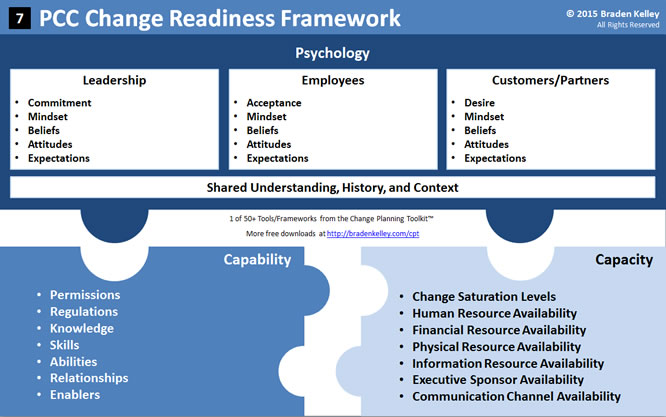
My PCC Change Readiness Framework focuses on the psychology of key groups surrounding the identified change, the capabilities needed to successfully execute the change, and the organization’s capacity to tackle this change effort (along with everything else).

PCC Change Readiness Framework

You will notice that I don’t speak about organizational psychology or culture in my PCC Change Readiness Framework. The reason I don’t highlight culture in the same way that many other people do is that in today’s more social, customer-centric business, we must look more broadly than the typical inward focus of company culture when it comes to identifying the readiness of not only employees, but leaders, customers, and partners too. Inevitably many of our change efforts will have some impact on one or more external groups (possibly even non-profit entities and one or more governments).

You will notice that within the PSYCHOLOGY box there is a common focus on the mindsets, attitudes, beliefs and expectations of the individuals. Culture is incorporated into the psychology realm by focusing on what the shared understandings are around the potential change, but more broadly too. And, finally you will notice that my PCC Change Readiness Framework highlights the need for successful change efforts to move towards gaining commitment to the change from leadership, acceptance of the change by employees, and a desire for the change from customers and partners.

Within the CAPABILITY box of my PCC Change Readiness Framework we must investigate whether our change effort has any regulatory or statutory implications and whether we are ready to adapt, adopt or influence the changes necessary in this sphere. We must also ask ourselves a series of questions:

  1. “Do we need to get permission from anyone to do this?”
  2. “What knowledge, skills, and abilities needed for this change do we already possess?”
  3. “What knowledge, skills, and abilities needed for this change do we need to acquire?”
  4. “What relationships do we possess that will be useful in advancing the change?”
  5. “What relationships do we need to build to help advance the change?”
  6. “What are the enablers of making this change successful?”

Within the CAPACITY box we have to look at where our resources are approaching, or have already achieved, change saturation. This means they are unable to productively participate in any more change efforts or adopt any more change. But we also have to look at the availability of our resources:

  1. Human
  2. Financial
  3. Physical
  4. Information
  5. Executive Sponsors
  6. Space in our desired communication channels

It is easy to take for granted that the organization will have the capacity to undertake your change effort, but often there are capacity constraints that you will run into, especially as the pace and volume of change increases inside an organization. The one that is easiest to overlook and fail to plan for, is making sure that you’re going to be able to communicate your change messages in your desired messaging channels (they may already be full).

There is a worksheet that goes with the PCC Change Readiness Framework that will help you capture information around the:

  • History
  • Capability
  • Capacity
  • Partners
  • Context
  • Leadership
  • Employees
  • Customers
  • Shared Understanding
  • Strategic Alignment (Commitment)
  • Cultural Alignment (Acceptance)
  • Brand Alignment (Desire)

EDITOR’S NOTE: I’ve gone ahead and created a free downloadable flipbook PDF for people to grab. It was inspired by Braden’s article titled Change the World – Step Two, which was the follow-up predictably to Change the World – Step One.

PCC Change Readiness Framework Flipbook

You will find these companion tools for the PCC Change Readiness Framework in the Change Planning Toolkit™ to download for printing and use in your collaborative exploration of your change readiness.

Get Your Copy of Charting ChangeIn my next book Charting Change we will investigate additional aspects of change readiness and have a special section from one of my invited guest experts in the book, Beth Montag Schmaltz of PeopleFirm looking at several topics including change fatigue, where the change threshold lies, why people resist change, how to reduce change fatigue, how to build change capability, what change capable employees look like, and how you can embed change behavior into the very fabric of your organization.

The book is available for pre-order, and has received several strong endorsements, so I hope you’ll pick up a copy (or one for each member of your team). You can find more information on the Charting Change book page.

Subscribe to Human-Centered Change & Innovation WeeklySign up here to get Human-Centered Change & Innovation Weekly delivered to your inbox every week.

Change Resistance is Not Inevitable

Change Resistance is Not InevitableThe idea that people always resist change is a lie, and it is extremely damaging to organization’s seeking to increase their organizational agility.
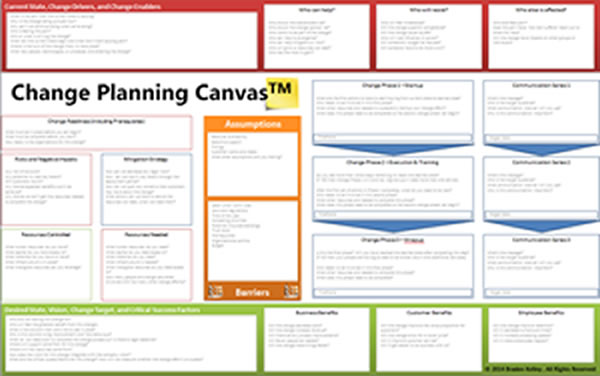
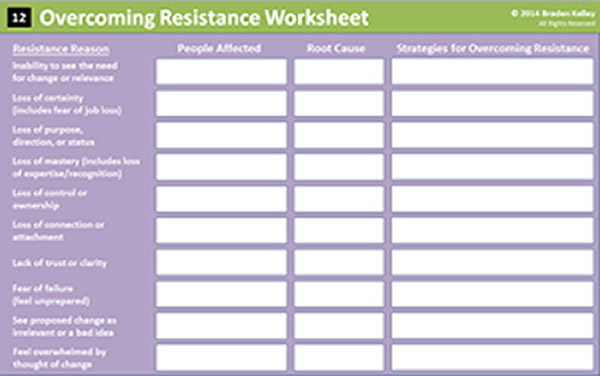
The truth is that people only resist changes that they either do not understand or for which they do not interpret there to be benefits great enough to offset the costs of their participation.

The truth is also that the natural response to a potential change in an organization is greatly impacted by the level of trust in an organization.

While it is a lie that change resistance is inevitable, it is true that executing change is hard. If it wasn’t, 70 percent of change efforts wouldn’t fail, but they do. There are many reasons for this, including the fact that most change efforts are communicated not explained.

Let’s look at definitions of both words from Dictionary.com to see the root of this difference:

Communication: A document or message imparting news, views, information, etc.

Explanation: A mutual declaration of the meaning of words spoken, actions, motives, etc., with a view to adjusting a misunderstanding or reconciling differences

You’ll notice here a big difference between the two mindsets – seeking to communicate versus seeking to explain. When you focus on explaining the change, you are focusing on ensuring UNDERSTANDING, and when people understand the change, and the purpose for the change they will be more likely to support the change.

We don’t resist change, WE RESIST THAT WHICH WE DON’T UNDERSTAND.

One great way for increasing your ability to explain change is the use of a tool like the Change Planning Canvas™ to involve more people in the planning of a change, which increases the number of people capable of explaining the change and its purpose, plus it provides a visual map of the change effort that explains the change at a glance.

This is not say that even when people completely understand a potential change and the purpose for it, that they still might not not fight against it, but they will be more likely to support the change.
.

Change Planning Canvas

(For Illustration Purposes Only – Get the toolkit or the book for a clear copy)

.

The Change Planning Canvas™ is one of the more than fifty tools that make up my new Change Planning Toolkit™ that is now available via individual licenses for educational use and site licenses for professional and commercial use. It helps you move away from the incredibly counter-productive practice of planning change in isolation.

Organizations that do a better job of explaining their changes and the purposes for them, not coincidentally also tend to build up a higher level of trust over time, and organizations that do a better job at change explanation and maintain higher levels of trust are able to change faster!

But some people may still resist, why?

Some people may resist your change effort for a number of different reasons, but you need to identify up-front not only why people resist but also who will likely resist. Change Planning Toolkit™ users will want to capture the group’s thoughts on who will resist in the middle box of the People Worksheet from the toolkit and the corresponding box on the Change Planning Canvas™.

Some of the typical reasons why people will resist include:

  • inability to see the need for change or relevance;
  • loss of certainty (includes fear of job loss);
  • loss of purpose, direction, or status;
  • loss of mastery (includes loss of expertise/recognition);
  • loss of control or ownership;
  • loss of connection or attachment;
  • lack of trust or clarity;
  • fear of failure (feel unprepared);
  • see proposed change as irrelevant or a bad idea;
  • feel overwhelmed by thought of change.

You’ll want to identify the individuals or groups who have one of the above reasons for resisting change, and you will want to plan from the start to overcome that resistance in the same way that any good salesperson plans for objections, learns to hear them, and practices how to overcome them (for example, by developing and sharing strategies with coworkers).
.

Overcoming Resistance Worksheet

(For Illustration Purposes Only – Get the toolkit for a clear copy)

.

In the Change Planning Toolkit™ I’ve provided space in the Overcoming Resistance Worksheet for your team to brainstorm both the groups and individuals likely to feel any of these reasons for resistance, together with space to capture some ideas for overcoming these objections (aka resistance).

The Change Planning Toolkit™ also provides the Five Change Reactions Worksheet which allows you to identify which groups and individuals tend towards each of the five change reactions highlighted in this worksheet and explained in my book Charting Change.. These five change reactions typically occur in a standard distribution (aka bell curve) and you can increase the chances of your change success by shifting enough people to the left along the curve.

So, there you have it, a quick look at The Big Change Management Lie about the inevitability of change resistance and some ways that it can be avoided or at least mitigated, and an introduction to how some of the tools from the Change Planning Toolkit™ can provide even more help.

Accelerate your change and transformation success

Subscribe to Human-Centered Change & Innovation WeeklySign up here to get Human-Centered Change & Innovation Weekly delivered to your inbox every week.