Dissecting the Psychological Architecture of Transformation
GUEST POST from Chateau G Pato
I. Introduction: The Myth of the “Difficult” Employee
In the high-stakes arena of organizational transformation, a dangerous narrative persists. When a brilliant new digital strategy stalls, or an innovative framework faces friction, leadership all too often points the finger at the workforce. Resistance is labeled as stubbornness, complacency, or a simple failure to “get it.” This diagnosis is not only lazy; it is fundamentally flawed. People do not resist change because they are inherently difficult; they resist because the human architecture is wired to survive, and survival favors the known.
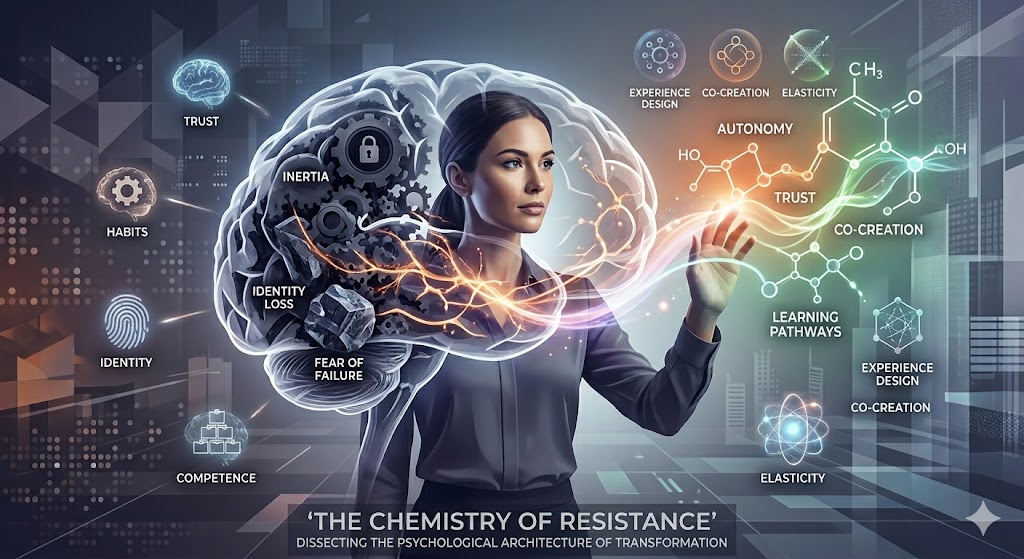
To truly understand why transformation fails, we have to look past the surface-level behavioral pushback and explore the underlying emotional and psychological equilibrium of our people. Think of your organization as a delicate chemical compound. Every workflow, cultural norm, and established expertise represents a stable bond. When leadership introduces a massive strategic pivot, they are dropping a highly reactive agent into that stable compound. Without a proper catalyst, the reaction is almost always volatile.
The paradigm shift we must embrace is a move away from enforcing compliance and toward designing a safer human experience. True, human-centered change management isn’t about building a bigger battering ram to smash through employee resistance. It is about fundamentally altering the underlying formula of the environment, lowering the activation energy required to evolve, and ensuring that movement toward the future feels safer and more rewarding than standing still.
II. The Biology of the Status Quo: Why the Brain Fights Change
To design an experience that guides people through transformation, we must first respect the biological reality of the human brain. Evolution has spent millions of years optimizing the mind to conserve energy and predict threats. When leaders demand a sudden pivot, they aren’t just changing a workflow; they are asking the human nervous system to override its deepest survival programming.
The Cognitive Tax of Innovation
The brain is an energy-hungry organ, consuming roughly 20% of the body’s metabolic resources despite making up only 2% of its weight. To maintain efficiency, the brain relies heavily on established mental models — cognitive shortcuts developed through years of repetition. When an employee operates on “autopilot,” their brain burns minimal fuel. Introducing a new enterprise tool or a restructured operating model abruptly shatters those shortcuts. It forces the prefrontal cortex into overdrive, burning massive amounts of glucose to map out unfamiliar territory. In a very literal, biological sense, innovation feels exhausting because it imposes a massive cognitive tax.
The Amygdala Hijack
When leadership announces a major transformation without psychological preparation, the subconscious mind rarely interprets it as an “exciting opportunity.” Instead, the amygdala — the brain’s ancient radar for danger — registers the ambiguity of change as a threat. Before the rational mind can process the strategic benefits, the body is flooded with cortisol and adrenaline. This “amygdala hijack” narrows focus, heightens anxiety, and triggers a defensive fight, flight, or freeze response. The employee who aggressively questions a new process isn’t necessarily being difficult; their biology is actively fighting a perceived threat to their safety and stability.
Loss Aversion in High Definition
Human psychology is deeply governed by what behavioral economists call loss aversion. The pain of losing something we already possess is roughly twice as powerful as the pleasure of gaining something of equal value. In an organizational shift, the losses are immediate and concrete: a familiar routine, a hard-won piece of subject matter expertise, or a comfortable team dynamic. Conversely, the promised gains of the transformation are distant, abstract, and uncertain. When we look through the lens of loss aversion, resisting change isn’t irrational — it is a perfectly natural human equation trying to protect what is known from the risk of the unknown.
III. Dissecting the Psychological Architecture (The Four Elements)
When resistance manifests in an organization, it rarely looks like a thoughtful critique of strategy. Instead, it surfaces as passive aggression, missed deadlines, or a sudden dip in morale. To transform effectively, leaders must look past these surface behaviors and dissect the four foundational pillars that form the psychological architecture of resistance.
1. Identity and Autonomy
At the core of every high-performing employee is a sense of professional identity. People build their self-worth around what they are exceptionally good at doing. When you introduce artificial intelligence, automation, or a dramatic restructuring, the unvoiced fear isn’t just about losing a job — it is about losing an identity. Employees quietly ask themselves: “Who am I if the expertise I spent a decade building is suddenly automated or rendered obsolete?” When a transformation strips away an individual’s autonomy and alters their professional narrative without their input, resistance becomes an act of self-preservation.
2. Competence and Fear of Failure
Nobody wakes up hoping to do a mediocre job. Yet, transformation frequently demands that seasoned experts step away from their zone of mastery and become absolute beginners again. This transition creates immense anxiety. The psychological friction of feeling clumsy, slow, or incompetent while learning a new framework can be paralyzing. If the organizational culture prioritizes flawless execution over iterative learning, employees will naturally cling to legacy systems where their competence is guaranteed, rather than risking failure on an unfamiliar stage.
3. Inertia and Habits
Organizations run on habits. These deeply ingrained routines allow teams to collaborate and deliver results without burning out from constant decision-making. However, these habits also create immense organizational inertia. Unlearning an old workflow requires significantly more psychological energy than learning a new one from scratch. When leaders underestimate the sheer friction involved in breaking daily habit loops, they mistake the gravitational pull of old routines for willful defiance.
4. Trust and Psychological Safety
The final and most critical element is the relational foundation between leadership and the workforce. In an environment lacking transparency, ambiguity is instantly filled with fear, rumor, and worst-case scenarios. Psychological safety — the belief that one can take risks, speak up, and make mistakes without fear of retaliation — acts as the primary neutralizer to the threat response. Without it, any new strategic initiative is viewed with skepticism, and resistance becomes a protective shield against a system that hasn’t earned the right to be trusted.
IV. From Resistance to Reaction: Designing the Catalyst
Understanding the psychological chemistry of resistance is only the first step. The true work of an innovation leader lies in designing the catalyst — the deliberate interventions that alter the environment and allow a positive, collaborative reaction to occur. We must transition from managing change as a top-down mandate to designing it as a human-centered employee experience.
Human-Centered Experience Design (XD) for Change
For decades, organizations have heavily invested in customer experience (CX) design, mapping out every emotional high and low of the buyer’s journey to remove friction. Yet, when it comes to internal transformation, that same level of empathy is rarely applied to our own people. Human-centered experience design for change means treating the employee journey during a rollout as a premium product. Leaders must map out the emotional arc of the transformation, identifying precisely where cognitive fatigue, anxiety, or confusion will peak, and proactively design support systems, clear communication, and intuitive training to smooth those specific valleys.
Co-Creation as an Antidote
One of the most effective ways to neutralize the brain’s threat response is to restore a sense of autonomy. When a change is pushed down from an isolated executive suite, it feels like an external threat. However, when employees are actively invited into the design process, the psychological dynamic completely shifts. Co-creation turns passive recipients of change into active authors of the future. By utilizing collaborative workspaces, visual canvases, and iterative feedback loops, we can leverage the unique insights of frontline teams. When people help build the solution, they don’t resist the outcome — because they are defending a future they helped create.
Re-framing the Narrative
Every transformation requires a narrative shift. Traditional change management focuses heavily on the “what” and the “when” — the timelines, the features, and the cost savings. This purely logical approach fails to speak to the emotional brain. To inspire movement, leaders must re-frame the narrative from a story of loss to a story of liberation. The conversation should pivot away from “what we are forced to leave behind” and focus intensely on “what this transformation unlocks for your personal capability.” We must paint a vivid picture of a future where mundane tasks are stripped away, allowing people to focus on higher-value, more creative, and deeply fulfilling work.
V. The Futurist’s Perspective: Building Change Fluidity
As we look toward the horizon of business and technology, one reality becomes undeniable: the velocity of disruption is accelerating. The traditional cycles of stability interrupted by occasional shifts are gone. To thrive in an era shaped by continuous technological evolution, we must fundamentally reinvent how our organizations approach the concept of adaptation itself.
The End of “Static” Organizations
For decades, change management has been anchored to classic linear models — most notably the idea of “Unfreeze, Change, Refreeze.” The assumption was that an organization could disrupt its steady state, implement a new strategy, and then settle back into a comfortable, frozen equilibrium. In a world of fluid market demands, that model is obsolete. Attempting to “refreeze” an organization today only creates a brittle structure that breaks the next time a market disruption hits. We must abandon the pursuit of a permanent static state and accept that transformation is no longer a project with a start and end date; it is a core business competency.
Designing for Elasticity
Instead of building rigid structures that require massive, painful overhauls to pivot, future-ready organizations must design for elasticity. This means embedding adaptability directly into the daily habit loop of the enterprise. By utilizing modular team structures, continuous learning pathways, and visual alignment tools, we can make small, iterative adjustments a natural part of daily operations. When minor experiments, feedback loops, and process refinements are normalized, the organization builds collective muscle memory for agility. This gradual exposure drastically lowers the activation energy required for larger strategic shifts, turning a potentially volatile reaction into a smooth transition.
The Role of Leadership as Experience Architects
This shifting landscape demands a profound evolution in leadership style. The era of the top-down change manager who drives compliance through governance and metrics is giving way to a new paradigm. Tomorrow’s leaders must act as experience architects. Their primary responsibility is not to police a implementation schedule, but to intentionally curate a psychological and physical environment where safe experimentation can flourish. This means actively rewarding fast learning, dismantling the silos that stall cross-functional collaboration, and providing the steady, human-centered vision that keeps teams grounded — even when the ground beneath them is constantly moving.
VI. Conclusion: The Balanced Formula
When we look beneath the surface of organizational friction, we find that resistance is not an obstacle to innovation — it is a vital component of it. Resistance is simply unchanneled energy, a natural biological signpost pointing directly to where our people feel exposed, unprotected, or unheard. When leaders stop trying to override this energy and instead choose to respect, diagnose, and integrate it into the design process, it transforms into the very friction that stabilizes, tests, and refines a strategy.
Managing transformation successfully requires balancing a clear, strategic vision with deep human empathy. By moving away from rigid, top-down compliance and adopting a human-centered design approach, we can turn a potentially volatile organizational reaction into a powerful, sustained evolution. The future belongs to the organizations that don’t just tolerate change, but build a collective capability for it.
For change leaders, the mandate is clear: stop trying to manage resistance. Step up as an experience architect, respect the biology of your workforce, co-create the path forward, and start designing human experiences worthy of the people driving your future.
Frequently Asked Questions
Why do employees naturally resist organizational transformation?
Employee resistance is primarily driven by biological and psychological defense mechanisms rather than stubbornness. The human brain treats unfamiliar changes as a cognitive tax that burns massive metabolic energy, frequently triggering an “amygdala hijack” that treats the unknown as a physical threat. Additionally, psychological factors like loss aversion make the immediate loss of familiar routines feel twice as painful as the abstract promise of future gains.
How can leaders neutralize the brain’s threat response during change?
Leaders can lower the workforce’s threat response by introducing co-creation and human-centered experience design (XD). Instead of mandating changes from the top down, involving employees in designing the transition restores their sense of autonomy. Reframing the strategic narrative from what is being lost to what the transformation personally unlocks for their professional capability also shifts the mind from a defensive state to an opportunistic one.
What is organizational elasticity and why is the “unfreeze-refreeze” model dead?
The classic “unfreeze-change-refreeze” model fails because market disruption and technological evolution are now continuous; attempting to “refreeze” an organization creates a brittle structure prone to breaking. Organizational elasticity is the practice of embedding adaptability directly into daily workflows through modular teams and iterative feedback loops. This builds collective muscle memory, making constant adaptation a normal habit rather than a disruptive event.
Image credit: Gemini
 Sign up here to get Human-Centered Change & Innovation Weekly delivered to your inbox every week.