Tag Archives: artificial general intelligence

Embodied Artificial Intelligence is the Next Frontier of Human-Centered Innovation

LAST UPDATED: December 8, 2025 at 4:56 PM

Embodied Artificial Intelligence is the Next Frontier of Human-Centered Innovation

GUEST POST from Art Inteligencia

For the last decade, Artificial Intelligence (AI) has lived primarily on our screens and in the cloud — a brain without a body. While large language models (LLMs) and predictive algorithms have revolutionized data analysis, they have done little to change the physical experience of work, commerce, and daily life. This is the innovation chasm we must now bridge.

The next great technological leap is Embodied Artificial Intelligence (EAI): the convergence of advanced robotics (the body) and complex, generalized AI (the brain). EAI systems are designed not just to process information, but to operate autonomously and intelligently within our physical world. This is a profound shift for Human-Centered Innovation, because EAI promises to eliminate the drudgery, danger, and limitations of physical labor, allowing humans to focus exclusively on tasks that require judgment, creativity, and empathy.

The strategic deployment of EAI requires a shift in mindset: organizations must view these agents not as mechanical replacements, but as co-creators that augment and elevate the human experience. The most successful businesses will be those that unlearn the idea of human vs. machine and embrace the model of Human-Embodied AI Symbiosis.

The EAI Opportunity: Three Human-Centered Shifts

EAI accelerates change by enabling three crucial shifts in how we organize work and society:

1. The Shift from Automation to Augmentation

Traditional automation replaces repetitive tasks. EAI offers intelligent augmentation. Because EAI agents learn and adapt in real-time within dynamic environments (like a factory floor or a hospital), they can handle unforeseen situations that script-based robots cannot. This means the human partner moves from supervising a simple process to managing the exceptions and optimizations of a sophisticated one. The human job becomes about maximizing the intelligence of the system, not the efficiency of the body.

2. The Shift from Efficiency to Dignity

Many essential human jobs are physically demanding, dangerous, or profoundly repetitive. EAI offers a path to remove humans from these undignified roles — the loading and unloading of heavy boxes, inspection of hazardous infrastructure, or the constant repetition of simple assembly tasks. This frees human capital for high-value interaction, fostering a new organizational focus on the dignity of work. Organizations committed to Human-Centered Innovation must prioritize the use of EAI to eliminate physical risk and strain.

3. The Shift from Digital Transformation to Physical Transformation

For decades, digital transformation has been the focus. EAI catalyzes the necessary physical transformation. It closes the loop between software and reality. An inventory algorithm that predicts demand can now direct a bipedal robot to immediately retrieve and prepare the required product from a highly chaotic warehouse shelf. This real-time, physical execution based on abstract computation is the true meaning of operational innovation.

Case Study 1: Transforming Infrastructure Inspection

Challenge: High Risk and Cost in Critical Infrastructure Maintenance

A global energy corporation (“PowerLine”) faced immense risk and cost in maintaining high-voltage power lines, oil pipelines, and sub-sea infrastructure. These tasks required sending human crews into dangerous, often remote, or confined spaces for time-consuming, repetitive visual inspections.

EAI Intervention: Autonomous Sensory Agents

PowerLine deployed a fleet of autonomous, multi-limbed EAI agents equipped with advanced sensing and thermal imaging capabilities. These robots were trained not just on pre-programmed routes, but on the accumulated, historical data of human inspectors, learning to spot subtle signs of material stress and structural failure — a skill previously reserved for highly experienced humans.

  • The EAI agents performed 95% of routine inspections, capturing data with superior consistency.
  • Human experts unlearned routine patrol tasks and focused exclusively on interpreting the EAI data flags and designing complex repair strategies.

The Outcome:

The use of EAI led to a 70% reduction in inspection time and, critically, a near-zero rate of human exposure to high-risk environments. This strategic pivot proved that EAI’s greatest value is not economic replacement, but human safety and strategic focus. The EAI provided a foundational layer of reliable, granular data, enabling human judgment to be applied only where it mattered most.

Case Study 2: Elderly Care and Companionship

Challenge: Overstretched Human Caregivers and Isolation

A national assisted living provider (“ElderCare”) struggled with caregiver burnout and increasing costs, while many residents suffered from emotional isolation due to limited staff availability. The challenge was profoundly human-centered: how to provide dignity and aid without limitless human resources.

EAI Intervention: The Adaptive Care Companion

ElderCare piloted the use of adaptive, humanoid EAI companions in low-acuity environments. These agents were programmed to handle simple, repetitive physical tasks (retrieving dropped items, fetching water, reminding patients about medication) and, critically, were trained on empathetic conversation models.

  • The EAI agents managed 60% of non-essential, fetch-and-carry tasks, freeing up human nurses for complex medical care and deep, personalized interaction.
  • The EAI’s conversation logs provided caregivers with Small Data insights into the emotional state and preferences of the residents, allowing the human staff to maximize the quality of their face-to-face time.

The Outcome:

The pilot resulted in a 30% reduction in nurse burnout and, most importantly, a measurable increase in resident satisfaction and self-reported emotional well-being. The EAI was deployed not to replace the human touch, but to protect and maximize its quality by taking on the physical burden of routine care. The innovation successfully focused human empathy where it had the greatest impact.

The EAI Ecosystem: Companies to Watch

The race to commercialize EAI is accelerating, driven by the realization that AI needs a body to unlock its full economic potential. Organizations should be keenly aware of the leaders in this ecosystem. Companies like Boston Dynamics, known for advanced mobility and dexterity, are pioneering the physical platforms. Startups such as Sanctuary AI and Figure AI are focused on creating general-purpose humanoid robots capable of performing diverse tasks in unstructured environments, integrating advanced large language and vision models into physical forms. Simultaneously, major players like Tesla with its Optimus project and research divisions within Google DeepMind are laying the foundational AI models necessary for EAI agents to learn and adapt autonomously. The most promising developments are happening at the intersection of sophisticated hardware (the actuators and sensors) and generalized, real-time control software (the brain).

Conclusion: A New Operating Model

Embodied AI is not just another technology trend; it is the catalyst for a radical change in the operating model of human civilization. Leaders must stop viewing EAI deployment as a simple capital expenditure and start treating it as a Human-Centered Innovation project. Your strategy should be defined by the question: How can EAI liberate my best people to do their best, most human work? Embrace the complexity, manage the change, and utilize the EAI revolution to drive unprecedented levels of dignity, safety, and innovation.

“The future of work is not AI replacing humans; it is EAI eliminating the tasks that prevent humans from being fully human.”

Frequently Asked Questions About Embodied Artificial Intelligence

1. How does Embodied AI differ from traditional industrial robotics?

Traditional industrial robots are fixed, single-purpose machines programmed to perform highly repetitive tasks in controlled environments. Embodied AI agents are mobile, often bipedal or multi-limbed, and are powered by generalized AI models, allowing them to learn, adapt, and perform complex, varied tasks in unstructured, human environments.

2. What is the Human-Centered opportunity of EAI?

The opportunity is the elimination of the “3 Ds” of labor: Dangerous, Dull, and Dirty. By transferring these physical burdens to EAI agents, organizations can reallocate human workers to roles requiring social intelligence, complex problem-solving, emotional judgment, and creative innovation, thereby increasing the dignity and strategic value of the human workforce.

3. What does “Human-Embodied AI Symbiosis” mean?

Symbiosis refers to the collaborative operating model where EAI agents manage the physical execution and data collection of routine, complex tasks, while human professionals provide oversight, set strategic goals, manage exceptions, and interpret the resulting data. The systems work together to achieve an outcome that neither could achieve efficiently alone.

Your first step toward embracing Embodied AI: Identify the single most physically demanding or dangerous task in your organization that is currently performed by a human. Begin a Human-Centered Design project to fully map the procedural and emotional friction points of that task, then use those insights to define the minimum viable product (MVP) requirements for an EAI agent that can eliminate that task entirely.

UPDATE – Here is an infographic of the key points of this article that you can download:
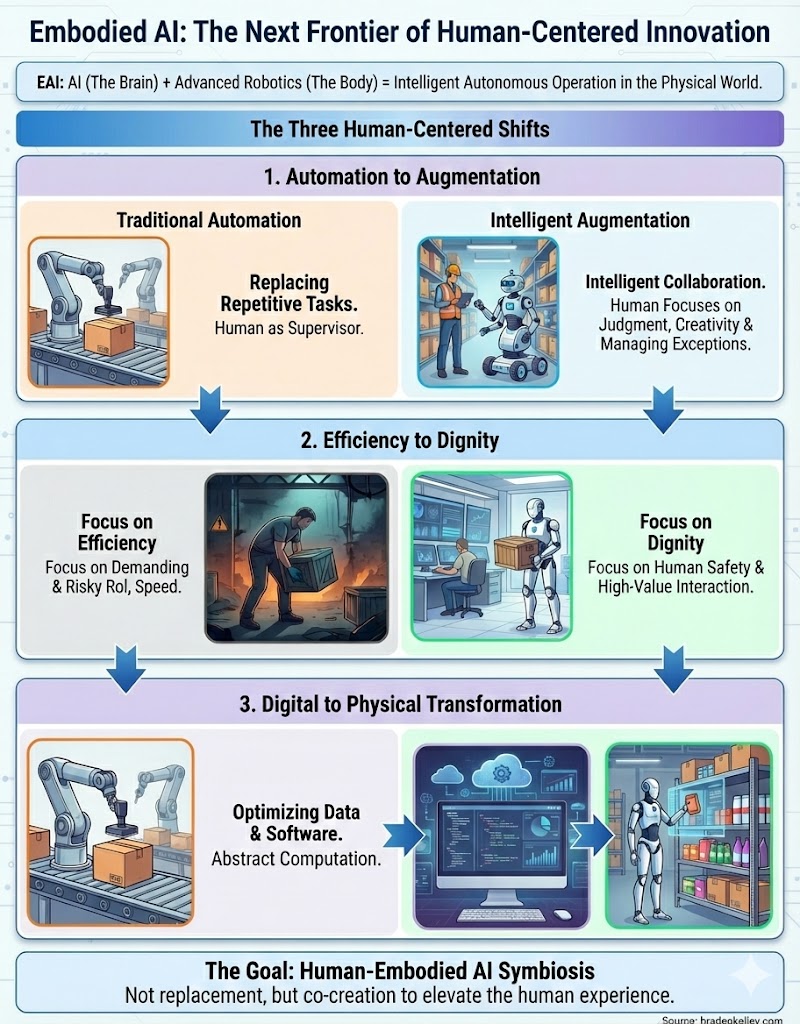
Embodied Artificial Intelligence Infographic

Disclaimer: This article speculates on the potential future applications of cutting-edge scientific research. While based on current scientific understanding, the practical realization of these concepts may vary in timeline and feasibility and are subject to ongoing research and development.

Image credit: 1 of 1,000+ quote slides for your meetings & presentations at http://misterinnovation.com

Subscribe to Human-Centered Change & Innovation WeeklySign up here to get Human-Centered Change & Innovation Weekly delivered to your inbox every week.

Top 10 Human-Centered Change & Innovation Articles of October 2025

Top 10 Human-Centered Change & Innovation Articles of October 2025Drum roll please…

At the beginning of each month, we will profile the ten articles from the previous month that generated the most traffic to Human-Centered Change & Innovation. Did your favorite make the cut?

But enough delay, here are October’s ten most popular innovation posts:

  1. AI, Cognitive Obesity and Arrested Development — by Pete Foley
  2. Making Decisions in Uncertainty – This 25-Year-Old Tool Actually Works — by Robyn Bolton
  3. The Marketing Guide for Humanity’s Next Chapter – How AI Changes Your Customers — by Braden Kelley
  4. Don’t Make Customers Do These Seven Things They Hate — by Shep Hyken
  5. Why Best Practices Fail – Five Questions with Ellen DiResta — by Robyn Bolton
  6. The Need for Organizational Learning — by Mike Shipulski
  7. You Must Accept That People Are Irrational — by Greg Satell
  8. The AI Innovations We Really Need — by Art Inteligencia
  9. Three Reasons You Are Not Happy at Work – And What to Do to Become as Happy as You Could Be — by Stefan Lindegaard
  10. The Nuclear Fusion Accelerator – How AI is Commercializing Limitless Power — by Art Inteligencia

BONUS – Here are five more strong articles published in September that continue to resonate with people:

If you’re not familiar with Human-Centered Change & Innovation, we publish 4-7 new articles every week built around innovation and transformation insights from our roster of contributing authors and ad hoc submissions from community members. Get the articles right in your Facebook, Twitter or Linkedin feeds too!

Build a Common Language of Innovation on your team

Have something to contribute?

Human-Centered Change & Innovation is open to contributions from any and all innovation and transformation professionals out there (practitioners, professors, researchers, consultants, authors, etc.) who have valuable human-centered change and innovation insights to share with everyone for the greater good. If you’d like to contribute, please contact me.

P.S. Here are our Top 40 Innovation Bloggers lists from the last four years:

Subscribe to Human-Centered Change & Innovation WeeklySign up here to get Human-Centered Change & Innovation Weekly delivered to your inbox every week.

Top 10 Human-Centered Change & Innovation Articles of September 2025

Top 10 Human-Centered Change & Innovation Articles of September 2025Drum roll please…

At the beginning of each month, we will profile the ten articles from the previous month that generated the most traffic to Human-Centered Change & Innovation. Did your favorite make the cut?

But enough delay, here are September’s ten most popular innovation posts:

  1. McKinsey is Wrong That 80% Companies Fail to Generate AI ROI — by Robyn Bolton
  2. Back to Basics for Leaders and Managers — by Robyn Bolton
  3. Growth is Not the Answer — by Mike Shipulski
  4. The Most Challenging Obstacles to Achieving Artificial General Intelligence — by Art Inteligencia
  5. Charlie Kirk and Innovation — by Art Inteligencia
  6. You Just Got Starbucked — by Braden Kelley
  7. Metaphysics Philosophy — by Geoffrey Moore
  8. Invention Through Co-Creation — by Janet Sernack
  9. Sometimes Ancient Wisdom Needs to be Left Behind — by Greg Satell
  10. The Crisis Innovation Trap — by Braden Kelley and Art Inteligencia

BONUS – Here are five more strong articles published in August that continue to resonate with people:

If you’re not familiar with Human-Centered Change & Innovation, we publish 4-7 new articles every week built around innovation and transformation insights from our roster of contributing authors and ad hoc submissions from community members. Get the articles right in your Facebook, Twitter or Linkedin feeds too!

Build a Common Language of Innovation on your team

Have something to contribute?

Human-Centered Change & Innovation is open to contributions from any and all innovation and transformation professionals out there (practitioners, professors, researchers, consultants, authors, etc.) who have valuable human-centered change and innovation insights to share with everyone for the greater good. If you’d like to contribute, please contact me.

P.S. Here are our Top 40 Innovation Bloggers lists from the last four years:

Subscribe to Human-Centered Change & Innovation WeeklySign up here to get Human-Centered Change & Innovation Weekly delivered to your inbox every week.

The Most Challenging Obstacles to Achieving Artificial General Intelligence

The Unclimbed Peaks

The Most Challenging Obstacles to Achieving Artificial General Intelligence

GUEST POST from Art Inteligencia

The pace of artificial intelligence (AI) development over the last decade has been nothing short of breathtaking. From generating photo-realistic images to holding surprisingly coherent conversations, the progress has led many to believe that the holy grail of artificial intelligence — Artificial General Intelligence (AGI) — is just around the corner. AGI is defined as a hypothetical AI that possesses the ability to understand, learn, and apply its intelligence to solve any problem, much like a human. As a human-centered change and innovation thought leader, I am here to argue that while we’ve made incredible strides, the path to AGI is not a straight line. It is a rugged, mountainous journey filled with profound, unclimbed peaks that require us to solve not just technological puzzles, but also fundamental questions about consciousness, creativity, and common sense.

We are currently operating in the realm of Narrow AI, where systems are exceptionally good at a single task, like playing chess or driving a car. The leap from Narrow AI to AGI is not just an incremental improvement; it’s a quantum leap. It’s the difference between a tool that can hammer a nail perfectly and a person who can understand why a house is being built, design its blueprints, and manage the entire process while also making a sandwich and comforting a child. The true obstacles to AGI are not merely computational; they are conceptual and philosophical. They require us to innovate in a way that goes beyond brute-force data processing and into the realm of true understanding.

The Three Grand Obstacles to AGI

While there are many technical hurdles, I believe the path to AGI is blocked by three foundational challenges:

  • 1. The Problem of Common Sense and Context: Narrow AI lacks common sense, a quality that is effortless for humans but incredibly difficult to code. For example, an AI can process billions of images of cars, but it doesn’t “know” that a car needs fuel or that a flat tire means it can’t drive. Common sense is a vast, interconnected web of implicit knowledge about how the world works, and it’s something we’ve yet to find a way to replicate.
  • 2. The Challenge of Causal Reasoning: Current AI models are masterful at recognizing patterns and correlations in data. They can tell you that when event A happens, event B is likely to follow. However, they struggle with causal reasoning — understanding why A causes B. True intelligence involves understanding cause-and-effect relationships, a critical component for true problem-solving, planning, and adapting to novel situations.
  • 3. The Final Frontier of Human-Like Creativity & Understanding: Can an AI truly create something new and original? Can it experience “aha!” moments of insight? Current models can generate incredibly creative outputs based on patterns they’ve seen, but do they understand the deeper meaning or emotional weight of what they create? Achieving AGI requires us to cross the final chasm: imbuing a machine with a form of human-like creativity, insight, and self-awareness.

“We are excellent at building digital brains, but we are still far from replicating the human mind. The real work isn’t in building bigger models; it’s in cracking the code of common sense and consciousness.”


Case Study 1: The Fight for Causal AI (Causaly vs. Traditional Models)

The Challenge:

In scientific research, especially in fields like drug discovery, identifying causal relationships is everything. Traditional AI models can analyze a massive database of scientific papers and tell a researcher that “Drug X is often mentioned alongside Disease Y.” However, they cannot definitively state whether Drug X *causes* a certain effect on Disease Y, or if the relationship is just a correlation. This lack of causal understanding leads to a time-consuming and expensive process of manual verification and experimentation.

The Human-Centered Innovation:

Companies like Causaly are at the forefront of tackling this problem. Instead of relying solely on a brute-force approach to pattern recognition, Causaly’s platform is designed to identify and extract causal relationships from biomedical literature. It uses a different kind of model to recognize phrases and structures that denote cause and effect, such as “is associated with,” “induces,” or “results in.” This allows researchers to get a more nuanced, and scientifically useful, view of the data.

The Result:

By focusing on the causal reasoning obstacle, Causaly has enabled researchers to accelerate the drug discovery process. It helps scientists filter through the noise of correlation to find genuine causal links, allowing them to formulate hypotheses and design experiments with a much higher probability of success. This is not about creating AGI, but about solving one of its core components, proving that a human-centered approach to a single, deep problem can unlock immense value. They are not just making research faster; they are making it smarter and more focused on finding the *why*.


Case Study 2: The Push for Common Sense (OpenAI’s Reinforcement Learning Efforts)

The Challenge:

As impressive as large language models (LLMs) are, they can still produce nonsensical or factually incorrect information, a phenomenon known as “hallucination.” This is a direct result of their lack of common sense. For instance, an LLM might confidently tell you that you can use a toaster to take a bath, because it has learned patterns of words in sentences, not the underlying physics and danger of the real world.

The Human-Centered Innovation:

OpenAI, a leader in AI research, has been actively tackling this through a method called Reinforcement Learning from Human Feedback (RLHF). This is a crucial, human-centered step. In RLHF, human trainers provide feedback to the AI model, essentially teaching it what is helpful, honest, and harmless. The model is rewarded for generating responses that align with human values and common sense, and penalized for those that do not. This process is an attempt to inject a form of implicit, human-like understanding into the model that it cannot learn from raw data alone.

The Result:

RLHF has been a game-changer for improving the safety, coherence, and usefulness of models like ChatGPT. While it’s not a complete solution to the common sense problem, it represents a significant step forward. It demonstrates that the path to a more “intelligent” AI isn’t just about scaling up data and compute; it’s about systematically incorporating a human-centric layer of guidance and values. It’s a pragmatic recognition that humans must be deeply involved in shaping the AI’s understanding of the world, serving as the common sense compass for the machine.


Conclusion: AGI as a Human-Led Journey

The quest for AGI is perhaps the greatest scientific and engineering challenge of our time. While we’ve climbed the foothills of narrow intelligence, the true peaks of common sense, causal reasoning, and human-like creativity remain unscaled. These are not problems that can be solved with bigger servers or more data alone. They require fundamental, human-centered innovation.

The companies and researchers who will lead the way are not just those with the most computing power, but those who are the most creative, empathetic, and philosophically minded. They will be the ones who understand that AGI is not just about building a smart machine; it’s about building a machine that understands the world the way we do, with all its nuances, complexities, and unspoken rules. The path to AGI is a collaborative, human-led journey, and by solving its core challenges, we will not only create more intelligent machines but also gain a deeper understanding of our own intelligence in the process.

Disclaimer: This article speculates on the potential future applications of cutting-edge scientific research. While based on current scientific understanding, the practical realization of these concepts may vary in timeline and feasibility and are subject to ongoing research and development.

Image credit: Dall-E

Subscribe to Human-Centered Change & Innovation WeeklySign up here to get Human-Centered Change & Innovation Weekly delivered to your inbox every week.