
Category Archives: Strategy

A Guide to Organizing Innovation

A Guide to Organizing Innovation

GUEST POST from Jesse Nieminen

I recently read a couple of excellent articles by Nick Skillicorn, and Prof. Rita McGrath where both discuss the challenges and intricacies involved in structuring and governing innovation within a large organization.

This is a classic topic that every corporate innovator has without a doubt come across, and it’s also one where “the right approach” is often quite elusive.

Inspired by those articles, we’ll present the most common archetypes and then dig a little deeper on the topic and share our thoughts and experiences to help you figure out how innovation should be structured within your organization.

Why organizing innovation is challenging

Before we dive into the different models for governing and organizing innovation, it’s important to understand why this is such a challenging topic to begin with.

That’s of course quite a lengthy and nuanced topic, but in short, there is no such thing as a perfect organizational structure or governance model. The bottom line is that a large organization is simply such a complex entity that structuring everything perfectly so that there aren’t any kind of bottlenecks, misaligned incentives, or any duplication of work just isn’t very realistic. If you’ve ever worked in large organization, you’ve certainly come across some of these challenges.

Now, most of these challenges are likely to be worse with innovation than with “business as usual” as, by definition, innovation means introducing changes. And most organizations simply aren’t designed for constant change.

What’s more, businesses are naturally very different from one another. A structure that works for a single product software company probably isn’t ideal for a CPG manufacturer or a house of brands because not only are their industries different, so are the innovations they are going after. So, what works well for some organization probably won’t be ideal for you.

This means that benchmarking and then applying “best practices” likely won’t work too well. Unfortunately, there just isn’t a single correct way to organize innovation.

Exploring the organizational archetypes for innovation

Having said that, there are a handful of common approaches, which we like to call archetypes, that most organizations use as the foundation for their efforts to organize and govern innovation.

Both McGrath and Skillicorn have done an excellent job in presenting many of these approaches, so a lot of credit for the following descriptions goes to them and I’d warmly recommend you read their takes too. Regardless, we’ve summarized their main points and combined them with our own experiences to create the following archetypes.

We’ll next explain each of these briefly, along with a quick summary of the key strengths and weaknesses for each.
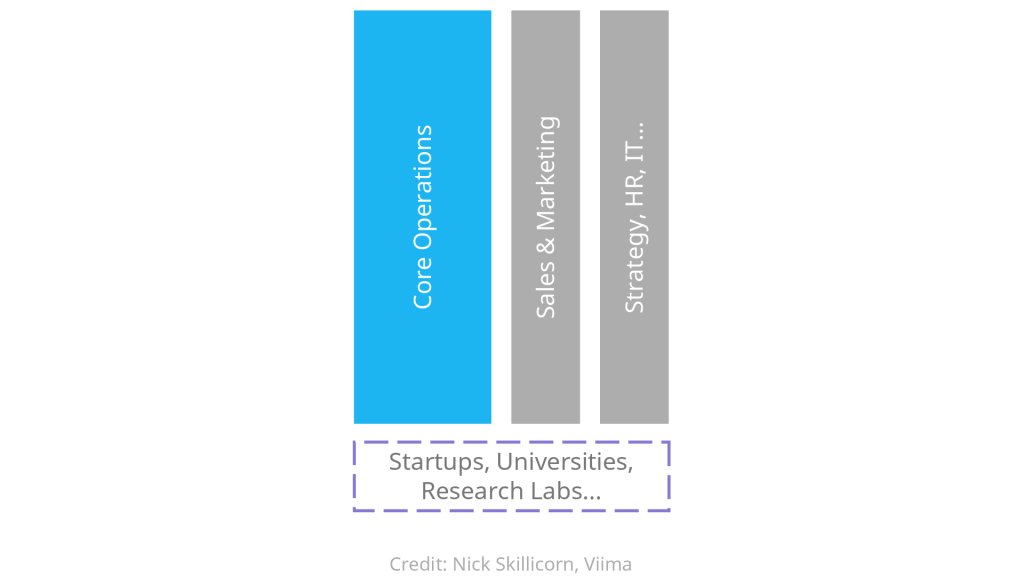
External Innovation Organizational Model

No in-house innovation

The first and simplest way to organize innovation is to not do it, or to completely outsource it. Perhaps the most common method here is to simply keep tabs on promising startups and then acquire them, or to have tight collaboration with universities and other research institutions.

While this obviously keeps things simple organization-wise and minimizes fixed costs, it also means that you no longer have control over your own destiny, and are instead reliant on third parties, which puts you in a very vulnerable position long term. Furthermore, in the last decade, we’ve seen a huge inflow of capital to fund startups, which means that valuations for promising startups have skyrocketed and acquiring them on the cheap is simply no longer a very feasible strategy.

Suffice to say, if you want to build an organization that thrives in the long run, I wouldn’t recommend this approach.

Pros

  • Low fixed costs
  • Structurally simple


Cons

  • Lack of strategic control and ability to build the future of the organization
  • Lack of differentiation
  • Reliance on third parties for both execution and especially exploration
  • Acquisition of promising innovations has become expensive
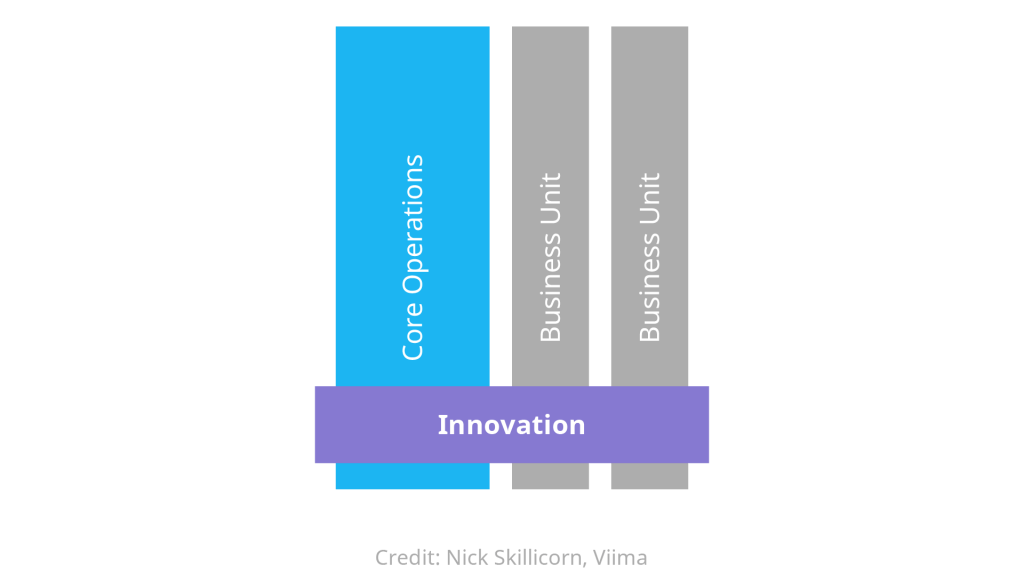
Centralized Innovation Organizational Model

Centralized

Perhaps the most common way large organizations set up innovation is by creating a centralized department that serves the innovation needs of the entire organization including each business unit and support functions, such as IT or HR. This can be a subdivision within R&D, but these days it’s typically a separate cross-departmental unit serving the innovation needs of business units.

Either way, such a unit is quick and easy to set up, and the approach has some other obvious advantages too, such as innovation expertise being built and managed centrally, which speeds up learning, as well as management and reporting being easy to organize.

It’s these advantages that make centralization the obvious choice for many who are just starting out with innovation. This is also an especially common approach for large industrial companies that typically have a strong R&D tradition.

If all of the innovation has to go through a single team, that team will inevitably become a bottleneck for innovation, no matter how skilled or large it is.

However, in the long run, this approach is also one that is likely to significantly limit your innovation potential. The reason is simple: if all of the innovation has to go through a single team, that team will inevitably become a bottleneck for innovation. No matter how large or skilled the team, they’ll never have enough resources. What’s more, this will also disincentivize everyone else in the organization from innovating and that prevents you from creating a true culture of innovation.

Pros

  • Quick, easy, and cheap to set up
  • Dedicated resources for working on innovation
  • Easy to govern, manage, and report on the overall innovation portfolio
  • Centralization can speed up learning


Cons

  • Poor scalability as centralized team will inevitably become a bottleneck for innovation
  • Likely to be pulled into too many projects, which leads to poor execution
  • High risk of degenerating into a support function serving business unit requests instead of strategically building the future of the organization
  • Likely to disincentivize others in the organization from innovating
  • Conflicting interests between business units can make prioritization difficult
  • Typically lack authority to make important, hard decisions
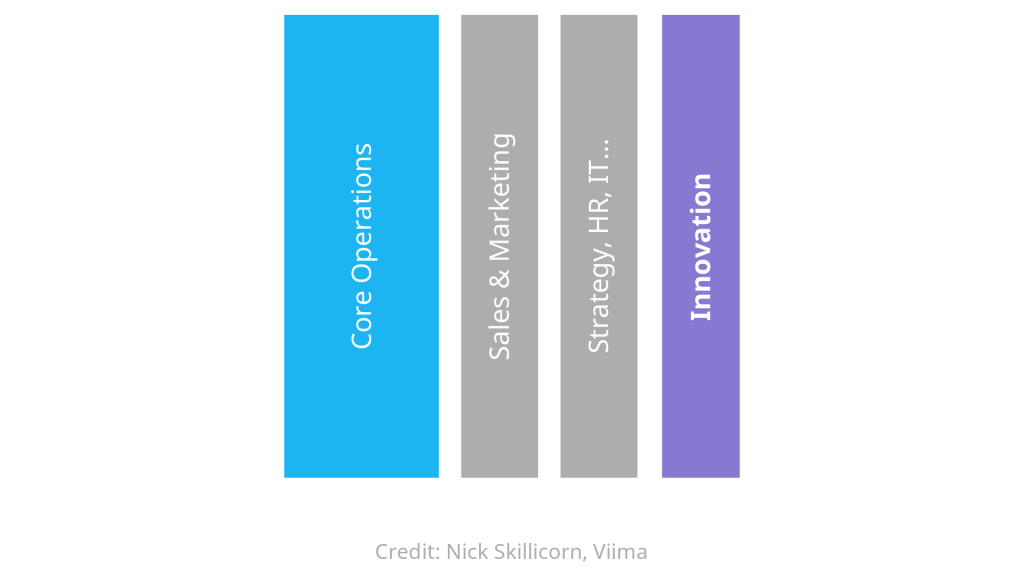
Dedicated Innovation Organizational Model

Dedicated

Popularized by Clayton Christensen as a solution to the Innovators’s Dilemma, dedicated business units for innovation have become increasingly popular in large organizations that are looking for the next stage of their growth. Sometimes these units have proper P&L responsibility, and they might even report directly to the CEO or others in senior management, but at times they can also be innovation labs responsible primarily for testing and piloting new ideas before they are to be integrated into the core business.

Regardless of the particularities, these approaches have some specific strengths, but also clear weaknesses. The good thing is that because the unit is independent, it can usually avoid being held back by the restrictions of the business as usual and can build their talent and approaches from scratch.

If innovation is the job of a select few, it will be incredibly hard to build a pro-innovation culture.

The downside is that they also don’t necessarily play to the strengths that the organization has already built. Without strong and clear leadership, these kinds of innovation efforts are likely to have an equally poor success rate as your average startup – but without the asymmetric upside.

The reason is simple: if you already have hundreds of millions or billions in revenue, most new businesses just don’t move the needle enough – unless they can quickly grow to a massive size or be combined with the strengths and competitive advantages of the core business.

And just like with the centralized model, this model again limits innovation to one part of the organization. As before, that will likely prevent you from creating a true culture of innovation, and thus lead to the unit becoming a bottleneck down the road.

Pros

  • Freedom to operate independently from processes of existing business units, which is essential for trying new things and creating disruptive innovations
  • Ability to hire and organize specifically for innovation
  • If led well, ability to focus on the long-term instead of short-term performance
  • High profile innovation unit can also be used for marketing and employer branding purposes


Cons

  • Conflicts of interest and lack of cooperation between core business and innovation unit likely to lead to politics, tension, and other challenges in integrating innovations into core business
  • Independence and lack of communication between business units might hurt strategic alignment and prevent the innovation unit from benefiting from the existing strengths of the organization
  • Can easily degenerate into a cost center performing innovation theaterwithout a clear strategic focus, strong leadership, and evidence-based processes
  • Likely to disincentivize innovation in other parts of the organization and thus prevent the creation of an innovation culture
  • High initial investment with lots of uncertainty can make the business case for investing in innovation look bad
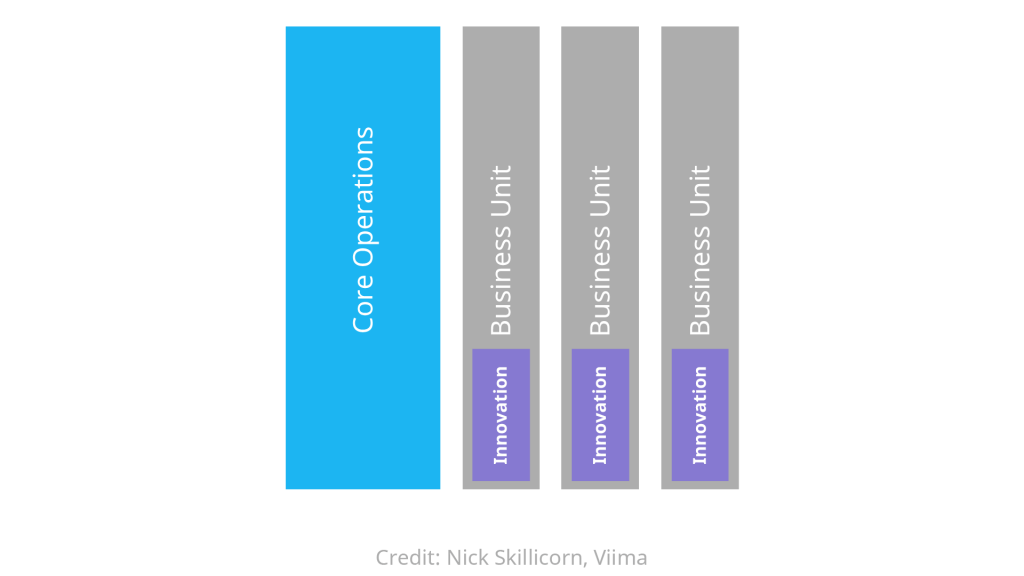
Embedded Innovation Organizational Model

Embedded

Many organizations have relatively independent business units or product and brand teams, and for them it can often make sense for innovation to be embedded within these units.

Traditional examples of such an approach are companies like P&G and other CPG companies with strong brands. These companies are working hard to keep up to date with evolving trends and consumer needs to innovate and create new products for the consumer. However, the same can also be true for many other kinds of businesses, such as software companies with multiple products.

Depending on the industry and organization, these units might have varying levels of control over their innovations once they are on the market. For example, in CPG companies manufacturing, logistics and many other functions would likely be managed by core business operations instead of this unit.

Pros

  • Better able to focus innovation on things that matter for each business, be they strategic projects or emerging customer needs
  • More control over innovation resources and ability to get talent that meets specific needs
  • Parallelization over different units can increase innovation throughput of the organization overall
  • Easier to align innovation with business needs and plans within the unit
  • The business case for investing in innovation is typically easy to make as you can start from low-hanging fruits that provide immediate value


Cons

  • Innovation likely to be biased towards more applied and incremental projects due to focus on immediate business needs
  • Some efforts may be duplicated between teams, especially if more long-term R&D work is being done
  • Can lead to a silo-effect, extra need to focus on facilitating knowledge transfer between units
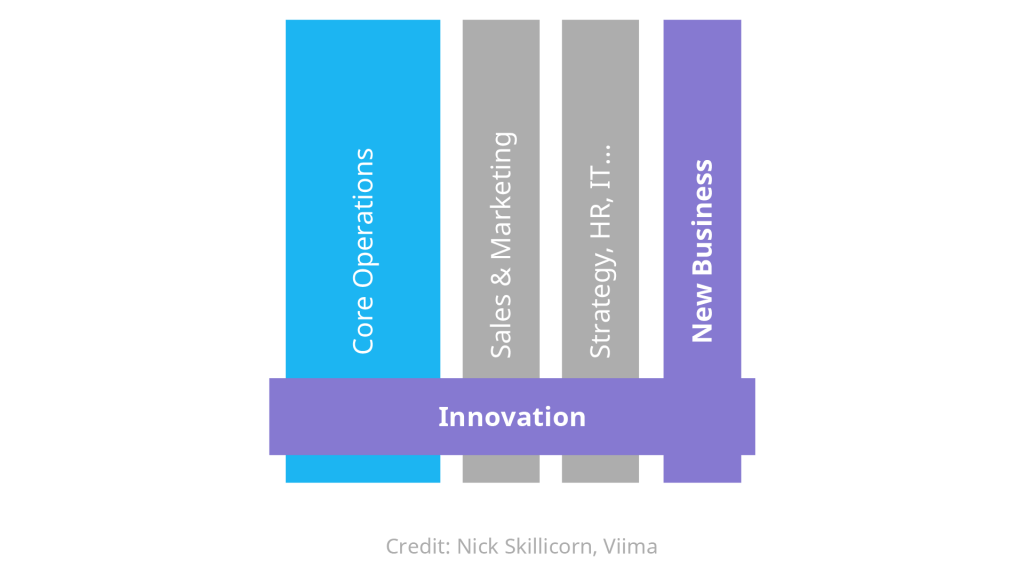
Ambidextrous Innovation Organizational Model

Ambidextrous

Our fifth approach is usually referred to as the ambidextrous organization. We’ve  also seen it be referred to as the Hybrid model, and it’s quite a natural evolution from the previous archetypes as it seeks to combine the best of both worlds.

In a nutshell, the idea is that innovation should happen across the organization with existing business units focused on exploiting their current position through incremental innovation, and a separate dedicated unit being responsible for exploring and building the future of the organization through more radical or disruptive innovation.

In the ambidextrous model, existing units use incremental innovation to exploit the current position and new units are set up to explore and build future.

In practice, a new P&L responsible division will be setup for new non-core businesses, and the more incremental innovation will then be organised either as Embedded or Centralized.

If an organization does successfully implement such an approach, it can lead to exceptional long-term performance, but that’s of course easier said than done. For most organizations, this is likely to require a significant transformation, and it can be challenging to get everyone onboard, build the right processes, as well as to align goals and incentives the right way across the organization.

Pros

  • Easier to build a balanced innovation portfolio with both strong short and long-term performance
  • Enables building an innovation-oriented culture across the organization
  • Enough resources for key projects across the organization
  • Makes it easier to communicate the innovation strategy with clear roles and responsibilities for each part of the organization
  • Can customize governance models to meet the needs of different types of innovation in different parts of the organization


Cons

  • Expensive and difficult to build, as well as to maintain
  • Requires clear leadership and a commitment to a transformation from the top
  • Can demotivate innovation-oriented employees that are in the core business
  • Usually requires extensive changes to processes and the re-skilling of managers and employees across the organization
  • While easier than with most other models on paper, prioritization and division of responsibilities can still be challenging in practice
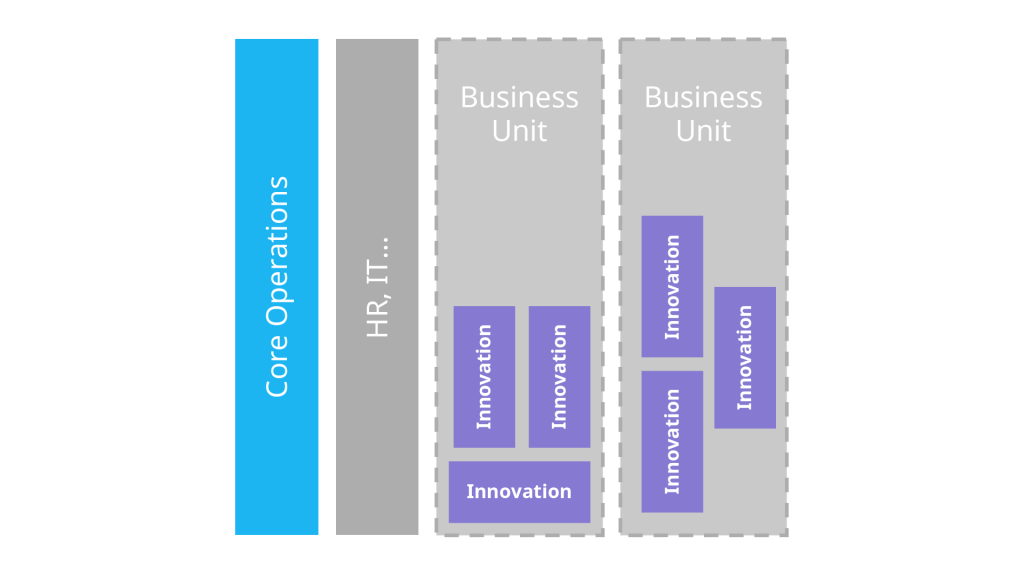
Decentralized Innovation Organization

Decentralized

Our final model is the decentralized approach. If you look at any of the best innovators in the world, be it Apple, Tesla, SpaceX, or Amazon, this is closest to the model they use. None of these organizations has a centralized or dedicated team responsible for all innovation in the organization.

Instead, the organization decentralizes the responsibility for innovation to happen in individual teams (which are typically cross-functional and relatively small) across the organization. Each team is focused on figuring out how they could help the organization better reach their strategic goals, and innovation is just one of the key tools in that process.

If a team (or an individual leader or employee) comes across a big idea that shows promise but would require significant additional investments, they’ll apply for additional resources from management via a quick and streamlined process. If approved, that typically leads to another team being set up to pursue that idea.

This approach is sometimes called the permissionless model due to the significant freedom each team possesses to make decisions affecting their own work. The obvious advantages are that they usually know the problems intimately and have the resources, incentive, and know-how to solve them, and have fewer dependencies to other parts of the organization. That leads to an extremely high pace of innovation and innovation throughput for the organization, which together create a tremendous competitive advantage.

Loosely Coupled vs Tightly Coupled Organization

Having said that, this too isn’t exactly an easy model to implement for most organizations. Typically, this would require a fundamentally different mindset, leadership philosophy, and a significantly higher talent density. For the average organization, that means a full-blown transformation where most fundamentals in the organization would need to change, which of course isn’t feasible for many.

Pros

  • Extremely high throughput and pace of innovation
  • Ability to adapt, re-organize and meet changing demands quickly
  • Strong focus on execution and value creation
  • Clear roles and responsibilities


Cons

  • Would require a fundamental transformation for most organizations
  • Requires strong communication and strategic clarity from management
  • Active management involvement required to remove barriers and to organize teams so that the portfolio remains balanced
  • Requires high talent density across the organization, which can be very challenging to achieve in practice
  • Continuously evolving and rapidly changing landscape might be too intensive for some employees
  • Some work often initially duplicated across teams, but can be managed by creating horizontal support teams

Choosing the right approach for your organization

As you can see, every approach has their benefits, but also their disadvantages.

In our experience, the Hybrid and especially Decentralized are the likeliest approaches to lead to sustained levels of high innovation performance in the 21stcentury but implementing either isn’t exactly a walk in the park for a large organization. If you have the luxury of meeting (or are close to meeting) the prerequisites, these are the models I’d personally go for.

However, for many, that just isn’t the reality. Even if you’re like most organizations and don’t quite have the talent, leadership, or other prerequisites needed for these approaches, I’d keep either the Hybrid or Decentralized approach as your eventual goal to build towards.

Move control and decision-making down in the organization to be able to move faster, make more informed decisions, respond to changes quicker, and to simply innovate more.

However, instead of a major overnight transformation, you should be prepared for a set of smaller, gradual steps that build your capabilities and culture towards that future while solving the current problems with your processes and structures.
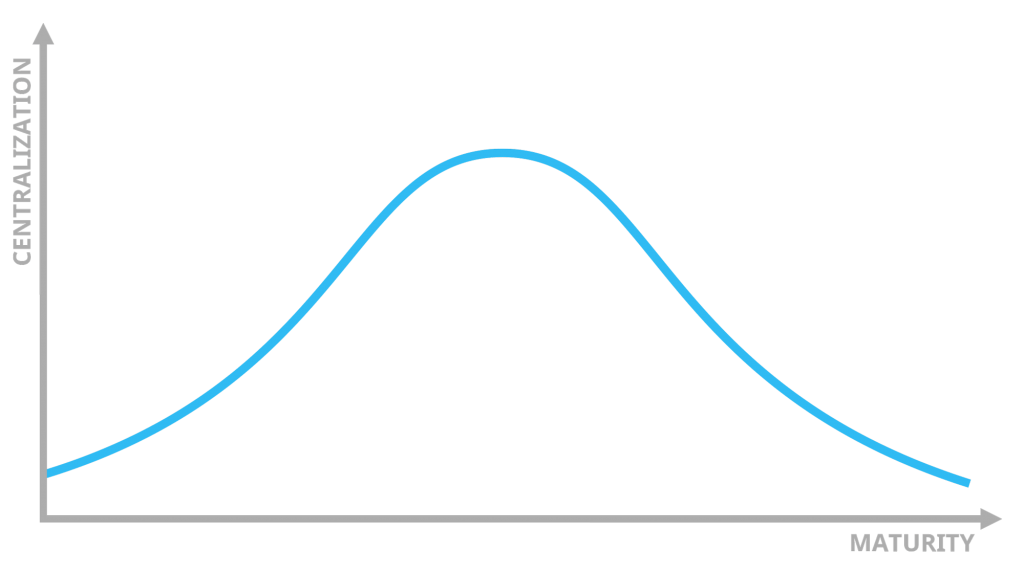
Centralization vs Innovation Maturity

While not ideal in theory, in practice the journey towards becoming a mature top innovator typically first leads towards centralization for most incumbent organizations. They need to build their innovation strategy, knowledge and capabilities before they can successfully decentralize and move control and decision-making down in the organization to be able to move faster, make more informed decisions, respond to changes quicker, and to simply innovate more.

With that background, if such an approach is used, it’s crucial that this centralized innovation function understands and embraces their temporary role so that they are willing to relinquish control and power over innovation to others. All too often we see these leaders clinging on to the team, budget and power they’ve built long after it would’ve been in the organizations’ best interest to re-organize.

Best practices for organizing innovation

As we’ve discussed, if you’re planning to make changes to the way you organize innovation, most decisions will depend on your context. Still, there are a few things that are good to keep in mind regardless of the approach you end up choosing. Here’s my top three:

The best innovators continuously evolve

The first, and perhaps the most important point to remember is that the best innovators continuously evolve and improve the way they work. They don’t just pick one organizational structure and go with that forever. Instead, they are constantly looking for ways to re-organize their efforts so that they work on whatever is likely to best help them reach their goals. This is of course one of the fundamental strengths of the Decentralized model but applies to other approaches too.

This is also in line with how the most successful organizations approach re-organizations in general. They don’t just wait until the old structure is burning, they act proactively to position themselves for the future they want to create.

Clear roles and decision-making structures

It’s pretty obvious, but if people don’t know who can make a decision on an idea that they may have, or even who’s responsibility it would fall under, odds are that not a lot of innovation will happen.

The reality is that there will always be some ambiguity and overlap, especially in fast moving environments, but clear roles and decision-making structures are regardless important for an organization that wants to innovate.

If projects or decisions seem to get stuck, or turf battles seem to consistently pop up in your organization, unclear roles and ambiguous decision-making are likely to be the main culprits.

Organize according to strategy and plan for the execution

Again, it might sound obvious, but especially with innovation, the differences can be dramatic. Organization is the link between your strategy and your execution, so make sure it isn’t detached from the realities of what it will take to reach your goals with innovation.

To use a bit of a simplified example, if your strategy is focused on creating new business from emerging disruptive technologies, then the Embedded model probably won’t cut it as your innovators will be kept busy by the priorities from the core business.

How to organize innovation

Plan for the execution, on the other hand means that each team should have the resources and the freedom needed to reach your goals. If, using our previous example, you allocate just a few engineers to the team and then hope that sales will magically turn those technologies into booming businesses, odds are very much against you.

In other words, try to allocate resources so that the team has everything they need to reach their goals. While this sounds super basic, we still see these mistakes frequently when innovation is a bit of an afterthought for management.

Conclusion

As is probably evident by now, no structure or approach to governing innovation is ever going to be perfect, at least for long. As your goals change or your business and industry keep evolving, you will need to change and evolve too.

Even though organizing innovation doesn’t seem to get the same kind of attention as innovation strategy or culture, it’s extremely important, nevertheless. Get it wrong, and it will be almost impossible for your organization to succeed at innovation. Get it right, and you’ll at the very least have a realistic shot at that.

Hopefully this article has provided you with more thoughts on the topic, and some views on what to do and not-to-do.

This article was originally published in Viima’s blog.

Image credits: Unsplash, Viima, Nick Skillicorn

Subscribe to Human-Centered Change & Innovation WeeklySign up here to get Human-Centered Change & Innovation Weekly delivered to your inbox every week.

Top 40 Innovation Bloggers of 2021

Top 40 Innovation Bloggers of 2021After a week of torrid voting and much passionate support, along with a lot of gut-wrenching consideration and jostling during the judging round, I am proud to announce your Top 40 Innovation Bloggers of 2021:

  1. Janet Sernack
    Janet SernackJanet Sernack is the Founder and CEO of ImagineNation™ which provides innovation consulting services to help organizations adapt, innovate and grow through disruption by challenging businesses to be, think and act differently to co-create a world where people matter & innovation is the norm.

  2. Greg Satell
    Greg SatellGreg Satell is a popular speaker and consultant. His first book, Mapping Innovation: A Playbook for Navigating a Disruptive Age, was selected as one of the best business books in 2017. Follow his blog at Digital Tonto or on Twitter @Digital Tonto.

  3. Braden Kelley
    Braden KelleyBraden Kelley is a Human-Centered Experience, Innovation and Transformation consultant at HCL Technologies, a popular innovation speaker, workshop leader, and creator of the Human-Centered Change™ methodology. He is the author of Stoking Your Innovation Bonfire from John Wiley & Sons and Charting Change from Palgrave Macmillan. Follow him on Linkedin, Twitter, Facebook, or Instagram.


  4. Jesse Nieminen
    Jesse NieminenJesse Nieminen is the Co-founder and Chairman at Viima, the best way to collect and develop ideas. Viima’s innovation management software is already loved by thousands of organizations all the way to the Global Fortune 500. He’s passionate about helping leaders drive innovation in their organizations and frequently writes on the topic, usually in Viima’s blog.

  5. Robert B Tucker
    Robert TuckerRobert B. Tucker is the President of The Innovation Resource Consulting Group. He is a speaker, seminar leader and an expert in the management of innovation and assisting companies in accelerating ideas to market.

  6. Rachel Audige
    Rachel AudigeRachel Audige is an Innovation Architect who helps organisations embed inventive thinking as well as a certified Systematic Inventive Thinking Facilitator, based in Melbourne.


  7. Howard Tiersky
    Howard TierskyHoward Tiersky is an inspiring and passionate speaker, the Founder and CEO of FROM, The Digital Transformation Agency, innovation consultant, serial entrepreneur, and the Wall Street Journal bestselling author of Winning Digital Customers: The Antidote to Irrelevance. IDG named him one of the “10 Digital Transformation Influencers to Follow Today”, and Enterprise Management 360 named Howard “One of the Top 10 Digital Transformation Influencers That Will Change Your World.”

  8. Paul Sloane
    Paul SloanePaul Sloane writes, speaks and leads workshops on creativity, innovation and leadership. He is the author of The Innovative Leader and editor of A Guide to Open Innovation and Crowdsourcing, both published by Kogan-Page.

  9. Pete Foley
    A twenty-five year Procter & Gamble veteran, Pete has spent the last 8+ years applying insights from psychology and behavioral science to innovation, product design, and brand communication. He spent 17 years as a serial innovator, creating novel products, perfume delivery systems, cleaning technologies, devices and many other consumer-centric innovations, resulting in well over 100 granted or published patents. Find him at pete.mindmatters@gmail.com

  10. Nicolas Bry
    Nicolas BryNicolas is an International Innovation Executive, expert in corporate innovation programs, and innovation labs, designing place where good innovation thrives! He currently helps the 20 innovation managers of Orange Africa to develop their projects locally. In 2019 he wrote The Intrapreneurs’ Factory, a practical guide to leverage intrapreneurship for your company, and is the writer of the innovation blog RapidInnovation.fr.

  11. Build a common language of innovation on your team


  12. Arlen Meyers
    Arlen MyersArlen Meyers, MD, MBA is the President and CEO of the Society of Physician Entrepreneurs at www.sopenet.org

  13. Linda Naiman
    Linda NaimanLinda Naiman helps executives and their teams develop creativity, innovation, and leadership capabilities, through coaching, training and consulting. She brings a multi-disciplinary approach to learning and development by leveraging arts-based practices to foster creativity at work, and design thinking as a strategy for innovation.


  14. Anthony Mills
    Anthony MillsAnthony Mills is the Founder & CEO of Legacy Innovation Group (www.legacyinnova.com), a world-leading strategic innovation consulting firm working with organizations all over the world. Anthony is also the Executive Director of GInI – Global Innovation Institute (www.gini.org), the world’s foremost certification, accreditation, and membership organization in the field of innovation. Anthony has advised leaders from around the world on how to successfully drive long-term growth and resilience through new innovation. Learn more at www.anthonymills.com. Anthony can be reached directly at anthony@anthonymills.com.

  15. John Bessant
    John BessantJohn Bessant has been active in research, teaching, and consulting in technology and innovation management for over 25 years. Today, he is Chair in Innovation and Entrepreneurship, and Research Director, at Exeter University. In 2003, he was awarded a Fellowship with the Advanced Institute for Management Research and was also elected a Fellow of the British Academy of Management. He has acted as advisor to various national governments and international bodies including the United Nations, The World Bank, and the OECD. John has authored many books including Managing innovation and High Involvement Innovation (Wiley). Follow @johnbessant

  16. Mike Shipulski
    Mike ShipulskiMike Shipulski brings together people, culture, and tools to change engineering behavior. He writes daily on Twitter as @MikeShipulski and weekly on his blog Shipulski On Design.

  17. Scott Anthony
    Scott AnthonyScott Anthony is a strategic advisor, writer and speaker on topics of growth and innovation. He has been based in Singapore since 2010, and currently serves at the Managing Director of Innosight’s Asia-Pacific operations.


  18. Jeffrey Phillips
    Jeffrey Phillips has over 15 years of experience leading innovation in Fortune 500 companies, federal government agencies and non-profits. He is experienced in innovation strategy, defining and implementing front end processes, tools and teams and leading innovation projects. He is the author of Relentless Innovation and OutManeuver. Jeffrey writes the popular Innovate on Purpose blog. Follow him @ovoinnovation

  19. Phil McKinney
    Phil McKinneyPhil McKinney is the Author of “Beyond The Obvious”​, Host of the Killer Innovations Podcast and Syndicated Radio Show, a Keynote Speaker, President & CEO CableLabs and an Innovation Mentor and Coach.


  20. Gijs van Wulfen
    Gijs van WulfenGijs van Wulfen helps organizations to structure the chaotic start of innovation as author, speaker and facilitator. He is the founder of the FORTH innovation method and author of the innovation bestseller The Innovation Expedition. He was chosen by LinkedIn as one of their first 150 Influencers. Follow Gijs @gijsvanwulfen


  21. Kate Hammer
    Kate HammerKate Hammer is a joint founder of KILN, working with large-scale companies in the USA and Australia to transform their internal innovation processes. Kate works as a business storyteller. In 2012, she created StoryFORMs to help others articulate their commercial & organisational stories. Kate offers workshops & 1:1 coaching.

  22. Accelerate your change and transformation success


  23. Phil Buckley
    Phil BuckleyPhil Buckley is an award-winning author and change management strategist with over 32 large-scale change initiatives, including co-leading global change management for the $19.6 billion Kraft Foods acquisition of Cadbury. He is the author of two books: Change on the Run and Change with Confidence. You can find Phil’s podcast and monthly newsletter at www.changewithconfidence.com.

  24. Tamara Ghandour
    Tamara GhandourTamara Ghandour of GoToLaunchStreet is a TED speaker and entrepreneur. From building and running multimillion dollar businesses, advising Fortune 500 like Disney, Procter and Gamble and RICOH on fostering innovative ideas and people. Tamara’s life is about breaking through the status quo for game-changing results, and that’s what her keynotes, online programs and assessments can do for you.

  25. Tom Koulopoulos
    Thomas KoulopoulosTom Koulopoulos is the author of 10 books and founder of the Delphi Group, a 25-year-old Boston-based think tank and a past Inc. 500 company that focuses on innovation and the future of business. He tweets from @tkspeaks.

  26. Michael Graber
    Michael GraberMichael Graber is the cofounder and managing partner at Southern Growth Studio, a Memphis-based firm that specializes in growth strategy and innovation. A published poet and musician, Graber is the creative force that complements the analytical side of the house. He speaks and publishes frequently on best practices in design thinking, business strategy, and innovation and earned an MFA from the University of Memphis.

  27. Yoram Solomon
    Four Rules to Snap Judge a New VentureDr. Yoram Solomon is the author of The Book of Trust and 12 more books, a TEDx and keynote speaker, the founder of the Innovation Culture Institute, and an adjunct professor of entrepreneurship. You can follow him everywhere on @yoramsolomon.

  28. Shilpi Kumar
    Shilpi KumarShilpi Kumar an inquisitive researcher, designer, strategist and an educator with over 15 years of experience, who truly believes that we can design a better world by understanding human behavior. I work with organizations to identify strategic opportunities and offer user-centric solutions.

  29. Shawn Nason
    Shawn NasonShawn Nason, founder and CEO of MOFI, lives his life with a commitment to make everyone he meets a part of his family. Armed with the gift of discernment, he has the uncanny ability to walk alongside people as they struggle to connect with their deepest passions and engage their most debilitating demons. He challenges the world around him to be fully present, get real, and knock down the barrier that separates the various compartments in their lives.


  30. John Carter
    John CarterJohn Carter has been a widely respected adviser to technology firms over his career. John is the author of Innovate Products Faster: Graphical Tools for Accelerating Product Development. As Founder and Principal of TCGen Inc., he has advised some of the most revered technology firms in the world.

  31. Jeff Rubingh
    Jeff RubinghJeff Rubingh is a technology innovation expert, consultant and analyst. Focused on the intersection between technology and business, Jeff helps clients identify ground-breaking solutions that maximize ROI across existing and emerging technology disciplines.

  32. Ludwig Melik
    Ludwig MelikLudwig Melik is CEO of Planbox, whose mission is to help organizations thrive by transforming the culture of agile work, continuous innovation, and creativity across the entire organization… Connect with him on LinkedIn or join the conversation by following Planbox on Facebook, Twitter, and LinkedIn.


    Get the Change Planning Toolkit


  33. Soren Kaplan
    Soren KaplanSoren Kaplan is the bestselling and award-winning author of Leapfrogging and The Invisible Advantage, an affiliated professor at USC’s Center for Effective Organizations, a former corporate executive, and a co-founder of UpBOARD. He has been recognized by the Thinkers50 as one of the world’s top keynote speakers and thought leaders in business strategy and innovation.

  34. Shelly Greenway
    Shelly GreenwayShelly Greenway is a front-end innovation strategist and partner at The Strategy Distillery – a brand innovation consultancy that specialises in opportunity hunting and proposition development. Their success rates are driven by their proprietary consumer co-creation IP. Follow @ChiefDistiller

  35. Eric Eskey
    Eric EskeyEric Eskey is a Managing Director at Strategyn, an innovation consultancy. Eric is in the business of creating the future. I aim to use the resources he has – his work, investments, voice, and imagination – to encourage innovation and defeat the hidden forces that resist it.


  36. Mick Simonelli
    Mick SimonelliMick Simonelli is an innovator with 20+ years of implementing change and positive disruption at USAA. As a military veteran, he held transformation roles in numerous military organizations; and as a business executive, he purposely hired vets to help launch numerous innovations as the Chief Innovation Officer for a Fortune 500 company. Mick currently serves as an innovation consultant and can be found at www.micksimonelli.com Follow @MickSimonelli


  37. Mitch Ditkoff
    Mitch Ditkoff is the Co-Founder and President of Idea Champions and the author of “Awake at the Wheel”, as well as the very popular Heart of Innovation blog.


  38. Peter Cook
    Peter CookPeter Cook leads Human Dynamics and The Academy of Rock, providing Keynotes, Organisational Development and Coaching. He is the author of seven books on business leadership. His three passions are science, business and music, having led innovation teams for 18 years to develop life-saving drugs including the first treatments for AIDS and the development of Human Insulin. Peter is Music and Business editor at Innovation Excellence. You can follow him on twitter @Academyofrock.


  39. Mukesh Gupta
    Mukesh GuptaMukesh Gupta is Director of Customer Advocacy, SAP India Private Limited. He also served as Executive Liaison for the SAP User group in India, and as a Global Lead in Sales & Business Development. He blogs, and shares podcasts and videos, on his site rmukeshgupta.com


  40. Paul Hobcraft
    Paul HobcraftPaul Hobcraft runs Agility Innovation, an advisory business that stimulates sound innovation practice, researches topics that relate to innovation for the future, as well as aligning innovation to organizations core capabilities. Follow @paul4innovating

  41. Ralph Christian Ohr
    Ralph OhrDr. Ralph-Christian Ohr has extensive experience in product/innovation management for international technology-based companies. His particular interest is targeted at the intersection of organizational and human innovation capabilities. You can follow him on Twitter @Ralph_Ohr.

  42. Randy Pennington
    Randy PenningtonRandy Pennington is an award-winning author, speaker, and leading authority for helping leaders deliver positive results in a world of uncertainty and change. To learn more or to engage Randy for your organization, visit www.penningtongroup.com, email info@penningtongroup.com, or call 972-980-9857 (U.S.).

If your favorite didn’t make the list, then next year try to rally more votes for them or convince them to increase the quality and quantity of their contributions.

Our lists from the ten previous years have been tremendously popular, including:

Top 40 Innovation Bloggers of 2015
Top 40 Innovation Bloggers of 2016
Top 40 Innovation Bloggers of 2017
Top 40 Innovation Bloggers of 2018
Top 40 Innovation Bloggers of 2019
Top 40 Innovation Bloggers of 2020

Download PDF versions of the Top 40 Innovation Bloggers of 2020 and 2021 lists here:


Top 40 Innovation Bloggers of 2020 PDF . . . Top 40 Innovation Bloggers of 2021

Happy New Year everyone!

Subscribe to Human-Centered Change & Innovation WeeklySign up here to get Human-Centered Change & Innovation Weekly delivered to your inbox every week.

Sickcare Digital Transformation Playbook

Sickcare Digital Transformation Playbook

GUEST POST from Arlen Meyers

First there was the Great Recession. Then came the Great Resignation. Now we are facing the Great Digital Transformation, i.e. how do businesses win the 4th industrial revolution?

When cloud computing collides with 5G, the internet of medical things, quantum computing, virtual reality and virtual medicine, all occuring in an environment of volatility, uncertainty, complexity and ambiguity, things get wicked.

So what should be your next steps if you want to be standing on the middle podium of sickcare digital transformation?

  1. Create value by constantly changing and testing your business models
  2. Scale your culture
  3. Lead innovators, don’t manage innovation systems
  4. Focus on the people part
  5. Transform sick care to healthcare
  6. Fix your dysfunctional processes and eliminate waste
  7. Steal ideas from other industries
  8. Be sure you get the right information and communication tools to the job site
  9. Change your mindset1
  10. Commit to adoption of digital solutions with the same passion that you commit to strategy.
  11. Become an ambidextrous organization
  12. Think big, start small, stay small on projects that matter to end users and patients.

The digital transformation of medicine has become a land grab for investor’s money and end user shelf space. Some think it is a bubble and it remains to be seen how much will be left after the pandemic. One thing you can be sure of, though, is that the solutions will mutate faster than the corona virus and we will need constant innovation to immunize ourselves against obsolescence and the corporate immune system.

Image credit: Pixabay

Subscribe to Human-Centered Change & Innovation WeeklySign up here to get Human-Centered Change & Innovation Weekly delivered to your inbox every week.

Voting Closed – Top 40 Innovation Bloggers of 2021

Vote for Top 40 Innovation BloggersFor more than a decade I’ve devoted myself to making innovation insights accessible for the greater good, because I truly believe that the better our organizations get at delivering value to their stakeholders the less waste of natural resources and human resources there will be.

As a result we are eternally grateful to all of you out there who take the time to create and share great innovation articles, presentations, white papers, and videos with Braden Kelley and the Human-Centered Change and Innovation team. As a small thank you to those of you who follow along, we like to make a list of the Top 40 Innovation Bloggers available each year!

Our lists from the ten previous years have been tremendously popular, including:

Top 40 Innovation Bloggers of 2015
Top 40 Innovation Bloggers of 2016
Top 40 Innovation Bloggers of 2017
Top 40 Innovation Bloggers of 2018
Top 40 Innovation Bloggers of 2019
Top 40 Innovation Bloggers of 2020

Do you just have someone that you like to read that writes about innovation, or some of the important adjacencies – trends, consumer psychology, change, leadership, strategy, behavioral economics, collaboration, or design thinking?

Human-Centered Change and Innovation is now looking to recognize the Top 40 Innovation Bloggers of 2021.

It is time to vote and help us narrow things down.

The deadline for submitting votes is December 31, 2021 at midnight GMT.

Build a Common Language of Innovation on your team

The ranking will be done by me with influence from votes and nominations. The quality and quantity of contributions to this web site by an author will be a BIG contributing factor (through the end of the voting period).

You can vote in any of these three ways (and each earns points for them, so please feel free to vote all three ways):

  1. Sending us the name of the blogger by @reply on twitter to @innovate
  2. Adding the name of the blogger as a comment to this article’s posting on Facebook
  3. Adding the name of the blogger as a comment to this article’s posting on our Linkedin Page (Be sure and follow us)

The official Top 40 Innovation Bloggers of 2021 will then be announced here in early January 2022.

Here are the people who received nominations this year along with some carryover recommendations (in alphabetical order):

Adi Gaskell – @adigaskell
Alex Goryachev
Andy Heikkila – @AndyO_TheHammer
Arlen Meyers – @sopeofficial
Braden Kelley – @innovate
Chad McAllister – @ChadMcAllister
Chris Beswick
Dan Blacharski – @Dan_Blacharski
Daniel Burrus – @DanielBurrus
Daniel Lock
Dr. Detlef Reis
David Burkus
Douglas Ferguson
Drew Boyd – @DrewBoyd
Frank Mattes – @FrankMattes
Gregg Fraley – @greggfraley
Greg Satell – @Digitaltonto
Janet Sernack – @JanetSernack
Jeffrey Baumgartner – @creativejeffrey
Jeff Freedman – @SmallArmyAgency
Jeffrey Phillips – @ovoinnovation
Jesse Nieminen – @nieminenjesse
Jorge Barba – @JorgeBarba
Julian Birkinshaw – @JBirkinshaw
Julie Anixter – @julieanixter
Kate Hammer – @Kate_Hammer
Kevin McFarthing – @InnovationFixer
Lou Killeffer – @LKilleffer

Accelerate your change and transformation success

Mari Anixter- @MariAnixter
Maria Paula Oliveira – @mpaulaoliveira
Matthew E May – @MatthewEMay
Michael Graber – @SouthernGrowth
Mike Brown – @Brainzooming
Mike Shipulski – @MikeShipulski
Mukesh Gupta
Nick Partridge – @KnewNewNeu
Nicolas Bry – @NicoBry
Pamela Soin
Paul Hobcraft – @Paul4innovating
Paul Sloane – @paulsloane
Pete Foley – @foley_pete
Ralph Christian Ohr – @ralph_ohr
Richard Haasnoot – @Innovate2Grow
Robert B Tucker – @RobertBTucker
Saul Kaplan – @skap5
Scott Anthony – @ScottDAnthony
Scott Bowden – @scottbowden51
Shelly Greenway – @ChiefDistiller
Soren Kaplan – @SorenKaplan
Stefan Lindegaard – @Lindegaard
Stephen Shapiro – @stephenshapiro
Steven Forth – @StevenForth
Tamara Kleinberg – @LaunchStreet
Tim Stroh
Tom Koulopoulos – @TKspeaks
Yoram Solomon – @yoram

Subscribe to Human-Centered Change & Innovation WeeklySign up here to get Human-Centered Change & Innovation Weekly delivered to your inbox every week.

We’re curious to see who you think is worth reading!

Unraveling the Psychology of Pricing

Enhancing Innovation Strategies

Unraveling the Psychology of Pricing

GUEST POST from Art Inteligencia

As businesses navigate the ever-evolving landscape of consumer behavior, one key factor that continues to play a pivotal role in driving purchasing decisions is pricing. The psychology of pricing is a fascinating field that delves into the intricate ways in which consumers perceive and react to different pricing strategies. By understanding these principles, businesses can effectively enhance their innovation strategies and drive sustainable growth.

One of the fundamental concepts in the psychology of pricing is price anchoring. This principle suggests that consumers tend to rely heavily on the first piece of information they receive about a product’s price as a reference point for subsequent price judgments. By strategically anchoring prices, businesses can influence the perceived value of their products and steer consumers towards making purchasing decisions in their favor.

A prime example of successful price anchoring can be seen in the case of Apple’s pricing strategy for its iPhone lineup. By introducing a high-priced flagship model such as the iPhone Pro, Apple effectively anchors the prices of its other models, making them appear more affordable by comparison. This strategy not only helps Apple drive sales of its premium models but also boosts the perceived value of its entire product range.

Another powerful concept in the psychology of pricing is price framing. This principle highlights the importance of how prices are presented to consumers in shaping their perceptions of value. For instance, presenting a product’s price as a monthly subscription fee rather than a lump sum can make it appear more affordable and appealing to budget-conscious consumers.

A standout example of effective price framing can be seen in the case of Netflix. By offering a variety of subscription plans at different price points, Netflix caters to a wide range of consumer preferences while also emphasizing the value and convenience of its streaming service. This pricing strategy has not only helped Netflix attract and retain a large customer base but has also positioned the company as a key player in the competitive streaming industry.

Conclusion

Understanding the psychology of pricing is essential for businesses looking to drive innovation and stay ahead in today’s dynamic marketplace. By leveraging principles such as price anchoring and price framing, businesses can enhance their pricing strategies, influence consumer behavior, and ultimately drive sustainable growth. By unraveling the psychology of pricing, businesses can unlock new opportunities for innovation and success in an ever-changing business landscape.

Bottom line: Futurology is not fortune telling. Futurists use a scientific approach to create their deliverables, but a methodology and tools like those in FutureHacking™ can empower anyone to engage in futurology themselves.

Image credit: Unsplash

Subscribe to Human-Centered Change & Innovation WeeklySign up here to get Human-Centered Change & Innovation Weekly delivered to your inbox every week.

Nominations Closed – Top 40 Innovation Bloggers of 2021

Nominations Open for the Top 40 Innovation Bloggers of 2021Human-Centered Change and Innovation loves making innovation insights accessible for the greater good, because we truly believe that the better our organizations get at delivering value to their stakeholders the less waste of natural resources and human resources there will be.

As a result we are eternally grateful to all of you out there who take the time to create and share great innovation articles, presentations, white papers, and videos with Braden Kelley and the Human-Centered Change and Innovation team. As a small thank you to those of you who follow along, we like to make a list of the Top 40 Innovation Bloggers available each year!

Our lists from the ten previous years have been tremendously popular, including:

Top 40 Innovation Bloggers of 2015
Top 40 Innovation Bloggers of 2016
Top 40 Innovation Bloggers of 2017
Top 40 Innovation Bloggers of 2018
Top 40 Innovation Bloggers of 2019
Top 40 Innovation Bloggers of 2020

Do you just have someone that you like to read that writes about innovation, or some of the important adjacencies – trends, consumer psychology, change, leadership, strategy, behavioral economics, collaboration, or design thinking?

Human-Centered Change and Innovation is now looking for the Top 40 Innovation Bloggers of 2021.

The deadline for submitting nominations is December 24, 2021 at midnight GMT.

You can submit a nomination either of these two ways:

  1. Sending us the name of the blogger and the url of their blog by @reply on twitter to @innovate
  2. Sending the name of the blogger and the url of their blog and your e-mail address using our contact form

(Note: HUGE bonus points for being a contributing author)

So, think about who you like to read and let us know by midnight GMT on December 24, 2021.

We will then compile a voting list of all the nominations, and publish it on December 25, 2021.

Voting will then be open from December 25, 2021 – January 1, 2022 via comments and twitter @replies to @innovate.

The ranking will be done by me with influence from votes and nominations. The quality and quantity of contributions by an author to this web site will be a contributing factor.

Contact me with writing samples if you’d like to self-publish on our platform!

The official Top 40 Innovation Bloggers of 2021 will then be announced on here in early January 2022.

We’re curious to see who you think is worth reading!

Subscribe to Human-Centered Change & Innovation WeeklySign up here to get Human-Centered Change & Innovation Weekly delivered to your inbox every week.

Digital Transformation Roadmap

An Actionable Guide to Planning and Executing Your Transformation Strategy

Digital Transformation Roadmap

GUEST POST from Chateau G Pato

In today’s rapidly evolving digital landscape, businesses are faced with the critical challenge of adapting to the demands of a digital economy. The key to successful digital transformation lies in developing a comprehensive roadmap that outlines a clear strategy for leveraging technology to drive business growth and innovation.

Creating a digital transformation roadmap requires a strategic approach that encompasses a thorough assessment of organizational goals, current capabilities, and technology infrastructure. By developing a roadmap that is both comprehensive and actionable, businesses can effectively navigate the complexities of digital transformation and achieve sustainable success in the digital age.

Case Study Example 1: Coca-Cola

One of the most iconic brands in the world, Coca-Cola has successfully embraced digital transformation to drive business growth and enhance customer engagement. By focusing on leveraging technology to create personalized experiences for customers, Coca-Cola has been able to stay ahead of the competition and maintain its leadership position in the market.

To support its digital transformation efforts, Coca-Cola developed a comprehensive roadmap that included investing in cutting-edge technologies, such as AI and machine learning, to better understand customer preferences and deliver targeted marketing campaigns. By leveraging data analytics and automation tools, Coca-Cola has been able to streamline its operations and improve efficiency, while also enhancing the overall customer experience.

Case Study Example 2: Amazon

As one of the world’s largest e-commerce companies, Amazon has set the standard for digital transformation in the retail industry. By continuously innovating and adapting to changing consumer preferences, Amazon has been able to stay at the forefront of digital innovation and drive significant growth in its business.

Amazon’s digital transformation roadmap is centered around leveraging technology to enhance the customer experience and drive operational efficiency. By investing in cloud computing, data analytics, and artificial intelligence, Amazon has been able to streamline its operations, optimize its supply chain, and deliver personalized recommendations to customers. As a result, Amazon has been able to create a seamless shopping experience that has helped to drive customer loyalty and increase sales.

Conclusion

Digital transformation is a complex and challenging process that requires careful planning and execution. By developing a comprehensive roadmap that outlines a clear strategy for leveraging technology to drive business growth and innovation, businesses can effectively navigate the complexities of digital transformation and achieve sustainable success in the digital age. By following the examples set by companies like Coca-Cola and Amazon, businesses can learn valuable insights on how to successfully plan and execute their digital transformation strategy.

SPECIAL BONUS: The very best change planners use a visual, collaborative approach to create their deliverables. A methodology and tools like those in Change Planning Toolkit™ can empower anyone to become great change planners themselves.

Image credit: Pexels

Subscribe to Human-Centered Change & Innovation WeeklySign up here to get Human-Centered Change & Innovation Weekly delivered to your inbox every week.
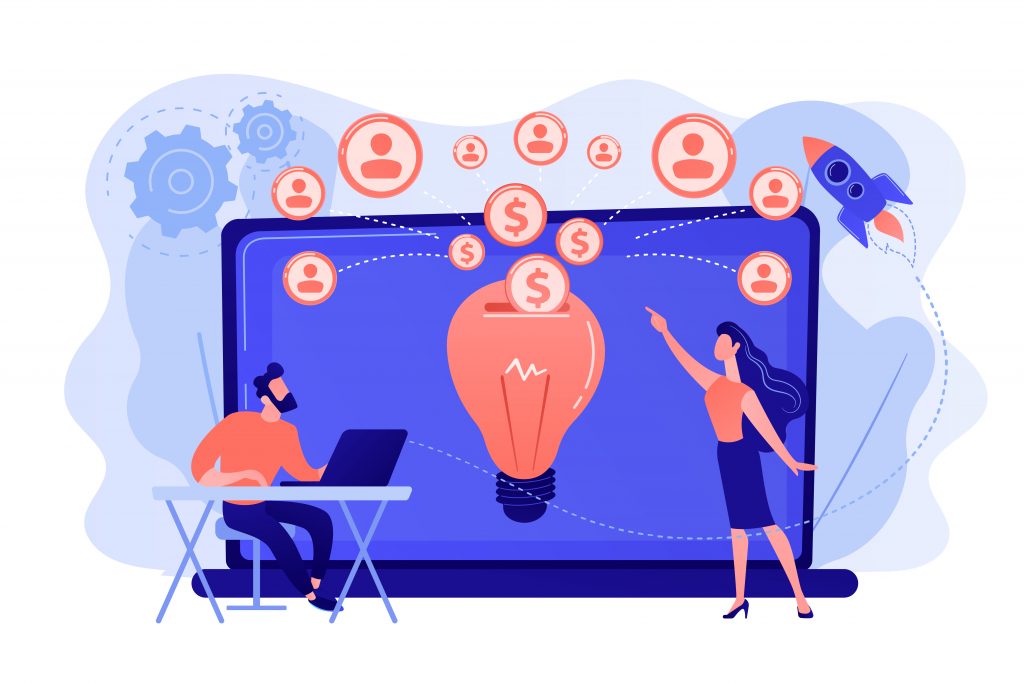
Can You Be TOO Strategic?

Can You Be TOO Strategic?

GUEST POST from Howard Tiersky

While the lack of a clear strategy can create problems in any business, there is another end of that spectrum.

Having a strategy means having clarity on what you want to achieve and a plan on how to get there. These are good things, but it’s also possible to be too strategic—too focused on a single goal and plan.

When Being TOO Strategic is a Problem

1. You Have an Ineffective Plan

What if you have a plan for reaching your goal but it doesn’t work? You could be putting all your eggs in one basket.

In some cases, you may be able to determine very quickly if your strategy isn’t working. That’s one of the beauties of digital. For example, with ecommerce, you can try a new email subject line and within a few hours (or even minutes) you can see whether people are responding to it.

There are other strategies, however, that demonstrate their effectiveness over time. A program that is designed to build relationships to drive more long-term customer loyalty is an example of a strategy that you won’t be able to determine the success of overnight.

Regardless of whether your plan can be evaluated quickly, if you put all your eggs in one strategic basket, there’s always the possibility that you’re wrong about the method to achieve your goal.

2. You Set the Wrong Goal

There’s also the possibility that you have either the wrong goal or a goal that’s not optimal.

No matter what group of consumers you choose to target, things can change quickly; it may turn out that you haven’t chosen a good target at all.

For example, think about when COVID-19 first disrupted our world. Consumers’ needs and habits changed because of the pandemic, which caused many companies to adjust their goals because their original goals were no longer going to bring successful outcomes. If you stayed laser focused on the goal of increasing the number of shoppers coming to your store each day amidst the pandemic, you were a little too strategically disciplined.

Even in less extreme cases, there are still situations where leaders fail to see new trends and opportunities for growth.

Blockbuster VideoBlockbuster is a great example of a company that had the wrong goal in mind. They were so hyper focused on putting a video rental store in every neighborhood that they failed to see the potential opportunity in digital streaming services.

Netflix, on the other hand, did an excellent job seeing that opportunity and successfully transformed from the DVD rental by mail service to the popular digital streaming service consumers love today.

There’s always the risk that either you’re pursuing the wrong destination or the wrong means to get there. And what do you do then? You have the opportunity to say, “Maybe I shouldn’t be 100% strategic.”

Often, mistakes and variability promote evolution and growth in a company, so it’s important to determine what percentage of your business should be based on strategy and what percentage should be based on trying new and different things which may not align with the current official strategy.

3. Consider a Balanced Approach

Ideally, find a balance of mostly strategic activities, but carve out some time for non-strategic activity to allow employees to be creative and freely come up with new ideas that just might turn into something great.

An example of a company who does this well and has seen success come out of this strategy is Google. Google offers “20% time,” which allows each employee to spend 20% of their work time on independent projects they feel will benefit Google in the long run without having to justify it to anyone.

This freedom promotes innovation and creativity, making employees feel like their work and input really matters to the company. Many of Google’s widely known products have come out of this non-strategic time, such as Gmail and Google Maps.

Another area of business that often takes a balanced approach to strategy is Research and Development (R&D). R&D teams are typically made up of creative and original thinkers; they may be faced with problems that they’re fascinated by and are trying to solve. It’s not always clear how solving that problem is going to help the company right away, but some of the world’s greatest innovations have come out of R&D departments.

For example, at Bell Labs, the transistor was invented by people who were fascinated by the way materials could be used to control electricity. It wasn’t clear when they were doing that original research exactly how the product would be used; it was much later that the potential was realized for commercial applications such as the microchip

Another example is Steve Jobs in the early days of Apple. When the Apple ][ computer was at its height, it was the main focus of the company and where all the money was coming from. The long term success of the Apple ][ platform was the strategic focus of the company.

At the time, in order to politically sideline him, Jobs was assigned to work on a seemingly non-strategic project, which was the Apple Macintosh, originally intended as a product for the education market. As successful as the Apple ][ was, ultimately, the innovation that came from launching the Macintosh massively eclipsed the Apple ][ and is a key product line to this day. Thank goodness for a non-strategic project.

4. It Might Be Worth It to Pursue a “Moonshot Idea”

It can be beneficial to allow a certain amount of time to work on complete “moonshot ideas”—
ideas that are highly risky but could change the company or the industry as a whole if they’re successful.

While these grand ideas have only proven to be occasionally successful, the payoff can be so huge when they do succeed that they are worth pursuing.

The bottom line is that you want to be good at being strategic, but not get so caught up in being so strategic that you miss out on a great opportunity for growth and success in your company that may not align with your strategy.

Parting Gift

My Wall Street Journal bestselling book, Winning Digital Customers: The Antidote to Irrelevance, contains a blueprint for developing a successful strategy for your company as well as practices to aid in identifying new trends and opportunities to explore. You can download the first chapter for free here or purchase the book here.

Image credits: Pixabay and Unsplash

Subscribe to Human-Centered Change & Innovation WeeklySign up here to get Human-Centered Change & Innovation Weekly delivered to your inbox every week.

Balancing Short-Term Wins and Long-Term Innovation Goals

Balancing Short-Term Wins and Long-Term Innovation Goals

GUEST POST from Chateau G Pato

In today’s rapidly evolving business landscape, organizations face the dual challenge of achieving short-term wins while steadily progressing towards long-term innovation goals. The ability to balance these two objectives is crucial for sustainable success. In this article, we will explore strategies for maintaining this balance and examine two compelling case studies that highlight the importance of aligning short-term and long-term efforts.

Strategies for Balancing Short-Term and Long-Term Goals

To successfully balance short-term wins with long-term innovation goals, organizations should consider the following strategies:

  • Set Clear Objectives: Outline specific, measurable objectives that align with both short-term and long-term goals.
  • Foster an Innovative Culture: Cultivate a culture that encourages experimentation, learning, and the sharing of ideas.
  • Ensure Agility: Implement agile methodologies to quickly adapt to changes and seize opportunities.
  • Allocate Resources Wisely: Allocate resources, including time, budget, and talent, strategically to support both immediate and future initiatives.
  • Monitor and Adjust: Continuously monitor progress and be prepared to adjust plans as necessary to maintain alignment with overall goals.

Case Study 1: Adobe – Embracing Continuous Innovation

Background

Adobe, a multinational software company known for its creative tools such as Photoshop and Illustrator, faced a critical decision in the early 2010s. The company needed to transition from traditional software licensing to a cloud-based subscription model to ensure long-term growth and innovation.

Short-Term Wins

To gain buy-in and demonstrate immediate value, Adobe introduced Adobe Creative Cloud, allowing users to subscribe to their software on a monthly basis. This move provided immediate financial gains by creating a steady, recurring revenue stream, and giving customers more flexibility.

Long-Term Innovation

While the transition to a subscription model was a significant short-term win, Adobe also invested heavily in long-term innovation. They focused on integrating AI and machine learning across their platforms, as well as expanding their ecosystem with new tools and services. The shift to Creative Cloud allowed Adobe to continuously update their software, ensuring that customers had access to the latest innovations without the need for new purchases.

Impact

The balance of short-term wins with a focus on long-term goals enabled Adobe to thrive in a rapidly changing market. Today, Adobe Creative Cloud is a cornerstone of the company’s success, providing substantial value to customers while ensuring sustained innovation.

Case Study 2: Amazon – Innovating for the Future

Background

Amazon, the global e-commerce and technology giant, has consistently balanced short-term operational efficiency with long-term innovation. One notable example of this balance is their approach to Amazon Web Services (AWS).

Short-Term Wins

Initially, Amazon focused on optimizing its retail operations to achieve short-term wins. They streamlined logistics, optimized the supply chain, and enhanced customer experience. These efforts generated immediate gains and established Amazon as a leader in the retail space.

Long-Term Innovation

Simultaneously, Amazon recognized the potential of cloud computing and invested heavily in the development of AWS. This long-term vision required substantial investment but promised a revolutionary shift in how businesses manage their IT infrastructure. AWS allowed Amazon to introduce new services and products, such as data analytics and machine learning, which have had a transformative impact across industries.

Impact

The strategy of balancing short-term improvements with visionary, long-term projects has paid off profoundly for Amazon. AWS is now a significant revenue generator and a critical driver of the company’s future growth and innovation. Amazon’s ability to balance the two has made it one of the most valuable and innovative companies in the world.

SPECIAL BONUS: The very best change planners use a visual, collaborative approach to create their deliverables. A methodology and tools like those in Change Planning Toolkit™ can empower anyone to become great change planners themselves.

Image credit: Pixabay

Subscribe to Human-Centered Change & Innovation WeeklySign up here to get Human-Centered Change & Innovation Weekly delivered to your inbox every week.

Re-Skilling and Upskilling People & Teams

Re-Skilling and Upskilling People & Teams

GUEST POST from Janet Sernack

The pandemic has increased the pace of change in a digitally accelerated world, and at the same time, it is forcing organizations, leaders, and teams to become more purposeful, human, and customer-centric. Where managing both the future and the present simultaneously requires people to unlearn what has worked in the past and relearn new mindsets and behaviors as to what might be possible, useful, and relevant in the future.

This is crucial to enabling people to perform at their best, and it requires investment in reskilling and upskilling people to be future-fit to meet the needs of previously unheard-of occupations, newly emerging flexible job options. All of which are being transformed by the pandemic, coupled with technologies created by accelerated digitization. Where organizations, leaders, and teams can increase speed, agility and improve simplicity and strategically generate new ways of tapping into the power of and harnessing and mobilizing people’s collective intelligence.

To better enable them to balance and resource organizational digital, agile, or cultural transformational initiatives with the needs of its people, users, customers, and communities, and execute them accordingly.

Collective Intelligence

Collective intelligence is group intelligence that emerges from the collaboration, efforts, and engagement of diverse groups, tribes, teams, and collectives. Which poses a great opportunity, which is also critical to recovery, for organizations to attract, retain, manage and leverage talent  through reskilling and upskilling people to be future-fit by:

  1. Enhancing flexible work options

The recent World Economic Forum Job Reset Summit reported that – “in 2020, the global workforce lost an equivalent of 255 million full-time jobs, an estimated $3.7 trillion in wages and 4.4% of global GDP, a staggering toll on lives and livelihoods.”

McKinsey & Co in a recent article state that – as many as 25 percent more workers may need to switch occupations than before the pandemic.

This means that in a hybrid work environment, without the constriction of location, and with the ability to leverage connection digitally, at little, or no cost, there is a greater talent pool to draw from. Including, according to a recent Harvard Business Review article “What your future employees want most” untapped pools of talent such as the “home force” which includes bringing people back into the workforce including people who put their careers on hold due to raising children, caring for the elderly and retired baby boomers.

It also means that some people will be more likely to prioritize lifestyle (family and personal interests) over proximity to work, and will pursue jobs in locations where they can focus on both – even if it means taking a pay cut. Workers will be more likely to move out of cities and other urban locations if they can work remotely for a majority of the time, creating new work hubs in rural areas.

  1. Measuring the value delivered and not the volume

Designing people and customer-centric work experiences, roles gives people the space to unlock their full potential, maximize their impact by delivering transformative results that contribute to the common good and to the future of humanity.

It also encourages cross-fertilization of creative ideas through teaming and networking, maximizing the power of collaboration and collaborative technologies to create and capture value, through inventing new business models, services, and products that users and customers appreciate and cherish.

  1. Prioritizing continuous learning, reskilling and upskilling

At the same time, customer expectations and preferences are also constantly changing, giving rise and opening doors to new roles and opportunities, that may have never previously existed.

Organizations also need to discover and explore new ways of competing and future-proofing against uncertainty and disruption. They also need to invent new ways of boosting productivity and improving efficiency, through adapting and flexing to flow with the new reality and to ultimately grow and thrive within it.

There are also opportunities to solve complex problems by increasing reciprocity and collaboration through cross-functional partnerships, collectives, tribes, and ecosystems, designed to capture and deliver value co-creatively.

Continuous learning

Reskilling and upskilling people to be future-fit by maximizing collective intelligence require disrupting complacency and stagnation and creating an environment of continuous learning and trust.

Where people are focused on delivering a great customer experience and have the permission and safety and are “allowed” to:

  • Value and leverage differences and diversity in ways that evoke, provoke, and create new ways of being through unlearning, and through relearning to adopt a beginner’s mind, develop a paradox lens, and elastic thinking strategies to pivot quickly into new roles and structures as situations demand.
  • Challenge the status quo, by withholding judgment and evaluation, through developing vital generative questioning, listening, and debating skills to deep dive into and unleash creative and inventive ideas.
  • Continuously learn, to remain both agile and adaptive, collaborative and innovative, to discover, evolve, and grow talent in ways that are both nimble and sustainable.
  • Create lines of sight between strategy, structures, systems, people, and customers, identifying and maximizing interdependencies, through intentional collaboration where everyone knows that their efforts contribute to, and make a difference to the delivery of organizational outcomes.
  • Provide rigor, discipline by driving accountability and by constantly measuring and sharing feedback and results to allow for engaging people in continuous learning, iterative process, and real-life pivots.

Leveraging collective genius

Only by prioritizing reskilling and upskilling people to be future-fit organizations will leverage people’s collective genius and enhance their agility to survive and thrive, flow, and flourish in a VUCA world.

Organizations that are future-focused will create meaningful and purposeful hybrid workplaces that increase peoples’ job satisfaction and support.  That provides flexible work options, continuous learning, and focus on generating value delivery will build people’s loyalty and retention and lower hiring costs over time.

An uncertain future

According to the World Economic Forum Job Reset Summit – “While vaccine rollout has begun and the growth outlook is predicted to improve, and even socio-economic recovery is far from certain”.

Yet, with so much uncertainty about the future, there is one thing that we can all control and is controllable, are our mindsets – how we think, feel, and choose to act in any situation, especially in our communication, problem-solving, and decision-making processes.

All of us have the freedom to choose, to develop our independent wills, and create new ways of being, thinking, feeling, and doing – to meet the needs of a wide range of previously unheard-of occupations that are emerging, to provide more flexible, meaningful and purposeful job options.

To leverage the current turning point, which is full of possibilities and innovative opportunities for enabling organizations, people, and customers to be more equitable, resilient, sustainable, and future-fit, in an ever-changing landscape, impacted by the technologies created by accelerated digitization.

This is the next blog a series of blogs, podcasts, and webinars on Developing a Human-Centric Future-Fitness organization

Find out more about our work at ImagineNation™

Find out about The Coach for Innovators Certified Program, a collaborative, intimate, and deep personalized innovation coaching and learning program, supported by a global group of peers over 8-weeks, starting October 19, 2021. It is a blended learning program that will give you a deep understanding of the language, principles, and applications of a human-centered approach to innovation, within your unique context. Find out more.

Image credit: Pixabay

Subscribe to Human-Centered Change & Innovation WeeklySign up here to get Human-Centered Change & Innovation Weekly delivered to your inbox every week.