While I found the Lit C-1 to be an interesting gadget but unlikely to be widely adopted given the other solutions already available at much better price to performance ratios to the problem it is trying to solve, I am a bit more optimistic about this intriguing design from Honda through a slightly different lens than they might examining its possibilities through.
Regular readers will know that I feel that innovation is all about:
Value Creation
Value Access
Value Translation
There is no doubt that Honda has created a lot of potential value here. The problem is that they’ve done a really poor job to date with Value Translation. Notice that in both video examples the users are small females. This introduces doubt unconsciously into the viewers. Will this work for a person who is large and/or tall?
Another point that I often highlight is that disruptive innovations require more than explanation, they require education. This is definitely a device that will require a fair amount of education to get people comfortable with the idea and start to see the need. Honda needs to do more education to help with that. They also need to better visualize where the greatest need for this device will be.
For me this is an amazing device because at 10kg (22 lbs) it is a truly portable personal mobility device (if you integrate a strap or two so that people can carry it on their back).
One hour of battery life seems like a big challenge though. But, not if people are using the device in place of crutches or for when they need a break from standing or walking, and don’t need to go far at any one time before plugging in.
I think this device has real potential, but I have no idea what it costs (and that could change my opinion). But for now it is clear it is a solution in search of a problem. So Honda needs to better identify what the problem is that the U3-X is solving before it will gain any traction, and then educate people so that they feel comfortable with it.
Too many companies invent things and feel the need to announce them too early before they find an application where their solution will be more valuable than all existing alternatives. Don’t make this mistake yourself.
But, what do you think? Invention or innovation?
Sign up here to get Human-Centered Change & Innovation Weekly delivered to your inbox every week.
I originally posed this software design challenge to application developers in September 2008 based on an InfoWorld article that warmed my heart, but have yet to see any major changes in how most software applications are designed.
For far too long, especially on the PC, software developers have been building applications with a feature arms race mentality. Because of rapidly expanding memory and hard disk space on customers’ machines, developers have not had to write tight code in the same way they had to in the early days of the PC.
Now, hopefully Symantec’s focus on creating Norton applications that install in under a minute and consume far less memory will spread to other industry players. Just because I have 4gb of RAM and 160gb of hard disk space does not give software developers the right to consume it thoughtlessly or to make my computer run slower.
Why can’t software developers give us adaptive software?
If I don’t use a feature of a product in 30 days, it should uninstall itself.
Why can’t I choose lean and mean (give me only the basic features) as an install option?
Software should be smart enough to minimize its footprint, while at the same time giving you the opportunity to add a feature easily later. So, an unused feature should get uninstalled, and simplify the menus as a result. But, if I hold the bottom of the menu it should expand to show uninstalled menu features in grey. If I select a greyed out feature it should tell me it is going to re-install it and then do so automatically.
I can only imagine how much smaller Vista, Office, Photoshop, and other applications would get if they were designed in this way.
If you know of applications designed in this way, please feel free to let me know by commenting on this article.
What do you think?
Sign up here to get Human-Centered Change & Innovation Weekly delivered to your inbox every week.
Or does someone out there already have an awesome design idea for a deluxe tarot-style approach for the visuals to go with my Nine Innovation Roles product offerings?
Sign up here to get Human-Centered Change & Innovation Weekly delivered to your inbox every week.
If there is one logo in the world that is definitely in desperate need of updating, it is the logo of Sherwin Williams.
My stomach turns at the site of the earth dripping with paint and the slogan “Cover the Earth” only makes it worse.
Is there anyone out there that would actually like to see the earth covered in paint?
Especially paint that looks like blood?
Sherwin Williams, I implore you, please update your logo as soon as possible to reflect the changing world we live in, where people are concerned about toxicity and where sustainability and being green are increasingly important.
If you could do it before Earth Day on April 22, 2012 that would be even better.
You may not realize the negative logo your logo is having on your business because your stock price is moving up and to the right, but imagine how much better it might be doing if you updated your image to reflect your surroundings?
Come on Sherwin Williams, you can do it!
Sign up here to get Human-Centered Change & Innovation Weekly delivered to your inbox every week.
Innovation comes in all different forms, and there is more than one way to boost profits in organizations.
Layoffs are not the only way to improve the bottom line when times get tough. Often asking the right questions can uncover new revenue sources in areas that previously had only been seen as a source of costs.
There is an article in Fast Company from 2007 when I wrote this article that talks about ways that companies are greening themselves. I highly recommend that every entrepreneur and manager read it. It’s not a hippie and granola, look at us aren’t we great type of article but instead highlights loads of different ways that organizations are becoming green. This article highlights lots of different ways that organizations are improving their bottom lines, while greening themselves at the same time.
There are many reasons why trying to make your organization more environmentally responsible has the potential to improve the bottom line:
It focuses the organization on identifying and eliminating waste
Creating new directions for the waste your organization produces:
Are our waste products of value to someone?
Can we recycle or otherwise use our waste products for something useful?
Could we produce our products closer to our customers?
Could we source our inputs closer to our factories?
Could we change how we package our product to reduce the amount of raw materials needed?
Could we somehow distribute our products in reusable containers?
Finally, there is no escaping the fact that becoming more environmentally responsible as an organization will either gain you additional sales now or prevent you from losing sales in the future. as the standards of government and corporate procurement departments begin to shift towards purchasing from more environmentally responsible vendors.
So, what does your organization have to gain from trying to identify areas of environmental opportunity?
Sign up here to get Human-Centered Change & Innovation Weekly delivered to your inbox every week.
Traffic is a problem for drivers and bus riders alike. When traffic gets bad, it gets even worse for buses downtown. Here is why:
Transit agencies, in their quest to put more capacity on popular routes, have added long “bendy” buses to their fleets. The problem is that these buses require twice the available space before an intersection to be able to move from one block to another. They also have more difficulty changing lanes and negotiating corners than standard buses. During periods of heavy traffic this often results in “bendy” buses being unable to move to the next block for more than one light cycle, backing up traffic behind them and delaying other, shorter buses that might have fit into the smaller space in front of them. The answer?
Seattle and other communities should take a second look at double-decker buses for popular routes that traverse the city center or look to banish “bendy” buses from downtown routes altogether. Double-decker buses are only slightly taller than most standard buses, have a smaller footprint than bendy buses, and give riders a nice view of the city.
Now I must say that I did one time see a double-decker public bus cruising through downtown Seattle the other day. It was a route 417 on its way to Mukilteo and it effortlessly cruised through a yellow light to get the last spot in the bus zone (one a bendy bus wouldn’t have fit in).
I don’t know if the regional transit bureau serving areas north of Seattle has more than one double-decker bus in their fleet or whether this is a test bus for a future purchase, but it sure looked better cruising through downtown Seattle than a bendy bus bouncing up and down. There is nothing quite like the view from the upper-deck of a double-decker bus as you cruise through a city. I hope this is the sign of more to come. Bendy buses may be a newer concept, but double-decker buses are a better one. Oh yeah, and keep the WiFi coming, people love their WiFi on the buses. 🙂
Sign up here to get Human-Centered Change & Innovation Weekly delivered to your inbox every week.
I was flipping through the throwaway coupon circular the other day to see if there were any coupons for anything that I buy anyways, and I came across a couple of items that for me it wasn’t immediately obvious what they were. At the bottom you have an item that looks like a cross between a milk bottle and a flower, but is in fact a room freshener spray, and at the top you have an item that almost looks like a night light but is a room freshener. Both of these are part of the new Glade Expressions line from SC Johnson. I love it that more companies are paying more attention to not just the function of their products, but the form too. And after all, doesn’t everybody deserve a little design in their life?
Sign up here to get Human-Centered Change & Innovation Weekly delivered to your inbox every week.
There have been several recent product announcements or launches that move a step closer to the future vision of computing that I began advocating two years ago. That vision that moves computing to the pocket, home, or office and envisions display and input devices relevant to the context the person is currently in.
I believed two years ago and still believe that what the world needs is not more smart devices, but more flexible and plentiful dumb devices that are driven by the one smart device to rule them all – an extensible smart phone that can not only drive multiple display and input devices wirelessly, but also augment its processing and storage capabilities via wireless devices or the cloud.
Here is a flashback to what I said the Apple iPhone should become two years ago:
“People don’t want a fourth screen. What they want to do is extend the screen they have in their pocket.”
What would be most valuable for people, what they really want, is an extensible, pocketable device that connect wirelessly to whatever input or output devices that they might need to fit the context of what they want to do. To keep it simple and Apple-specific, in one pocket you’ve got your iPhone, and in your other pocket you’ve got a larger screen with limited intelligence that folds in half (or quarters) and connects to your iPhone and can also transmit touch and gesture input for those times when you want a bigger screen. When you get to work you put your iPhone on the desk and it connects to your monitor, keyboard, and possibly even auxiliary storage and processing unit to augment the iPhone’s onboard capabilities. Ooops! Time for a meeting, so I grab my iPhone, get to the conference room and wirelessly connect my iPhone to the in-room projector and do my presentation. On the bus home I can watch a movie or read a book, and when I get home I can connect my iPhone to the television and download a movie or watch something from my TV subscriptions. So why do I need to spend $800 for a fourth screen again?
So what are some of the devices that show that we’re getting close to realizing this vision?
Motorola Atrix – A dockable 4G smart phone that while apparently it makes a pretty good smart phone, the lapdock that it connects to in order to give you laptop type functionality has received pretty poor reviews – making it sound like it’s not very-well designed or compelling.
RIM Blackberry Playbook – RIM’s entry into the tablet market is the Blackberry Playbook. RIM failed to take the full leap and release an inexpensive dumb screen that connects to the user’s Blackberry. Instead it appears to be a fully functional (and priced) 7-inch tablet computer that uses the bigger screen to display the user’s email from their mobile handset without cables. RIM’s lack of commitment to the vision I’ve laid out has resulted in a ‘stuck in the middle’ device that is unlikely to catch on in the marketplace.
Nintendo WiiU – Nintendo is launching an oversize motion sensing controller that also has a display for game developers to utilize to extend the gaming environment out of the TV and closer to the gamer. This opens up the opportunity to either remove some of the visual visual clutter from the big screen onto the little one (creating a more immersive experience) or to leverage the second screen to deliver more game information (imagine flipping through pages of item inventories, maps, etc.). In this case the Nintendo Wii has the smarts and delivers the images wirelessly to the WiiU controller.
Now, let’s discuss Apple’s efforts in advancing the vision I laid out a couple of years to hopefully encourage device manufacturers to make it real so that we can all enjoy a more flexible, useful, valuable computing experience across multiple contexts.
Apple is launching Airplay Mirroring in iOS5 (PICTURED AT THE TOP) which allows you to display what’s on your Apple iPad2 (or part of it in the case of specially programmed games or other apps) WIRELESSLY. Apparently Airplay Mirroring works with all 90,000 iPad apps. There is one catch – you must have an Apple TV connected to your TV. Taken a step further, the next Apple iPhone will have the same (or better) processor that’s inside the Apple iPad2 and will run iOS5 so it may have Airplay Mirroring as well. These latest developments may also be part of the reason we are hearing rumblings of Apple and Samsung possibly partnering together to bring out a line of Apple branded televisions. Personally I think that would be the wrong way to go. Apple should focus on selling the minimal hardware necessary to facilitate an Airplay Mirroring connection to anyone who wants to build the connection capability into their televisions (or tablets or monitors or conference room projectors or laptops). Here is a video that shows all of the Apple Airplay Mirroring capabilities:
As you can see Apple is getting very close to fully realizing the potential of the vision I laid out a couple of years ago and it’s all very exciting. Of course they will probably make it work with only Apple hardware, so that leaves a huge opportunity for someone like HP or Dell or Samsung to take this and run with it in the way I’ve described now that the major hurdle (the video transmission) seems to have been solved, and to bring it to the mass audience. Here’s one company that has a conference room flat panel solution. Hopefully the big players will get together and build a standard so we can all enjoy the benefits of mobile-centric, extensible, flexible, context-sensitive computing very soon. Come on folks you’re almost to the finish line, just a little bit more innovating and you’re there!
How exciting!
P.S. I still believe there is an opportunity for someone to subsidize the cost of a bigger screen (to drive massive adoption) by allocating a portion of the potential incremental media purchases or search advertising that it would drive but nobody has done that yet.
Sign up here to get Human-Centered Change & Innovation Weekly delivered to your inbox every week.
I had the opportunity to attend an event hosted by the Seattle office of design firm NBBJ yesterday. The event featured Roger Martin, Dean of the Rotman School of Management at the University of Toronto, and author of “The Design of Business” and “The Opposable Mind.” I’d like to share a video interview I did with Roger before the event:
I’d also like to share some of the key insights from Roger’s talk at the event:
People think in ways that form rules in their brains, and they are not always aware of the ways that those rules constrain them
That which tends to get you more reliability often gets you less validity
IQ tests have test/re-test reliability, but only 30% of life outcomes are related to IQ, 70% is attributable to other factors
Emotional intelligence measures may be more valid, but not reliable
If you insist on reliability, you can’t prove in advance that your heuristic of a mystery is correct
Innovation is a prisoner of deductive and inductive logic
We learn to analyze quantities, but what matters more often are the qualities
Abductive logicians welcome variance because they want to try and understand the outliers. Our modern education system beats abductive logic out of you. Are you focusing on quantities or qualities?
We depend too much on quantities – Having more Science Technology & Math (STeM) graduates is not the way to invent the future
Our businesses run on abstractions to help us understand the world, so new ones can be created and existing ones can be questioned
Outliers in data can be significant sources for growth and innovation. Take the example of Intuit’s QuickBooks – it was created because of the persistent existence of Quicken outliers trying to use the program to run their business instead of their personal finances.
From the book – “It’s not necessarily that some young whippersnapper’s going to come up with some better idea than you. They’re going to start from a different premise and they’re going to come to a different conclusion that makes you irrelevant.””
Sometimes you have to marinate on wicked problems. Instead of trying to simplify them, wade in a ways and then take a break and ruminate.
If you live in a way that sets up your mind to determine whether things are true or false, then you can’t invent the future.
Innovation is more about combining and synthesizing existing conceptualizations and models. There are three main ways to do this:
Disaggregation – Target is a good example – In packaged goods, they focus on price, but in soft goods the focus on design.
Doubling-Down – To get the buzz of exclusivity that Cannes gets, the Toronto Film Festival pushed so hard on inclusivity that they created the buzz through the People’s Choice Awards
Mixing – Hidden gems
“It’s not the job of the customer to invent the future.”
Quantitative and qualitative surveys force customers to make something up when they don’t know how to answer
Customers only know themselves and are happy to talk about themselves
Interesting question – Should we be teaching intuitive thinking to science, technology and math majors? – Yes! – We should focus more energy in science on the intuitive leaps of the mind necessary to come up with interesting hypotheses.
CEOs should see themselves as the Chief Validity Officer because of the overwhelming reliability-focus of our organizations
Heuristics are a drug for strategy & design consultants – Often they are so busy with the heuristics that they don’t take the time to push heuristics down into algorithms or to explore new mysteries
My book review of “The Design of Business” can be found here.
My previous interview with “The Design of Business” author Roger Martin can be found here.
Sign up here to get Human-Centered Change & Innovation Weekly delivered to your inbox every week.
A few weeks ago I received “The Design of Business” by Roger Martin in the mail. “The Design of Business” is a relatively short, easy, and pleasant read.
The main premise of the book is that our organizations, and the business schools that fill out their top leadership ranks, are too focused on analytical thinking at the expense of intuitive thinking. This focus creates too much emphasis on reliability at the expense of validity.
“The most successful businesses in the years to come will balance analytical mastery and intuitive originality in a dynamic interplay that I call design thinking.” – Roger Martin
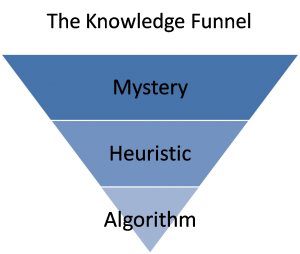
One of the key concepts of the book is the introduction of the Knowledge Funnel – a visual element that shows how knowledge progresses from mysteries to heuristics to algorithms. It all begins with a question at the top of the funnel, and at each stage transition, knowledge and execution can typically be transferred to lower cost labor (and possibly handled by a computer when they reach the algorithm level).
At the same time, there are other tensions in our organizations that managers in the era of the creative economy will have to become attuned to, and these include managing an appropriate balance between exploitation and exploration and not falling victim to the false certainty of the past when making business development decisions.
Ultimately, the exploration of the mysteries at the top of the knowledge funnel and exploitation of the algrithms at the bottom of the funnel are equally important. Companies that focus too much on one, at the expense of the other, risk their very future.
Creating a design thinking organization is not easy, and several pages are devoted to describing the struggles of A.G. Lafley and Claudia Kotchka in transforming P&G;’s organizational culture to be more design-centric.
In addition to other examples of organizations pushing themselves more towards design thinking, there is also a great deal of focus in the book on the transformation of mysteries into heuristics and heuristics into algorithms.
Overall, the book is another way of looking at the challenge facing innovators everywhere who are looking to embed design or innovation (or both) into their organization.
So, are you ready to tackle the challenge of achieving a balance of analytical thinking with intuitive thinking in your organization?
My interview with “The Design of Business” author Roger Martin can be found here.
Sign up here to get Human-Centered Change & Innovation Weekly delivered to your inbox every week.
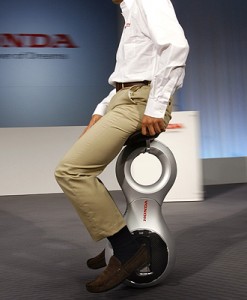 In writing my article yesterday – Innovation or Invention? – Gyroscopically Stabilized Electric Motorcycle – I came across an interesting video from 2009 of an invention called the U3-X from the research labs at Honda.
 Sign up here to get Human-Centered Change & Innovation Weekly delivered to your inbox every week.
 I originally posed this software design challenge to application developers in September 2008 based on an InfoWorld
 Innovation comes in all different forms, and there is more than one way to boost profits in organizations.
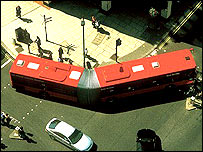 Traffic is a problem for drivers and bus riders alike. When traffic gets bad, it gets even worse for buses downtown. Here is why:
 Seattle and other communities should take a second look at double-decker buses for popular routes that traverse the city center or look to banish “bendy” buses from downtown routes altogether. Double-decker buses are only slightly taller than most standard buses, have a smaller footprint than bendy buses, and give riders a nice view of the city.
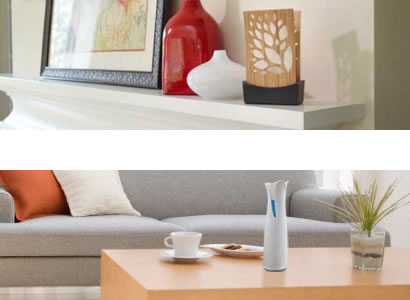 I was flipping through the throwaway coupon circular the other day to see if there were any coupons for anything that I buy anyways, and I came across a couple of items that for me it wasn’t immediately obvious what they were. At the bottom you have an item that looks like a cross between a milk bottle and a flower, but is in fact a room freshener spray, and at the top you have an item that almost looks like a night light but is a room freshener. Both of these are part of the new
 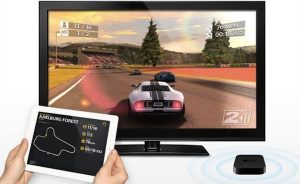 There have been several recent product announcements or launches that move a step closer to the future vision of computing that I began advocating two years ago. That vision that moves computing to the pocket, home, or office and envisions display and input devices relevant to the context the person is currently in.
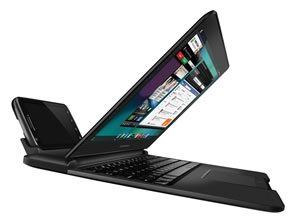 Motorola Atrix – A dockable 4G smart phone that while apparently it makes a pretty good smart phone, the lapdock that it connects to in order to give you laptop type functionality has received pretty poor reviews – making it sound like it’s not very-well designed or compelling.
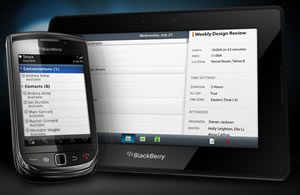 RIM Blackberry Playbook – RIM’s entry into the tablet market is the Blackberry Playbook. RIM failed to take the full leap and release an inexpensive dumb screen that connects to the user’s Blackberry. Instead it appears to be a fully functional (and priced) 7-inch tablet computer that uses the bigger screen to display the user’s email from their mobile handset without cables. RIM’s lack of commitment to the vision I’ve laid out has resulted in a ‘stuck in the middle’ device that is unlikely to catch on in the marketplace.
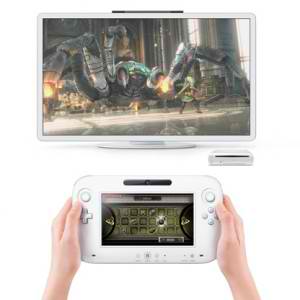 Nintendo WiiU – Nintendo is launching an oversize motion sensing controller that also has a display for game developers to utilize to extend the gaming environment out of the TV and closer to the gamer. This opens up the opportunity to either remove some of the visual visual clutter from the big screen onto the little one (creating a more immersive experience) or to leverage the second screen to deliver more game information (imagine flipping through pages of item inventories, maps, etc.). In this case the Nintendo Wii has the smarts and delivers the images wirelessly to the WiiU controller.
 A few weeks ago I received “The Design of Business” by Roger Martin in the mail. “The Design of Business” is a relatively short, easy, and pleasant read.
 At the same time, there are other tensions in our organizations that managers in the era of the creative economy will have to become attuned to, and these include managing an appropriate balance between exploitation and exploration and not falling victim to the false certainty of the past when making business development decisions.