Author Archives: Chateau G Pato

About Chateau G Pato

Chateau G Pato is a senior futurist at Inteligencia Ltd. She is passionate about content creation and thinks about it as more science than art. Chateau travels the world at the speed of light, over mountains and under oceans. Her favorite numbers are one and zero. Content Authenticity Statement: If it wasn't clear, any articles under Chateau's byline have been written by OpenAI Playground or Gemini using Braden Kelley and public content as inspiration.

Rebuilding Trust in a Changing Economy

The Psychological Contract of Work

LAST UPDATED: December 31, 2025 at 12:23PM

Rebuilding Trust in a Changing Economy

GUEST POST from Chateau G Pato

In my decades of work championing Human-Centered Change™, I have consistently maintained that innovation is change with impact. However, as we accelerate into the future, we are finding that the “impact” we desire is being throttled by a silent crisis: the disintegration of the psychological contract of work. This unwritten, often unspoken agreement — the invisible glue that binds an employee’s discretionary effort to an organization’s goals — is currently under immense strain from economic volatility, algorithmic displacement, and a persistent lack of empathy in corporate boardrooms.

When the psychological contract is healthy, it fosters a sense of belonging and mutual investment. But when it is broken, the corporate antibody — that natural organizational resistance to anything new — becomes hyper-aggressive. Rebuilding this trust is not a luxury for HR to manage; it is the fundamental duty of the modern leader who wishes to survive the 2020s.

“Trust is the oxygen of innovation. You can have the most advanced AI and the most brilliant strategy, but if your people do not feel safe enough to experiment, your organization will eventually suffocate in its own cynicism.”

Braden Kelley

The Erosion of Shared Purpose

For most of the industrial era, the contract was transactional: loyalty for stability. In the digital age, that shifted to performance for growth. Today, however, many employees feel the contract has become one-sided. We ask for agile resilience, constant upskilling, and deep emotional labor, yet the rewards often feel fleeting or disconnected from the human experience. To fix this, we must recognize that Human-AI Teaming and digital transformation cannot succeed if the humans involved feel like temporary placeholders.

Case Study 1: The Transparency Pivot at Buffer

The Challenge: Building a cohesive, high-trust culture in a fully remote environment during periods of market instability.

The Intervention: Buffer famously leaned into radical transparency as a design principle for their psychological contract. They chose to share everything — from exact salary formulas to revenue figures and diversity goals — publicly. When they faced financial difficulties that necessitated layoffs, they didn’t hide behind legalese. They shared the raw math and provided an empathetic off-boarding process that honored the value of those leaving.

The Insight: By honoring the “honesty” pillar of the psychological contract, Buffer prevented the remaining team from retreating into defensive, low-innovation postures. Trust was maintained not because things were perfect, but because the leadership was predictably authentic.

Case Study 2: Microsoft’s Cultural “Empathy OS”

The Challenge: A “know-it-all” culture that stifled collaboration and led to internal silos and stagnating innovation.

The Intervention: Under Satya Nadella, Microsoft underwent a human-centered change journey toward a “learn-it-all” growth mindset. They fundamentally renegotiated the psychological contract by prioritizing psychological safety. They encouraged managers to move from “judges” to “coaches,” using empathy as a tool to unlock collective intelligence rather than individual performance alone.

The Insight: This shift in the internal contract catalyzed a massive resurgence. When employees felt that their growth was prioritized over their “correctness,” the speed of innovation increased. They proved that empathy is a strategic multiplier for technical excellence.

Leading Companies and Startups to Watch

If you are looking for the organizations architecting the new psychological contract, keep a close eye on Lattice and Culture Amp, which are moving beyond simple surveys to deep, AI-augmented sentiment analysis that helps leaders act before trust breaks. BetterUp is another key player, democratizing coaching to ensure the “growth” part of the contract is available to all, not just executives. On the startup front, ChartHop is bringing unprecedented clarity to organizational design, while Tessl and Vapi are exploring how AI can handle transactional “grunt work” to free humans for the meaningful, purpose-driven work that the new contract requires. These companies recognize that the Future Present belongs to those who prioritize the human spirit over the algorithmic output.

Architecting a Resilient Future

To rebuild trust, leaders must stop treating change management as a post-script to strategy. It must be baked into the design. We need to create environments where employees are not just “bought in,” but “brought in” to the decision-making process. As a top innovation speaker, I frequently advise organizations that the most successful transformations are those where the workers feel like co-architects of their own future.

We are currently standing at a crossroads. We can continue to optimize for short-term efficiency, risking creative atrophy and total disengagement, or we can choose to rebuild a psychological contract based on mutual flourishing. The choice we make today will determine which organizations thrive in the next decade and which ones are rejected by the very talent they need most.

Frequently Asked Questions

What is the “Psychological Contract” of work?
It is the unwritten set of expectations, beliefs, and obligations between an employer and employee. Unlike a legal contract, it governs the emotional and social exchange — things like trust, loyalty, growth opportunities, and a sense of belonging.
How has the changing economy damaged this contract?
Economic volatility and rapid AI integration have created a sense of “precarity.” When companies prioritize short-term stock gains or automation over human value, employees feel the agreement has been violated, leading to “Quiet Quitting” or creative resistance.
What is the first step in rebuilding workplace trust?
Radical transparency and empathetic communication are the foundations. Leaders must move away from “command and control” and instead involve employees in the transformation process, ensuring they feel secure enough to innovate without fear of immediate displacement.

Extra Extra: Because innovation is all about change, Braden Kelley’s human-centered change methodology and tools are the best way to plan and execute the changes necessary to support your innovation and transformation efforts — all while literally getting everyone all on the same page for change. Find out more about the methodology and tools, including the book Charting Change by following the link. Be sure and download the TEN FREE TOOLS while you’re here.

Image credits: Google Gemini

Subscribe to Human-Centered Change & Innovation WeeklySign up here to get Human-Centered Change & Innovation Weekly delivered to your inbox every week.

Future-Proofing Human Creativity in the Age of Algorithmic Output

LAST UPDATED: December 30, 2025 at 2:51PM

Future-Proofing Human Creativity in the Age of Algorithmic Output

GUEST POST from Chateau G Pato

Innovation has always been about change with impact. But as we navigate the late 2025 landscape, a new threat has emerged: the AI Creativity Trap. Organizations are rushing to replace human ideation with algorithmic output, lured by the siren song of “infinite content” and “zero-cost drafts.” However, we must be vigilant. If we are not intentional, a myopic focus on this technology will take us down the path of least resistance — the path where our creative energy moves to where it is easiest to go, rather than where it is most meaningful.

The truth is that Artificial Intelligence is superhuman at pattern recognition but fundamentally “backward-looking.” It is trained on yesterday’s data. To get to the future first, we need analogical thinking — the ability to connect unrelated domains and find the “Aha!” moments that a database of the past simply cannot predict. We are not just building tools; we are managing a transition of the human spirit.

“The algorithm can find the pattern, but only the human can find the purpose. Innovation isn’t just about what is possible; it is about what is purposeful and how it transforms the quality of people’s lives in ways they cherish.”

Braden Kelley

The Corporate Antibody vs. The Generative Ally

When we introduce AI into the creative workflow, the corporate antibody — the natural organizational resistance to disruption — often manifests in two ways: total rejection or total abdication. Both are fatal. Future-proofing your organization requires Human-AI Teaming, where the machine handles the computational complexity and the human provides the emotional resonance and cultural nuance.

Case Study 1: The Empathy Engine in Global Contact Centers

The Challenge: A major global utility provider was seeing a “Trust Deficit” as their automated IVR systems frustrated customers, leading to high churn. Their initial instinct was to use Generative AI to replace agents entirely to save costs.

The Human-Centered Solution: Following the Cautious Adoption Framework, they shifted strategy. Instead of replacing agents, they deployed AI as a “Co-Pilot” that synthesized customer history and emotional sentiment in real-time. When a customer called in frustrated, the AI didn’t speak for the agent; it provided the agent with a three-bullet emotional dossier and suggested empathetic pathways. The Result: Resolution speed increased by 30%, but more importantly, agent job satisfaction rose because they were empowered to solve complex human problems rather than digging through data. They moved from being transactional clerks to high-value relationship managers.

Case Study 2: Breaking the ‘Average’ in Architectural Design

The Challenge: An urban planning firm found that using standard AI design tools led to “Architectural Homogenization” — every building proposal started to look like a blend of the most popular designs from the last five years. Their creative edge was evaporating into the “commodity of the average.”

The FutureHacking™ Approach: The firm implemented a rule: AI could only be used for stress-testing and rapid iteration, never for the initial “seed” of the idea. Architects were tasked with finding analogies from biology and music to create the initial concept. Only after the human “soul” of the building was defined did the AI step in to optimize for structural integrity and light efficiency. The Result: They won three consecutive international competitions because their designs possessed a distinctive cultural thumbprint that purely algorithmic competitors lacked. They proved that AI “collapses” when context changes, but human intuition thrives in the cracks of the unknown.

Leading Companies and Startups to Watch

In the current 2025 landscape, we must look beyond the “Big Tech” giants to find the true architects of human-AI collaboration. Anthropic continues to lead with their “Constitutional AI” approach, ensuring Claude remains aligned with human ethical frameworks. Adobe has set the gold standard for IP-friendly creativity with the Firefly Video Model, which empowers creators rather than scraping them. Startups like Anysphere (the team behind Cursor) are redefining “vibe coding,” allowing developers to stay in a flow state while the AI handles the boilerplate. Meanwhile, Cerebras Systems is building the “wafer-scale” hardware that will allow us to move beyond the limitations of current GPUs, potentially opening the door for AI that understands physics and three-dimensional context more deeply than ever before.

Architecting the Future Present

Success in this age will not be defined by who has the most powerful LLM, but by who has the most resilient creative culture. We must tell our employees the truth: technology will change your job, but it doesn’t have to eliminate your value. By focusing on experience design and empathy-driven innovation, we can ensure that we aren’t just optimizing for obsolescence, but building a world where technology serves the human spark, not the other way around.

Frequently Asked Questions

How do we prevent AI from making all creative work look the same?

The key is to use AI as an iterative partner rather than an originative source. By forcing the “initial seed” of a project to come from human analogical thinking — finding connections across unrelated domains — you ensure the output has a unique “soul” that a pattern-matching algorithm cannot replicate.

What is the biggest risk of over-automating creativity?

I call this the AI Creativity Trap. When teams rely too heavily on AI for ideation, their “creative muscles” atrophy. Research shows that when context or constraints change unexpectedly, purely AI-driven solutions often “collapse,” whereas human-led teams can flex and adapt using their unique emotional intelligence.

How can leaders build trust during AI transitions?

Trust is built through behavior, not just words. Leaders must be transparent about why the change is happening and involve employees early in defining how the tools will be used. Following a Cautious Adoption Framework — starting with low-risk, high-utility tasks — helps people see the AI as an ally that removes “grunt work” to free them up for “soul work.”

Extra Extra: Because innovation is all about change, Braden Kelley’s human-centered change methodology and tools are the best way to plan and execute the changes necessary to support your innovation and transformation efforts — all while literally getting everyone all on the same page for change. Find out more about the methodology and tools, including the book Charting Change by following the link. Be sure and download the TEN FREE TOOLS while you’re here.

Image credits: Google Gemini

Subscribe to Human-Centered Change & Innovation WeeklySign up here to get Human-Centered Change & Innovation Weekly delivered to your inbox every week.

Quantifying the Opportunity Loss of Not Innovating

The Cost of Inertia

LAST UPDATED: December 29, 2025 at 12:15PM

Quantifying the Opportunity Loss of Not Innovating

GUEST POST from Chateau G Pato

In boardrooms around the world, innovation is framed as an expense that must be justified. What is rarely debated with equal rigor is the mounting cost of delay. In a world defined by accelerating change, inertia is no longer passive. It is actively destructive.

The cost of inertia is the accumulation of missed opportunities, weakened capabilities, and eroded trust that results from failing to adapt. While these losses may not appear on balance sheets, they shape long-term viability.

“Inertia is not the absence of change. It is the slow acceptance of decline.”

Braden Kelley

Why Organizations Underestimate Inertia

Leaders are trained to avoid visible failure. Innovation introduces uncertainty and accountability, while maintaining the status quo spreads responsibility thinly.

This creates a bias toward short-term stability over long-term relevance. By the time consequences emerge, the window for easy adaptation has closed.

Reframing Innovation as Loss Prevention

Innovation should not be viewed solely as growth investment. It is also a form of risk mitigation. Organizations that fail to innovate lose optionality, resilience, and talent.

The question shifts from “What if this fails?” to “What is the cost if we never try?”

Case Study 1: Media Industry Transformation

A traditional media company resisted digital subscription models to protect advertising revenue. Digital-native competitors moved quickly, capturing audience loyalty.

The eventual transition required deeper cuts and brand repositioning. Early experimentation would have preserved both revenue and trust.

Case Study 2: Enterprise Software Evolution

An enterprise software provider delayed cloud migration to protect legacy licensing models. Customers migrated to more flexible competitors.

When the shift finally occurred, it required aggressive pricing concessions and cultural change that could have been incremental years earlier.

Quantifying the Invisible

Leaders can make inertia visible by tracking leading indicators such as:

  • Declining customer lifetime value
  • Increasing time-to-decision
  • Reduced experimentation rates

These metrics reveal organizational drag before financial decline becomes irreversible.

The Human Cost of Standing Still

Talented people leave organizations where learning stalls. Customers disengage when experiences stagnate.

Innovation signals belief in the future. Inertia communicates resignation.

Designing Momentum Instead of Disruption

Overcoming inertia does not require dramatic reinvention. It requires consistent progress. Small experiments, clear learning objectives, and visible leadership support create momentum.

Innovation succeeds when it is treated as a system, not a side project.

A Leadership Choice

Every organization innovates or decays by default. The only question is whether that process is intentional.

Leaders who measure the cost of inertia gain the clarity to act before decline becomes destiny.

Frequently Asked Questions

FAQ

How do leaders justify innovation investment?
By framing it as loss prevention and capability building.

Is inertia always a strategic failure?
It becomes one when it prevents learning and adaptation.

What is the first step to overcoming inertia?
Making opportunity loss visible and discussable.

Extra Extra: Because innovation is all about change, Braden Kelley’s human-centered change methodology and tools are the best way to plan and execute the changes necessary to support your innovation and transformation efforts — all while literally getting everyone all on the same page for change. Find out more about the methodology and tools, including the book Charting Change by following the link. Be sure and download the TEN FREE TOOLS while you’re here.

Image credits: Google Gemini

Subscribe to Human-Centered Change & Innovation WeeklySign up here to get Human-Centered Change & Innovation Weekly delivered to your inbox every week.

Applying Project Learning to Personal Growth

Agile Retrospectives for Life

LAST UPDATED: December 28, 2025 at 11:54AM

Applying Project Learning to Personal Growth

GUEST POST from Chateau G Pato

We live in a world obsessed with forward motion. New goals, new habits, new aspirations constantly demand attention. What is missing is a disciplined pause to learn from what already happened.

Agile retrospectives for life offer a practical way to transform lived experience into lasting growth. They bring clarity to chaos and replace vague self-assessment with structured learning.

“Reflection is the bridge between intention and improvement. Without it, effort becomes noise.”

Braden Kelley

Why Agile Thinking Belongs Beyond Work

Agile methods succeed because they shorten feedback loops. Life, however, often stretches feedback across months or years. Retrospectives compress learning, helping individuals see patterns earlier and adjust sooner.

This is not about productivity hacking. It is about becoming more intentional with time, energy, and attention.

A Simple Framework for Life Retrospectives

1. Observe Without Judgment

Begin by noticing outcomes and emotions as data. Curiosity creates insight. Judgment shuts it down.

2. Identify Patterns

One bad week is noise. Repeated behaviors reveal systems at work in your life.

3. Design Small Experiments

Choose one change to test before the next retrospective. Progress compounds through iteration.

Case Study 1: Managing Burnout

A leader experiencing chronic burnout used biweekly retrospectives to examine workload, boundaries, and recovery habits.

Instead of attempting radical change, they tested small adjustments. Over several months, energy and clarity improved without sacrificing performance.

Case Study 2: Learning and Skill Development

An individual pursuing a new skill applied retrospectives after each learning sprint. They reviewed study methods, motivation, and comprehension.

This approach reduced frustration and increased retention by aligning effort with how they actually learned best.

The Role of Compassion in Retrospectives

Personal retrospectives must be grounded in compassion. Without it, reflection becomes self-criticism.

Agile teaches us that systems fail more often than people. This insight is equally powerful in personal growth.

Scaling the Practice Over Time

As retrospectives become habitual, their scope can expand. Monthly reviews may examine goals and relationships, while quarterly retrospectives can explore purpose and direction.

The cadence matters less than the commitment to learning.

A Competitive Advantage for Life

In a rapidly changing world, the ability to learn faster than circumstances change is a profound advantage.

Agile retrospectives for life do not promise perfection. They offer progress, awareness, and resilience.

Frequently Asked Questions

FAQ

How often should life retrospectives be done?
Weekly or monthly works well for most people.

What tools are needed?
A notebook, calendar reminder, and honesty.

Can retrospectives improve happiness?
They increase self-awareness, which supports better choices.

Extra Extra: Because innovation is all about change, Braden Kelley’s human-centered change methodology and tools are the best way to plan and execute the changes necessary to support your innovation and transformation efforts — all while literally getting everyone all on the same page for change. Find out more about the methodology and tools, including the book Charting Change by following the link. Be sure and download the TEN FREE TOOLS while you’re here.

Image credits: Pexels

Subscribe to Human-Centered Change & Innovation WeeklySign up here to get Human-Centered Change & Innovation Weekly delivered to your inbox every week.

Mapping the Blended Digital-Physical Customer Journey

Experience Architecture

LAST UPDATED: December 27, 2025 at 10:49AM

Mapping the Blended Digital-Physical Customer Journey

GUEST POST from Chateau G Pato

Digital transformation promised seamless experiences. What many organizations delivered instead were faster silos. Customers gained more channels, but lost coherence. Experience architecture emerged as a response to this fragmentation.

Experience architecture is the practice of designing how people move through an ecosystem of interactions over time. It recognizes that experiences are not consumed in isolation, but constructed through sequences, transitions, and memory.

“Great experiences are not designed at the point of interaction. They are designed in the space between interactions.”

Braden Kelley

Why Journey Transitions Matter More Than Touchpoints

Most experience breakdowns occur during transitions: when customers switch channels, repeat information, or encounter conflicting signals. These moments shape perception more than polished interfaces.

Experience architecture focuses on these seams, ensuring that intent, context, and emotion carry forward.

Designing for a Blended Reality

Customers no longer distinguish between digital and physical experiences. They expect continuity across screens, spaces, and people.

Architecting for this reality requires organizations to think in systems rather than channels.

A Practical Experience Architecture Framework

1. Persistent Context

Customer history, preferences, and intent should travel with them. Every interaction should feel informed, not isolated.

2. Emotional Progression

Journeys should reduce anxiety, build confidence, and reinforce trust over time.

3. Organizational Orchestration

Experience architecture aligns teams, platforms, and incentives around shared journey outcomes.

Case Study 1: Financial Services Onboarding

A financial institution redesigned its onboarding journey across digital applications and in-branch verification. Previously, customers felt confused and mistrustful during handoffs.

By architecting the journey holistically, the bank reduced drop-offs and improved satisfaction while lowering operational rework.

Case Study 2: Smart Mobility Services

A mobility provider integrated mobile apps, physical kiosks, and customer support into a unified experience. Real-time context flowed across channels, enabling proactive assistance.

The result was increased usage, fewer support calls, and stronger customer confidence during disruptions.

Experience Architecture as Strategic Infrastructure

Experience architecture is not a design deliverable. It is strategic infrastructure. It shapes how investments are made, how teams collaborate, and how success is measured.

Organizations that treat it as such outperform those that chase isolated improvements.

The Leadership Imperative

Leaders must move beyond channel ownership and optimize for journey outcomes. This requires shared accountability and a willingness to redesign internal systems in service of human experience.

Experience architecture succeeds when leadership treats experience as a system, not a surface.

Frequently Asked Questions

FAQ

Is experience architecture only for digital businesses?
No. Any organization with multiple touchpoints benefits from it.

Does it replace UX or service design?
No. It integrates and aligns them.

Where should organizations start?
Start by mapping transitions, not channels.

Extra Extra: Because innovation is all about change, Braden Kelley’s human-centered change methodology and tools are the best way to plan and execute the changes necessary to support your innovation and transformation efforts — all while literally getting everyone all on the same page for change. Find out more about the methodology and tools, including the book Charting Change by following the link. Be sure and download the TEN FREE TOOLS while you’re here.

Image credits: Unsplash

Subscribe to Human-Centered Change & Innovation WeeklySign up here to get Human-Centered Change & Innovation Weekly delivered to your inbox every week.

Designing for the Extremes, Benefiting the Middle

The “Dark Horse” Customer

LAST UPDATED: December 25, 2025 at 10:59AM

Designing for the Extremes, Benefiting the Middle

GUEST POST from Chateau G Pato

Organizations often say they are customer-centric, yet their design decisions quietly optimize for convenience, averages, and assumptions. The result is a polished experience that works well until reality intervenes.

Human-centered design reaches its full power when teams stop designing for the mythical “average” user and start learning from the edges. The Dark Horse customer — underestimated, inconvenient, or misunderstood — holds the key to building experiences that scale under real-world conditions.

“When a system works for people under stress, constraint, or uncertainty, it doesn’t just survive the real world — it earns trust in it.”

Braden Kelley

Why Extremes Predict the Future

Extreme users are not anomalies; they are early signals. Aging populations, increasing cognitive load, language diversity, and economic pressure all push more people toward what was once considered the edge.

Designing for extremes today is how organizations stay relevant tomorrow.

The Hidden Cost of Designing for the Average

Average-based design creates fragile systems. When stress increases — time pressure, emotional intensity, technical failure — these systems collapse.

Dark Horse customers experience these breakdowns first, but never last.

A Practical Framework for Designing at the Edges

1. Seek Out Struggle

Do not recruit only confident or successful users. Study frustration, confusion, and improvisation.

2. Design for Recovery

Extreme users make mistakes under pressure. Systems that allow easy recovery benefit everyone.

3. Reduce Cognitive Load

Clarity is the ultimate inclusive design strategy. If the experience works for someone overwhelmed, it will work for anyone.

Case Study 1: Healthcare Appointment Systems

A healthcare provider redesigned appointment scheduling after observing patients managing chronic illness and limited digital skills.

By reducing steps, clarifying language, and confirming understanding, the system improved no-show rates and satisfaction across the entire patient population.

Case Study 2: E-Commerce Under Time Pressure

An e-commerce company studied last-minute shoppers during high-stress periods. These users abandoned carts due to unclear delivery expectations and complex checkout flows.

Simplifying choices and emphasizing reassurance increased conversion rates not only during peak times, but year-round.

Designing for Dignity

At its core, designing for the Dark Horse customer is about dignity. It acknowledges that people are human, not idealized users with unlimited time, focus, or confidence.

This mindset shift transforms inclusion from a compliance exercise into a competitive advantage.

The Middle Benefits the Most

When organizations design for extremes, the middle experiences ease, clarity, and confidence without realizing why.

That invisibility is the mark of great design.

Frequently Asked Questions

FAQ

Are Dark Horse customers rare?
No. Most people become extreme users under certain conditions.

Is this the same as inclusive design?
Inclusive design is a result; designing for extremes is a method.

Where should teams start?
Start where customers struggle the most.

Extra Extra: Because innovation is all about change, Braden Kelley’s human-centered change methodology and tools are the best way to plan and execute the changes necessary to support your innovation and transformation efforts — all while literally getting everyone all on the same page for change. Find out more about the methodology and tools, including the book Charting Change by following the link. Be sure and download the TEN FREE TOOLS while you’re here.

Image credits: Unsplash

Subscribe to Human-Centered Change & Innovation WeeklySign up here to get Human-Centered Change & Innovation Weekly delivered to your inbox every week.

A Leader’s Framework for Uncertainty

Decision-Making Under Ambiguity

LAST UPDATED: December 25, 2025 at 10:59AM

A Leader's Framework for Uncertainty

GUEST POST from Chateau G Pato

Ambiguity has become the permanent operating condition for modern leaders. Strategy horizons shrink, assumptions expire quickly, and yesterday’s best practice becomes today’s constraint. In this reality, decision-making is no longer about choosing the optimal path — it is about enabling progress without full visibility.

The leaders who thrive are not those who eliminate uncertainty, but those who design organizations capable of acting intelligently within it.

“Uncertainty does not paralyze organizations; rigid thinking does. The leader’s job is to replace the need for certainty with the capacity to learn and adapt.”

Braden Kelley

From Certainty to Capability

Many leadership models still reward decisiveness as confidence. Under ambiguity, confidence must be redefined. It is no longer about being right; it is about being responsive.

This requires shifting from outcome certainty to capability certainty — confidence that the organization can sense, adapt, and respond effectively.

Understanding the Nature of Ambiguity

Ambiguity emerges when the environment changes faster than meaning can stabilize. Customer needs evolve, technologies converge, and competitive boundaries blur.

In such conditions, leaders must abandon the illusion of control while strengthening alignment around shared intent.

An Updated Framework for Ambiguous Decisions

1. Define Non-Negotiables

Clarify values, purpose, and constraints that will guide decisions regardless of direction. These act as stabilizers when everything else shifts.

2. Sequence Commitments

Avoid all-or-nothing decisions. Break commitments into stages, increasing investment as learning reduces uncertainty.

3. Design for Feedback Speed

The faster feedback arrives, the safer decisions become. Leaders should optimize for learning velocity, not decision finality.

4. Normalize Intelligent Failure

Punishing failure under ambiguity suppresses information. Rewarding thoughtful experimentation accelerates clarity.

Case Study 1: Financial Services Product Innovation

A financial services firm explored new digital offerings amid regulatory and market ambiguity. Leadership framed initiatives as learning journeys rather than launches.

By staging investments and reviewing insights frequently, the organization avoided costly misalignment while building confidence in future opportunities.

Case Study 2: Urban Infrastructure Planning

A city government faced uncertainty around population growth and climate impact. Instead of committing to a single long-term plan, leaders adopted adaptive infrastructure principles.

Projects were designed to evolve over time, allowing the city to respond as conditions changed rather than locking in outdated assumptions.

What Strong Leaders Do Differently

Leaders effective under ambiguity:

  • Ask better questions instead of demanding answers
  • Share uncertainty transparently
  • Focus on learning signals rather than lagging indicators

These behaviors create trust and momentum even when outcomes remain unclear.

Ambiguity as a Strategic Advantage

Organizations comfortable with ambiguity move faster because they are not waiting for permission from the future. They act, learn, and adjust while others hesitate.

In a world defined by uncertainty, this capability is the ultimate competitive advantage.

Frequently Asked Questions

FAQ

How should leaders communicate during uncertainty?
By being honest about what is known, unknown, and being learned.

Does ambiguity mean abandoning strategy?
No. It means holding strategy as a hypothesis, not a fixed plan.

What is the most important leadership skill under ambiguity?
Sensemaking combined with decisive learning.

Extra Extra: Because innovation is all about change, Braden Kelley’s human-centered change methodology and tools are the best way to plan and execute the changes necessary to support your innovation and transformation efforts — all while literally getting everyone all on the same page for change. Find out more about the methodology and tools, including the book Charting Change by following the link. Be sure and download the TEN FREE TOOLS while you’re here.

Image credits: Pexels

Subscribe to Human-Centered Change & Innovation WeeklySign up here to get Human-Centered Change & Innovation Weekly delivered to your inbox every week.

Allocating Innovation Time – The Strategy Behind the 20% Rule

LAST UPDATED: December 24, 2025 at 9:19AM

Allocating Innovation Time - The Strategy Behind the 20% Rule

GUEST POST from Chateau G Pato

The “20% rule” has become shorthand for enlightened innovation culture. Unfortunately, it is also one of the most misunderstood practices in modern management. Too often, leaders copy the label without designing the system required to support it.

Innovation time is not about generosity. It is about strategic resilience.

“Innovation time is not a gift to employees; it is a hedge against the certainty of change. Organizations that don’t invest time in continuous innovation will eventually spend far more time recovering lost market share.”

Braden Kelley

From Myth to Mechanism

The original insight behind the 20% rule was simple: breakthroughs rarely emerge from fully optimized schedules. Slack, when intentionally designed, creates room for exploration, reflection, and synthesis.

However, copying a percentage without addressing incentives, governance, and leadership behavior leads to frustration rather than innovation.

What Innovation Time Is Really For

Innovation time serves three strategic purposes:

  • Exploring uncertain opportunities
  • Building future-relevant capabilities
  • Increasing employee engagement through autonomy

Each purpose requires different design choices. Treating them as interchangeable undermines results.

Design Principles for Effective Innovation Time

1. Strategic Alignment Without Overcontrol

Teams should understand why innovation matters and where learning is needed. This creates direction without prescribing solutions.

2. Visible Executive Sponsorship

When innovation time conflicts with delivery deadlines, only leadership can resolve the tension. Silence is interpreted as permission to deprioritize innovation.

3. Learning-Centered Accountability

Innovation time should culminate in shared learning, not just demos. Organizations should expect evidence of insight, not certainty of outcomes.

Case Study 1: Enterprise Software Organization

An enterprise software company reintroduced innovation time after a failed attempt years earlier. This time, leadership connected it to explicit learning themes tied to future markets.

Teams shared insights quarterly, and several experiments informed the company’s next product roadmap — even when ideas themselves were not commercialized.

Case Study 2: Healthcare Services Provider

A healthcare organization facing burnout introduced innovation time focused on patient experience improvement. Clinicians were given protected time to explore workflow and communication challenges.

The program led to incremental but meaningful improvements, reduced frustration, and renewed professional purpose — outcomes more valuable than any single innovation.

When Not to Use Innovation Time

Innovation time is not a substitute for:

  • Clear strategy
  • Adequate staffing
  • Basic process improvement

If teams are overwhelmed by operational chaos, innovation time will feel like an additional burden rather than an opportunity.

Innovation Time as Cultural Infrastructure

Over time, well-designed innovation time reshapes how people think about risk, learning, and ownership. Employees stop waiting for permission and start seeing themselves as contributors to the future.

That mindset shift is the true return on investment.

Frequently Asked Questions

FAQ

Does innovation time reduce productivity?
In the short term, it reallocates effort; in the long term, it increases adaptability.

Can innovation time work outside tech companies?
Yes. The principle applies to any organization facing change.

What replaces the 20% rule if it fails?
Purposeful learning time designed around strategic uncertainty.

Extra Extra: Because innovation is all about change, Braden Kelley’s human-centered change methodology and tools are the best way to plan and execute the changes necessary to support your innovation and transformation efforts — all while literally getting everyone all on the same page for change. Find out more about the methodology and tools, including the book Charting Change by following the link. Be sure and download the TEN FREE TOOLS while you’re here.

Image credits: Unsplash

Subscribe to Human-Centered Change & Innovation WeeklySign up here to get Human-Centered Change & Innovation Weekly delivered to your inbox every week.
Metrics for Systemic Human-Centered Design Success

Measuring Empathy

LAST UPDATED: December 23, 2025 at 1:51PM

Metrics for Systemic Human-Centered Design Success

GUEST POST from Chateau G Pato

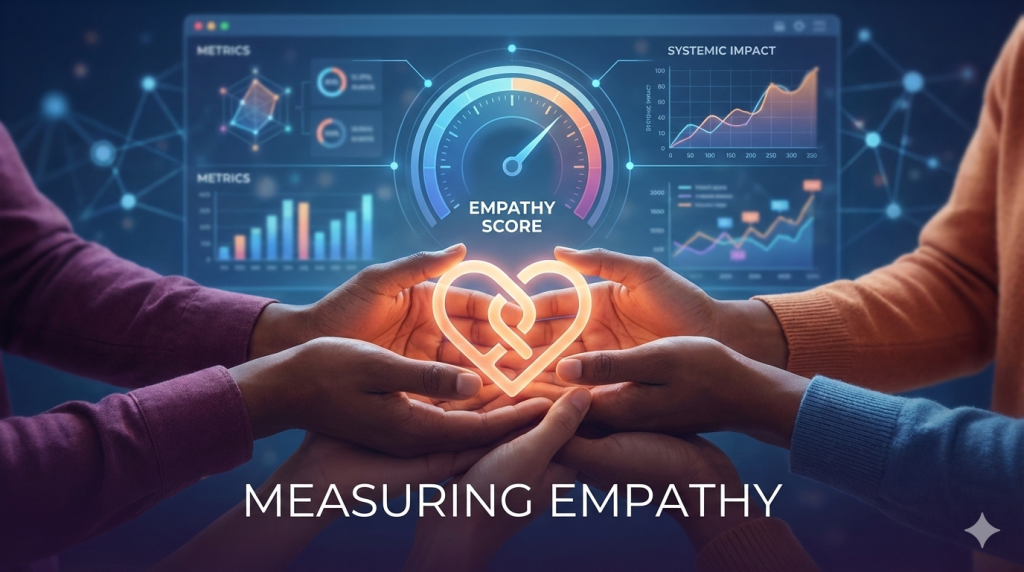
Empathy is frequently praised and rarely operationalized. In too many organizations, it lives in sticky notes, inspirational posters, and kickoff workshops — disconnected from how decisions are actually made. As human-centered design matures from a project-level practice into an enterprise capability, empathy must become measurable, repeatable, and systemic.

Measuring empathy is not about stripping humanity from design. It is about ensuring that human understanding survives scale, complexity, and quarterly pressure.

Re-framing Empathy as a Capability

Empathy is often misunderstood as an individual trait. In reality, sustainable empathy is an organizational capability supported by structures, incentives, and feedback loops. The question leaders should ask is not “Are our designers empathetic?” but rather “Does our system consistently produce empathetic outcomes?”

Metrics provide the answer.

A Practical Empathy Measurement Framework

1. Human Insight Integrity

These metrics assess whether decisions are grounded in real human understanding:

  • Percentage of strategic initiatives informed by primary research
  • Recency of customer insights used in decisions
  • Inclusion of marginalized or edge users

Outdated or secondhand insights are a hidden empathy killer.

2. Experience Friction Reduction

Empathy should reduce unnecessary effort and stress:

  • Time-on-task improvements
  • Drop-off and abandonment rates
  • Emotion-based experience ratings

3. Organizational Behavior Change

Look for evidence that empathy is shaping behavior:

  • Frequency of cross-functional research participation
  • Leadership presence in customer interactions
  • Reuse of validated insights across teams

4. Long-Term System Health

At scale, empathy improves system resilience:

  • Reduction in rework and failure demand
  • Employee engagement and retention
  • Trust and loyalty over time

“Empathy is not proven by how deeply we feel in a workshop, but by how consistently our systems change behavior in the real world. If you can’t measure that change, empathy remains a belief instead of a capability.”

Braden Kelley

Case Study 1: Retail Banking Transformation

A large retail bank invested heavily in digital channels but continued to see declining trust. By introducing empathy metrics focused on customer anxiety and clarity, the bank discovered that customers felt overwhelmed rather than empowered.

Design teams simplified language, reduced choice overload, and measured success through emotional confidence indicators. Within eighteen months, complaint volume dropped while product adoption increased — a clear signal of systemic empathy at work.

Case Study 2: Public Transportation Services

A metropolitan transit authority applied empathy metrics to rider experience. Beyond punctuality, they measured perceived safety, clarity of wayfinding, and stress during disruptions.

By addressing emotional pain points and tracking their reduction, the authority improved satisfaction without major infrastructure investment, proving that empathy can outperform capital expenditure.

Embedding Empathy into Governance

Empathy metrics only matter if they influence decisions. Leading organizations embed them into:

  • Executive dashboards
  • Investment prioritization
  • Performance reviews

When empathy metrics sit alongside financial and operational metrics, they shape trade-offs instead of reacting to them.

The Future of Human-Centered Measurement

As AI and automation accelerate, empathy will become a primary differentiator. Organizations that can measure and manage it will design systems that are not only efficient, but humane.

The goal is not perfect empathy. The goal is continuous human understanding at scale.

Frequently Asked Questions

FAQ

Why are empathy metrics necessary?
They ensure human needs remain visible and actionable as organizations scale.

Do empathy metrics replace qualitative research?
No. They amplify and sustain qualitative insights over time.

What is the first empathy metric to implement?
Track how often real customer insights directly inform decisions.

Extra Extra: Because innovation is all about change, Braden Kelley’s human-centered change methodology and tools are the best way to plan and execute the changes necessary to support your innovation and transformation efforts — all while literally getting everyone all on the same page for change. Find out more about the methodology and tools, including the book Charting Change by following the link. Be sure and download the TEN FREE TOOLS while you’re here.

Image credits: Pixabay, Google Gemini

Subscribe to Human-Centered Change & Innovation WeeklySign up here to get Human-Centered Change & Innovation Weekly delivered to your inbox every week.

The Leader’s Guide to Change Adoption

From Reluctant to Ready

LAST UPDATED: December 22, 2025 at 12:02PM

The Leader's Guide to Change Adoption

GUEST POST from Chateau G Pato

Change does not fail at the strategy level as often as leaders think. It fails at the human level. Organizations announce transformation, deploy tools, and track milestones, only to discover that people quietly revert to old behaviors. Adoption, not execution, is the real bottleneck.

As a human-centered change and innovation practitioner, I see resistance as a signal, not a setback. The journey from reluctance to readiness is the leader’s most important responsibility.

Re-framing Resistance

Resistance is frequently misdiagnosed as unwillingness. More often, it reflects uncertainty about competence, consequences, or credibility. People ask themselves whether they can succeed, whether the change will last, and whether leadership can be trusted.

Leaders who re-frame resistance as feedback gain clarity about what readiness requires.

Readiness Is Built, Not Announced

Readiness emerges when people understand the change, believe it matters, and feel capable of acting differently. This requires time, practice, and reinforcement.

Human-centered leaders design change as a learning journey rather than a rollout.

Case Study One: Microsoft and the Power of Modeling

Microsoft’s cultural shift under a growth mindset philosophy succeeded because leaders modeled the behavior they expected. Curiosity replaced certainty, and learning replaced defensiveness.

This visible shift reduced fear and normalized experimentation, accelerating adoption across the organization.

Psychological Safety as an Adoption Accelerator

People adopt change faster when they feel safe admitting what they do not know. Psychological safety turns learning into a shared endeavor rather than an individual risk.

Leaders create safety through transparency, patience, and consistent reinforcement.

Case Study Two: Clinician-Led Change in Healthcare

A hospital system struggling with digital adoption shifted its approach by empowering respected clinicians as change champions. Peer-led learning replaced top-down mandates.

Adoption improved because trust already existed within peer networks.

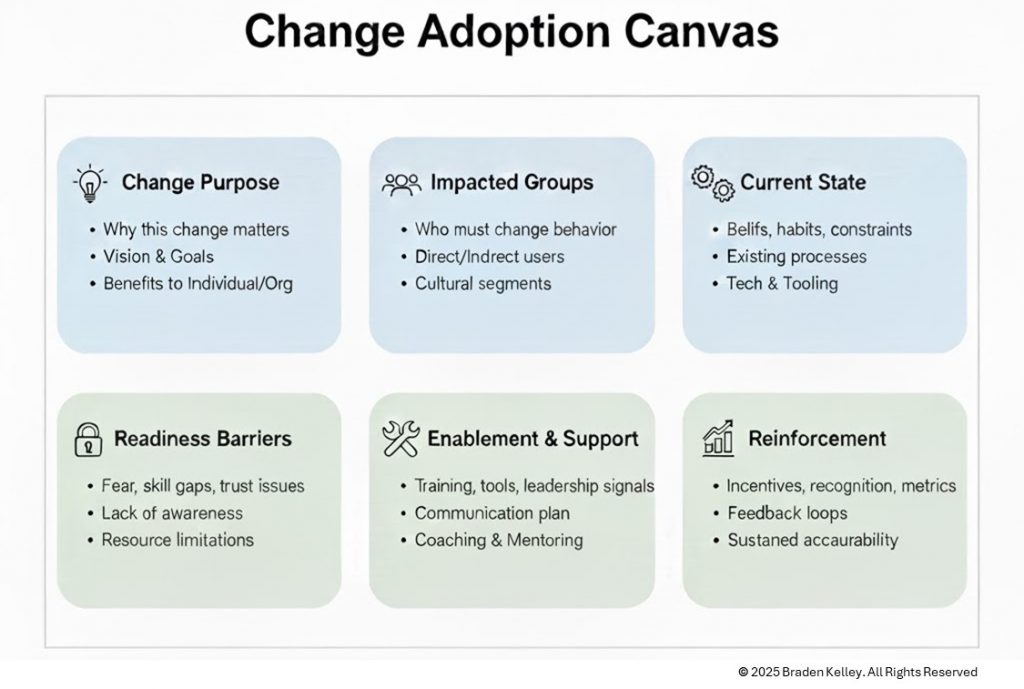
The Change Adoption Canvas

The Change Adoption Canvas is a practical, human-centered tool designed to help leaders move beyond announcing change and toward achieving sustained behavior adoption. Rather than focusing on project plans or communications alone, the canvas prompts teams to examine change through the lived experience of the people who must actually behave differently.

Change Adoption Canvas

By working through the six sections, leaders clarify why the change matters, identify who is most impacted, and surface the beliefs, habits, and constraints that shape current behavior. The canvas is best used collaboratively in workshops or leadership sessions, where diverse perspectives can reveal hidden readiness barriers and misaligned signals. Once those barriers are visible, the canvas guides leaders to intentionally design enablement, support, and reinforcement mechanisms that build confidence and trust over time. Used iteratively, the Change Adoption Canvas becomes both a diagnostic and a design tool, helping organizations course-correct, strengthen adoption, and embed change as a repeatable capability rather than a one-time effort.

Signals Over Statements

People believe what leaders do more than what they say. Promotions, budgets, and recognition send powerful signals about what truly matters.

Aligning these signals with desired behaviors is essential to sustaining change.

“Leaders do not create readiness by demanding change; they create it by making people feel capable, supported, and safe enough to begin.”

— Braden Kelley

Conclusion

The journey from reluctant to ready is not linear, and it cannot be rushed. It requires empathy, patience, and intentional design.

Leaders who invest in readiness do more than implement change. They build organizations capable of continuous adaptation.

Frequently Asked Questions

Why do well-communicated changes still fail?

Because understanding does not automatically create confidence or capability.

How can leaders measure change adoption?

By observing sustained behavior change and real-world usage, not just task completion.

What role does leadership behavior play in adoption?

Leadership behavior sets the tone and determines whether people feel safe embracing change.

Extra Extra: Because innovation is all about change, Braden Kelley’s human-centered change methodology and tools are the best way to plan and execute the changes necessary to support your innovation and transformation efforts — all while literally getting everyone all on the same page for change. Find out more about the methodology and tools, including the book Charting Change by following the link. Be sure and download the TEN FREE TOOLS while you’re here.

Image credits: Pixabay, Google Gemini

Subscribe to Human-Centered Change & Innovation WeeklySign up here to get Human-Centered Change & Innovation Weekly delivered to your inbox every week.