Tag Archives: IDEO

Designing for Humans

Bridging Empathy and Innovation

Designing for Humans - Bridging Empathy and Innovation

GUEST POST from Art Inteligencia

In a world that is constantly evolving, the need to innovate is imperative. However, innovation should not be pursued at the expense of human-centric design. To truly succeed, businesses and innovators must build a bridge between empathy and innovation, ensuring that every solution aligns with the deeper needs, desires, and behaviors of real people. As a thought leader in human-centered change and innovation, I’m passionate about this intersection and how it can lead to transformational success.

Harnessing Empathy in Design

Empathy is at the heart of human-centered design. It involves stepping into the shoes of your users and understanding their experiences, pain points, and motivations. By prioritizing empathy, design teams can uncover insights that traditional data analysis might miss, leading to more meaningful, impactful innovations.

Case Study 1: IDEO and the Design of the First Apple Mouse

In the early 1980s, Apple collaborated with the design and innovation consultancy IDEO to create the first computer mouse for personal computers. While the technical design and innovation were crucial, IDEO’s commitment to understanding the everyday user’s experience was what set this project apart.

By observing how people interacted with computers, IDEO was able to design a mouse that was intuitive and easy to use. This focus on user experience and empathy led to a product that not only met functional requirements but also transformed how people interacted with technology, paving the way for Apple’s user-centric philosophy.

Bridging Empathy and Innovation through Collaborative Design

Collaborative design is a method of integrating diverse perspectives and expertise into the innovation process. By bringing together cross-functional teams and incorporating feedback from users, organizations can ensure that solutions are not only innovative but also grounded in real-world needs.

Case Study 2: Airbnb’s Evolution through Storytelling and Empathic Research

Airbnb’s journey from a struggling startup to a global hospitality powerhouse is a testament to the power of empathy and storytelling. The company invested in deeply understanding the journey and experiences of their users – both hosts and guests.

Through empathic research and storytelling workshops, Airbnb’s design team was able to identify key pain points and emotional highs present in their customer journey. This enabled them to design a platform that addresses both practical and emotional needs, fostering trust and engagement with the brand.

The Path Forward: Empathy-Driven Innovation Cultures

For organizations looking to replicate such success, fostering a culture that values empathy and innovation is paramount. By investing in ongoing user research, promoting cross-disciplinary collaborations, and prioritizing human-centered outcomes, businesses can create products and services that resonate deeply with users.

To explore further, check out my other articles on Human-Centered Innovation: The New Imperative and Empathic Research: Unlocking Insights for Breakthrough Innovation for deeper insights on embedding empathy into the innovation process.

As we venture into the future, it is clear that the most successful innovations will be those that are intimately connected with human needs and aspirations. By bridging empathy and innovation, we can create a world where technology and design truly enhance the human experience.

Please make sure the links provided are reviewed as they are conceptual in this context. Confirm their existence on your site at the actual URLs.

Extra Extra: Futurology is not fortune telling. Futurists use a scientific approach to create their deliverables, but a methodology and tools like those in FutureHacking™ can empower anyone to engage in futurology themselves.

Image credit: Pexels

Subscribe to Human-Centered Change & Innovation WeeklySign up here to get Human-Centered Change & Innovation Weekly delivered to your inbox every week.

Overcoming Common Pitfalls in Human-Centered Design

Overcoming Common Pitfalls in Human-Centered Design

GUEST POST from Art Inteligencia

Human-centered design (HCD) is an approach that grounds the creation of new products and services in understanding the needs, preferences, and limitations of the end-users. Despite its potential to foster innovation and create meaningful solutions, the process is fraught with pitfalls that can undermine its effectiveness. This article explores common challenges encountered in HCD and presents case studies that illustrate how organizations have overcome these obstacles to deliver successful outcomes.

Understanding User Needs: The Key to Avoiding Assumptions

One of the most prevalent pitfalls in HCD is the assumption that designers inherently know what users need. This can lead to solutions that are misaligned with user expectations and fail to address their true problems. A human-centered approach requires an empathetic understanding of the user’s world, which can only be achieved through direct engagement and observation.

Case Study: IDEO and the Redesign of a Medical Device

IDEO, a leader in human-centered design, faced a challenge when a medical device company approached them to redesign an insulin pump. The initial assumption was that users — primarily diabetic patients — primarily desired a smaller, more discreet device. However, through ethnographic research and user interviews, IDEO discovered that usability was the real concern. The pump’s interface was confusing, leading to frequent user errors.

Armed with this insight, IDEO shifted their focus from size to user-friendliness. They developed a new interface that was intuitive and easy to navigate, significantly reducing user errors. The redesigned device received widespread acclaim, illustrating the importance of challenging initial assumptions and truly understanding user needs.

Iterative Testing: Ensuring Solutions Are Refined and Effective

Another common pitfall is neglecting the iterative testing process. Human-centered design thrives on a cycle of prototyping, testing, and refining solutions based on user feedback. Skipping or underestimating this cycle can result in products that are technically sound but fail to resonate with users.

Case Study: Airbnb’s Evolving Website Experience

Airbnb, now a giant in the hospitality industry, wasn’t always the polished platform users see today. In its early days, Airbnb’s website was initially met with poor user engagement. Recognizing the need for iterative testing, the team began conducting regular sessions with users to gather feedback directly.

User testing revealed critical insights that guided several iterations of the website. Changes were made to the search functionality, listing presentations, and booking processes. Each iteration was tested and refined, leading to a more seamless and user-friendly experience. This dedication to understanding and iterating on the product from a user-centered perspective played a significant role in Airbnb’s success.

Cross-Functional Collaboration: Leveraging Diverse Perspectives

HCD is inherently multidisciplinary, yet many organizations work in silos, stifling the richness of diverse perspectives. Effective HCD requires collaboration among cross-functional teams, bringing together designers, engineers, marketers, and end-users to foster innovation and creativity.

Conclusion

Overcoming pitfalls in human-centered design requires a commitment to understanding users deeply, iteratively testing and refining solutions, and fostering cross-functional collaboration. These principles ensure that products and services resonate with users and deliver tangible value. By embracing these practices, organizations can navigate the complexities of HCD and create truly innovative solutions that stand the test of time.

Bottom line: Futurology is not fortune telling. Futurists use a scientific approach to create their deliverables, but a methodology and tools like those in FutureHacking™ can empower anyone to engage in futurology themselves.

Image credit: Unsplash

Subscribe to Human-Centered Change & Innovation WeeklySign up here to get Human-Centered Change & Innovation Weekly delivered to your inbox every week.

Case Studies in Human-Centered Design

Lessons from Top Companies

Principles of Inclusive Design

GUEST POST from Art Inteligencia

Human-centered design (HCD) is a creative and strategic approach to problem-solving that places the needs, behaviors, and experiences of people at the forefront of the design and development process. Unlike traditional methods that may prioritize technical feasibility or business goals in isolation, HCD seeks to integrate these elements with deep empathy and understanding of the end user. By involving users throughout different stages of the design process, from research to prototyping and testing, HCD ensures that the solutions created are both usable and meaningful to those they are intended to serve. This approach not only enhances user satisfaction but also drives innovation and success for organizations that embrace it.

Case Study 1: IDEO’s Approach with Ford’s Focus

IDEO, a global design company renowned for its human-centered design methodology, partnered with Ford to redesign the Ford Focus, making it more user-friendly and appealing. This collaboration offers a wealth of lessons on the importance of putting the user at the center of the design process.

The Challenge: Ford wanted to revitalize the Focus, a line that was quickly becoming outdated and faced stiff competition.

Key Steps Taken:

  • User Research: IDEO conducted extensive ethnographic research, observing how real users interacted with their vehicles. This research highlighted pain points such as difficult-to-use controls and the need for a more intuitive interface.
  • Prototyping: Rapid prototyping allowed IDEO to quickly iterate on design ideas and receive real-time feedback from users.
  • Empathy Maps and Personas: Detailed empathy maps and personas were created to ensure that the design team stayed focused on actual user needs throughout the process.

The Result: By focusing on the human experience, the new Ford Focus was not only aesthetically pleasing but also significantly more intuitive and user-friendly. Sales of the Focus increased, and the car was awarded multiple design accolades.

Lessons Learned:

  • Consistent user research provides invaluable insights and ensures the product meets the real needs of users.
  • Rapid prototyping and user feedback loops are essential for refining ideas quickly and effectively.
  • Empathy maps and personas keep the design process grounded in user realities, leading to more meaningful and impactful design decisions.

Case Study 2: Airbnb’s Design Transformation

Airbnb’s journey from a struggling startup to a global powerhouse is a quintessential example of the power of human-centered design. By focusing on the user experience, Airbnb transformed its service and significantly improved customer satisfaction.

The Challenge: In its early days, Airbnb struggled with low user retention and satisfaction. The booking process was cumbersome, and listings were inconsistent in quality.

Key Steps Taken:

  • User Journey Mapping: Airbnb analyzed the entire user journey from search to booking to check-in. This helped identify friction points and areas for improvement.
  • Design Thinking Workshops: The company held design thinking workshops with stakeholders from various departments. This collaborative approach ensured that everyone had a shared understanding of user needs and priorities.
  • Improved Visuals and UX: Investing in professional photography for listings and redesigning the website and mobile app interfaces made the experience visually appealing and easier to navigate.

The Result: Airbnb’s user-centered redesign led to dramatically improved user satisfaction and engagement. The platform became more accessible, visually appealing, and user-friendly, which contributed to its explosive growth.

Lessons Learned:

  • User journey mapping is crucial for identifying pain points and opportunities across the entire experience.
  • Collaborative design thinking can unlock innovative solutions and foster a unified vision around user-centric goals.
  • Investing in visual and functional design elements can significantly enhance user experience and satisfaction.

Human-centered design is not just a buzzword—it’s a transformative approach that can propel companies to new heights. By learning from the case studies of IDEO and Ford, as well as Airbnb, organizations can see the tangible benefits of putting the user at the center of their design processes. These examples highlight the importance of empathy, collaboration, and iterative design in creating products and services that truly resonate with users.

Bottom line: Futurology is not fortune telling. Futurists use a scientific approach to create their deliverables, but a methodology and tools like those in FutureHacking™ can empower anyone to engage in futurology themselves.

Image credit: Microsoft Copilot

Subscribe to Human-Centered Change & Innovation WeeklySign up here to get Human-Centered Change & Innovation Weekly delivered to your inbox every week.

Empathy-Driven Design

The Heart of Human-Centered Innovation

Empathy-Driven Design

GUEST POST from Chateau G Pato

In the rapidly evolving world of innovation, one principle remains steadfast: the importance of understanding and addressing human needs. Empathy-driven design, also known as human-centered design, sits at the heart of this principle, ensuring that the end-users are always the focus of the innovation process. By prioritizing empathy, companies can create products, services, and experiences that resonate deeply with users. Let’s explore the transformative power of empathy-driven design through two compelling case studies.

Case Study 1: IDEO and the Redesign of the Shopping Cart

Overview

IDEO, a global design company known for its pioneering approaches, was tasked with an interesting challenge: redesign the traditional shopping cart to enhance the shopping experience, improve safety, and boost efficiency.

Empathy in Action

IDEO’s approach began with gaining a deep understanding of the people who use, interact with, and are impacted by shopping carts – from shoppers to store employees. They conducted extensive observations, interviews, and followed the user journey in various shopping environments.

Innovative Outcomes

The empathy-driven design led to several key innovations:

  • Improved Safety: The redesigned cart featured a basket that could be elevated to reduce back strain and an enclosed child seat for enhanced safety.
  • Enhanced Maneuverability: Swiveling wheels and a smaller footprint allowed for easier navigation through the store.
  • User Convenience: Added features such as cup holders, specialized compartments for fragile items, and a streamlined shape to prevent bumping into shelves.

Impact

This user-centered redesign not only transformed the shopping experience but also highlighted the significant role empathy plays in creating solutions that truly meet users’ needs. By stepping into the shoes of their users, IDEO was able to identify problems and opportunities that weren’t immediately obvious and create a product that was well-received by both shoppers and store staff alike.

Case Study 2: Airbnb’s Journey to User-Centric Excellence

Overview

In its early days, Airbnb faced significant challenges in gaining traction and trust among users. The founders realized that to truly connect with their audience, they needed to deeply understand the issues potential customers were facing.

Empathy in Action

The Airbnb team embarked on a journey of empathy by immersing themselves in the user experience. The founders personally stayed in various listings, talked with hosts and guests, and gathered firsthand insights into the pain points and joys of using the platform.

Innovative Outcomes

This deep empathy-driven approach led to several critical innovations:

  • High-Quality Images: Realizing that poor-quality photos were a major drawback, Airbnb introduced professional photography service to enhance the visual appeal of the listings.
  • Trust and Safety Measures: They implemented robust review systems, secure payment methods, and a comprehensive verification process to build trust within the community.
  • User-Friendly Design: The platform’s interface was redesigned to be more intuitive and user-friendly, making it easier for hosts and guests to navigate.

Impact

Empathy-driven design transformed Airbnb from a struggling startup to a global giant in the hospitality industry. By putting themselves in their users’ shoes, the founders were able to identify and address critical issues, leading to a surge in user satisfaction and engagement. Airbnb’s success story underscores the power of empathy in driving meaningful, user-centered innovation.

Conclusion: The Power of Empathy

Empathy-driven design is more than a methodological approach; it’s a fundamental shift in how we think about innovation. By prioritizing the feelings, needs, and experiences of users, companies can uncover hidden insights and create solutions that truly resonate with people. The case studies of IDEO and Airbnb demonstrate that when empathy is placed at the heart of the design process, the results can be transformative, driving both user satisfaction and business success.

As we continue to navigate an increasingly complex world, it’s clear that empathy-driven design will remain a cornerstone of human-centered innovation. By embracing this approach, organizations can ensure that they not only meet but exceed the evolving needs of their users, fostering deeper connections and driving lasting impact.

SPECIAL BONUS: The very best change planners use a visual, collaborative approach to create their deliverables. A methodology and tools like those in Change Planning Toolkit™ can empower anyone to become great change planners themselves.

Image credit: Pexels

Subscribe to Human-Centered Change & Innovation WeeklySign up here to get Human-Centered Change & Innovation Weekly delivered to your inbox every week.

Design Thinking for Social Impact

Creating Positive Change

Design Thinking for Social Impact

GUEST POST from Chateau G Pato

In today’s complex world, addressing social challenges requires innovative approaches that go beyond conventional problem-solving techniques. Design thinking is emerging as a powerful methodology to tackle issues ranging from poverty to healthcare, by putting human needs at the forefront of the solution process. This approach not only fosters creativity but also ensures that solutions are sustainable and impactful. In this article, we’ll explore how design thinking can be applied for social impact through two compelling case studies.

What is Design Thinking?

Design thinking is a human-centered approach to innovation that draws from the designer’s toolkit to integrate the needs of people, the possibilities of technology, and the requirements for business success. It involves five stages:

  • Empathize: Understand the users and their needs.
  • Define: Clearly articulate the problem you want to solve.
  • Ideate: Brainstorm a range of ideas and potential solutions.
  • Prototype: Build simple models to test your ideas.
  • Test: Try out your solutions and iterate based on feedback.

By following these stages, design thinking enables us to create solutions that are deeply rooted in real human experiences.

Case Study 1: IDEO.org and Clean Water Access

IDEO.org, the nonprofit arm of the globally renowned design firm IDEO, has employed design thinking to address the global water crisis. Access to clean water is a pressing issue in many parts of the world, causing a range of health and economic problems.

Empathize

IDEO.org started by engaging with communities in Kenya and India to understand their daily struggles with water scarcity. Through interviews and observations, they gathered insights about the challenges people face in accessing clean water.

Define

Using the data collected, IDEO.org defined the core problem: limited access to affordable and clean water sources.

Ideate

The team brainstormed a variety of solutions, from water purification systems to mobile distribution units. They consulted with local stakeholders and experts to refine their ideas.

Prototype

They developed prototypes of their top solutions, including a low-cost water filter and a mobile water delivery service.

Test

These prototypes were tested in the communities to gather feedback. The water filter, for instance, was iterated several times based on user responses until it met the needs of the communities effectively.

As a result, IDEO.org facilitated the development of sustainable water solutions that significantly improved access to clean water, thereby enhancing health and economic outcomes for these communities.

Case Study 2: Design for America and Education

Design for America (DFA) is an award-winning nationwide network of student-led studios using design thinking to create local and social impact. One of their notable projects involved improving STEM education in underserved schools.

Empathize

DFA teams worked with teachers, students, and parents in various low-income schools to understand the barriers to effective STEM education. They identified several challenges, including lack of resources, outdated curriculums, and disengaged students.

Define

Based on their findings, DFA defined the problem as the need to create engaging and accessible STEM learning experiences that could be implemented with limited resources.

Ideate

The teams brainstormed a range of solutions, such as hands-on science kits, community science fairs, and digital learning platforms. They prioritized ideas that could be easily scaled and adapted to different school environments.

Prototype

They developed prototypes including simple, affordable science kits and interactive, gamified learning modules. These were designed to make STEM subjects more engaging and relevant to students’ lives.

Test

Prototypes were tested in pilot programs across several schools. Feedback was gathered from students and teachers to refine the solutions. The hands-on science kits, for example, were adjusted to include more locally sourced materials, making them even more cost-effective.

The outcome was a set of innovative STEM learning tools that not only improved student engagement but also fostered a deeper understanding of scientific principles, thereby enhancing STEM education in underserved schools.

Conclusion

Design thinking offers a powerful framework for tackling complex social issues by prioritizing human needs and fostering creative, sustainable solutions. Through the case studies of IDEO.org and Design for America, we see the tangible impact this methodology can have on critical areas such as clean water access and education. As we continue to face global challenges, the application of design thinking for social impact can lead to meaningful and lasting change, benefiting communities around the world.

SPECIAL BONUS: The very best change planners use a visual, collaborative approach to create their deliverables. A methodology and tools like those in Change Planning Toolkit™ can empower anyone to become great change planners themselves.

Image credit: Pixabay

Subscribe to Human-Centered Change & Innovation WeeklySign up here to get Human-Centered Change & Innovation Weekly delivered to your inbox every week.

The Design Thinking Process

A Step-by-Step Guide

The Design Thinking Process

GUEST POST from Chateau G Pato

In an age where technological advancements and global connectivity continually reshape the competitive landscape, the ability to innovate has never been more critical. Design thinking has emerged as a potent methodology to foster innovation, enabling organizations to approach problems from a human center to drive disruptive solutions. Today, I delve into this dynamic process in crafting my very best article ever, outlining the fundamental steps with insightful case studies to illuminate how design thinking can catalyze transformative results.

Understanding Design Thinking

Design thinking is not just a problem-solving tool; it is a way to infuse innovation into the cultural fabric of an organization. At its core, design thinking is about harnessing empathy to understand user needs deeply, ideating solutions collaboratively, and iterating continuously to refine those solutions.

What is the Design Thinking Process?

The design thinking process is a human-centered, iterative approach to problem-solving that prioritizes deep understanding of user needs before generating and testing solutions. Unlike traditional linear problem-solving methods that move from problem definition directly to solution implementation, design thinking embraces ambiguity, encourages experimentation, and treats early failures as essential learning rather than setbacks to avoid.

Design thinking was formalized as a methodology at Stanford’s d.school and popularized by the design firm IDEO, but its roots go back decades in engineering, architecture, and cognitive science. Today it is applied across industries — from product design and software development to organizational change, healthcare, education, and public policy — wherever complex, human-centered problems need to be solved creatively.

The five stages of the design thinking process are: Empathize, Define, Ideate, Prototype, and Test. These stages are not strictly sequential — design thinking is an iterative process, meaning teams regularly cycle back through earlier stages as new insights emerge. A prototype that fails in testing, for example, typically sends the team back to Define or even Empathize to reexamine their understanding of the problem.

The Five Stages of Design Thinking — In Depth

Stage 1: Empathize

Empathy is the foundation of design thinking and the stage that most distinguishes it from conventional problem-solving approaches. In the Empathize stage, the goal is to develop a deep, genuine understanding of the people you are designing for — their needs, motivations, frustrations, behaviors, and the context in which they live and work.

This understanding is built through direct engagement rather than assumption. Common empathy methods include:

  • Observation — watching people in their natural environment to understand how they actually behave, as opposed to how they say they behave
  • Interviews — open-ended conversations designed to surface feelings, motivations, and needs that users themselves may not consciously articulate
  • Immersion — experiencing the user’s situation firsthand, where possible, to develop visceral understanding of their context
  • Journey mapping — documenting the end-to-end experience of a user to identify pain points, friction, and moments of delight

The most common mistake in this stage is shortcutting it. Organizations under pressure to deliver solutions quickly often skip deep empathy work and rely on assumptions, surveys, or existing data instead. The result is solutions that are technically functional but miss the actual human need — or solutions that solve the wrong problem entirely.

What good looks like: A team that has spent significant time with real users, has specific stories and observations (not just data summaries), and can articulate not just what users do but why they do it and how they feel about it.

Stage 2: Define

The Define stage synthesizes everything learned in the Empathize stage into a clear, actionable problem statement — often called a Point of View (POV) or How Might We (HMW) statement. This is the bridge between understanding the user and generating solutions, and it is arguably the most consequential stage in the process.

A well-crafted problem definition is specific enough to provide meaningful direction for ideation but open enough not to prematurely constrain the solution space. Compare:

  • Weak definition: “How might we improve our onboarding process?”
  • Strong definition: “How might we help new employees who feel overwhelmed by information in their first two weeks develop the confidence and connections they need to contribute meaningfully within 30 days?”

The strong definition is grounded in a specific human insight (feeling overwhelmed, needing confidence and connection), targets a specific outcome (contribute meaningfully within 30 days), and opens multiple solution directions without prescribing any of them.

Common tools used in the Define stage include affinity mapping (organizing observations into themes), persona development (creating composite user archetypes that capture key insights), and empathy maps (visual tools for synthesizing what users say, think, do, and feel).

What good looks like: A problem statement that the whole team finds genuinely energizing and that opens more solution directions than the team initially anticipated.

Stage 3: Ideate

Ideation is the generative stage of design thinking — the phase dedicated to producing a wide range of possible solutions to the defined problem. The guiding principle is quantity before quality: the goal is to generate as many ideas as possible before evaluating any of them.

This runs counter to how most organizations approach problem-solving, where the first plausible solution is often adopted without exploration of alternatives. Design thinking’s insistence on wide ideation before evaluation is grounded in research showing that the best ideas rarely emerge first — they emerge after the obvious solutions have been exhausted and the team is forced to think more creatively.

Effective ideation techniques include:

  • Brainstorming — structured group ideation with explicit rules (defer judgment, build on others’ ideas, stay focused, go for quantity)
  • Brainwriting — silent individual ideation before group sharing, which reduces groupthink and surfaces more diverse ideas
  • Worst possible idea — deliberately generating terrible solutions, then inverting them to find unexpected approaches
  • Analogous inspiration — looking at how similar problems are solved in completely different industries or contexts
  • SCAMPER — a structured prompt framework (Substitute, Combine, Adapt, Modify, Put to other uses, Eliminate, Reverse) for generating variations on existing ideas

After ideation, ideas are clustered, evaluated against the problem definition and user needs, and narrowed to the most promising candidates for prototyping. Evaluation criteria should include desirability (do users want this?), feasibility (can we build it?), and viability (does it make business sense?).

What good looks like: A team that has generated 50–100+ ideas, including some that seem absurd, before narrowing to 3–5 candidates for prototyping.

Stage 4: Prototype

Prototyping is the stage where ideas become tangible enough to be tested and learned from. The central principle of design thinking prototyping is: build to think, not to present. A prototype is not a polished deliverable — it is a learning tool designed to test a specific assumption or hypothesis as quickly and cheaply as possible.

Prototypes in design thinking can take many forms depending on what you are trying to learn:

  • Paper prototypes — hand-drawn sketches of interfaces, products, or experiences that can be tested with users in minutes
  • Role-play and bodystorming — physically acting out a service or experience to identify friction points and opportunities
  • Storyboards — visual narratives that walk through a user’s experience with a proposed solution
  • Wireframes and mockups — low-fidelity digital representations of digital products
  • Physical models — rough three-dimensional representations of physical products built from inexpensive materials
  • Service blueprints — detailed maps of how a service experience would work, including frontstage user interactions and backstage operational requirements

The critical discipline in this stage is maintaining low fidelity until you have validated the core concept. Organizations that invest in high-fidelity prototypes before testing basic assumptions waste time and money — and create psychological investment in the prototype that makes it harder to abandon when testing reveals fundamental flaws.

What good looks like: Multiple rough prototypes built in hours or days rather than weeks, each designed to test one specific assumption, with teams that are emotionally willing to discard any of them based on what they learn.

Stage 5: Test

Testing brings prototypes back to real users to gather feedback, validate assumptions, and generate new insights. In design thinking, testing is not a validation exercise — it is a learning exercise. The goal is not to prove that your solution works; it is to discover what you got right, what you got wrong, and what you still don’t understand.

Effective testing in design thinking involves:

  • Observing how users interact with the prototype rather than just asking them if they like it
  • Asking open-ended questions that surface underlying needs and reactions rather than leading questions that confirm existing assumptions
  • Paying particular attention to confusion, hesitation, and workarounds — these are often more informative than direct feedback
  • Testing with people who represent the actual target user, not just the most convenient available participants

What you learn in testing typically sends you back through the process — refining the prototype, redefining the problem, or in some cases returning to empathy work to investigate unexpected user reactions. This iterative cycling is not a sign that the process is failing; it is the process working exactly as intended.

What good looks like: A team that treats negative feedback as valuable data, that can clearly articulate what they learned from each test, and that is willing to significantly change direction based on what they observe.

Design Thinking vs. Traditional Problem-Solving

Design Thinking Traditional Problem-Solving
Starting point Deep understanding of the human need Definition of the technical problem
Problem definition Emerges from empathy research; often reframed Defined upfront, rarely revisited
Solution generation Wide ideation before evaluation First plausible solution often adopted
Validation approach Cheap, fast prototypes tested with real users Detailed specification followed by full build
Attitude to failure Failure is learning; fail early and cheaply Failure is to be avoided; risk is minimized upfront
Process structure Iterative; regularly cycles back through stages Linear; stages completed sequentially
Success metric Solutions that genuinely serve human needs Solutions that meet technical specifications

Design Thinking in Organizational Change and Innovation

Design thinking was developed in the context of product and service design, but its principles transfer directly to organizational change and innovation leadership — which is where it becomes most powerful for readers of this blog.

Applied to change management: The most common failure in organizational change is designing change programs around the organization’s needs rather than the needs of the people experiencing the change. Applying the Empathize stage to change management means spending real time understanding how employees experience the current state — what works, what doesn’t, what they fear losing, and what they hope to gain. This human insight then informs a change approach that is more likely to earn genuine adoption rather than grudging compliance.

Applied to innovation programs: Design thinking provides innovation teams with a structured methodology for moving from insight to validated concept without the enormous upfront investment that traditional innovation processes require. The prototype-test cycle enables organizations to explore many more potential innovations at low cost, failing fast on the ones that don’t work and doubling down on the ones that do.

Applied to leadership: The mindsets that design thinking develops — empathy, comfort with ambiguity, bias toward action, learning orientation — are exactly the mindsets that effective change and innovation leaders need. Organizations that embed design thinking not just as a process but as a way of working develop leaders who are fundamentally better equipped for the complexity of modern organizational challenges.

Braden Kelley’s Human-Centered Change™ methodology draws directly on design thinking principles — particularly the emphasis on deep empathy with the people experiencing change, collaborative visual planning, and iterative refinement. The Change Planning Toolkit™ provides the visual, collaborative tools that bring these principles into practice for change leaders and their teams.

Case Study 1: Empathy in Healthcare Design

Consider the case of IDEO’s redesign of hospital patient admission processes. The team immersed themselves in the healthcare environment, observing, interviewing, and shadowing patients, nurses, and doctors. They discovered that anxiety stemmed not just from medical concerns but from inadequate communication and disorganized workflows. By empathizing deeply with patients and healthcare workers, IDEO identified nuanced pain points—insights that underpinned innovative solutions.

Case Study 2: Redesigning the Banking Experience

Another illuminating example is the redesign of the financial services experience by Bank of America. To capture the essence of user needs, their design team spent extensive time interviewing and observing customers and bank employees.

After empathizing and defining the core problems—such as the stress surrounding financial management and the intimidating nature of banking for new customers—they ideated solutions focusing on ease and trust.

Prototypes included simplified online interfaces, interactive financial planning tools, and revamped branch layouts to promote a welcoming atmosphere. Testing these prototypes with users led to iterative enhancements, eventually culminating in features like the “Keep the Change” program, which rounds up debit-card purchases to the nearest dollar and deposits the difference into a savings account—making saving effortless and habitual.

Conclusion

Design thinking is more than a methodological approach; it is a philosophy that places human needs at the epicenter of problem-solving. By embodying empathy, framing actionable challenges, embracing diverse ideas, and iterating through prototypes and tests, organizations can unlock unprecedented creativity and innovation.

As witnessed through IDEO’s healthcare intervention and Bank of America’s user-centric banking overhaul, design thinking can drive meaningful change across industries. It is a beacon guiding us toward innovations that resonate profoundly with end-users, creating solutions that are not only successful but also deeply impactful.

Let us continue to champion design thinking, fostering a world where creative solutions and human-centered innovations usher in a future replete with possibilities.

Frequently Asked Questions About the Design Thinking Process

What are the 5 stages of the design thinking process?

The five stages of the design thinking process are: Empathize (developing deep understanding of the people you are designing for), Define (synthesizing empathy insights into a clear problem statement), Ideate (generating a wide range of possible solutions), Prototype (building rough, testable representations of the most promising solutions), and Test (gathering feedback from real users to learn and refine). These stages are iterative rather than strictly sequential — teams regularly cycle back through earlier stages as new insights emerge from testing and prototyping.

What is design thinking used for?

Design thinking is used to solve complex, human-centered problems across virtually any domain. It originated in product and service design but is now applied to software development, organizational change, healthcare system design, education, public policy, social innovation, and business model development. The methodology is most valuable when the problem is not fully understood at the outset, when the solution needs to work for real humans rather than just meeting technical specifications, and when early-stage experimentation is preferable to large upfront investments in unvalidated solutions.

What is the difference between design thinking and agile?

Design thinking and agile are complementary but distinct methodologies. Design thinking focuses on understanding the problem and generating validated concepts — it is most powerful in the early, exploratory phases of innovation when the right solution is not yet known. Agile focuses on building and delivering working solutions iteratively — it is most powerful once the direction is established and the challenge is execution. Many organizations combine both: using design thinking to discover and define the right problem and solution concept, then using agile to build and deliver it efficiently.

Is design thinking only for designers?

No — design thinking is for anyone who needs to solve complex problems that involve human needs. The methodology is widely taught in business schools (Stanford, Harvard, MIT), used by management consultants, applied by change leaders and HR professionals, and practiced in government and nonprofit organizations. The “design” in design thinking refers to a way of thinking and working — human-centered, iterative, prototype-driven — not to visual or aesthetic design skills. Leaders, managers, strategists, and practitioners in any field can learn and apply design thinking effectively.

How long does the design thinking process take?

The design thinking process can be compressed into a single day for simple challenges or run over months for complex ones. Design sprints — a popular format developed at Google Ventures — complete the full five-stage process in five days. For organizational change or complex innovation challenges, deep empathy research alone may take several weeks, with the full process running three to six months before a validated concept is ready for scaling. The key principle is that speed in prototyping and testing saves time overall — organizations that build cheap prototypes and test quickly consistently outperform those that spend months specifying solutions before any user validation.

What are the most common mistakes in applying design thinking?

The most common mistakes are: shortcutting the Empathize stage by relying on assumptions or surveys instead of direct user engagement; treating the process as linear and not returning to earlier stages when new insights emerge; building high-fidelity prototypes before validating the core concept; testing with internal stakeholders instead of real users; and treating design thinking as a one-time workshop rather than an ongoing practice. The organizations that get the most value from design thinking are those that embed it as a regular way of working — not a special event — and that build the empathy, curiosity, and comfort with ambiguity that the methodology requires across their leadership teams.

SPECIAL BONUS: The very best change planners use a visual, collaborative approach to create their deliverables. A methodology and tools like those in Change Planning Toolkit™ can empower anyone to become great change planners themselves.

Image credit: Pixabay

Subscribe to Human-Centered Change & Innovation WeeklySign up here to get Human-Centered Change & Innovation Weekly delivered to your inbox every week.

Building Trust and Collaboration within Innovation Teams

Building Trust and Collaboration within Innovation Teams

GUEST POST from Art Inteligencia

Innovation is the lifeblood of any forward-thinking organization. The ability to generate and implement new ideas is paramount. Yet, the most challenging aspect often isn’t coming up with those ideas but fostering the kind of environment where innovation can thrive. Central to this environment are trust and collaboration. In their absence, even the most brilliant ideas can stall. In their presence, however, teams become a powerhouse of creativity and problem-solving. Let’s delve into the principles and practical steps for building trust and collaboration within innovation teams, informed by illuminating case studies.

The Foundation of Trust and Collaboration

Trust and collaboration stand as the twin pillars supporting a culture of innovation. Trust can be distilled into two primary elements: reliability and psychological safety. Team members need to trust in each other’s abilities and reliability, and they must also feel safe to express their ideas without fear of ridicule or retribution.

Collaboration, meanwhile, thrives on diversity of thought, open communication, and a shared vision. When people from different backgrounds and expertise come together, they bring with them a rich tapestry of ideas and perspectives. Facilitating open communication ensures that these valuable insights are shared and harnessed. A shared vision, on the other hand, aligns the team and gives them a common goal to strive towards.

Case Study 1: IDEO – A Living Laboratory of Collaboration

IDEO, one of the world’s leading design firms, is often cited as a paragon of innovation. Their secret sauce? A unique blend of trust and collaboration.

At IDEO, the philosophy of radical collaboration permeates the organizational culture. Every project is approached with a cross-disciplinary team, drawing individuals from fields as diverse as anthropology, engineering, and graphic design. This diversity ensures a broad range of perspectives and ideas.

To foster trust, IDEO places a strong emphasis on creating a psychologically safe environment. One of the cornerstones of their process is the “Yes, and…” mindset borrowed from improv comedy. This approach encourages team members to build upon each other’s ideas rather than dismissing them. Such a practice not only validates the contributor but also often leads to unexpected and innovative solutions.

For example, when IDEO was tasked with redesigning a shopping cart for ABC’s “Nightline,” team members were encouraged to voice even their wildest ideas. One team member suggested a child seatbelt that speaks to the user in a reassuring voice. Initially, this sounded whimsical, but it led to further exploration of how to enhance the shopping experience with added safety and family-friendliness. The open-minded environment allowed this idea to mature into practical innovations that were incorporated into the final design.

Case Study 2: Netflix – Trust as the Bedrock of Innovation

Another powerful example comes from Netflix, a company that has revolutionized both the DVD rental and streaming service industries. At Netflix, the concept of trust goes beyond just inter-team dynamics and extends to a high-trust corporate culture.

Netflix’s famous “Freedom and Responsibility” culture empowers employees to make decisions autonomously. Leaders trust their team members to act in the company’s best interests without micromanagement. This level of trust is built through rigorous hiring processes, ensuring that only people who fit the company’s values and high standards for performance are brought on board.

One notable instance of this culture in action involved the development of the company’s streaming service. Faced with declining DVD rentals, Netflix needed to pivot quickly. The innovation team was given the autonomy to explore various avenues without constant oversight. They adopted an open and transparent communication model that allowed every team member to contribute their ideas and insights freely. This high level of trust and collaborative spirit enabled them to develop, test, and roll out their streaming service, which ultimately positioned the company for overwhelming success.

Steps to Building Trust and Collaboration in Your Team

1. Cultivate Psychological Safety:

  • Leaders must model vulnerability and openness.
  • Encourage risk-taking and frame failures as learning opportunities.
  • Establish norms where team members listen and build on each other’s ideas.

2. Promote Cross-Functional Collaboration:

  • Include diverse team members from different departments and backgrounds.
  • Create regular opportunities for cross-departmental meetings and interactions.
  • Encourage job rotations or shadowing programs to foster understanding and empathy.

3. Establish Clear, Shared Goals:

  • Co-create a shared vision that the entire team believes in.
  • Ensure that roles are clearly defined, but also flexible enough for collaborative effort.
  • Use OKRs (Objectives and Key Results) to align efforts and measure progress.

4. Celebrate Success and Reflect on Failures:

  • Publicly recognize both big and small wins.
  • Hold post-mortem meetings to reflect on what went well and what could be improved.
  • Develop a culture of continuous feedback and improvement.

5. Empower Through Autonomy:

  • Give team members the freedom to make decisions and take ownership.
  • Provide the resources and support they need to succeed.
  • Trust in their abilities and judgment, stepping in only when necessary.

Conclusion

Building trust and collaboration within innovation teams is not merely an ideal but a critical necessity for fostering a culture of innovation. As demonstrated by the case studies of IDEO and Netflix, both trust and collaboration can serve as dynamic catalysts for creativity and sustained success. By cultivating psychological safety, promoting cross-functional collaboration, establishing shared goals, celebrating all achievements, and empowering team members, organizations can create fertile ground where innovation not only survives but thrives.

As we look to the future, remember that innovation isn’t just about the ideas themselves but about cultivating an environment where those ideas can be born, nurtured, and brought to fruition. By investing in trust and collaboration, you are essentially investing in the future of your organization.

So, are you ready to transform your innovation teams into high-performing powerhouses? Start with trust and collaboration, and watch as the magic unfolds.

Bottom line: Futurology is not fortune telling. Futurists use a scientific approach to create their deliverables, but a methodology and tools like those in FutureHacking™ can empower anyone to engage in futurology themselves.

Image credit: Pixabay

Subscribe to Human-Centered Change & Innovation WeeklySign up here to get Human-Centered Change & Innovation Weekly delivered to your inbox every week.

What is design thinking? – EPISODE FIVE – Ask the Consultant

Live from the Innovation Studio comes EPISODE FIVE of a new ‘Ask the Consultant’ series of short form videos. EPISODE FIVE aims to answer a question that many people struggle to answer or accurately discuss:

“What is design thinking?”

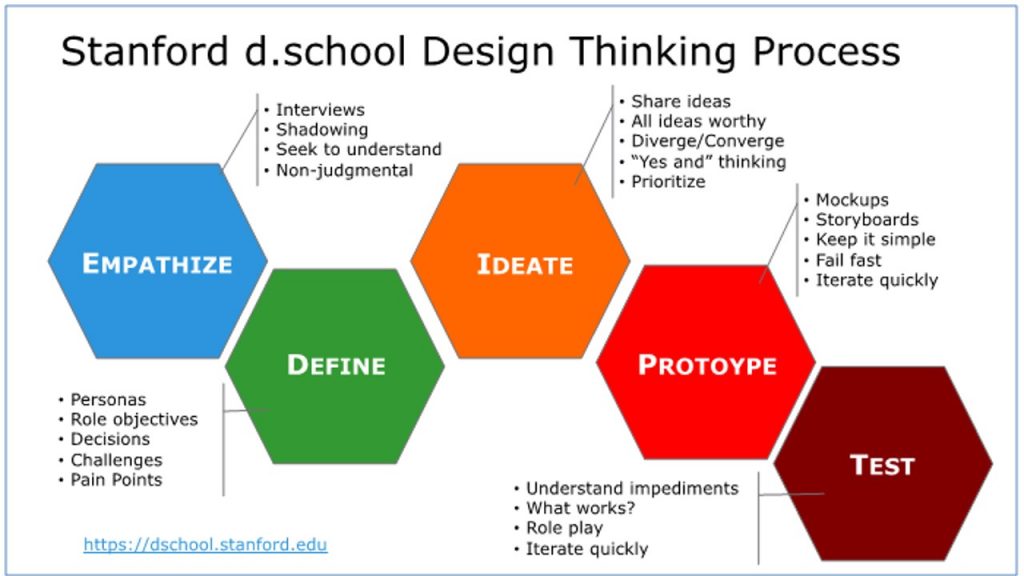
Design Thinking is often misunderstood and sometimes even maligned because too many people think it is a process. It doesn’t help when visuals like this one from the Stanford d.School label it as such:

Stanford d.School Design Thinking Process

Instead design thinking should be thought of as a mindset, or a collection of mindsets, including the novice mindset.

There is a big difference between knowing the design thinking components and being a design thinker. Design Thinking is not a technical skill, it is a collection of soft skills, so buyer beware.

One of the key things to remember about design thinking (or human-centered design) is that it is a highly iterative process intended to leverage extensive prototyping and testing.

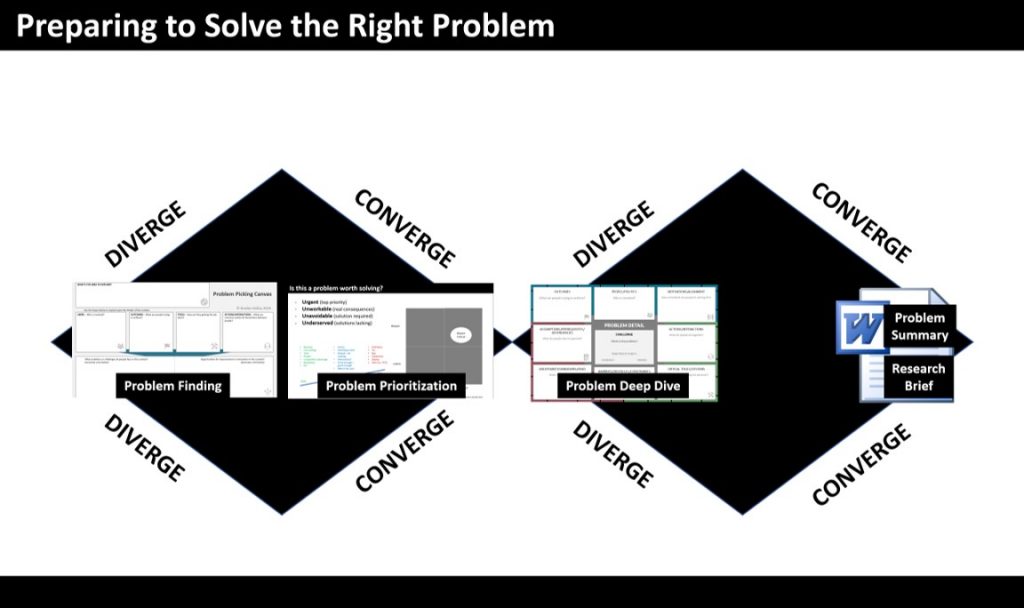
Another important thing to remember is that unlike other problem solving methods, good design thinking professionals will spend as much, if not more, time and energy on the problems(s) than on the solution(s).

Preparing to Solve the Right Problem

To help with this I’ve created a Problem Finding Canvas to help you identify all of the potential problems in a particular search area.

It’s available for only $9.99 here in the shop.

}} Click here to watch the video {{

Help Shape the Next ‘Ask the Consultant’ Episode

  1. Grab a great deal on Stoking Your Innovation Bonfire on Amazon while they last!
  2. Get a copy of my latest book Charting Change on Amazon
  3. Contact me with your question for the next video episode of “Ask the Consultant” live from my innovation studio

Below are the previous episodes of ‘Ask the Consultant’:

  1. EPISODE ONE – What is innovation?
  2. EPISODE TWO – How do I create continuous innovation in my organization?
  3. EPISODE THREE – What is digital transformation?
  4. EPISODE FOUR – What is the best way to create successful change?
  5. All other episodes of Ask the Consultant


Accelerate your change and transformation success

Subscribe to Human-Centered Change & Innovation WeeklySign up here to get Human-Centered Change & Innovation Weekly delivered to your inbox every week.

Design Thinking in Action

Case Studies of Companies that Thrive on Innovation

Design Thinking in Action

GUEST POST from Art Inteligencia

In today’s fast-paced and rapidly changing business landscape, companies are constantly seeking new innovative solutions to stay ahead of the competition. One approach that has gained traction in recent years is design thinking. Design thinking is a human-centered approach to innovation that emphasizes empathy, creativity, and iterative problem-solving. In this article, we will explore how two companies – Apple and IDEO – have successfully implemented design thinking principles to drive innovation and achieve business success.

Apple: Designing for Delight

Apple is synonymous with innovation and design excellence, and much of its success can be attributed to its design thinking approach. From the sleek and intuitive design of the iPhone to the user-friendly interface of the iPad, Apple’s products are known for their attention to detail and focus on user experience. One key aspect of Apple’s design thinking process is its emphasis on empathy – understanding the needs and desires of its customers to create products that truly delight and inspire.

A prime example of this is the development of the iPod. In the early 2000s, Apple recognized the growing demand for portable music players but saw that existing products were cumbersome and hard to use. By conducting in-depth user research and observing how people interacted with music on a daily basis, Apple was able to design a product that revolutionized the music industry. The result was the iPod – a sleek and intuitive device that made it easy for users to access and enjoy their music on the go.

IDEO: Empowering Creativity Through Collaboration

IDEO is a global design and innovation consultancy known for its human-centered approach to solving complex problems. Founded in 1991, IDEO has worked with companies ranging from startups to Fortune 500 companies to create innovative products and services that have a lasting impact on society. At the core of IDEO’s design thinking process is its emphasis on collaboration and iteration – bringing together diverse perspectives and ideas to create truly groundbreaking solutions.

One of IDEO’s most famous projects is the redesign of the shopping cart for a major retail chain. By engaging with customers and employees to understand their pain points and frustrations with the existing shopping cart, IDEO was able to develop a new cart design that improved the shopping experience for everyone involved. The new design featured ergonomic handles, self-checkout capabilities, and modular components that made it easy to customize based on individual needs. The result was a shopping cart that not only enhanced the customer experience but also increased efficiency and profitability for the retailer.

Conclusion

Design thinking is a powerful tool for companies looking to drive innovation and achieve business success. By focusing on empathy, creativity, and collaboration, companies like Apple and IDEO have been able to create products and services that truly resonate with their customers and set them apart from the competition. As technology continues to evolve and consumer expectations continue to rise, design thinking will play an increasingly important role in shaping the future of business and driving growth and success for companies around the world.

Bottom line: Futurology is not fortune telling. Futurists use a scientific approach to create their deliverables, but a methodology and tools like those in FutureHacking™ can empower anyone to engage in futurology themselves.

Image credit: Unsplash

Subscribe to Human-Centered Change & Innovation WeeklySign up here to get Human-Centered Change & Innovation Weekly delivered to your inbox every week.

From Problem to Solution: Applying the Design Thinking Process

From Problem to Solution: Applying the Design Thinking Process

GUEST POST from Chateau G Pato

In today’s world, where challenges and problems arise daily, organizations and individuals are constantly seeking effective solutions. The traditional problem-solving methods are no longer enough to tackle complex and ambiguous issues. This is where the design thinking process comes into play.

Design thinking is a human-centered approach to innovation and problem-solving. It focuses on understanding the needs of people in order to create innovative solutions that are both useful and sustainable. By applying a structured and iterative approach, design thinking encourages creativity, collaboration, and empathy to tackle problems from multiple angles. Let’s explore two case study examples that highlight the effectiveness of the design thinking process.

Case Study 1: IDEO’s Success with the Palm V

In the late 1990s, Palm Computing faced a significant challenge. Its early personal digital assistants (PDA) were clunky and unintuitive, failing to gain mass market appeal. Palm turned to the design firm IDEO to lead a design thinking process that would transform their product.

IDEO conducted in-depth interviews and observations to understand user needs. They discovered that people wanted a device that was slim, convenient, and easy to use. By shifting their focus from technology-driven features to user-centric needs, IDEO’s team devised the concept of the Palm V.

Through multiple iterations and constant feedback from users, IDEO crafted a sleek PDA that fit in the palm of the hand. The design thinking process allowed IDEO to transform the PDA into an intuitive and user-friendly device. The Palm V became a tremendous success, revolutionizing the PDA market for years to come.

Case Study 2: Airbnb’s Rapid Growth and Disruption

At its inception in 2008, Airbnb faced a challenging problem. The founders struggled to find a scalable business model and to attract users to their home-sharing platform. In search of a solution, they applied the design thinking process.

The founders immersed themselves in their customers’ experiences, staying in homes listed on their platform and meeting with hosts to understand their pain points. By empathizing with both sides of the marketplace, they identified opportunities for improvement.

Through iterative prototyping and constant feedback loops, Airbnb gradually improved its platform, introducing features such as professional photography, guest reviews, and secure payment systems. These enhancements addressed key user concerns, increased trust, and facilitated bookings.

By applying the principles of design thinking, Airbnb not only solved its immediate problem but also disrupted the entire hospitality industry. Today, Airbnb is a household name with millions of listings worldwide.

Conclusion

These two case studies demonstrate how the design thinking process can lead to innovative and impactful solutions. By shifting the focus to users’ needs, using iterative methods, and fostering collaboration, organizations and individuals can tackle complex problems with creativity and empathy. Whether it’s revolutionizing the PDA industry or disrupting the hospitality market, design thinking provides a framework for turning problems into solutions.

SPECIAL BONUS: Braden Kelley’s Problem Finding Canvas can be a super useful starting point for doing design thinking or human-centered design.

“The Problem Finding Canvas should help you investigate a handful of areas to explore, choose the one most important to you, extract all of the potential challenges and opportunities and choose one to prioritize.”

Image credit: Pixabay

Subscribe to Human-Centered Change & Innovation WeeklySign up here to get Human-Centered Change & Innovation Weekly delivered to your inbox every week.