
I am an artist.
There, I’ve said it. This statement may confuse some people who know me, and come as a shock to others.
Braden, what do you mean you’re an artist? You’ve got an MBA from London Business School, you’ve led change programs for global organizations, helped companies build their innovation capabilities and cultures, are an expert in digital transformation, and you can’t even draw a straight line without a ruler. What makes you think you’re an artist?
Well, okay, that may all be true, but there are lots of different kinds of artists. I may not be a painter, a sculptor, a musician, an illustrator, or even a singer, but I am an artist, a business artist.
What is a business artist you ask?
A business artist sees through complexity to what matters most. A business artist loves working with PowerPoint and telling stories, often through keynote speeches and training facilitation, or through writing. A business artist loves to share, often doing so for the greater good, sometimes to their own financial detriment, in an effort to accelerate the knowledge, learning, and creating new capabilities in others. A business artist is a builder, often creating new businesses, new web sites, and new thinking. A business artist is comfortable stepping into a number of different business contexts and bringing a different energy and a different approach to creating solutions to complex requirements. Part of the reason a business artist can do this is because a business artist values their intuitive skills just as much as they value their intellectual skills, and may also consciously invest in getting in touch with higher levels of intuitive capabilities and an entrepreneurial mindset, enabling them to excel in roles that involve a great deal of what might be termed ‘organizational psychology’.
A business artist often appears to be a jack of all trades, sometimes bordering on what was portrayed in the television show The Pretender, and can be an incredibly powerful addition to any team tackling a big challenge, but a business artist’s incredible ability to contribute to the success of an organization is often discounted by the traditional recruiting processes of most human resource organizations because of its emphasis on skill matching and experience, skewing hiring in favor of someone with a lot of experience at being mediocre at a certain skillset over someone with limited experience but greater capability. A business artist often appears to be ahead of the curve, often to their own detriment, arriving too early to the party by grasping where organizations need to go before the rest of the organization is willing to accept the new reality. This is a real problem for business artists.
Now is the time for a change. Given human’s increasing access to knowledge, and the shorter time now required to acquire the necessary knowledge and skills required to perform a task, people who are comfortable with complexity, ambiguity, and capable of learning quickly are incredibly valuable to organizations as continual change becomes the new normal. Because experience is increasingly detrimental to success instead of a long-lived asset, given the accelerating pace of innovation and change, we need business artists now more than ever.
So how do we create more business artists?
Unfortunately our public schools are far too focused on indoctrination than education, on repetition over discovery. Our educational system specializes in creating trivia masters and kids that hate school, instead of building a new generation of creative problem solvers that love to learn and explore new approaches instead of defending status conferred based on mastery of current truths (which may be tomorrow’s fallacies). We are far too obsessed with STEM (Science Technology Engineering and Math) when we should be focused on STEAM (Science Technology Engineering Art and Music). Music is creative math after all. My daughter’s school has a limited music program and NO ART. How is this possible?
To create more business artists we need to shift our focus towards art, creative problem solving and demonstrated learning, and away from memorization, metrics, and repetition. Can we do this?
Can we create an environment where the status quo is seen not as a source of power through current mastery and instead towards a system where improvements to the status quo are seen as the new source of power?
Organizations that want to survive will do so. Countries that want to stay at the top of the economic pyramid will do so. So what kind of country do you want to live in? What kind of company do you want to be part of?
Do you have the courage to join me as a business artist or to help create a new generation of them?
Image credit: blogs.nd.edu
This article originally appeared on Linkedin
 Sign up here to get Human-Centered Change & Innovation Weekly delivered to your inbox every week.
 Now that I’ve got your attention, let’s talk about homosexuality and whether it has any impact on innovation. There probably are two no more polarizing topics in the United States than homosexuality and abortion. But the truth is that if both sides of the political and religious spectrum focused on the
 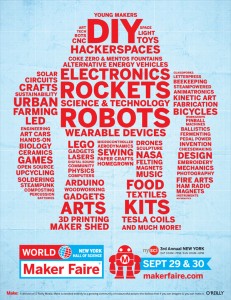 The Maker movement is steadily gaining steam and some cities are looking to help it grow and thrive, seeing it as an opportunity to inspire artists and entrepreneurs. One such city is Edmonton, which lies in the Alberta province of Canada, and its program in their public library system to provide maker spaces staffed with library employees and equipped with 3D printers, computers with Apple’s Garage Band and Adobe’s Creative Suite, and more.
 This article will be the first of a series of articles digging into the recently released Global Innovation Index 2011. In this issue we will give you just the country rankings. In the coming days I will dig through the Global Innovation Index 2011 report and see what interesting insights I can uncover about innovation in different regions, and report back here on