Navigating the Long-Term Risks of Institutional Amnesia
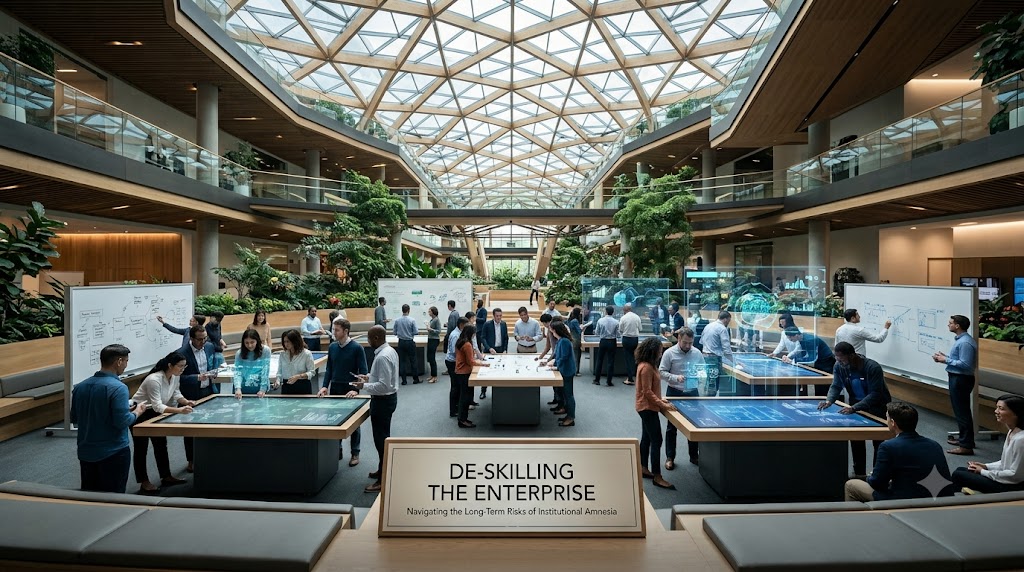
GUEST POST from Art Inteligencia
When organizations prioritize short-term efficiency and algorithmic automation over human capability development, they inadvertently create a dangerous trade-off: operational speed in the present at the cost of institutional intelligence in the future.
As automation, AI generation, and hyper-optimized workflows strip away the friction of daily problem-solving, they also remove the primary mechanism through which organizational knowledge, intuition, and adaptive capacity are built.
The Illusion of Efficiency: How Automation Breeds Institutional Amnesia
In the relentless pursuit of digital transformation, organizations often confuse operational speed with organizational intelligence. We celebrate frictionless workflows and algorithmic decision-making as triumphs of modern management. Yet, beneath the surface of these optimized dashboards lies a dangerous, creeping reality: the slow bleed of institutional memory. When we automate the human out of the loop, we don’t just eliminate busywork; we often inadvertently eliminate the crucible where human expertise and adaptive capacity are forged.
The Capability Paradox
Every enterprise faces a systemic trade-off that I call the Capability Paradox. In the short term, introducing advanced automation and generative AI into workflows yields undeniable productivity spikes. Cycle times decrease, and output volume surges. However, these immediate gains act as a smokescreen, masking the quiet erosion of foundational employee skills and judgment. We have become hyper-focused on measuring the velocity of execution, completely neglecting to measure the cognitive atrophy of our workforce. When the machine does the heavy lifting of problem-solving, the human muscle of critical thinking begins to waste away.
From Apprenticeship to Execution
Historically, deep organizational knowledge was never transferred through static manuals; it was passed down through the messy, friction-filled intermediate steps of actually doing the work. This informal apprenticeship model relied on employees wrestling with raw data, making mistakes, and relying on senior experts for course correction. Today, automated workflows bypass these developmental milestones entirely. When an employee is transitioned from a creator to a mere editor or approver of an algorithmic output, the chain of tacit knowledge is severed. We are minting a generation of operators who know how to deploy technological tools, but lack the underlying mastery to fundamentally question or improve them.
The Danger of Black-Box Operations
The ultimate risk of enterprise de-skilling is the creation of black-box operations — systems that function seamlessly until they don’t, managed by teams who have no idea how they actually work. By abstracting the “why” and the “how” behind operational decisions, we leave our teams blind to nuance and context. This systemic fragility means that when edge cases arise, market conditions suddenly shift, or the algorithm fails, there is no one left inside the building who knows how to audit the logic, troubleshoot the root cause, or rebuild the process from scratch. Institutional amnesia transforms the enterprise from a resilient, human-centered organism into a brittle, inflexible machine.
The Human Cost of Skill Atrophy
While the financial impact of de-skilling manifests in operational bottlenecks, the human cost is far more pervasive. When we reduce complex, human-centered work to a series of mechanical hand-offs and automated validations, we do not merely streamline tasks — we alter the psychological contract between employees and their work. Human capability is built through friction, struggle, and agency. When technology removes that friction entirely, it strips away the very conditions required for deep cognitive engagement and professional mastery.
The Erosion of Critical Thinking
The most immediate casualty of enterprise de-skilling is the degradation of critical reasoning. As smart platforms, predictive analytics, and automated decision engines take center stage, human teams are progressively repositioned from active problem solvers to passive prompt approvers and exception handlers. Over time, this reliance creates a cognitive shortcut loop: employees default to the system’s recommendations without evaluating the underlying logic or testing assumptions against ground reality. When critical thinking is no longer exercised daily, the muscle weakens, leaving teams ill-equipped to recognize subtle flaws, question invalid premises, or navigate ambiguity when automated systems offer flawed outputs.
Loss of Organizational Context
Algorithmic abstraction promises clarity by distilling vast inputs into simple binary choices or pre-packaged outputs. However, in stripping away the raw complexity of a process, it also strips away the operational “why.” Employees lose sight of how their specific choices ripple across the value chain, how legacy decisions shaped current parameters, and how subtle human behaviors influence outcomes. Without this deep contextual map, decision-making becomes transactional rather than strategic. Teams lose the ability to read the room, evaluate edge cases with empathy, or interpret nuance — resulting in organizations that operate efficiently on paper, yet remain fundamentally out of touch with the living ecosystem of their business.
Cognitive Disengagement and Loss of Agency
Beyond skill loss lies a profound human and organizational threat: the erosion of employee agency. Pride in craftsmanship and career growth are intrinsically linked to autonomy, mastery, and purpose. When employees are relegated to monitoring algorithms and stamping approvals on machine-generated deliverables, their sense of ownership evaporates. Work becomes passive surveillance rather than active creation. This systemic disengagement degrades employee motivation, stifles internal mobility, and fuels high turnover among top-tier talent who refuse to serve as placeholders for a system that no longer values human intelligence.
The Innovation Threat: Why De-Skilled Organizations Can’t Adapt
The ultimate paradox of enterprise de-skilling is that in our obsession with optimizing for current operations, we systematically dismantle our capacity to invent future ones. True innovation is rarely the product of pristine, perfectly linear algorithms executing predictable tasks. It emerges from the edges — from domain experts wrestling with operational friction, questioning legacy assumptions, and synthesizing disparate insights. When an enterprise replaces deep human domain mastery with surface-level tool operation, it trades its long-term adaptability for short-term predictability.
The Death of Unintended Discovery
Breakthrough innovation relies heavily on serendipity, lateral thinking, and what I call “productive friction.” When humans actively engage in the messy details of problem-solving, they notice anomalies, discover unscripted workarounds, and stumble upon happy accidents that open entirely new market opportunities. Automated, hyper-optimized workflows are explicitly designed to eliminate this friction. In doing so, they also eliminate the variance that feeds creative problem-solving. A de-skilled enterprise may execute its current business model with razor-sharp precision, but it becomes incapable of stumbling upon the next one.
Fragility in Crisis
De-skilled organizations perform exceptionally well under static, predictable conditions. However, when market disruptions, technological shifts, or Black Swan events shatter the baseline assumptions encoded into automated systems, these organizations experience catastrophic failure. Algorithmic loops cannot improvise when confronted with unprecedented contexts. In a crisis, the survival of the enterprise depends entirely on human adaptability, intuitive judgment, and fundamental first-principles thinking. If those human capabilities have been allowed to atrophy, the organization stands paralyzed — unable to override its own broken scripts.
The Experience Design Gap
There is an unbreakable tether between internal operational mastery and the external customer experience. When employees lose their deep, intuitive understanding of the products, services, and systems they manage, the quality of customer interaction degrades exponentially. Experience design is fundamentally an exercise in empathy, nuance, and value delivery. When de-skilled teams rely blindly on automated scripts and AI outputs to serve customers, interactions become mechanical, rigid, and transactional. The human touch — the capacity to truly listen, resolve complex edge cases, and forge meaningful relationships — is lost, leaving the brand vulnerable to agile competitors who prioritize human-centered value creation.
FutureHacking™ the Enterprise: A Call to Action
The choice facing modern executives is not whether to adopt advanced automation and intelligent technologies, but how to deploy them without bankrupting the organization’s human capital. The current trajectory — maximizing short-term margin by trading away institutional knowledge — is a strategic dead end. To build an enterprise that thrives amidst relentless disruption, we must fundamentally shift our perspective: technology should serve to elevate human intellect, not eclipse it.
Redefining the ROI of Technology
It is time for leadership to abandon narrow, headcount-reduction metrics when evaluating technological investments. True technology ROI cannot be measured solely by how many human hours are excised from a process. We must expand our executive dashboards to evaluate systemic resilience, adaptive capacity, and skill health. A technology implementation that slashes operational costs by 20% while simultaneously destroying the organization’s ability to innovate, audit, or respond to market shifts is not an efficiency gain — it is an unmanaged liability.
The Leader’s Imperative
The ultimate role of the future-focused leader is not to automate human intelligence out of the value chain, but to architect dynamic ecosystems where human creativity, empathy, and strategic judgment remain the primary engines of value creation. By embedding intentional learning loops, leveraging visual collaborative frameworks, and protecting the cognitive exercise of our workforce, we ensure our organizations remain sharp, agile, and deeply human-centered. Navigating the future requires technology that accelerates our speed, powered by human capabilities that preserve our soul.
Frequently Asked Questions
What is enterprise de-skilling?
Enterprise de-skilling is the gradual loss of foundational employee skills, critical thinking, and domain expertise caused by over-reliance on automated systems, generative AI, and hyper-optimized, friction-free workflows.
How does automation lead to institutional amnesia?
When automated workflows bypass the messy, problem-solving steps where tacit knowledge is traditionally built and passed down, organizations lose the contextual “why” behind operational decisions. This leaves teams unable to audit, troubleshoot, or rebuild processes when systems fail.
How can organizations adopt AI and automation without losing human capability?
Leaders can protect institutional knowledge by designing workflows with “desirable difficulty” (strategic manual touchpoints), creating continuous experiential learning loops, and using visual collaborative toolkits to ensure human judgment and systemic transparency remain central to operations.
Bring This Thinking to Your Next Event
Braden Kelley is a LinkedIn Top Voice, bestselling author, and innovation keynote speaker who helps organizations get to the future first and build sustainable innovation cultures.
Image credit: Gemini
 Sign up here to get Human-Centered Change & Innovation Weekly delivered to your inbox every week.