Tag Archives: AI

AI Literacy for Every Role (Not Just CoE Members)

LAST UPDATED: March 4, 2026 at 11:14 AM
AI Literacy for Every Role (Not Just CoE Members)

GUEST POST from Art Inteligencia


I. The Myth of the “AI Specialist” Silo

In my years helping organizations navigate the Human-Centered Innovation™ landscape, I’ve seen a recurring ghost in the machine: the belief that innovation belongs in a locked room. We saw it with the early days of “Digital Transformation,” and we are seeing it again with Artificial Intelligence. Many leaders are rushing to build an AI Center of Excellence (CoE), thinking that by gathering a few specialists in a silo, they have “solved” the AI problem.

This is a dangerous misunderstanding of how organizational agility works. When you confine AI literacy to a CoE, you create a catastrophic “Assumption Gap.” The specialists understand the math, but they don’t understand the friction of the front-line salesperson or the nuanced empathy required by a customer success lead.

“Software — and by extension, AI — is far too important to be left solely to the software people.”

If the rest of your workforce remains AI-illiterate, your CoE becomes an island. You end up with “Rigid Decay,” where the specialist team builds high-tech solutions that the rest of the organization is either too afraid to use or too uninformed to integrate. To move from a static “project” mindset to a living Inherent Capability, we must democratize the language of AI.

The goal isn’t to turn every accountant into a data scientist; it is to ensure every accountant knows how to collaborate with one. We need to stop treating AI as a “specialty” and start treating it as a foundational layer of the Change Planning Canvas™.

II. Defining AI Literacy: The “Stable Spine” of Knowledge

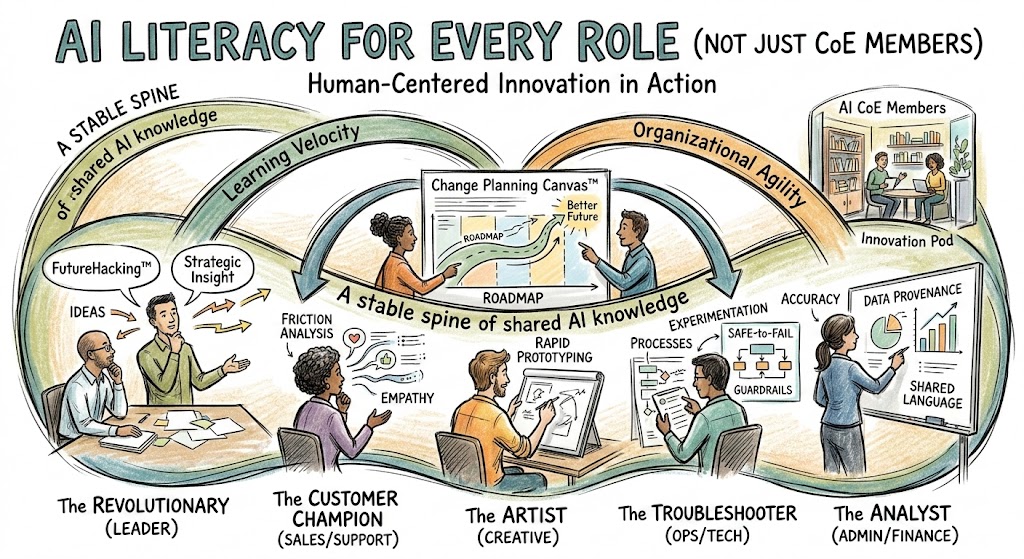
In any Human-Centered Innovation™ initiative, we must distinguish between “tool-fluency” and “literacy.” Knowing how to type a prompt into a chatbot is a fleeting skill; understanding the logic of Generative AI and its impact on your specific value chain is a durable capability. I call this the “Stable Spine” — the core set of principles that stay upright even as the technology shifts beneath our feet.

True AI literacy for the broader workforce isn’t about learning Python. It’s about building a Common Language across the organization. When Marketing, HR, and Operations speak the same dialect of “Data Provenance,” “Hallucination Risks,” and “Iterative Refinement,” the Change Planning Canvas™ actually begins to work.

  • Beyond Tool-Picking: We must move from “What tool should I use?” to “What problem am I solving?” This reduces “Cognitive Clutter” and ensures we aren’t just automating bad processes.
  • Understanding Causal AI: Every employee should grasp the “Why” behind the output. If you don’t understand the logic, you can’t provide the “Human-in-the-Loop” oversight that prevents catastrophic brand or operational errors.
  • The Ethics of Insight: Literacy includes recognizing bias. We must learn the lessons of the past — like the “Tay” chatbot — to ensure our AI implementations don’t scale our existing organizational prejudices.

By establishing this spine, we move from “Experience Narcissism” (assuming our old ways are best) to a state of Marked Flexibility. We aren’t just using AI; we are integrating it into the very marrow of how we innovate.

III. The Role-Based AI “Squad” Strategy

One size does not fit all in the Change Planning Canvas™. To democratize AI literacy, we must translate it into the specific “Value-Add” for different roles. When we move beyond the CoE, we empower individuals to become part of an Innovation Squad, each using AI as a “Force Multiplier” for their unique perspective.

The Persona The AI “Superpower” Human-Centered Outcome
The Revolutionary (Leadership) Strategic “FutureHacking™” and Trend Synthesis. Reducing “Time-to-Insight” to make bolder, data-backed bets.
The Customer Champion (Front Line) Real-time Friction Analysis and Sentiment Mapping. Closing the “Experience Narcissism” gap by truly hearing the customer.
The Artist & Troubleshooter (Technical/Creative) Rapid Prototyping and “Safe-to-Fail” Simulation. Increasing “Learning Velocity” without risking the core business.

By equipping The Revolutionary with AI literacy, we ensure they aren’t just chasing “Shiny Object Syndrome.” Instead, they are using AI to identify where the organization can be Markedly Flexible.

Meanwhile, The Customer Champion uses AI to sift through the “Cognitive Clutter” of thousands of feedback points, identifying the one intervention that will actually move the needle on customer loyalty. This isn’t just “using a tool” — it’s a deliberate Human-Centered Intervention to create a better future for the user.

IV. Overcoming the “70% Failure Rate” in AI Adoption

Statistics in the change management world are sobering: nearly 70% of change initiatives fail. When we layer the complexity of Artificial Intelligence onto that, the risk of “Rigid Decay” skyrockets. To beat these odds, we must look past the algorithms and focus on the PCC Framework: Psychology, Capability, and Capacity.

1. Addressing the Psychology of “Replacement Anxiety”

If an employee perceives AI as a threat to their livelihood, they will subconsciously (or consciously) sabotage its adoption. We must reframe AI as a tool for “Subjective Time Expansion.” By automating the mundane, we aren’t replacing the human; we are freeing them to perform the high-value, high-empathy tasks that AI cannot touch.

2. Clearing the “Cognitive Clutter”

AI literacy helps teams identify where they are drowning in “Cognitive Clutter” — those low-value tasks that prevent them from reaching a state of flow. Literacy allows a worker to say, “AI can handle the data synthesis here, so I can focus on the strategic intervention.”

3. Establishing “Safe-to-Fail” Zones

Organizational Agility requires a culture where experimentation is the norm. We must reward Learning Velocity. If a team tries an AI-driven workflow and it fails, but they document why and share that insight across the Change Planning Canvas™, that is a win for the entire organization.

“The goal of AI literacy is to move from fear of the unknown to the mastery of a new medium.”

By visualizing these change hurdles using collaborative tools, we ensure the entire “Squad” is literally on the same page. We aren’t just pushing a new tool; we are performing a Deliberate Intervention to evolve the company culture.

V. Moving from Theory to Practice: The Implementation Checklist

To avoid “Rigid Decay,” we must treat AI literacy as a living organism, not a one-time workshop. This checklist is designed to integrate AI into your Change Planning Canvas™, ensuring that the entire organization moves at the same Learning Velocity.

1. Audit for “Marked Flexibility”

Every department should identify three legacy processes that are currently “rigid.” Ask: “If we had an infinite amount of data synthesis capability, how would this process change?” This identifies where AI literacy can provide the most immediate Human-Centered lift.

2. Deploy “Safe-to-Fail” Micro-Pilots

Don’t wait for a company-wide rollout. Encourage Innovation Squads to run two-week experiments. The goal isn’t necessarily a “win,” but a documented insight. If the pilot fails, but the team learns something about their data quality, that is a successful intervention.

3. Establish the “Shared Vocabulary” Baseline

Create a “No-Jargon Zone.” Ensure that everyone from the CEO to the front-line intern understands the basics of Prompt Engineering, Algorithmic Bias, and Data Privacy. When everyone speaks the same language, the “Assumption Gap” disappears.

4. Visualize the Flow

Use collaborative tools to map out how AI-augmented work flows through the company. If the AI output stays in a silo, it’s useless. We must visualize how an AI-generated insight in Marketing triggers a Deliberate Intervention in Sales or Product Development.

“The future belongs to the organizations that can learn as fast as their tools evolve.”

By following this checklist, you aren’t just “buying AI” — you are building a Future-Ready culture that is Markedly Flexible and deeply human.

VI. Conclusion: The Future is Human-Led, AI-Augmented

Innovation is never about the technology itself; it is a Deliberate Intervention to create a better future. When we democratize AI literacy, we aren’t just teaching a new skill — we are dismantling “Rigid Decay” and replacing it with Organizational Agility.

By moving AI out of the CoE and into every role, we empower the Customer Champion, the Revolutionary, and the Troubleshooter to speak a Common Language. We bridge the “Assumption Gap” and ensure that our digital transformation is anchored in human empathy.

“The question is not how intelligent the AI is, but how we are intelligent in using it to expand our human potential.”

The organizations that thrive in this era will be those that prioritize Learning Velocity over static expertise. They will be the ones that use the Change Planning Canvas™ to visualize a future where AI handles the “spin” so that humans can provide the “lift.”

The future is not a destination we reach; it is a state of Marked Flexibility we inhabit every day. Let’s stop building silos and start building a literate, empowered, and innovative workforce.

Frequently Asked Questions: AI Literacy for All

1. Why should AI literacy extend beyond the Center of Excellence (CoE)?

Confining AI knowledge to a CoE creates “Rigid Decay,” where specialists build tools that the broader workforce cannot or will not use. Extending literacy to every role bridges the Assumption Gap, ensuring that AI solutions are human-centered and solve real-world friction rather than just adding to “Cognitive Clutter.”

2. Does every employee need to learn how to code or build AI models?

No. True AI literacy is about building a “Stable Spine” of knowledge—understanding the “why” and “how” of AI logic, data ethics, and Human-in-the-Loop oversight. The goal is Organizational Agility, where every “Innovation Squad” member has the common language to collaborate on the Change Planning Canvas™.

3. What is the immediate benefit of role-based AI literacy?

The primary benefit is “Subjective Time Expansion.” When every role — from the Revolutionary to the Customer Champion — understands how to use AI for data synthesis and rapid prototyping, they reduce their Learning Velocity and clear away the “Cognitive Clutter” of low-value tasks. This allows the human workforce to focus on high-empathy, high-strategy interventions that AI cannot replicate.

Image credit: Google Gemini

Subscribe to Human-Centered Change & Innovation WeeklySign up here to get Human-Centered Change & Innovation Weekly delivered to your inbox every week.

Design Thinking in the Age of AI and Machine Learning

Design Thinking in the Age of AI and Machine Learning

GUEST POST from Chateau G Pato

The world is rapidly changing, and with the emergence of new technologies like artificial intelligence (AI) and machine learning, it is becoming increasingly important for businesses to stay ahead of the curve. Design thinking has become a powerful tool for businesses to stay competitive by helping them to better understand customer needs and develop innovative solutions. In the age of AI and machine learning, design thinking can be used to create better experiences, drive innovation, and improve the quality of products and services.

Design thinking is an approach that focuses on understanding user needs, designing solutions that meet those needs, and testing those solutions to ensure they are successful. By taking a human-centered approach to problem solving, design thinking helps businesses to develop products and services that are tailored to customer needs. It also provides a structure for understanding customer feedback and making iterative improvements.

In the age of AI and machine learning, design thinking is more important than ever for businesses to stay competitive. AI and machine learning technologies are transforming the way businesses operate and creating new opportunities for innovation. Design thinking can help businesses to identify the customer needs that AI and machine learning can address, develop solutions to meet those needs, and create customer experiences that are tailored to the changing landscape.

One example of design thinking in the age of AI and machine learning is the development of predictive customer service. Predictive customer service uses AI and machine learning technologies to anticipate customer needs and provide personalized experiences. Companies like Amazon and Google are using AI and machine learning to provide personalized recommendations and customer support. By understanding customer needs and leveraging the power of AI and machine learning, these companies are able to provide better experiences and improve customer satisfaction.

Another example of design thinking in the age of AI and machine learning is the development of intelligent products and services. Companies are using AI and machine learning technologies to create products and services that can anticipate customer needs and provide tailored experiences. For example, Amazon is using AI and machine learning to develop Alexa, a virtual assistant that is able to understand customer requests and provide personalized responses. By leveraging the power of AI and machine learning, companies are able to create products and services that are more intuitive and provide better customer experiences.

Design thinking is an important tool for businesses to stay competitive in the age of AI and machine learning. By understanding customer needs and leveraging the power of AI and machine learning, businesses can create better customer experiences and drive innovation. Design thinking provides a framework for understanding customer needs and developing solutions that will meet those needs. By using design thinking, businesses can create products and services that are tailored to the changing landscape and stay ahead of the competition.

SPECIAL BONUS: Braden Kelley’s Problem Finding Canvas can be a super useful starting point for doing design thinking or human-centered design.

“The Problem Finding Canvas should help you investigate a handful of areas to explore, choose the one most important to you, extract all of the potential challenges and opportunities and choose one to prioritize.”

Image credit: Pixabay

Subscribe to Human-Centered Change & Innovation WeeklySign up here to get Human-Centered Change & Innovation Weekly delivered to your inbox every week.

Examining the Impact of Machine Learning on the Future of Work

Examining the Impact of Machine Learning on the Future of Work

GUEST POST from Chateau G Pato

As technology continues to evolve, it is becoming increasingly clear that the future of human labor is changing. Machine learning is a subset of artificial intelligence (AI) that is revolutionizing the way businesses operate and the opportunities that are available for workers. In this article, we will explore how machine learning is impacting the future of work and how organizations can best prepare for this shift.

One of the primary ways that machine learning is impacting the future of work is by automating certain tasks. Machine learning algorithms are able to analyze large datasets and identify patterns and trends that can be used to automate certain processes. This automation can help organizations become more efficient, as tasks that would traditionally take a long time to complete can be accomplished quickly and accurately with the help of machine learning. In addition, automation can also lead to cost savings, as human labor is no longer required to complete certain tasks.

Another way that machine learning is impacting the future of work is by providing new opportunities for skilled workers. Certain jobs that would traditionally require manual labor can now be performed by machines, freeing up workers to focus on tasks that require more creativity and problem-solving skills. This shift can help organizations become more competitive, as they are able to tap into the skills of workers that may not have been available in the past.

Finally, machine learning is also impacting the future of work by creating new employment opportunities. In addition to automating certain tasks, machine learning algorithms can also be used to create new products and services. Companies are now able to use machine learning algorithms to create new applications and services that can be used to improve customer experience or to provide new solutions to existing problems. This can open up new job opportunities for workers who are able to use their skills in areas such as data science, software development, and machine learning.

Overall, it is clear that machine learning is having a profound impact on the future of work. Organizations need to understand how this technology can be used to automate certain processes and create new opportunities for their employees. By leveraging the power of machine learning, organizations can become more efficient, cost-effective, and competitive in the ever-evolving landscape of the modern workplace.

Image credit: Pixabay

Subscribe to Human-Centered Change & Innovation WeeklySign up here to join 17,000+ leaders getting Human-Centered Change & Innovation Weekly delivered to their inbox every week.

AI Strategy That Respects Human Autonomy

LAST UPDATED: February 13, 2026 at 3:15PM

AI Strategy That Respects Human Autonomy

GUEST POST from Chateau G Pato

In the rush to integrate Generative AI into every fiber of the enterprise, many organizations are making a critical error: they are designing for efficiency while ignoring agency. As a leader in Human-Centered Innovation™, I believe that if your AI strategy doesn’t explicitly protect and enhance human autonomy, you aren’t innovating—you are simply automating your way toward cultural irrelevance.

Real innovation happens when technology removes the bureaucratic corrosion that clogs our creative wiring. AI should not be the decision-maker; it should be the accelerant that allows humans to spend more time in the high-value realms of empathy, strategic foresight, and ethical judgment. We must design for Augmented Ingenuity.

“AI may provide the seeds of innovation, but humans must provide the soil, water, and fence. Ownership belongs to the gardener, not the seed-producer.”
— Braden Kelley

Preserving the “Gardener” Role

An autonomy-first strategy recognizes that ownership belongs to the human. When we offload the “soul” of our work to an algorithm, we lose the accountability required for long-term growth. To prevent this, we must ensure that our FutureHacking™ efforts keep the human at the center of the loop, using AI to synthesize data while humans interpret meaning.

Case Study: Intuit’s Human-Centric AI Integration

Intuit has long been a leader in using AI to simplify financial lives. However, their strategy doesn’t rely on “black box” decisions. Instead, they use AI to surface proactive insights that the user can act upon. By providing the “why” behind a tax recommendation or a business forecast, they empower the customer to remain the autonomous director of their financial future. The AI provides the seeds, but the user remains the gardener.

Case Study: Haier’s Rendanheyi Model and AI

At Haier, the focus is on “zero distance” to the customer. They use AI to empower their decentralized micro-enterprises. Rather than using AI to control employees from the top down, they use it to provide real-time market signals directly to frontline teams. This respects the autonomy of the individual units, allowing them to innovate faster based on data that supports, rather than dictates, their local decision-making.

“The goal of AI is not to remove humans from the system. It is to remove friction from human potential.”

— Braden Kelley

The Foundation: Augment, Illuminate, Safeguard

Augment: Design AI to extend human capability. Keep meaningful decisions anchored in human review.
Illuminate: Make AI processes visible and explainable. Hidden influence erodes trust.
Safeguard: Establish governance structures that preserve accountability and ethical oversight.

When these foundations align, AI strengthens agency rather than diminishing it.

From Efficiency to Legitimacy

AI strategy is not just about productivity. It is about legitimacy. Stakeholders increasingly evaluate whether institutions deploy AI responsibly. Employees want clarity. Customers want fairness. Regulators want accountability.

Organizations that treat autonomy as a design constraint, rather than an obstacle, build durable trust. They keep humans in the loop for consequential decisions. They provide explainability tools. They align incentives with long-term impact rather than short-term automation wins.

Autonomy is not inefficiency. It is engagement. And engagement is a competitive advantage.

Leadership as Stewardship

Ultimately, AI governance reflects leadership intent. Culture shapes implementation. Incentives shape behavior. Leaders who explicitly prioritize dignity and accountability create environments where AI enhances rather than erodes human agency.

The future will not be defined by how intelligent our systems become. It will be defined by how wisely we integrate them. AI strategy that respects human autonomy is not just ethical—it is strategic. It builds trust, strengthens culture, and sustains innovation over time.

Conclusion: The Human-AI Partnership

The future of work is not a zero-sum game between humans and machines. It is a partnership where empathy and ethics are the primary differentiators. By implementing an AI strategy that respects autonomy, we ensure that our organizations remain resilient, creative, and profoundly human. If you are looking for an innovation speaker to help your team navigate these complexities, the focus must always remain on the person, not just the processor.

Strategic FAQ

How do you define human autonomy in the context of AI?

Human autonomy refers to the ability of employees and stakeholders to make informed decisions based on their own judgment, values, and ethics, supported—but not coerced—by AI-generated insights.

Why is “Human-in-the-Loop” design essential?

Keeping a human in the loop ensures that there is a layer of ethical oversight and qualitative context that algorithms lack. This prevents “hallucinations” from becoming business realities and maintains institutional trust.

Can an AI strategy succeed without a focus on change management?

No. Without Human-Centered Innovation™, AI implementation often leads to fear and resistance. Success requires clear communication, training, and a culture that views AI as a tool for empowerment rather than displacement.

Image credits: Google Gemini

Subscribe to Human-Centered Change & Innovation WeeklySign up here to get Human-Centered Change & Innovation Weekly delivered to your inbox every week.
Intellectual Property in the Age of Man-Machine Collaboration

Who Owns the AI-Assisted Idea?

LAST UPDATED: February 8, 2026 at 8:45PM

Intellectual Property in the Age of Man-Machine Collaboration

GUEST POST from Chateau G Pato

Throughout my career championing Human-Centered Innovation™, I have consistently maintained that innovation is a team sport. Historically, that “team” consisted of diverse human minds — designers, engineers, anthropologists, and marketers — clashing and coalescing in a physical or digital room. But today, the locker room has a new player that never sleeps, never tires, and has read everything ever written. As we integrate generative AI into the very marrow of our “Value Creation” process, we are hitting a massive legal and ethical wall: Who actually owns the output?

This isn’t just a question for lawyers; it is a fundamental challenge for innovation leaders. In my Chart of Innovation, we distinguish between invention and innovation. Invention is the seed; innovation is the widely adopted solution. If the seed is planted by a machine, or if the machine is the water that makes it grow, the harvest — the intellectual property (IP) — becomes a contested territory. We are moving from a world of “Sole Authorship” to a world of “Co-Pilot Contribution,” and our current IP frameworks are woefully unprepared for this shift.

The Shift from Lone Inventor to Networked Creation

Traditional intellectual property regimes assume a relatively clean chain of custody. An inventor creates something novel. An organization files a patent. Ownership is defined by employment contracts and jurisdictional law. Collaboration complicates this, but AI fundamentally disrupts it.

AI systems contribute pattern recognition, recombination, and acceleration. They do not merely automate tasks; they influence direction. When a product manager refines a concept based on AI-generated insights, who is the author of the resulting idea? When a design team iterates with generative tools trained on external data, whose intellectual DNA is embedded in the output?

These questions matter not because AI needs credit, but because humans and organizations do. Ownership determines incentives, investment, accountability, and trust.

The Paradox of the Prompt

The core of the conflict lies in the “Human Spark.” Patent offices around the world, most notably the USPTO and the European Patent Office, have largely held that AI cannot be listed as an inventor. Property rights are reserved for natural persons. However, in the Value Translation phase of innovation, the human prompt is the catalyst. If I provide a highly specific, complex architectural prompt to a generative model and it produces a blueprint, am I the creator? Or am I merely a curator of the machine’s statistical probabilities?

For organizations, this creates a terrifying “IP Void.” If a product’s core design or a software’s critical algorithm is deemed to have been “authored” by AI, it may fall into the public domain, stripping the company of its competitive advantage and its ability to monetize the solution. To navigate this, we must rethink the human-centered aspect of our collaboration with silicon.

Case Study 1: The Pharmaceutical “In Silico” Breakthrough

In early 2025, a leading biotech firm utilized a proprietary AI platform to screen millions of molecular combinations to find a stable binder for a previously “undruggable” protein target. The AI identified the top three candidates, one of which eventually passed clinical trials. When the firm filed for a patent, the initial application was scrutinized because the invention — the specific molecular arrangement — was suggested by the algorithm.

The firm successfully argued that the IP belonged to their human scientists because they had set the constraints, validated the results through physical lab work, and made the critical Human-Centered Change of translating a digital suggestion into a medical reality. This case established a precedent: IP is secured through the human-guided synthesis of AI output, not the raw output itself.

Case Study 2: Generative Design in Automotive Engineering

A major automotive manufacturer used generative design to create a lightweight, ultra-strong chassis component. The AI generated 5,000 iterations based on weight and stress parameters. The engineering team selected one, but then manually modified 15% of the geometry to account for manufacturing constraints and aesthetic alignment with the brand’s Human-Centered Design language.

Because of this 15% manual intervention and the “Intentional Curation” of the parameters, the manufacturer was able to secure a design patent. The lesson for innovation leaders is clear: Direct human modification is the bridge to ownership. Raw AI output is a commodity; human-refined AI output is an asset.

“Innovation transforms the useful seeds of invention into widely adopted solutions. In the age of AI, the machine may provide the seeds, but the human must provide the soil, the water, and the fence. Ownership belongs to the gardener, not the seed-producer.”

— Braden Kelley

The Startup Landscape: Securing the Future

A new wave of companies is emerging to help innovation leaders manage this “Ownership Crisis.” Proof of Concept (PoC) platforms like AIPatent.ai and ClearAccessIP are creating digital audit trails that document every step of human intervention in the AI process. Meanwhile, startups like Fairly Trained are certifying that AI models are trained on licensed data, reducing the risk of “IP Contamination.” These tools are essential for any leader looking to FutureHack™ their way into a sustainable market position without losing their legal shirt.

As an innovation speaker, I am frequently asked how to balance speed with security. My answer is always the same: Do not let the “corporate antibodies” of your legal department kill the AI experiment, but do not let the experiment run without a human-centered leash. You must document the intent. Ownership in 2026 is not about who pressed the button, but who defined why the button was pressed and what the resulting light meant for the world.

The Real Risk: Governance Lag

The greatest risk is not that AI will “steal” ideas, but that organizations will fail to update their innovation governance. Ambiguity erodes trust. When people are unsure how their contributions will be treated, they contribute less, or not at all.

Forward-thinking organizations are moving beyond ownership-as-control toward stewardship-as-strategy. They are defining contribution frameworks, transparency norms, and value-sharing models that reflect how innovation actually occurs.

This is not a legal exercise alone. It is a leadership responsibility.

Designing for Fairness, Speed, and Strategic Advantage

Leaders must ask different questions. Not just “Who owns this idea?” but “What behaviors do we want to encourage?” and “What clarity do our collaborators need to feel safe innovating with us?”

AI-assisted innovation rewards those who replace rigid ownership models with adaptable, principle-driven systems. The organizations that win will be those that treat intellectual property not as a defensive weapon, but as an enabling architecture for collaboration.

Conclusion

The age of collaboration demands a new philosophy of intellectual property. One that recognizes contribution over authorship, stewardship over possession, and trust over control. AI has not broken innovation. It has simply revealed how outdated our assumptions have become.

Those willing to redesign their IP thinking will unlock more than compliance. They will unlock commitment, creativity, and sustained advantage.

I believe that it is important to understand that while technology changes, the need for human accountability never does. If you are looking for an innovation speaker who can help your team navigate the ethics and ownership of AI, consider Braden Kelley to help you turn these technological challenges into human-centered triumphs.

FAQ: AI and Intellectual Property

1. Can an AI be listed as a co-inventor on a patent?
As of current legal standards in the US and EU, AI cannot be listed as an inventor. Only “natural persons” are eligible for authorship or inventorship rights.

2. How can companies protect ideas generated by AI?
Protection is achieved by documenting significant human intervention. This includes the “creative selection” of prompts, the human validation of results, and the manual refinement of the final output.

3. What is the risk of “IP Contamination”?
IP Contamination occurs when an AI model trained on unlicensed or copyrighted data produces output that mirrors protected works, potentially exposing the user to infringement lawsuits.

Image credits: Microsoft CoPilot

Subscribe to Human-Centered Change & Innovation WeeklySign up here to get Human-Centered Change & Innovation Weekly delivered to your inbox every week.

Using Generative AI to Break Creative Deadlocks

The Algorithmic Muse

Using Generative AI to Break Creative Deadlocks

GUEST POST from Chateau G Pato
LAST UPDATED: January 28, 2026 at 4:43PM

Innovation is rarely a lightning bolt from the blue; it is more often a sustained fire built through the collision of diverse perspectives and the relentless pursuit of “the next.” However, even the most seasoned innovation teams hit the inevitable wall—the creative deadlock. This is where the friction of organizational inertia meets the exhaustion of the ideation cycle.

In my work centered around human-centric innovation, I have always advocated for tools that empower the individual to see beyond their own cognitive biases. Today, we find ourselves at a fascinating crossroads where Generative AI (GenAI) acts not as a replacement for human ingenuity, but as an Algorithmic Muse—a partner capable of shattering the glass ceilings of our own imagination.

The Friction of the Blank Page

The greatest enemy of innovation is often the blank page. We suffer from “functional fixedness,” a cognitive bias that limits us to using objects or concepts only in the way they are traditionally used. When we are stuck, we tend to dig the same hole deeper rather than digging a new one elsewhere.

Generative AI serves as a lateral thinking engine. It doesn’t “know” things in the human sense, but it excels at pattern recognition and improbable synthesis. By feeding the AI our constraints, we aren’t asking it for the final answer; we are asking it to provide the clutter—the raw, unpolished associations that trigger a human “Aha!” moment.

“True innovation occurs when we stop looking at AI as a magic wand and start treating it as a mirror that reflects possibilities we were too tired or too biased to see.”

— Braden Kelley

Case Study I: Rethinking Urban Mobility

A mid-sized architectural firm was tasked with designing a “multi-modal transit hub” for a city with extreme weather fluctuations. The team was deadlocked between traditional Brutalist designs (for durability) and glass-heavy modernism (for aesthetics). They were stuck in a binary choice.

By using GenAI to “hallucinate” structures that blended biomimicry with 1920s Art Deco, the team was presented with a series of visual prompts that used “scales” similar to a pangolin. This wasn’t the final design, but it broke the deadlock. It led the humans to develop a kinetic facade system that opens and closes based on thermal load. The AI provided the metaphoric leap the team couldn’t find in their data sets.

Case Study II: The Stagnant Product Roadmap

A consumer goods company found their flagship skincare line losing relevance. Internal workshops yielded the same “safer, faster, cheaper” ideas. They used an LLM (Large Language Model) to simulate “extreme personas”—such as a Martian colonist or a deep-sea diver—and asked how these personas would solve for “skin hydration.”

The AI suggested “encapsulated atmospheric harvesting.” While scientifically adventurous, it pushed the R&D team to move away from topical creams and toward transdermal patches that react to local humidity levels. The deadlock was broken not by a better version of the old idea, but by a provocation generated by the Muse.

The Human-Centric Guardrail

We must be careful. If we rely on the Muse to do the thinking, we lose the humanity that makes innovation resonate. The “Braden Kelley approach” to AI is simple: Human-in-the-loop is not enough; it must be Human-in-command. Use AI to expand the top of the funnel, but use human empathy, ethics, and strategic intuition to narrow the bottom.

“AI doesn’t replace creativity. It destabilizes certainty just enough for imagination to re-enter the room.”

— Braden Kelley

The Anatomy of Creative Stagnation

Most creative deadlocks emerge from premature alignment. Teams converge too early around what feels reasonable, affordable, or politically safe. Over time, this creates a narrowing funnel where bold ideas are filtered out before they can mature.

Generative AI widens that funnel. It introduces alternative framings at scale, surfaces edge cases, and allows teams to explore ideas without ownership or defensiveness.

The Leadership Imperative

Leaders play a critical role in determining whether AI becomes a creativity accelerator or a conformity engine. Used poorly, AI speeds up existing thinking. Used well, it challenges it.

Effective leaders:

  • Position AI as a challenger, not an authority
  • Create space for reaction, not just evaluation
  • Reward learning over polish

“The future belongs to leaders who know when to trust the algorithm—and when to ignore it.”

— Braden Kelley

Frequently Asked Questions

How does Generative AI help in breaking creative blocks?GenAI acts as a lateral thinking partner by providing improbable associations and diverse perspectives that challenge human cognitive biases like functional fixedness.

Should AI replace the human innovator?No. AI should be used as a “Muse” to generate raw ideas and provocations, while humans provide the empathy, strategic context, and final decision-making.

What is the best way to start using AI for innovation?Start by using AI to simulate extreme personas or to apply metaphors from unrelated industries to your current problem statement.

Looking for an innovation speaker to inspire your team? Braden Kelley is a world-renowned expert in human-centered change and sustainable innovation.


Extra Extra: Because innovation is all about change, Braden Kelley’s human-centered change methodology and tools are the best way to plan and execute the changes necessary to support your innovation and transformation efforts — all while literally getting everyone all on the same page for change. Find out more about the methodology and tools, including the book Charting Change by following the link. Be sure and download the TEN FREE TOOLS while you’re here.

Image credits: Google Gemini

Subscribe to Human-Centered Change & Innovation WeeklySign up here to get Human-Centered Change & Innovation Weekly delivered to your inbox every week.

AI as a Cultural Mirror

How Algorithms Reveal and Reinforce Our Biases

AI as a Cultural Mirror

GUEST POST from Chateau G Pato
LAST UPDATED: January 9, 2026 at 10:59AM

In our modern society, we are often mesmerized by the sheer computational velocity of Artificial Intelligence. We treat it as an oracle, a neutral arbiter of truth that can optimize our supply chains, our hiring, and even our healthcare. But as an innovation speaker and practitioner of Human-Centered Innovation™, I must remind you: AI is not a window into an objective future; it is a mirror reflecting our complicated past.If innovation is change with impact, then we must confront the reality that biased AI is simply “change with negative impact.” When we train models on historical data without accounting for the systemic inequalities baked into that data, the algorithm doesn’t just learn the pattern — it amplifies it. This is a critical failure of Outcome-Driven Innovation. If we do not define our outcomes with empathy and inclusivity, we are merely using 2026 technology to automate 1950s prejudices.

“An algorithm has no moral compass; it only has the coordinates we provide. If we feed it a map of a broken world, we shouldn’t be surprised when it leads us back to the same inequities. The true innovation is not in the code, but in the human courage to correct the mirror.” — Braden Kelley

The Corporate Antibody and the Bias Trap

Many organizations fall into an Efficiency Trap where they prioritize the speed of automated decision-making over the fairness of the results. When an AI tool begins producing biased outcomes, the Corporate Antibody often reacts by defending the “math” rather than investigating the “myth.” We see leaders abdicating their responsibility to the algorithm, claiming that if the data says so, it must be true.

To practice Outcome-Driven Change in today’s quickly changing world, we must shift from blind optimization to “intentional design.” This requires a deep understanding of the Cognitive (Thinking), Affective (Feeling), and Conative (Doing) domains. We must think critically about our training sets, feel empathy for those marginalized by automated systems, and do the hard work of auditing and retraining our models to ensure they align with human-centered values.

Case Study 1: The Automated Talent Filtering Failure

The Context: A global technology firm in early 2025 deployed an agentic AI system to filter hundreds of thousands of resumes for executive roles. The goal was to achieve the outcome of “identifying high-potential leadership talent.”

The Mirror Effect: Because the AI was trained on a decade of successful internal hires — a period where the leadership was predominantly male — it began penalizing resumes that included the word “Women’s” (as in “Women’s Basketball Coach”) or names of all-female colleges. It wasn’t that the AI was “sexist” in the human sense; it was simply being an efficient mirror of the firm’s historical hiring patterns.

The Human-Centered Innovation™: Instead of scrapping the tool, the firm used it as a diagnostic mirror. They realized the bias was not in the AI, but in their own history. They re-calibrated the defined outcomes to prioritize diverse skill sets and implemented “de-biasing” layers that anonymized gender-coded language, eventually leading to the most diverse and high-performing leadership cohort in the company’s history.

Case Study 2: Predictive Healthcare and the “Cost-as-Proxy” Problem

The Context: A major healthcare provider used an algorithm to identify high-risk patients who would benefit from specialized care management programs.

The Mirror Effect: The algorithm used “total healthcare spend” as a proxy for “health need.” However, due to systemic economic disparities, marginalized communities often had lower healthcare spend despite having higher health needs. The AI, reflecting this socioeconomic mirror, prioritized wealthier patients for the programs, inadvertently reinforcing health inequities.

The Outcome-Driven Correction: The provider realized they had defined the wrong outcome. They shifted from “optimizing for cost” to “optimizing for physiological risk markers.” By changing the North Star of the optimization, they transformed the AI from a tool of exclusion into an engine of equity.

Conclusion: Designing a Fairer Future

I challenge all innovators to look closer at the mirror. AI is giving us the most honest look at our societal flaws we have ever had. The question is: do we look away, or do we use this insight to drive Human-Centered Innovation™?

We must ensure that our useful seeds of invention are planted in the soil of equity. When you search for an innovation speaker or a consultant to guide your AI strategy, ensure they aren’t just selling you a faster mirror, but a way to build a better reality. Let’s make 2026 the year we stop automating our past and start architecting our potential.

Frequently Asked Questions

1. Can AI ever be truly “unbiased”?

Technically, no. All data is a collection of choices and historical contexts. However, we can create “fair” AI by being transparent about the biases in our data and implementing active “de-biasing” techniques to ensure the outcomes reflect our current values rather than past mistakes.

2. What is the “Corporate Antibody” in the context of AI bias?

It is the organizational resistance to admitting that an automated system is flawed. Because companies invest heavily in AI, there is an internal reflex to protect the investment by ignoring the social or ethical impact of the biased results.

3. How does Outcome-Driven Innovation help fix biased AI?

It forces leaders to define exactly what a “good” result looks like from a human perspective. When you define the outcome as “equitable access” rather than “maximum efficiency,” the AI is forced to optimize for fairness.

Extra Extra: Because innovation is all about change, Braden Kelley’s human-centered change methodology and tools are the best way to plan and execute the changes necessary to support your innovation and transformation efforts — all while literally getting everyone all on the same page for change. Find out more about the methodology and tools, including the book Charting Change by following the link. Be sure and download the TEN FREE TOOLS while you’re here.

Image credits: Unsplash

Subscribe to Human-Centered Change & Innovation WeeklySign up here to get Human-Centered Change & Innovation Weekly delivered to your inbox every week.

Exploring the Role of AI and Robotics in Futurology

Exploring the Role of AI and Robotics in Futurology

GUEST POST from Art Inteligencia

The field of futurology is constantly evolving and growing in complexity as technology advances. Artificial intelligence (AI) and robotics are two technologies that are playing an increasingly important role in futurology. As we move further into the 21st century, these two fields of technology are being used to create a new era of possibilities and potential. In this article, we will explore the role of AI and robotics in futurology and discuss the ways they are being used to shape the future of our world. Here are five ways AI and robotics will contribute to our future:

1. Smarter and More Efficient Systems

First and foremost, AI and robotics are being used to create smarter and more efficient systems. By using AI and robotics, futurologists are able to create smarter systems that can process more data in a shorter amount of time. This allows for faster decision-making and improved analysis of data. AI and robotics are also being used to create autonomous systems that can make decisions without human input. This allows for faster, more efficient decision-making and improved accuracy.

2. Advanced Methods of Communication

Second, AI and robotics are being used to develop more advanced and sophisticated methods of communication. This includes the development of voice recognition and natural language processing technologies that allow for better communication between humans and machines. AI and robotics are also being used to create more sophisticated forms of communication between humans and machines, such as facial recognition and gesture recognition.

3. Effective and Efficient Goods and Services

Third, AI and robotics are being used to develop more effective and efficient ways of producing goods and services. By using AI and robotics, futurologists are able to create machines that can produce goods faster and more efficiently. This enables companies to reduce production costs and increase their profits. AI and robotics are also being used to create smarter machines that can be used to automate certain tasks, such as packaging and shipping, which increases efficiency and decreases costs.

4. Secure and Reliable Systems

Fourth, AI and robotics are being used to develop more secure and reliable systems. By using AI and robotics, futurologists are able to create systems that are more secure and reliable. This includes systems that are less vulnerable to cyber-attacks and data breaches. AI and robotics are also being used to create systems that can detect threats and respond accordingly.

5. Intelligent and Advanced Transformation

Finally, AI and robotics are being used to develop more intelligent and advanced forms of transportation. This includes the development of self-driving cars and other autonomous vehicles that can navigate roads and other terrain with greater accuracy and safety. AI and robotics are also being used to create smarter forms of transportation that can transport goods and people more efficiently.

Conclusion

AI and robotics are playing an increasingly important role in futurology. By using AI and robotics, futurologists are able to create smarter and more efficient systems, develop more advanced and sophisticated methods of communication, produce goods and services more effectively and efficiently, create more secure and reliable systems, and develop more intelligent and advanced forms of transportation. As technology continues to advance, AI and robotics will continue to play an important role in shaping the future of our world.

Image credit: Pixabay

Subscribe to Human-Centered Change & Innovation WeeklySign up here to get Human-Centered Change & Innovation Weekly delivered to your inbox every week.
Integrating AI into the Innovation Pipeline

From Ideation to Execution

LAST UPDATED: November 30, 2025 at 8:21AM

Integrating AI into the Innovation Pipeline

GUEST POST from Chateau G Pato

The quest for innovation has always been constrained by human bandwidth: the time it takes to conduct research, synthesize data, and test concepts. Artificial Intelligence shatters these constraints. However, simply using AI to generate more ideas faster leads to digital noise. True competitive advantage comes from using AI to enhance the quality of human judgment and focus our finite human empathy where it matters most: the Moments of Insight.

We must move beyond the narrow view of AI as just a tool for cost reduction and embrace it as a partner that dramatically accelerates our Learning Velocity. The innovation pipeline is no longer a linear process of discovery, design, and delivery; it is a Synergistic Loop where AI handles the heavy lift of data synthesis, freeing human teams to focus on unstructured problem-solving and radical concept generation.

The AI Augmentation Framework: Three Critical Integration Points

To integrate AI mindfully, we must define clear roles for the human and the machine at three stages of the pipeline:

1. Deepening Empathy through AI Synthesis (Discovery Phase)

The Discovery Phase is traditionally dominated by ethnographic research. While human observation remains irreplaceable for capturing nuance and emotion, AI excels at processing vast, disparate datasets that inform that empathy. An AI system can ingest millions of customer service transcripts, social media sentiment, competitor product reviews, and historical sales figures to immediately generate a prioritized list of friction points and unmet needs. This doesn’t replace the human ethnographer; it provides the ethnographer with a laser-focused map, allowing them to spend their time understanding the why behind the patterns AI found, rather than manually searching for the patterns themselves.

2. Augmenting Ideation through AI Diversification (Design Phase)

Human teams tend to cluster around familiar solutions (Affinity Bias). AI breaks this pattern. In the Design Phase, after the human team defines the core problem, AI can be tasked with generating radical concept diversification. By training an AI on solutions from entirely different industries (e.g., applying aerospace logistics solutions to retail inventory management), it can suggest analogous concepts that humans would never naturally connect. The human team’s role shifts from generating 100 average ideas to selecting the best 5 from 1,000 machine-generated, diverse, and well-researched concepts — a massive multiplier on human creativity.

3. Accelerating Validation through AI Simulation (Delivery Phase)

The most time-consuming step is validation (prototyping, testing, and iterating). AI, specifically in the form of digital twins and sophisticated simulation models, can dramatically accelerate this. For complex physical products (like self-driving cars or new materials), AI can run thousands of scenario tests in a virtual environment before a single physical prototype is built. This shifts the human team’s focus from slow, expensive physical validation to data interpretation and hypothesis refinement. The human only builds the prototype when the AI simulation suggests a 95% likelihood of success, maximizing the efficiency of capital and time.

Case Study 1: The Financial Institution and Regulatory Forecasting

Challenge: Slow Time-to-Market Due to Regulatory Risk

A global financial institution (FinCorp) found its innovation pipeline paralyzed by regulatory uncertainty. Every new product launch required months of legal review and risked fines if the regulatory landscape shifted mid-deployment. The fear of compliance risk stifled breakthrough innovation.

AI Integration: Predictive Compliance Synthesis

FinCorp deployed an AI system trained on global regulatory history, legal documents, and legislative debate transcripts. This AI was integrated into the Discovery Phase:

  • The AI scanned new product proposals and immediately generated a “Compliance Risk Score” based on predicted future regulatory shifts.
  • It identified regulatory white space — areas where new products could be safely launched with minimal legal friction.
  • Human compliance officers shifted their role from reactive policing to proactive strategic guidance, advising innovation teams on how to shape products to be future-compliant.

The Human-Centered Lesson:

The AI removed the fear of the unknown, boosting the team’s psychological safety. Time-to-market for new financial products was reduced by 40% because the human teams were empowered to innovate within a clear, AI-forewarned boundary. The risk management was automated, freeing the humans to focus on value creation.

Case Study 2: The Consumer Goods Company and Material Innovation

Challenge: Years-Long Material R&D Cycle

A major consumer goods company (ConsumerCo) required years to develop new sustainable packaging materials, involving countless failed lab experiments due to the sheer volume of possible chemical combinations.

AI Integration: Generative Material Design

ConsumerCo integrated a generative AI model into the Ideation and Delivery Phase. This model was given constraints (e.g., “must be compostable in 90 days, withstand $180^\circ$C, and cost less than $0.05 per unit”).

  • The AI generated millions of hypothetical chemical formulas and simulated their real-world properties instantly (Accelerated Validation).
  • The human material scientists reviewed the top 0.1% of AI-generated formulas, using their expertise to filter for manufacturing feasibility and supply chain reality.

The Human-Centered Lesson:

The AI transformed the material scientists’ job from performing repetitive, blind experiments to becoming expert filters and hypothesis builders. This augmentation reduced the R&D cycle from four years to 18 months, leading to a massive increase in the Learning Velocity of the entire organization. The result was a successful launch of a proprietary, highly sustainable packaging line, directly attributing its success to the speed of AI-driven simulation.

The Future: Human-AI Co-Creation

The integration of AI into the innovation pipeline must be governed by a single rule: AI handles the volume, humans retain the veto and the empathy. Leaders must focus on training their teams not in how to use the AI, but how to ask it the right, human-centered questions.

Embrace the Synergistic Loop. Use AI to synthesize complexity, diversify ideas, and accelerate validation. Use your people for vision, ethics, and the profound, qualitative understanding of the human condition. That is how you drive sustainable, breakthrough innovation.

“AI does not make humans less creative; it removes the repetitive labor that prevented them from being creative in the first place.”

Frequently Asked Questions About AI in the Innovation Pipeline

1. What is the biggest risk of integrating AI into the innovation pipeline?

The biggest risk is relying on AI to generate ideas without human oversight, which leads to “algorithmic echo chambers” — innovations that are merely optimizations of past successes, not true breakthroughs. Humans must retain the veto and inject radical new, empathetic concepts that defy historical data.

2. How does AI enhance “Discovery” without replacing human ethnographers?

AI enhances discovery by acting as a powerful data synthesizer. It processes massive, unstructured datasets (like customer reviews and call transcripts) to identify patterns, friction points, and statistically significant unmet needs. This information guides the human ethnographer to focus their high-touch observation time on the most critical and complex qualitative problems.

3. What is “Learning Velocity” and how does AI affect it?

Learning Velocity is the speed at which an organization can generate, test, and codify actionable insight from experiments. AI dramatically increases Learning Velocity by accelerating the “Test & Refine” stage through simulation and digital twins, minimizing the time and cost required for physical prototyping and validation.

Your first step toward AI integration: Identify your most time-consuming, data-intensive manual synthesis task in your current Discovery phase (e.g., manually summarizing customer feedback). Prototype an AI solution to automate only that synthesis, then measure how much more time your human ethnographers spend on direct customer interaction rather than data processing.

Extra Extra: Because innovation is all about change, Braden Kelley’s human-centered change methodology and tools are the best way to plan and execute the changes necessary to support your innovation and transformation efforts — all while literally getting everyone all on the same page for change. Find out more about the methodology and tools, including the book Charting Change by following the link. Be sure and download the TEN FREE TOOLS while you’re here.

Image credit: Dall-E

Subscribe to Human-Centered Change & Innovation WeeklySign up here to get Human-Centered Change & Innovation Weekly delivered to your inbox every week.

The Future of Artificial Intelligence and Its Impact on Society

The Future of Artificial Intelligence and Its Impact on Society

GUEST POST from Art Inteligencia

As technology advances, so too does the potential of artificial intelligence (AI). AI has already had a tremendous impact on our lives, from controlling our home appliances to driving our cars, and the possibilities are only expanding. As AI continues to evolve, it will have a profound and far-reaching impact on our future society.

1. AI and the Job Market

One of the major impacts of AI will be on the job market. Automation is already taking over many manual labor jobs, and AI will continue to increase the number of jobs that can be automated. This could result in major economic disruption, as traditional jobs are replaced by AI-driven ones. At the same time, AI will create new job opportunities, such as AI engineers, data scientists and software developers.

2. AI and Healthcare

Another impact of AI will be on healthcare. AI has already revolutionized healthcare, and it will continue to do so in the future. AI-driven technologies such as machine learning and deep learning can be used to diagnose diseases more accurately and quickly, enabling better patient care. AI can also be used to analyze large datasets to identify new treatments and therapies, allowing for more personalized care.

3. AI and Education

AI will also have an impact on education. AI-driven technologies can be used to develop more personalized learning experiences, allowing students to learn at their own pace and in their own way. AI can also be used to create virtual classrooms, where students can interact with teachers and other students from around the world.

4. AI and Security & Privacy

Finally, AI will have a major impact on our security and privacy. AI-driven technologies such as facial recognition and voice recognition are already being used to increase security, and this trend is likely to continue. At the same time, however, AI can be used to track our online activities and personal information, raising important questions about our right to privacy.

Conclusion

Overall, AI will have a major impact on our society in the future. It will have a major impact on the job market, healthcare, education, and our security and privacy. It is important to be aware of the potential implications of AI, and to ensure that its development is done in a responsible and ethical manner.

Bottom line: Futurology and prescience are not fortune telling. Skilled futurologists and futurists use a scientific approach to create their deliverables, but a methodology and tools like those in FutureHacking™ can empower anyone to engage in futurology themselves.

Image credit: Pixabay

Subscribe to Human-Centered Change & Innovation WeeklySign up here to get Human-Centered Change & Innovation Weekly delivered to your inbox every week.