Category Archives: Technology

Will AI Threaten Your Job?

Take This Quiz To Get Future-Ready

Will AI Threaten Your Job?

GUEST POST from Robert B. Tucker

Will artificial intelligence threaten your job? Not to alarm you, but it probably already does. The assessment below will tell you if you have the mindset and skillset that makes you future-proof.

The current “white collar” recession is at least partially attributable to productivity gains from AI. Since 2022, Silicon Valley firms have eliminated 552,000 jobs. Numerous firms from Accenture (19,000 jobs eliminated in 2024 alone) to Nike are quietly shedding jobs. Already, companies are finding they can get by with fewer workers.

In years past, blue collar jobs were threatened by recession and automation. But the future economy infused with a growing array of AI tools, is showing that white collar office jobs are vulnerable. More importantly, the organization of the future will demand different skillsets from those who work in offices. There is a shift underway.

LinkedIn researcher Aneesh Raman and Maria Flynn, president of Jobs for the Future, recently examined what they call “a huge shift in the skills our economy values most.” They parsed which skills any given job actually requires. From this, they then identified over 500 jobs likely to be affected by generative AI technologies. For example, they discovered that 96 percent of a software engineer’s current skills — mainly proficiency in programming languages — can eventually be replicated by AI. Skills associated with jobs like legal associates and finance officers will also be highly exposed.

“Technical and data skills that have been highly sought after for decades appear to be among the most exposed to advances in artificial intelligence,” note Raman and Flynn. “But other skills, particularly the people skills that we have long undervalued as soft, will very likely remain the most durable. That is a hopeful sign that AI could usher in a world of work that is anchored more, not less, around human ability.”

Yet while large organizations the world over are shedding jobs, they are desperately in need of people with what I call innovation skills (I-Skills) — the all too rare talent who can think ahead of the curve, conceptualize new products and services that grow revenue, delight customers, slash costs, motivate teams, and achieve outsized results.

Below are 14 questions that will help you determine if you’re AI vulnerable.

Print out this assessment and rate yourself on your I-Skills. If you strongly agree with the statement, give yourself a 10. If you strongly disagree, give yourself a 1 or 2. Remember to consider not only your self-perception, but also the perception of your coworkers, customers and your boss.

  1. I approach my work with an opportunity mindset and show initiative and solve problems with a “can-do” attitude.
  2. I embrace and use new technology (AI) and am often among the first in my organization to try out new tools.
  3. I volunteer to lead new initiatives. I regularly get involved in projects having to do with building the future of my organization.
  4. I align myself with the strategic goals of my organization’s senior leadership.
  5. I engage deeply with people in my company and work to improve my communication, collaboration, and innovation skills.
  6. I have a genuine passion for serving the end user (internal or external customer).
  7. I look for ways to take on the customer’s problem.
  8. I often take calculated risks.
  9. I collaborate effectively in cross-functional teams.
  10. I see through barriers and hurdles to achieving my goals.
  11. I welcome feedback and use it to grow.
  12. I am idea-oriented and constantly gather new ideas to build more creative outcomes.
  13. I work to build a network of people who I create value for and receive value from.
  14. I sell my ideas effectively and work hard at enrolling and converting others to my vision.

Here’s how to score yourself on your I-Skills.

As you completed the survey, did you consider your coworkers’ perceptions of you, or did you answer the questions based on your self-perception? Bear in mind that it’s not only about how you perceive your I-Skills. It’s about what you do and what you’re recognized for by others on your team. If you’re going to add unique value to your organization, you must take all your great ideas, skills, and abilities and turn them into concrete actions and initiatives that make a positive difference.

If you scored yourself 100 or higher, congratulations. You’ve developed quite a few of the I-Skills already. If you scored yourself in the 75 to 99 range, you’re still ahead of most of your peers, but you’ve got some skill building to do.

If you scored below 74, take heart. These are new skills for the vast majority of people, ones they haven’t had to use to be successful in the past.

Summary: AI doesn’t have to threaten your job. Not as long as you work to build up your I-Skills. The time to get started on this is right now.

This article originally appeared in Forbes
Image credit: Pexels

Subscribe to Human-Centered Change & Innovation WeeklySign up here to get Human-Centered Change & Innovation Weekly delivered to your inbox every week.

Six Leadership Strategies for Navigating the Singularity

Mastering The Futurist Mindset

Six Leadership Strategies for Navigating the Singularity

GUEST POST from Robert B. Tucker

In a world that’s shifting faster than we can often comprehend, the ability to anticipate the direction of change isn’t just an asset—it’s an essential competitive advantage. Intel, IBM, and Chevron once dominated their industries. Today, they are struggling to remain relevant. Jobs, and professionals, that once seemed secure are now encountering the burgeoning impacts of artificial intelligence and automation. For leaders in every industry, insight into what’s coming next can make the difference between thriving and being blindsided by change.

That’s where adopting the futurist mindset can give you an edge.

Contrary to popular perception, futurists aren’t crystal ball gazers. Yes, some of us, such as futurist Ray Kurzweil, make specific predictions about when the AI-Singularity will occur (2029, the point at which machines will become smarter than humans), but our value is not in our predictive capabilities.

Instead, futurists are methodical, systematic thinkers who approach the future not as a fixed path, but as a set of possibilities and probabilities that can be influenced and even shaped.

“The future is coming at us with mind-boggling speed,” observes Zurich-based futurist Gerd Leonhard. “What I do is not prediction — it’s observation. Just paying attention. I can’t tell you how many of my clients are just not paying attention to what’s happening. They don’t listen to their kids or their wives, never mind the futurists, because they’re so busy with the present.”

Being overwhelmed with the present is all too easy when change is accelerating this rapidly. The good news is that with effort, you can learn to think like a futurist. Here’s how.

1. Expand Your Time Horizon

One of the first shifts to make when thinking like a futurist is to expand your time horizon. Most humans operate on a relatively short timeline—weeks, months, or a year or two ahead. Futurists, on the other hand, look five, ten, or even twenty years into the future. We help our clients ask strategic questions: What are the forces that could shape the world a decade from now? Which of these forces are most likely to impact our industry/organization? Where are the opportunities emerging, and how do we exploit them?

Futurist Peter Schwartz, author of The Art of the Long View, emphasizes looking beyond the immediate future and considering multiple time frames. Schwartz encourages leaders to look at emerging trends and societal issues, weak signals, and scenarios that might seem distant or far-fetched but could have profound impacts if they come to fruition. To adopt Schwartz’s long-view perspective, start by asking yourself: What will my profession/industry look like in 2035? What will customers want from us that today remain unarticulated? What new business models (Airbnb, Uber, SpaceX) might one day come to your industry? What technological shifts are redefining the competitive landscape?

2. Use Scenarios to Explore Alternate Futures

A staple of futurist thinking is scenario planning. This technique was pioneered by futurists such as Herman Kahn and popularized by companies like Royal Dutch Shell, who used it to anticipate the oil crises of the 1970s. Scenarios aren’t predictions; they’re plausible and detailed stories about different ways the future might unfold. The idea is to build a range of possible futures based on variables such as technology, consumer behavior, regulatory shifts, and geopolitical changes.

When using scenario planning, consider factors that are both uncertain and important. For instance, how would a widespread adoption of artificial intelligence impact your business? What would happen if geopolitical tensions between the United States and China escalate in our markets? What would the impact be on our supply chain?

Scenario planning is best done in cross-functional group settings, especially at offsites, free from distraction. I encourage my clients to imagine three to four distinct scenarios for how things will unfold: an optimistic scenario, a pessimistic, all-hell-break-loose scenario, a most likely-to-happen scenario, and a wildcard scenario. Next, I invite participants to think through how you and your organization will navigate each scenario environment should it materialize. Such exercises not only prepare you and your organization for multiple futures but also help in identifying opportunities and risks you may not have considered.

3. Revamp Your Information Diet (and Track Trends)

To think like a futurist, scan and monitor differently. Think about how you “consume” news and reports. Audit your “information diet,” and avoid reading the news for trivia and entertainment. Are you exposing your mind to the best thinkers on how, for example, innovations like AI, the climate crisis, and the rise of authoritarianism are altering the landscape?

Recalibrating your information diet will help you understand the driving forces of change, or what futurists Thomas Koulopoulos and Nathaniel Palmer call “Gigatrends,” important developments that will shape the future for billions of people. Trends are often misunderstood. A trend is not a fad or a blip on the radar; it’s a sustained, underlying force that, over time, will create fundamental change.

There are different types of trends to watch: social, technological, economic, environmental, political, and demographic (often referred to as STEEPD). Each of these trend categories can have multiple drivers and intersections with others.

One technique favored by futurist Amy Webb, author of The Signals are Talking, is trend mapping. Webb’s approach involves categorizing trends as either signals (early-stage indicators), patterns (when signals repeat), or movements (when they reach critical mass). By mapping these trends, you can visualize how they interact and predict where they might lead.

To get started with trend tracking, begin by regularly reading a diverse array of information sources that go beyond your industry’s usual publications. Attend conferences outside your field. Be curious about what’s happening in adjacent industries.

4. Seek Out Weak Signals

Weak signals are often subtle indicators of change—so subtle that they’re easy to overlook. Yet, they can be precursors to major disruptions. As futurist and scenario planning expert Joseph Voros puts it, weak signals are “seeds of the future.”

These can be new technologies that are still in experimental stages, social movements that haven’t hit the mainstream, or unexpected behaviors by new demographic segments. One way to spot weak signals is to look for anomalies—data points or events that don’t fit into the current understanding of your industry or market.

To get better at recognizing weak signals, develop a “peripheral vision” strategy. This involves scanning not just what’s in front of you, but what’s happening at the edges. What innovations are startups in your sector working on? What’s happening in markets that aren’t your primary focus? Keep a log of these signals and review them periodically to see if they’re gaining traction.

5. Cultivate a Cross-Disciplinary Mindset

Futurists rarely work in isolation. They’re skilled at synthesizing insights from multiple disciplines. They draw connections between technology and society, economics and politics, or psychology and design. Alvin Toffler, author of Future Shock, was known for his ability to weave together insights from various fields to present a coherent view of the future.

This cross-disciplinary mindset enables futurists to see patterns and implications that specialists might miss. To cultivate it, expose yourself to new fields of study. Read books and articles from disciplines you’re unfamiliar with. Attend workshops that are outside your usual areas of expertise. Ask, “What might a biologist, an economist, or a technologist see that I don’t?”

6. Challenge Assumptions

Perhaps most importantly, thinking like a futurist means challenging the status quo and questioning long-held assumptions. What are the unspoken assumptions that guide decision-making in your organization? What beliefs are holding you back from seeing new opportunities?

One powerful technique is to use “backcasting.” Instead of starting from the present and projecting forward, imagine it’s ten years from now, and you’ve achieved your most aspirational goals. Then work backward: What had to happen for you to get there? What obstacles did you overcome? What assumptions did you have to discard?

By incorporating these techniques and frameworks into your thinking, you’ll be well on your way to thinking like a futurist. You’ll be prepared not just to anticipate the future, but to shape it. The key is to stay curious, remain vigilant, and never stop questioning. After all, your future view is the future you.

This article originally appeared in Forbes
Image credit: Pexels

Subscribe to Human-Centered Change & Innovation WeeklySign up here to get Human-Centered Change & Innovation Weekly delivered to your inbox every week.

Artificial Innovation

Artificial Innovation

by Braden Kelley

Recently several people have asked me whether or not artificial intelligence (AI) has a role to play innovation. One of the ways I’ve answered this question is by speaking about how artificial intelligence can be used to help test/disprove assumptions. Innovation always makes assumptions and often the success or failure of any innovation effort is determined by how well the team identifies the critical assumptions to test, those that if incorrectly assumed to be true could later derail the pursuit of innovation or waste limited innovation investment dollars.

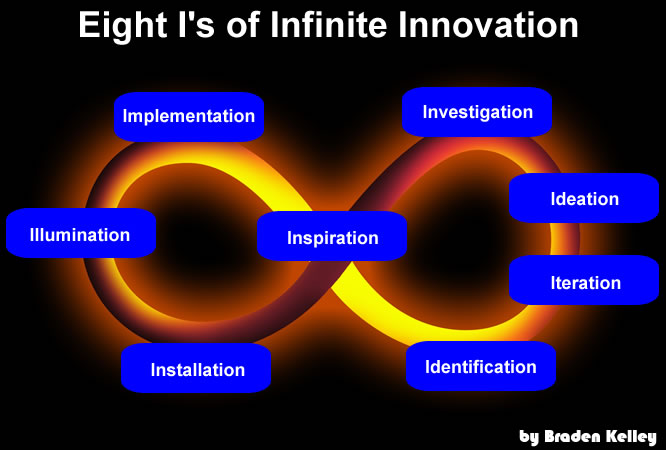
But I thought it could be interesting to use AI to answer this question in more detail, leveraging my Eight I’s of Infinite Innovation framework to highlight how artificial intelligence could be used at each step of the continuous innovation journey.

Below you will find a detailed explanation of the Eight I’s of Infinite Innovation framework along with clearly called out contextual responses generated by Microsoft CoPilot detailing how AI could be used productively during that specific phase of the continuous innovation journey from prompts generated by me after uploading a PDF version of the original Eight I’s of Infinite Innovation article (see the link at the bottom).

Eight I's of Infinite Innovation

Creating a Continuous Innovation Capability

To achieve sustainable success at innovation, you must work to embed a repeatable process and way of thinking within your organization, and this is why it is important to have a simple common language and guiding framework of infinite innovation that all employees can easily grasp. If innovation becomes too complex, or seems too difficult then people will stop pursuing it, or supporting it.

Some organizations try to achieve this simplicity, or to make the pursuit of innovation seem more attainable, by viewing innovation as a project-driven activity. But, a project approach to innovation will prevent it from ever becoming a way of life in your organization. Instead you must work to position innovation as something infinite, a pillar of the organization, something with its own quest for excellence – a professional practice to be committed to.

So, if we take a lot of the best practices of innovation excellence and mix them together with a few new ingredients, the result is a simple framework organizations can use to guide their pursuit of continuous innovation – the Eight I’s of Infinite Innovation. This framework anchors what is a very collaborative process. Here is the framework and some of the many points organizations must consider during each stage of the continuous process:

1. Inspiration

  • Employees are constantly navigating an ever changing world both in their home context, and as they travel the world for business or pleasure, or even across various web pages in the browser of their PC, tablet, or smartphone.
  • What do they see as they move through the world that inspires them and possibly the innovation efforts of the company?
  • What do they see technology making possible soon that wasn’t possible before?
  • The first time through we are looking for inspiration around what to do, the second time through we are looking to be inspired around how to do it.
  • What inspiration do we find in the ideas that are selected for their implementation, illumination and/or installation?

How to leverage artificial innovation during the Inspiration phase (according to AI):

  • AI can help employees find inspiration by analyzing vast amounts of data from various sources, such as social media, news articles, and industry reports. By identifying emerging trends and patterns, AI can provide insights into what is possible and inspire new ideas for innovation. Additionally, AI-powered tools can help employees visualize potential solutions and explore creative possibilities.

2. Investigation

  • What can we learn from the various pieces of inspiration that employees come across?
  • How do the isolated elements of inspiration collect and connect? Or do they?
  • What customer insights are hidden in these pieces of inspiration?
  • What jobs-to-be-done are most underserved and are worth digging deeper on?
  • Which unmet customer needs that we see are worth trying to address?
  • Which are the most promising opportunities, and which might be the most profitable?

How to leverage artificial innovation during the Inspiration phase (according to AI):

  • AI can assist in the investigation phase by processing and analyzing large datasets to uncover hidden insights and customer needs. Machine learning algorithms can identify patterns and correlations that may not be immediately apparent to humans, helping organizations understand which opportunities are most promising and worth pursuing. AI can also automate the process of gathering and organizing information, making it easier for employees to focus on deeper analysis.

3. Ideation

  • We don’t want to just get lots of ideas, we want to get lots of good ideas
  • Insights and inspiration from first two stages increase relevance and depth of the ideas
  • We must give people a way of sharing their ideas in a way that feels safe for them
  • How can we best integrate online and offline ideation methods?
  • How well have we communicated the kinds of innovation we seek?
  • Have we trained our employees in a variety of creativity methods?

How to leverage artificial innovation during the Inspiration phase (according to AI):

  • AI can enhance the ideation process by generating a wide range of ideas based on input from employees and external sources. Natural language processing (NLP) algorithms can analyze and categorize ideas, making it easier to identify the most relevant and promising ones. AI-powered collaboration tools can also facilitate brainstorming sessions, allowing employees to share and build on each other’s ideas in real-time, regardless of their physical location.

4. Iteration

  • No idea emerges fully formed, so we must give people a tool that allows them to contribute ideas in a way that others can build on them and help uncover the potential fatal flaws of ideas so that they can be overcome
  • We must prototype ideas and conduct experiments to validate assumptions and test potential stumbling blocks or unknowns to get learnings that we can use to make the idea and its prototype stronger
  • Are we instrumenting for learning as we conduct each experiment?

How to leverage artificial innovation during the Inspiration phase (according to AI):

  • AI can support the iteration phase by providing tools for rapid prototyping and experimentation. Machine learning models can simulate different scenarios and predict potential outcomes, helping teams identify and address potential flaws in their ideas. AI can also automate the process of collecting and analyzing feedback from experiments, enabling continuous improvement and refinement of prototypes.

Eight I's of Infinite Innovation

5. Identification

  • In what ways do we make it difficult for customers to unlock the potential value from this potentially innovative solution?
  • What are the biggest potential barriers to adoption?
  • What changes do we need to make from a financing, marketing, design, or sales perspective to make it easier for customers to access the value of this new solution?
  • Which ideas are we best positioned to develop and bring to market?
  • What resources do we lack to realize the promise of each idea?
  • Based on all of the experiments, data, and markets, which ideas should we select?

How to leverage artificial innovation during the Inspiration phase (according to AI):

  • AI can help organizations identify the most viable ideas by analyzing data from experiments, market research, and customer feedback. Predictive analytics can assess the potential success of different ideas and prioritize those with the highest likelihood of success. AI can also identify potential barriers to adoption and suggest strategies to overcome them, ensuring that innovative solutions are accessible and valuable to customers.

You’ll see in the framework that things loop back through inspiration again before proceeding to implementation. There are two main reasons why. First, if employees aren’t inspired by the ideas that you’ve selected to commercialize and some of the potential implementation issues you’ve identified, then you either have selected the wrong ideas or you’ve got the wrong employees. Second, at this intersection you might want to loop back through the first five stages though an implementation lens before actually starting to implement your ideas OR you may unlock a lot of inspiration and input from a wider internal audience to bring into the implementation stage.

6. Implementation

  • What are the most effective and efficient ways to make, market, and sell this new solution?
  • How long will it take us to develop the solution?
  • Do we have access to the resources we will need to produce the solution?
  • Are we strong in the channels of distribution that are most suitable for delivering this solution?

How to leverage artificial innovation during the Inspiration phase (according to AI):

  • AI can streamline the implementation process by optimizing production, marketing, and sales strategies. AI-powered project management tools can help teams plan and execute tasks more efficiently, while machine learning algorithms can optimize supply chain and distribution processes. AI can also personalize marketing campaigns and sales approaches, ensuring that new solutions reach the right customers at the right time.

7. Illumination

  • Is the need for the solution obvious to potential customers?
  • Are we launching a new solution into an existing product or service category or are we creating a new category?
  • Does this new solution fit under our existing brand umbrella and represent something that potential customers will trust us to sell to them?
  • How much value translation do we need to do for potential customers to help them understand how this new solution fits into their lives and is a must-have?
  • Do we need to merely explain this potential innovation to customers because it anchors to something that they already understand, or do we need to educate them on the value that it will add to their lives?

How to leverage artificial innovation during the Inspiration phase (according to AI):

  • AI can enhance the illumination phase by helping organizations communicate the value of their innovations to potential customers. NLP algorithms can generate compelling marketing content and product descriptions, while sentiment analysis can gauge customer reactions and adjust messaging accordingly. AI can also identify key influencers and target them with personalized messages to amplify the reach of new solutions.

8. Installation

  • How do we best make this new solution an accepted part of everyday life for a large number of people?
  • How do we remove access barriers to make it easy as possible for people to adopt this new solution, and even tell their friends about it?
  • How do we instrument for learning during the installation process to feedback new customer learnings back into the process for potential updates to the solution?

How to leverage artificial innovation during the Inspiration phase (according to AI):

  • AI can facilitate the installation of new solutions by removing barriers to adoption and ensuring a seamless customer experience. AI-powered customer support tools can provide instant assistance and troubleshooting, while machine learning algorithms can personalize onboarding processes to meet individual customer needs. AI can also monitor usage patterns and gather feedback, enabling continuous improvement and updates to the solution.

Conclusion

The Eight I’s of Infinite Innovation framework is designed to be a continuous learning process, one without end as the outputs of one round become inputs for the next round. It’s also a relatively new guiding framework for organizations to use, so if you have thoughts on how to make it even better, please let me know in the comments. The framework is also ideally suited to power a wave of new organizational transformations that are coming as an increasing number of organizations (including Hallmark) begin to move from a product-centered organizational structure to a customer needs-centered organizational structure. The power of this new approach is that it focuses the organization on delivering the solutions that customers need as their needs continue to change, instead of focusing only on how to make a particular product (or set of products) better.

By leveraging AI at each stage of the innovation process, organizations can enhance their ability to generate, develop, and implement successful innovations.

So, as you move from the project approach that is preventing innovation from ever becoming a way of life in your organization, consider using the Eight I’s of Infinite Innovation to influence your organization’s mindset and to anchor your common language of innovation. The framework is great for guiding conversations, making your innovation outputs that much stronger, and will contribute to your quest for innovation excellence – it is even more powerful when you combine it with my Value Innovation Framework (found here). The two are like chocolate and peanut butter. They’re powerful tools when used separately, but even more powerful when used together.

Click to access this framework as a FREE scalable 11″x17″ PDF download

Click to download the PDF version of this article

People who upgrade to the Bronze Version of the Change Planning Toolkit™ will get access to my Innovation Planning Canvas™ which combines the Value Innovation Framework together with the Eight I’s of Infinite Innovation, allowing you to track the progress of each potential innovation on the three value innovation measures as you evolve any individual idea through this eight step process.

Subscribe to Human-Centered Change & Innovation WeeklySign up here to get Human-Centered Change & Innovation Weekly delivered to your inbox every week.

The State of Customer Experience and the Contact Center

The State of Customer Experience and the Contact Center

GUEST POST from Shep Hyken

Oh, what a difference a year makes. A few months ago I traveled to Las Vegas to attend the Customer Contact Week (CCW), the largest conference and trade show in the contact center industry. For the past several years, the big discussion has centered on artificial intelligence (AI), and that continues, but Customer Experience (CX) is also moving into the spotlight. AI and natural language models can give customers an almost human-like experience when they have a question or complaint. However, no surprise, some companies do it better than others.

First, all the hype around AI is not new. AI has been in our lives for decades, just at a much simpler level. How do you think Outlook and other email companies recognize that an email is spam and belongs in the junk/spam folder? Of course, it’s not 100% perfect, and neither are today’s best AI programs.

Many of us use Siri and Alexa. That’s AI. And as simple as that is, it’s obviously more sophisticated when you apply it to customer support and CX.

Let’s go back 10 years ago when I attended the IBM Watson conference in Las Vegas. The big hype then was around AI. There were some incredible cases of AI changing customer service, sales and marketing, not to mention automated processes. One of the demonstrations during the general session showcased AI’s stunning capability. Here’s what I saw:

A customer called the contact center. While the customer service agent listened to the customer, the computer (fueled by AI) listened to the conversation and fed the agent answers without the agent typing the questions. In addition, the computer informed the agent how long the customer had been doing business with the company, how often they made purchases, what products they had bought and more. The computer also compared this customer to others who had the same questions and suggested the agent answer those questions. Even though the customer didn’t yet know to ask them, at some point in the future, they would surely be calling back to do so.

That demonstration was a preview of what we have today. One big difference is that implementing that type of solution back then could have cost hundreds of thousands of dollars, if not more than a million. Today, that technology is affordable to almost any company, costing a fraction of what it cost back then (as in just a few thousand dollars).

Voice Technology Gets Better

Less than two years ago, ChatGPT was introduced to the world. Similar technologies have been developed. The capability continues to improve at an incredibly rapid pace. The response from an AI-fueled chatbot is lightning fast. Now, the technology is moving to voice. Rather than type a question for the chatbot, you talk, and it responds in a human-like voice. While voice technology has existed for years, it’s never been this good. Google introduced voice technology that seemed almost human-like. The operative word here is almost. As good as it was, people could still sense they weren’t talking to a human. Today, the best systems are human-like, not almost human-like. Think Alexa and Siri on steroids.

Foreign Accents Are Disappearing

We’ve all experienced calling customer support, and an offshore customer service agent with a heavy accent answers the call. Sometimes, it’s nearly impossible to understand the agent. New technologies are neutralizing accents. A year ago, the software sounded a little “digital.” Today, it sounds almost perfect.

Why Customers Struggle with AI and Other Self-Service Solutions

As far as these technologies have come, customers still struggle to accept them. Our customer service research (sponsored by RingCentral) found that 63% of customers are frustrated by self-service options, such as ChatGPT and similar technologies. Furthermore, 56% of customers admit to being scared of these technologies. Even though 32% of the customers surveyed said they had successfully resolved a customer service issue using AI or ChatGPT-type technologies, it’s not their top preference as 70% still choose the phone as their first level of support. Inconsistency is part of the problem. Some companies still use old technology. The result is that the customer experience varies from company to company. In other words, customers don’t know whether the next time they experience an AI solution if it will be good or not. Inconsistency destroys trust and confidence.

Companies Are Investing in Creating a Better CX

I’ve never been more excited about customer service, CX and the contact center. The main reason is that almost everything about this conference was focused on creating a better experience for the customer. The above examples are just the tip of the iceberg. Companies and brands know what customers want and expect. They know the only way to keep customers is to give them a product that works with an experience they can count on. Price is no longer a barrier as the cost of some of these technologies has dropped to a level that even small companies can afford.

Customer Service Goes Beyond Technology: We Still Need People!

This article focused on the digital experience rather than the traditional human experience. But to nail it for customers, a company can’t invest in just tech. It must also invest in its employees. Even the best technology doesn’t always get the customer what they need, which means the customer will be transferred to a live agent. That agent must be properly trained to deliver the experience that gets customers to say, “I’ll be back.”

Image Credits: Pexels, Shep Hyken

This article originally appeared on Forbes.com

Subscribe to Human-Centered Change & Innovation WeeklySign up here to join 17,000+ leaders getting Human-Centered Change & Innovation Weekly delivered to their inbox every week.

Success is a Hardship Too

Success is a Hardship Too

GUEST POST from Mike Shipulski

Everything has a half-life, but we don’t behave that way. Especially when it comes to success. The thinking goes – if it was successful last time, it will be successful next time. So, do it again. And again. It is an efficient strategy – the heavy resources to bring it to life have already been spent. And it is predictable – the same customers, the same value proposition, the same supply base, the same distribution channel, and the same technology. And it is dangerous.

Success is successful right up until it isn’t. It will go away. But it will take time. A successful product line will not fall off the face of the earth overnight. It will deliver profits year-over-year and your company will come to expect them. And your company will get hooked on the lifestyle enabled by those profits. And because of the addiction, when they start to drop off the company will do whatever it takes to convince itself all is well. No need to change. If anything, it is time to double-down on the successful formula.

Here’s a rule: When your successful recipe no longer brings success, it’s not time to double-down.

Success’ decline will be slow, so you have time. But creating a new recipe takes a long time, so it is time to declare that the decline has already started. And it is time to learn how to start work on the new recipe.

Hardship 1 – Allocate resources differently. The whole company wants to spend resources on the same old recipes, even when told not to. It is time to create a funding stream that is independent of the normal yearly planning cycle. Simply put, the people at the top have to reallocate a part of the operating budget to projects that will create the next successful platform.

Hardship 2 – Work differently. The company is used to polishing the old products and they don’t know how to create new ones. You need to hire someone who can partner with outside companies (likely startups), build internal teams with a healthy disrespect for previous success, create mechanisms to support those teams and teach them how to work in domains of high uncertainty.

Hardship 3 – See value differently. How do you provide value today? How will you provide value when you cannot do it that way? What is your business model? Are you sure that’s your business model? Which elements of your business model are immature? Are you sure? What is the next logical evolution of how you go about your business? Hire someone to help you answer those questions and create projects to bring the solutions to life.

Hardship 4 – Measure differently. When there is no customer, no technology and no product, there is no revenue. You must learn how to measure the value of the work (and the progress) with something other than revenue. Good luck with that.

Hardship 5 – Compensate differently. People that create something from nothing want different compensation than people that do continuous improvement. And you want to move quickly, violate the status quo, push through constraints and create whole new markets. Figure out the compensation schemes that give them what they want and helps them deliver what you want.

This work is hard, but it’s not impossible. But your company doesn’t have all the pieces to make it happen. Don’t be afraid to look outside your company for help and partnership.

Image credit: Pixabay

Subscribe to Human-Centered Change & Innovation WeeklySign up here to join 17,000+ leaders getting Human-Centered Change & Innovation Weekly delivered to their inbox every week.

Components of a Good Digital Strategy

Components of a Good Digital Strategy

GUEST POST from Howard Tiersky

If I told you I had a document in my hand that was the new digital strategy for your company, what would you expect it to contain?

A list of projects? A “mission” statement? A technology vision? A competitive market analysis? A financial forecast?

One of the problems with the label “digital strategy” is that there’s not a common understanding of what it actually means or should contain. Naturally, the needs vary by company, but what if I said I had one menu for a Chinese restaurant and one for an Italian restaurant? Of course, there would be some differences, but there would also be some similarities: both would contain a list of foods you can order and their prices.

While we know what to expect to see in a menu, what should we expect to find in a digital strategy?

We develop digital strategies for companies from media to retail to financial services, and we use a ten-chapter outline for our digital strategy documents. Starting from this point, we often customize, and I’d encourage you to do that as well. Consider this a cheat-sheet that, if it works for your organization, can form the basis for your digital strategy.

Chapter One: Our Current Situation

Describe your company’s current situation vis a vis digital. Outline the digital touchpoints that currently exist, how recently they have been “remodeled,” how you measure their performance and what feedback you receive from both customers and stakeholders. Neither exaggerate the problems nor sweep them under the rug. The idea is to present a clear, objective, and fact-based description of the current state. Ideally, cite specific stats such as conversion, ad revenue, usability testing results or other data-driven “evidence” for your position. Also, describe any obvious gaps in your digital landscape. If you have clarity on the reasons for some of the problems or gaps (technical issues, business process issues, etc.), then state these as well.

Chapter Two: The Customer and Competitive Landscape

Describe your customer segments succinctly. What is understood about their current needs? How have they changed? Ideally, cite evidence from market research. In particular, how have their channel/touchpoint preference and expectations been evolving? What does that suggest about what your brand needs to do to stay relevant? If you have data to support it, describe how the current digital ecosystem for your company impacts your customer’s perception, behavior and purchase decisions (either positively or negatively — you may have examples of both). Now take a look at competitors. Your customers are evaluating you against your competitive set; what are they offering regarding a digital experience? How does it differ from what your brand is doing? What success metrics do you have available to indicate how successful competitive efforts are? (remember not everything your competitor is doing differently is necessarily successful). Remember to look not just at your traditional large competitors, but also at smaller competitors who may not be taking a significant market share (yet) but who might be more nimble or creative. Look also at “comparative” brands. If you are a hotel, what are airlines doing? What is Uber or Amazon doing? And how are their latest innovations both creating new expectations your customers have for you and also highlighting opportunities for your industry to do something similar?

Chapter Three: Trends

Chapters One and Two describe the current state. Chapter Three is your space to forecast the future. What trends are likely to impact your customer and your industry over the next few years? I suggest focusing on a 2-3 year time horizon. In today’s fast-moving world trying to forecast farther than that is too inaccurate. What kind of trends should you focus on? Certainly focus on digital trends, such as the shift to mobile or other digital technologies that may be relevant to your industry (wearables, VR, AR, chatbots, etc.). But also focus on trends that may not be inherently digital but which may have a significant impact in your industry over the next few years. These could be growth in China, the different priorities of the millennial generation, etc.

Chapter Four: Our Assets

Nothing in the outline of the first three chapters is inherently good news or bad news — it’s just a journalistic perspective on your brand, your customers, and competitors- where they are today and where they are going. It’s not uncommon for it to be an inventory of all the ways you are behind and that can be a bit of a downer. This chapter is your opportunity to remind the reader of any untapped assets you may have that might be able to help you leap ahead. What kind of asset should you describe? Here are some ideas. Consider which apply in your situation:

  1. Your brand — How is your brand viewed by customers? Even if you are behind the curve in digital, it takes a long time to build a trusted brand. That’s worth a lot, and if you catch up, that brand may be a huge competitive weapon even against companies who seem to be ahead of you today.
  2. Your content — Perhaps you have a backlog of content that is not being fully leveraged. A new digital strategy may enable you to tap value that is currently latent.
  3. Technology — You might have some proprietary technology that, if connected to a stronger digital touchpoint, could enable you to bring capabilities to the market that would be difficult for others to match.
  4. Your people and their skills — Your organization may be uniquely good at something. Perhaps there is a way to leverage that strength. Or you may have specific individuals whose talents aren’t fully leveraged but who could make a major difference if given the opportunity to drive new digital strategies.

Your scale, financial resources, partnership relationships, network of stores, licensed IP, etc. Companies have many other assets, far too many to list here. Try to inventory everything you have to work with and consider which other assets might have a place in developing a strategy that provides sustainable competitive differentiation.

Chapter Five: The Future Customer Journey

Chapter Five is where you describe your vision of the future. You have been setting up the rationale for change in the previous four chapters; this is where you propose your solution. Describe how the customer will interact with your brand differently in the future — what changes will be made to the different touchpoints? How does their journey play out from initial introduction to your brand, through the phases of initial interest and research, through their purchase decisions, experience of your product or service, problem resolution, and future re-purchase? Describe your customer, their situation, and their priorities and tell a compelling story that rings the intuitive bell of the user that this future journey will be both far better for the customer and also lead to better business outcomes for the brand. Support the alignment with customer needs via research data where available. One format for describing the customer journey is a roadmap.

However you describe it, your strategy should align with the three key priorities of a successful digital business.

Chapter Six: Money and Business Model

If you have done a good job in Chapter Five, you now have your reader or listener (if it’s a presentation) thinking, “Sounds great, but how much is this going to cost??” Chapter Six is where you lay out three things — roughly what implementing this strategy will cost, what your projections are for financial return, and how the business model under the new strategy changes, if at all. Clarity around investment and returns is what separates digital strategies that sound good from ones that actually get done. After all, an ambitious digital strategy for a major brand is likely to be a substantial investment. Most of the time those at the CFO and CEO level making investment decisions of hat scale are not doing it because of the inherent “good” of digital, but because they expect a return that justifies the decision. You must help them see your story in the kind of financial language that they use to make all of their other decisions. Be sure to describe not only the total budget but how much you anticipate will be capital vs operating budget and what the cash flow timing looks like. You’ll want someone from your finance department to be involved in modeling this in spreadsheet form.

Chapter Seven: Technology

It’s quite likely that your new strategy will be closely tied to technology. In Chapter Seven describe the technologies that are needed. It’s not essential to describe hardcore “tech” details or reference specific software tools. Rather, the idea here is to describe the key requirements you will have of technology to achieve the strategy.

Chapter Eight: Business Process and Organization

Often a substantial digital transformation will change the way you do business. If so, then no doubt you will need to reconsider various business processes or parts of your organizational structure. Chapter Eight should describe the types of changes that may be needed.

Chapter Nine: Timeline and Challenges

In Chapter Nine, you lay out a detailed quarter by quarter plan of how you intend to proceed. In addition, be upfront about the assumptions, risks and anticipated challenges your strategy will face. It may seem like it would be better to keep quiet about possible risks, but actually, the opposite is true for two reasons. First, it adds credibility to your plan and process to show you’re realistic about the possible roadblocks and are already thinking about how to avoid them. And second, when you get funded, and your project actually does encounter challenges it won’t be a shock to your stakeholders. Most major transformations encounter a lot of twists and turns, and you need not only the initial support but the sustained support of your key stakeholders. Having a frank conversation about the things that could go wrong in advance is planting the seeds for their support when you need it in the future.

Chapter Ten: The Cost of Failure

The last chapter addresses the question of what if we don’t do it? Or what if we do it half-heartedly? Digital transformation projects inevitably involve risks. And really wouldn’t we all rather avoid risk? This last chapter is the time to describe the risks of not proceeding or not fully proceeding. How will this impact sales? How will it impact your brand? If you just delay a year or two and then proceed, how will that impact your ability to catch up to the market?

So there you are: ten chapters of your digital strategy (or at least a starting point). One final suggestion is to make the development of your strategy an inclusive process. These days an effective digital strategy touches every part of an organization, and people can be quite resistant to an outside “digital team” deciding their fate for them. Furthermore, I suggest you create an inclusive process around the finalization of your digital strategy outline before you begin the process of developing the strategy. To the point I began with, there is a risk that when you come back to your CMO or your CEO with “The Digital Strategy” they may be surprised by what is and what isn’t covered. You can use this outline as a starting discussion point to gauge their expectations and jointly agree on what the strategy actually needs to address so that the scope and structure of the strategy meets their expectations and you can focus on the substance. Good luck strategizing and as always let us know if we can be of any help!

This article originally appeared on the Howard Tiersky blog

Image Credits: FreePik

Subscribe to Human-Centered Change & Innovation WeeklySign up here to get Human-Centered Change & Innovation Weekly delivered to your inbox every week.
Sustainability Requires Doing Less Not More

GUEST POST from Mike Shipulski

If you use fewer natural resources, your product costs less.

If you use recycled materials, your product costs less.

If you use less electricity, your product costs less.

If you use less water to make your product, your product costs less.

If you use less fuel to ship your product, your product costs less.

If you make your product lighter, your product costs less.

If you use less packaging, your product costs less.

If you don’t want to be environmentally responsible because you think it’s right, at least do it to be more profitable.

Image credit: Pexels

Subscribe to Human-Centered Change & Innovation WeeklySign up here to join 17,000+ leaders getting Human-Centered Change & Innovation Weekly delivered to their inbox every week.

What the Singularity Means for Business

What the Singularity Means for Business

GUEST POST from Robert B. Tucker

In 2006, Nokia was the global leader in cell phones, growing by double digits. They were rated the eighth most innovative company in the world, according to BusinessWeek. What could possibly go wrong?

Turns out, plenty.

In 2006, Nokia invited me to lecture on driving growth through innovation before an elite group of 50 of their “high-potential” managers, who would be flying into Palo Alto from all over the world. A pre-session survey I conducted should have alerted me to Nokia’s future dilemma. I asked about barriers to innovation, half expecting they would leave that question unanswered. Instead: “We are risk averse.” “Our operational mindset dominates” and we suffer from large corporation syndrome.”

I still remember posing a question to this group: “If I work for you and I have an idea, what do you want me to do with it? One manager spoke up and said, “I’d just advise you to forget about it. In this company, you’re just going to frustrate yourself; there’s so much bureaucracy you’ll never get anywhere with the idea.”

I passed off what I’d learned about Nokia as an anomaly: “Rapid growth covers a lot of sins.” But one year later Nokia found out differently. In 2007, Apple introduced the iPhone and Nokia began its spectacular fall from grace. They were woefully unprepared for the inflection point that suddenly confronted them.

We are about to face the biggest business and social inflection point in history, and, like Nokia, we are unprepared.

Futurist Ray Kurzweil defines the Singularity as a period during which the pace of technological change will be so rapid, its impact so deep, that human life and business will be irreversibly transformed. We are almost there, and the impacts are everywhere.

Simultaneous revolutions are happening at the same time: in business, in society, in geopolitics, and in climate. Over the next ten years, industry after industry will experience exponential change. Customer needs will shift overnight. New technologies will emerge at record rates. The workforce and the kind of talent that will be needed will be radically different. In my work, I’m seeing a lot of companies caught off guard by the Singularity future. I believe that the single biggest issue organizations will face is the challenge of rapid change. In 10 years, research suggests that forty percent of the 500 largest public companies will no longer be around.

Intel, once led by a CEO (Andrew S. Grove) who wrote “Only the Paranoid Survive” got caught up serving the PC and data center markets. Intel missed the smartphone trend. Ten years later, they missed the AI revolution. But Intel rival saw the opportunity and pounced. Nvidia repurposed its chips designed for video games and began using them to power the AI Revolution.

Boeing faces its own Singularity Moment. Once the company’s commitment to safety and quality were second to none. Their catchword was “If it ain’t Boeing, I ain’t going.” Boeing gobbled up rivals, expanded from jets to military hardware to rockets. The Saturn V rocket that powered Apollo 11 to the moon was proudly manufactured by Boeing.

But then the bean-counters took over. Today Boeing appears in a never-ending tailspin. Two of its 737 Max jets crashed, killing hundreds of passengers all because, as various investigations revealed, Boeing tried to avoid pilot retraining costs.

Two astronauts, riding in a Boeing-built Starliner spacecraft, arrived at the International Space Station on June 6th, 2024. They were expecting to stay for a week. But because of an embarrassing series of technical failures they are still there. They won’t be heading back to Earth until February. NASA calls Starliner “too risky.”

Meanwhile, rival SpaceX is making the most of its Singularity Moment. Their Falcon 9 rockets are driving unprecedented growth and market share. The Falcon 9 was developed at a fraction of the cost it took Boeing to develop comparable systems. CEO Elon Musk’s insistence on a fixed-price, milestone-based payment model pushed SpaceX to adopt a leaner, more innovative engineering approach. Boeing limped along with the traditional “cost-plus” business model.

To thrive and prosper in the next decade, organizations and their leaders need to grapple with the ever increasing pace of change and the need to constantly disrupt or be disrupted.

This article originally appeared in Forbes
Image credit: Pexels

Subscribe to Human-Centered Change & Innovation WeeklySign up here to get Human-Centered Change & Innovation Weekly delivered to your inbox every week.

28 Things I Learned the Hard Way

28 Things I Learned the Hard Way

GUEST POST from Mike Shipulski

  1. If you want to have an IoT (Internet of Things) program, you’ve got to connect your products.
  2. If you want to build trust, give without getting.
  3. If you need someone with experience in manufacturing automation, hire a pro.
  4. If the engineering team wants to spend a year playing with a new technology, before the bell rings for recess ask them what solution they’ll provide and then go ask customers how much they’ll pay and how many they’ll buy.
  5. If you don’t have the resources, you don’t have a project.
  6. If you know how it will turn out, let someone else do it.
  7. If you want to make a friend, help them.
  8. If your products are not connected, you may think you have an IoT program, but you have something else.
  9. If you don’t have trust, you have just what you earned.
  10. If you hire a pro in manufacturing automation, listen to them.
  11. If Marketing has an optimistic sales forecast for the yet-to-be-launched product, go ask customers how much they’ll pay and how many they’ll buy.
  12. If you don’t have a project manager, you don’t have a project.
  13. If you know how it will turn out, teach someone else how to do it.
  14. If a friend needs help, help them.
  15. If you want to connect your products at a rate faster than you sell them, connect the products you’ve already sold.
  16. If you haven’t started building trust, you started too late.
  17. If you want to pull in the delivery date for your new manufacturing automation, instead, tell your customers you’ve pushed out the launch date.
  18. If the VP knows it’s a great idea, go ask customers how much they’ll pay and how many they’ll buy.
  19. If you can’t commercialize, you don’t have a project.
  20. If you know how it will turn out, do something else.
  21. If a friend asks you twice for help, drop what you’re doing and help them immediately.
  22. If you can’t figure out how to make money with IoT, it’s because you’re focusing on how to make money at the expense of delivering value to customers.
  23. If you don’t have trust, you don’t have much.
  24. If you don’t like extreme lead times and exorbitant capital costs, manufacturing automation is not for you.
  25. If the management team doesn’t like the idea, go ask customers how much they’ll pay and how many they’ll buy.
  26. If you’re not willing to finish a project, you shouldn’t be willing to start.
  27. If you know how it will turn out, it’s not innovation.
  28. If you see a friend that needs help, help them ask you for help.

Image credit: Pixabay

Subscribe to Human-Centered Change & Innovation WeeklySign up here to join 17,000+ leaders getting Human-Centered Change & Innovation Weekly delivered to their inbox every week.

Everyone Clear Now on What ChatGPT is Doing?

Everyone Clear Now on What ChatGPT is Doing?

GUEST POST from Geoffrey A. Moore

Almost a year and a half ago I read Stephen Wolfram’s very approachable introduction to ChatGPT, What is ChatGPT Doing . . . And Why Does It Work?, and I encourage you to do the same. It has sparked a number of thoughts that I want to share in this post.

First, if I have understood Wolfram correctly, what ChatGPT does can be summarized as follows:

  1. Ingest an enormous corpus of text from every available digitized source.
  2. While so doing, assign to each unique word a unique identifier, a number that will serve as a token to represent that word.
  3. Within the confines of each text, record the location of every token relative to every other token.
  4. Using just these two elements—token and location—determine for every word in the entire corpus the probability of it being adjacent to, or in the vicinity of, every other word.
  5. Feed these probabilities into a neural network to cluster words and build a map of relationships.
  6. Leveraging this map, given any string of words as a prompt, use the neural network to predict the next word (just like AutoCorrect).
  7. Based on feedback from so doing, adjust the internal parameters of the neural network to improve its performance.
  8. As performance improves, extend the reach of prediction from the next word to the next phrase, then to the next clause, the next sentence, the next paragraph, and so on, improving performance at each stage by using feedback to further adjust its internal parameters.
  9. Based on all of the above, generate text responses to user questions and prompts that reviewers agree are appropriate and useful.

OK, I concede this is a radical oversimplification, but for the purposes of this post, I do not think I am misrepresenting what is going on, specifically when it comes to making what I think is the most important point to register when it comes to understanding ChatGPT. That point is a simple one. ChatGPT has no idea what it is talking about.

Indeed, ChatGPT has no ideas of any kind — no knowledge or expertise — because it has no semantic information. It is all math. Math has been used to strip words of their meaning, and that meaning is not restored until a reader or user engages with the output to do so, using their own brain, not ChatGPT’s. ChatGPT is operating entirely on form and not a whit on content. By processing the entirety of its corpus, it can generate the most probable sequence of words that correlates with the input prompt it had been fed. Additionally, it can modify that sequence based on subsequent interactions with an end user. As human beings participating in that interaction, we process these interactions as a natural language conversation with an intelligent agent, but that is not what is happening at all. ChatGPT is using our prompts to initiate a mathematical exercise using tokens and locations as its sole variables.

OK, so what? I mean, if it works, isn’t that all that matters? Not really. Here are some key concerns.

First, and most importantly, ChatGPT cannot be expected to be self-governing when it comes to content. It has no knowledge of content. So, whatever guardrails one has in mind would have to be put in place either before the data gets into ChatGPT or afterward to intercept its answers prior to passing them along to users. The latter approach, however, would defeat the whole purpose of using it in the first place by undermining one of ChatGPT’s most attractive attributes—namely, its extraordinary scalability. So, if guardrails are required, they need to be put in place at the input end of the funnel, not the output end. That is, by restricting the datasets to trustworthy sources, one can ensure that the output will be trustworthy, or at least not malicious. Fortunately, this is a practical solution for a reasonably large set of use cases. To be fair, reducing the size of the input dataset diminishes the number of examples ChatGPT can draw upon, so its output is likely to be a little less polished from a rhetorical point of view. Still, for many use cases, this is a small price to pay.

Second, we need to stop thinking of ChatGPT as artificial intelligence. It creates the illusion of intelligence, but it has no semantic component. It is all form and no content. It is a like a spider that can spin an amazing web, but it has no knowledge of what it is doing. As a consequence, while its artifacts have authority, based on their roots in authoritative texts in the data corpus validated by an extraordinary amount of cross-checking computing, the engine itself has none. ChatGPT is a vehicle for transmitting the wisdom of crowds, but it has no wisdom itself.

Third, we need to fully appreciate why interacting with ChatGPT is so seductive. To do so, understand that because it constructs its replies based solely on formal properties, it is selecting for rhetoric, not logic. It is delivering the optimal rhetorical answer to your prompt, not the most expert one. It is the one that is the most popular, not the one that is the most profound. In short, it has a great bedside manner, and that is why we feel so comfortable engaging with it.

Now, given all of the above, it is clear that for any form of user support services, ChatGPT is nothing less than a godsend, especially where people need help learning how to do something. It is the most patient of teachers, and it is incredibly well-informed. As such, it can revolutionize technical support, patient care, claims processing, social services, language learning, and a host of other disciplines where users are engaging with a technical corpus of information or a system of regulated procedures. In all such domains, enterprises should pursue its deployment as fast as possible.

Conversely, wherever ambiguity is paramount, wherever judgment is required, or wherever moral values are at stake, one must not expect ChatGPT to be the final arbiter. That is simply not what it is designed to do. It can be an input, but it cannot be trusted to be the final output.

That’s what I think. What do you think?

Image Credit: Pexels

Subscribe to Human-Centered Change & Innovation WeeklySign up here to join 17,000+ leaders getting Human-Centered Change & Innovation Weekly delivered to their inbox every week.