Category Archives: Psychology

Do What’s Right, Even if It is Not Expected

Do What's Right, Even if It is Not Expected

GUEST POST from Shep Hyken

Often, it’s just a tiny bit more effort.

Not long ago, I wrote an article and created a video on Doing More Than Expected – even when it’s not included in your job description. I used the example of the server at a restaurant who ran outside during a storm to move the outdoor furniture blowing across the patio to a safer, more secure spot. He returned to the restaurant, drenched from the rain, to applause from the guests. I jokingly asked him, “Was moving patio furniture included in your job description?” He said, “I just do what it takes.”

That’s a great attitude to have. First, you have to be the kind of person who innately knows you should do something right, even if it isn’t expected. Second, you have to be empowered to make those choices and act on them.

I’m reminded of an employee who fixed things around the office. If he saw something that wasn’t right, he made it right. For example, we had a frame with a motivational quote that we changed every week. One week later, the quote and picture frame were crooked. I noticed it, and while it bothered me a bit, it wasn’t worth saying anything about it. By the end of the day, it was fixed.

If I don’t do it, who will?

I knew who did it, but I still asked loud enough for others to hear, “Who fixed the weekly quote?” The answer, of course, was the same guy who fixed everything around the office. I thanked him and asked him why he handles things like this. He said, “If I don’t do it, who will?”

I love those seven words. “If I don’t do it, who will?” is right up there with “I just do what it takes.” These are the mindsets of people who go the extra mile, and by the way, it’s not really an extra mile. Often, it’s just a tiny bit more effort, if any. It’s just doing it because, “If they don’t, who will?”

When someone comes to work for you, whatever their role and responsibility, you hope they are good at it. If all they do is that role and don’t care to do anything else, such as fixing a crooked piece of art in a frame, you would still be happy with their work. But what if another employee did the same and, in addition, was willing to fix the metaphorical piece of art in a frame, even without being asked? Who would you rather have working for you?

Your answer is most likely the second option. That employee is the type of team member who will do whatever they can to take care of their internal and external customers. Why? Because they do what it takes and know, “If I don’t do it, who will?”

Image Credits: Shep Hyken, Unsplash

Subscribe to Human-Centered Change & Innovation WeeklySign up here to join 17,000+ leaders getting Human-Centered Change & Innovation Weekly delivered to their inbox every week.

Five Ways to Make People Feel Heard

Five Ways to Make People Feel Heard

GUEST POST from David Burkus

One of the most common complaints among disengaged employees is about not feeling heard, not being seen or recognized for what they do, who they are and what they are experiencing. As a leader, a lot of this frustration may stem from you. When people approach you with their problems and you jump right to give advice, you may feel you’re helping their problem…but you’re not helping them feel heard. And if they don’t feel heard, they’re not really hearing your advice anyway. Other times people speak up to share a new idea and get met with a quick retort about lack of budget or previous, similar ideas that didn’t work. You may think you’re helping move the conversation along, but you’re more likely causing team members to want to move along to find a new leader.

In this article, we’ll outline how to make people feel heard through five actions leaders can take to send the message that they are listening and respecting the contribution every member of their team is making.

1. Model Active Listening

The first way to make people feel heard is to model active listening. There’s no faster way to make someone feel ignored than to…ignore them. But in an era of constant distractions fighting for our attention, it can be difficult to focus in on someone sharing, and even more difficult to communicate that you are focused. That’s where active listening comes in. Make sure you’re truly centering your attention on them, receiving what they have to say. In addition, demonstrate your attention through non-verbals like nodding and gesturing. Before you take a turn responding, try to summarize what you heard and check for understanding. As you demonstrate active listening, you’ll find your team members feel more heard, but also that they hear each other better as well.

2. Praise The Contribution

The second way to make people feel heard is to praise their contribution, even if you disagree with their idea. Recognizing and appreciating their willingness to share their thoughts fosters a sense of validation and encourages continued participation. Highlighting the positive aspects of their contribution is crucial in creating an inclusive environment. By focusing on what they did well, you acknowledge their effort and encourage them to further develop their ideas. Moreover, praising contributions can also inspire others to share their thoughts and opinions. When individuals witness positive reinforcement, they are more likely to feel comfortable expressing their own ideas, leading to a more diverse and innovative team dynamic.

3. Challenge Assumptions, Not Ideas

The third way to make people feel heard is to challenge assumptions, not ideas. There may well be ideas shared in team meetings you want to push back on or challenge. But it’s important to maintain that feeling that you’re hearing and considering those ideas. So instead of criticizing the person or the idea directly, a more constructive approach is to question the assumptions behind their ideas. This allows for a deeper understanding of their thought process and encourages open-mindedness. Avoiding personal criticism is essential in maintaining a respectful and inclusive environment. By focusing on the assumptions, you shift the conversation towards exploring different perspectives and finding common ground. Asking questions to delve into the assumptions behind the idea not only demonstrates a genuine interest in understanding their viewpoint but also encourages critical thinking and fosters a culture of collaboration.

4. Questions Before Advice

The fourth way to make people feel heard is to ask questions before offering advice. Before providing advice, it is crucial to focus on understanding the problem at hand. By asking questions, you allow the person to feel heard and understood, creating a safe space for them to share their thoughts and concerns. Asking follow-up questions helps to delve deeper into the situation, uncovering underlying factors that may not be immediately apparent. This thorough understanding enables you to provide more relevant and effective advice. Show empathy throughout the conversation, acknowledging their emotions and experiences. By creating a safe and supportive environment, individuals are more likely to open up and engage in meaningful dialogue.

5. Addition Before Subtraction

The final way to make people feel heard is to add before you subtract, meaning build upon their existing idea or comments before challenging anything you heard. When offering feedback or criticism, it is essential to always start by highlighting the positive aspects of what was shared. By acknowledging the strengths and value of their contribution, you create a more receptive atmosphere. Even better, when you build upon the idea you demonstrate how much you value it. If you must offer constructive feedback and suggestions for improvement, focus on growth and development rather than solely pointing out flaws. This approach encourages individuals to embrace feedback as an opportunity for growth rather than feeling discouraged. Building on strengths and encouraging growth fosters a positive and supportive environment. By emphasizing the positive aspects, you inspire individuals to continue sharing their ideas and contribute to the team’s success.

Making people feel heard is a fundamental aspect of effective leadership. By modeling active listening, praising contributions, questioning assumptions, asking questions before offering advice, and focusing on addition before subtraction, leaders can create an inclusive and empowering environment. When individuals feel valued and understood, they are more motivated to contribute their ideas, leading to better outcomes and improved team culture. By implementing these tactics, leaders can foster a culture where everyone can do their best work ever.

Image credit: Pexels

Originally published at https://davidburkus.com on July 10, 2023

Subscribe to Human-Centered Change & Innovation WeeklySign up here to get Human-Centered Change & Innovation Weekly delivered to your inbox every week.

How to Tell if You Are Trusted

How to Tell if You Are Trusted

GUEST POST from Mike Shipulski

When you have trust, people tell you the truth.
— When you don’t have trust, people tell you what you want to hear.

When you have trust, people tell you when others tell you what you want to hear.
— When you don’t have trust, people watch others tell you what you want to hear.

When you have trust, you can talk about the inconvenient truth.
— When you don’t have trust, you can’t.

When you have trust, you can ask for something unreasonable and people try to do it.
— When you don’t have trust, they don’t.

When you have trust, you don’t need organizational power.
— When you have organizational power, you better have trust.

When you have trust, you can violate the rules of success.
— When you don’t have trust, you must toe the line.

When you have trust, you can go deep into the organization to get things done.
— When you don’t have trust, you go to the managers and cross your fingers.

When you have trust, cross-organization alignment emerges mysteriously from the mist.
— When you don’t have trust, you create a steering team.

When you do have trust, the Trust Network does whatever it takes.
— When you don’t have trust, people work the rule.

When you have trust, you do what’s right.
— When you don’t have trust, you do what you’re told.

When you have trust, you don’t need a corporate initiative because people do what you ask.
— When you don’t have trust, you need a dedicated team to run your corporate initiatives.

When you have trust, you don’t need control.
— When you don’t have trust, control works until you get tired.

When you have trust, productivity soars because people decide what to do and do it.
— When you don’t have trust, your bandwidth limits productivity because you make all the decisions.

When you have trust, you send a team member to the meeting and empower them to speak for you.
— When you don’t have trust, you call the meeting, you do the talking, and everyone else listens.

When you have trust, it’s because you’ve earned it.
— When you don’t have trust, it’s because you haven’t.

If I had to choose between trust and control, I’d choose trust.
— Trust is more powerful than control.

Image credit: Unsplash

Subscribe to Human-Centered Change & Innovation WeeklySign up here to join 17,000+ leaders getting Human-Centered Change & Innovation Weekly delivered to their inbox every week.

The Psychology of Winning

An Interview on Mindset and Agency

The Most Important Choice We Make is Choosing How to Think

GUEST POST from Robert B. Tucker

I began my career interviewing thought leaders, futurists, innovators, and visionaries as a Los Angeles-based journalist. For the May 1982, edition of PSA Magazine, I interviewed renowned speaker and behavioral psychologist Dr. Denis Waitley, whose “Psychology of Winning” cassette learning system was riding high on bestseller lists, and Waitley’s calendar was full of speaking engagements.

Waitley’s ideas were pivotal in fueling my own career trajectory and belief system, for he and other human potential leaders opened my eyes to how far you can go if you work to control your thoughts and self beliefs. Waitley and I eventually wrote a book together called Winning the Innovation Game, and sadly, we have lost touch.

Nevertheless, when I came across this interview the other day, I thought about Waitley’s ideas on not blaming others (“the government,” “racism,” “the other party,” “the Deep State,” “growing up in poverty,” etc.), I couldn’t help notice how the pendulum has swung even more towards victimization. These days, we seem to be moving away from our own sense of agency (“If it’s going to be, it’s up to me”) and towards nursing grievances and blaming others for our lack of results, rather than taking responsibility for our lives and making it happen every day by the way we control our thoughts.

TUCKER: Of all the characteristics of high-achieving individuals that you’ve had a chance to observe, which one seems to define them best?

WAITLEY: It’s their understanding of the degree of control that their thoughts have over the actions that follow in their lives. Whether they happen to be astronauts or parents or prisoners of war, these people have taken responsibility for their own achievements. They’re self-managers.

TUCKER: What does that mean?

WAITLEY: Self-management is declaring that life is a do-it-to-myself project. Instead of just letting life happen, I’m going to make it happen for me, and I’m going to exercise the greatest freedom I have, which is the freedom of choice. The deepest, most significant choice we make is in the way we choose to think.

TUCKER: Isn’t controlling one’s thoughts one of the hardest things to do?

WAITLEY: No, but I think one of the hardest things to believe is that it can have any effect on your life. Almost all people believe that they are victims of environmental circumstances, the government, the weather, their horoscopes, certainly the economy. They feel they must wait for luck or fate or karma to change before they can have some effect on their lives. What’s hardest to understand is that we’re doing it every day, using our self-talk either for or against ourselves.

TUCKER: What do you mean by self-talk?

WAITLEY: We’re talking to ourselves every moment of our waking lives. It comes automatically. We’re seldom even aware that we’re doing it. We all have a running commentary going on in our heads on events and our reactions to them. By changing what you’re saying, you can change your behavior.

TUCKER: Should we consciously try to stop thinking negative thoughts by repressing doubts and fears?

WAITLEY: No. Those are natural emotions.

TUCKER: If you’re giving a speech, for instance, and you’re nervous, should you go ahead and admit it to the audience?

WAITLEY: No, because that is self-fulfilling and becomes a habit. It’s much better to go on and do it anyway and listen for positive responses from the audience and try to reward yourself for a successful speech. It’s not so much the performance that counts, because on any given day your performance will be good or not so good—a lot of factors affect your performance. But your response to it is what’s most important of all.

TUCKER: But people do have fears. Businesspeople worry constantly about a slump in their businesses, and salespeople worry about blowing a sale. Are you suggesting we shouldn’t verbalize those fears?

WAITLEY: I see the expression of fear as fine, but most fears and phobias are imaginary. A Michigan study found that 60 percent of our fears are totally unwarranted; 20 percent have already passed and are out of our control entirely; and another 10 percent are so petty that they don’t make any difference. Of the remaining 10 percent, only 4 or 5 percent are real and justifiable fears, And even of those, we couldn’t do anything about half of them! The other half we could easily solve by seeking out further information. Fear is not an effective emotion. It’s an emotion you should feel under physical danger.

TUCKER: How do you control your interior dialogue? What instructions can you offer?

WAITLEY: The self-talk of winners is affirmative and directed toward the results they want: after a poor performance, a winner would say, “That’s not like me, I can do better than that. I need more information about the target because I didn’t hit it. Therefore, I’ve either set the target too far off for right now, or I don’t have enough to go on.” The immediate self-talk of that performance should be, “target correction necessary.” After a good performance, on the other hand, the immediate feedback would be, “Now we’re getting somewhere. This is the way I see myself performing.” Non-high-performance individuals will have a good day or do something exceptional, but they’ll totally defeat themselves because they’ll have convinced themselves that it was a fluke.

TUCKER: So you believe in coaxing the mind toward the goal, almost talking to yourself?

WAITLEY: Absolutely. I believe in talking to myself in words, pictures, and emotions for a long time before a performance and just afterward. It’s even more important after a successful performance to assimilate it.

TUCKER: You recommend using simulation also as a way of improving performance. How does the system work?

Waitley: The neat thing about the brain is that it is a mimic of what we put into it in advance. Airline pilots have been using simulation for years. But it’s also a technique that businesspeople and everybody can practice, just by creating each experience that we want in our imagination first, before the event. The other day on a flight to Chicago, I was sitting next to a fellow who was making a weird, high-pitched humming noise, with his eyes closed. I turned the overhead air nozzle on his face and asked him if he wanted me to call the stewardess to come to his aid. It turned out that he was an oboist for the Chicago Symphony and he was practicing for that night’s performance. I met a world-champion Russian figure skater who told me that she rarely falls because she practices each sequence in her imagination at night with her eyes closed. She could probably perform her entire routine blindfolded with no hesitation. Simulation is the ability to do within when you’re without.

TUCKER: What is your primary message to those you teach?

WAITLEY: That the period of time we’re living in is no worse than any other period in history, and probably better. Because problems are normal and inherent with change. And since society is changing rapidly, it’s up to the individual to view change as normal and to see many of the changes taking place as positive rather than negative. But we’re not historians by nature. So we’re not apt to say, let’s look at what happened in the past for guidance. There’s such an incredible focus in society on deviant behavior, bad news, and things going wrong that most people take it all on their shoulders. They feel that things were better before and will probably be better at some unpredictable point in the future called “someday.”

TUCKER: Do you consider yourself a psychologist first or a motivator?

WAITLEY: I’m a motivational trainer first. I teach people how to view the world, how to view themselves in the world, and how to establish some rules of conduct toward their personal and professional lives. So in effect, I’m a performance enhancer. I consider myself a psychologist second, although I’m constantly trying to make sure that the techniques, I’m applying have some basis in fact and have been researched.

TUCKER: What do your audiences want from you?

WAITLEY: They think what motivation is is a pump up, let’s-go-out-there-and-kill-’em mentality. Motivation has been one of the most misunderstood, oversold words I’ve ever come across. What researchers have found is that the old locker-room psych-up causes you to peak too early. The adrenaline athletes have pumped up in the locker room tends to make them overanxious, and they make mistakes. They go out there, and instead of being relaxed and knowing exactly what they’re going to do, they’re actually too aroused to think. The new way is to have quiet time in the locker room —this applies to both Olympic and Super Bowl athletes- when athletes sit and listen to soft music and rehearse in their imaginations the game they know they are capable of playing because they’re prepared. And it’s really the same situation in life if you think about it.

TUCKER: Why is it more important to replay a successful performance than to analyze a bad one?

WAITLEY: Because most of us don’t spend enough time preparing for or simulating success in advance, and we aren’t prepared for it when we achieve it. We haven’t spent enough time thinking about how good it is going to feel to be successful. For whatever reason we become successful, we don’t completely understand it. And because of this, we don’t feel deserving of it; it comes upon us like instant stardom or winning the sweepstakes. Right away, our self-talk begins to tear down the success, and we get back to where we were before or we go back to being our “practiced selves.”

TUCKER: Of the high-achieving people you’ve observed, do they seem to be

goal-oriented?

WAITLEY: It’s definitely a common denominator of successful people. I find that the most common problem with people who never reach their goals is that they never set them. It isn’t that goals are unreachable; it’s that most people never take the time to write them down. They spend more time planning Christmas or a vacation than they do their lives. I’ll ask people what they are going to do in 1983 and they’ll say, “Who can tell? It depends on whether Reaganomics works.” Then I’ll ask, “What are you going to be doing by 1985?” they’ll reply, “Well, it will probably be worse, with the interest rates and all. We don’t have any idea.”

TUCKER: What’s your method for setting goals?

WAITLEY: I believe it’s best to write out your life goals first, the things you want to do in the long range. Then, break down your goals into intermediate ones: What do you want to accomplish in the next three years? What do you intend to accomplish in the next six months? And then, after you’ve done this, how are you going to achieve them? It’s very important to be specific; not just that you want to be happy. You want to be happy in what way? Do you want to be happy with your children at night when you come home? To answer these questions, you’ll have to put down certain affirmative statements that will project you toward your goals.

TUCKER: What do you say to people who reach their goals and find that they still aren’t happy?

WAITLEY: If your goals are symbols of success—a mansion, a yacht, a certain position in business or in the university—those I call shallow and superficial targets. If your goal was to make a million dollars and you made it, you’d find it shallow, because no one really cares. It isn’t the achievement of the million dollars that’s important; it was the process you went through in achieving it. So, goal setters have to be careful. They must understand that life itself is a process and that there is a big picture, that they fit into the big universe and that the most successful people look beyond themselves and their own goals for meaning and purpose in life.

These people are the ones who are busy planting shade trees under which they know they’ll never sit. The biggest fools are the ones who look at the destination as the answer and not the process of the journey as being important. But it’s equally foolish to go out there and just journey without having a destination.

TUCKER: What role does ambition play in your psychology of winning?

WAITLEY: A great one. Ambition is the role of imagination. It’s simply a desire for change or a dissatisfaction with the status quo. A desire for change means that I can see something out there that is better than what I have.

TUCKER: You mentioned earlier that we Americans may be working so hard that we may not be taking enough time to relax and reflect. What do you recommend as ways to keep from becoming too narrowly focused in one’s work?

WAITLEY: I think reading the best-selling nonfiction books is important. And if you don’t have time to read those, then definitely read the digests of them. They even have digests of medical breakthroughs, and they’re starting to put these digests on tape, so that what we used to think of as downtime in rush-hour traffic can be come in your auto-classroom. Attending seminars and lectures of all kinds, is important. Even more important is talking to people who have different views from yours.

TUCKER: Do you advocate having a specific daily routine?

WAITLEY: I’m a big believer in a success routine if the things you are doing are really beneficial. That might include getting up half an hour earlier, to ask yourself, “What is the most important thing I can do today that’s going to benefit me and those close to me?” Unfortunately, routines often end up stifling growth; we start resting on our laurels, becoming complacent, thinking about retirement. And then some young Turk comes along who’s not in a routine and can knock you right off your perch.

TUCKER: The direct opposite of resting on one’s laurels would be continually innovating, and continually undertaking new projects. What are your thoughts on that?

WAITLEY: I have a rule for that. If you’re just starting to succeed, keep repeating the success, and don’t innovate at the beginning of a successful pattern, but continue until you have succeeded for some time. Once you’re successful in your own eyes and in the eyes of the audience, then diversify, because people will help you do anything you want to after you are successful in each field.

TUCKER: In your book, The Psychology of Winning, you talk about creating a model for yourself. Could you explain the idea?

WAITLEY: Throughout the first half of most people’s lives they operate under a system of trial and error. Finally, we get smart through our failures and begin to repeat a success. It’s a heck of a way to live, yet everyone says you must go through it. But you really don’t. What is important is for a person to find a role model or a success model of someone who seems similar in intelligence and maybe even background, and maybe in a similar field. The only difference is that this model has had a great deal more success. Modeling is looking at other people’s lives, how they do what they do, interviewing them, reading about them, listening to them, really studying them, and finding out how they do it.

This article originally appeared in Forbes
Image credit: Pexels

Subscribe to Human-Centered Change & Innovation WeeklySign up here to get Human-Centered Change & Innovation Weekly delivered to your inbox every week.

Trust is the Answer to Any Question

Trust is the Answer to Any Question

GUEST POST from Mike Shipulski

If you want to make a difference, build trust.

If you want to build trust, do a project together.

If you want to build more trust, help the team do work they think is impossible.

If you want to build more trust, contribute to the project in the background.

If you want to build more trust, actively give credit to others.

If you want to build more trust, deny your involvement.

If you want to create change, build trust.

If you want to build trust, be patient.

If you want to build more trust, be more patient.

If you want to build more trust, check your ego at the door so you can be even more patient.

If you want to have influence, build trust.

If you want to build trust, do something for others.

If you want to build more trust, do something for others that keeps them out of trouble.

If you want to build more trust, do something for others that comes at your expense.

If you want to build more trust, do it all behind the scenes.

If you want to build more trust, plead ignorance.

If you want the next project to be successful, build trust.

If you want to build trust, deliver what you promise.

If you want to build more trust, deliver more than you promise.

If you want to build more trust, deliver more than you promise and give the credit to others.

If you want deep friendships, build trust.

If you want to build trust, give reinforcing feedback.

If you want to build more trust, give reinforcing and correcting feedback in equal amounts.

If you want to build trust, give reinforcing feedback in public and correcting feedback in private.

If you want your work to have meaning, build trust.

Image credit: misterinnovation.com

Subscribe to Human-Centered Change & Innovation WeeklySign up here to join 17,000+ leaders getting Human-Centered Change & Innovation Weekly delivered to their inbox every week.

3 Steps to Building a Psychologically Safe Environment

or The No-Cost, No-Hug Secret to Smarter Teams

3 Steps to Building a Psychologically Safe Environment

GUEST POST from Robyn Bolton

Welcome to the exciting conclusion of “Everything You Ever Wanted to Know About Psychological Safety but Were Afraid to Ask.”

Our generous expert, Alla Weinberg, CEO and Culture designer at Spoke & Wheel, has been patiently leading us beyond and through the buzzy frothiness that we (I) usually associate with Psychological Safety and into the deeply powerful and absolutely essential core elements.

In Part 1, we learned that psychological safety is more neuroscience than psychology (and required to be your smartest self).

In Part 2, we learned the first step to creating safety (and why corporate mandates are antithetical to the goal). 

Today, we’re going where we need but don’t want to go – how to create a psychologically safe environment so everyone can thrive.


If Step 1 in creating Psychological Safety is verbalizing your emotions and understanding others’ emotions, I’m hoping Step 2 is easier.

Step two is relational intelligence.

There are three intelligences: emotional, relational, and systems

Relational intelligence is about understanding how to connect with different people, being aware when disconnection happens, and then acknowledging and repairing it. That last part is the most important because, without repair, there’s no safety.

Are you saying that saying, “I’m sorry” is essential to building psychological safety?  Because I would much rather ignore the issues and move on.  Or, better yet, pretend it never happened.

Nice try.  But you know as well as I do that people are messy, and when we come together, there’s tension and conflict, and someone will get hurt or make mistakes. It’s normal.  It’s okay as long as you know how to recover, repair, and heal.

The issue isn’t the conflict but how we handle it and whether we can repair it. I have a diagram of a relationship, which is a circle of connection, disconnection, and repair. We go around this circle just like breathing is inhaling and exhaling.  Relating, connecting, disconnecting, and repairing is what a relationship is.

OK, step 2 is relational intelligence which requires repairing relationships, so how do I do that?  Bonus points if I don’t have to admit to being wrong.

Not only do you have to admit that, but you also need to take responsibility for your impact, not just your intentions. Intentions are great, but without action, they don’t mean much.

When apologizing, we tend to try to explain ourselves.  For example, we say, “I didn’t say anything in that meeting, and I’m sorry, but that wasn’t my intention, and I wanted to, but I had my own issue.” Instead, we should say, “I didn’t say anything in that meeting, and I’m sorry.”

When you apologize, don’t say “but.” To repair a relationship, you must take responsibility for your actions and their impact. Saying “but” negates all of that.

(head now on the desk because this is a lot to take in): I’m afraid to ask what Step 3 is, but I will practice verbalizing my feelings and ask anyway.  What’s Step 3?

You’re doing great.  This is a lot, and it’s ok that you feel overwhelmed.

Step 3 is systems intelligence, which focuses on the relationships within an organization that gives rise to its culture. Systems thinking is about understanding how structures, policies, processes, and relationships interact to create a greater whole,

Systems thinking!  We’re getting back to left-brained stuff now.  I’m feeling better.

Yes, and since connection is core to psychological safety, systems thinking tells us that we must fundamentally rethink how people work together by centering connection.

How do we do that?

We must reinvent, innovate, and rethink how we work together.

Lack of safety leads to power struggles, walls, and departmental rivalries, creating divisions and “othering.”

Hierarchy doesn’t align with connection, but shared leadership does. Hierarchy erodes trust because you need manager approvals, beg for budgets, or are told to prove your worth to get a seat at the table.

Silos are another problem because they lead to turf wars and people making decisions to protect themselves or their team rather than do what’s best for the greater good. 

Look, I love challenging the status quo, but you’re suggesting that we burn it all to the ground and start over.

(Laughing) I don’t lead with that.  When I work with organizations, I start with meetings.

Most meetings focus on work topics like status, decisions, and updates. But where are the meetings where we discuss emotions, share personal stories, and express hurt feelings? Everything shifts when we center connection.

Isn’t that called therapy?

Organizations value information, right?  Emotions are information.

Emotions reside in our bodies, but in many organizations, the focus is on the intellect.  It’s as if the head is the only important part, and the body is merely a vessel to transport the head from meeting to meeting.

And that brings us full circle to why psychological safety is mostly neuroscience.  Our body houses our nervous system, where we feel safety or the lack thereof. So, when people talk about bringing their whole selves to work, I mean our entire body, not just the intellect. Our bodies contain wisdom and information that we often overlook and undervalue, yet this is where the crucial information resides to create psychological safety.

We don’t think of emotions as information.  We think of them as signs of weakness, and you can’t be weak and successful.

It’s a lot of fear because how we’ve worked for the last 50 years gave us an illusion of certainty.  Acknowledging that there is no certainty and that we’re in entirely uncharted territory is scary, and there’s a fear that everything will fall apart. We think the business won’t survive if we do it the other way.

I respect that fear. It’s okay to be afraid. But if we acknowledge that all of this comes from fear, we will be open to new ideas or thoughts. For organizations that want to innovate, they must change how they work. You can’t keep doing the same thing and expect different results. You need to innovate your approach to work.

Thank you so much for all of this.  You’ve shared so much.  Some of it was hard to hear, but I think that’s also a sign that it’s important to hear.  Any last words of advice?

Give yourself and others permission to be human beings again.  Not robots or cogs, not human resources, but to be human beings. That includes our bodies, our emotions, our messiness, and our relationships with each other.


If you would like to learn more about Alla and her work, please visit her firm’s website, www.spokeandwheel.coand definitely download a FREE digital copy of her book, A Culture of Safety: Building a Work Environment Where People Can Think, Collaborate, and Innovate

Image Credit: Pexels

Subscribe to Human-Centered Change & Innovation WeeklySign up here to get Human-Centered Change & Innovation Weekly delivered to your inbox every week.

Resistance to Innovation – What if electric cars came first?

Resistance to Innovation - What if electric cars came first?

GUEST POST from Dennis Stauffer

In his acclaimed book the The Diffusion of Innovations—the most-cited work in all the social sciences—Everett Rogers explained how innovations frequently meet resistance. Resistance that isn’t always rational. How all-too-often we’re willing to accept the status quo despite its flaws and reject new options despite their benefits.

We’re seeing exactly this phenomenon with electric vehicles. Demand from what Rogers identified as the early adopters—wealthy buyers who can pay a premium for the newest technology—has largely been met. The challenge now is to reach a broader market of buyers with more practical concerns about cost, range, reliability, and safety. News articles and commentary are popping up noting those concerns and expressing doubts about just how useful electric cars really are. The lack of charging stations, the environmental impact of mining lithium, the danger of battery fires, and potential strains to the electrical grid. There are some legitimate concerns, but how much of that skepticism is grounded in the reality of electrification and how much is good old-fashioned resistance to change?

To answer that question, let’s turn the tables. What if electric cars came first, and we’re trying to introduce internal combustion engines? Here are some predictable—and quite similar—objections.

  • How can we possibly build all the gas stations we’re going to need, and should we? (If electrification is the entrenched technology, we’d have plenty of charging stations everywhere.)
  • Do you really want trucks carrying 10,000 gallons of highly explosive gasoline driving down the highway next to you? Accidents happen! Do you want 20 gallons of it parked in your garage, waiting for just one spark to set it off—taking your house with it?
  • You can charge your electric car at home while you sleep, or at a charging station while at work. You can’t do that with a gasoline engine. You must go somewhere to buy gas, take time to get there, and then stand next to a hose pumping one of the most flammable liquids we know of.
  • We’re going to need a lot of that gasoline. Where will we find it, and at what environmental cost? Are we going to start drilling everywhere? Even in the ocean, the arctic, and in fragile ecosystems?  Are we going to have massive tankers crisscrossing the oceans? What if there’s a leak or a spill?
  • How are we going to build all the refining capacity we’ll need to process and transport all that gas? That’s a massive investment. Who’s going to pay for it?
  • What if we need to get that gas from countries that don’t like us? Will they refuse to sell to us or charge exorbitant prices? Will we make our enemies rich?
  • Gasoline is more expensive per mile driven than electricity, and because it’s a commodity, its price fluctuates—sometimes a lot. You never know what you may have to pay.
  • Gasoline engines are a lot more expensive than electric motors. They’re much more complex and since we’re building them in smaller numbers at first, carmakers don’t have the same economies of scale.
  • Internal combustion engines are more complex to repair. How often will your car need to be fixed? Will your mechanic know how?
  • What about air pollution? Just one internal combustion car emits 4.6 metric tons of carbon dioxide each year. Multiply that by all the cars on the road!
  • Would you like a car that’s slower? The most powerful—and most expensive—internal combustion cars on the road have less torque than a typical electric vehicle. That means less acceleration when you need to pass someone.

Some of these concerns are a bit overblown — just like some of the concerns about electric cars. But others are entirely valid. Yet too often we shrug them off because we’ve already accepted those costs, inconveniences, and dangers.

What we’re seeing with electric cars is the same progression we saw with early automobiles, airplanes, hybrid crops, personal computers, and many other now widely popular innovations. We’ll get there, but not without some pushback.

Image Credit: Pixabay

Subscribe to Human-Centered Change & Innovation WeeklySign up here to get Human-Centered Change & Innovation Weekly delivered to your inbox every week.

Master the Customer Hierarchy of Needs

Embrace Customer Expectations

Master the Customer Hierarchy of Needs

GUEST POST from Shep Hyken

Abraham Maslow was an American psychologist who created a model for understanding human behavior. Specifically, he was interested in what motivated people, and he devised five levels in the shape of a pyramid representing each of those needs. For those who need a refresher in psychology, those levels, starting with the basic needs at the bottom and working their way toward the top, are physiological needs (such as food, water and sleep), safety, love and belonging, self-esteem and self-actualization.

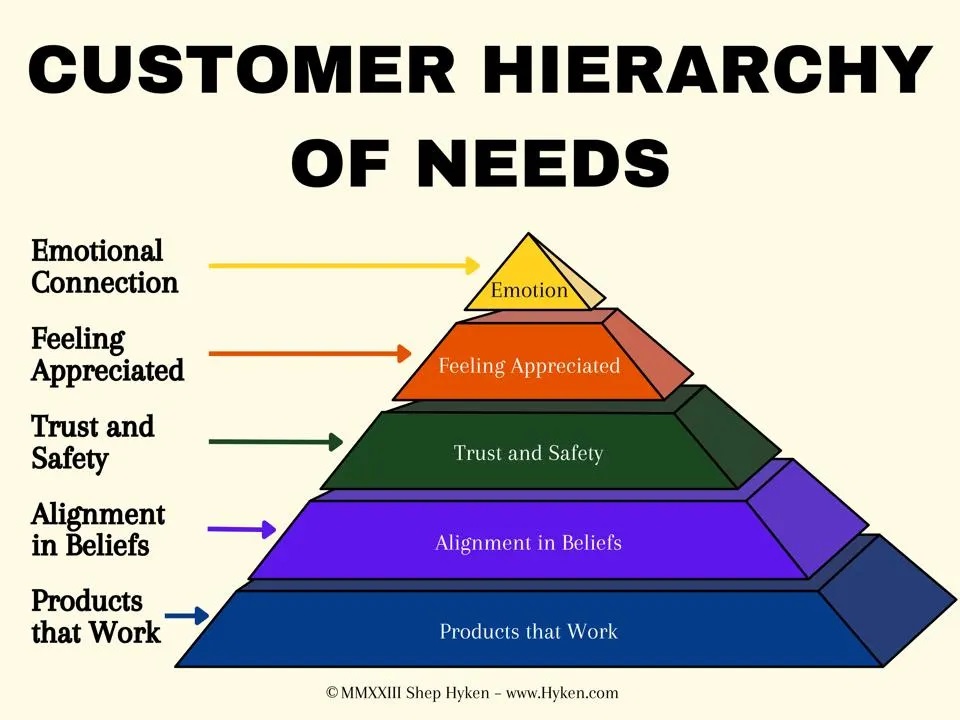
I’ve been thinking about a similar model for customers. I’m not a psychologist, and I’ve not done formal research on this idea, but I’ve been studying customer and employee experience in some form for more than 40 years. I’ve identified five areas (at least) that are important to customers when they buy from you and put them into logical order. So, here is ‘The Customer Hierarchy Of Needs’:

Customer Hierarchy of Needs

1. Products that Work – We’re starting at the bottom of the pyramid and working our way up. This is the base, and it’s simple: whatever you sell must do what you promise it will do. It doesn’t matter how great your customer service and experience (CX) are, if the product or service doesn’t work, customers will find an alternative.

2. Alignment in Beliefs – Your mission and vision statements are your beliefs. Your customers shouldn’t have to read those statements to know what they are. They should experience them when they do business with you. They will quickly learn how you treat them. If they like the experience, they align with you and what you stand for. While that can be enough, they may also enjoy doing business with you because of something that may or may not be in your mission and vision statements. That is a cause, charity or community activity your company or brand is involved with or contributes to. It adds to the emotional connection you’re trying to achieve with your customers.

3. Trust and Safety – If the company or brand has a bad reputation, getting and keeping customers will be tough. Even customers willing to take a chance may eventually experience what others have warned them about. Trust and safety belong together, but let’s first discuss trust. A sense of trust comes from different areas that can include (but are not limited to) a good reputation, positive reviews and ratings, customer-friendly policies (like easy returns), simple and friction-less processes, fast response times and friendly, helpful employees. Safety comes from assurances, including data privacy, secure websites, safe physical environments and more. Even if you have products that work—the basic need—without trust and safety, you might not be able to keep your customers past the first sale, assuming you have any at all.

4. Feeling Appreciated – Every customer willing to pay you for your goods and services deserves to feel appreciated. If you don’t acknowledge the customer with a simple thank you, they may not notice the first time. But there will be a point at which they feel underappreciated, and when they do, you put yourself at risk of losing them. Never miss an opportunity to express appreciation to your customers.

5. Emotional Connection – This is where you move customers from being satisfied to becoming loyal. Satisfied customers come back until something better comes along. Loyal customers come back because they like doing business with you and have made an emotional connection with you. They know your product works, they trust you, you make them feel confident (and safe) when engaging with you, they believe you have a good company and there may even be a cause or charity you mutually support, and every time they interact with you, they feel appreciated. At that point, your customers are feeling emotionally connected to you. Trust and appreciation are emotions. When all the boxes are ticked, you have the emotional connection that drives customer loyalty, advocacy and evangelism.

I could have written an entire article—or even a chapter in a book—on each of these five customer needs. Consider this article as a conversation starter. Perhaps you can add to this list of customer needs. Just because Maslow had five in his model doesn’t mean we are limited to that number.

Next week I’ll cover a similar concept, but instead of customers, I’ll focus on ‘The Employee Hierarchy Of Needs’. Stay tuned!

This article originally appeared on Forbes.com

Image Credits: Shep Hyken

Subscribe to Human-Centered Change & Innovation WeeklySign up here to join 17,000+ leaders getting Human-Centered Change & Innovation Weekly delivered to their inbox every week.

Are You Testing Your Intuitions?

Are You Testing Your Intuitions?

GUEST POST from Dennis Stauffer

Do you trust your intuitions? When you have a hunch, do you go with it or hold back? There’s been a long-running debate about which is the better strategy.

Some have claimed that top executives are at their best when they “go with their gut” or “follow their instincts.” They can give examples of when that’s turned out well for them. But what we don’t know is how often other intuitions may have turned out badly.

Trusting your intuitions can sometimes keep you safe. Some research has found that firefighters are well-served by their intuitions, because it helps them avoid danger. Women who are uneasy walking alone at night are advised to follow their intuitions.

That makes sense when you’re crossing a dark parking lot or at the scene of a fire. Being cautious when there might be no threat is better than being careless when there might be one. But that doesn’t mean those intuitions are accurate.

Innovators also have intuitions—and need to. Hunches about the value of an idea, or a sense of how customers will react. For an innovator, asking whether you should trust your intuitions is the wrong question. What needs to be asked instead is: How can I test my intuitions? What can I do to find out whether those feelings are reliable?

That’s one reasons innovators have a bias for action. Because acting on their ideas—in ways that will test them—is how they find out whether those ideas will work. That’s not only a more prudent approach than just following hunches; it’s excellent practice at evaluating the merits of your ideas. So over time, you become better at forming those hunches. Because you know how well it worked in the past, and maybe where you might have biases.

If you want to enhance your intuitions—and your innovativeness—don’t trust them or distrust them.

Test them.

View this post on video here if you prefer:

Image Credit: misterinnovation.com

Subscribe to Human-Centered Change & Innovation WeeklySign up here to get Human-Centered Change & Innovation Weekly delivered to your inbox every week.
Top 100 Innovation and Transformation Articles of 2023

Top 100 Innovation and Transformation Articles of 2023

2021 marked the re-birth of my original Blogging Innovation blog as a new blog called Human-Centered Change and Innovation.

Many of you may know that Blogging Innovation grew into the world’s most popular global innovation community before being re-branded as InnovationExcellence.com and being ultimately sold to DisruptorLeague.com.

Thanks to an outpouring of support I’ve ignited the fuse of this new multiple author blog around the topics of human-centered change, innovation, transformation and design.

I feel blessed that the global innovation and change professional communities have responded with a growing roster of contributing authors and more than 17,000 newsletter subscribers.

To celebrate we’ve pulled together the Top 100 Innovation and Transformation Articles of 2023 from our archive of over 1,800 articles on these topics.

We do some other rankings too.

We just published the Top 40 Innovation Bloggers of 2023 and as the volume of this blog has grown we have brought back our monthly article ranking to complement this annual one.

But enough delay, here are the 100 most popular innovation and transformation posts of 2023.

Did your favorite make the cut?

1. Fear is a Leading Indicator of Personal Growth – by Mike Shipulski

2. The Education Business Model Canvas – by Arlen Meyers

3. Act Like an Owner – Revisited! – by Shep Hyken

4. Free Innovation Maturity Assessment – by Braden Kelley

5. The Role of Stakeholder Analysis in Change Management – by Art Inteligencia

6. What is Human-Centered Change? – by Braden Kelley

7. Sustaining Imagination is Hard – by Braden Kelley

8. The One Movie All Electric Car Designers Should Watch – by Braden Kelley

9. 50 Cognitive Biases Reference – Free Download – by Braden Kelley

10. A 90% Project Failure Rate Means You’re Doing it Wrong – by Mike Shipulski

11. No Regret Decisions: The First Steps of Leading through Hyper-Change – by Phil Buckley

12. Reversible versus Irreversible Decisions – by Farnham Street

13. Three Maps to Innovation Success – by Robyn Bolton

14. Why Most Corporate Innovation Programs Fail (And How To Make Them Succeed) – by Greg Satell

15. The Paradox of Innovation Leadership – by Janet Sernack

16. Innovation Management ISO 56000 Series Explained – by Diana Porumboiu

17. An Introduction to Journey Maps – by Braden Kelley

18. Sprint Toward the Innovation Action – by Mike Shipulski

19. Marriott’s Approach to Customer Service – by Shep Hyken

20. Should a Bad Grade in Organic Chemistry be a Doctor Killer? – NYU Professor Fired for Giving Students Bad Grades – by Arlen Meyers, M.D.

21. How Networks Power Transformation – by Greg Satell

22. Are We Abandoning Science? – by Greg Satell

23. A Tipping Point for Organizational Culture – by Janet Sernack

24. Latest Interview with the What’s Next? Podcast – with Braden Kelley

25. Scale Your Innovation by Mapping Your Value Network – by John Bessant

26. Leveraging Emotional Intelligence in Change Leadership – by Art Inteligencia

27. Visual Project Charter™ – 35″ x 56″ (Poster Size) and JPG for Online Whiteboarding – by Braden Kelley

28. Unintended Consequences. The Hidden Risk of Fast-Paced Innovation – by Pete Foley

29. A Shortcut to Making Strategic Trade-Offs – by Geoffrey A. Moore

30. 95% of Work is Noise – by Mike Shipulski


Build a common language of innovation on your team


31. 8 Strategies to Future-Proofing Your Business & Gaining Competitive Advantage – by Teresa Spangler

32. The Nine Innovation Roles – by Braden Kelley

33. The Fail Fast Fallacy – by Rachel Audige

34. What is the Difference Between Signals and Trends? – by Art Inteligencia

35. A Top-Down Open Innovation Approach – by Geoffrey A. Moore

36. FutureHacking – Be Your Own Futurist – by Braden Kelley

37. Five Key Digital Transformation Barriers – by Howard Tiersky

38. The Malcolm Gladwell Trap – by Greg Satell

39. Four Characteristics of High Performing Teams – by David Burkus

40. ACMP Standard for Change Management® Visualization – 35″ x 56″ (Poster Size) – Association of Change Management Professionals – by Braden Kelley

41. 39 Digital Transformation Hacks – by Stefan Lindegaard

42. The Impact of Artificial Intelligence on Future Employment – by Chateau G Pato

43. A Triumph of Artificial Intelligence Rhetoric – Understanding ChatGPT – by Geoffrey A. Moore

44. Imagination versus Knowledge – Is imagination really more important? – by Janet Sernack

45. A New Innovation Sphere – by Pete Foley

46. The Pyramid of Results, Motivation and Ability – Changing Outcomes, Changing Behavior – by Braden Kelley

47. Three HOW MIGHT WE Alternatives That Actually Spark Creative Ideas – by Robyn Bolton

48. Innovation vs. Invention vs. Creativity – by Braden Kelley

49. Where People Go Wrong with Minimum Viable Products – by Greg Satell

50. Will Artificial Intelligence Make Us Stupid? – by Shep Hyken


Accelerate your change and transformation success


51. A Global Perspective on Psychological Safety – by Stefan Lindegaard

52. Customer Service is a Team Sport – by Shep Hyken

53. Top 40 Innovation Bloggers of 2022 – Curated by Braden Kelley

54. A Flop is Not a Failure – by John Bessant

55. Generation AI Replacing Generation Z – by Braden Kelley

56. ‘Innovation’ is Killing Innovation. How Do We Save It? – by Robyn Bolton

57. Ten Ways to Make Time for Innovation – by Nick Jain

58. The Five Keys to Successful Change – by Braden Kelley

59. Back to Basics: The Innovation Alphabet – by Robyn Bolton

60. The Role of Stakeholder Analysis in Change Management – by Art Inteligencia

61. Will CHATgpt make us more or less innovative? – by Pete Foley

62. 99.7% of Innovation Processes Miss These 3 Essential Steps – by Robyn Bolton

63. Rethinking Customer Journeys – by Geoffrey A. Moore

64. Reasons Change Management Frequently Fails – by Greg Satell

65. The Experiment Canvas™ – 35″ x 56″ (Poster Size) – by Braden Kelley

66. AI Has Already Taken Over the World – by Braden Kelley

67. How to Lead Innovation and Embrace Innovative Leadership – by Diana Porumboiu

68. Five Questions All Leaders Should Always Be Asking – by David Burkus

69. Latest Innovation Management Research Revealed – by Braden Kelley

70. A Guide to Effective Brainstorming – by Diana Porumboiu

71. Unlocking the Power of Imagination – How Humans and AI Can Collaborate for Innovation and Creativity – by Teresa Spangler

72. Rise of the Prompt Engineer – by Art Inteligencia

73. Taking Care of Yourself is Not Impossible – by Mike Shipulski

74. Design Thinking Facilitator Guide – A Crash Course in the Basics – by Douglas Ferguson

75. What Have We Learned About Digital Transformation Thus Far? – by Geoffrey A. Moore

76. Building a Better Change Communication Plan – by Braden Kelley

77. How to Determine if Your Problem is Worth Solving – by Mike Shipulski

78. Increasing Organizational Agility – by Braden Kelley

79. Mystery of Stonehenge Solved – by Braden Kelley

80. Agility is the 2023 Success Factor – by Soren Kaplan


Get the Change Planning Toolkit


81. The Five Gifts of Uncertainty – by Robyn Bolton

82. 3 Innovation Types Not What You Think They Are – by Robyn Bolton

83. Using Limits to Become Limitless – by Rachel Audige

84. What Disruptive Innovation Really Is – by Geoffrey A. Moore

85. Today’s Customer Wants to Go Fast – by Shep Hyken

86. The 6 Building Blocks of Great Teams – by David Burkus

87. Unlock Hundreds of Ideas by Doing This One Thing – Inspired by Hollywood – by Robyn Bolton

88. Moneyball and the Beginning, Middle, and End of Innovation – by Robyn Bolton

89. There are Only 3 Reasons to Innovate – Which One is Yours? – by Robyn Bolton

90. A Shortcut to Making Strategic Trade-Offs – by Geoffrey A. Moore

91. Customer Experience Personified – by Braden Kelley

92. 3 Steps to a Truly Terrific Innovation Team – by Robyn Bolton

93. Building a Positive Team Culture – by David Burkus

94. Apple Watch Must Die – by Braden Kelley

95. Kickstarting Change and Innovation in Uncertain Times – by Janet Sernack

96. Take Charge of Your Mind to Reclaim Your Potential – by Janet Sernack

97. Psychological Safety, Growth Mindset and Difficult Conversations to Shape the Future – by Stefan Lindegaard

98. 10 Ways to Rock the Customer Experience In 2023 – by Shep Hyken

99. Artificial Intelligence is Forcing Us to Answer Some Very Human Questions – by Greg Satell

100. 23 Ways in 2023 to Create Amazing Experiences – by Shep Hyken

Curious which article just missed the cut? Well, here it is just for fun:

101. Why Business Strategies Should Not Be Scientific – by Greg Satell

These are the Top 100 innovation and transformation articles of 2023 based on the number of page views. If your favorite Human-Centered Change & Innovation article didn’t make the cut, then send a tweet to @innovate and maybe we’ll consider doing a People’s Choice List for 2023.

If you’re not familiar with Human-Centered Change & Innovation, we publish 1-6 new articles every week focused on human-centered change, innovation, transformation and design insights from our roster of contributing authors and ad hoc submissions from community members. Get the articles right in your Facebook feed or on Twitter or LinkedIn too!

Editor’s Note: Human-Centered Change & Innovation is open to contributions from any and all the innovation & transformation professionals out there (practitioners, professors, researchers, consultants, authors, etc.) who have a valuable insight to share with everyone for the greater good. If you’d like to contribute, contact us.

Subscribe to Human-Centered Change & Innovation WeeklySign up here to get Human-Centered Change & Innovation Weekly delivered to your inbox every week.