Category Archives: Futurology

Exploring the Benefits of Group Foresight

Exploring the Benefits of Group Foresight

GUEST POST from Art Inteligencia

Foresight is the process of predicting the future, whether it is on an individual, organizational, or industry level. Group foresight allows multiple voices and points of view to be stimulating discussions and debates, offering valuable insights for accurate future predictions. Group foresight offers multiple benefits, which has been evident in a range of case studies.

Collaboration and Critical Thinking

The first benefit of group foresight is that it encourages collaboration and critical thinking. This is important to breaking into new areas of analysis, as different perspectives and ideas can open a new dialogue on a particular topic. In a case study conducted by the University of Dayton, faculty leaders explored possible scenarios for their university’s future. The group was asked to explore the various diverse University contexts, such as the changing student demographics and the regulatory environment, among other things. Through a facilitated discussion among the participants, a collective vision for the University’s future was created, which was later implemented in the University’s strategic plan.

Understanding the External Environment

The second benefit of group foresight is that it creates an understanding of the external environment. This is especially important in industries like finance, which are under constant market fluctuation and change. Group foresight can provide a platform for discerning underlying trends in the market and seeing their potential impact on the organization’s future. In a case study conducted by the Foresight Team of the Bank of Australia, the team organized a series of workshops, where different stakeholders were invited to explore future scenarios and analyze their potential impacts. These workshops allowed the participants to gain an insight into the future of the market and the industry, thus enabling the Bank to better position itself in this constantly changing environment.

Conclusion

Group foresight is a valuable tool for organizations and businesses looking to take a deeper dive into the future. By encouraging collaboration and critical thinking, as well as understanding the external environment, group foresight provides insights on how to create and implement successful plans. These benefits are evident from a range of case studies, making it a valuable tool for any organization looking towards the future.

Bottom line: Futurology is not fortune telling. Futurists use a scientific approach to create their deliverables, but a methodology and tools like those in FutureHacking™ can empower anyone to engage in futurology themselves.

Image credit: Pixabay

Subscribe to Human-Centered Change & Innovation WeeklySign up here to get Human-Centered Change & Innovation Weekly delivered to your inbox every week.

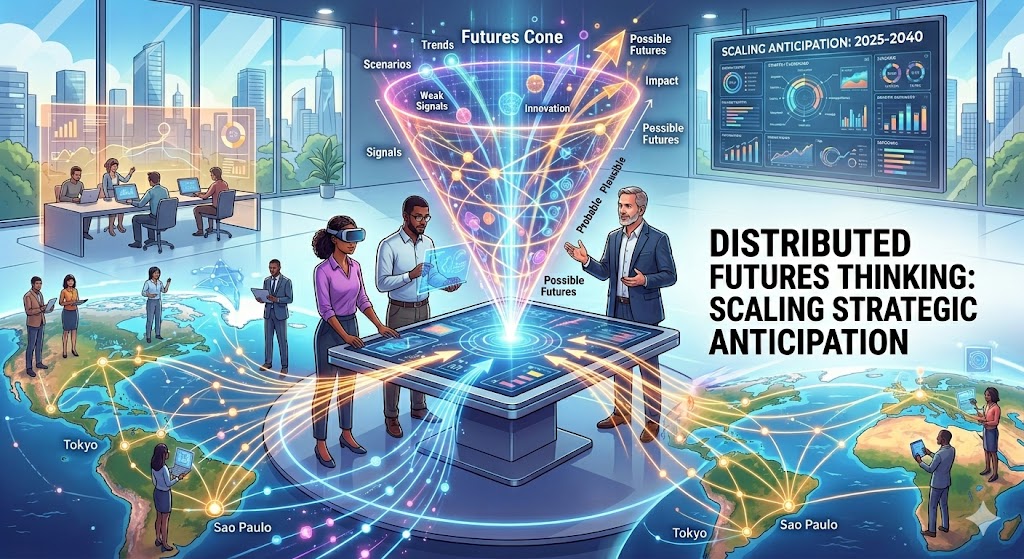
Distributed Futures Thinking – Scaling Strategic Anticipation

LAST UPDATED: April 16, 2026 at 2:21 PM

Distributed Futures Thinking - Scaling Strategic Anticipation

GUEST POST from Chateau G Pato


The Fallacy of the Lone Futurist

For decades, corporate foresight has been treated as an elite, cloistered exercise. Organizations typically tuck their “Futurists” into isolated strategy departments or high-level innovation labs, tasking them with predicting the next decade from the comfort of a boardroom. However, in an era defined by radical volatility and hyper-connectivity, this centralized model has become a dangerous bottleneck.

The reality of modern business is that change does not arrive in a single, predictable wave; it emerges as a series of “weak signals” scattered across disparate geographies, departments, and customer touchpoints. When foresight is siloed, the organization loses its peripheral vision. We can no longer afford “Foresight as a Function” — a niche service provided by the few to the many.

To survive, we must transition toward “Anticipation as a Culture.” This means moving the responsibility of future-gazing out of the executive suite and into the hands of the frontline employees who interact with customers, the engineers seeing technical friction, and the designers observing shifting human behaviors.

“The future is already here — it’s just not evenly distributed. To see it, you must distribute your ability to look.”

Distributed Futures Thinking is the framework for this democratization. By scaling strategic anticipation, we transform a static organization into a living sensor network, capable of not only seeing the future coming but having the collective agility to design it.

The Architecture of Distributed Thinking

Scaling anticipation requires more than just a change in mindset; it requires a structural redesign of how information flows through an organization. We must move away from top-down directives and toward a human-centered architecture that treats every employee as a vital node in a collective intelligence network.

Human-Centered Foresight

Strategic anticipation is often mistaken for cold data analysis. In reality, the most impactful shifts are rooted in human behavior and unmet needs. By applying experience design principles to futurology, we look past the “what” of a trend to understand the “why.” When foresight starts with empathy, it becomes actionable. It allows us to design futures that people actually want to inhabit, rather than simply reacting to technological inevitabilities.

The Sensor Network: Scaling Signal Detection

The frontline is your greatest diagnostic tool. A salesperson in Southeast Asia or a customer success lead in London will notice a shift in sentiment months before it appears in a quarterly report. By distributing the “sensor” function, we create a wide-angle lens for the organization. This network detects “weak signals” — small, seemingly local disruptions that have the potential to scale into industry-wide sea changes.

The Power of Cognitive Diversity

The greatest enemy of foresight is groupthink. When a homogeneous leadership team imagines the future, they often recreate a slightly shinier version of the present. Distributed futures thinking intentionally leverages cognitive diversity — gathering perspectives across different cultures, age groups, and professional disciplines. This variety acts as a natural stress-test for our assumptions, ensuring that our strategic scenarios are robust enough to survive reality.

By democratizing access to these insights, we don’t just predict the future; we create a shared mental map that allows the entire organization to move in sync when the environment shifts.

Scaling the Toolkit: The “How” of Democratized Foresight

The primary barrier to scaling futures thinking is often the perceived complexity of the methodology. To move from a handful of experts to an entire organization of “anticipators,” we must strip away the academic jargon and provide modular, intuitive frameworks that empower teams to act autonomously.

Modular Frameworks for the Masses

Traditional tools like STEEP (Social, Technological, Economic, Environmental, and Political analysis) are powerful but often feel like homework. We reframe these as “Lens Kits” — simple prompts that encourage employees to view their daily work through different horizons. By standardizing the language of Scenario Planning, we enable a marketing manager and a software engineer to collaborate on a “What If?” exercise using the same conceptual shorthand.

“Always-On” Curiosity over Periodic Planning

Strategy is too often a “once-a-year” event. Distributed futures thinking replaces the annual retreat with continuous scanning. Through digital collaboration platforms and internal “signal repositories,” we create a cultural habit of sharing observations in real-time. This turns the organization into a living laboratory where insights are crowdsourced and validated continuously, rather than waiting for a consultant’s report.

Experience Design: Prototyping the Future

Data rarely changes minds; experiences do. This is where experience design becomes the secret weapon of strategic anticipation. We move beyond white papers and create “Future Artifacts” — tangible or digital prototypes that represent a specific scenario. Whether it’s a mockup of a 2030 bank statement or a video of a futuristic customer journey, these artifacts make abstract possibilities feel visceral.

“If you can’t feel the future, you won’t prepare for it. We must design the evidence of tomorrow to spark the decisions of today.” — Braden Kelley

When teams can “touch” a potential future, the strategic implications become clear. It bridges the gap between high-level theory and boots-on-the-ground innovation, ensuring that anticipation leads directly to designing better human experiences.

Overcoming Institutional Inertia

Even with the best tools in place, the greatest threat to distributed futures thinking is the gravity of the “now.” Most organizations are optimized for the present, creating a natural resistance to any signal that threatens current business models or operational efficiencies.

The “Present Bias” Trap

The tyranny of the urgent — driven by quarterly results and immediate KPIs — often suffocates long-term thinking. To scale anticipation, we must adjust the incentive structures. This means rewarding teams not just for hitting today’s targets, but for identifying the disruptions that will make those targets irrelevant tomorrow. We have to make it safe to look up from the grindstone.

Psychological Safety and the “Wild Card”

Innovation dies in environments where being “wrong” is penalized. Distributed foresight requires high levels of psychological safety. If an employee spots a radical shift — a “wild card” event — they must feel empowered to share it without fear of being labeled a distraction. A culture of strategic anticipation treats every outlier as a potential opportunity rather than a nuisance.

The Power of Narrative: Bridging the Gap

Facts and figures are easily dismissed; stories are not. To overcome inertia, we use strategic storytelling to connect future scenarios to today’s reality. By crafting compelling narratives about how our customers’ lives will change, we transform “change” from a threat into a shared mission. We don’t just present a report; we tell the story of our future relevance.

“The hardest part of looking forward is letting go of the certainty of today. Narrative is the bridge that carries the team across that gap.” — Braden Kelley

By addressing these cultural and psychological barriers, we ensure that distributed thinking doesn’t just result in a collection of ideas, but in a fundamental shift in organizational behavior.

From Anticipation to Agility: Closing the Loop

Anticipation without action is merely a daydream. The true value of Distributed Futures Thinking lies in its ability to influence the “now.” Once we have democratized the sensing of signals, we must create clear pathways for those insights to penetrate our operational DNA.

Closing the Insight Loop

For a distributed network to remain motivated, contributors must see their observations translated into tangible outcomes. This requires a formal “Insight-to-Action” pipeline. Whether it’s a small UX tweak based on an emerging behavior or a pivot in the R&D roadmap, the link between a detected signal and an organizational response must be visible and rapid. This feedback loop transforms passive observation into active innovation.

Adaptive Strategy: Strategic Wayfinding

The era of the rigid “Five-Year Plan” is over. In its place, we adopt Strategic Wayfinding — a dynamic approach where strategy is treated as a continuous hypothesis. As new signals are fed into the system from the distributed network, the organization adjusts its course in real-time. This doesn’t mean changing your vision every week; it means being agile enough to change your tactics to reach that vision as the landscape shifts.

Case Studies in Scaled Anticipation

We see this model succeeding in organizations that have decentralized their decision-making.

  • Global Tech Leaders: Companies that utilize internal “prediction markets” to crowdsource the probability of project success or market shifts.
  • Decentralized NGOs: Organizations that empower field workers to act as primary sensors, allowing them to pivot disaster relief efforts before centralized data even hits the dashboard.

When anticipation is distributed, agility becomes a byproduct of awareness. The organization stops reacting to the future and starts moving with it, maintaining a constant state of readiness that competitors simply cannot match.

Conclusion: Designing the Future Together

The future is not a destination we reach; it is a manifestation of the collective choices we make today. When we move beyond the “Lone Futurist” model and embrace Distributed Futures Thinking, we do more than just improve our forecasting — we upgrade our organizational consciousness.

The Call to Collective Intent

Strategic anticipation is the ultimate human-centered endeavor. By empowering every individual within an organization to look forward, we foster a sense of agency and purpose. No longer are employees merely cogs in a machine reacting to external shocks; they become active architects of a shared destiny. This shift in mindset is what separates the legacy companies that fade away from the enduring icons that redefine their industries.

“Innovation is everyone’s job, and so is the future. If you aren’t scaling your vision, you’re narrowing your horizon.”

Final Thought: Anticipation as Survival

In a world of exponential change, the ability to see around corners is no longer a luxury — it is a survival trait. Organizations that democratize foresight will be the ones that navigate uncertainty with confidence and design experiences that truly resonate with the evolving human spirit. The tools are available, the frameworks are ready; all that remains is the courage to trust your people with the future.

Let’s stop trying to predict the future and start designing it — together.

Frequently Asked Questions

What is Distributed Futures Thinking?

Distributed Futures Thinking is a strategic framework that moves foresight out of isolated boardrooms and into the hands of every employee. It transforms an organization into a collective sensor network to detect “weak signals” of change in real-time.

How does it differ from traditional strategic planning?

Unlike traditional planning, which often relies on annual reports and top-down directives, distributed anticipation is “always-on.” It focuses on human-centered signals and cognitive diversity to create a dynamic “Strategic Wayfinding” approach rather than a rigid five-year plan.

Who should lead the effort of scaling anticipation?

While the initiative often begins with innovation or strategy leaders, the goal is democratization. A human-centered change leader facilitates the process by providing modular toolkits, ensuring psychological safety, and fostering a culture of continuous curiosity across all departments.

Image credit: Google Gemini

Subscribe to Human-Centered Change & Innovation WeeklySign up here to get Human-Centered Change & Innovation Weekly delivered to your inbox every week.

The Role of Big Data in Futures Research

The Role of Big Data in Futures Research

GUEST POST from Chateau G Pato

As research evolves and the greater digital age becomes more and more defined by its vastness and capabilities, so too does the way in which research is conducted. No longer are questionnaires, question prompts, and surveys considered to be the only methods scientists have to delve into the future of their chosen discipline, Gathered and collated data has become commonplace, and the big data analytics and insights that come along with this have allowed the research community to unravel the complexities associated with future forecasting. Here, we explore the role of big data in futures research.

In order for scientists to determine what the future may hold in any given field, they rely heavily on the available information that has been gathered from various sources and third-party data centers. This type of data, commonly referred to as “Big Data”, provides researchers with analytical capabilities, the ability to identify trends, and the capacity to draw accurate conclusions regarding future trends.

Big data can be found in virtually all fields, from healthcare to marketing and finance. With advancements in technology, researchers can gather, store, and analyze large amounts of data much more quickly than ever before. Additionally, the advancements in artificial intelligence have allowed researchers to embed algorithms into their analysis to develop more accurate trend predictions for the future.

Case Study 1 – Atlantic Council’s Global Futures Exchange

A great example of this is the work being done by the Atlantic Council’s Global Futures Exchange. This particular project has seen several big data initiatives implemented, such as machine learning algorithms and natural language processing to help it accurately predict future trends in global affairs. By analyzing massive amounts of data related to climate change, geopolitics, terrorism, and more, researchers can better prepare themselves for what the future may hold in a given field.

Case Study 2 – Pacific Institute for Research and Evaluation (PIRE)

Another great example of the role of big data in futures research is the work done by the Pacific Institute for Research and Evaluation (PIRE). This organization has been able to leverage big data to create a predictive model that helps inform their decision making and future forecasts. PIRE uses these models to generate forecasts related to various factors such as the global economy, risk management, and energy efficiency. Using predictive analytics, they were able to identify potential areas of risk before they became issues and equipped themselves with the necessary resources to combat them before they become serious.

Conclusion

It’s clear to see that big data and the insights it provides are becoming increasingly important to futures research. This type of data provides researchers with much more accurate and timely results, enabling them to increase the efficiency of their research. With big data analytics, scientists are now presented with the opportunity to use predictive analytics to identify potential trends and outcomes before they become a reality. By leveraging the power of big data, researchers are more prepared to better understand the future and what it holds in their respective fields.

Bottom line: Futurology is not fortune telling. Futurists use a scientific approach to create their deliverables, but a methodology and tools like those in FutureHacking™ can empower anyone to engage in futurology themselves.

Image credit: Pixabay

Subscribe to Human-Centered Change & Innovation WeeklySign up here to get Human-Centered Change & Innovation Weekly delivered to your inbox every week.

Using Technology to Predict and Prepare for Shifting Consumer Trends

Using Technology to Predict and Prepare for Shifting Consumer Trends

GUEST POST from Chateau G Pato

In the current consumer-driven market, it is becoming increasingly crucial for businesses to stay ahead of customer demands and stay informed on the emergence of new trends. By utilizing the vast possibilities of modern technology, businesses can easily access customer data, comprehend rapidly changing consumer trends, and optimize their profits. Adopting these readily available solutions in advance can help businesses rise above their competitors and meet customers’ needs in a timely manner.

Businesses have an unlimited number of methods to apply in their market research. One of the essential approaches is identifying shifts in consumer trends by leveraging predictive analysis and machine learning algorithms. This modern method makes use of large amounts of customer data and provides customers with personalized packages that best satisfy their requirements. On the other hand, advanced analytics and automation technology make it possible for businesses to rapidly process customer feedback and anticipate the requirements of their target demographic.

Case Study 1: Walmart

Walmart has successfully implemented predictive analytics and automation technology into their business strategy to anticipate customer needs and make their operations run more efficiently. By collecting data from customer interactions, transactions, and sales, Walmart is able to detect changes in consumer behavior and use those insights to optimize their store layout and product selection. Automation tools are also used to manage responses to customer queries quickly, streamline supply chain operations, and deliver accurate customer service.

Case Study 2: Amazon

Amazon has also successfully utilized technology to predict and prepare for shifting consumer trends. By combining predictive analytics and machine learning algorithms, Amazon can use customer data to anticipate customer needs and provide tailored recommendations to match those needs. Amazon also uses automation technology to ensure its internal processes run as smoothly as possible, from inventory control to shipping and delivery.

Conclusion

Businesses have a vast array of tools at their disposal to accurately analyze and predict consumer trends. These technologies allow businesses to remain in tune with the rapidly shifting demands of customers and optimize their operations accordingly. By utilizing the power of predictive analytics and automation, businesses can stay one step ahead of the competition and ensure they are delivering the best possible experience for their customers.

Bottom line: Futurology is not fortune telling. Futurists use a scientific approach to create their deliverables, but a methodology and tools like those in FutureHacking™ can empower anyone to engage in futurology themselves.

Image credit: Pixabay

Subscribe to Human-Centered Change & Innovation WeeklySign up here to join 17,000+ leaders getting Human-Centered Change & Innovation Weekly delivered to their inbox every week.

The Impact of Technology on Futures Research

The Impact of Technology on Futures Research

GUEST POST from Art Inteligencia

Technology has been a game changer in the world of futures research. In the past, futurists had to rely on slow and manual processes to analyze data and make predictions. But with the advent of advanced technologies such as artificial intelligence (AI) and machine learning (ML), the process has become much more efficient and accurate. In this article, we’ll explore the impact of technology on futures research and provide two case studies to illustrate the point.

Case Study 1 – Artificial Intelligence (AI) and Machine Learning (ML)

The first example of technology’s impact on futures research is the use of AI and ML. These technologies allow researchers to analyze large amounts of data quickly and accurately. AI and ML can identify patterns and trends that may have been difficult to spot in the past. This makes it easier for futurists to make predictions about the future. For instance, AI and ML can be used to analyze stock market data and predict market movements. This can be invaluable to investors and traders who want to make informed decisions about their investments.

Case Study 2 – Big Data

The second case study involves the use of big data. Big data is a term used to refer to extremely large datasets that are difficult to process using traditional methods. Big data can be used by futurists to gain insights into a wide variety of topics, such as consumer behavior, economic trends, and the impact of technological developments. For example, by analyzing big data, futurists can make predictions about how emerging technologies may shape the future.

Conclusion

As these two examples illustrate, technology has had a profound impact on the field of futures research. By leveraging AI and ML, big data, and other advanced technologies, futurists can now make more accurate predictions about the future. This can be invaluable to businesses and investors who want to make informed decisions about their investments. In short, technology has revolutionized the field of futures research and is only going to become more important as new technologies continue to emerge.

Bottom line: Futurists are not fortune tellers. They use a formal approach to achieve their outcomes, but a methodology and tools like those in FutureHacking™ can empower anyone to be their own futurist.

Image credit: Pexels

Subscribe to Human-Centered Change & Innovation WeeklySign up here to get Human-Centered Change & Innovation Weekly delivered to your inbox every week.

Building Collective Foresight, Not Just Executive Foresight

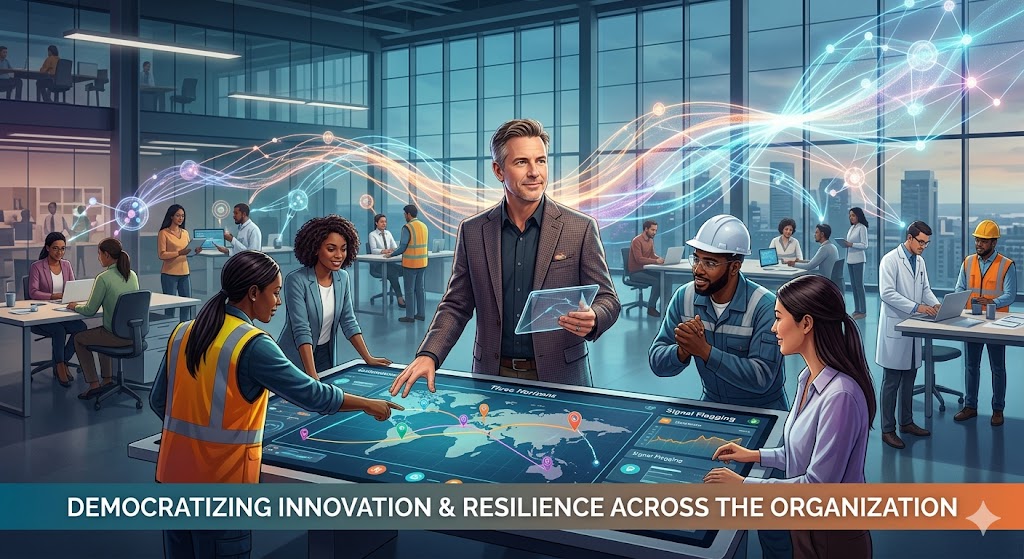
Democratizing Innovation & Resilience Across the Organization

LAST UPDATED: April 6, 2026 at 7:13 PM

Building Collective Foresight, Not Just Executive Foresight

GUEST POST from Chateau G Pato


I. Introduction: The Strategic Blind Spot

For decades, the corporate world has operated under the “Crystal Ball” Fallacy—the belief that foresight is a rarefied skill reserved exclusively for the C-suite or a handful of elite strategists. This centralized approach assumes that those at the top have a clearer view of the horizon, but in a world defined by volatility and rapid shifts, this perspective is often too narrow and too distant from the ground floor.

In today’s landscape, centralized foresight has become a strategic bottleneck. As the speed of change accelerates, a small group of executives cannot possibly process every “weak signal” emerging from the fringes of technology, customer behavior, and global markets. When the ability to anticipate is trapped in the boardroom, the rest of the organization remains reactive, waiting for instructions rather than actively sensing the environment.

The core thesis of this shift is simple but profound: True organizational resilience does not come from a single “visionary” leader. Instead, it is built by developing a distributed “anticipatory muscle” across the entire workforce. To thrive, we must move beyond executive foresight and embrace Collective Foresight, turning every employee into a sensor for the future.

II. Why Executive Foresight Fails in Isolation

While executive leadership is essential for setting direction, relying solely on top-down foresight creates significant organizational vulnerabilities. When the responsibility for “seeing the future” is restricted to a small group, several critical failure points emerge:

The Echo Chamber Effect

Executives often operate within high-level strategic bubbles. This distance can lead to cognitive bias, where leaders prioritize data that confirms their existing worldview while missing “weak signals” that emerge from the front lines. Those closest to the customer and the technology—the engineers, sales reps, and support staff—often see the cracks in a business model months or years before they appear on a boardroom spreadsheet.

Implementation Friction

A common pitfall of executive-led foresight is the “not invented here” syndrome. When a vision is handed down from on high without broader involvement, it often meets cultural resistance. People naturally support what they help create; by excluding the workforce from the foresight process, organizations miss the opportunity to build the intellectual buy-in necessary for rapid pivots.

The Fragility of Linearity

Executive foresight frequently relies on historical data and linear projections—essentially looking through the rearview mirror to steer forward. Collective foresight, however, leverages diverse, lived experiences. This cognitive diversity is better equipped to spot non-linear shifts and “black swan” events because it draws from a wider variety of mental models and external touchpoints.

Key Insight: Foresight is not a product to be delivered; it is a capability to be distributed. When anticipation is isolated at the top, the organization loses its ability to react in real-time.

III. The Architecture of Collective Foresight

Building a collective foresight capability requires more than just an open-door policy; it requires a structured framework that captures, filters, and synthesizes insights from every corner of the organization. This architecture transforms individual observations into organizational intelligence.

Human-Centered Input: From Data to Insight

While big data provides the “what,” your people provide the “why.” Collective foresight focuses on insight-mining—systematically gathering observations from employees who occupy the “edge” of the organization. These individuals interact with shifting customer frustrations, emerging competitor tactics, and technological friction points daily. By treating every employee as a human sensor, the organization gains a high-resolution view of the market that no dashboard can replicate.

The Three Horizons Model (Revisited)

In a collective framework, the Three Horizons model serves as a collaborative language for innovation rather than just a reporting tool for leadership:

  • Horizon 1: Optimization. The entire workforce identifies ways to improve and defend the current core business.
  • Horizon 2: Evolution. Cross-functional teams explore adjacent opportunities and “next-generation” versions of current offerings.
  • Horizon 3: Revolution. A diverse group of “pathfinders” from different levels identifies disruptive possibilities that could render the current model obsolete.

Diversity as a Strategic Filter

The greatest defense against strategic blind spots is cognitive diversity. The architecture of collective foresight intentionally brings together disparate viewpoints—marketing, engineering, HR, and finance—to stress-test assumptions. When people with different mental models look at the same trend, they see different risks and opportunities. This friction is exactly what produces a robust, multi-dimensional view of the future.

By democratizing access to these frameworks, the organization shifts from a culture of “waiting for instructions” to a culture of active anticipation.

IV. Tools for Democratizing Anticipation

To move from the theory of collective foresight to a functional reality, organizations must provide the infrastructure that allows insights to flow freely. The goal is to lower the barrier to entry so that “sensing the future” becomes a natural byproduct of daily work. Here are the essential tools for democratizing anticipation:

Crowdsourced Trend Scouting

Rather than relying on expensive, static annual reports, forward-thinking organizations implement internal signal-flagging platforms. These are digital spaces where any employee—from the warehouse to the sales floor—can post a “signal”: a new competitor product, a strange customer request, or a niche technological development. By tagging and aggregating these signals, patterns emerge that would be invisible to a centralized strategy team.

Scenario Planning Workshops

Foresight is a muscle that requires regular exercise. Collective scenario planning involves moving away from “telling the future” and toward “practicing the future.” Using cross-functional roleplay and “pre-mortems,” teams can explore “What If?” scenarios together. This creates a shared mental map of potential disruptions, ensuring that if a crisis or opportunity hits, the organization has already mentally rehearsed its response.

Innovation Gamification

To drive engagement, organizations can utilize internal prediction markets or incentive structures. By gamifying the spotting of significant market shifts or technological milestones, you tap into the collective intelligence of the crowd. This doesn’t just generate data; it cultivates a culture of curiosity where employees feel that their unique perspective on the horizon is both valued and rewarded.

FutureHacking™: A Framework for Collective Anticipation

To move beyond mere observation, organizations can employ Braden Kelley’s FutureHacking™ methodology that helps any employee or entrepreneur become their own futurist. This human-centered approach focuses on identifying and analyzing “weak signals”—those subtle indicators of change that are often ignored by traditional strategic planning. By engaging the entire workforce in this process, FutureHacking™ transforms foresight from a static report into a dynamic, ongoing capability. It empowers individuals at every level to look beyond the immediate horizon, challenge existing assumptions, and actively design the future rather than simply reacting to it. This methodology ensures that innovation isn’t just a localized event, but a continuous, organization-wide practice of sensing and responding to the next big shift.

By equipping the workforce with these tools, foresight shifts from a mysterious executive ritual into a transparent, participatory process that builds organizational agility from the ground up.

V. Overcoming the Cultural Barriers

The primary obstacles to collective foresight are rarely technological; they are cultural. Transitioning from a top-down visionary model to a distributed sensing model requires a fundamental shift in how an organization values information and handles dissent.

Psychological Safety: The Bedrock of Foresight

For collective foresight to function, employees must feel safe to share “uncomfortable” truths. If a culture punishes those who point out the obsolescence of a flagship product or the rise of a disruptive competitor, the organization’s early warning system will go silent. Building psychological safety ensures that contrarian views are viewed as strategic assets rather than signs of disloyalty.

The “Not My Job” Syndrome

Foresight is often viewed as an “extra” task that sits outside an employee’s core responsibilities. To overcome this, organizations must redefine foresight as a core competency for every role. Whether in HR, finance, or operations, understanding how the future might impact one’s specific domain is essential for long-term excellence. We must move from the idea of a “Strategy Department” to a “Strategy Culture.”

Incentivizing Curiosity

Most corporate structures are designed to reward execution and efficiency—doing today’s job better. However, collective foresight requires exploration. To bridge this gap, leadership must find ways to celebrate and reward the “scouts” within the company. This means recognizing not just the success of a project, but the value of the insight that prevented a failure or identified a new path forward.

Reframing the Goal: The objective is to shift the internal narrative from “knowing the answer” to “asking the right questions.”

VI. Conclusion: From Prediction to Preparedness

The ultimate goal of fostering collective foresight is not to turn every employee into a fortune teller. It is to move the organization from a posture of prediction to one of preparedness. In a world of constant flux, being “right” about the future is often a matter of luck; being “ready” for multiple futures is a matter of design.

The Shift in Mindset

When foresight is democratized, the internal narrative shifts. It is no longer about following a fixed five-year plan set by the board; it is about maintaining a living, breathing map of possibilities. This shift ensures that the organization remains agile, capable of pivoting not because it was told to, but because it saw the turn in the road coming from a mile away.

The Competitive Advantage

Organizations that master collective foresight move faster than their competitors. This isn’t just because they have better information, but because the “why” of a pivot is already understood at every level of the company. When change is co-created, the friction of implementation evaporates. Strategy becomes a conversation, and innovation becomes a shared responsibility.

Final Call to Action: Stop looking for a crystal ball in the executive suite. Your most powerful early warning system is already on your payroll. Empower your people, build the infrastructure for their insights to reach the surface, and remember: The future is too big for one room to hold.

Frequently Asked Questions

What is the difference between executive foresight and collective foresight?

Executive foresight relies on a small group of leaders to predict the future, often creating bottlenecks and missing “weak signals.” Collective foresight democratizes this process, leveraging the diverse perspectives of the entire workforce to build a more responsive, distributed “anticipatory muscle.”

How can an organization start building collective foresight?

It begins by creating psychological safety and implementing simple tools like signal-flagging platforms. By encouraging employees at all levels to share observations about market shifts or customer friction, foresight moves from a boardroom ritual to a core organizational competency.

Why is cognitive diversity important for strategic planning?

Cognitive diversity acts as a filter against executive bias. When people from different departments—like engineering, sales, and HR—examine the same trend, they identify different risks and opportunities, resulting in a more robust and realistic view of potential futures.

Image credits: Gemini

Subscribe to Human-Centered Change & Innovation WeeklySign up here to join 17,000+ leaders getting Human-Centered Change & Innovation Weekly delivered to their inbox every week.

How Futures Research Can Help Organizations Develop Long-Term Strategies

How Futures Research Can Help Organizations Develop Long-Term Strategies

GUEST POST from Art Inteligencia

The development of long-term strategies is a key element of success for any organization, but it can be a difficult process. Futures research is a powerful tool that can help organizations understand the future and develop strategies that are based on current and future trends. This article will explore how organizations can use futures research to develop long-term strategies and provide two case study examples of organizations that have successfully used futures research.

Futures research, also known as strategic foresight or scenario analysis, is an interdisciplinary approach that combines elements of social science and technology to explore possible future scenarios. It involves using a variety of methods and tools to evaluate the impact of existing and emerging trends on an organization. This approach can help organizations identify potential opportunities and threats, assess risks, and develop strategies to navigate an uncertain future.

Organizations can use futures research to develop long-term strategies in a variety of ways. Firstly, it can be used to identify potential future trends that may impact the organization’s operations and strategies. This can include identifying demographic trends, technological advances, and global events that may affect the organization. Secondly, futures research can be used to develop scenarios that explore how different trends may interact with each other and shape the organization’s future. These scenarios can help the organization understand the potential risks and opportunities associated with each possible future. Finally, futures research can be used to identify strategies that can help the organization navigate the future.

To illustrate how futures research can help organizations develop long-term strategies, here are two case studies of organizations that have successfully used this approach.

Case Study 1

The first case study is of the City of Melbourne, Australia. The city council used futures research to develop a 20-year vision and strategic plan that focused on creating a vibrant, sustainable, and prosperous city. The council used a variety of methods to identify future trends and assess their impact on the city. They developed scenarios that explored different possible futures, and identified strategies to help the city adapt and thrive in the face of these emerging trends. As a result, the city council was able to develop a comprehensive long-term plan that addressed the challenges and opportunities of the future.

Case Study 2

The second case study is of the US Navy. The Navy used futures research to develop a strategy to identify emerging technologies and develop new capabilities that could be used to protect US interests. The Navy used a variety of methods, including scenario planning and trend analysis, to identify potential technological advances and assess their impact on naval operations. As a result, the Navy was able to develop a long-term strategy that focused on developing new capabilities and technologies to ensure the Navy’s continued success.

Conclusion

These two case studies demonstrate how futures research can be used to develop long-term strategies. By using a variety of methods and tools to identify future trends and assess their impact on an organization, futures research can help organizations develop strategies that are based on current and future trends. This approach can help organizations prepare for the future and ensure their long-term success.

Bottom line: Futurists are not fortune tellers. They use a formal approach to achieve their outcomes, but a methodology and tools like those in FutureHacking™ can empower anyone to be their own futurist.

Image credit: Pexels

Subscribe to Human-Centered Change & Innovation WeeklySign up here to get Human-Centered Change & Innovation Weekly delivered to your inbox every week.

How to Use Futurology to Make More Accurate Predictions About the Future

How to Use Futurology to Make More Accurate Predictions About the Future

GUEST POST from Art Inteligencia

Futurology is the practice of using data and analysis to make predictions about future events and trends. It is an important tool for businesses, governments, and individuals in order to make more informed decisions. Futurology can help us better prepare for potential challenges and opportunities that may arise in the future. By using futurology, we can better understand the forces driving change in our world and make more accurate predictions about what lies ahead.

Case Study 1: Autonomous Vehicles

Futurology has been used to make predictions about the rise of autonomous vehicles, such as self-driving cars. Autonomous vehicles are expected to revolutionize our transportation systems, as well as our daily lives. The use of futurology has enabled researchers to predict how autonomous vehicles will impact our economy, public safety, and the environment. For example, futurology has been used to project that the use of autonomous vehicles could reduce the number of fatal car accidents by up to 90%. Furthermore, futurology has been used to estimate the potential economic benefits of autonomous vehicles, such as increased efficiency and reduced emissions.

Case Study 2: Artificial Intelligence

Futurology has also been used to make predictions about the rise of artificial intelligence (AI). AI is expected to have a major impact on our lives, as AI-based technologies become more commonplace. Futurology has been used to project the potential economic, social, and ethical implications of this new technology. For example, futurology has been used to predict potential job losses due to automation, as well as potential increases in inequality due to the introduction of AI-powered algorithms. Additionally, futurology has been used to anticipate the potential ethical issues which may arise from the development of AI, such as privacy concerns and algorithmic bias.

Conclusion

Futurology is an invaluable tool for making more accurate predictions about the future. By using futurology, we can better understand the forces driving change in our world and make better decisions about the future. Examples of how futurology has been used to make predictions about autonomous vehicles and artificial intelligence demonstrate the potential of this powerful tool.

Bottom line: Futurists are not fortune tellers. They use a formal approach to achieve their outcomes, but a methodology and tools like those in FutureHacking™ can empower anyone to be their own futurist.

Image credit: Pixabay

Subscribe to Human-Centered Change & Innovation WeeklySign up here to get Human-Centered Change & Innovation Weekly delivered to your inbox every week.

Forecasting Innovation Blockers Before They Happen

LAST UPDATED: March 27, 2026 at 3:17 PM

Forecasting Innovation Blockers Before They Happen

GUEST POST from Art Inteligencia


Section I: The High Cost of Reactive Innovation

In the modern landscape of human-centered innovation, the most dangerous phrase an organization can utter is: “We’ll cross that bridge when we come to it.” In the realm of innovation, by the time you reach the bridge, it is often already washed out by the torrents of organizational inertia and legacy thinking.

The Innovation Illusion

Many leaders mistake firefighting for innovation management. They wait for a project to stall, for a budget to be frozen, or for cultural resistance to peak before they intervene. This reactive stance creates an “Innovation Illusion” — the false belief that because we are solving problems, we are moving forward. In reality, we are merely exhausting our best talent by forcing them to navigate a gauntlet that should have been cleared weeks or months in advance.

“True innovation leadership isn’t about having the best ideas; it’s about architecting the path so those ideas can actually survive the journey.” — Braden Kelley

The Hidden Tax: Innovation Theater

When blockers are addressed only after they manifest, the organization pays a heavy “Hidden Tax.” This manifests as:

  • Velocity Atrophy: The slow death of momentum that turns a breakthrough concept into a multi-year slog.
  • Talent Hemorrhaging: High-potential employees leaving because they are tired of fighting the “corporate immune system.”
  • Innovation Theater: A state where plenty of sticky notes and workshops exist, but zero tangible value reaches the customer because the “blockers” were baked into the process from the start.

The Strategic Pivot: Proactive Forecasting

To move beyond this, we must adopt a future-ready stance. Forecasting innovation blockers isn’t about being pessimistic; it’s about radical realism. It requires us to look at our organizational DNA — our hierarchy, our incentives, and our history — and predict exactly where the friction will occur. By identifying these hurdles during the design phase rather than the execution phase, we transform innovation from a series of lucky breaks into a repeatable, sustainable discipline.

Section II: Mapping the Ecosystem of Resistance

To forecast blockers, we must first understand that they are rarely random. Resistance is a byproduct of a system doing exactly what it was designed to do: maintain equilibrium. In a human-centered innovation framework, we categorize these friction points into four distinct pillars that form the “Corporate Immune System.”

The Four Pillars of Resistance

  • Structural Blockers: These are the “hard” barriers built into the org chart. They include misaligned KPIs — where a manager is incentivized for efficiency while the innovation team needs experimentation — and budgetary silos that prevent cross-departmental resource sharing.
  • Cultural Blockers: The “soft” barriers that are often the hardest to break. Watch for the “Not Invented Here” syndrome and a lack of psychological safety, where employees fear that a failed experiment equals a failed career.
  • Technical & Resource Blockers: Innovation often dies on the vine because of legacy debt. If your new digital solution requires an API that the current infrastructure can’t support, the blocker was predictable before the first line of code was written.
  • Operational Blockers: This includes bureaucratic friction like rigid procurement cycles. When it takes six months to approve a $500 software subscription for a pilot, the system has effectively blocked innovation.

The Human Element: Change Weariness

Beyond systems and structures lies the most critical factor: The People. We often talk about “Change Management” as a set of tasks, but we ignore Change Weariness. This is the silent killer where your best innovators simply stop trying because the emotional energy required to push through the “No” becomes too high.

Forecasting this requires measuring the “Delta” between the ambition of the project and the current emotional bandwidth of the team. If the team is already underwater with “Run the Business” (RTB) tasks, your innovation project is a blocker waiting to happen.

By mapping this ecosystem early, we stop seeing resistance as a surprise and start seeing it as a data point for our next design iteration.

Section III: The “Pre-Mortem” Framework for Innovation

In most organizations, a “Post-Mortem” is conducted after a project has already failed — when the budget is spent and the morale is crushed. To forecast blockers effectively, we must flip the script and conduct a Pre-Mortem. This exercise creates a safe psychological space for team members to voice concerns without being labeled as “not a team player.”

Visualizing Failure: The Strategic Time Machine

The Hypothetical Disaster: Gather your core stakeholders and announce: “It is one year from today. This project has failed spectacularly. It is a disaster. Now, tell me why.” By shifting the focus to the future, you bypass the defensiveness often found in real-time project discussions.

Identifying “The Usual Suspects”: Teams often find that the reasons for failure aren’t new breakthroughs by competitors, but rather internal “friction points.” These are the historical blockers — like procurement delays or lack of executive buy-in—that have killed past initiatives.

The Pivot to Prevention: Once the list of failure points is generated, the team shifts to designing “Antidotes.” If the pre-mortem suggests failure due to “Middle Management Resistance,” the project plan must now include a strategy for early middle-management alignment.

Stakeholder Empathy Mapping

We cannot forecast blockers without understanding the empathy gap between the innovation team and those who must eventually adopt it. Middle Management is often the “Frozen Middle” not because they hate innovation, but because their performance metrics are built on stability and predictability.

By mapping the motivations of these stakeholders before the first prototype is built, we can identify where Middle Management Friction will occur. We must ask: “How does this innovation threaten their current status, budget, or daily routine?”

The Pre-Mortem transforms “unforeseen obstacles” into “anticipated design constraints,” allowing us to build a sturdier path for our ideas to travel.

Section IV: Identifying Early Warning Signals

Forecasting isn’t just a one-time exercise at the start of a project; it is an ongoing sensory discipline. We must develop “Organizational Radar” to detect the subtle shifts in climate that signal a blocker is forming. These early warning signals, if caught early, allow for micro-pivots that keep the innovation on track without requiring a massive course correction.

The “Silence” Signal

One of the most common early warning signs is The Wall of Silence. When a project stops being discussed in leadership meetings, or when cross-functional partners stop responding to requests for data, the blocker isn’t “busy-ness” — it is Deprioritization. In a human-centered framework, silence is a loud signal that the perceived value of the innovation has dropped below the threshold of operational noise.

The “Scope Creep” Camouflage

Often, a blocker doesn’t look like a “No.” It looks like a “Yes, and…” that slowly smothers the project. When stakeholders begin adding layers of complexity or demanding “just one more feature” before a pilot can launch, they are often unconsciously (or consciously) using scope creep as a defensive mechanism to delay the risk of a real-world launch. Recognizing this as a blocker rather than “helpful feedback” is key to maintaining velocity.

Metric Latency: The Idea-to-Value Gap

We must track the Idea-to-Value (I2V) Gap. If the time between a successful prototype and the first customer interaction begins to stretch, you are hitting a systemic blocker. This “Metric Latency” usually points to friction in the “last mile” of innovation — legal reviews, security audits, or procurement bottlenecks that were not cleared during the design phase.

By treating these signals as Leading Indicators rather than annoying delays, we can intervene while the project still has the political capital and budget to overcome them. The goal is to move from “Managing the Crisis” to “Managing the Momentum.”

Section V: Building the “Antidote” into the Design Phase

Forecasting a blocker is only half the battle. The true discipline of human-centered innovation is in the pre-emptive design of solutions. If we know a wall exists, we don’t wait to hit it; we build the door into our initial blueprint. This is about moving from “Innovation Management” to “Innovation Architecture.”

Invisible Architecture & Fast Tracks

Most blockers are caused by forcing “Change the Business” (CTB) initiatives through “Run the Business” (RTB) pipes. We must design Invisible Architecture — pre-negotiated “Fast Tracks” for procurement, legal, and IT security that are triggered automatically for projects under a certain risk threshold. If the path is pre-cleared, the blocker never manifests.

Dynamic & Trigger-Based Governance

Traditional annual budgeting is a primary innovation blocker. We must shift to Dynamic Governance, where funding is released based on “Value Triggers” rather than calendar dates. This prevents the “Budget Freeze” blocker that often kills high-potential projects mid-stream because they didn’t align with a rigid fiscal cycle.

Co-Creation as a Strategic Shield

The most effective way to neutralize a blocker is to turn the “Blocker” into an “Owner.” In the design phase, we must identify the departments most likely to resist and invite them into the co-creation process. When a skeptic helps build the solution, they are no longer defending the status quo; they are defending their contribution.

This isn’t just “alignment” — it is Psychological Anchoring. It transforms the corporate immune system from an adversary into a collaborative filter that improves the idea’s viability. By building these antidotes early, we ensure that when the immune system reacts, the project already has the necessary antibodies to thrive.

Safe-to-Fail Zones

Finally, we must architect “Safe-to-Fail” zones where the cost of a blocker is minimized. By ring-fencing these experiments, we reduce the organizational anxiety that triggers resistance. When the stakes of failure are lowered through intentional design, the number of blockers actively hunting your project drops significantly.

Section VI: Conclusion – The Leader as a Path-Clearer

The traditional image of the “Innovation Leader” is often someone who stands at the top of a mountain, pointing toward a distant, shiny future. But in a truly human-centered organization, the most effective leaders aren’t just visionaries — they are Path-Clearers. They understand that the greatest barrier to progress isn’t a lack of ideas, but the friction of the environment those ideas must live in.

The Mandate Shift: From “Approver” to “Obstacle Remover”

Stop asking, “Is this a good idea?” and start asking, “What is currently preventing this idea from succeeding today?” When leadership moves from being a gatekeeper to a facilitator, the entire psychological safety of the organization changes. Teams stop hiding potential blockers for fear of cancellation and start surfacing them as shared challenges to be solved collectively.

The 40/60 Rule of Innovation

Success in forecasting and mitigating blockers requires a fundamental reallocation of focus. Most teams spend 90% of their energy perfecting the “thing” — the product, the service, the app. However, the most resilient innovators adopt a different ratio: 40% focus on the Idea (Value Proposition & Design) and 60% focus on the Path (Culture, Structure, & Politics).

If the path is overgrown with bureaucratic weeds and cultural landmines, the most brilliant idea in the world will never reach the customer. By forecasting these blockers before they happen, you aren’t just “managing” a project; you are architecting a legacy. The future belongs to those who don’t just dream of a better way, but actively clear the way for it to arrive.

Frequently Asked Questions

What is the primary difference between a Pre-Mortem and a Post-Mortem?

A Post-Mortem analyzes why a project failed after the fact. A Pre-Mortem is a proactive exercise where a team imagines a project has already failed in the future and works backward to identify the “usual suspects” or friction points that caused it, allowing for the design of “antidotes” before execution begins.

How do you measure the “Idea-to-Value” ratio?

This metric tracks the elapsed time from the initial conceptual spark to the delivery of measurable value (revenue, efficiency, or experience). A stretching ratio typically indicates hidden bureaucratic blockers, decision latency, or resource cannibalization rather than technical complexity.

Why is Middle Management often seen as an innovation blocker?

Middle Management is rarely “anti-innovation” by nature. However, they are often incentivized by metrics tied to stability, predictability, and efficiency (RTB). Innovation, which is inherently messy and unpredictable (CTB), creates a perceived threat to their established performance goals and operational bandwidth.

Image credit: Google Gemini

Subscribe to Human-Centered Change & Innovation WeeklySign up here to get Human-Centered Change & Innovation Weekly delivered to your inbox every week.

Exploring the Use of Artificial Intelligence in Futures Research

Exploring the Use of Artificial Intelligence in Futures Research

GUEST POST from Chateau G Pato

The use of Artificial Intelligence (AI) in futures research is becoming increasingly popular as the technology continues to develop and become more accessible. AI can be used to quickly analyze large amounts of data, identify patterns, and make predictions that would otherwise be impossible. This can significantly reduce the amount of time and resources needed to conduct futures research, making it more efficient and cost-effective. In this article, we will explore how AI can be used in futures research, as well as look at two case studies that demonstrate its potential.

First, it is important to understand the fundamentals of AI and how it works. AI is a field of computer science that enables machines to learn from experience and make decisions without being explicitly programmed. AI systems can be trained using various methods, such as supervised learning, unsupervised learning, and reinforcement learning. The most common type of AI used in futures research is supervised learning, which involves using labeled data sets to teach the system how to recognize patterns and make predictions.

Once an AI system is trained, it can be used to analyze large amounts of data and identify patterns that would otherwise be impossible to detect. This can be used to make predictions about future trends, as well as to identify potential opportunities and risks. AI can also be used to develop scenarios and simulations that can help to anticipate and prepare for future events.

To illustrate the potential of AI in futures research, let’s look at two case studies. The first is a project conducted by the US intelligence community to identify potential terrorist threats. The project used AI to analyze large amounts of data, including social media posts and other online activities, to identify patterns that could indicate the potential for an attack. The AI system was able to accurately identify potential threats and alert the appropriate authorities in a timely manner.

The second case study is from a team at the University of California, Berkeley. The team used AI to develop a simulation of the California energy market. The AI system was able to accurately predict future energy prices and suggest ways that energy companies could optimize their operations. The simulation was highly successful and led to significant cost savings for energy companies.

These two case studies demonstrate the potential of AI in futures research. AI can be used to quickly analyze large amounts of data, identify patterns, and make predictions that would otherwise be impossible. This can significantly reduce the amount of time and resources needed to conduct futures research, making it more efficient and cost-effective.

Overall, AI is rapidly becoming an invaluable tool for futures research. It can be used to quickly analyze large amounts of data, identify patterns, and make predictions that would otherwise be impossible. AI can also be used to develop scenarios and simulations that can help to anticipate and prepare for future events. With the continued development of AI technology, there is no doubt that its use in futures research will only continue to grow.

Bottom line: Futurology is not fortune telling. Futurists use a scientific approach to create their deliverables, but a methodology and tools like those in FutureHacking™ can empower anyone to engage in futurology themselves.

Image credit: Unsplash

Subscribe to Human-Centered Change & Innovation WeeklySign up here to get Human-Centered Change & Innovation Weekly delivered to your inbox every week.