Category Archives: Customer Experience

The Customer Confidence Score™ (CCS)

The Customer Confidence Score™ (CCS)

GUEST POST from Shep Hyken

Recently, I wrote about a customer trust survey. The feedback was amazing, which compelled me to take this a step further. After more writing and additional research, I recognized the need for more attention to a metric that measures a customer’s trust, which will directly correlate with customer satisfaction levels, loyalty, and any metric that measures what keeps customers or drives them away.

Merriam-Webster defines trust as an assured reliance on the character, ability, strength, or truth of someone or something. One in which confidence is placed.

One can’t ignore that the word confidence is part of the definition! They are very closely linked. We might ask something similar to, “Which came first, the chicken or the egg?” The question would be, “Which comes first, confidence or trust?”

Or, put another way: Does more trust lead to higher confidence, or does a higher level of confidence lead to more trust?

Or does it really matter? If you have both, you win. My take is that trust leads to confidence. Customers show confidence in your company through repeat business and referrals. That’s how they express their trust.

And that is why I’m officially announcing to you, our subscribers, readers, and viewers, a name to describe the trust questions I recently covered. I call it the Customer Confidence Score™ (CCS), another question to add to the survey questions you use to measure customer satisfaction (CSAT) and Net Promoter Score (NPS). Here’s an anchor question from my recent article on trust surveys:

On a scale of 1-10, how much do you trust that we will always do what’s right for you as our customer?

If your customer doesn’t give you a perfect 10 on this question, there are trust issues. Customers either fully trust you, or they don’t. And obviously, the lower the score, the less likely you’ll see them return. But a score alone is just a number. The real insight comes when you ask your customers why they gave you that score. The answer is your opportunity to resolve trust issues and improve the likelihood they will return.

The Customer Confidence Score™ is the result of surveying for trust, but it’s more than just another metric. It doesn’t replace CSAT or NPS. It completes them by measuring the foundation they are built on: trust. Without trust, a high CSAT or NPS score may be temporary at best. Measure CCS consistently, act on the insights, and you’ll build the kind of confidence and loyalty that get customers to say, “I’ll be back!”

Image Credit: Pexels

Subscribe to Human-Centered Change & Innovation WeeklySign up here to join 17,000+ leaders getting Human-Centered Change & Innovation Weekly delivered to their inbox every week.

Go Beyond SLAs and Measure Human Success with the New XLM Matrix (free download)

An Experience Level Measure (XLM) is a metric that quantifies human experience success — not just system uptime or ticket speed. Where a traditional SLA (Service Level Agreement) commits to technical or operational performance, an XLM asks whether people can reach their goal without unnecessary friction, confusion, or cognitive fatigue.

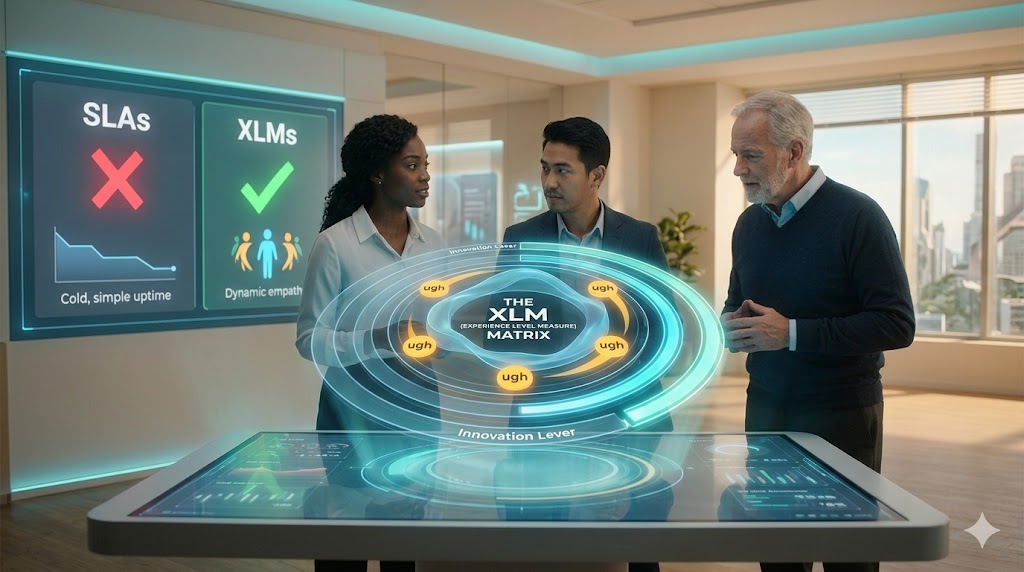
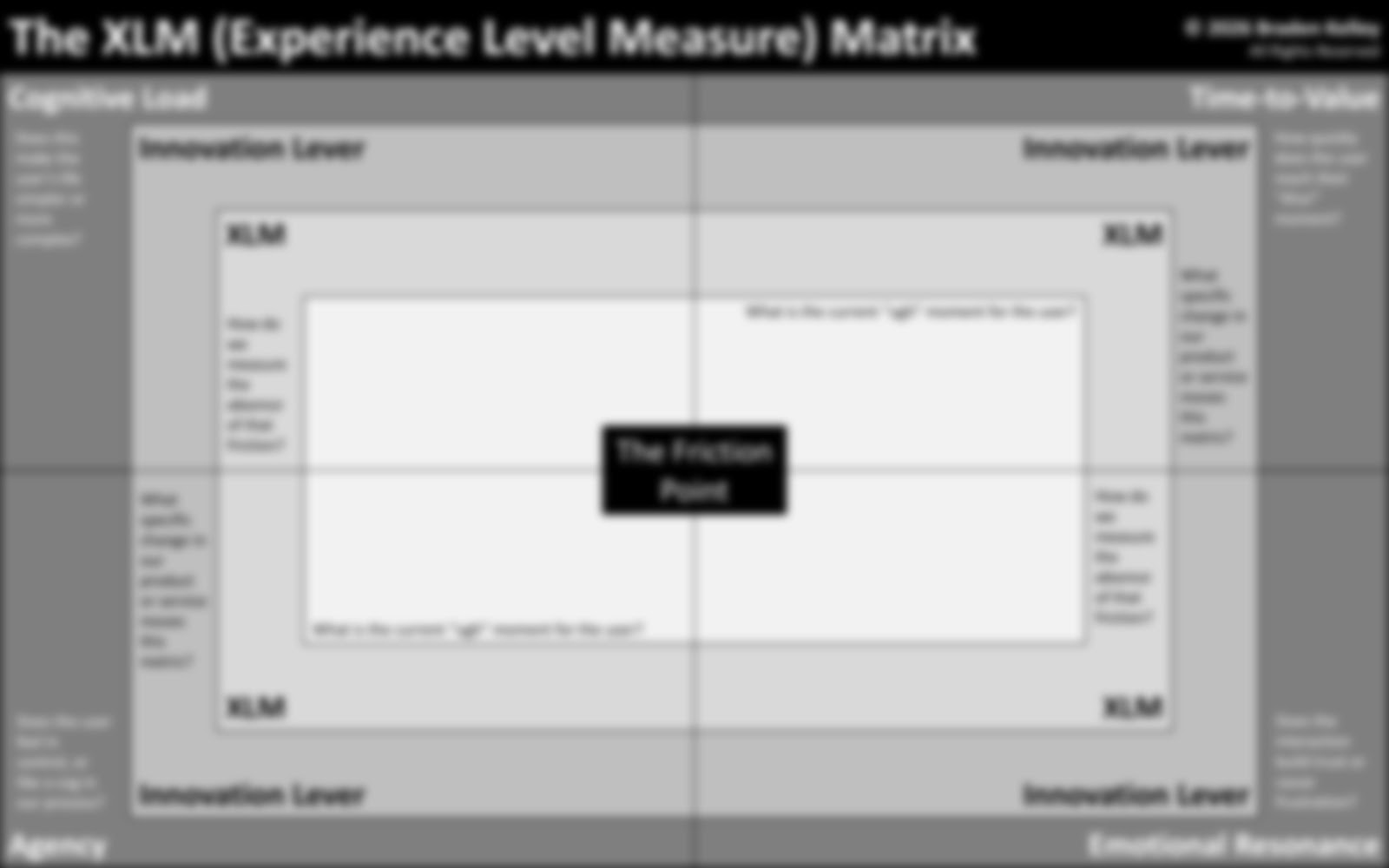
The XLM (Experience Level Measure) Matrix™ is Braden Kelley’s visual workshop framework for moving from a specific “ugh” moment (friction) → to an XLM that measures the absence of that friction → to the innovation or design lever that improves it. Use it for customer, employee, partner, patient, or constituent experiences.

In short:

  • SLA = Did the system/process meet a technical threshold?
  • XLM = Did the human succeed without avoidable pain?
  • XLA (Experience Level Agreement) = A commitment to experience outcomes, informed by XLMs
  • XLM Matrix™ = The tool that connects friction → measure → fix

Free download: Get the XLM Matrix™ (11″×17″)
Related: Experience Design Glossary — XLM & XLA · Customer Experience Audit


Go Beyond SLAs and Measure Human Success with the XLM Matrix

by Braden Kelley


The Crisis of the “Efficient but Empty” Experience

In our current landscape of rapid digital transformation, we have achieved unprecedented levels of speed and automation. Organizations have mastered the “how” of delivery, yet many find themselves facing a growing paradox: processes are becoming more efficient while human satisfaction is simultaneously declining. We are successfully building faster systems that often leave the user feeling more like a cog in a machine than a valued participant.

The root of this issue lies in our reliance on traditional Service Level Agreements (SLAs). For decades, SLAs have served as the gold standard for operational success, measuring technical markers like system uptime, response times, and throughput. While these metrics are essential for maintaining infrastructure, they are fundamentally “cold” metrics. They can tell you that a system is functioning, but they cannot tell you if the person using that system is thriving, frustrated, or merely exhausted by the interaction.

To innovate effectively in a human-centered future, we must look beyond technical availability and begin measuring the actual quality of the human encounter. We need a shift in perspective—moving from monitoring system performance to measuring human success. This evolution requires a new framework: Experience Level Measures (XLMs). By focusing on how an innovation impacts the user’s cognitive load, sense of agency, and emotional resonance, we can move past “efficient but empty” outputs and toward solutions that deliver genuine value.

Introducing the XLM Matrix

To bridge the gap between technical output and human success, we developed the XLM (Experience Level Measure) Matrix. This visual framework is designed to help innovation teams move beyond abstract empathy and toward concrete, measurable experience improvements. By visualizing the relationship between friction, measurement, and action, teams can align their efforts with the outcomes that actually move the needle for their users.

The matrix is structured as a series of concentric rings, requiring teams to work from the “inside out” to ensure every innovation is rooted in a real-world human need:

  • The Inner Circle (The Friction Point): This is the starting line. Here, teams identify the specific “ugh” moment—the point in the journey where the user currently feels confused, slowed down, or disempowered.
  • The Middle Ring (The XLM): This layer transforms qualitative frustration into a quantitative metric. It asks: “How do we measure the absence of that friction?” An XLM isn’t about system uptime; it’s about the user’s success rate in reaching their goal without cognitive fatigue.
  • The Outer Ring (The Innovation Lever): Once the friction is identified and the metric is set, the outer ring focuses on the solution. It identifies the specific change in the product, service, or workflow that will directly influence the XLM and eliminate the friction point.

By using this “Target Logic,” teams ensure that they aren’t just innovating for the sake of novelty, but are strategically pulling levers that have a measurable impact on the human experience.

The XLM (Experience Level Measure) Matrix

The Four Pillars of Human-Centered Innovation

To provide a comprehensive view of the user experience, the XLM Matrix is divided into four critical quadrants. Each quadrant represents a fundamental pillar of how humans interact with technology and services. By examining an innovation through these four lenses, teams can uncover hidden friction points and prioritize improvements that resonate most deeply with their audience.

1. Cognitive Load

“Does this make the user’s life simpler or more complex?”

In an age of information abundance, mental energy is a finite resource. This pillar focuses on the mental effort required to complete a task. Innovation here is about reducing noise, simplifying navigation, and ensuring that the “cost of thinking” is kept to an absolute minimum.

2. Time-to-Value

“How quickly does the user reach their ‘Aha!’ moment?”

Success is often determined by the distance between a user’s first interaction and their first realization of value. This quadrant measures the speed of relevance. Effective innovation in this space removes barriers to entry and streamlines the path to a meaningful outcome.

3. Agency

“Does the user feel in control, or like a cog in the process?”

As systems become more autonomous, maintaining human agency is vital. This pillar explores whether a tool empowers the user or forces them into a rigid, predetermined path. High-agency innovations provide the user with the autonomy to make meaningful choices and direct the outcome.

4. Emotional Resonance

“Does the interaction build trust or cause frustration?”

Every interaction leaves an emotional footprint. This quadrant assesses the “vibe” of the experience. It looks beyond function to ask if the solution feels reliable, empathetic, and aligned with the user’s values, transforming a transactional moment into a relational one.

How to Use the Matrix with Your Team

The XLM Matrix is most effective when used as a collaborative workshop tool. By gathering cross-functional perspectives—from product and design to engineering and customer success—you can ensure a 360-degree view of the human experience. Follow these three steps to run your first experience audit:

Step 1: The Empathy Audit

Focus on the Inner Circle. Select one of the four quadrants and ask the team to identify the most persistent “ugh” moment currently facing the user. Be specific. Instead of saying “the checkout process is slow,” identify the exact friction point, such as “the user feels overwhelmed by the number of form fields.”

Step 2: Defining the Metric

Move to the Middle Ring. Once the friction point is clear, brainstorm how you would measure its absence. This is your Experience Level Measure (XLM). If the friction is cognitive overload from form fields, your XLM might be “reduction in time spent on the checkout page” or “a 20% increase in completion rate without support intervention.”

Step 3: Pulling the Innovation Lever

Reach the Outer Ring. Now, identify the specific technical or design change that will move that metric. This is your “Innovation Lever.” It could be an AI-driven auto-fill feature, a progress bar to improve the sense of agency, or a “save for later” option to reduce immediate emotional pressure.

Repeat this process for each quadrant to build a robust, human-centered innovation roadmap that prioritizes meaningful outcomes over simple feature checklists.

Conclusion: Creating a Human-Centered Future

The transition from measuring system performance to measuring human success is not just a technical shift; it is a cultural one. As we move deeper into an era of agentic AI and rapid digital acceleration, the organizations that thrive will be those that prioritize the human experience as their primary north star. Innovation is no longer defined solely by what we can build, but by how effectively we enable people to feel, act, and succeed.

The XLM Matrix provides a structured, repeatable path to this future. By moving from the friction of the “ugh” moment to the strategic clarity of the innovation lever, your team can ensure that every project delivers meaningful, human-centered value. It is time to stop guessing how our users feel and start building for their success.

Start Your Experience Transformation Today

Ready to move beyond SLAs? Download the high-resolution, 11″x17″ (works as A3 too) printable version of The XLM Matrix and begin identifying the measures that truly matter for your innovation team. You can also use it virtually by uploading it and locking it down as a background in Miro, Mural, LucidSpark, Figjam or the FREE Microsoft Whiteboard or Google Jamboard.


Download the Free XLM Matrix Canvas

Frequently Asked Questions

What is the difference between an SLA and an XLM?

A Service Level Agreement (SLA) measures technical system performance, such as uptime or response speed. An Experience Level Measure (XLM) focuses on human outcomes, measuring how effectively an innovation reduces cognitive load, increases user agency, or builds emotional resonance.

How does the XLM Matrix help innovation teams?

The XLM Matrix provides a visual framework to move from identifying user friction (“ugh” moments) to defining specific metrics and identifying the technical or design “levers” required to improve the human experience.

Can the XLM Matrix be used for internal digital transformation?

Yes. The matrix is highly effective for internal projects. By measuring the cognitive load and time-to-value for employees using new internal tools, organizations can ensure their digital transformation efforts actually increase productivity rather than just adding complexity.

Image credits: Braden Kelley, Google Gemini

Subscribe to Human-Centered Change & Innovation WeeklySign up here to get Human-Centered Change & Innovation Weekly delivered to your inbox every week.

You Chose the Top 10 Customer Service Brands

You Chose the Top 10 Customer Service Brands

GUEST POST from Shep Hyken

We live in a world where 76% of customers say they will switch to a competitor if they know they will receive a better customer experience. Understanding which brands consistently win their customers’ hearts and wallets and why isn’t just interesting—it’s essential knowledge that will help you stay competitive.

Each year I survey more than 1,000 U.S. consumers for my annual customer service and CX research. The “audience” mirrors the U.S. population demographics for age, gender, ethnicity, geography and more. We learn about their likes, dislikes, expectations and more when it comes to customer service and customer experience (CX). One of my favorite questions to ask each year is, “When you think of customer service, what are your favorite companies?”

We ask each person to name their three favorites. Many of these brands you would expect to be on this list. For the research report, we listed the top 25 brands. For this article, I’m sharing the top 10. In addition to listing the brands, I’ve shared a few sentences about why these brands are loved by consumers. These lessons show us what our customers want, not just from these brands, but from any brand or company, including yours.

And here’s a disclaimer. This is a “people’s choice” list. You may or may not agree with the choices, but you can’t argue with the numbers. Furthermore, many of these brands have shown up on the list year after year.

So, with no further ado, let’s start with No. 10 and work our way to No. 1 for 2025!

No. 10 – Home Depot

Customers appreciate the friendly service and help from employees who are knowledgeable about tools, paint and building supplies. Home Depot customers appreciate how employees guide them to the right solution and sometimes even share helpful tips. Here’s my tip, based on personal experience. When you have a project, look for an older employee. They often have the experience and wisdom you’re looking for. The lesson: Friendly employees empowered with knowledge create confidence for customers, and confidence builds loyalty.

No. 9 – AT&T

Customers value AT&T’s nationwide coverage, international packages and helpful support, whether in stores or over the phone. Many mention the responsiveness of employees who work to resolve issues quickly. The lesson: In a competitive industry, fast response and reducing friction can win over customers.

No. 8 – Verizon

“Can you hear me now?” Those five words have been part of Verizon’s marketing campaign since the early 2000s. It means Verizon customers can trust its products. In addition, it has reliable service and knowledgeable support teams. Its staff consistently provides clear answers and helps customers make sense of plans, devices and upgrades. The lesson: Reliability plus clarity equals trust, and trust creates the confidence that brings customers back.

No. 7 – Google

I did a Google search and asked, “How many Google searches are there per day? The answer is more than 13 billion! While Google is known for its search engine, it also has many products such as Gmail, YouTube, Google Maps and many others. While much of the experience is self-service, the technology itself delivers convenience that feels effortless. The lesson: Sometimes the best service is making things so easy that customers don’t even need to ask for help.

No. 6 – Costco

Customers love the value (low prices) and quality that Costco delivers through its membership program with generous return policies and an in-store experience that includes friendly and helpful employees. They’ve built a reputation for standing behind what they sell. The lesson: Customer-friendly policies send a powerful message: we’ve got your back.

No. 5 – Chick-fil-A

“It’s my pleasure!” is the phrase the brand’s founder, Truett Cathy, asked employees to use instead of “You’re welcome.” It symbolizes commitment to hospitality. Customers consistently rave about the friendliness of its employees. Even though it is considered to be a fast-food restaurant, it has proven that consistently friendly service—not to mention delicious chicken—wins the hearts of customers. The lesson: A smile and a genuine expression of “my pleasure” can transform ordinary transactions into extraordinary experiences.

No. 4 – Apple

Customers value not only the products but also the support, especially through the Genius Bar and the knowledgeable employees at its retail stores. Employees are trained to explain, teach and solve problems in a way that makes technology approachable. The lesson: Knowledgeable employees who can make the complicated simple remove customers’ fears and replace them with confidence.

No. 3 – Target

Customers want a clean shopping environment with employees who are helpful and approachable. The brand even refers to its customers as guests. That, combined with smooth checkouts and easy returns, is why Target ranks high. The recent news about the DEI rollback can’t be ignored, but Target recognizes this, and its new CEO has announced how they plan to win back customers. The lesson: Customers appreciate friendly employees, an easy shopping experience and convenience in the form of traditional shopping, curbside pickup and same-day delivery options.

No. 2 – Walmart

Customers love the convenience of thousands of locations and low prices. Approximately 90% of Americans live within 10 miles of a Walmart store. That’s convenience, and when you combine that with low prices, you have a winning combination. While you may not find an employee in every aisle (one of the ways Walmart keeps prices down), when you do interact with Walmart employees, they are friendly and helpful. The lesson: Low prices get customers in the door, but an overall positive customer experience that includes friendly employees helps bring customers back.

No. 1 – Amazon

It should not be a surprise that Amazon is ranked No. 1. Often, in my customer service keynote speech, I ask the audience to yell out their favorite company to do business with. I hear Amazon more than any other. Customers love its unmatched convenience. It is open 24/7, has fast delivery and easy returns. It is the ultimate company when it comes to removing friction from the buying experience. The lesson: Easy wins. Make doing business with your company simple, fast and reliable, and customers will reward you with repeat business and loyalty.

Final Words

You may or may not agree with the brands on this list. I was even surprised that a couple of them ended up in the top 10, but this wasn’t my list. It’s a people’s choice list. My comments about each of these brands are based on research, personal experience and informed opinion. Feel free to share your comments, as well as your opinion of other companies you would add to the list.

This article was originally published on Forbes.com.

Image Credit: Shep Hyken

Subscribe to Human-Centered Change & Innovation WeeklySign up here to join 17,000+ leaders getting Human-Centered Change & Innovation Weekly delivered to their inbox every week.

Turning the Customer Experience Trifecta into a Sure Thing

Turning the Customer Experience Trifecta into a Sure Thing

GUEST POST from Shep Hyken

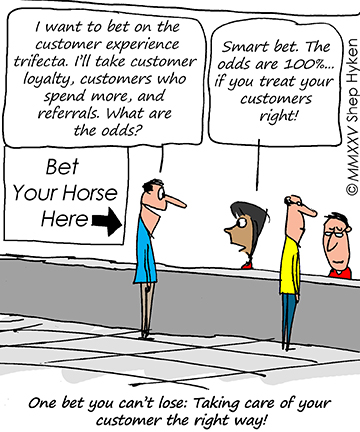
If you go to the horse race, you can place a bet known as the trifecta. This is where you correctly predict which horses will finish first, second, and third, and in the specific order. The payout is typically big because, while it’s simple in theory and easy to explain, it is a hard bet to win.

Here’s a bet you can always win: taking care of your customers. And when you do it right, you hit the trifecta:

  • First, they come back.
  • Second, customers who come back will typically spend more every time.
  • Third, customers who come back also recommend you. We love it when customers do our advertising and marketing for us.

So, how can we define taking care of your customers? Here’s a simple definition:

Taking care of your customers means you consistently deliver on what they expect, and do it in a way that’s easy, respectful, and reliable every time.

So, let’s break down the important words within this definition:

  • Consistently: The experience must be predictable and consistent. Consistency creates confidence. Confidence creates trust, and that leads to repeat business, and ideally and ultimately, customer loyalty.
  • Expect: Customers want you to meet their expectations. If you consistently – there’s that word again – meet those expectations, you don’t leave your customers hoping for more. And once in a while, you can go “above and beyond” or “over the top” when the opportunity presents itself.
  • Easy: This is about convenience. Customers love doing business with a company or brand that is easy and convenient. I wrote an entire book on this one, The Amazement Revolution.
  • Respectful: In addition to treating customers with respect, also respect their time. Wasting someone’s time is a sign of disrespect.
  • Reliable: This goes along with consistency and expectations. The product must do what the customer paid for it to do. No matter how good the service is, if the product doesn’t work, even the friendliest customer service won’t get customers to come back.

When a customer chooses to do business with you, there’s an implied agreement. They give you money in exchange for a product or service, and they expect you to take care of them as I’ve defined it. It may seem like common sense, and it is, but that doesn’t mean it’s easy to implement. You need all employees on board with this simple concept. Everyone must understand how they contribute to the concept of taking care of the customer. Do that, and you’re not gambling. You’re betting on a sure thing. You’ll hit the trifecta!

Image Credit: Pexels

Subscribe to Human-Centered Change & Innovation WeeklySign up here to join 17,000+ leaders getting Human-Centered Change & Innovation Weekly delivered to their inbox every week.
This One Thing Could Cost You 1/3 of Your Customers

This One Thing Could Cost You 1/3 of Your Customers

GUEST POST from Shep Hyken

If your customers reach out to you for customer support or for problems to be resolved, this is must-have information. In my annual customer experience research, we asked more than 1,000 U.S. consumers if they had ever stopped doing business with a company or brand because self-service options were not provided. Thirty-four percent said yes, which means:

Not offering self-service options for customer support could cost you one-third of your customers.

Age makes a difference. When you break it down by generations, more than twice as many Gen-Z customers (43%) than Baby Boomers (20%) have stopped doing business with a company because it didn’t offer self-service options for customer support.

Traditional Customer Support

The majority of all customers (68%) prefer the phone to self-service options. While the phone may be the first choice, it does have its drawbacks. Often, customers experience wait times. While the friendly recorded message may indicate the customer’s call “is very important,” a long wait time sends a different message. Sometimes customers become frustrated with being transferred, having to repeat their story to multiple customer support agents, language barriers and more.

Self-Service Options

Self-service customer support options are available to customers 24 hours a day, 7 days a week. They typically handle simple questions and problems, and in some cases, are interactive, allowing customers to complete simple transactions. Customers using self-service appreciate how quickly they can get answers to questions and get their problems resolved without wait times and the hassle of authentication procedures that customers view as time wasters. Some of these options include:

  • Frequently Asked Questions: This is typically on a website and provides brief answers or articles related to the most common customer inquiries.
  • Video Tutorials: These are often found on a website, and many companies and brands also host these videos on YouTube, which means that they are potentially searchable by using Google to ask the question.
  • Interactive Voice Response (IVR) Systems: This is a phone-based automated system that allows customers to navigate menu options to find simple answers or complete easy transactions.
  • AI-Fueled Chatbots: Similar to traditional IVR systems (but usually better), chatbots can message back and forth with customers. With the latest ChatGPT-type technology, it can seem as if you’re communicating with a human.
  • Customer Portals: Access on a company’s website allows customers to log in and check orders, make payments, set appointments and much more.
  • Mobile Apps: If a customer is willing to download the company’s app on their mobile phone/device, they may have access to an easier experience that provides many or all of the above options.

A warning: Just because some customers are demanding self-service options doesn’t mean they won’t be as frustrated (or even more) than with traditional phone support. If they don’t get their answers or you waste their time, they won’t be happy. For example, even though 39% of customers would rather clean a toilet than contact live customer support, 76% say they have been trapped in an automated menu system (IVR) and repeatedly screamed into the phone, “Agent” or “Representative,” and eventually hung up out of frustration. While these findings may seem funny, there’s a lot of truth in humor.

Demand For Self-Service Increases

In 2025, 34% of customers demand that companies provide self-service options or they will seek out a competitor, up from 26% in 2024. That’s a 30% increase. If the trend continues at that pace, we’re less than two years away from more than half of customers walking away because of the lack of self-service options.

Final Words

Self-service is about convenience, and customers love convenience. In 2025, 91% of customers said convenience is important to them, and 73% are willing to pay more if the experience is more convenient. Self-service options, when done right, deliver exactly that: convenience. They give customers control, save time and are available 24/7. Companies that provide excellent self-service can earn customer loyalty by proving they respect their customers’ time and preferences.

But, self-service options aren’t enough. Not every question or problem can be handled through self-service, which is why the best companies provide a blend. A powerful self-service option allows customers to easily and seamlessly transfer to a live agent, and rather than forcing the customer to start over, the agent can see why the customer is contacting support.

The companies that win in the future won’t be those that choose between self-service and human support. They’ll be the ones that blend both to create a customer support experience that makes customers say, “I’ll be back!”

Image Credit: Google Gemini

This article was originally published on Forbes.com.

Subscribe to Human-Centered Change & Innovation WeeklySign up here to join 17,000+ leaders getting Human-Centered Change & Innovation Weekly delivered to their inbox every week.

9 Multi-Sensory CX Levers Retail and Service Brands Still Ignore

9 Multi-Sensory CX Levers Retail and Service Brands Still Ignore

by Braden Kelley and Chateau G Pato


Which Multi-Sensory CX Levers Do Retail and Service Brands Still Ignore? (Short Answer)

Nine multi-sensory CX levers retail and service brands still ignore: (1) acoustic privacy and soundscape ownership, (2) congruent scent — and anti-scent, (3) light for dignity and wayfinding, (4) haptic quality of the transaction, (5) thermal comfort as experience, (6) spatial density and movement choreography, (7) the wait as a sensory journey, (8) cross-channel sensory congruence, and (9) sensory recovery after failure. Soft landings design what people feel. Hard landings optimize what people click.

People don’t experience your brand as a channel map. They experience it as a body in a place — and most brands still leave that body undesigned.

Why Do Brands Own Screens — and Leave the Senses to Chance?

I keep watching retail and service brands fund visual merchandising, apps, and queue math while the body still decides loyalty. Vision and screens get owners. Facilities “handles” the rest. Marketing owns scent for a campaign week. Nobody owns acoustic privacy, thermal dignity, haptic quality, wait atmosphere, or sensory recovery when the promise breaks.

Ambience is a loyalty system, not décor — I unpack that frame in The Science of Ambience. This piece is the ignored lever kit: what to own in stores, branches, clinics, hotels, and hybrid service spaces.

Lever Usually owned by… Should force…
1. Acoustic privacy Nobody / facilities noise Trust in speech and calm
2. Scent Campaign / landlord Congruence or deliberate absence
3. Light Merchandising only Wayfinding + dignity
4. Haptics Procurement Hand-feel of the brand
5. Thermal Facilities KPI Stay/leave comfort
6. Density/flow Throughput / planograms Body safety and ease
7. Wait atmosphere Queue math Felt time and status
8. Cross-channel congruence Siloed teams Promise the body recognizes
9. Sensory recovery “Apology script” Make-right the nervous system can trust

If only eyes and screens have owners, your CX is half-blind.

1. Why Is Acoustic Privacy a Multi-Sensory CX Lever?

Lever: Design what people hear — and what others can overhear — as CX, not background.

Why ignored: Playlists feel like branding; acoustic privacy feels like construction cost.

Humans feel: Stress, shame in overheard conversations, inability to think or decide.

Soft-landing move: Name a soundscape owner; create quiet zones; mask or separate sensitive speech; measure “could I be overheard?” — not only average decibels. Stores, banks, clinics, and service counters all live or die on this lever.

2. How Do Congruent Scent — and Anti-Scent — Shape Loyalty?

Lever: Intentional scent aligned to the job — or deliberate clean, neutral air when scent would harm trust.

Why ignored: Scent marketing as a campaign stunt; everyday odor left to chance.

Humans feel: Welcome and memory — or nausea, allergy, “cheap,” distrust.

Soft-landing move: Congruence-test scent against the brand promise; provide opt-out paths; ban conflicting vendor scents; never use scent to cover neglect. Manipulation is not design.

3. Why Should Light Serve Dignity and Wayfinding — Not Only Merchandising?

Lever: Light that helps people find, read, feel safe, and look (and feel) respected.

Why ignored: Spotlight the product; leave pathways, faces, and forms in glare or gloom.

Humans feel: Confusion, aging-eyes struggle, a surveillance vibe — or flattering calm.

Soft-landing move: Build a light map for tasks (find, choose, pay, wait, exit); reduce glare on screens and faces; respect circadian needs where dwell is long.

4. What Is Haptic Quality of the Transaction?

Lever: Touch quality of counters, devices, bags, cards, pens, samples, seating, and doors.

Why ignored: Procurement buys “durable and cheap”; the brand book stops at the logo.

Humans feel: Care or contempt in the fingers — sticky screens, cold metal, flimsy bags.

Soft-landing move: Run a haptic audit of the last three meters to “done”; choose materials that match the promise; treat cleanability as dignity.

5. Why Is Thermal Comfort a Customer Experience Lever?

Lever: Air temperature, drafts, humidity, and microclimates designed for the human job — not only energy targets.

Why ignored: Facilities owns HVAC KPIs; CX owns NPS.

Humans feel: Urgency to leave, irritability, inability to browse or decide.

Soft-landing move: Dual scorecard — energy and dwell comfort; zone by activity (try-on vs checkout vs wait); treat employee comfort as CX, because they set the emotional weather.

6. How Does Spatial Density and Movement Choreography Affect CX?

Lever: How close, how fast, how blocked — proxemics, aisle width, queue shape, wheelchair and stroller truth.

Why ignored: Throughput and planograms win; body stress is dismissed as a “busy day.”

Humans feel: Threat, fatigue, abandoned carts, skipped service.

Soft-landing move: Choreograph peak density; make escape routes visible; design accessibility as the default, not an exception; measure leave-without-buying and leave-without-asking-for-help. Efficient layouts that exhaust humans are a cousin of efficient misery.

7. Why Design the Wait as a Sensory Journey?

Lever: Multi-sensory design of waiting — status, seating, sound, light, micro-care — not only queue length.

Why ignored: SLA and average wait; atmosphere is “someone else’s budget.”

Humans feel: Helplessness and rage — or surprisingly calm progress.

Soft-landing move: Pair status-as-experience with sensory comfort; give honest ETAs; give the body something useful or kind to do while waiting. The status-less wait is often a moment that matters more than the score — see 8 Moments That Matter More Than Your NPS Dashboard.

8. What Is Cross-Channel Sensory Congruence?

Lever: Align what digital promises with what the place smells, sounds, and feels like — and vice versa.

Why ignored: App, store, and service teams optimize locally.

Humans feel: Whiplash — calm app, chaotic floor; premium site, sticky counter.

Soft-landing move: One sensory signature card across channels; journey owners accountable for congruence breaks; prototype the handoff from phone to place. Congruence is also a trust design problem — see 11 Principles for Designing Trust (Not Just Usability).

9. How Do You Design Sensory Recovery After Failure?

Lever: When something breaks, redesign the sensory context of recovery — calm space, private voice, unhurried light, empowered human — not only a script.

Why ignored: Recovery is policy and CRM; the body stays in the same stressful soundscape.

Humans feel: A second injury — apology under fluorescent panic — or restored dignity.

Soft-landing move: Recovery zones or rituals; acoustic privacy for complaints; time and power for make-right; train for sensory de-escalation so the nervous system can trust the repair.

What Should You Ask Before the Next Retail or Service Redesign?

Five questions for a multi-sensory audit:

  1. Who owns sound and privacy?
  2. Where does scent help or harm the job?
  3. Does light serve faces and tasks — or only products?
  4. What do hands and temperature teach about our promise?
  5. When we fail, does the body get a softer place to recover?

Mantra: Stop decorating the vibe. Start owning the senses that decide whether humans stay, trust, and return.

FAQ: Multi-Sensory CX Levers

What is multi-sensory CX?

Multi-sensory CX is customer experience designed for the whole body — sound, scent, light, touch, temperature, space, waiting atmosphere, and recovery feel — not only screens, visuals, and queue metrics.

What sensory levers improve retail experience?

Sensory levers that improve retail experience include acoustic privacy, congruent (or deliberately absent) scent, dignifying light and wayfinding, haptic quality at the transaction, thermal comfort, density choreography, sensory waits, cross-channel congruence, and sensory recovery after failure.

How does ambience affect customer loyalty?

Ambience affects customer loyalty because sensory cues shape emotion and memory before people rationalize a score — coherent, dignifying environments invite return; mismatched or stressful senses teach the body to leave.

What is sensory congruence in CX?

Sensory congruence in CX means the body’s experience of sound, scent, light, touch, and space matches the brand promise across digital and physical channels — so the handoff from phone to place feels like one relationship, not whiplash.

How do you design waiting rooms for better CX?

Design waiting rooms for better CX by treating the wait as a sensory journey: honest status, comfortable seating and temperature, acoustic calm, dignifying light, and something useful or kind for the body to do — not only shorter average wait on a dashboard.

Image credits: Gemini

Content Authenticity Statement: The topic area, key elements to focus on, etc. were decisions made by Braden Kelley, with a little help from Google Gemini and Cursor to clean up the article, add images and create infographics.

Subscribe to Human-Centered Change & Innovation WeeklySign up here to get Human-Centered Change & Innovation Weekly delivered to your inbox every week.

6 Trust Pillars for Agentic Customer Experience

6 Trust Pillars for Agentic Customer Experience

by Braden Kelley and Art Inteligencia


What Are the Trust Pillars for Agentic CX? (Short Answer)

Six trust pillars for agentic customer experience: (1) Clarity, (2) Competence, (3) Control, (4) Care, (5) Consent, and (6) Accountability. Agents that act — refund, rebook, route, negotiate, commit — change the trust contract. Containment, deflection, and “the model said so” are not design. Soft landings design all six before scale.

Agentic CX earns trust when customers can see the actor, finish the job, stay in control, feel cared for, consent to the scope of action, and still find a human accountable when the agent gets it wrong.

Why Six Pillars — Not Only Automation Metrics?

I keep watching teams ship agentic power as if a smarter FAQ were enough. It isn’t. Agentic CX is delegated action. Customers will forgive imperfect speed. They will not forgive betrayal — opacity, trapped loops, brand-first optimization, no undo, and nobody who can be asked why.

The original four — Clarity, Competence, Control, Care — still hold. I unpacked that contract in When AI Agents Act on Your Behalf. Two pillars complete it when authority is real: Consent (what they authorized the agent to do) and Accountability (who owns recovery when it fails). Autonomy without those six is a hard landing with a better chatbot costume.

For the broader product lens beyond agents, see 11 Principles for Designing Trust (Not Just Usability). For how leaders must own agentic scenarios across the enterprise, see 5 Scenarios for Agentic Organizations.

Pillar Customer question Hard landing tell
1. Clarity Who is acting and what can it do? “Wait — was that a bot?” after damage
2. Competence Will this finish without making me restart? Loops; retelling tax
3. Control Can I stop, undo, or reach a human? Trapped; punished for escalating
4. Care Is this for me or for containment? Cheap resolution that costs dignity
5. Consent Did I authorize this scope of action? Surprises in money, data, commitments
6. Accountability Who owns this when it fails? “The system decided”; no recovery power

Ship the agent’s power only as fast as you can design these six.

1. What Is Clarity in Agentic Customer Experience?

Pillar: Make the actor, scope, and limits visible — human, system, or agent — before and during action.

When agents act: Customers must know they are delegating, not chatting with a FAQ costume.

Hard landing: Hidden automation; surprise commitments; “Was that a bot?” after the charge.

Soft-landing move: Disclose identity, capabilities, and boundaries in the channel; update when scope expands.

Tell: Post-action confusion; chargebacks; “I didn’t know it could do that.”

2. What Is Competence When Agents Act?

Pillar: Resolve completely across steps; carry memory; don’t loop people through the same dead end.

When agents act: Multi-step work is the product — not a clever first reply.

Hard landing: Partial completion; lost context; restart tax; endless clarification.

Soft-landing move: End-to-end completion metrics; context that travels; escalate before the third loop.

Tell: Repeat contacts; “I already told you”; high containment, low resolution. Efficient misery often starts here — see 8 Service Design Mistakes That Create Efficient Misery.

3. Why Does Control Matter More When Agents Have Authority?

Pillar: Real agency includes pause, reverse, override, and human help without punishment.

When agents act: Authority without an exit is coercion with better UX.

Hard landing: No undo on money or data moves; escalation buried; AHT and containment punish the handoff.

Soft-landing move: One-tap stop/undo for high-stakes actions; a human path with teeth; a dual scorecard so green containment cannot close a red trust review.

Tell: Customers force a channel-switch to escape the agent; human agents inherit angry cleanup.

4. What Does Care Mean for Agentic CX?

Pillar: At the decision point, design for the customer’s job and dignity — not only conversion, deflection, or cost.

When agents act: The agent’s objective function is the brand promise in motion.

Hard landing: Containment KPIs; upsell in distress; “resolved” tickets that leave the job unfinished.

Soft-landing move: Objective functions and policies that prefer make-right over cheap close; care metrics beside automation rate.

Tell: High script scores, low loyalty; viral “the bot wouldn’t help” stories. Soft landings split human and machine work on purpose — see The AI Soft Landing.

6. What Is Accountability When the Agent Gets It Wrong?

Pillar: A named human (or role) and a powered recovery path when the agent errs — explainability plus make-right, not a shrug.

When agents act: “The system decided” is not a brand. Someone must still be askable.

Hard landing: Unowned model choices; recovery as exception hell; liability parked on the customer.

Soft-landing move: Named accountable owner per journey; recovery journeys equal to the primary flow; explain why in plain language; log decisions for appeal.

Tell: No one to escalate to; make-right requires a second odyssey; trust dies at the seam.

What Should You Ask Before Scaling Agentic CX?

Six questions before the next agentic CX release:

  1. Is the actor and scope clear?
  2. Can the median journey finish without a loop trap?
  3. Can the customer stop, undo, and reach a human without punishment?
  4. Does the objective function optimize for their interest?
  5. Was consent earned for this band of action?
  6. Who owns recovery — with power — when it fails?

Mantra: Don’t scale the agent’s authority faster than you can design Clarity, Competence, Control, Care, Consent, and Accountability.

FAQ: Trust Pillars for Agentic Customer Experience

What are the trust pillars for agentic CX?

The six trust pillars for agentic CX are Clarity, Competence, Control, Care, Consent, and Accountability — the contract customers need when AI agents act on their behalf, not only chat.

How do you design trust for AI agents?

Design trust for AI agents by disclosing who is acting and what they can do, finishing jobs with context, giving stop/undo/human paths, optimizing for the customer’s interest, earning consent for the scope of action, and naming who owns powered recovery when the agent fails.

What is consent in agentic customer experience?

Consent in agentic customer experience is explicit, reversible permission for what the agent may do with money, data, identity, and commitments — matched to stakes — not a buried default that expands the agent’s authority without the customer knowing.

Why isn’t automation enough for CX trust?

Automation is not enough for CX trust because agentic systems take actions that can help or harm. Speed and containment without clarity, control, care, consent, and accountability feel like betrayal — and customers forgive friction more readily than betrayal.

How do you measure agentic CX trust?

Measure agentic CX trust with completion without loops, undo and human-reach success, consent revoke rates, recovery time and power after agent error, and whether customers understood who acted — not automation or containment rate alone.

Image credits: Pixabay

Content Authenticity Statement: The topic area, key elements to focus on, etc. were decisions made by Braden Kelley, with a little help from Google Gemini and Cursor to clean up the article, add images and create infographics.

Subscribe to Human-Centered Change & Innovation WeeklySign up here to get Human-Centered Change & Innovation Weekly delivered to your inbox every week.

12 Conversational VoC Questions That Beat Dead Survey Forms

12 Conversational VoC Questions That Beat Dead Survey Forms

by Braden Kelley and Chateau G Pato


Which Conversational VoC Questions Beat Dead Survey Forms? (Short Answer)

Twelve conversational VoC questions that beat dead survey forms: (1) What were you trying to get done? (2) Where did it first go sideways? (3) What did that cost you? (4) What workaround did you invent? (5) Who else had to hear this story? (6) What would “made right” look like today? (7) What almost made you leave? (8) What should we stop doing? (9) Which handoff or policy broke trust? (10) What did you need to know that nobody told you? (11) Who helped — and were they allowed to finish? (12) What should we tell you next time something breaks?

A dead survey form harvests a number. A conversational VoC question invites a story you can act on — and a human who feels less alone for telling it.

Why Do Dead Survey Forms Lose to Real Questions?

Conversational VoC is listening as dialogue — adaptive prompts, messaging, voice, or short interviews in or near the moment of experience — aimed at understanding and closed-loop action, not only score capture. Dead survey forms are static questionnaires that arrive late, feel extractive, and rarely change anything the customer can see.

I have watched response rates fall while dashboards stayed confident. People did not stop having opinions. They stopped volunteering unpaid labor to a form that never proved it was listening. Soft landings for loyalty intelligence require questions that surface jobs, seams, dignity costs, and make-right — not another 1–10 scale after the heat has cooled. For the wider method shift, see Surveys Are Collapsing — Conversational and Agentic VoC.

Question Form fails Dialogue surfaces
1. Trying to get done? Score before the job Real progress they hired you for
2. First went sideways? Surveys after “resolved” First fail point
3. What did it cost? Effort scores flatten dignity Time, money, shame, trust
4. What workaround? “How easy?” hides shadow paths Design debt customers invent
5. Who else heard it? Channel scores miss seams Retelling tax
6. Made right today? Callbacks close cases Concrete recovery
7. Almost leave? Silent churn never responds Quiet-exit cliffs
8. What should we stop? Forms hunt promoters Subtraction customers need
9. What broke trust? One score collapses betrayal Unfair vs merely hard
10. What weren’t you told? Late satisfaction asks Status and expectation gaps
11. Allowed to finish? Agent scores punish care Powerless frontline moments
12. Tell you next time? “Any other comments?” junk drawer Preferred honesty for bad news

1. “What Were You Trying to Get Done When This Started?”

The question: Open on the job, not the brand or the ticket number.

Why the form fails: NPS/CSAT assume the episode is already framed. Comment boxes come after the score.

Dialogue surfaces: The real progress the human hired you for.

Ask without theater: In-channel, right after the moment — one sentence, then listen.

Closed-loop move: Tag the journey/job owner, not only a sentiment bucket.

2. “Where Did It First Go Sideways?”

The question: Find the first fail point — not the last contact.

Why the form fails: Post-close surveys fire after “resolved,” missing the spike.

Dialogue surfaces: Wrong door, unclear next step, status-less wait.

Ask without theater: “Walk me to the first moment it stopped making sense.”

Closed-loop move: Instrument that fail point. Don’t only coach the last agent.

3. “What Did That Cost You — Time, Money, Dignity, or Trust?”

The question: Name the human cost in their language.

Why the form fails: Effort scores flatten shame, fear, and unpaid homework.

Dialogue surfaces: Dignity costs and emotional residue forms never code well.

Ask without theater: Offer the dimensions; let them choose and expand.

Closed-loop move: Recovery proportional to cost — not a coupon reflex.

4. “What Workaround Did You Invent to Get Unstuck?”

The question: Archaeology of the shadow path.

Why the form fails: “How easy was it?” hides the spreadsheet, the second account, the friend who knows someone.

Dialogue surfaces: Competing hires and design debt.

Ask without theater: “What did you do that we didn’t design for?”

Closed-loop move: Kill or adopt the workaround on purpose.

5. “Who Else Did You Have to Tell This Story To?”

The question: Map the retelling tax and orphan seams.

Why the form fails: Channel scores miss bot → agent → specialist handoffs.

Dialogue surfaces: Seams with no owner.

Ask without theater: Count the tells. Thank them for the labor.

Closed-loop move: Context that travels. Seam owner named. For the beats forms miss entirely, see 8 Moments That Matter More Than Your NPS Dashboard.

6. “What Would ‘Made Right’ Look Like for You — Today?”

The question: Co-design recovery with specificity.

Why the form fails: Detractor callbacks close cases; they rarely ask for a concrete make-right.

Dialogue surfaces: The fix they will actually trust.

Ask without theater: “If we could only do one thing before end of day…”

Closed-loop move: Power to deliver that make-right — or an honest constraint.

7. “What Almost Made You Leave, Switch, or Stop Trying?”

The question: Surface the quiet-exit cliff while they’re still talking.

Why the form fails: Non-respondents and silent churn never enter the harvest.

Dialogue surfaces: Leading indicators of abandonment.

Ask without theater: Normalize the near-exit. Don’t punish honesty.

Closed-loop move: Watch unfinished jobs and repeat contact — not only scores.

8. “What Should We Stop Doing Because of What Happened?”

The question: Invite a stop, not only a fix.

Why the form fails: Forms hunt promoters; they rarely fund subtraction.

Dialogue surfaces: Policy cliffs, dark patterns, busywork the org still loves.

Ask without theater: “If you ran this place for a day, what would you kill?”

Closed-loop move: A visible stop with a date — reciprocity they can see. If your program still manages the number instead of the journey, use 11 Signs Your CX Program Is Scorekeeping, Not Sense-Making.

9. “Which Handoff or Policy Moment Broke Trust?”

The question: Separate usability friction from trust violation.

Why the form fails: One score collapses betrayal and a slow page load.

Dialogue surfaces: Fine-print cliffs, denied recovery, opaque decisions.

Ask without theater: “Was it hard — or did it feel unfair?”

Closed-loop move: Trust redesign (control, care, accountability), not only UX polish.

10. “What Did You Need to Know That Nobody Told You?”

The question: Status, next step, and expectation gaps.

Why the form fails: Timing mismatches; surveys ask satisfaction after silence already hurt.

Dialogue surfaces: Opacity as the product.

Ask without theater: “What update would have lowered your stress?”

Closed-loop move: Status-as-experience design. Proactive messaging with truth.

11. “Who Helped — and Were They Allowed to Finish the Job?”

The question: Honor frontline power — or its absence.

Why the form fails: Agent scores punish care; customers rarely get asked about mandate.

Dialogue surfaces: Powerless moments of truth.

Ask without theater: Name the human if they want; protect them from blame theater.

Closed-loop move: Recovery bands and dual scorecards — not handle-time theater. For the rulebook, see 10 Agent Empowerment Rules Your Customer Deserves Before They Quit.

12. “What Should We Tell You Next Time Something Breaks?”

The question: Co-design the future promise and alerting.

Why the form fails: “Any other comments?” is a junk drawer.

Dialogue surfaces: Preferred channel, timing, and honesty level for bad news.

Ask without theater: Close by giving them authorship of the next loop.

Closed-loop move: Preference captured. Next incident proves you heard them.

How Do You Run a Conversational Listening Check Before the Next VoC Redesign?

Before the next VoC redesign, run five go/no-go questions:

  1. Are we asking in the heat or after the harvest?
  2. Do our questions invite jobs and costs — or only scores?
  3. Who can act on what we hear this week?
  4. What will customers see that we stopped or fixed?
  5. How do we measure “felt heard,” not only response rate?

Dead forms extract. Living questions listen — and then change something.

Frequently Asked Questions

What is conversational VoC?

Conversational VoC is listening as dialogue — adaptive prompts, messaging, voice, or short interviews in or near the moment of experience — aimed at understanding and closed-loop action, not only capturing a score on a static form.

What questions should I ask instead of surveys?

Ask what they were trying to get done, where it first went sideways, what it cost them, what workaround they invented, who else had to hear the story, what “made right” looks like today, what almost made them leave, what you should stop, which handoff broke trust, what nobody told them, whether helpers were allowed to finish, and what to tell them next time something breaks.

Why are survey response rates falling?

Survey response rates are falling because forms feel extractive, arrive after the heat has cooled, mismatch how people already converse, and rarely show customers that anything changed. People still have stories — they stop volunteering unpaid labor to dead forms.

How do you run conversational VoC?

Run conversational VoC in-channel and near the moment: ask job- and cost-centered questions, follow curiosity without theater, route themes to journey owners who can act, close the loop with visible fixes or stops, and measure whether people felt heard — not only response rate.

What is the difference between VoC surveys and conversational feedback?

VoC surveys optimize for structured scores and dashboard hygiene. Conversational feedback optimizes for dialogue, context, and action — surfacing jobs, seams, dignity costs, and make-right while the experience is still hot. Scores can remain a pulse; they should not be the whole conversation.

Image credits: Pexels

Content Authenticity Statement: The topic area, key elements to focus on, etc. were decisions made by Braden Kelley, with a little help from Google Gemini and Cursor to clean up the article, add images and create infographics.

Subscribe to Human-Centered Change & Innovation WeeklySign up here to get Human-Centered Change & Innovation Weekly delivered to your inbox every week.

Top 10 Human-Centered Change & Innovation Articles of March 2026

Top 10 Human-Centered Change & Innovation Articles of March 2026Drum roll please…

At the beginning of each month, we will profile the ten articles from the previous month that generated the most traffic to Human-Centered Change & Innovation. Did your favorite make the cut?

But enough delay, here are March’s ten most popular innovation posts:

  1. Resilient Innovation — by Braden Kelley
  2. Has AI Killed Design Thinking? — by Braden Kelley
  3. Mapping Customer Experience Risk to the P&L — by Braden Kelley
  4. Moral Uncertainty Engines — by Art Inteligencia
  5. Necesita un Diagnóstico de Riesgo de Experiencia del Cliente y Fuga de Ingresos — por Braden Kelley
  6. Layoffs, AI, and the Future of Innovation — by Braden Kelley
  7. Organizational Digital Exhaust Analysis — by Art Inteligencia
  8. You Need a Customer Experience Risk & Revenue Leakage Diagnostic — by Braden Kelley
  9. Stereotypes – Are They Useful and Should We Use Them? — by Pete Foley
  10. Is There Such a Thing as a Collective Growth Mindset? — by Stefan Lindegaard

BONUS – Here are five more strong articles published in February that continue to resonate with people:

If you’re not familiar with Human-Centered Change & Innovation, we publish 4-7 new articles every week built around innovation and transformation insights from our roster of contributing authors and ad hoc submissions from community members. Get the articles right in your Facebook, Twitter or Linkedin feeds too!

Build a Common Language of Innovation on your team

Have something to contribute?

Human-Centered Change & Innovation is open to contributions from any and all innovation and transformation professionals out there (practitioners, professors, researchers, consultants, authors, etc.) who have valuable human-centered change and innovation insights to share with everyone for the greater good. If you’d like to contribute, please contact me.

P.S. Here are our Top 40 Innovation Bloggers lists from the last five years:

Subscribe to Human-Centered Change & Innovation WeeklySign up here to get Human-Centered Change & Innovation Weekly delivered to your inbox every week.

5 Stages from SLAs to XLAs (A CX Maturity Roundup)

5 Stages from SLAs to XLAs (A CX Maturity Roundup)

by Braden Kelley and Art Inteligencia


What Are the Five Stages from SLAs to XLAs? (Short Answer)

Five CX maturity stages from SLAs to XLAs: (1) SLA Default — green metrics, miserable humans; (2) Experience Sensing — listening without power; (3) XLM Definition — human success becomes measurable; (4) XLA Adoption — experience becomes a commitment; (5) Experience-Led Management — XLAs steer, SLAs enable. An SLA (Service Level Agreement) tells you the service ran. An XLM (Experience Level Measure) tells you whether humans succeeded. An XLA (Experience Level Agreement) is how you promise and manage that success.

CX maturity is not “more surveys.” It is whether human success can change a budget meeting. Mature organizations rarely delete SLAs — they demote them from the steering wheel to the dashboard lights.

Why Do Green Dashboards Hide Red Tuesdays?

I have lost count of how many “healthy” service reviews I have sat through where every SLA was green and every human in the room was exhausted.

The portal was up. The tickets closed. The vendor collected their availability credit theater. And somehow employees still needed three workarounds to finish one task, customers still repeated their story to four people, and leaders still wondered why loyalty and productivity refused to follow the scorecard.

That is not a tooling failure. It is a maturity failure. Organizations learn to manage what they can defend in a contract — uptime, response, resolution — and then mistake green for good. Cold metrics create warm fiction.

This roundup is the map: five stages from steering by SLA to managing by human success. Each stage has a trap, an exit signal, and a different Tuesday when you climb.

Stage Managing by… Trap Exit signal
1. SLA Default SLAs and SLA-like KPIs Optimizing the metric, not the human Admit green ≠ good; structured listening on one journey
2. Experience Sensing SLAs + ad hoc listening Listening theater — dashboards, same decisions Defined XLMs with owners and baseline
3. XLM Definition SLAs + human-success measures Too many XLMs; “experience = speed” XLA language with targets and cadence
4. XLA Adoption SLAs and experience commitments Paper XLAs — no funding or teeth Portfolio led by XLA/XLM outcomes
5. Experience-Led Management XLAs first, SLAs as enablers Stage 5 in town hall, Stage 1 in payroll Red XLA stops a green review

1. What Is Stage 1 — SLA Default?

The stage: Service performance is managed through SLAs (or SLA-like KPIs), often inconsistently across teams and vendors. Experience shows up as complaints, escalations, or heroic recoveries — not as a managed system.

Primary question: Did we meet the technical target?

The trap: Optimizing the metric — faster closes, defensive ticket hygiene, throughput over outcome — instead of the human result.

Exit signal: Leaders admit SLA-green ≠ experience-good, and begin structured listening beyond tickets for at least one critical journey.

On Tuesday: Employees and customers can be miserable while every SLA is green. Cold metrics, warm fiction.

2. What Is Stage 2 — Experience Sensing?

The stage: SLAs still run the operating rhythm. Beside them appears experience signal: surveys, VoC, shadowing, journey maps, advisory boards. Insight exists; it is not yet designed into commitments or tradeoff decisions.

Primary question: What are people feeling, and where does it hurt?

The trap: Listening theater — more dashboards, same decisions. Frontline cynicism grows: “we surveyed again.” Sensing without power to act is worse than not listening.

Exit signal: For a priority journey, a small set of XLMs tied to human success — effort, confidence, agency — with owners and a baseline.

On Tuesday: Frontline staff often know the truth first. The organization hears pain; it does not yet manage by it. For scorekeeping disguised as CX, see 11 Signs Your CX Program Is Scorekeeping, Not Sense-Making.

3. What Is Stage 3 — XLM Definition?

The stage: The organization deliberately designs Experience Level Measures — translating friction into measurable human outcomes. XLMs sit beside SLAs: task effort, time-to-confidence, sense of agency, repeat contact for the same intent, EX enablement to deliver CX. Not SLAs renamed.

Primary question: Which human outcomes must improve for this journey to count as successful?

The trap: Too many XLMs; or “experience = speed” — SLAs in disguise. A metric that only celebrates faster failure is still cold.

Exit signal: Stakeholders agree to XLA language — targets, review cadence, consequences — for at least one service, vendor, or internal shared service.

On Tuesday: Teams can finally argue for fixes that do not move an SLA but remove massive human struggle. Human success becomes a number you can improve — and defend.

4. What Is Stage 4 — XLA Adoption?

The stage: Experience Level Agreements sit beside SLAs. A dual scorecard: SLA health and XLA attainment. Joint reviews; XLAs in charters or SOWs; escalation when XLMs breach even if SLAs pass.

Primary question: Did we keep our promise about how this should feel and work for humans — not only whether the system was up?

The trap: Paper XLAs — beautiful agreements with no funding, no decision rights, no repair paths at the moment of truth.

Exit signal: Portfolio priorities and vendor tradeoffs begin led by XLA/XLM outcomes. SLAs remain hard constraints but are no longer the primary definition of success.

On Tuesday: Authority starts matching empathy. Recovery power is designed into the system — not left as an accident of character on the front line.

5. What Is Stage 5 — Experience-Led Management?

The stage: The organization manages by XLAs first. Reliability is table stakes. Human success is how strategy, funding, and continuous improvement are judged. Innovation is evaluated on XLM lift, not demo applause.

Primary question: Where is human success leaking — and what will we stop, start, or redesign to recover it?

The trap: Declaring Stage 5 in a town hall while Stage 1 incentives still run payroll and promotions.

Signs you are actually here: A green SLA cannot close an executive review if the XLA is red. Vendors are retained or exited on experience outcomes, not only uptime credits. Journey owners can fund repairs that improve XLMs without waiting for an outage.

On Tuesday: People stop choosing between “hit the SLA” and “do right by the human.” The system expects both — and funds the second.

How Do You Check CX Maturity Before the Next Review?

Before the next service or CX review, run five honest questions. If you cannot answer them, you are reporting maturity you have not earned:

  1. Are we steering by SLA or by human success? — Who owns the experience outcome, not only the uptime number?
  2. Is listening changing decisions — or decorating decks?
  3. Do we have XLMs we would defend in a budget fight? — Not vanity scores; human outcomes with baselines.
  4. Do XLAs have owners, cadence, and teeth? — Or paper promises?
  5. Would a red XLA stop a green review? — If not, you are still in Stage 1 with better graphics.

One-journey climb (without boiling the ocean):

  1. Pick one critical journey.
  2. Keep SLAs as reliability rails.
  3. Define 3–5 XLMs that measure human success on that journey.
  4. Baseline current performance.
  5. Commit — turn XLMs into an XLA with owners and cadence.
  6. Rewire escalations so red XLAs trigger action as reliably as red SLAs — then scale.

For the full framework — stuck points, governance detail, and the one-pager — read The XLA Maturity Model: How Organizations Move from SLA Theater to Human Success. For why belief in CX rarely survives the budget meeting, see 9 Reasons Companies Underinvest in CX. For economics that fund the climb, use 7 Ways to Calculate CX ROI Without Hope-Based Slideware.

SLAs measure whether the service ran. XLMs measure whether humans succeeded. XLAs are how we promise — and manage — that success.

Frequently Asked Questions

What are the stages from SLA to XLA?

Five stages: (1) SLA Default — managing by uptime and handle time; (2) Experience Sensing — listening without commitment; (3) XLM Definition — human success becomes measurable; (4) XLA Adoption — experience becomes a shared commitment; (5) Experience-Led Management — XLAs steer, SLAs enable reliability underneath.

What is the difference between SLA, XLM, and XLA?

An SLA (Service Level Agreement) commits to operational performance — uptime, response, resolution. An XLM (Experience Level Measure) tracks human success — effort, confidence, agency, emotional residue. An XLA (Experience Level Agreement) is a shared commitment to defined experience outcomes, governed with XLMs. SLAs tell you the machine worked; XLMs tell you whether humans succeeded; XLAs are how you promise and manage that success.

What is XLA maturity?

XLA maturity is how far an organization has moved from steering by SLAs alone to managing by human success through XLMs and XLAs. Low maturity means green dashboards and red Tuesdays. High maturity means experience outcomes influence funding, vendor decisions, and executive reviews — with SLAs as reliability rails, not the definition of success.

How do you move from SLAs to XLAs?

Start with one critical journey. Keep SLAs as reliability constraints. Define 3–5 XLMs tied to human success, baseline them, then commit via an XLA with owners and review cadence. Rewire escalations so red XLMs trigger action like red SLAs. Scale to vendors and shared services once one journey proves the model.

What is experience-led management?

Experience-led management is Stage 5 CX maturity: the organization steers by XLAs and human-success outcomes first, with SLAs as enabling conditions underneath. Portfolio priorities, vendor scorecards, and innovation bets are judged on XLM lift. A green SLA cannot close a review if the experience commitment is red.

Image credits: Pixabay

Content Authenticity Statement: The topic area, key elements to focus on, etc. were decisions made by Braden Kelley, with a little help from Google Gemini and Cursor to clean up the article, add images and create infographics.

Subscribe to Human-Centered Change & Innovation WeeklySign up here to get Human-Centered Change & Innovation Weekly delivered to your inbox every week.