Category Archives: Customer Experience

12 Friction Points Customers Feel Before Your Journey Map Does

12 Friction Points Customers Feel Before Your Journey Map Does

by Braden Kelley and Art Inteligencia


Why Do Customers Feel Friction Before Your Journey Map Does? (Short Answer)

Customers feel friction before your journey map does because maps are stage posters, not nervous systems. They capture channels, steps, and the happy path. They miss homework before entry, the wrong door, identity theater, story-retelling, unowned waiting, handoff cliffs, life-context tax, dignity costs, status opacity, recovery that never made the swimlane, policy after “done,” and powerless humans at the moment of truth.

A journey map is a photograph of the path you already believe. Friction is what the body pays while you are still scheduling the workshop.

The Map Is a Late Instrument

I have stood in rooms where the journey map could have hung in a gallery. Stages were labeled. Emotions were color-coded. Someone had even drawn a little heart at “loyalty.”

Meanwhile, a human was still on hold in a parking lot, assembling a stack of documents your portal already has, about to retell their story for the third time — to a person who is not allowed to help.

That is not a mapping skill gap. It is a timing gap. Maps organize the path you can already see. Lived friction shows up in voids, homework, and dignity costs that workshops flatten into arrows. If you want the artifact to catch up, start with what Tuesday already knows.

Friction Why maps miss it Do instead
1. Homework before entry Mapping starts at “start” Inventory and kill unpaid pre-work
2. Wrong door Assumes they found the right journey Design wayfinding, not punishment
3. Identity theater Login is a technical box Time-to-recognized-human
4. Story-retelling tax Each lane has its own intake Context that travels; own the seam
5. Unowned waiting Wait is an arrow or omitted Design the silence with an owner
6. Handoff cliffs Arrows look like integration Seam owners, not just stages
7. Life-context tax Personas sit still at a desk Design for interrupted humans
8. Dignity costs Emotion is color, not requirement Name shame with owners and power
9. Status opacity Your stages, their fog Progress as a product
10. Unmapped recovery Happy path starts at browse Map from the mess
11. Policy after “done” Rules live in another department Surface constraints before close
12. Powerless humans Frontline is a box, not a constraint Fund authority at the moment of truth

1. What Homework Do Customers Do Before Your Journey Even Starts?

What they feel: Assembling documents, researching which form, rehearsing the call, printing what your portal already has. The journey has not “started.” The labor has.

Why the map lags: Mapping begins at awareness or start service. Unpaid pre-work is off-canvas — therefore it is nobody’s job.

Instead: Inventory the homework. Kill it or own it as a designed step with less burden. If they had to prepare to be your customer, you already charged them — in time.

2. Why Is the Wrong Door Friction Your Journey Map Never Shows?

What they feel: The wrong product, phone tree, chatbot, or department — then starting over. Lost is treated as their error.

Why the map lags: Maps assume the customer found the right journey. Wrong-door is “not our segment,” which is a polite way of saying not our poster.

Instead: Design wayfinding and first-contact triage as part of the experience, not a filter that punishes the lost. The first door is the journey.

3. How Does Identity Theater Hurt Customers Before Stages Do?

What they feel: Prove who you are again — account numbers, one-time codes, “security questions,” matching a household that does not match your system.

Why the map lags: Login is a technical box, not an emotional stage. The map never scores the humiliation of being a stranger to a company that already has your money.

Instead: Measure time-to-recognized-human. Reduce proof loops. Preserve identity across handoffs. Recognition is experience, not IT hygiene.

4. What Is the Story-Retelling Tax in Customer Experience?

What they feel: Explaining the situation to the IVR, then the agent, then the specialist, then the portal. Same wound, new clipboard.

Why the map lags: Each swimlane has its own “intake.” The artifact does not feel the repeat. Only the human does.

Instead: Context that travels. If they must retell, the seam is broken — name an owner. Retelling is not thoroughness. It is failure demand with a smile.

5. Why Is Unowned Waiting Invisible on Most Journey Maps?

What they feel: Hold music, “we’ll be in touch,” tickets with no clock, overnight voids that are not a “stage.” Anxiety has nowhere to sit on the poster.

Why the map lags: Waiting is drawn as an arrow or omitted. Arrows do not have anxiety. Silence has no swimlane.

Instead: Make wait a designed moment — what they know, when, and who is accountable for the silence. If nobody owns the gap, the customer owns the dread.

6. What Is a Handoff Cliff in Customer Experience?

What they feel: Falling between teams, systems, or shifts. The map’s neat arrow is a cliff in real life. They did not “drop off.” They were dropped.

Why the map lags: Workshops love arrows. Operating models hate owning the seam. Integration on paper is not a handshake in the work.

Instead: Seam owners, not just stage owners. Test the handoff, not the poster. If the arrow cannot name a human, it is decoration.

7. How Does Life Context Create Friction Maps Don’t Capture?

What they feel: Doing this while at work, with a child, on a bus, in a language that is not the workshop’s, on a phone with a dying battery.

Why the map lags: Personas sit still at a desk in a dedicated “user hour.” Real customers do not. Interrupted life is treated as edge case.

Instead: Design for interrupted, mobile, exhausted humans. If it only works in the lab’s quiet hour, it does not work.

8. Which Dignity Costs Do Journey Maps Soften Into Color?

What they feel: Shame. Being talked down to. Proving they are not a fraud. Begging for an exception they should not have to beg for.

Why the map lags: Emotion lanes become color, not design requirements. Dignity is filed under “tone of voice.”

Instead: Name dignity failures as friction with owners — recovery power, language, and the right to be believed. If it cannot be funded, it was never a requirement. It was wallpaper.

9. Why Does Status Opacity Hurt Customers More Than Your Stages Admit?

What they feel: Not knowing what happens next, whether it worked, or who has the ball. Your internal stages are a cathedral. Their view is fog.

Why the map lags: Progress is visible to you. It is invisible to them. The map is drawn from the inside out.

Instead: Customer-facing status as a product — not a courtesy email when legal remembers. If they have to call to learn where they are, you hid the journey.

10. Why Does Recovery Friction Never Make the Happy-Path Map?

What they feel: Something already broke. The map still starts at browse, buy, onboard. Their whole journey is “please undo this.”

Why the map lags: Happy-path mapping treats failure as an exception swimlane nobody funds. Failure demand is a large share of real volume.

Instead: Map from the mess. If recovery is not a first-class journey, you are mapping a brochure.

11. How Does Policy After “Done” Betray Customers Maps Call Successful?

What they feel: Fine print, eligibility, fees, “that’s not covered” — a rule that appears after they already committed, emotionally and sometimes financially.

Why the map lags: Policy lives in a different department’s map, or in no map. The happy path ends at conversion. The ambush starts after.

Instead: Surface constraints before the emotional close. Surprise policy is not a compliance detail. It is a designed betrayal.

12. Why Do Powerless Humans Create Friction Before Your VoC Loop Does?

What they feel: A person who knows what they deserve and an employee who is not allowed to deliver it. The gap is audible in the first ten seconds.

Why the map lags: Maps show “agent / frontline” as a box, not a constraint. Voice of customer arrives after the quit or the rant — late, as maps are late.

Instead: Fund authority where the moment lives. The customer felt the power gap before your closed loop did. Enablement is not a cascade deck. It is decision rights on Tuesday.

How Do You Find Customer Friction Before You Reprint the Journey Map?

Before the next mapping offsite, answer five questions. If you cannot, you are about to photograph a path that is already lying:

  1. Where is the unpaid homework before “start”?
  2. Where do they retell the same story across seams?
  3. Where is the wait unowned — silence with no clock and no human?
  4. Where does dignity fail — shame, disbelief, begging?
  5. Where does policy ambush “done” after they thought they had finished?

If your maps still end at the wall with nobody owning the seam, that is a different failure — see 7 Ways Design Thinking Gets Misused. If listening still arrives as a dead form after the moment has passed, read Conversational and Agentic VoC. If the friction is felt and still unfunded, the budget story is in 9 Reasons Companies Underinvest in CX.

If it is not on the map yet, it is already in the customer’s Tuesday. Map late if you must. Listen early.

Frequently Asked Questions

Why do journey maps miss customer friction?

Journey maps miss friction because they are stage posters drawn from the path the organization already believes. They capture channels, steps, and happy paths while customers pay in homework, waiting, retelling, dignity costs, and seams nobody owns — voids that workshops flatten into arrows.

What friction do customers feel that maps miss?

Common missed frictions include unpaid homework before entry, the wrong door, identity theater, story-retelling, unowned waiting, handoff cliffs, life-context tax, dignity costs, status opacity, recovery that never made the happy path, policy after “done,” and powerless frontline humans at the moment of truth.

How do you find friction before mapping a customer journey?

Listen in lived time: ride-alongs, contact recordings, failure-demand tickets, and the questions customers ask while waiting. Inventory homework, retells, unowned waits, dignity failures, and policy ambushes before you reprint stages. If evidence could not have been invented in a conference room, you are getting closer.

Are customer journey maps still useful?

Yes — as a shared picture after you have contact with reality, with owners for stages and seams. They fail when they lead, when they photograph the happy path only, or when they hang on a wall with no operator for broken handoffs. Maps should follow listening, not replace it.

What is a handoff cliff in CX?

A handoff cliff is the gap between teams, systems, or shifts where the customer falls even though the journey map shows a neat arrow. The arrow is not an owner. Until someone is accountable for the seam, integration exists only on the poster.

Image credits: Pixabay

Content Authenticity Statement: The topic area, key elements to focus on, etc. were decisions made by Braden Kelley, with a little help from Pixbay and Cursor to clean up the article, add images and create infographics.

Subscribe to Human-Centered Change & Innovation WeeklySign up here to get Human-Centered Change & Innovation Weekly delivered to your inbox every week.

Top 10 Human-Centered Change & Innovation Articles of February 2026

Top 10 Human-Centered Change & Innovation Articles of February 2026Drum roll please…

At the beginning of each month, we will profile the ten articles from the previous month that generated the most traffic to Human-Centered Change & Innovation. Did your favorite make the cut?
But enough delay, here are February’s ten most popular innovation posts:

  1. Three Myths That Kill Change and Transformation — by Greg Satell
  2. Why a Customer Experience Audit is Non-Negotiable in 2026 — by Braden Kelley
  3. Innovation Lessons from the 50 Most Admired Companies of 2026 — by Braden Kelley
  4. Is Your Customer Experience a Lie? — by Braden Kelley
  5. Important or Urgent? — by Stefan Lindegaard
  6. The Greatest Inventor You’ve Never Heard of — by John Bessant
  7. 5 Simple Keys to Becoming a Powerful Communicator — by Greg Satell
  8. Do You Have What It Takes to be a Visionary? — Exclusive Interview with Mark C. Winters
  9. Temporal Agency – How Innovators Stop Time from Bullying Them — by Art Inteligencia
  10. Causal AI – Moving Beyond Prediction to Purpose — by Art Inteligencia

BONUS – Here are five more strong articles published in January that continue to resonate with people:

If you’re not familiar with Human-Centered Change & Innovation, we publish 4-7 new articles every week built around innovation and transformation insights from our roster of contributing authors and ad hoc submissions from community members. Get the articles right in your Facebook, Twitter or Linkedin feeds too!

Build a Common Language of Innovation on your team

Have something to contribute?

Human-Centered Change & Innovation is open to contributions from any and all innovation and transformation professionals out there (practitioners, professors, researchers, consultants, authors, etc.) who have valuable human-centered change and innovation insights to share with everyone for the greater good. If you’d like to contribute, please contact me.

P.S. Here are our Top 40 Innovation Bloggers lists from the last five years:

Subscribe to Human-Centered Change & Innovation WeeklySign up here to get Human-Centered Change & Innovation Weekly delivered to your inbox every week.

The Many Meanings of AI Beyond Artificial Intelligence

The Many Meanings of AI Beyond Artificial Intelligence

GUEST POST from Shep Hyken

AI, as in artificial intelligence, is the hot topic of the past two years. The experts say we’ve barely opened the door on AI’s possibilities. We all know AI stands for artificial intelligence, and a simple definition of AI, as it applies to customer service and experience (CX), is technology that can think and learn like humans to help solve problems and answer questions, making companies and their employees more productive and efficient.

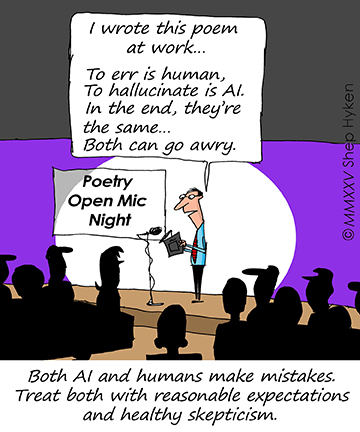
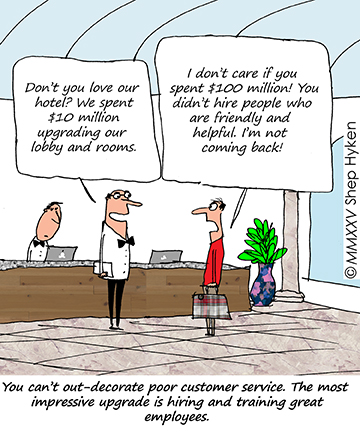
Beyond AI Shep Hyken Cartoon

I’ve shared alternative meanings of AI before, such as Artificial Incompetence, in my past articles and videos. I thought it would be fun to expand on those. So, here are some more alternative definitions of AI:

AI = Avoiding Inconvenience: This is one of my favorite definitions of AI. If you had the choice of getting an answer to your question immediately or waiting on hold for 10 minutes, which would you choose? (That’s a rhetorical question.) AI is your friend. And, AI can eliminate waiting on hold, having to prove you’re a customer and other time-consuming activities. AI, as in Avoiding Inconvenience, is super-efficient and eliminates friction from the customer experience. You might even call this version of AI Absolutely Immediate.

AI = Always Interested: AI will always try to help the customer. Even though it may fail at times, the goal of using AI to support CX and customer support is to take care of the customer. That’s what AI is programmed to do, which is why it appears to be Always Interested in helping the customer.

AI = Artificial Incompetence or Almost Intelligent: This is a definition of AI we want to avoid. AI can make mistakes. Sometimes it misunderstands customers or concocts and shares fictitious information that seems correct but is Absolutely Incorrect. Experiences like this give AI and chatbots a bad reputation. So, here’s a good AI strategy: Avoid Incompetence.

AI = Always Improving: As fast as we program and teach AI to support our customers, it is learning even faster. Things that AI couldn’t do a few months ago are routine today. Furthermore, customers are now experiencing human-like responses versus the robotic responses they were used to just a year or two ago. The point is that the technology is Always Improving.

AI = Amazing Impact:  If nothing else, we can all agree that AI can transform the customer experience by personalizing interactions at scale and freeing human customer support agents to handle complex issues rather than answering basic questions all day. This makes businesses more productive while improving the customer experience.

With all of these alternative definitions of AI, most of them positive, it’s important to remember that AI is just a tool. It’s only as good as how you use it. The companies getting AI right know they can’t go “all in” on AI and replace the human experience. I’ve interviewed dozens of executives from some of the largest brands on the planet, and not one of them thinks AI will replace people. The key is to find the right balance between AI and the human experience to create an Amazing Impact.

Image credits: ChatGPT, Shep Hyken

Subscribe to Human-Centered Change & Innovation WeeklySign up here to join 17,000+ leaders getting Human-Centered Change & Innovation Weekly delivered to their inbox every week.

Why It Matters WHO Conducts Your Customer Experience Audit

LAST UPDATED: May 29, 2026 at 4:42 PM

Why It Matters WHO Conducts Your Customer Experience Audit

by Braden Kelley and Art Inteligencia

I. Introduction: The Audit as a Mirror

In the hyper-competitive landscape of 2026, many organizations are drowning in data but starving for insight. They perform audits, yet the fundamental “why” of customer friction remains elusive.

The Diagnostic Gap

Most companies have more tools than ever to track clicks, bounce rates, and conversion funnels. Yet, there remains a persistent Diagnostic Gap: the distance between knowing what a customer did and understanding why they felt compelled to do it. Organizations often fail to see their own blind spots because they are looking into a mirror they’ve polished themselves.

The Core Thesis: Perspective over Procedure

A Customer Experience (CX) Audit (aka Customer Experience Risk and Revenue Leakage Diagnostic) is more than a technical inspection; it is an act of empathy. If the auditor lacks a human-centered innovation lens, the resulting report will be mathematically correct but strategically hollow. It might tell you that a button is in the wrong place, but it won’t tell you that your entire value proposition is losing its soul.

The Stakes in 2026

In today’s market, brand loyalty is fragile. A single friction point isn’t just an inconvenience — it’s a broadcast signal to your competitors that there is an opening to disrupt you. Who you choose to hold up the mirror determines whether you see a minor blemish or a structural crack that needs immediate innovation.

Key Takeaways: You cannot solve a problem using the same level of consciousness that created it. The value of an audit is not in the findings, but in the new perspective that allows your team to stop fearing the “How” of the present and start building the “Why” of the future.

II. Internal Audits: The Myth of Objectivity

While internal teams possess deep product knowledge, that very proximity often creates a “distortion field” that obscures the true customer experience.

The “Curse of Knowledge”

Internal teams are often too close to the project to see the friction. Because they know how the system is supposed to work, they subconsciously compensate for poor design. They skip over the confusing copy and ignore the lag because they have developed internal workarounds. A customer doesn’t have that luxury; they only see the barrier, not the intent behind it.

The Hidden Pressure of Internal Politics

An internal audit rarely exists in a vacuum. There is often an unspoken pressure to validate previous executive decisions or to protect the “babies” of influential departments. When the person auditing the experience reports to the person who designed it, the “truth” is often softened to avoid conflict, leading to incremental tweaks rather than the bold innovation required in 2026.

The Efficiency Trap vs. Customer Delight

Internal audits tend to focus on operational efficiency — how can we make this process faster or cheaper for us? While important, this lens often misses the emotional resonance of the journey. You might have a process that is 100% efficient but 0% engaging. Internal teams often solve for “Done,” while customers are looking for “Delight.”

Key Takeaways: You cannot read the label from inside the bottle. Internal audits are great for maintenance, but they are rarely the catalyst for breakthrough change. To find the “Why” of the future, you need a lens that isn’t colored by the “How” of your internal legacy.

III. Independent Audits: The Power of the Outsider

The greatest value an independent auditor brings isn’t just a new set of eyes — it’s a different set of experiences and the freedom to be radically honest.

Fresh Eyes and Cross-Industry Intelligence

An independent auditor lives outside your corporate “echo chamber.” They bring insights from diverse sectors — retail, healthcare, tech, and hospitality — to identify “unobvious” friction points you’ve grown accustomed to. In 2026, your customers don’t just compare you to your direct competitors; they compare you to the best experience they had earlier that morning. An outsider helps you measure up to that global standard.

Closing the “Accountability Gap”

Truth is the primary currency of a successful audit. An independent voice can speak truth to power without the fear of internal repercussions or career friction. This objectivity allows for a “radical transparency” that internal teams often find impossible. By closing the accountability gap, the independent auditor ensures that the real barriers to innovation are named, faced, and eventually dismantled.

Bridging the ‘Why’ and the ‘How’

While internal audits often provide a checklist of “How” to fix specific bugs, an independent auditor investigates the “Why” behind the customer’s emotional journey. They look at the narrative, not just the nodes. This perspective shift allows an organization to move beyond mere troubleshooting and into the realm of strategic experience design.

Key Takeaways: An independent auditor is the customer’s ultimate advocate. When you bring in an outside perspective, you aren’t just buying a report; you are investing in the clarity required to see your organization as the world sees it. Only then can you begin to change it.

IV. The Braden Kelley Edge: Beyond the Checklist

A standard audit tells you where the leaks are; my audit tells you how to change the flow. My approach integrates human-centered change directly into the diagnostic process.

Human-Centered Change as a Methodology

I don’t view Customer Experience as a series of static touchpoints on a map. I view it as a living ecosystem of human interactions. My “Edge” comes from treating the audit as an organizational change exercise. We don’t just look for technical errors; we look for where your internal culture and external experience have lost alignment. By centering the human — both employee and customer — we identify the psychological barriers to a seamless journey.

The Innovation Integration

Most auditors stop at “What is broken?” I start at “Where is the opportunity?” My lens is uniquely calibrated to find where your next innovation is hiding within your current customer friction. If a customer is struggling with a specific step, that isn’t just a bug — it’s a signal of unmet need. I help you translate that struggle into a roadmap for a new product, service, or business model that your competitors haven’t even imagined yet.

Strategic Alignment and Brand Soul

A “good” experience isn’t enough in 2026; it must be your experience. I ensure that every touchpoint is strategically aligned with your unique brand soul and ethical guardrails. An audit under my guidance ensures that efficiency never comes at the cost of authenticity. We solve for the “How” of the present while keeping a relentless focus on your “Why” for the future.

Key Takeaways: An audit shouldn’t just result in a list of repairs; it should result in a vision for renewal. When I audit your experience, I am looking for the spark of innovation that turns a satisfied customer into a lifelong advocate.

V. Why Braden Kelley is the Perfect Partner for Your CX Audit

Selecting an auditor is about trust, legacy, and the ability to translate observation into transformation.

A Legacy of Innovation Leadership

With years of experience as a globally recognized innovation thought leader, I don’t just see a customer journey; I see a competitive battlefield. My background in human-centered design ensures that every recommendation is grounded in the reality of human behavior. I have spent my career helping organizations navigate the complexities of change, making me uniquely qualified to identify the structural hurdles that prevent your team from delivering excellence.

The “Resilient Auditor” Framework

I apply the same resilience routines I advocate for in my speaking and writing to the audit process. This ensures a level of focus, objectivity, and deep synthesis that standard consulting firms often miss. I don’t provide “off-the-shelf” solutions; I provide a custom diagnostic that accounts for the psychological and operational resilience of your specific organization.

Actionable Velocity

The biggest failure of most CX audits is that they sit on a shelf. My goal is Actionable Velocity. I deliver a roadmap that doesn’t just list what’s wrong, but prioritizes fixes based on their potential for ROI and innovation impact. I provide your team with the “Why” they need to stay motivated and the “How” they need to execute immediately.

The Braden Kelley Promise: When I conduct your audit, you aren’t just getting a consultant; you are getting a partner dedicated to making your organization smart enough to solve its own most complex problems. We will bridge the gap between where you are and where the future demands you to be.

VI. Conclusion: Choosing Your Mirror

Ultimately, a Customer Experience Audit is an investment in clarity. In an era where disruption is the only constant, you cannot afford to look through a distorted lens. Whether you choose an internal review for maintenance or an independent audit for transformation, remember that the quality of the insight is entirely dependent on the perspective of the auditor.

Don’t Just Audit the Past — Design the Future

The goal of a world-class audit isn’t just to find out where you’ve been, but to illuminate where you are capable of going. By choosing an auditor who understands human-centered change and innovation strategy, you ensure that your organization doesn’t just fix the “How” of today, but masters the “Why” of tomorrow.

The mirror you choose today will determine the reflection your customers see tomorrow. Make sure it is a mirror that shows the full potential of your brand’s soul.

Ready to Transform Your Customer Journey?

Stop guessing and start innovating. Let’s work together to find the “unobvious” opportunities hidden within your customer experience.

— Braden Kelley

Ready to find your Customer Experience innovation opportunities?

Request a Customer Experience Audit

For more on Customer Experience Audits check out:

Customer Experience Audit 101
Why a Customer Experience Audit is Non-Negotiable in 2026
Is Your Customer Experience a Lie?

CX Audit: Frequently Asked Questions

1. Why is an independent CX audit better than an internal one?

Internal teams often suffer from the “Curse of Knowledge” — they are so familiar with how things should work that they miss how they actually work for the customer. An independent auditor brings unbiased clarity and the courage to name the structural issues that internal politics might keep hidden.

2. How does Braden Kelley’s approach differ from others?

Most audits look for bugs; Braden Kelley looks for breakthroughs. By applying a human-centered innovation lens, Braden identifies not just where you are failing the customer, but where the customer is signaling a need for a new solution you haven’t built yet.

3. What is the main outcome of this audit?

The primary outcome is Actionable Velocity. You won’t receive a static report; you’ll get a prioritized roadmap that balances immediate experience “quick wins” with long-term strategic innovation goals, ensuring your CX is a driver of growth, not just a line item.

Image credits: ChatGPT

Content Authenticity Statement: The topic area, key elements to focus on, etc. were decisions made by Braden Kelley, with a little help from Google Gemini to clean up the article and add citations.

Subscribe to Human-Centered Change & Innovation WeeklySign up here to get Human-Centered Change & Innovation Weekly delivered to your inbox every week.

Five Ways to React to Online Customer Feedback

Five Ways to React to Online Customer Feedback

GUEST POST from Shep Hyken

It’s one thing to listen to what your customers are saying when they reach out to you directly through calls, emails, texts, or direct messages. But many customers prefer to “go social” and comment on social media, review sites, and online forums.

So the question is, “Are you listening?”

By “listening,” I mean social listening, paying attention to what customers are saying about you everywhere except directly to you.

In the past month, I’ve been asked twice about social listening, responding to surveys, and monitoring online comments and reviews. However, let me emphasize that comments and reviews are not limited to the typical review sites, such as Google, Yelp, TripAdvisor, and others. Your customers will also share comments on Facebook, Instagram, and other social media sites.

So, even though we call it social listening, a better name might be social reacting. If you take the time to “listen,” which means reading or watching what customers are saying about you, it is in your best interest to react with an appropriate response.

Negative Reviews Shep Hyken Cartoon

While I believe you should respond to all comments and reviews, it’s especially important to respond to the negative. By the way, negative reviews aren’t so bad. In one of my articles about embracing negative reviews, I mentioned that a perfect five-star rating causes some customers to think, “This is too good to be true.” Perfection is not reality, and customers know this.

With that in mind, here are five social reaction strategies and tactics:

  1. React to Positive Comments: A short thank you is appropriate. If you can personalize it, even better.
  2. React to Negative Comments: As mentioned, it’s especially important to respond to negative reviews and comments, and I’ll add, in a timely fashion. The sooner the better. This adds a sense of urgency and creates credibility. If possible, take the complaint “offline” and deal directly with the customer. Then return to the site where the comment or review was first shared and let the world know you resolved the issue.
  3. React to Unreasonable Comments: Not every comment will be reasonable. Some people will be unreasonable. A simple and professional response is appropriate. Offer a way for the customer to contact you directly. Don’t be defensive, or you’ll add fuel to the fire.
  4. It’s Okay to Use AI and Templates When Reacting: Depending on how many comments you get, AI and templates can save you time. But, make sure to customize them to the situation. Don’t just copy and paste comments. Customers will notice.
  5. Treat Customer Comments as Learning Opportunities: This idea goes beyond social channels and review sites. Any comment that comes your way, positive or negative, is a learning opportunity. If you get negative feedback, find ways to prevent it from happening again. If the feedback is positive, find ways to make sure it always happens.

Companies spend a lot of money to get customers to notice them through marketing and advertising. Don’t waste that investment by not considering social reacting as part of your marketing and customer experience (CX) plan.

Image credits: Pixabay

Subscribe to Human-Centered Change & Innovation WeeklySign up here to join 17,000+ leaders getting Human-Centered Change & Innovation Weekly delivered to their inbox every week.

Digital Phenotyping and the Future of Preventative Experience Design

The Silent Pulse

LAST UPDATED: February 16, 2026 at 6:01 PM

Digital Phenotyping and the Future of Preventative Experience Design

GUEST POST from Art Inteligencia


I. Introduction: Beyond the Survey

The Death of “Self-Reporting”

For decades, the gold standard for understanding employee well-being or customer satisfaction has been the survey. We ask people how they feel, and they give us an answer filtered through their own biases, current mood, or what they think we want to hear. In the world of innovation, self-reporting is a lagging indicator — and a flawed one at that.

Defining Digital Phenotyping

We are entering the era of Digital Phenotyping: the moment-by-moment quantification of the individual-level human phenotype in situ using data from personal digital devices. By analyzing the “digital exhaust” from smartphones and wearables — mobility patterns, social interactions, and even typing rhythm — we can infer behavioral, emotional, and cognitive states with unprecedented accuracy.

The Paradigm Shift: From Reactive to Preventative

The true power of this technology lies in its ability to turn experience design from a reactive fix into a preventative strategy. We no longer have to wait for a “burnout crisis” or a drop in productivity to realize our team is under excessive stress. The signals are there, in real-time, hidden in the cadence of our digital lives.

“Innovation is about solving the problems that people haven’t yet found the words to describe. Digital Phenotyping gives us the ears to hear those unspoken needs.”
— Braden Kelley

As we move beyond the survey, we must lead with a human-centered lens. The goal isn’t to monitor; it’s to support. We are shifting from a world that reacts to failure to a world that senses — and sustains — human flourishing.

II. The Mechanics of Passive Sensing

Digital phenotyping relies on passive data — information collected in the background without requiring any active input from the user. This removes the “friction” of participation and provides a continuous stream of objective reality.

The Three Primary Data Streams

1. Mobility and Physical Activity

Using GPS and accelerometers, we can map “life space.” A sudden constriction in a person’s physical movement — fewer locations visited or reduced steps — can be a powerful proxy for depressive states or social withdrawal. Conversely, erratic movement patterns might signal high levels of anxiety or agitation.

2. Social and Communication Meta-data

This isn’t about what is being said, but how the person is interacting. Call frequency, text latency, and social media engagement patterns reveal shifts in social connectivity. A drop in outbound communication often precedes a burnout phase before the employee even feels “tired.”

3. Human-Computer Interaction (HCI)

The way we interact with our screens is a window into our cognitive health. Typing speed, the frequency of “backspacing,” and scrolling patterns can indicate cognitive overload or a lapse in focus. These “digital biomarkers” are the most immediate indicators of whether a task is designed for human success or human failure.

The Synthesis: From Signals to Insights

The magic happens in the AI synthesis layer. By correlating these streams, machine learning models can identify a “baseline” for an individual. When the data deviates from that baseline, the system identifies a “glitch” — a moment where the human-centered design of the environment is no longer supporting the human within it.

“Data is just a signal; insight is the story. In digital phenotyping, we are learning to read the stories written in the rhythm of our daily digital interactions.”
— Braden Kelley

III. Value Creation: Turning Insight into Action

The true ROI of digital phenotyping isn’t found in the data itself, but in the Experience Design it enables. By moving from reactive to preventative models, we can create environments that adapt to the human state in real-time.

Preventative Experience Design in Practice

Real-Time Burnout Mitigation

Imagine a project management tool that senses cognitive overload through typing patterns and erratic screen switching. Instead of pushing another notification, the system “softens” — delaying non-essential alerts and suggesting a recovery break. This is human-centered design in action: protecting the asset (the person) before the damage occurs.

Adaptive User Interfaces (AUI)

In high-stakes environments like healthcare or emergency response, digital phenotyping allows interfaces to simplify themselves when stress markers are detected. By reducing the “information density” during moments of high stress, we prevent human error and improve outcomes.

The Strategic Advantage of “Wellness as a Service”

Organizations that implement these tools as a benefit rather than a monitor will see a massive shift in retention and engagement. When an employee knows the “system” is looking out for their mental health — flagging potential depression signals or isolation patterns early — the relationship between employer and employee evolves from transactional to collaborative.

“Value in the future of work won’t be measured by output alone, but by the sustainability of the human spirit behind that output.”
— Braden Kelley

By leveraging these insights, we aren’t just innovating products; we are innovating the way we treat people.

IV. The Innovation Ethical Frontier

Digital phenotyping sits at the intersection of extreme utility and extreme vulnerability. As innovators, we must acknowledge that data is a surrogate for intimacy. When we measure a person’s gait or typing rhythm, we are entering their private mental space. Without a robust ethical framework, we risk building a “Digital Panopticon” rather than a supportive ecosystem.

The Three Pillars of Ethical Phenotyping

1. Radical Transparency & Consent

Standard “Terms and Conditions” are insufficient. Consent must be active and ongoing. Users should know exactly what biomarkers are being tracked and have the “Right to Disconnect” without penalty. Transparency isn’t just a legal hurdle; it’s a trust-building feature.

2. Purpose-Driven Data Minimization

The temptation to “collect it all” is the enemy of ethics. We must practice data minimalism: collecting only the specific signals required to provide the promised human-centered value. If a signal doesn’t directly contribute to a preventative intervention, it shouldn’t be gathered.

3. The “Benefit Flow” Guarantee

The value derived from the data must flow primarily back to the individual. If the organization is the only one benefiting (through higher productivity), it’s surveillance. If the individual benefits (through better mental health and reduced stress), it’s empowerment.

Leading with Empathy-Led Ethics

We must move beyond “compliance-based” privacy. In a human-centered organization, we ask: “Would our employees feel cared for or watched if they knew how this worked?” If the answer is “watched,” the innovation is flawed at the architectural level.

“Trust is the only currency that matters in the future of innovation. Once you spend it on surveillance, you can never buy it back.”
— Braden Kelley

By establishing these guardrails early, we ensure that digital phenotyping remains a tool for human flourishing rather than a weapon for corporate control.

V. Leading the Human-Centered Change

Implementing digital phenotyping is not a technical deployment; it is a cultural transformation. If leaders treat this like a software update, they will face immediate resistance. To succeed, we must lead with transparency and a clear focus on the “human” in human-centered innovation.

The Role of the “Architect” in Rollout

Leaders must act as the architects of trust. This means the Chief Innovation Officer and the CHRO must work in lockstep to ensure that the purpose of the data is clearly defined and that those definitions are unshakeable.

Strategies for Successful Integration:

  • The “Opt-In” Mandate: Never make passive sensing mandatory. The power of these tools comes from voluntary participation. When people choose to participate, they become stakeholders in their own well-being.
  • Stakeholder Education: We must educate every level of the organization — especially our “Sensors” (the employees) — on what digital biomarkers are and how they are used to trigger supportive interventions.
  • Feedback Loops: Create a mechanism where employees can provide feedback on the interventions. If a system suggests a “burnout break,” was it helpful or annoying? The human must remain the final authority.

Transparency as a Competitive Feature

In the future, the most successful organizations will be those that are radically transparent about their data practices. By being open about the algorithms and the “why” behind the sensing, we remove the mystery and the fear. Transparency turns a “black box” into a “glass box.”

“Change happens at the speed of trust. If you want to innovate at the edge of human behavior, you must first build a foundation of absolute integrity.”
— Braden Kelley

By focusing on the human-centered change, we ensure that digital phenotyping isn’t something done to people, but something done for them.

VI. Conclusion: Designing a More Intuitive World

The transition from reactive to preventative design represents one of the most significant leaps in the history of Human-Centered Innovation. Digital phenotyping allows us to stop guessing and start knowing — not for the sake of control, but for the sake of care.

The Future is Empathetic

We are moving toward a world where our tools understand our limits as well as we do. Imagine a workplace that recognizes your stress before you have a headache, or a digital assistant that knows you’re cognitively overloaded and helps you prioritize. This is the Intuitive World we are designing.

A Leader’s Final Responsibility

As innovators and leaders, our responsibility is to ensure that as our machines become more “human-literate,” we do not become less human in our leadership. Digital phenotyping is a tool of immense power. Used correctly, it can eradicate burnout, foster deep engagement, and support mental health on a global scale.

“The most advanced technology is the one that makes us feel most human. Our job is to ensure digital phenotyping does exactly that.”
— Braden Kelley

The signals are all around us, pulsing through the devices in our pockets and on our wrists. The question is no longer whether we can hear them, but whether we have the innovation leadership and ethical courage to act on what they are telling us.

Deep Dive: Frequently Asked Questions

Does Digital Phenotyping mean my boss is reading my texts?

Absolutely not. Ethical digital phenotyping focuses on metadata and patterns, not content. It looks at the frequency of communication or the speed of your typing, not the words you say. As an innovation leader, I advocate for systems where the content remains private and encrypted.

Why is this better than a monthly wellness survey?

Surveys are “lagging indicators” — they tell us how you felt in the past. By the time a survey is analyzed, burnout has often already occurred. Digital phenotyping provides real-time signals, allowing for immediate, helpful interventions that can prevent a crisis before it starts.

Can I opt-out of this kind of data collection?

In any human-centered organization, the answer must be yes. Trust is the foundation of innovation. For digital phenotyping to work, it must be an opt-in benefit that employees use because they see the value in their own well-being and professional growth.

Disclaimer: This article speculates on the potential future applications of cutting-edge scientific research. While based on current scientific understanding, the practical realization of these concepts may vary in timeline and feasibility and are subject to ongoing research and development.

Image credits: Google Gemini

Subscribe to Human-Centered Change & Innovation WeeklySign up here to get Human-Centered Change & Innovation Weekly delivered to your inbox every week.

Top 10 Human-Centered Change & Innovation Articles of January 2026

Top 10 Human-Centered Change & Innovation Articles of January 2026Drum roll please…

At the beginning of each month, we will profile the ten articles from the previous month that generated the most traffic to Human-Centered Change & Innovation. Did your favorite make the cut?
But enough delay, here are January’s ten most popular innovation posts:

  1. Top 40 Innovation Authors of 2025 — Curated by Braden Kelley
  2. Trust is a Gold Mine for Organizations, but it Takes a Bit of Courage — by Oscar Amundsen
  3. Outcome-Driven Innovation in the Age of Agentic AI — by Braden Kelley
  4. Building Your Dream Organization — by Braden Kelley
  5. Why Photonic Processors are the Nervous System of the Future — by Art Inteligencia
  6. Reimagining Personalization — by Geoffrey Moore
  7. We Must Hold AI Accountable — by Greg Satell
  8. The Keys to Changing Someone’s Mind — by Greg Satell
  9. Concentrated Wealth, Consolidated Markets, and the Collapse of Innovation — by Art Inteligencia
  10. It’s Impossible to Innovate When … — by Mike Shipulski

BONUS – Here are five more strong articles published in December that continue to resonate with people:

If you’re not familiar with Human-Centered Change & Innovation, we publish 4-7 new articles every week built around innovation and transformation insights from our roster of contributing authors and ad hoc submissions from community members. Get the articles right in your Facebook, Twitter or Linkedin feeds too!

Build a Common Language of Innovation on your team

Have something to contribute?

Human-Centered Change & Innovation is open to contributions from any and all innovation and transformation professionals out there (practitioners, professors, researchers, consultants, authors, etc.) who have valuable human-centered change and innovation insights to share with everyone for the greater good. If you’d like to contribute, please contact me.

P.S. Here are our Top 40 Innovation Bloggers lists from the last five years:

Subscribe to Human-Centered Change & Innovation WeeklySign up here to get Human-Centered Change & Innovation Weekly delivered to your inbox every week.

Why We Love to Hate Chatbots

Why We Love to Hate Chatbots

GUEST POST from Shep Hyken

More and more, brands are starting to get the chatbot “thing” right. AI is improving, and customers are realizing that a chatbot can be a great first stop for getting quick answers or resolving questions. After all, if you have a question, don’t you want it answered now?

In a recent interview, I was asked, “What do you love about chatbots?” That was easy. Then came the follow-up question, “What do you hate about chatbots?” Also easy. The truth is, chatbots can deliver amazing experiences. They can also cause just as much frustration as a very long phone hold. With that in mind, here are five reasons to love (and hate) chatbots:

Why We Love Chatbots

  1. 24/7 Availability: Chatbots are always on. They don’t sleep. Customers can get help at any time, even during holidays.
  2. Fast Response: Instant answers to simple questions, such as hours of operation, order status and basic troubleshooting, can be provided with efficiency and minimal friction.
  3. Customer Service at Scale: Once you set up a chatbot, it can handle many customers at once. Customers won’t have to wait, and human agents can focus on more complicated issues and problems.
  4. Multiple Language Capabilities: The latest chatbots are capable of speaking and typing in many different languages. Whether you need global support or just want to cater to different cultures in a local area, a chatbot has you covered.
  5. Consistent Answers: When programmed properly, a chatbot delivers the same answers every time.

Chatbots Shep Hyken Cartoon

Why We Hate Chatbots

  1. AI Can’t Do Everything, but Some Companies Think It Can: This is what frustrates customers the most. Some companies believe AI and chatbots can do it all. They can’t, and the result is frustrated customers who will eventually move on to the competition.
  2. A Lack of Empathy: AI can do a lot, but it can’t express true emotions. For some customers, care, empathy and understanding are more important than efficiency.
  3. Scripted Retorts Feel Robotic: Chatbots often follow strict guidelines. That’s actually a good thing, unless the answers provided feel overly scripted and generic.
  4. Hard to Get to a Human: One of the biggest complaints about chatbots is, “I just want to talk to a person.” Smart companies make it easy for customers to leave AI and connect to a human.
  5. There’s No Emotional Connection to a Chatbot: You’ll most likely never hear a customer say, “I love my chatbot.” A chatbot won’t win your heart. In customer service, sometimes how you make someone feel is more important than what you say.

Chatbots are powerful tools, but they are not a replacement for human connection. The best companies use AI to enhance support, not replace it. When chatbots handle the routine issues and agents handle the more complex and human moments, that’s when customer experience goes from efficient to … amazing.

Image credits: Unsplash

Subscribe to Human-Centered Change & Innovation WeeklySign up here to join 17,000+ leaders getting Human-Centered Change & Innovation Weekly delivered to their inbox every week.

Is Your Customer Experience a Lie?

LAST UPDATED: May 29, 2026 at 10:40 AM

Is Your Customer Experience a Lie?

by Braden Kelley and Art Inteligencia

In the high-stakes theater of modern business, many leaders have developed a remarkable talent for a dangerous form of “experience narcissism.” They stand in boardrooms, surrounded by glowing dashboards and rising Net Promoter Scores (NPS), convincing themselves of a comforting delusion: that they already know exactly what it feels like to be their customer. They assume that because the machine is running, it must be well-oiled. But as a champion of Customer Experience Audits (aka Customer Experience Risk and Revenue Leakage Diagnostic), I have seen far too many organizations fail not because they lacked a great product, but because they lacked the courage to look in the mirror.

The refusal to conduct regular, rigorous customer experience audits is rarely a matter of resources; it is a defensive reflex. It is the Corporate Antibody Response protecting the status quo. Leaders tell themselves that their digital analytics tell the whole story, or that “if it were truly broken, we’d hear about it.” These are the lies that create Invisible Friction — the silent, compounding drag that prevents an invention from ever reaching its potential as a true innovation.

When we avoid the audit, we aren’t just saving time; we are actively choosing to ignore the hurdles that drive customers into the arms of more agile competitors. We treat the customer journey as a static map we drew five years ago, rather than a living, breathing, and often messy reality. To be a leader in the age of Purpose-Driven Innovation, you must be willing to trade your comfortable assumptions for the uncomfortable truth.

1. The Lie of “We Already Know Our Customers”

The first, and perhaps most seductive, lie that leaders tell themselves is the myth of the “Static Persona.” This is the belief that because the leadership team spent six months on a deep-dive research project three years ago, they now possess a permanent, intuitive understanding of their customer’s psyche. They treat customer knowledge as a milestone to be reached rather than a perishable asset. Competitors change the baseline for “convenience,” global events shift priorities, and technology alters how customers view value. Without a regular audit, leaders are effectively navigating today’s stormy seas using a map of a coastline that has already eroded.

This lie often manifests as “Experience Narcissism,” where executives assume their own personal interactions with the brand are representative of the average user’s journey. They use the latest flagship hardware on a high-speed corporate network and wonder why the front-line customer, using a three-year-old device on a spotty cellular connection, is frustrated. They confuse their authority with empathy. A rigorous audit acts as a necessary “ego-check,” stripping away the polished executive view to reveal the Invisible Friction that customers face every single day.

Furthermore, leaders frequently mistake “Customer Data” for “Customer Truth.” They point to demographic reports and purchase histories as proof of their intimacy with the market. But data tells you the what, while an audit tells you the why. You might know that a customer abandoned their cart, but without an audit of the experience, you won’t know if they left because of a technical glitch, a confusing shipping policy, or a sudden moment of brand distrust. To ignore the audit is to choose to lead from a spreadsheet rather than from the soul of the customer journey.

2. The Lie of “Digital Analytics Tells the Whole Story”

The second great deception is the worship of the “Dashboard Delusion” — the belief that a green arrow on a conversion chart is synonymous with a satisfied customer. Leaders often hide behind quantitative data because it feels objective, safe, and controllable. They see a steady flow of traffic and a predictable checkout rate and conclude that the Value Access path is clear. However, digital analytics are purely evidentiary; they show you where the footprints are, but they never show you the “ghosts”—the thousands of potential customers who looked at your landing page, felt a subtle pang of confusion or distrust, and vanished without leaving a single data point behind.

An audit is required because analytics cannot measure what didn’t happen. They don’t capture the frustration of a user who successfully completed a task but vowed never to return because the process was emotionally draining. They don’t show the Invisible Friction of a customer who had to open a separate tab to search for an explanation of your jargon. When leaders skip the audit, they are essentially trying to understand a symphony by looking at a spreadsheet of decibel levels; they see the volume, but they completely miss the dissonance.

Furthermore, relying solely on digital metrics often leads to “Local Maxima” thinking. You might optimize a button color or a headline to increase a click-through rate by $2\%$, but an experience audit might reveal that the entire feature is redundant or misaligned with the customer’s actual goal. Analytics tell you how to do the wrong thing more efficiently, while auditing tells you if you are doing the right thing at all. As I often emphasize, true Value Translation happens in the heart of the user, a place where Google Analytics has no login credentials.

3. The Lie of “We’ll Hear About It If It’s Broken”

The third lie is perhaps the most comfortable, and therefore the most catastrophic: the “Silence is Golden” fallacy. Leaders often operate under the assumption that their customers act as a free, 24/7 quality assurance team. They believe that if a friction point were truly detrimental to the brand, it would trigger a flood of support tickets or a viral social media outcry. This creates a false sense of security that I call the Reactive Trap. In reality, the vast majority of customers do not have the time, energy, or desire to help you fix your business. When they encounter a broken experience, they don’t complain — they simply evaporate.

This silence is not a sign of health; it is the sound of Silent Churn. For every one customer who takes the time to write a detailed email about a confusing interface or a lackluster service interaction, there are dozens more who quietly moved their business to a competitor who made the “Value Access” feel effortless. By the time a problem is “loud” enough to reach the executive suite without an audit, the organization has likely already lost significant market share. An audit is a proactive hunt for these silent killers, allowing for Human-Centered Change™ before the damage becomes irreversible.

Relying on complaints also skews a leader’s perspective toward “extreme” failures while ignoring the “death by a thousand cuts” that truly defines a brand’s reputation. A customer might not complain about a slightly slow load time, a mildly confusing confirmation email, or a repetitive form field, but the cumulative Cognitive Load of these micro-frictions erodes trust over time. As an innovation speaker, I frequently remind my clients that “no news” is often just a polite way of saying “I’ve found someone better.”

4. The Lie of “It’s Too Expensive and Time-Consuming”

The fourth lie is a classic case of “Accounting Myopia” — the belief that a customer experience audit is a discretionary expense rather than a fundamental investment in Value Creation. Leaders often look at the price tag of a comprehensive audit or the internal hours required to map a journey and immediately relegate it to the “maybe next year” pile. They view the audit as a cost center, a luxury to be indulged only when the budget is flush. What they fail to realize is that they are already paying for the audit every single day — not in invoices, but in the “Friction Tax” of lost conversions, increased support costs, and skyrocketing customer acquisition fees.

When you refuse to audit, you are essentially pouring expensive marketing “water” into a leaky bucket. You might spend millions on a new brand campaign, but if your Value Access path is riddled with Invisible Friction, a significant portion of that investment is being wasted. I’ll argue that if you think an audit is expensive, you haven’t calculated the cost of the “Experience Void” — the revenue left on the table by customers who encountered a hurdle and walked away. An audit doesn’t cost money; it recovers stolen profit.

Furthermore, the “Time-Consuming” argument is often a mask for a lack of organizational agility. Leaders fear that an audit will uncover a mountain of technical debt or procedural flaws that they aren’t prepared to fix, so they avoid the diagnosis to avoid the surgery. But in the age of Purpose-Driven Innovation, time is your most precious commodity. Every month you spend operating with a flawed experience is a month you give your competitors to build a better relationship with your audience. Let’s be honest: “You don’t have time not to audit.” You can either spend the time now to fix the journey, or spend the time later explaining to the board why your market share has evaporated.

5. The Lie of “Our NPS Score is Great”

The final, and perhaps most insidious, deception is the “Metric Shield” — the belief that a high Net Promoter Score (NPS) is a definitive certificate of health that renders a customer experience audit unnecessary. Leaders often cling to this single, shiny number as a way to soothe their egos and pacify the board. They argue that if the “score is up,” the customers must be happy. However, as any customer experience practitioner knows, NPS is a trailing indicator that is notoriously easy to manipulate and dangerously void of context. It tells you the temperature of the room, but it doesn’t tell you if the air is toxic.

When leaders use NPS to bypass an audit, they are choosing to prioritize a vanity metric over Value Translation. An NPS score can be high simply because your customers have no better alternative at the moment, or because your team has learned to “game” the survey by sending it only after successful interactions. It fails to capture the Invisible Friction of the silent majority who were too frustrated to even take the survey. An audit, by contrast, dives into the “Why” behind the number. It reveals the cracks in the foundation that a single-digit score is designed to cover up.

Relying on NPS without an audit is like checking your heart rate and assuming you’re fit for a marathon without checking if your legs are broken. You might have “Promoters” who love your brand’s mission but are secretly exhausted by your checkout process. These are “Fragile Promoters” who will defect the moment a competitor offers a lower Cognitive Load. Often the most dangerous place for a leader to be is standing on top of a high NPS score, refusing to look down at the crumbling experience beneath their feet.

Conclusion

The greatest threat to your organization’s future isn’t a lack of vision or a shortage of capital — it is the comfort of your own assumptions. Every lie you tell yourself about the state of your customer journey acts as a Corporate Antibody, attacking the very innovation you claim to champion. By avoiding the regular, rigorous mirror of a customer experience audit, you are essentially choosing to drive a high-performance vehicle with the windshield blacked out, relying solely on a GPS map that hasn’t been updated in years. True leadership requires the humility to admit that what you think you know about your customer is likely outdated, and what your dashboards are telling you is likely incomplete.

The path to success in 2026 is paved with the friction you choose to remove today. If you are ready to stop hiding behind “Experience Narcissism” and vanity metrics, you must treat auditing not as a chore, but as a strategic competitive advantage. For those ready to take the first step toward a clearer perspective, I encourage you to explore my deep-dive guide in Customer Experience Audit 101 or understand the shifting landscape in Why a Customer Experience Audit is Non-Negotiable in 2026. The wilderness of the market is moving fast, and only those who constantly tend to their “customer garden” will survive.

I have spent my career helping leaders turn their Invisible Friction into visible opportunity. Don’t wait for your customers to tell you it’s broken by leaving; be proactive and reclaim the experience excellence they deserve. Do you need help conducting a transformative customer experience audit?

Let’s work together to ensure your innovation doesn’t just look good on paper, but feels incredible in the hands of your customers.

Five Lies Leaders Tell Themselves About CX

Download the Five Lies Leaders Tell Themselves About CX Flipbook as a PDF by clicking the link or the image above.

Image credits: ChatGPT

Content Authenticity Statement: The topic area, key elements to focus on, etc. were decisions made by Braden Kelley, with a little help from Google Gemini to clean up the article and add citations.

Subscribe to Human-Centered Change & Innovation WeeklySign up here to get Human-Centered Change & Innovation Weekly delivered to your inbox every week.

Synthetic Ethnography

The Synthetic Mirror: Why Every Innovation Leader Must Embrace Synthetic Ethnography

LAST UPDATED: February 6, 2026 at 3:28 PM

Synthetic Ethnography

GUEST POST from Art Inteligencia

Innovation is not a lightning strike; it is a discipline. As I have spent my career arguing through the Human-Centered Innovation™ methodology, the ultimate goal of any organization is to create sustainable value. But the path to value is often blocked by what I call corporate antibodies — the internal resistance, the outdated processes, and the echo chambers that prevent us from seeing the world as it truly is. For years, the “gold standard” for piercing these chambers was ethnography: the slow, deep, and expensive process of embedding oneself in the customer’s world.

But today, we find ourselves at a precipice. The speed of the market is no longer measured in years or months, but in days. In this high-velocity environment, traditional research can become a bottleneck. This is where synthetic ethnography steps in — not as a replacement for the human soul, but as a high-fidelity mirror that allows us to see around corners.

Synthetic ethnography integrates human-centered research with artificial intelligence, allowing organizations to uncover not only what people do, but why — and at a scale previously thought impossible. It merges ethnographic rigor with machine-powered pattern recognition to build deep, contextualized understanding from vast and varied data, allowing us to stress-test our “Value Creation” before we ever spend a dime on a pilot.


“Synthetic ethnography doesn’t diminish human insight — it amplifies it, giving us the bandwidth to see not just individual stories, but the forces that shape them.”

— Braden Kelley

What Is Synthetic Ethnography?

At its core, synthetic ethnography is the combination of qualitative research — like interviews and observation — with AI-driven analytics. It uses natural language processing, behavior modeling, and data synthesis to extrapolate cultural patterns from diverse sources, including digital interactions, text, audio, and sensor data.

Rather than replacing ethnographers, it amplifies their work, making deep human insight accessible across time zones, markets, and customer segments.

The Shift from “Asking” to “Simulating”

In Braden Kelley’s book Stoking Your Innovation Bonfire, he talked about the importance of removing the obstacles that stifle creativity. One of the biggest obstacles is the “Assumption Gap.” We assume we know why a customer chooses a competitor. We assume we know why they abandon a cart. Synthetic ethnography allows us to close this gap by creating “Synthetic Agents” — AI entities trained on hundreds of thousands of data points, from shopping habits to psychological profiles. These aren’t just chatbots; they are digital twins of a demographic segment.

When we use these agents, we are embracing the FutureHacking™ mindset. We can run ten thousand “what-if” scenarios. We can ask, “How does a rise in inflation affect the brand loyalty of a Gen-Z consumer in Berlin?” and receive a statistically grounded simulation of that reaction. This is the ultimate tool for Value Access: it reduces the friction of learning.

Why It Matters

Synthetic ethnography doesn’t just scale research — it deepens it. Organizations can:

  • Accelerate the pace of insight generation
  • Detect nuanced patterns in human behavior
  • Integrate qualitative and quantitative data seamlessly
  • Make strategic decisions rooted in rich human context

Case Study 1: The CPG “Flavor Evolution” Challenge

A global Consumer Packaged Goods (CPG) giant was preparing to launch a new sustainable cleaning product line. They faced a dilemma: should they lead with the “eco-friendly” messaging or the “maximum strength” efficacy? Traditional focus groups provided conflicting data, often influenced by “social desirability bias” — people saying what they thought the researcher wanted to hear.

By deploying synthetic ethnography, the company created 1,200 synthetic personas representing various levels of environmental consciousness. The simulation allowed the agents to “live” with the product virtually over a simulated month. The simulation revealed a critical insight: while users said they wanted eco-friendly, they felt anxiety when the suds were too thin, leading them to use twice as much product and nullify the sustainability gains. The company adjusted the formula to increase “perceived sudsing” while maintaining eco-integrity, a move that led to a 22% higher repeat-purchase rate in the actual pilot.

Case Study 2: Reimagining the Patient Experience in Healthcare

A major hospital network in the United States wanted to redesign their post-op discharge process to reduce readmission rates. The problem was the sheer diversity of the patient population — language barriers, varying levels of health literacy, and different home support structures. It was impossible to shadow every type of patient.

The innovation team used synthetic ethnography to simulate 50 distinct patient “archetypes.” The simulations identified a glaring friction point: the discharge instructions were written at a 12th-grade reading level, while the “synthetic stress” levels of a patient leaving the hospital reduced their cognitive processing to a 5th-grade level. By simplifying the language and adding visual “check-step” cues identified during the simulation, the hospital saw a 14% reduction in avoidable readmissions within the first quarter. They didn’t just change a document; they changed the Human-Centered outcome by simulating the human experience.

“Innovation transforms the useful seeds of invention into widely adopted solutions valued above every existing alternative. Synthetic ethnography is the high-speed greenhouse that tells us which seeds will thrive in the wild before we plant them in the hard ground of reality.”

Braden Kelley

Case Study 3: Telecommunications Across Cultures

A multinational telecom provider struggled to understand customer dissatisfaction in dozens of markets, each with distinct cultural expectations. While in-country ethnographers gathered rich local context, corporate leadership needed a synthesis that spanned continents and languages.

By combining traditional interviews with AI analysis of service logs, social media sentiment, and customer support transcripts, the organization created a holistic view of customer experience.

  • Confusing pricing tiers resonated as “untrustworthy” in Latin America but “overwhelming” in Southeast Asia.
  • Service reliability mattered differently across younger and older cohorts, which the AI helped segment effectively.
  • Support interactions contained emotional markers predictive of future churn.

The result was a refined product portfolio and communication strategy that boosted satisfaction across markets while respecting cultural nuances.

The Competitive Landscape

The market for synthetic insights is exploding. Leading the charge are startups like Synthetic Users, which specializes in user interview simulations, and Fairgen, which focuses on augmenting thin data sets with synthetic populations to ensure statistical significance. We also see SurveyAuto using AI to bridge the gap in emerging markets. Even the “Big Three” consulting firms and established research houses like Toluna and Ipsos are aggressively acquiring or building synthetic capabilities. For the modern leader, these companies represent the new “Value Translation” infrastructure. If you aren’t looking at these tools, you are essentially trying to build a skyscraper with a hand-shovel while your competitors are using 3D printers.

However, we must remain vigilant. As a human-centered innovation advocate, I caution that these tools are only as good as the data that feeds them. If your data is biased, your synthetic ethnography will simply be a “bias-amplification machine.” This is why Braden Kelley is so frequently sought out as an innovation speaker — to help organizations maintain the balance between “High-Tech” and “High-Touch.” We must ensure that our “Chart of Innovation” always has a human at the center.

Innovation Intelligence: The FAQ

1. How does synthetic ethnography improve the ROI of innovation?
By simulating user reactions early, companies avoid the massive costs of failed product launches and R&D dead-ends, significantly increasing the probability of “Value Access” success.

2. What is the biggest risk of using synthetic personas?
The “Hallucination of Empathy.” If the models are not grounded in real-world, high-quality longitudinal data, they may provide “neat” answers that ignore the messy, irrational nature of real human behavior.

3. Is synthetic ethnography appropriate for B2B innovation?
Absolutely. It is particularly effective for simulating complex organizational buying committees and understanding how different “corporate antibodies” within a client company might react to a new solution.

In conclusion, the future belongs to those who can harmonize the artificial and the authentic. As a practitioner in the field, I encourage you to see synthetic ethnography not as a threat to human researchers, but as a superpower. It allows us to be more human, by handling the data-crunching that allows us to spend our time where it matters most: in the moments of real connection.

Disclaimer: This article speculates on the potential future applications of cutting-edge scientific research. While based on current scientific understanding, the practical realization of these concepts may vary in timeline and feasibility and are subject to ongoing research and development.

Image credits: Google Gemini

Subscribe to Human-Centered Change & Innovation WeeklySign up here to get Human-Centered Change & Innovation Weekly delivered to your inbox every week.