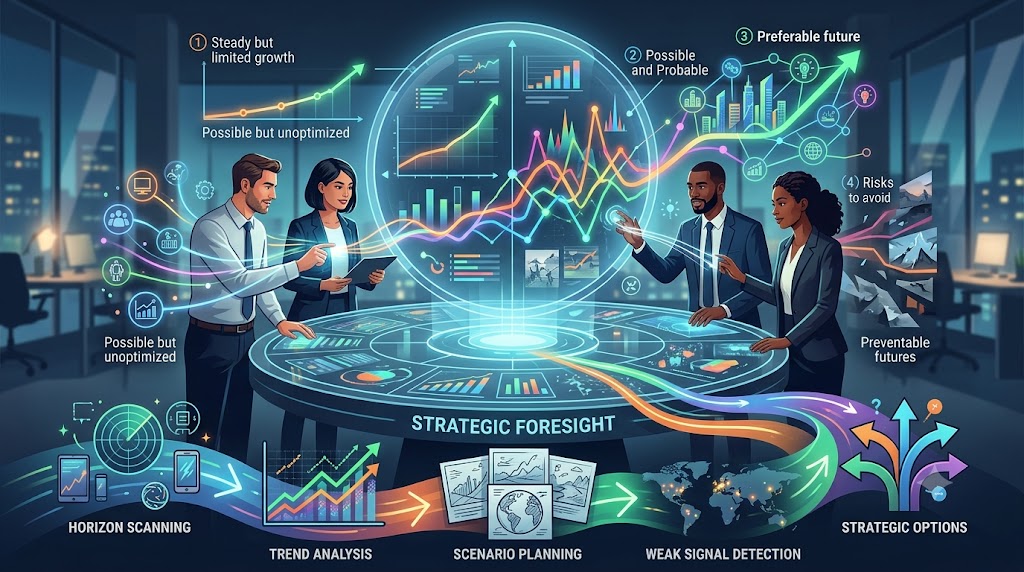
Every January, I watch the same ritual play out inside otherwise well-run organizations. Leadership spends weeks, sometimes months, building a strategic plan for the year ahead: a single narrative about where the market is going, what the company will do about it, and how success will be measured twelve months from now. By the time Q2 closes, half of that plan is already quietly out of date, and everyone in the room knows it. Nobody says so out loud, because saying so would mean admitting the process itself is the problem, not the plan.
The plan was never wrong. It was just singular.
Here’s what I’ve learned after two decades of helping organizations navigate exactly this moment: the plan usually wasn’t badly built. The people in the room were smart, the research was real, the logic held together. The failure isn’t in the thinking, it’s in the structure. A traditional strategic plan describes one future and commits real budget, real headcount, and real organizational attention to it. When that one future doesn’t materialize exactly as modeled, and it never does, not exactly, the plan doesn’t bend. It breaks, quietly, and everyone starts working around it instead of updating it.
Strategic planning and strategic foresight are not the same discipline
This is the distinction most planning processes skip entirely. Strategic planning asks: given what we believe about the future, what should we do? Strategic foresight asks a prior question: what do we actually know, and don’t know, about the future we’re planning for? Skip that second question, and you’re not really planning for uncertainty, you’re planning for a single scenario and hoping it holds. Most organizations skip it not because they don’t value it, but because nobody on the team has been trained to do it, and hiring a dedicated foresight function feels like a luxury reserved for companies with a research budget most teams don’t have.
Why I built FutureHacking™
That gap, real demand for foresight, no accessible way to practice it, is exactly what I built FutureHacking™ to close. It’s not a framework that asks your team to become professional futurists. It’s a structured, visual, collaborative methodology that takes a cross-functional leadership team from raw signals in the market, through the trends those signals suggest, to a set of genuinely possible futures — and from there, to identifying which future is most probable and building a real path toward the future you’d actually prefer. “FutureHacking™ is the art and science of getting to the future first” isn’t a tagline I use lightly. It’s the whole point: the organizations that see a shift coming, and start moving before it’s obvious to everyone else, are the ones who get to shape what happens next instead of reacting to it after the fact.
Where to start before your next planning cycle
If your team has never run a structured foresight exercise, the fastest way to feel what this actually looks like is with the free FutureHacking Signal Picker — it walks you through identifying and prioritizing the real signals worth watching, the first and most foundational step in the whole methodology, at no cost. Run it before your next planning offsite, and bring the output into the room instead of starting from a blank whiteboard.
Something new I’m building
I’m also putting the finishing touches on a second tool, the FutureCanvas Picker, that goes a step further than signal identification. It’s designed to give planners a genuine taste of the full arc: moving from signals, to the trends they suggest, to a real set of possible futures, then narrowing to your most probable future, and finally mapping the path to the future you’d actually prefer to build. It’s the clearest, fastest way I’ve built yet to feel what FutureHacking™ makes possible in a single sitting.
I’m not opening this one to everyone right away. I’m looking for a select group of strategic planners, CSOs, and leaders running planning processes right now to get early access before it’s broadly available — partly because I want real feedback from people doing this work under real deadline pressure, not from a general audience. If that’s you, and you’d like to be considered for early access, reach out and let me know — I’ll be following up personally with the select few who get in first.
The organizations that get to the future first aren’t the ones with the biggest planning budgets. They’re the ones who stopped mistaking a single confident narrative for genuine foresight, and built a process that can hold more than one future at a time.
Image Credits: Gemini
Content Authenticity Statement: The topic area, key elements to focus on, etc. were decisions made by Braden Kelley, with a little help from Claude to clean up the article.
Sign up here to get Human-Centered Change & Innovation Weekly delivered to your inbox every week.
There’s a specific kind of loss that stings more than losing on price, and it’s becoming more common: a deal you were competitive on, with a product that stacked up well, lost anyway — and the reason, when you dig into it, wasn’t the product at all. It was how easy the competitor was to do business with.
Why this loss is harder to see coming
A price loss shows up cleanly in a deal review. Someone quotes a lower number, the math doesn’t work, everyone understands what happened. An experience loss is messier — it rarely gets stated in those terms. The prospect says something vague about “fit” or “timing,” and the real reason (a confusing proposal process, a slow response to a technical question, friction in the trial) never makes it into the CRM note at all. Sales teams are generally good at capturing price objections and bad at capturing experience ones, because experience friction often isn’t recognized as the actual cause even by the prospect who felt it.
The tell that this is happening to you
If your win-loss reviews keep landing on soft, hard-to-pin-down explanations — “they went with someone who felt more aligned,” “the timing wasn’t right on our side” — that vagueness is itself a signal. A genuine timing or budget loss usually has a specific, nameable cause. A persistent pattern of vague ones often means the real cause is something nobody on your team experienced directly enough to name: the prospect’s experience of your process, compared to a competitor’s.
Where these losses actually happen
They rarely happen at the final pricing conversation. They accumulate earlier — in how quickly a technical question gets answered during evaluation, in how many people the prospect has to loop in to get a straight answer, in whether the trial or demo experience felt like something built for them or something generic run through for everyone. By the time price comes up, a prospect who’s had friction throughout the process is already primed to see a competitor’s slicker experience as the safer bet, even at a similar or higher price.
Why your team usually can’t self-diagnose this
The people running your sales and onboarding process are, understandably, not well positioned to evaluate whether that process creates friction — they’re used to it, they know the workarounds, and what feels like a minor extra step to someone who does it daily can feel like a real obstacle to a prospect experiencing it for the first time. This is a case where walking the actual prospect journey firsthand, the way an outside evaluator would, tends to surface friction that’s become completely invisible to the people running it.
What to do once you suspect this is the pattern
The instinct is usually to ask sales for more detail in win-loss interviews, and that helps, but it’s limited by the same problem — you’re asking people to accurately recall and report friction they may not have consciously registered as friction. A more reliable approach is auditing the actual buyer and evaluation journey directly: walking it the way a prospect would, mapping where friction lives at each touchpoint, and benchmarking specifically against how the competitors you’re losing to run their own process.
If this pattern sounds familiar — technically competitive deals lost for reasons nobody can quite pin down — a Customer Experience Audit scoped to your sales and evaluation journey, including direct benchmarking against the competitors you’re actually losing to, is built for exactly this. And if you want a rough sense of what those losses are costing before scoping an engagement, the CX ROI Calculator is a fast way to start putting a number on it.
Content Authenticity Statement: The topic area, key elements to focus on, etc. were decisions made by Braden Kelley, with a little help from Claude to clean up the article.
Sign up here to get Human-Centered Change & Innovation Weekly delivered to your inbox every week.
In the small town of Alamogordo, New Mexico in 2002, a plan was hatched to pass a no smoking ordinance. The wife of a City Council member, a strong no-smoking advocate, orchestrated the campaign. She recruited activists from the next town over, twisted arms and, in a show of force, pushed for a quick vote. It failed.
Compare that to a similar effort in El Paso, Texas around the same time. The central advocate in this case was not anybody with great clout, but a student on an internship assigned to do research on the issue. As he quietly gathered facts, he became a local authority, spreading what he learned. The ordinance passed by a vote of 7-1.
People often say that change has to start at the top, but that’s not really true. Change isn’t top-down, nor is it bottom up. It emanates from the center of networks. Ironically, the way you get to the center is by connecting out to small groups, loosely connected and uniting them with a shared purpose. To really drive change, you can’t overpower, you need to attract.
Change Always Comes From The Outside
Whenever we see a successful transformation we look to the actions of leaders. We see a CEO who gave a speech, a marketer who came up with a big product idea or an engineer who took a project in a new direction. These events are real, but they rarely, if ever, appear out of nowhere. They are products of webs of influence.
When we look more closely, we inevitably find that the CEO was inspired to give the pivotal speech from a conversation he had with his daughter. The marketer got the initial idea for the campaign from a junior team member, who saw it somewhere else. Or the engineer changed the direction of the project after a fateful encounter on vacation.
One of the things we know from the earliest studies of how innovations spread is that change always comes from the outside. For example, the first Iowa farmers to adopt hybrid corn were the ones who visited Des Moines most frequently and the early adopters of tetracycline were doctors that most often attended out of town conferences.
So change doesn’t have to start at the top. What is true is that culture starts at the top. Leaders determine what gets rewarded and what gets punished. If people feel free to experiment with new things, more innovations will be adopted. If, on the other hand, there is an atmosphere of strict regimentation, then little will ever change.
The truth is though, most organizations are somewhere in between. There is a certain amount of freedom within agreed upon guardrails. What was striking about the two no-smoking ordinance examples is that the successful effort worked within the culture, while the unsuccessful effort tried to break established norms. Successful change efforts don’t overpower, they attract.
Working At Every Level
Once you realize that change doesn’t have to start at the top, it becomes clear that every level of the organization has a role to play. Leaders tend to be enthusiastic about change, because they want to be seen as dynamic and leading somewhere rather than standing still. People at the bottom are often open to change because they aren’t invested in the status quo.
It’s the so-called “muddy middle” where you tend to get the most resistance. They are high enough in the organization to have some attachment to the current state of affairs, while at the same time they, unlike senior leadership, will actually have to do the work to implement changes. For overworked executives, that can be a tough sell.
Yet it is precisely those middle level executives that are absolutely essential to any change effort. They usually have enough authority and resources to get an initial Keystone Change started and can help recruit others. They also usually have been around long enough to have some political savvy and know where the pitfalls and tripwires in the organization lie.
So the truth is that every level of the organization can be helpful. The most junior people are the easiest to recruit. Senior people have clout and are usually predisposed to want to see change (if, for no other reason than they can take credit if it is successful). The middle-level executives can actually help you get stuff done.
Identifying Your Apostles
What’s first striking about the two no-smoking ordinance efforts is the power differential. In Alamogordo, the wife of the City Council member had significant power and relationships in another town, where the student with the internship had none. It almost seems like having power can be a disadvantage.
As counterintuitive as that may seem, it is often the case. Decades of research show that change follows an S-curve, meaning that it starts out slowly, hits an inflection point and then begins to accelerate exponentially. The same research shows that the inflection point is usually hit when the participation rate is between 10%-20%.
If you try to overpower, you will begin to draw resistance before you’ve hit the inflection point and your effort will likely be sabotaged before it ever gets off the ground. But if you quietly gain support, without doing a lot to draw attention from detractors, you’re less likely to incur resistance early on and will have a much better chance of reaching the inflection point.
When we begin to work with an organization on a transformational initiative, one of the first things we work on is building a recruiting strategy for the initial group. Often, they know exactly who to approach. Other times it’s not as obvious. One tactic that’s often effective is to create an introductory workshop and then wait to see who comes up afterward.
What’s most important is that you identify people who are enthusiastic about the change you want to see. They will be the ones who will help you get to that 10%-20% tipping point that unlocks a cascade.
Going To Where The Energy Is
Discussions about change tend to gravitate to one of two poles: Either change has to come from the top or it has to be grass roots. As I explain in Cascades, transformation isn’t top-down or bottom-up, but happens from side-to-side. You can find the entire spectrum—from active support to active resistance—at every level.
The answer doesn’t lie in any specific strategy or initiative, but in how people are able to internalize the need for change and transfer ideas through social bonds. The truth is that it is small groups, loosely connected, but united by a common purpose that drives transformation. Effective change leaders help those groups to connect and unite them with a sense of shared values and shared purpose.
What’s important is that you go to where the energy is, not try to create or maintain it by yourself. Go out and find those who are enthusiastic about change, who want it to work and will not only work to bring it about, but bring in others who can bring in others still. You need to recognize that the urge to persuade is a red flag. It usually means you have the wrong people or the wrong change.
Change never happens all at once and can’t simply be willed into existence. The best way to do that is to empower those who already believe in change to bring in those around them. That’s what’s key to successful transformations. A leader’s role is not to plan and direct action, but to inspire and empower belief.
$2.6M+ to Film a Future Worth Building — And Why You Should Vote Now
by Braden Kelley and Art Inteligencia
Innovation Shows Up First as a Story
Innovation almost always shows up first as a story. Someone writes down the submarine, the moon landing, the video call — and decades later we build it. Culture dreams of a destination. Engineering finds the path.
That is the remit of the Future Vision XPRIZE: a global competition — with a $3.5M+ prize pool and a $2.6M+ grand prize path to turn a short vision into a feature film — asking creators to show an optimistic, abundant, technology-enabled future worth wanting. Not a utopia without stakes. Not dystopia as the only imagination we fund. A future where humanity faces real danger and still figures something out — or at least believes it can.
The assignment was clear: a trailer of up to three minutes, plus a treatment of up to twelve pages, depicting a compelling hopeful future. Tools were wide open — traditional filmmaking, animation, AI, hybrids. The spirit was Star Trek’s deeper bet: that humanity can evolve intellectually, ethically, and socially toward greater understanding, possibility, and purpose. Judges for the competition include voices such as Neil deGrasse Tyson, Neal Stephenson, Mira Lane, and Rod Roddenberry. Finals land live at Moonshots LIVE in Los Angeles on September 25, 2026.
Why This Competition Matters Beyond the Prize
Incentive competitions are how XPRIZE has long pulled breakthroughs into the open. Future Vision flips the lens: the breakthrough here is collective imagination. Cautionary tales still matter — they help us navigate risk. But builders also need a north star. Soft landings for technology are designed. Soft landings for culture start with stories that make a better Tuesday feel real enough to pursue.
That is why this prize can inspire more than filmmakers and futurists. When the public watches fifty short visions of progress — climate and cities, longevity and memory, oceans and robotics, first contact and consciousness — people are not only entertained. They are rehearsing what “good” might look like. They are practicing hope with craft. Innovators get a richer brief than a white paper. Citizens get permission to want a future that is not only less bad, but more human.
Key Themes Across the Top 50
From more than 2,500 submissions, Range, XPRIZE, and Google selected fifty official films. Browse them and a pattern emerges — not a single prescribed future, but a cluster of human-centered themes:
Connection and consciousness — how we stay human to each other when tools get intimate with mind and dream.
Memory, biotech, and longevity — what we inherit, repair, and refuse to treat as disposable.
Nature, climate, oceans, and energy — technology solving real planetary constraints, not escaping them in costume.
AI, robotics, and cities — intelligence and infrastructure as partners in thriving, not only engines of extraction.
Space and first contact — exploration as shared purpose, not only conquest theater.
The competition’s own brief says it well: technology solving problems, humanity thriving (not merely surviving), a future worth building, and stories that move people emotionally. The Top 50 are the proof that creators worldwide answered that brief with ambition.
Trailers Beat Paper Scripts — And AI Changed Who Can Compete
For decades, “vision” in innovation and entertainment often traveled as a PDF: treatments, decks, and scripts that only a small room could feel. A trailer is different. In three minutes you either earn belief or you do not. You show the stakes, the texture, the emotional residue. Creative teams get to demonstrate their thinking — world, tone, character, craft — over and above the traditional paper scripts that usually get circulated and politely ignored.
AI did not invent storytelling. It did change the cost of a compelling, professional-looking trailer. Small teams can now prototype cinematic language that once required budgets only studios could touch. That is not a guarantee of soul — fluency without contact is still decoration — but it is a genuine opening. More than 2,500 submissions is not a marketing slogan. It is evidence that the barrier to showing a future dropped, and the world answered.
Used well, AI becomes a soft landing for creation: glue and production friction absorbed so human judgment, taste, and meaning stay in the frame. Used poorly, it becomes dystopia cosplay at higher RPM. The Future Vision XPRIZE rewards the former — visions with craft and hope that still feel earned.
Pairwise Voting Is Open on the 50 Finalists
Right now the public gets a real job. The SPECS Audience Choice Award puts $100,000 behind crowd favorites — $50K for first, $30K for second, $10K for third, and $5K each for fourth and fifth — decided entirely by vote. Crowdvoting is powered in partnership with SIV.org, and the experience is built as a simple, human question: Which future do you prefer?
That pairwise framing matters. You are not ranking fifty titles in the abstract. You are choosing between living visions — side by side — the way culture actually chooses what it wants more of. Watch. Compare. Vote. On September 25, the Top 5 also screen live in Los Angeles, with the grand prize path aimed at producing the winning feature with Range Media Partners and a $2.6M+ package ($100K cash for screenplay development plus $2.5M equity investment toward production), alongside runners-up and Top 10 prizes across the wider pool.
How to Vote — and a Preview of My Top 3
You can watch the Top 50 and cast your Audience Choice votes at https://vote.futurevisionxprize.com/. It takes about a minute to start — and every pairwise choice is a small act of futurology: telling the culture which north stars deserve oxygen.
Here is a preview of my Top 3 from the fifty. These are not the only films worth your time — watch widely — but they are the three I keep returning to:
1. PROVENANCE — Chris Winterton
Themes: Memory · Biotech · Connection. In 2160, ancestral memory is inherited through craft, and a young ceramicist starts inheriting the one memory she cannot hold. Human-centered sci-fi at its best: technology intimate with identity, dignity still in the room.
Themes: Consciousness · Connection. Two teenagers meet inside on-demand lucid dreams and go looking for the boundless world childhood promised. A reminder that optimistic futures are not only about machines — they are about what we still long for when the tools get powerful.
Themes: Space · First Contact. A space trucker hauling a town-sized asteroid to an Earth he’s never touched finds a stowaway carrying proof we were never alone. Exploration with grit, wonder, and a future that still has room for surprise.
Stories shape what we fund, what we build, and what we forgive ourselves for wanting. Future Vision XPRIZE is a rare chance to put public imagination on a scoreboard that still has money, stages, and makers attached. Watch the fifty. Prefer a future on purpose. Soft landings for humanity start with north stars we can feel.
I’m curious! Please SHARE YOUR TOP 3 in the comments.
Frequently Asked Questions
What is the Future Vision XPRIZE?
Future Vision XPRIZE is a global sci-fi film competition from XPRIZE (with partners including Google and Range) inviting creators to submit up to three-minute trailers of optimistic, abundant futures. The prize pool is $3.5M+, with a $2.6M+ grand prize path to develop the winning vision into a feature film.
How do you vote in the Future Vision XPRIZE Audience Choice Award?
Go to https://vote.futurevisionxprize.com/ and compare finalist visions in a pairwise “Which future do you prefer?” experience. The SPECS Audience Choice Award distributes $100,000 based entirely on public voting. You can also browse all 50 official selections at https://fvxp.moonshots.com/.
How many submissions did Future Vision XPRIZE receive?
More than 2,500 films were entered worldwide. Fifty were selected as official finalists for public voting and the path toward live finals in Los Angeles on September 25, 2026.
What themes appear in Future Vision XPRIZE finalists?
Finalist themes span AI, biotech, cities, connection, consciousness, energy, first contact, longevity, memory, nature and climate, oceans, robotics, and space — unified by the remit of technology solving problems and humanity thriving in a future worth building.
Can AI be used to create a Future Vision XPRIZE trailer?
Yes. Competition guidelines allowed any production tools — traditional filming, animation, AI, or hybrids. AI lowered the barrier to professional-looking trailers and helped enable the scale of 2,500+ submissions, while human craft and hopeful storytelling remain what the remits reward.
Image Credits: Cursor
Content Authenticity Statement: The topic area, key elements to focus on, etc. were decisions made by Braden Kelley, with a little help from Cursor to clean up the article.
Sign up here to get Human-Centered Change & Innovation Weekly delivered to your inbox every week.
Bicycles are big business. It’s hard to get an exact figure but estimates suggest there are around 2 billion bikes in the world today. And of course they exist in all sorts of shapes and sizes — town bikes, racing bikes, mountain bikes, foldable bikes, electric bikes and many more besides. They’re available in cutting-edge high tech versions but their underlying design is very simple. They’re very green — once built they can be repaired and resurrected, some live for ages, handed on from generation to generation.
But bicycles weren’t always around and perhaps it’s worth reflecting a little more on their history, not least because it can teach us some useful lessons about innovation. In particular how (or not) to manage it for impact and scale.
In the earliest days — around 3500 BC — the Mesopotamians used them to make pottery which seems to be the first application of this breakthrough idea. The problem with using them for transport wasn’t so much the wheel as finding an axle strong enough to enable the wheels to work. It took another 300 years before new materials and better carpentry techniques led to their being fixed to chariots and ushering in the era of mobile warfare. But once the wheels started rolling they were attached to an increasing variety of military and domestic vehicles, so it was only going to be a matter of time before someone came up with the idea of using them to enable personal transportation.
Well quite a lot of time, actually. Although there’s probably a sketch for something resembling a bike in Leonardo da Vinci’s notebooks or in some other inventor’s imagination, the reality is that it wasn’t until the early 19 century that the vehicle that we know and love began to see the light of day. That shouldn’t surprise us — innovation depends on a mixture of needs and means and the idea of personal transportation never mind the technologies to enable it was not a particularly high priority. People didn’t travel far — and if they did Nature had already supplied a robust solution in the form of horses (or mules, camels and other alternatives).
The average human being can walk at around 5 km per hour so covering any distance is going to take time and effort. Enter Baron von Drais, a minor aristocrat in Germany who in 1817 came up with the ‘Laufmaschine’ — walking machine — otherwise known as the Draisienne. He was already an experienced engineer and inventor, having come up with several working prototypes for devices like a piano music recording system, a periscope, and a typewriter. (All ideas which turned out, much later, to have considerable significance but not in the form he developed them). And he had a passion for horseless transportation.
This wasn’t some idle curiosity or pet project. Times were tough in the years of the Napoleonic wars and grain prices were high, something not helped by the failure of harvests in 1816. This was the so-called ‘year without a summer’ when the fallout (literally) from a volcanic eruption in south east Asia blotted out the sun. People died of starvation — and horses had an even harder time of it, either starving themselves or else used for food. The possibilities of their being used for transportation shrank faster than the animals themselves.
Drais was also aware of new technologies and materials which he could make use of and he developed a working prototype of his machine on which he could cover the kilometres around his home town of Karlsruhe. He experimented with variations including a four wheeled passenger carriage powered by an (unlucky) servant whose job was to pedal on planks connected to the wheels. But his breakthrough idea was a two-wheeler — the Draisienne. This did away with pedals; instead the rider sat and scooted along the ground with his feet — a kind of adult version of the child’s hobby-horse.
There was nothing childish about the impact this had on moving around the place though. On 12 June 1817, a crowd gathered along the best road in Mannheim, Germany to watch him climb aboard and set out for the Schwetzinger Relaishaus (a coaching inn, located in nearby Rheinau. Less than an hour later, he was back, having completed the 13km round trip in a quarter of the time it would take to walk.
He was a man of vision — and saw the potential for what he had built. By October 1817, he had produced 3-page brochure of laufmaschine designs which pictured possible applications (such as for military couriers or in the postal service) as well as general and leisure transport. He proposed different models with both 2 and 4 wheels and even a tandem and potential customers could choose between standard machiens or customised version. The French version of the brochure, published a year later, included accessories such as lamps, an umbrella and even a sail to help with extra momentum on windy days.
Drais’s laufmaschine was pretty heavy by today’s standards, weighing in at 22kg, made mostly of wood but with hoops of iron nailed to the wheels to function as tyres. This design had an unfortunate side-effect because it made any journey on the fairly primitive roads of the time somewhat less than comfortable. At least the machine was blessed with a brake on the rear wheel; perhaps more important were some of the technologies Drais put to use in his design, like the brass bushes inside the wheel bearings (which enabled the wheels to turn freely) and a trailer to the front wheel which helped the rider maintain balance.
Drais had the vision to see the possibilities in his machine — but he didn’t really have a business model to help him create and capture value from it. Although he staged a number of impressive demonstrations around Europe the reception was mixed and once the novelty wore off the market retreated to being one for hobbyists and pleasure seekers. Riding rinks (where customers could rent a machine for an hour or so) appeared in the parks of various European cities but the mainstream dream of providing personal transportation faded. It wasn’t helped by the appalling state of the roads at the time; without any form of shock absorbers the seat, despite being well-padded, was not a comfortable place to spend much of the day.
‘All’s fair in love and war’ is a principle which often also seems to extend to innovation. The pattern is one of imitation and the first mover is not always the one who can gain advantage, especially if they have inadequate protection for their intellectual property. Drais had tried to patent his idea but it only applied locally, a loophole quickly spotted and exploited by an Englishman, Denis Johnson. He’d seen the early demonstrations and guessed at the significant opportunity such machines might offer. So he set about patenting the idea in England and then building in more systematic fashion a business model around which it might be exploited.
Johnson was a coachmaker so he quickly worked out how to build the machines; what he had to do was create and grow the market. He advertised, offered demonstration machines, organised racing competitions and even established two riding schools where people could learn the skills involved. He adapted the product so that his ‘pedestrian curricle’ had a Ladies Walking Machine variant with a lower saddle such that women could mount the machine decorously.
He was particularly successful in attracting the attention of the young men of the time. This was the era of Beau Brummel and the London Dandies and they enthusiastically took up the idea, adding to it all sorts of fashion accessories — boots, gloves, etc — without which the daredevil owner would not be seen about town. Its popularity amongst this group was heightened by the inherently unsafe nature of something ridden about narrow streets at (relatively) high speed which offered thrills (and accidents) a-plenty until an increasing number of city authorities began banning the machine
It was an expensive hobby. Retailing for around £10 (about £750) it carried additional running costs. Riders wore out their expensive leather boots surprisingly rapidly, and the imposition of fines of £2 (£150 today) for riding on the pavement added to the burden. The fashion for draisiennes began to fade but the real reason for their failure to reach a wider market was down to much simpler economics. By 1820, the price of oats had come back down to pre-1815 levels, and horses were readily available to those who could afford them.
Innovation isn’t just a gleam in the eye, a flash of insight and then instant creation. It’s a lot of hard work, experimentation and improvisation to bring that dream to reality. But even when the first fruits are there there’s still plenty of room for improvement. As Johnson showed, there’s plenty of scope for doing things better, sorting out the bugs and wrinkles, continuously improving on the design. It’s a pattern of restless experimentation, pushing the frontiers of what might be possible. Metalworking technology in particular was improving such that machines could be made strong and (relatively) light, displacing wood as the only means of construction. People explored using different numbers of wheels — two, three, four, more even — opening up the possibilities of carrying multiple passengers.
But innovation is also about sudden leaps, of someone else very often picking up the baton and giving the wheel an extra hard push that sends it off in a new direction. Sometimes this is about timing — a technology which wasn’t available earlier on suddenly appears . or a market which didn’t exist begins to grow to the point where there is a demand for the innovation, pulling it in new refreshed directions. Whatever, this pattern of ‘punctuated equilibrium’ is at the heart of most innovation stories. And in the case of the bicycle it certainly was.
If you are going to have a mysterious legend to weave about the next phase of bicycle innovation where better to do it than Scotland? Land of towering mountains, shady glens, deep lochs and plenty of rain to fill them. Shrouded in mists and secrecy — and home, amongst others to a blacksmith named Kirkpatrick McMillan.
Macmillan completed construction of a pedal driven bicycle of wood in 1839, one which also included iron-rimmed wooden wheels, a steerable wheel in the front and a larger wheel in the rear which was connected to pedals via connecting rods. Various accounts tell of his travelling about the roads near Kier and regularly making the journey to the town of Dumfries (14 miles away) in less than an hour.
He was a modest man and his claim to innovation fame doesn’t rest on patents so much as PR, particularly the research of his relative James Johnston in the 1890s. Johnston wanted “to prove that to my native country of Dumfries belongs the honour of being the birthplace of the invention of the bicycle”. He might have been a little creative with his reworking of history, suggesting for example that Macmillan was the gentleman in question in a Glasgow newspaper report in 1842 of an accident in which an anonymous “gentleman from Dumfries-shire… bestride a velocipede… of ingenious design” knocked over a pedestrian in the Gorbals and was fined five British shillings”.
A criminal record is perhaps not the strongest piece of intellectual property protection and a more robust claim to be the pedal innovator lies with the French. Specifically a young blacksmith and machinist from the town of Nancy called Pierre Lallement. He developed his ideas in 1863 and showed them off publicly during the next year; moved to the USA in 1865 and in the following year registered US Patent number 59915 for his version of the ‘velocipede’.
So most people give the pedal crown — and with it the title of inventor of the modern bicycle — to Lallement. But he was not alone.
In the early 1860s Pierre Michaux (yet another blacksmith) had a successful business producing parts for the carriage trade and had diversified into making “vélocipède à pédales” on a small scale. Across Paris two brothers, Andre and Rene Olivier were students but also came from a wealthy family. This enabled them not only to be early adopters of the bicycle, (enjoying a memorable road trip in 1865 from Avignon to Paris which took them 8 days) but also to become the first entrepreneurs in the game. They saw the considerable potential in pedal cycles and teamed up with Michaux, brought in another friend George de la Boublise and in 1868 set up a partnership to make and sell them.
For a while France (and Paris with its smooth flat roads) became the focus of a market which grew in popularity on both sides of the Atlantic. But a combination of the Franco-Prussian war of 1870 (which stopped French cyclists) and bad roads (whose boneshaking characteristics held back even the hardiest of north American users) meant that the centre of innovation gravity moved to Britain.
Pedal power depends on how much you can push — and cycle design next began to explore ways of maximising this. Two wheels of equal size aren’t particularly good in this equation; better is to have as long a stride as possible since the larger the wheel, the further you can go with one rotation of the pedals. So wheels became higher and higher, the only limit being the length of the rider’s legs. It’s an idea which is good for propulsion but not so good for steering or balance. And so bicycles became ever more exotic looking in their arrangements of wheels and sizes, not least giving birth to the familiar ‘penny farthing’ shape.
But although high wheelers experienced some market growth they weren’t really practical for the average man or woman on the street. Enter John Kemp Starley, an English inventor who came up with a winning idea for a “safety bicycle”, one which would appeal to a much bigger market. His first model was the “Ariel” launched in 1871 and although still featuring wheels of different sizes it was getting closer to a configuration which people would accept. Not least because he integrated many of the key features which people valued — improvements in stability, comfort, usability _especially steering), and all at a price they could afford.
Starley was a classic innovator and over the next fifteen years he developed an increasing range of machines, drawing in ideas and technologies from all over the place. Learning all the time with the market about what it actually wanted, not least through the experience of dissatisfied riders.
For example he sorted out the problem with the wheels. Early bikes had heavy wooden wheels with iron rims but in 1849 William Stanley had invented steel-wheel spider spokes. In 1868, Eugene Meyer in Paris developed an all-metal wheel that relied on the tension of wires rather than compression of heavy metal spokes to achieve structural integrity. Two years later, William Henry James Grout, a builder of velocipedes from Shadwell, London, patented spokes that had eyed nipples at the outer end. Starley drew these ideas together to create (and patent) the spoked wheel in 1874 which gave a much more comfortable ride because of its sprung nature and it also made bicycles much lighter.
In similar fashion he took other ideas and used them as ingredients in the innovation soup which was now coming nicely to the boil. Finally in 1885, Starley introduced the “Rover.” With its nearly equal-sized wheels, centre pivot steering and differential gears that operate with a chain drive, Starley’s “Rover” was the first highly practical iteration of the bicycle. Like Henry Ford with his Model T twenty years later he’d produced the bicycle for Everyman (and woman). It became the dominant design — and it’s pretty much the same shape as we’d recognise today.
Starley’s work kick-started the industry into its growth phase. His company grew and with it the product range, opening up cycling to a wide market in the ways Baron von Drais had dreamt about seventy years earlier. The safety bicycle completely displaced the high wheeler and by 1889 there were around 200,000 bicycles on the roads of Europe.
Ten years later over a million machines were being pedalled around the world. Innovation didn’t stop there — and with each new development the pace of growth accelerated. Pneumatic tyres made of rubber made for a smoother ride, chain drives meant the power came from the rear wheel leaving the front to steer and making cornering easier. The application of gears helped tame even the most stubborn of inclines and opened up the whole landscape to conquest by bicycle. And inventors began looking to provide alternatives to legs as the main power source, with a battery electric cycle appearing. And over in Germany Gottfried Daimler played around with hooking an internal combustion engine up to a cycle to create the motorbike…..
So it’s not entirely surprising that we now have 2 billion bicycles pedalling their way along roads and up and down the mountainsides of the world. There’s still plenty of scope for further innovation, for branching in new directions and picking up old ones — the e-scooter craze looks like a good candidate for becoming the next major shift, with not a few nods back in the direction of good old Baron von Drais. What’s clear , though, is that these innovations will only take hold and become widely adopted if we pay attention to working at the system level.
Successful scaling of innovation is all about wheels within wheels…
Walking into a new customer experience role — CX lead, CMO, VP of Customer Success — comes with an unspoken clock. You have a window, usually measured in months rather than years, where you’re expected to understand what you inherited and start showing you can improve it. Most new leaders spend that window doing exactly the wrong thing first.
The trap of trusting what you’re told
Every new leader inherits a story about the customer experience, told by the people who built it. It’s rarely dishonest — it’s just inevitably shaped by whoever’s closest to each part of the business, and by what the previous regime chose to measure and report upward. Spending your first quarter absorbing that story, then acting on it, means your first major decisions are built on someone else’s blind spots, not your own judgment.
Why independence matters more here than almost anywhere else
An internal review, run by your own team in your first months, has a structural problem: the people doing the reviewing often have a stake in what it finds, whether or not anyone intends that. A team that built the current onboarding flow isn’t the ideal group to independently evaluate whether it’s working. An independent audit doesn’t carry that conflict — it walks the journey and evaluates the data with no incentive to protect any particular decision that came before you.
It gives you a real baseline, not a borrowed one
Six months from now, when you’re reporting on what’s improved, you’ll want a credible “before” picture that isn’t just a set of dashboard screenshots someone else built. An audit run at the start of your tenure — covering validated personas, a current journey map, an honest read of the existing data, firsthand walkthroughs of the real experience, and a look at how you compare to competitors — becomes the fixed point everything else gets measured against. Without it, your progress reporting six or twelve months in rests on metrics your predecessor chose, defined, and possibly optimized for their own narrative.
It tells you where to spend your political capital first
New leaders get a limited amount of organizational goodwill to spend on change, and spending it on the wrong priority is one of the most common ways a promising tenure stalls early. A structured audit gives you a prioritized, evidence-based view of where the real gaps are — not the loudest complaint in the building, not the pet project someone’s been pushing for years, but where the customer data and the firsthand journey walk actually point. That’s a far stronger position to walk into your first big budget conversation from than “my gut says we should fix X.”
It’s a credibility move, not just a diagnostic one
There’s also a simple organizational-politics benefit that’s easy to underrate: commissioning an outside, objective audit early signals that you’re not there to defend the status quo or protect any particular team’s prior decisions. That reads very differently to a skeptical organization than announcing changes based on your own first impressions, however well-founded those impressions might be.
Where to start
If you’re inside your first few months in a CX role and want to see where an independent read of your team’s own current state stands, the Customer Experience Audit Checklist walks through the same five activities a full audit runs. And if you want a defensible number to bring into your first budget conversation, the CX ROI Calculator is a fast way to get one. When you’re ready for the real diagnostic, a Customer Experience Audit run in your first 90 days gives you the independent baseline every decision after that can stand on.
Content Authenticity Statement: The topic area, key elements to focus on, etc. were decisions made by Braden Kelley, with a little help from Claude to clean up the article.
Sign up here to get Human-Centered Change & Innovation Weekly delivered to your inbox every week.
In today’s world of continuous improvement, everything is seen as an opportunity for improvement. The good news is things are improving. But the bad news is without governance and good judgement, things can flip from “lots of opportunity for improvement” to “nothing is good enough.” And when that happens people would rather hang their heads than stick out their necks.
When there’s an improvement goal is propose like this “We’ve got to improve the throughput of process A by 12% over the next three months.” a company that respects their people should want (and expect) responses like these:
As you know, the team is already working to improve processes C, D, and E and we’re behind on those improvement projects. Is improvement of process A more important than the other three? If so, which project do you want to stop so we can start work on process A? If not, can we wait until we finish one of the existing projects before we start a new one? If not, why are you overloading us when we’re making it clear we already have too much work?
Are we missing customer ship dates on process A? If so, shouldn’t we move resources to process A right now to work off the backlog? If we have no extra resources, let’s authorize some overtime so we can catch up. If not, why is it okay to tolerate late shipments to our customers? Are you saying you want us to do more improvement work AND increase production without overtime?
That’s a pretty specific improvement goal. What are the top three root causes for reduced throughput? Well, if the first part of the improvement is to define the root causes, how do you know we can achieve 12% improvement in 3 months? We learned in our training that Deming said all targets are artificial. Are you trying to impose an artificial improvement target and set us up for failure?
Continuous improvement is infinitely good, but resources are finite. Like it or not, continuous improvement work WILL be bound by the resources on hand. Might as well ask for continuous improvement work in a way that’s in line with the reality of the team’s capacity.
And one thing to remember for all projects – there’s no partial credit. When you’re 80% done on ten projects, zero projects are done. It’s infinitely better to be 100% done on a single project.
Image credits: Pixabay
Sign up here to join 17,000+ leaders getting Human-Centered Change & Innovation Weekly delivered to their inbox every week.

Welcome to my annual article featuring customer service and customer experience (CX) trends and predictions. This year is another two-part article divided into two specific categories. Part One features trends and predictions that have little or nothing to do with AI. It may be that technology, including AI, helps drive the trend, but the overarching concept is not specific to AI. Part Two (coming next week) will include my AI and technology predictions. With that in mind, here are the first five of my 10 predictions:
When it comes to customer service and CX, customers continue to be smarter. I’ve opened with this same trend for several years, and it is becoming more relevant each year. Our customers know what great customer service is. They don’t compare you to your direct competitor. Instead, they compare you to their favorite company or brand to do business with. That sets a subconscious benchmark for what they consider good service. Brands like Amazon, Apple, Costco, Ritz-Carlton and others known for delivering a great experience are who you are now compared to.
Proactive service will become a new competitive advantage. Convenience and speed have been important competitive differentiators. Now, we can add the concept of proactive service. Proactive service equates to “no service,” meaning customers don’t have to reach out because you’ve already fixed the problem or communicated with them before they needed to. For example, you receive an email or text message from your internet provider informing you of an outage, with updates on the progress they are making to repair the problem. Or the airline that informs you of a travel delay and automatically re-books you so you don’t have to pick up the phone and wait on hold to talk to an agent.
Customers will expect companies to value and respect their time. My annual customer service and CX research finds that the importance of a company valuing its customers’ time is increasingly important. Customers equate speed with respect, and anything that they consider a waste of time, such as waiting on hold, repeating themselves, being transferred numerous times or anything else that steals their time away, is inconvenient friction that will cause customers to switch to a competitor, hoping for a better experience.
Employees will expect the same experience internally that customers expect externally. Getting and keeping good employees has never been more important—and difficult. Customer experience starts on the inside of the organization. Treating employees the same way you want customers to be treated sets a standard. In addition, employees can’t deliver a great experience if they are struggling with broken systems, unclear processes and outdated tools. While I’ve written about this many times over the years, it seems to be one of the topics that comes up in almost every conversation I have with the leadership of a company.
Trust will be recognized as part of the customer experience. Of course, the customer expects you to do what you say you will do. It’s always been that way. Customers want to do business with a company that delivers what it promises, with integrity and aligned values. And when companies deliver a better customer experience, they earn greater trust from their customers. (According to my annual CX research, 83% of consumers said a good customer experience increases their trust in a company or brand.) However, no matter how friendly and nice a company treats its customers, if the customer doesn’t get what they expect or there are ethical issues, it’s game over.
Most of these trends and predictions shouldn’t surprise you. The customer’s knowledge and experience with companies that excel in CX play a role in putting these trends and predictions in the spotlight. To make these trends actionable, consider the following:
Don’t compare your service experience to your direct competition, but instead to your favorite companies to do business with outside of your industry.
Be proactive and fix problems or communicate with customers before they contact you.
Identify the friction that causes customers to “waste time,” and work to eliminate or mitigate the friction.
Treat your employees the way you want your customers to be treated. Your CX strategy starts on the inside of your company.
Do what you promise. Whenever a customer decides to do business with you, there is an implied contract. In addition, an ethical breach becomes a bigger issue than just losing one customer. It puts your company’s reputation in jeopardy.
These trends aren’t complicated, but they are important. When companies focus on what customers value most (ease, honesty and consistency), they earn trust, loyalty and repeat business.
This article was originally published on Forbes.com.
Image Credits: Shep Hyken
Sign up here to join 17,000+ leaders getting Human-Centered Change & Innovation Weekly delivered to their inbox every week.
AI is the number one topic in the boardroom this year, and everybody wants to know how it is going to play out and what that means for their enterprise. Well, it’s not as if we have never seen versions of this movie before. How did the Internet play out? The Worldwide Web? eCommerce? Cloud computing? Smartphones? Digital marketing? Ride-sharing? Streaming media?
This is the Technology Adoption Life Cycle at work, for sure, and has been the basis of my life’s work and that of many colleagues as well. That said, however, most of our time has been spent helping clients see how best to navigate the current state of that life cycle, either as a disruptor or a disruptee. That’s all well and good, but what the board really wants to know is what can we expect from the end state. Where will all this land, and what future do we need to prepare for?
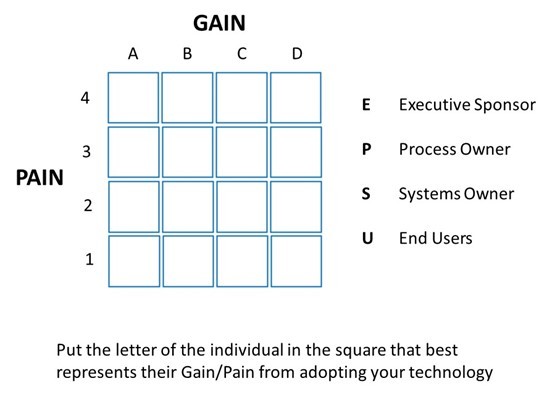
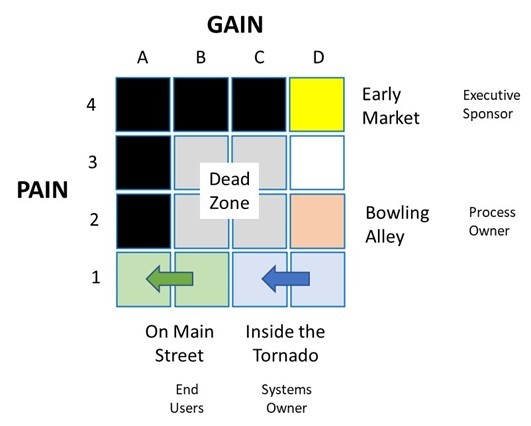
To answer this question properly we need to lay out the landscape of work along two axes (shockingly, creating a 2X2 matrix, the gold standard for all consulting models). One axis discriminates between output that is differentiating, giving customers a reason to choose your offers over those of your competitors, in contrast to work that is industry standard, things every competitor is expected to deliver. The other axis discriminates on the basis of risk exposure, distinguishing between outcomes that are mission-critical where failure is not an option, in contrast to outcomes that can tolerate a certain amount of scrap or rework.
We call this the core/context framework, and when overlaid onto the future of AI, it can look something like this:
In the context of this diagram here is how I predict the next ten years of AI will play out:
1. Stupid stuff first. One thing to which we will all testify is that there is no lack of stupid stuff encumbering the workflow of our daily lives. Wherever bureaucracy reigns, there will be an unending stream of compliance requirements, be that in the public or the private sector, and we suffer this burden because it does underpin the rule of law, albeit onerously.
Fulfilling these requirements does not take creative genius, it takes attention to detail and considerable patience. Humans are not strong on either front, but AI is, and this is where enterprises are already weighing in and will continue to do so for the rest of the decade and more.
That said, the ROI from such efforts is modest. Basically, we are automating an inefficient system, which does reduce cost, and does free up human talent to be used elsewhere. But what we find is that human talent is not as fungible as we would want, many displaced workers cannot find employment at a comparable salary, and the rest of the enterprise is not improved in any marked way. Things overall are better, but not a lot better.
2. Cool stuff in parallel. When it comes to new technology, wherever the risk barrier is low, technology enthusiasts will lean in regardless, whether that be on their own time or their employer’s. What they are doing is playing with an inefficient system, seeing what the bright new shiny object might bring to the table. This does take creative genius as well as some creative license, so once again, patience is required, but this time it is on the part of the investor or supervisor.
That said, in the domain of consumer products and services, there is the potential for blockbuster ROI here, as any number of freemium plays have demonstrated in the past. Many are short-lived, to be sure (remember ringtones?), but in their short life, they can capture an extraordinary amount of discretionary spend. And others can mature into abiding infrastructure as search, messaging, and file sharing have all demonstrated.
The key here is that these are not mission-critical and, therefore, do not attract regulatory regimes. If and when they should do so, as is happening with social media now, then their economics can turn upside down in a hurry.
3. Serious stuff takes time. This is where most of the big and abiding ROI will come from. When work is mission-critical but not differentiating, it requires considerable investment in table-stakes processes, which garner no premium in the marketplace. To be brutally honest, there is no prize for doing this work well but considerable penalties for any mistakes you make (think ransomware for a bone-chilling example).
In the 1990s, there was an Internet-enabled revolution in enterprise manufacturing that introduced global outsourcing as a high-ROI way to address mission-critical context workloads—move the work from your company, where it is context, to their company, where it is core. This was a hugely disruptive innovation, allowing the economies of China, India, and now Southeast Asia, to expand at exponential rates, creating increasingly vibrant middle classes where there were none before. However, these benefits have come with a price, both in terms of geopolitical risks, supply chain vulnerabilities, and societal downsides, all of which we are still trying to come to terms with.
Here, AI can have a major impact, not by automating an efficient system, but by completely reengineering it. This will entail on-shoring a lot of manufacturing and displacing a lot of call centers as we introduce more and more AI into these mission-critical workflows. The gains will be in faster response to changing market demands, better returns from high-variability small-volume manufacturing runs, and reduced scrap and rework. At the outset, these changes will entail a considerable amount of human-in-the-loop processing, but eventually, because AI-enabled systems need never stop learning, the human will become the biggest source of error in the system, and we will transition to full autonomy (self-driving cars will be a case study of this transition).
4. Game-changing happens when it happens. There is a reason why so many billionaires have appeared in my lifetime (I personally forgot to become one). Their fortunes are the natural outcome whenever a disruptive innovation does not simply reengineer the existing inefficient system but instead completely replaces it. Amazon Prime, Uber, Netflix, Salesforce, NVIDIA, Apple — each company categorically changed the landscape, rendering the incumbents irrelevant, redirecting the cash flows of their entire industry to flow past their doors.
These outcomes are inevitable, but they are also unpredictable. They are what puts the venture in venture capital. The good news for incumbents is that they do not happen very often, and even when they appear to be succeeding, they can still stumble and fall. That said, sooner or later there will be a reckoning, and that is when the incumbents need to activate their Transformation Zone if they are going to survive the transition.
My altruistic wish is that for AI, this time around, the target will be the public sector. Higher education, social services, healthcare, and law enforcement are all staggering under increasingly untenable demands accompanied by shrinking workforces and restricted budgets. All of them are target-rich environments for applying AI both to stupid stuff and serious stuff. We have never disrupted these sanctums in the past, each having been ruled by regulatory regimes and professional guilds that have deeply conservative roots blocking the kinds of changes that are now needed. Displacing these systems will take decades, but the ROI, both financial and social, would be truly game-changing.
That’s what I think. What do you think?
— Image credit: Gemini
Sign up here to join 17,000+ leaders getting Human-Centered Change & Innovation Weekly delivered to their inbox every week.

Most customer experience frameworks are written with a single decision-maker in mind — one person, one moment of dissatisfaction, one chance to leave. B2B SaaS almost never works that way, and an audit approach borrowed from consumer retail will miss most of what actually matters in a software buying and renewal relationship.
The journey has more than one customer in it
A single SaaS account often includes a buyer who approved the budget, an admin who configured the product, and a set of end users who never spoke to sales at all and may not even know your company name. Each of these roles experiences a completely different journey, forms a completely different opinion, and has completely different influence over renewal. An audit that only interviews the buyer — the person easiest to reach — misses the end users whose day-to-day frustration is often what actually drives churn, quietly, long before a renewal conversation happens.
Onboarding failures don’t show up until months later
In consumer contexts, a bad first experience usually shows up immediately — a return, a one-star review, a quick churn. In B2B SaaS, a confusing onboarding often doesn’t kill the relationship on day one. It just means the product never gets adopted the way it was sold to be used, usage stays shallow, and the account quietly becomes a non-renewal a year later for reasons that trace directly back to week one. Walking the onboarding journey firsthand — not reviewing the onboarding flowchart, but actually going through it as a new user would — is where this kind of audit consistently finds the most expensive gaps.
Support tickets are a lagging indicator, not a leading one
By the time a SaaS customer files a support ticket, they’ve usually already tried to solve the problem themselves, asked a colleague, checked the help docs, and given up more than once. The ticket is the tip of a much larger iceberg of friction that a support-ticket dashboard alone will never show you. This is exactly why data evaluation in an audit has to be paired with firsthand journey walking — the tickets tell you what people were frustrated enough to report; the journey walk tells you everything they weren’t.
Expansion revenue depends on trust building quietly in the background
Upsell and cross-sell in SaaS rarely happen through a single sales conversation — they happen because a champion inside the account has quietly built confidence in the product over months of ordinary use. Every piece of friction in that ordinary use is a small tax on that trust, invisible individually, but cumulative. An audit that maps the full post-sale journey — not just the support-facing parts — is usually where the connection between “small usability annoyance” and “expansion revenue we didn’t get” becomes visible for the first time.
Competitive benchmarking means something different here
In B2B SaaS, your real competitive benchmark often isn’t your closest direct competitor — it’s the best onboarding flow or support experience your buyer has encountered anywhere in their software stack. B2B buyers import their expectations from whatever consumer-grade product experience they use daily, which means “good enough” is a moving target set well outside your own category.
Where to start
If any of this sounds like it’s describing gaps you suspect exist but haven’t confirmed, the Customer Experience Revenue Leakage Self-Assessment is a good first step to see where your own program stands across the five core audit activities. From there, a Customer Experience Audit scoped specifically to a multi-stakeholder SaaS journey — buyer, admin, and end user — finds what a single-persona review structurally can’t.
Content Authenticity Statement: The topic area, key elements to focus on, etc. were decisions made by Braden Kelley, with a little help from Claude to clean up the article.
Sign up here to get Human-Centered Change & Innovation Weekly delivered to your inbox every week.