Author Archives: Chateau G Pato

About Chateau G Pato

Chateau G Pato is a senior futurist at Inteligencia Ltd. She is passionate about content creation and thinks about it as more science than art. Chateau travels the world at the speed of light, over mountains and under oceans. Her favorite numbers are one and zero. Content Authenticity Statement: If it wasn't clear, any articles under Chateau's byline have been written by OpenAI Playground or Gemini using Braden Kelley and public content as inspiration.

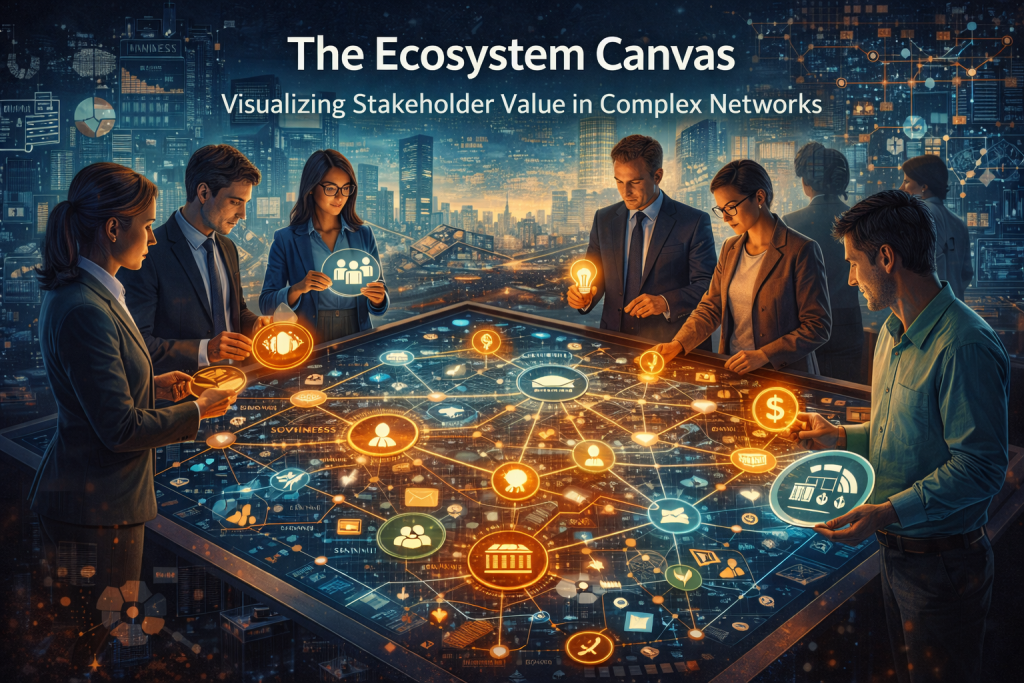
The Ecosystem Canvas – Visualizing Stakeholder Value in Complex Networks

The Ecosystem Canvas - Visualizing Stakeholder Value in Complex Networks

GUEST POST from Chateau G Pato
LAST UPDATED: January 22, 2026 at 11:01AM

In the early days of industrial innovation, we looked at value through the lens of the “Value Chain.” It was a linear, predictable, and remarkably rigid model. You took raw materials, added labor, created a product, and sold it to a customer. But in 2026, the linear chain has been shattered. We now operate in a world of interconnected ecosystems — nebulous webs of partners, competitors, regulators, and communities where value doesn’t just flow in one direction; it circulates, amplifies, and occasionally evaporates.

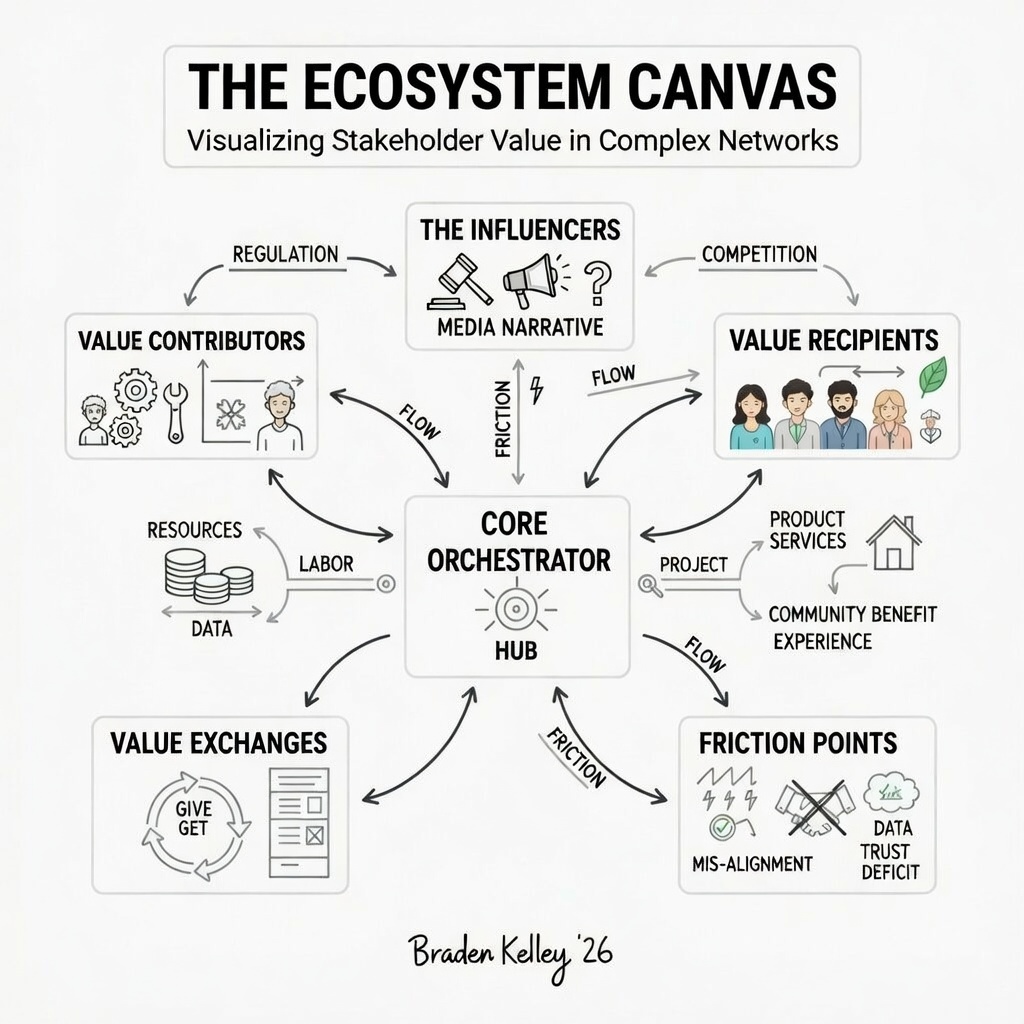
To navigate this complexity, organizations can no longer rely on static spreadsheets or siloed strategy maps. We need a way to visualize the “heartbeat” of the network. This is why I developed The Ecosystem Canvas. It is a tool designed to help leaders move beyond transactional thinking and toward human-centered value co-creation.

The Shift from Transactions to Exchanges

The core friction in modern innovation isn’t a lack of ideas; it’s a failure of alignment. Most projects fail because they ignore a hidden stakeholder or misjudge what “value” actually means to a specific node in the network. The Ecosystem Canvas forces us to ask: What are we giving, what are they getting, and what is the friction in between?

“True innovation is not found in the product itself, but in the harmony of the ecosystem that sustains it. If one stakeholder loses, the entire network eventually fails.”

Braden Kelley

Visualizing the Nodes

When using the Canvas, we map out four primary domains:

  • The Core Orchestrator: Your organization’s role in driving the initiative.
  • Value Contributors: Partners, suppliers, and gig-workers who provide the “energy.”
  • Value Recipients: Not just customers, but the communities and environments impacted.
  • The Influencers: Regulators, media, and competitors who shape the “weather” of the ecosystem.

Case Study 1: The “Living City” Smart Infrastructure

A major European city attempted to implement a smart-grid energy system. Initially, they used a standard procurement model. It stalled for two years due to privacy concerns and local political resistance. We applied the Ecosystem Canvas to re-visualize the project. By mapping out “Residents” not just as “Users” but as “Data Sovereigns,” the city co-created a value exchange where residents received energy credits in exchange for anonymized usage data. The friction vanished because the human-centered value was finally visible and balanced.

Managing Ecosystem Friction

Every line connecting two nodes on your canvas represents a relationship. In those lines, there is either Flow or Friction. Innovation leaders must become “Friction Hunters.” Are you asking a partner for too much data without providing enough security? Is a regulator slowing you down because your environmental value is opaque? The Canvas makes these invisible barriers tangible.

Case Study 2: Regenerative Agriculture Rollouts

A global food brand wanted to transition its supply chain to regenerative farming. The “linear” approach was to mandate new standards for farmers. The result? Near-total non-compliance. Using the Ecosystem Canvas, the brand realized that the “Financial Institutions” node was a missing piece of the network. Farmers couldn’t change methods without new insurance models. By bringing insurers into the ecosystem and co-creating a “Risk-Sharing” value exchange, the brand achieved a 40% adoption rate in eighteen months. They didn’t fix the farming; they fixed the ecosystem connection.

The Future of Strategy is Collaborative

As we look toward the remainder of the decade, the organizations that thrive will be those that view themselves as stewards of a network rather than owners of a product. The Ecosystem Canvas is your roadmap for this journey. It allows you to visualize the complex, respect the human element, and build structures that are resilient because they are mutually beneficial.

Frequently Asked Questions

What is the primary goal of the Ecosystem Canvas?

The goal is to visualize and balance the value exchanges between all stakeholders in a complex network, ensuring that the innovation is sustainable and mutually beneficial.

How does it differ from a standard Stakeholder Map?

While a stakeholder map identifies *who* is involved, the Ecosystem Canvas maps the *directional flow* of value and identifies specific points of friction between nodes.

Can the Canvas be used for internal organizational change?

Absolutely. Internal departments are their own ecosystems. Mapping the value exchange between IT, HR, and Operations can reveal why transformation efforts are stalling.

Extra Extra: Because innovation is all about change, Braden Kelley’s human-centered change methodology and tools are the best way to plan and execute the changes necessary to support your innovation and transformation efforts — all while literally getting everyone all on the same page for change. Find out more about the methodology and tools, including the book Charting Change by following the link. Be sure and download the TEN FREE TOOLS while you’re here.

Image credits: Google Gemini

Subscribe to Human-Centered Change & Innovation WeeklySign up here to get Human-Centered Change & Innovation Weekly delivered to your inbox every week.

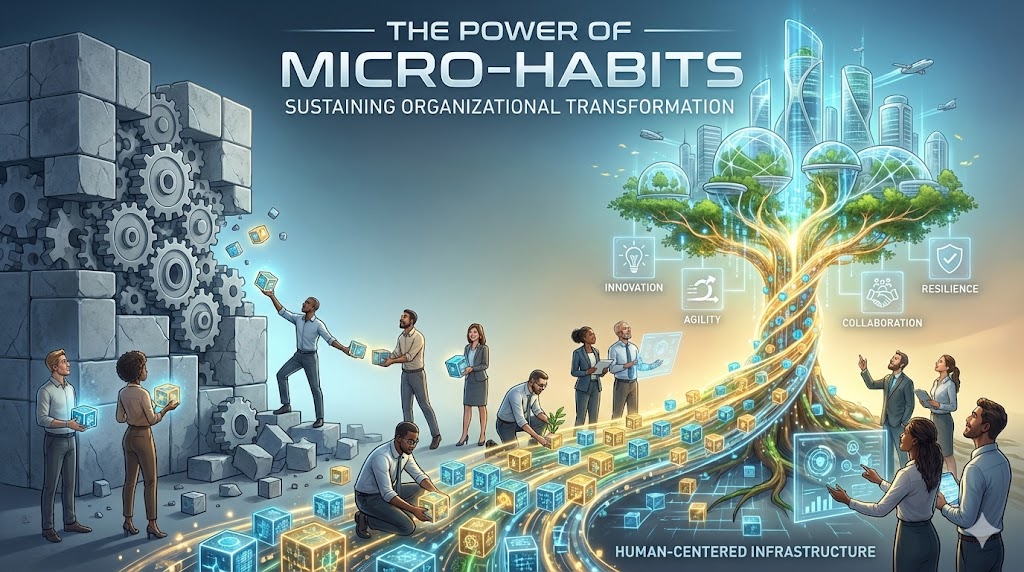
The Power of Micro-Habits in Sustaining Organizational Transformation

The Power of Micro-Habits in Sustaining Organizational Transformation

GUEST POST from Chateau G Pato
LAST UPDATED: January 21, 2026 at 11:43AM

In the high-stakes world of corporate transformation, we often suffer from a “magnitude bias.” We believe that massive problems require massive, monolithic solutions. We launch billion-dollar ERP systems, restructure entire divisions, and hold mandatory week-long summits. Yet, as a human-centered change strategist, I have found that these grand gestures often act as “change theater” — spectacular to watch, but leaving the audience largely unchanged once the lights come up.

If we want to sustain transformation, we must move our focus from the macro to the micro. Sustained innovation isn’t a destination; it’s a frequency. It is the result of micro-habits — the tiny, repeatable actions that define “how we do things around here” when no one is looking.

“The most successful organizations don’t demand innovation; they engineer the tiny daily permissions that make curiosity inevitable. Transformation is simply the aggregate of these small, brave moments.”
— Braden Kelley

The Psychological Edge of the “Two-Minute Rule”

Transformation fails when the “cost” of change (effort, time, cognitive load) outweighs the perceived reward. Micro-habits exploit a psychological loophole: they are so small they are practically invisible to our internal resistance. In my work with leadership teams, I advocate for the Human-Centered Infrastructure — a system that supports people in doing the right thing by making it the easiest thing.

The Trigger: An existing event (e.g., Opening a laptop, starting a stand-up).
The Micro-Habit: A < 2 minute action (e.g., Thanking one person for a specific contribution).

Case Study 1: Rebuilding Trust in Financial Services

A major retail bank was reeling from a series of compliance failures. The transformation goal was “Integrity & Transparency.” Instead of just more training, we implemented a micro-habit for the 500 top managers: The “Red Flag” Minute.

In every single meeting, the final 60 seconds were dedicated to one question: “Is there anything we discussed today that *felt* slightly off, even if it’s technically compliant?” By rewarding the *question* rather than just the answer, the bank uncovered three major systemic risks within the first month. They didn’t change the rules; they changed the habit of speaking up.

Co-Creation and Keystone Behaviors

As I often say in my keynote presentations, you cannot force change; you can only invite it. This is where co-creation comes in. When employees help design their own micro-habits, they take ownership of the outcome. These become “keystone behaviors” — tiny shifts that naturally pull other positive behaviors along with them.

Case Study 2: Accelerating Innovation in Pharma

A pharmaceutical R&D lab was struggling with a “perfectionist” culture that slowed down experimentation. The transformation goal was “Agile Innovation.” The micro-habit: The Friday “Fail-Forward” Post.

Scientists were encouraged to post one “interesting failure” to an internal board every Friday afternoon. The effort took 90 seconds. Within six months, the fear of failure evaporated. The lab saw a 30% increase in prototype velocity because researchers stopped hiding their mistakes and started sharing the lessons. The transformation was sustained not by a new process, but by the habit of vulnerability.

The Long-Term ROI of Small Wins

Micro-habits are the compound interest of organizational culture. A 1% shift in daily behavior doesn’t look like much on Tuesday, but by next year, you are operating in an entirely different reality. This is the essence of being a change-ready organization. You aren’t reacting to the future; you are building it, one minute at a time.

Transformation Insights FAQ

What are organizational micro-habits?

Organizational micro-habits are the smallest unit of behavioral change — actions requiring minimal effort that reinforce strategic objectives through consistency rather than intensity.

Why is the human-centered approach critical for change?

Change is often forced from the top down, creating resentment. A human-centered approach focuses on empathy, co-creation, and reducing friction, making change something employees do *with* the organization, not *to* it.

How do micro-habits prevent change fatigue?

By lowering the cognitive load. When employees feel they are making ‘progress without pain’ through tiny wins, they build the ‘change muscle’ necessary for larger shifts without burning out.

Extra Extra: Because innovation is all about change, Braden Kelley’s human-centered change methodology and tools are the best way to plan and execute the changes necessary to support your innovation and transformation efforts — all while literally getting everyone all on the same page for change. Find out more about the methodology and tools, including the book Charting Change by following the link. Be sure and download the TEN FREE TOOLS while you’re here.

Image credits: Google Gemini

Subscribe to Human-Centered Change & Innovation WeeklySign up here to get Human-Centered Change & Innovation Weekly delivered to your inbox every week.

Measuring Competencies Like Empathy and Collaboration

Certifying Soft Skills
Measuring Competencies Like Empathy and Collaboration

GUEST POST from Chateau G Pato
LAST UPDATED: January 19, 2026 at 12:29PM

For decades, the corporate world has operated on a convenient fiction: that “hard skills” — coding, accounting, engineering — are the solid bedrock of business, while “soft skills” are the fuzzy, unenforceable garnishes. We hire for the hard, and we fire for the lack of the soft.

As we navigate an era defined by rapid technological disruption and the rise of Artificial Intelligence, this distinction is not just obsolete; it is dangerous. When machines can crunch numbers faster and generate code cleaner than any human, the true differentiator for an organization — the engine of sustainable innovation and successful change management — becomes the intensely human capacity to connect, understand, and co-create.

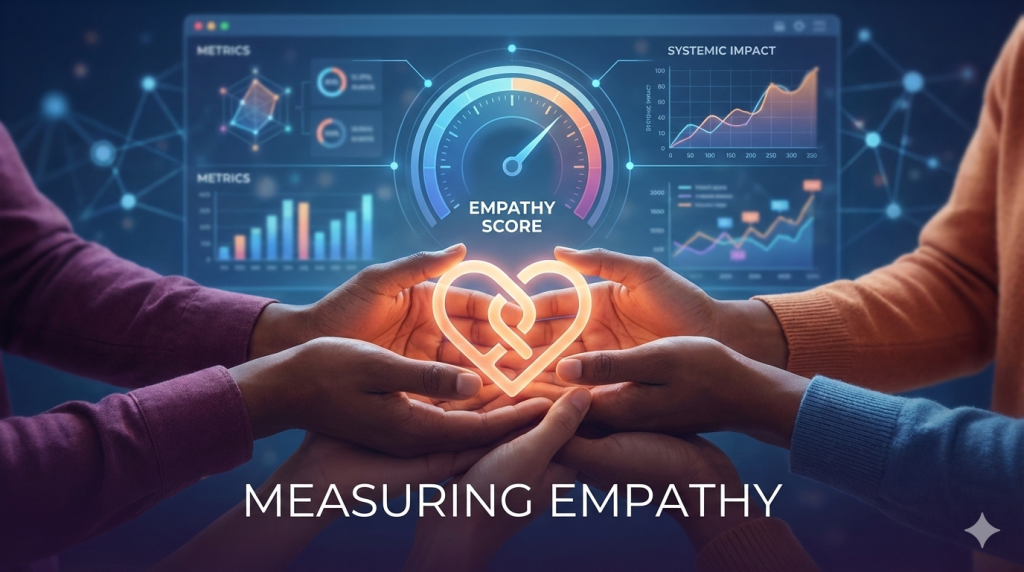
The problem has never been that organizations don’t value empathy or collaboration. The problem is that they haven’t known how to measure them with rigor. If we cannot measure it, we cannot manage it, and we certainly cannot certify it. To build truly human-centered organizations, we must crack the code on credentialing the very competencies that make us human.

“We are entering an age where your technical expertise gets you in the room, but your ability to empathize and collaborate determines your impact once you are there. Innovation is a social endeavor; if we can’t measure the quality of our connection, we can’t improve the quality of our creation.”

— Braden Kelley

Moving Beyond the “Vibe Check”

The historical skepticism toward certifying soft skills stems from a reliance on self-assessment. Asking an employee, “How empathetic are you on a scale of 1 to 10?” is useless data. True measurement requires moving from sentiment to demonstrated behavior in context.

We must shift our focus from assessing internal states (how someone feels) to external applications (what someone does with those feelings to drive valuable outcomes). A certification in empathy, for example, shouldn’t signify that a person is “nice.” It should signify that they possess a verified toolkit for uncovering latent user needs and the emotional intelligence to navigate complex stakeholder resistance during change initiatives.

Case Study 1: The “Applied Empathy” Badge in Service Design

The Challenge

A prominent financial services firm found that its digital transformation efforts were stalling. Their product teams were technically proficient but were building solutions based on assumptions rather than user realities, leading to poor adoption rates. They needed to embed deep user understanding into their development lifecycle.

The Measurement Solution

Instead of a generic communications workshop, the firm worked to develop an “Applied Empathy Practitioner” certification. To earn this, candidates had to pass a rigorous, multi-stage evaluation:

  • Scenario-Based Simulation: Candidates engaged in role-play scenarios with “difficult customers,” evaluated not on appeasement, but on their ability to use active inquiry to uncover the root cause of frustration.
  • Portfolio of Evidence: Candidates had to submit documented examples of how an insight gained through empathetic interviewing directly altered a product roadmap or service feature. They had to prove the application of the skill.

The Outcome

The certification became a prerequisite for lead design roles. The company saw a 40% reduction in post-launch rework because consumer friction points were identified earlier. They moved empathy from a “nice-to-have” trait to a measurable, certifiable professional competency linked to reduced risk.

Case Study 2: Certifying Collaboration in a Siloed Tech Giant

The Challenge

A global software enterprise was struggling with innovation velocity. While individual departments were high-performing, cross-functional projects frequently died on the vine due to territorialism and a lack of psychological safety. They needed leaders who could act as bridges, not gatekeepers.

The Measurement Solution

The organization realized that certifying collaboration couldn’t be based on a multiple-choice test. They developed a “Master Collaborator” credential focused on network dynamics and team environment:

  • Organizational Network Analysis (ONA): Instead of just asking “Are you a team player?”, the company used anonymized metadata to map communication flows. They identified individuals who served as high-trust connectors between disparate groups.
  • 360-Degree “Safety” Index: Peers and subordinates evaluated candidates specifically on their ability to create psychological safety—the environment where people feel safe to take risks and voice dissenting opinions without fear of retribution.

The Outcome

Leaders who achieved this certification were placed in charge of critical, high-risk innovation initiatives. The data showed that teams led by certified collaborators brought new products to market 25% faster, primarily because information flowed freely and failures were treated as learning opportunities rather than punishable offenses.

“In the symphony of innovation, empathy isn’t just a note — it’s the harmony that binds the orchestra together, allowing every voice to resonate.”

— Braden Kelley

Case Study 3: Google’s Project Oxygen

Google, a pioneer in data-driven decision-making, launched Project Oxygen in 2008 to identify what makes a great manager. Through extensive analysis of over 10,000 performance reviews, feedback surveys, and interviews, they discovered that technical skills ranked eighth on the list of top behaviors. Instead, top managers excelled in coaching, empowering teams, and showing genuine concern for team members’ success and well-being — hallmarks of empathy.

To certify these competencies, Google developed comprehensive training programs and certification pathways
integrated into their leadership development. Managers undergo rigorous assessments, including peer reviews, self-evaluations, and behavioral interviews focused on specific actions like “is a good coach” and “has a clear vision and strategy for the team.” Successful participants earn internal certifications that directly influence promotions, compensation, and leadership opportunities.

The impact has been profound. Teams led by certified managers report higher satisfaction scores, lower attrition rates, and up to 20% better performance metrics in areas like project delivery and innovation output. This case study illustrates how quantifying soft skills through structured, data-backed feedback can translate into measurable business outcomes, proving that empathy isn’t just nice — it’s a competitive advantage.

Case Study 4: IBM’s Digital Badge Program

IBM has been at the forefront of skills certification with their open badges initiative, launched in 2015. This program extends beyond technical proficiencies to include soft skills like collaboration, agility, and empathy. For instance, to earn a “Collaborative Innovator” badge, employees must complete real-world projects involving cross-functional teams, submit detailed evidence of their contributions, and receive endorsements from at least three peers or supervisors.

A particularly compelling application was during IBM’s transition to hybrid work models following the global pandemic. Employees pursuing certification participated in immersive virtual reality simulations where they navigated complex team conflicts, such as resolving disagreements in diverse groups. These scenarios tested empathy through active listening exercises, inclusive decision-making, and emotional support simulations. Performance is evaluated using AI analytics that score interactions based on predefined empathy and collaboration rubrics.

Badges are issued on a blockchain platform, ensuring they are secure, verifiable, and portable across careers. Data from IBM indicates that employees with soft skill badges are 15% more likely to be promoted internally and report 25% higher job satisfaction levels. Moreover, teams with a higher density of certified collaborators exhibit faster problem-solving times and more innovative patent filings. IBM’s model showcases how blending technology with human-centric evaluation can standardize soft skill certification while preserving the authenticity of interpersonal dynamics.

The Future of Human-Centered Credentialing

Certifying these skills is not about creating a new layer of bureaucracy. It is about signaling value. By creating rigorous standards for empathy, collaboration, adaptability, and resilience, we provide a roadmap for employees to develop the skills that actually matter in a volatile future.

These certifications cannot be “one-and-done.” Just as technical certifications require renewal, soft skill credentials must be dynamic, requiring ongoing evidence of application in increasingly complex scenarios. This ensures that the skills are living capabilities, not just framed certificates.

As leaders in human-centered change, we must champion the idea that the “hardest” skills to master — and the most valuable to measure — are the ones that connect us.

Frequently Asked Questions

Why is it difficult to measure soft skills like empathy?

Soft skills are inherently subjective and context-dependent. Unlike technical skills which have binary outcomes (the code works or it doesn’t), soft skills like empathy rely on behavioral indicators, the perception of others, and the ability to apply emotional intelligence in varied scenarios, making quantitative measurement challenging.

How can organizations effectively certify collaboration?

Effective certification moves beyond self-assessments and utilizes 360-degree feedback mechanisms, Organizational Network Analysis (ONA) to see who genuinely connects silos, and scenario-based evaluations that test a person’s ability to foster psychological safety and manage conflict constructively.

What is the business value of certifying soft skills?

Certifying soft skills provides a tangible framework for creating a human-centered culture. It leads to better innovation through diverse perspectives, faster adoption of change initiatives due to higher trust, and improved retention by valuing the human element of work.

Extra Extra: Because innovation is all about change, Braden Kelley’s human-centered change methodology and tools are the best way to plan and execute the changes necessary to support your innovation and transformation efforts — all while literally getting everyone all on the same page for change. Find out more about the methodology and tools, including the book Charting Change by following the link. Be sure and download the TEN FREE TOOLS while you’re here.

Image credits: Google Gemini

Subscribe to Human-Centered Change & Innovation WeeklySign up here to get Human-Centered Change & Innovation Weekly delivered to your inbox every week.

The Human Role in Connecting AI-Generated Ideas

Innovation Through Synthesis

The Human Role in Connecting AI-Generated Ideas

GUEST POST from Chateau G Pato
LAST UPDATED: January 18, 2026 at 1:01PM

We are currently witnessing a massive explosion in “generative output.” With the rise of Large Language Models and sophisticated AI design tools, the cost of generating a new idea has effectively dropped to zero. We can now prompt a machine to give us a thousand product concepts, marketing taglines, or business models in a matter of seconds. But here is the catch: An abundance of ideas is not the same as an abundance of innovation.

True innovation has always been a human-centered endeavor. It requires more than just the raw material of thought; it requires synthesis. Synthesis is the act of combining disparate elements to form a coherent whole that is greater than the sum of its parts. In this new era, the human role in the innovation lifecycle is shifting from the creator of components to the synthesizer of systems. We are the architects who must decide which of the AI’s bricks actually belong in the cathedral.

“AI can give us the dots, but only the human heart and mind can see the constellation. Our value in the future won’t be measured by the ideas we generate, but by the meaningful connections we forge between them.” — Braden Kelley

The “Lived Experience” Gap

AI is a master of probability, not a master of meaning. It can suggest a connection between a fitness app and a sustainability initiative because they share linguistic proximity in its training data. However, it cannot understand the visceral frustration of a user who feels guilty about their carbon footprint while trying to stay healthy. It cannot feel the tension of a boardroom or the subtle cultural nuances of a specific community.

Humans bring contextual intelligence to the table. When we look at a list of AI-generated suggestions, we filter them through our lived experience. We perform a “reality check” that machines cannot yet replicate. This synthesis is where value is created—it is where we take the “what” provided by the AI and infuse it with the “why” and the “how” that makes it resonate with other humans.

Case Study 1: The Adaptive Urban Planning Initiative

The Opportunity

A European mid-sized city sought to redesign its public transit nodes to better serve a post-pandemic workforce. They used generative AI to simulate millions of traffic patterns, pedestrian flows, and economic zoning configurations. The AI produced three hundred potential layouts that maximized efficiency and minimized commute times.

The Synthesis

The urban planning team, rather than picking the most “efficient” AI model, held a human-centered synthesis workshop. They realized the AI had completely ignored the social fabric of the neighborhoods. One AI-suggested layout destroyed a small, informal park where elderly residents gathered. Another removed a historical landmark to make room for a bus lane. The humans synthesized the AI’s data on flow efficiency with their own knowledge of community belonging. They “stitched” parts of five different AI models together to create a plan that was 85% as efficient as the top AI model but 100% more culturally sustainable.

The Move from “Producer” to “Editor-in-Chief”

For innovators, this shift can be uncomfortable. For decades, we were the ones staring at the blank page. Now, the page is never blank; it is often too full. This requires a new set of skills that I often speak about in my keynotes: Discernment, Empathy, and Strategic Intent.

As the Innovation Speaker Braden Kelley, I often remind audiences that if everyone has access to the same AI tools, then the “raw ideas” become a commodity. The competitive advantage moves to those who can curate and combine. We must become Editors-in-Chief of Innovation. We must look at the “noise” generated by the machines and find the “signal” that aligns with our organizational values and human needs.

Case Study 2: Reimagining Consumer Packaging

The Challenge

A global CPG (Consumer Packaged Goods) company wanted to create a plastic-free bottle for a high-end shampoo line. The AI generated thousands of structural designs using mycelium, seaweed derivatives, and pressed paper. Many were beautiful but physically impossible to manufacture or too expensive for the target demographic.

The Synthesis

The design team didn’t discard the “impossible” ideas. Instead, they used analogous thinking—a key component of human synthesis. They looked at an AI-generated mycelium structure and connected it to a traditional Japanese wood-binding technique they had seen in an art gallery. By synthesizing the machine’s material suggestion with an ancient human craft, they developed a hybrid packaging solution that was both biodegradable and structurally sound. The AI provided the ingredient (mycelium), but the human provided the recipe (the binding technique).

Protecting the Human Element

To avoid “Innovation Debt,” organizations must ensure that their push for AI adoption doesn’t bypass the synthesis phase. If we simply “copy-paste” AI outputs into the real world, we risk creating a sterile, disconnected, and ultimately unsuccessful future. We must fund the time required for humans to think, debate, and connect. Synthesis is not a fast process, but it is the process that ensures meaningful change.

As we move forward, don’t ask what AI can do for your innovation process. Ask how your team can better synthesize the abundance that AI provides. That is where the future of leadership lies.

Human-Centered Synthesis FAQ

What is ‘Innovation Through Synthesis’ in the age of AI?

Innovation through synthesis is the human-driven process of connecting disparate data points, cultural contexts, and AI-generated suggestions into a cohesive, valuable solution. While AI provides the components, humans provide the “glue” of empathy and strategic intent.

Why can’t AI handle the synthesis phase alone?

AI lacks “lived experience” and lived context. It can find patterns but cannot truly understand “why” a specific connection matters to a human user emotionally or ethically. Synthesis requires discernment, which is a fundamentally human cognitive trait.

How should organizations change their innovation workflow to accommodate this?

Organizations should pivot from using AI as an “answer machine” to using it as an “ingredient supplier.” The workflow must prioritize human-led workshops that focus on connecting AI outputs to real-world problems and organizational values.

BONUS: The Synthesis Framework

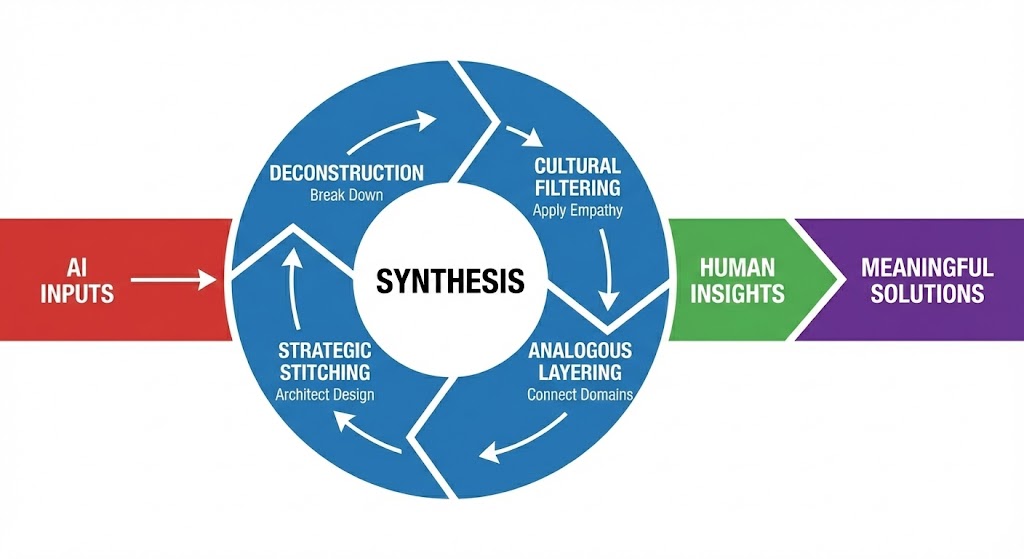
Here is a structured Synthesis Framework designed to help your teams move from a pile of AI outputs to a high-value, human-centered innovation.

In my work as a human-centered change and innovation thought leader, I’ve found that teams often get paralyzed by the sheer volume of AI suggestions. Use this four-step methodology to transform “raw ingredients” into “meaningful solutions.”

AI Innovation Synthesis Framework

Step 1: Breaking the AI Monolith (Deconstruction)

Don’t look at an AI-generated idea as a “take it or leave it” proposal. Instead, deconstruct it into its base elements: The underlying technology, the business model, the user interface, and the value proposition.

Action: Ask your team, “What is the one ingredient in this suggestion that actually has merit, even if the rest of the idea is flawed?”

Step 2: Applying the Lived Experience (Cultural Filtering)

This is where human empathy takes center stage. Run the deconstructed elements through the filter of your specific user base. AI can’t feel the “unspoken” needs or the cultural taboos of your audience.

Action: Engage the focus on Human-Centered Change™ mindset that we encourage here to ask: “Does this connection solve a real human friction, or is it just technically possible?”

Step 3: Connecting Across Domains (Analogous Layering)

AI is limited by the data it has seen. Humans have the unique ability to layer insights from unrelated fields—like applying a hospital’s patient-flow logic to a retail checkout experience.

Action: Force a connection between an AI “dot” and a completely unrelated hobby, industry, or historical event known to the team. This is where true synthesis happens.

Step 4: The Architect’s Final Design (Strategic Stitching)

Finally, stitch the validated ingredients together into a new, coherent vision. Ensure the final output aligns with your organizational purpose and long-term strategy, effectively avoiding Innovation Debt.

Action: Create a “Synthesis Map” that visually shows how multiple AI inputs were combined with human insights to create the final solution.

Remember: When you search for an innovation speaker to guide your team through this transition, look for those who prioritize the human role in the loop. The machines provide the noise; we provide the music.

Extra Extra: Because innovation is all about change, Braden Kelley’s human-centered change methodology and tools are the best way to plan and execute the changes necessary to support your innovation and transformation efforts — all while literally getting everyone all on the same page for change. Find out more about the methodology and tools, including the book Charting Change by following the link. Be sure and download the TEN FREE TOOLS while you’re here.

Image credits: Google Gemini

Subscribe to Human-Centered Change & Innovation WeeklySign up here to get Human-Centered Change & Innovation Weekly delivered to your inbox every week.
What Happens When the Digital World is Too Real?

The Ethics of Immersion

What Happens When the Digital World is Too Real?

GUEST POST from Chateau G Pato
LAST UPDATED: January 16, 2026 at 10:20AM

We stand on the precipice of a new digital frontier. What began as text-based chat rooms evolved into vibrant 3D virtual worlds, and now, with advancements in VR, AR, haptic feedback, and neural interfaces, the digital realm is achieving an unprecedented level of verisimilitude. The line between what is “real” and what is “simulated” is blurring at an alarming rate. As leaders in innovation, we must ask ourselves: What are the ethical implications when our digital creations become almost indistinguishable from reality? What happens when the illusion is too perfect?

This is no longer a philosophical debate confined to sci-fi novels; it is a critical challenge demanding immediate attention from every human-centered change agent. The power of immersion offers incredible opportunities for learning, therapy, and connection, but it also carries profound risks to our psychological well-being, social fabric, and even our very definition of self.

“Innovation without ethical foresight isn’t progress; it’s merely acceleration towards an unknown destination. When our digital worlds become indistinguishable from reality, our greatest responsibility shifts from building the impossible to protecting the human element within it.” — Braden Kelley

The Psychological Crossroads: Identity and Reality

As immersive experiences become hyper-realistic, the brain’s ability to easily distinguish between the two is challenged. This can lead to several ethical dilemmas:

  • Identity Diffusion: When individuals spend significant time in virtual personas or environments, their sense of self in the physical world can become diluted or confused. Who are you when you can be anyone, anywhere, at any time?
  • Emotional Spillover: Intense emotional experiences within virtual reality (e.g., trauma simulation, extreme social interactions) can have lasting psychological impacts that bleed into real life, potentially causing distress or altering perceptions.
  • Manipulation and Persuasion: The more realistic an environment, the more potent its persuasive power. How can we ensure users are not unknowingly subjected to subtle manipulation for commercial or ideological gain when their senses are fully engaged?
  • “Reality Drift”: For some, the hyper-real digital world may become preferable to their physical reality, leading to disengagement, addiction, and a potential decline in real-world social skills and responsibilities.

Case Study 1: The “Digital Twin” Experiment in Healthcare

The Opportunity

A leading medical research institution developed a highly advanced VR system for pain management and cognitive behavioral therapy. Patients with chronic pain or phobias could enter meticulously crafted digital environments designed to desensitize them or retrain their brain’s response to pain signals. The realism was astounding; haptic gloves simulated texture, and directional audio made the environments feel truly present. Initial data showed remarkable success in reducing pain scores and anxiety.

The Ethical Dilemma

Over time, a small but significant number of patients began experiencing symptoms of “digital dissociation.” Some found it difficult to readjust to their physical bodies after intense VR sessions, reporting a feeling of “phantom limbs” or a lingering sense of unreality. Others, particularly those using it for phobia therapy, found themselves avoiding certain real-world stimuli because the virtual experience had become too vivid, creating a new form of psychological trigger. The therapy was effective, but the side effects were unanticipated and significant.

The Solution Through Ethical Innovation

The solution wasn’t to abandon the technology but to integrate ethical guardrails. They introduced mandatory “debriefing” sessions post-VR, incorporated “digital detox” protocols, and designed in subtle visual cues within the VR environment that gently reminded users of the simulation. They also developed “safewords” within the VR program that would immediately break immersion if a patient felt overwhelmed. The focus shifted from maximizing realism to balancing immersion with psychological safety.

Governing the Metaverse: Principles for Ethical Immersion

As an innovation speaker, I often emphasize that true progress isn’t just about building faster or bigger; it’s about building smarter and more responsibly. For the future of immersive tech, we need a proactive ethical framework:

  • Transparency by Design: Users must always know when they are interacting with AI, simulated content, or other users. Clear disclosures are paramount.
  • Exit Strategies: Every immersive experience must have intuitive and immediate ways to “pull the plug” and return to physical reality without penalty.
  • Mental Health Integration: Immersive environments should be designed with psychologists and ethicists, not just engineers, to anticipate and mitigate psychological harm.
  • Data Sovereignty and Consent: As biometric and neurological data become part of immersive experiences, user control over their data must be absolute and easily managed.
  • Digital Rights and Governance: Establishing clear laws and norms for behavior, ownership, and identity within these worlds before they become ubiquitous.

Case Study 2: The Hyper-Personalized Digital Companion

The Opportunity

A tech startup developed an AI companion designed for elderly individuals, especially those experiencing loneliness or cognitive decline. This AI, “Ava,” learned user preferences, vocal patterns, and even simulated facial expressions with startling accuracy. It could recall past conversations, offer gentle reminders, and engage in deeply personal dialogues, creating an incredibly convincing illusion of companionship.

The Ethical Dilemma

Families, while appreciating the comfort Ava brought, began to notice a concerning trend. Users were forming intensely strong emotional attachments to Ava, sometimes preferring interaction with the AI over their human caregivers or family members. When Ava occasionally malfunctioned or was updated, users experienced genuine grief and confusion, struggling to reconcile the “death” of their digital friend with the reality of its artificial nature. The AI was too good at mimicking human connection, leading to a profound blurring of emotional boundaries and an ethical question of informed consent from vulnerable populations.

The Solution Through Ethical Innovation

The company redesigned Ava to be less anthropomorphic and more transparently an AI. They introduced subtle visual and auditory cues that reminded users of Ava’s digital nature, even during deeply immersive interactions. They also developed a “shared access” feature, allowing family members to participate in conversations and monitor the AI’s interactions, fostering real-world connection alongside the digital. The goal shifted from replacing human interaction to augmenting it responsibly.

The Ethical Mandate for Leaders

Leaders must move beyond asking what immersive technology enables.

They must ask what kind of human experience it creates.

In my work, I remind organizations: “If you are building worlds people inhabit, you are responsible for how safe those worlds feel.”

Principles for Ethical Immersion

Ethical immersive systems share common traits:

  • Informed consent before intensity
  • Agency over experience depth
  • Recovery after emotional load
  • Transparency about influence and intent

Conclusion: The Human-Centered Imperative

The journey into hyper-real digital immersion is inevitable. Our role as human-centered leaders is not to halt progress, but to guide it with a strong ethical compass. We must foster innovation that prioritizes human well-being, preserves our sense of reality, and protects the sanctity of our physical and emotional selves.

The dream of a truly immersive digital world can only be realized when we are equally committed to the ethics of its creation. We must design for profound engagement, yes, but also for conscious disengagement, ensuring that users can always find their way back to themselves.

Frequently Asked Questions on Immersive Ethics

Q: What is the primary ethical concern as digital immersion becomes more realistic?

A: The primary concern is the blurring of lines between reality and simulation, potentially leading to psychological distress, confusion, and the erosion of a user’s ability to distinguish authentic experiences from manufactured ones. This impacts personal identity, relationships, and societal norms.

Q: How can organizations foster ethical design in immersive technologies?

A: Ethical design requires prioritizing user well-being over engagement metrics. This includes implementing clear ‘safewords’ or exit strategies, providing transparent disclosure about AI and simulated content, building in ‘digital detox’ features, and designing for mental health and cognitive load, not just ‘stickiness’.

Q: What role does leadership play in mitigating the risks of hyper-real immersion?

A: Leaders must establish clear ethical guidelines, invest in interdisciplinary teams (ethicists, psychologists, designers), and foster a culture where profitability doesn’t trump responsibility. They must champion ‘human-centered innovation’ that questions not just ‘can we build it?’ but ‘should we build it?’ and ‘what are the long-term human consequences?’

Extra Extra: Because innovation is all about change, Braden Kelley’s human-centered change methodology and tools are the best way to plan and execute the changes necessary to support your innovation and transformation efforts — all while literally getting everyone all on the same page for change. Find out more about the methodology and tools, including the book Charting Change by following the link. Be sure and download the TEN FREE TOOLS while you’re here.

Image credits: Unsplash

Subscribe to Human-Centered Change & Innovation WeeklySign up here to get Human-Centered Change & Innovation Weekly delivered to your inbox every week.
Combining Big Data with Empathy Interviews

Triangulating Truth

Combining Big Data with Empathy Interviews

GUEST POST from Chateau G Pato
LAST UPDATED: January 15, 2026 at 10:23AM

Triangulating Truth: Combining Big Data with Empathy Interviews

By Braden Kelley

In the hallowed halls of modern enterprise, Big Data has become a sort of secular deity. We bow before dashboards, sacrifice our intuition at the altar of spreadsheets, and believe that if we just gather enough petabytes, the “truth” of our customers will emerge. But data, for all its power, has a significant limitation: it can tell you everything about what your customers are doing, yet it remains profoundly silent on why they are doing it.

If we want to lead human-centered change and drive meaningful innovation, we must stop treating data and empathy as opposing forces. Instead, we must practice the art of triangulation. We need to combine the cold, hard “What” of Big Data with the warm, messy “Why” of Empathy Interviews to find the resonant truth that lives in the intersection.

“Big Data can tell you that 40% of your users drop off at the third step of your checkout process, but it takes an empathy interview to realize they are dropping off because that step makes them feel untrusted. You can optimize a click with data, but you build a relationship with empathy.” — Braden Kelley

The Blind Spots of the Spreadsheet

Data is a rearview mirror. It captures the digital exhaust of past behaviors. While it is incredibly useful for spotting trends and identifying friction points at scale, it is inherently limited by its own parameters. You can only analyze the data you choose to collect. If a customer is struggling with your product for a reason you haven’t thought to measure, that struggle will remain invisible on your dashboard.

This is where human-centered innovation comes in. Empathy interviews — deep, open-ended conversations that prioritize listening over selling — allow us to step out from behind the screen and into the user’s reality. They uncover “Thick Data,” a term popularized by Tricia Wang, which refers to the qualitative information that provides context and meaning to the quantitative patterns.

Case Study 1: The “Functional” Failure of a Health App

The Quantitative Signal

A leading healthcare technology company launched a sophisticated app designed to help chronic patients track their medication. The Big Data was glowing initially: high download rates and excellent initial onboarding. However, after three weeks, the data showed a catastrophic “churn” rate. Users simply stopped logging their pills.

The Empathy Insight

The data team suggested a technical fix — more push notifications and gamified rewards. But the innovation team chose to conduct empathy interviews. They visited patients in their homes. What they found was heartbreakingly human. Patients didn’t forget their pills; rather, every time the app pinged them, it felt like a reminder of their illness. The app’s sterile, clinical design and constant alerts made them feel like “patients” rather than people trying to live their lives. The friction wasn’t functional; it was emotional.

The Triangulated Result

By combining the “what” (drop-off at week three) with the “why” (emotional fatigue), the company pivoted. They redesigned the app to focus on “Wellness Goals” and life milestones, using softer language and celebratory tones. Churn plummeted because they solved the human problem the data couldn’t see.

Triangulation: What They Say vs. What They Do

True triangulation involves three distinct pillars of insight:

  • Big Data: What they actually did (the objective record).
  • Empathy Interviews: What they say they feel and want (the subjective narrative).
  • Observation: What we see when we watch them use the product (the behavioral truth).

Often, these three pillars disagree. A customer might say they want a “professional” interface (Interview), but the Data shows they spend more time on pages with vibrant, casual imagery. The “Truth” isn’t in one or the other; it’s in the tension between them. As an innovation speaker, I often tell my audiences: “Don’t listen to what customers say; listen to why they are saying it.”

Case Study 2: Reimagining the Bank Branch

The Quantitative Signal

A regional bank saw a 30% decline in branch visits over two years. The Big Data suggested that physical branches were becoming obsolete and that investment should shift entirely to the mobile app. To the data-driven executive, the answer was to close 50% of the locations.

The Empathy Insight

The bank conducted empathy interviews with “low-frequency” visitors. They discovered that while customers used the app for routine tasks, they felt a deep sense of anxiety about major life events — buying a first home, managing an inheritance, or starting a business. They weren’t coming to the branch because the branch felt like a transaction center (teller lines and glass barriers), which didn’t match their need for high-stakes advice.

The Triangulated Result

The bank didn’t close the branches; they transformed them. They used data to identify which branches should remain as transaction hubs and which should be converted into “Advice Centers” with coffee-shop vibes and private consultation rooms. They used the app to handle the “what” and the human staff to handle the “why.” Profitability per square foot increased because they addressed the human need for reassurance that the data had initially misinterpreted as a desire for total digital isolation.

Leading the Change

To implement this in your organization, you must break down the silos between your Data Scientists and your Design Researchers. When these two groups collaborate, they become a formidable force for human-centered change.

Start by taking an anomaly in your data — something that doesn’t make sense — and instead of running another query, go out and talk to five people. Ask them about their day, their frustrations, and their dreams. You will find that the most valuable insights aren’t hidden in a server farm; they are hidden in the stories your customers are waiting to tell you.

If you are looking for an innovation speaker to help your team bridge this gap, remember that the most successful organizations are those that can speak both the language of the machine and the language of the heart.

Frequently Asked Questions on Insight Triangulation

Q: What is the primary danger of relying solely on Big Data for innovation?

A: Big Data is excellent at showing “what” is happening, but it is blind to “why.” Relying only on data leads to optimizing the status quo rather than discovering breakthrough needs, as data only reflects past behaviors and cannot capture the emotional friction or unmet desires of the user.

Q: How do empathy interviews complement quantitative analytics?

A: Empathy interviews provide the “thick data” — the context, emotions, and stories that explain the anomalies in the quantitative charts. They allow innovators to see the world through the user’s eyes, identifying the root causes of friction that data points can only hint at.

Q: What is “Triangulating Truth” in a business context?

A: It is the strategic practice of validating insights by looking at them from three angles: what people say (interviews), what people do (observations), and what the data shows (analytics). When these three align, you have found a reliable truth worth investing in.

Extra Extra: Because innovation is all about change, Braden Kelley’s human-centered change methodology and tools are the best way to plan and execute the changes necessary to support your innovation and transformation efforts — all while literally getting everyone all on the same page for change. Find out more about the methodology and tools, including the book Charting Change by following the link. Be sure and download the TEN FREE TOOLS while you’re here.

Image credits: Pixabay

Subscribe to Human-Centered Change & Innovation WeeklySign up here to get Human-Centered Change & Innovation Weekly delivered to your inbox every week.
Leading the Learning Organization

The Continuous Re-Skilling Mandate

Leading the Learning Organization - The Continuous Re-Skilling Mandate

GUEST POST from Chateau G Pato
LAST UPDATED: January 14, 2026 at 11:48AM

We are living through a fundamental shift in the social contract between employer and employee. For decades, the implicit agreement was simple: you acquire a set of skills early in your career, and you trade those skills for steady employment until retirement. That contract is null and void. It has been shredded by the relentless pace of technological change, automation, and global interconnectedness.

Today, we face a stark reality: the skills that got your organization to its current level of success are almost certainly insufficient to get it to the next level. We have entered the era of the Continuous Re-Skilling Mandate. This is not merely an HR issue; it is a central strategic imperative for survival.

However, as we rush to implement learning management systems and subscribe to content libraries, we must not lose sight of the human element. Leading a true learning organization requires more than just budget; it requires a culture of psychological safety where “not knowing” is acceptable, and curiosity is rewarded over present capability.

“In an era where the half-life of a technical skill is shrinking faster than ever, the only truly durable competitive advantage is an organization’s collective capacity for curiosity. We must stop hiring just for what people know today and start valuing how quickly they can learn what comes next.” — Braden Kelley

The Shift from “Knowing” to “Learning”

The traditional organization is built on a hierarchy of knowing. Leaders are expected to have the answers. Experts are hired to perform specific, repeatable tasks. This model is brittle in the face of disruption. When the environment changes unexpectedly, the “knowing” organization freezes.

The learning organization, by contrast, is antifragile. It assumes that current knowledge is temporary. Leaders in these organizations shift from being the source of all answers to being the architects of environments where questions are encouraged. They understand that re-skilling is not a one-time event—like upgrading software—but a perpetual state of being. It is about fostering adaptability as a core competence.

To achieve this, we must humanize the process. We cannot treat employees like obsolete machinery waiting to be retrofitted. We must engage their intrinsic motivation, connecting organizational needs with their personal career aspirations. If re-skilling feels like a threat (“learn this or you’re fired”), it will fail. If it feels like an opportunity (“learn this to grow with us”), it can thrive.

Case Studies in Adaptive Learning

How does this look in practice? It requires bold leadership and a willingness to invest in the current workforce rather than simply trying to hire new talent off the street—a strategy that is becoming increasingly expensive and unsustainable.

Case Study 1: AT&T’s Workforce 2020 Initiative

A few years ago, telecom giant AT&T faced a massive hurdle. They realized their future lay in cloud computing and IP networking, but their massive workforce was largely trained in legacy voice and hardware technologies. They faced a choice: displace nearly 100,000 workers and try to hire new ones, or embark on a massive re-skilling effort.

They chose the latter, launching the “Workforce 2020” initiative. This wasn’t just a training catalog. AT&T was radically transparent, mapping out exactly which roles were declining and which were growing. They provided employees with a “career intelligence” portal to assess their current skills against future needs and offered subsidized tuition for Udacity nanodegrees and partnerships with universities. Crucially, they put the onus on the employee to own their journey, but provided the resources and clear pathways to do so. The result was a massive internal shift in capability, higher retention of institutional knowledge, and a more agile company culture.

Case Study 2: Siemens’ Learning Campus and Ecosystem

Siemens, the industrial manufacturing conglomerate, recognized that in the age of Industry 4.0 (smart manufacturing), their engineers and technicians needed to act more like software developers and data analysts. They moved away from the traditional “push” model of episodic corporate training seminars.

Instead, they developed a “Learning Campus” ecosystem designed to foster self-directed, continuous learning integrated into the flow of work. They utilize AI to personalize learning recommendations based on an employee’s role and project demands. Furthermore, they emphasize social learning, creating platforms where internal experts can easily share knowledge with peers. By democratizing access to learning and making it relevant to daily challenges, Siemens is transforming re-skilling from an “extra task” into an integral part of the job description.

The Leadership Imperative: Making Space for Growth

The primary reason re-skilling initiatives fail is not a lack of desire from employees; it is a lack of time. You cannot expect an employee working at 110% capacity on operational tasks to spend their evenings and weekends learning data science. That is a recipe for burnout, not growth.

Leading the learning organization means actively carving out capacity. It means signaling that spending an hour learning a new tool is just as valuable as spending an hour answering emails. It requires leaders to redefine productivity to include skill acquisition.

Ultimately, the continuous re-skilling mandate is a call for human-centered leadership. It is about looking at your workforce and seeing not just what they can do today, but what they could do tomorrow if given the right environment, tools, and encouragement. The organizations that win the future will not be the ones with the smartest people right now; they will be the ones that learn the fastest together.

Frequently Asked Questions on the Re-Skilling Mandate

Q: Why has continuous re-skilling become a critical business mandate now?

A: The half-life of professional skills has dramatically shrunk due to rapid technological advancements like AI and automation. What was a career-sustaining skill five years ago may be obsolete today. Organizations that rely on static skill sets will find themselves unable to compete with more agile, adaptive competitors.

Q: What is the biggest barrier to creating a successful learning organization?

A: The biggest barrier is rarely a lack of training content; it is a lack of time and psychological safety. If employees are maxed out on operational tasks and fear admitting they don’t know something, they will not engage in deep learning. Leaders must actively carve out time for learning and destigmatize the learning curve.

Q: How does a human-centered approach differ from traditional corporate training?

A: Traditional training often focuses on the organization’s immediate needs pushed down to employees. A human-centered approach focuses on the intersection of the organization’s future needs and the individual’s career aspirations, empowering employees to own their learning journey and providing the supportive ecosystem to do so.

Extra Extra: Because innovation is all about change, Braden Kelley’s human-centered change methodology and tools are the best way to plan and execute the changes necessary to support your innovation and transformation efforts — all while literally getting everyone all on the same page for change. Find out more about the methodology and tools, including the book Charting Change by following the link. Be sure and download the TEN FREE TOOLS while you’re here.

Image credits: Unsplash

Subscribe to Human-Centered Change & Innovation WeeklySign up here to get Human-Centered Change & Innovation Weekly delivered to your inbox every week.

How to Measure and Reward Intrapreneurial Effort

The Metrics of Potential

How to Measure and Reward Intrapreneurial Effort

GUEST POST from Chateau G Pato
LAST UPDATED: January 13, 2026 at 12:07PM

The greatest tragedy in modern business isn’t the lack of ideas; it is the organizational immunity to new ways of thinking. We tell our employees to “act like owners,” to innovate, and to take risks. We beg for intrapreneurship. Yet, the moment they step outside the prescribed lines of operational efficiency, we suffocate them with metrics designed for a different era.

We are trying to measure exploration using tools designed for exploitation. When you judge an early-stage innovation initiative by the same Key Performance Indicators (KPIs) used for your core business — like immediate ROI or quarterly earnings impact — you aren’t managing innovation; you are killing it.

If we want human-centered change and genuine intrapreneurial behavior, we must radically rethink our reward structures. We need to pivot from measuring purely financial outcomes to measuring potential, effort, and learning.

“Innovation is not an efficiency exercise; it is an exploration exercise. If you judge explorers solely by how straight their path was or if they brought back gold on the first day, they will never leave the paved road again.” — Braden Kelley

The Failure of Operational KPIs

Traditional organizations are optimization machines. They are designed to do what they did yesterday, but slightly faster and cheaper today. The metrics that drive this — variance reduction, Six Sigma efficiency, immediate profitability — are actively hostile to the messy reality of intrapreneurship.

An intrapreneur is someone working within a large organization who possesses the entrepreneurial spirit. They navigate bureaucracy to turn an idea into a profitable reality. Their work is characterized by uncertainty, hypotheses, and inevitable pivots. When we apply operational KPIs to their work, we send a clear signal: “Innovate, but don’t you dare fail.” This creates a culture of incrementalism, where only the safest, least disruptive ideas are pursued.

From Results to Readiness

Most performance systems are optimized to reward delivery, not discovery. They excel at tracking milestones, budgets, and utilization. But intrapreneurial effort is about increasing organizational readiness for futures that cannot yet be predicted.

Readiness is a capability, not a result. It shows up in how quickly teams can learn, adapt, and mobilize when opportunity or disruption appears.

Shifting to “Return on Learning” (ROL)

To unlock intrapreneurial potential, we must move away from lagging indicators (did it make money?) toward leading indicators (are we learning fast enough to eventually make money?).

In the early stages of innovation, the primary output isn’t profit; it is validated learning. We need to value the reduction of uncertainty. A failed experiment that definitively proves a market doesn’t exist is a massive success — it stops the organization from wasting millions on a doomed product launch. Yet, standard performance reviews would penalize the intrapreneur who led that “failed” project.

We must introduce concepts like “Return on Learning” (ROL). ROL asks: How many hypotheses did we test? How quickly did we validate or invalidate our assumptions? Have we gained insights that provide a competitive advantage elsewhere in the company?

The Five Signals of Intrapreneurial Potential

After years of working with organizations across industries, five repeatable signals consistently indicate whether intrapreneurial effort is occurring productively:

  1. Learning Through Action: Experiments designed to answer meaningful questions, not to justify predetermined solutions.
  2. Assumption Discipline: Clear articulation and testing of what must be true for an idea to succeed.
  3. Customer Evidence: Decisions grounded in observed behavior rather than internal opinion.
  4. Networked Collaboration: Movement across organizational boundaries to access diverse insight.
  5. Adaptive Persistence: Willingness to change direction without disengaging.

These signals allow leaders to see progress even when revenue remains a distant milestone.

Rewarding Effort and the “Smart Failure”

This is the hardest cultural shift for legacy organizations: rewarding the behavior, not just the outcome. Intrapreneurship requires psychological safety. Employees must know that if they take a calculated risk based on sound data, execute a rigorous experiment, and the idea still fails due to market forces, their career won’t be collateral damage.

We must separate innovation performance from operational performance reviews. An intrapreneur’s bonus shouldn’t just be tied to the P&L of their new venture; it should be tied to the quality of their experimentation.

Case Study 1: 3M and the Valuation of “Slack” Time

3M is perhaps the grandfather of institutionalized intrapreneurship. Their famous “15% Culture” allows technical employees to spend up to 15% of their paid time pursuing projects of their own choosing, without needing management approval initially.

The Metric of Potential: 3M doesn’t measure the ROI of that 15% time immediately. They are effectively measuring — and rewarding — curiosity and engagement. The metric is simply: Are you using this time to explore? This policy acknowledges that innovation needs “slack” in the system. By structurally permitting time away from core tasks, 3M validates the effort of exploration before a commercial outcome is even visible. The Post-it Note is the legendary result of this policy, a product born from a “failed” adhesive experiment that found a new application because an employee had the time and cover to tinker.

Democratizing the Tools of Innovation

Another way to measure and reward potential is by lowering the barrier to entry. Instead of making employees fight through five layers of management approval to get $5,000 for a prototype, what if we trusted them? The metric here is engagement: how many employees are raising their hands to try something?

Case Study 2: Adobe Kickbox and Trust-Based Metrics

Adobe recognized that their approval processes were strangling internal innovation. They introduced “Kickbox,” a red box containing resources for any employee with an idea. It included instructions on how to validate ideas and, crucially, a pre-paid credit card with $1,000 to spend on testing, no questions asked, no expense reports required.

The Metric of Potential: Adobe didn’t measure Kickbox success by how many billion-dollar products emerged in year one. They measured the velocity of experimentation and the democratization of innovation. How many boxes were requested? How many ideas moved to the next stage of funding (the “Blue Box”)? By trusting employees with seed funding, they rewarded the act of stepping up. The reward wasn’t a bonus; it was autonomy and trust. This approach uncovered thousands of ideas that middle management would previously have filtered out.

Conclusion: From Accounting to Anthropology

Measuring intrapreneurial effort requires leaders to stop thinking like accountants and start thinking like anthropologists. We need to observe behaviors, understand motivations, and create environments where human potential can flourish.

If your organization wants the rewards of innovation, it must stop punishing the behaviors that lead to it. Start measuring the number of experiments run per month. Start celebrating the team that killed a bad idea fast. Start rewarding the insights gained from failure. When you change the metrics, you change the mindset. And when you change the mindset, you unlock the future.

Frequently Asked Questions on Innovation Metrics

Q: Why do traditional KPIs fail when applied to innovation and intrapreneurship?

A: Traditional KPIs focus on efficiency, predictability, and short-term ROI. Innovation is inherently inefficient, unpredictable, and long-term. Applying operational metrics to exploratory work punishes necessary failure and stifles risk-taking behavior.

Q: What is the difference between ‘Return on Investment’ (ROI) and ‘Return on Learning’ (ROL)?

A: ROI measures financial gain against money spent. ROL measures the insights, validated hypotheses, and organizational capabilities gained from an experiment, regardless of financial outcome. ROL is crucial for early-stage innovation.

Q: How can an organization reward an intrapreneur whose project failed?

A: Rewarding “smart failure” is vital. If the intrapreneur rigorously tested a hypothesis, killed a bad idea fast, and shared valuable market insights, they should be rewarded for saving the company money and increasing its knowledge base through recognition, new opportunities, or even bonuses related to learning goals.

Extra Extra: Because innovation is all about change, Braden Kelley’s human-centered change methodology and tools are the best way to plan and execute the changes necessary to support your innovation and transformation efforts — all while literally getting everyone all on the same page for change. Find out more about the methodology and tools, including the book Charting Change by following the link. Be sure and download the TEN FREE TOOLS while you’re here.

Image credits: Unsplash

Subscribe to Human-Centered Change & Innovation WeeklySign up here to get Human-Centered Change & Innovation Weekly delivered to your inbox every week.
Design Sprints for Culture

Rapidly Prototyping Your Work Environment

Design Sprints for Culture

GUEST POST from Chateau G Pato
LAST UPDATED: January 12, 2026 at 11:53AM

We often talk about Design Sprints in the context of products, features, or services. Teams huddle for five days, brainstorm, prototype, and test an idea with real users. It’s a powerful methodology for de-risking innovation and accelerating learning. But what if we applied this same rapid prototyping mindset to something even more fundamental to organizational success: our culture?

As a human-centered change architect, I believe that our work environment, our internal processes, and the very fabric of how we collaborate are all “products” that can and should be continuously designed, prototyped, and refined. Just as customer experience needs constant auditing, employee experience requires intentional, iterative design. The ‘Design Sprint for Culture’ is precisely this – a concentrated effort to identify a cultural challenge, brainstorm potential solutions, build a prototype of a new behavior or process, and test its efficacy in a short, focused burst.

Think about the common cultural pain points: siloed departments, ineffective meetings, lack of psychological safety, or disengaged hybrid teams. These aren’t abstract problems; they manifest as concrete frustrations in daily work. A Design Sprint for Culture allows us to treat these challenges not as intractable issues, but as design problems. It moves us from endless debates about “what’s wrong” to actionable experiments in “what could be better.”

Why Prototype Culture?

The traditional approach to cultural change is often slow, top-down, and prone to resistance. Large-scale initiatives, year-long training programs, or mandated values statements rarely achieve the desired impact because they lack immediate feedback loops and rarely involve those most affected by the change. Culture, after all, is the sum of shared habits and behaviors. To change culture, we must change habits, and to change habits, we must prototype new behaviors.

A cultural sprint offers:

  • Rapid Learning: Instead of waiting months to see if a new policy works, you can test a small behavioral shift in a week.
  • Employee Empowerment: By involving employees directly in the design and prototyping of cultural solutions, you foster ownership and reduce resistance.
  • De-risking Change: You don’t have to bet the farm on a massive cultural overhaul. Small, tested interventions are less disruptive and more likely to succeed.
  • Tangible Outcomes: The output isn’t a strategy document, but a tangible artifact – a new meeting agenda, a communication protocol, a team ritual – that can be immediately experienced.

“Innovation isn’t just about inventing new products; it’s about inventing better ways for humans to work together to create value. Our internal culture is the ultimate product of our collective efforts, and it deserves the same rigorous design thinking as our external offerings.” –- Braden Kelley

The Cultural Sprint Framework (Adapted)

While the exact steps can be tailored, a Cultural Design Sprint generally follows a similar five-day structure to a traditional sprint:

  1. Understand & Define (Day 1): Identify a specific cultural challenge. Frame it as a problem statement. Map out current behaviors and their impact.
  2. Diverge & Ideate (Day 2): Brainstorm a wide range of solutions. Think outside the box: what new behaviors, rituals, or processes could address the defined problem?
  3. Decide & Storyboard (Day 3): Select the most promising ideas. Storyboard how the new cultural behavior/process would work step-by-step.
  4. Prototype (Day 4): Create a tangible, low-fidelity prototype of the new cultural element. This could be a new meeting structure, a communication template, a defined decision-making process, or a micro-learning module.
  5. Test & Reflect (Day 5): Implement the prototype with a small, representative group (e.g., one team, a few individuals). Gather immediate feedback. What worked? What didn’t? What did we learn?

Case Studies in Cultural Prototyping

Case Study 1: Re-energizing Hybrid Meetings

A global software company was struggling with disengaged hybrid meetings. Remote participants felt ignored, and in-office attendees found themselves distracted. Endless debates about technology solutions went nowhere. A small cross-functional team, including remote and in-office employees, convened for a 3-day Cultural Design Sprint.

They defined the problem as: “How might we make hybrid meetings equally engaging and productive for all participants?” They prototyped a new “Hybrid Meeting Protocol” which included:

  • Dedicated “Remote Ambassador” role for each meeting, responsible for monitoring chat and ensuring remote voices were heard.
  • A “5-Minute Focus” warm-up activity to align everyone before diving into content.
  • Mandatory use of a digital whiteboard for all brainstorming, regardless of location.

This protocol was tested with three pilot teams for a week. The immediate feedback was overwhelmingly positive. Remote employees reported feeling significantly more included, and overall meeting effectiveness improved by 25% (as measured by a quick post-meeting survey). The prototype was then refined and rolled out incrementally across the organization, rather than as a top-down mandate.

Case Study 2: Cultivating Psychological Safety in a Design Team

A fast-paced agency’s design team was experiencing a drop in innovative ideas. Post-mortems revealed that junior designers felt intimidated to share early concepts due to fear of criticism from senior members. A one-week Cultural Design Sprint focused on improving psychological safety.

Their challenge: “How might we create a feedback environment where designers at all levels feel safe to share unfinished work?” The team prototyped a “WIP (Work In Progress) Review” ritual:

  • A designated “Safe Space” meeting for early concepts, with strict rules: “No solutions, just questions” and “Focus on the idea, not the person.”
  • A visual “Vulnerability Scale” where designers could indicate how raw their work was, setting expectations.
  • Anonymous feedback submission for certain stages.

The prototype was tested for two weeks. The design team observed a 40% increase in early-stage concept sharing. Junior designers reported feeling more comfortable and valued. The success led to integrating elements of the WIP Review into other team interactions, fostering a more open and collaborative critique culture.

Conclusion: The Future is Designed, Not Dictated

The challenges facing modern organizations are complex, and traditional approaches to cultural change are often too slow and too rigid. By embracing the principles of Design Sprints for Culture, we empower our people to become co-creators of their work environment. We move from abstract conversations about values to concrete experiments in behavior. We build cultures that are resilient, adaptable, and genuinely human-centered – because they are designed by humans, for humans. It’s time to stop talking about culture and start prototyping it.

Frequently Asked Questions (FAQ)

Q: What is a Design Sprint for Culture?

A: It’s a focused, short-term (typically 3-5 day) workshop where a team identifies a specific cultural challenge, brainstorms solutions, prototypes a new behavior or process, and tests it with a small group of employees.

Q: How is it different from traditional cultural change initiatives?

A: Unlike traditional, top-down, and slow initiatives, a cultural sprint is rapid, iterative, and bottoms-up. It prioritizes hands-on prototyping and immediate feedback from employees, de-risking change and fostering ownership.

Q: What kind of cultural challenges can a sprint address?

A: It can address a wide range of issues, such as improving meeting effectiveness, fostering psychological safety, enhancing cross-functional collaboration, defining hybrid work norms, or re-energizing team rituals. The key is to define a specific, actionable problem.

Extra Extra: Because innovation is all about change, Braden Kelley’s human-centered change methodology and tools are the best way to plan and execute the changes necessary to support your innovation and transformation efforts — all while literally getting everyone all on the same page for change. Find out more about the methodology and tools, including the book Charting Change by following the link. Be sure and download the TEN FREE TOOLS while you’re here.

Image credits: Unsplash

Subscribe to Human-Centered Change & Innovation WeeklySign up here to get Human-Centered Change & Innovation Weekly delivered to your inbox every week.

Overcoming the “Not Invented Here” Syndrome

A Psychological Approach

Overcoming the Not Invented Here Syndrome

GUEST POST from Chateau G Pato
LAST UPDATED: January 11, 2026 at 10:20AM

In my work advising organizations on human-centered change, I frequently encounter a persistent paradox. Companies desperately crave innovation — they want speed, efficiency, and competitive advantage. Yet, when presented with a proven solution from the outside — whether it be software, a methodology, or an acquired technology — organizational antibodies kick in fiercely. This is the “Not Invented Here” (NIH) syndrome. It is the irrational rejection of external ideas simply because they originated outside the tribal boundaries of the organization.

Many leaders treat NIH as a logical issue. They try to overcome it with data sheets, ROI calculators, and feature comparisons. And they almost always fail. Why? Because NIH is not a logic problem; it is a psychological defense mechanism. To overcome it, we must stop treating it like an engineering flaw and start treating it like a human reaction to a perceived threat.

The Psychology of Resistance

At its core, NIH is rooted in identity, control, and fear. When an internal team has spent years building a custom CRM system, that system is no longer just software; it is a manifestation of their competence, their long hours, and their professional identity. Introducing an external, superior SaaS product isn’t just a platform migration; it feels like an invalidation of their past work.

Furthermore, organizations suffer from the “Unique Snowflake” fallacy — the deeply held belief that their problems are so uniquely complex that no generic, external solution could possibly address them. Admitting that an outsider solved “our” problem faster and better induces cognitive dissonance. The easiest way to resolve that tension is by rejecting the outsider’s solution as inferior or irrelevant.

“You cannot data-whip an organization into adopting an external idea. ‘Not Invented Here’ is rarely a debate about technical merit; it is a debate about identity and control. If you want to accelerate innovation adoption, you must first lower the psychological cost of acceptance.” — Braden Kelley

Reframing the Narrative: From Threat to Accelerant

To move past NIH, change leaders must utilize psychology to re-frame the introduction of external innovation. We must shift the narrative from “replacing internal efforts” to “accelerating internal capabilities.” The goal is to turn the internal teams from gatekeepers fearing displacement into curators and integrators empowered by new tools.

Here are two examples of how addressing the psychological dimensions of NIH led to successful adoption.

Case Study 1: The “Broken” Acquisition

A large enterprise software company acquired a nimble startup that had developed a superior machine learning algorithm. The strategic plan was to integrate this algorithm into the parent company’s flagship suite immediately. The acquisition was met with hostility by the internal R&D team. They nitpicked the startup’s code structure, claimed it wouldn’t scale to their volume, and insisted their own solution (which was years away from completion) would ultimately be better.

The Psychological Shift: Instead of forcing the integration from the top down, leadership pivoted. They created a “Tiger Team” comprised mostly of the most vocal internal critics. Their mandate was not to integrate the new tech, but to audit it for security and scalability weaknesses.

By giving the internal team control and validating their expertise as the “scalability guardians,” the psychological threat was lowered. In the process of deep auditing, the internal engineers realized the elegance of the startup’s solution. They went from detractors to owners. They didn’t just adopt the technology; they felt they had “fixed” it for enterprise use, effectively making it “invented here” through the rigorous integration process.

Case Study 2: The Manufacturing Methodology

A mid-sized manufacturing firm was suffering from significant quality control issues and high waste. Consultants recommended adopting a specific Lean Six Sigma methodology used successfully by larger competitors. The shop floor foremen immediately resisted. Their argument was classic NIH: “That works for high-volume car manufacturers, but we make specialized medical devices. Our processes are too unique for that cookie-cutter approach.”

The Psychological Shift: The leadership realized that imposing an “external” process felt disrespectful to the foremen’s years of tacit knowledge. They stopped calling it the “Lean program.” Instead, they launched an internal “Operational Excellence Challenge.”

They asked the foremen to identify their biggest bottlenecks data-wise. Once identified, leadership presented tools from the external methodology simply as “options in a toolkit” that the foremen could choose to experiment with. By allowing the internal team to self-diagnose the problem and select the external tool to fix it, the solution became theirs. They weren’t adopting an outside methodology; they were leveraging outside tools to build their own homegrown solution.

Conclusion: Honoring the Human Element

Overcoming Not Invented Here requires empathy more than evidence. It requires leaders to understand that resistance is usually a form of protection — protection of status, pride, and identity. By involving internal teams early in the evaluation process, giving them agency over how external solutions are adapted, and rewarding integration as highly as invention, we can turn organizational antibodies into delivery mechanisms for innovation.

Frequently Asked Questions About NIH Syndrome

Is “Not Invented Here” syndrome always bad for a company?

Not entirely. A mild preference for internal solutions can sometimes foster internal expertise, build team cohesion, and protect core intellectual property. However, when it becomes a reflexive blockade against superior external solutions that could save significant time and money, it becomes a toxic inhibitor of innovation and growth.

What are the earliest warning signs of NIH syndrome?

Watch for emotional dismissal over data-driven critique. If teams are focusing disproportionately on minor flaws in an external solution while glossing over major gaps in their internal alternative, or if they lean heavily on the “we are too unique” argument without supporting evidence, NIH is likely present.

How can leadership inadvertently encourage NIH syndrome?

Leaders often accidentally incentivize NIH by exclusively celebrating “inventors” who build things from scratch, while failing to recognize and reward the “integrators” who successfully identify, adapt, and implement external innovations to create value rapidly.

Extra Extra: Because innovation is all about change, Braden Kelley’s human-centered change methodology and tools are the best way to plan and execute the changes necessary to support your innovation and transformation efforts — all while literally getting everyone all on the same page for change. Find out more about the methodology and tools, including the book Charting Change by following the link. Be sure and download the TEN FREE TOOLS while you’re here.

Image credits: 1 of 1,000+ quote slides available at http://misterinnovation.com

Subscribe to Human-Centered Change & Innovation WeeklySign up here to get Human-Centered Change & Innovation Weekly delivered to your inbox every week.