Author Archives: Braden Kelley

About Braden Kelley

Braden Kelley is a Human-Centered Experience, Innovation and Transformation consultant at HCL Technologies, a popular innovation speaker, and creator of the FutureHacking™ and Human-Centered Change™ methodologies. He is the author of Stoking Your Innovation Bonfire from John Wiley & Sons and Charting Change (Second Edition) from Palgrave Macmillan. Braden is a US Navy veteran and earned his MBA from top-rated London Business School. Follow him on Linkedin, Twitter, Facebook, or Instagram.

Amazon Makes Copy and Paste Fun

Amazon Makes Copy and Paste Fun

When companies start from the premise that innovation is all about value, it is amazing just how many innovations – big and small – that they can achieve.

So how do you make something as dull as giving someone a gift card, especially an online gift card where you’re buying a string of numbers and letters for the recipient to copy and paste the code into their Amazon account, interesting?

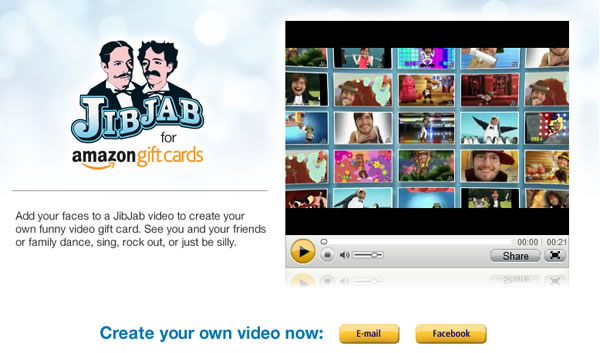
Well, Amazon has teamed with Jib Jab to transform this pretty boring but useful process into a valuable and fun one for both you the buyer and the recipient of your Amazon gift card by allowing you to make a fun, customized video card to send along with the gift card, that makes you the star.

Yes, it is a small thing, but when you put the focus of all of your employees on creating value, improving value access, and doing good value translation in every element of your business, just think how much innovation you can create.

Subscribe to Human-Centered Change & Innovation WeeklySign up here to get Human-Centered Change & Innovation Weekly delivered to your inbox every week.

Marketing Throwdown – Pull versus Push

Marketing Throwdown - Pull versus PushDescribing push marketing is easy (or at least it should be). Push marketing is the traditional marketing and advertising seen everywhere. Push marketing starts with the product or service, identifies the features or benefits that potential customers will find most compelling, and then utilizes targeting and segmentation to “push” carefully crafted marketing messages out via a variety of advertising, sales, and social media channels to the most likely potential customers.

But, stray into the pull marketing universe and prepare to be inundated by a plethora of widely divergent definitions. Some people would define pull marketing as similar to push, but instead of marketing to potential customers, potential decision makers or consumers (or even influencers) are targeted so that hopefully they will pull customers to the business. Still other people talk about technology push versus market pull in the context of determining which products get developed and sold (or should be developed and sold). Making it even more confusing, some people call the direct advertising to consumers of prescription medications like Viagra a pull marketing strategy. So just what is a pull marketing strategy then anyways? Who’s right?

I would argue that none of them are correct. While the communications produced might to talk to different groups of people than traditional marketing or in a slightly different way, they all are still, at their core, push marketing strategies. Pull marketing is something else entirely (and should be in order to maximize your investment in marketing). While push marketing focuses on the most likely potential customers, pull marketing should be focused on a totally different group of people – non-customers who are not yet ready to become customers at this time.

An effective pull marketing strategy begins with extensive research into what makes a person evolve from someone who is disinterested and unaware of a solution area, to seeing how it might fit into their personal or professional lives and make it better. This usually involves the creation of content that will raise awareness, interest, inspiration, and understanding of the whole solution area, and the need for it, not just the features and benefits of one company’s particular product or service. Pull marketing strategies are very uncomfortable for most marketers, and as a result most companies have no pull to balance their push.

So which is better push marketing or pull marketing?

Any organization that is interested in sustained revenue and profitability growth over time should invest in both, but most companies are seduced by the immediate payback of push marketing and pursue only push marketing strategies. Meanwhile, pull marketing helps grow new potential customers (or accelerates their purchase readiness timeline), so it is equally important in the long run. Smart companies, organizations that intend to succeed in the long run, need to invest in both push and pull marketing strategies in order to keep their sales pipeline full both for now AND for the future. And if your company is focused on innovation, then the more disruptive that you try to be, the more important that having a pull component to your marketing strategy will become. Push or pull? The answer lies in… the balance.


Build a common language of innovation on your team

Subscribe to Human-Centered Change & Innovation WeeklySign up here to get Human-Centered Change & Innovation Weekly delivered to your inbox every week.

New Thought Paper – Winning the War for Innovation

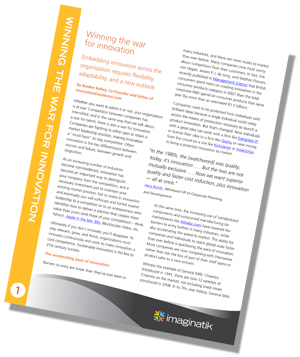
New Thought Paper - Winning the War for InnovationThere is a war for innovation brewing, and building a deep innovation capability is the only way to win it. The question is, will you lead the charge onto the innovation battlefield, or will you let your competitors bring the fight to you?

As an increasing number of industries become commoditized, innovation has become an important way to distinguish your company from the competition, and a necessary investment just to maintain your existing market position.

In this thought paper, I lead the charge against the status quo. I explore how your organization can stay relevant, grow, and thrive with an innovation framework that addresses four key areas: Leadership & Structure, Processes & Tools, People & Skills, and Culture & Values.

To download my new FREE thought paper on Winning the War for Innovation, please visit the link below.

Download a copy of Winning the War for Innovation

And grab a copy of my book designed to help you build a continuous innovation infrastructure!

Subscribe to Human-Centered Change & Innovation WeeklySign up here to get Human-Centered Change & Innovation Weekly delivered to your inbox every week.

Eight I’s of Infinite Innovation – PDF Version

Eight I's of Infinite Innovation - PDF VersionIn the wake of my hugely popular article on Innovation Excellence I’ve decided to make it available as a PDF.

Download the Eight I’s of Infinite Innovation PDF now

Some authors talk about successful innovation being the sum of idea plus execution, others talk about the importance of insight and its role in driving the creation of ideas that will be meaningful to customers, and even fewer about the role of inspiration in uncovering potential insight. But innovation is all about value and each of the definitions, frameworks, and models out there only tell part of the story of successful innovation.

To achieve sustainable success at innovation, you must work to embed a repeatable process and way of thinking within your organization, and this is why it is important to have a simple common language and guiding framework of infinite innovation that all employees can easily grasp. If innovation becomes too complex, or seems too difficult then people will stop pursuing it, or supporting it.

Some organizations try to achieve this simplicity, or to make the pursuit of innovation seem more attainable, by viewing innovation as a project-driven activity. But, a project approach to innovation will prevent it from ever becoming a way of life in your organization. Instead you must work to position innovation as something infinite, a pillar of the organization, something with its own quest for excellence – a professional practice to be committed to.

So, if we take a lot of the best practices of innovation excellence and mix them together with a few new ingredients, the result is a simple framework organizations can use to guide their sustainable pursuit of innovation – the Eight I’s of Infinite Innovation. This new framework anchors what is a very collaborative process. Here is the framework and some of the many points organizations must consider during each stage of the continuous process…

To continue reading, download the PDF

Subscribe to Human-Centered Change & Innovation WeeklySign up here to get Human-Centered Change & Innovation Weekly delivered to your inbox every week.

Simple Process Innovation – School Bus Style

Simple Process Innovation - School Bus StyleI was speaking with a friend recently about school, and the topic of tired teenagers came up. He said he mentioned to a member of the school board that they should start high school later so that the teenagers could sleep in. The school board member replied sorry, we can’t do that because we need the school buses to bring the elementary school kids to school at that time. Apparently this is how it works now in most places around the United States:

  1. School buses go and pick up the high school kids and bring them to school
  2. School buses go and pick up the middle school kids and bring them to school
  3. School buses go and pick up the elementary school kids and bring them to school

Which got both of thinking. Why not change this around to fit the children’s natural rhythms? After all, a lot of parents put their younger children to bed early, which means they wake up early anyways, and teenagers tend to naturally go to bed late and as a result of having to get up early to get to school, end up tired all of the time (making it harder to learn). So, why not flip the school run order around using the same school bus resources?

  1. School buses go and pick up the elementary school kids and bring them to school
  2. School buses go and pick up the middle school kids and bring them to school
  3. School buses go and pick up the high school kids and bring them to school

Elementary schools could swap out their before school and after school care for longer after school care, the high school kids could start and finish later, and all of the kids would be in school during times when they have better natural energy.

Maybe I’m oversimplifying things, or maybe I don’t know what I’m talking about, but as far as I can tell it would be worth trying this simple fix.

Subscribe to Human-Centered Change & Innovation WeeklySign up here to get Human-Centered Change & Innovation Weekly delivered to your inbox every week.

Webinar – Winning the War for Innovation – September 12th

Webinar - Winning the War for InnovationTomorrow, September 12, 2012 at 11am EDT (GMT -5:00) I will be presenting a webinar in cooperation with Imaginatik, a leader in the idea management software category.

The webinar is titled ‘Winning the War for Innovation‘ and we’ll be helping you take a look at whether or not you’re ready to accept that innovation has become a top priority.

Innovation has become a key source of competitive advantage, and the companies that thrive are those that innovate on a consistent basis – like Amazon and General Electric. Failing to innovate will put you on a straight, but treacherous path to extinction.

I will explain why innovation is so crucial today, and investigate the importance of building a continuous innovation capacity.

  1. How product cycles have fundamentally changed
  2. How global competition affects innovation
  3. How to build an innovation vision
  4. How to ‘make time’ for innovation

The world’s leading companies commit to embedding innovation deeply into their organizations. It becomes part of their DNA. Developing a consistent ability to innovate distinguishes today’s winners from losers.

Which group do you want your company to be a part of?

So, join me for this exclusive webinar Tomorrow, Wednesday, September 12, 2012.

Click to Register for FREE

Register for the Winning the War for Innovation Webinar

Subscribe to Human-Centered Change & Innovation WeeklySign up here to get Human-Centered Change & Innovation Weekly delivered to your inbox every week.

Eight I’s of Infinite Innovation

Eight I's of Infinite Innovation

Some authors talk about successful innovation being the sum of idea plus execution, others talk about the importance of insight and its role in driving the creation of ideas that will be meaningful to customers, and even fewer about the role of inspiration in uncovering potential insight. But innovation is all about value and each of the definitions, frameworks, and models out there only tell part of the story of successful innovation.

To achieve sustainable success at innovation, you must work to embed a repeatable process and way of thinking within your organization, and this is why it is important to have a simple common language and guiding framework of infinite innovation that all employees can easily grasp. If innovation becomes too complex, or seems too difficult then people will stop pursuing it, or supporting it.

Some organizations try to achieve this simplicity, or to make the pursuit of innovation seem more attainable, by viewing innovation as a project-driven activity. But, a project approach to innovation will prevent it from ever becoming a way of life in your organization. Instead you must work to position innovation as something infinite, a pillar of the organization, something with its own quest for excellence – a professional practice to be committed to.

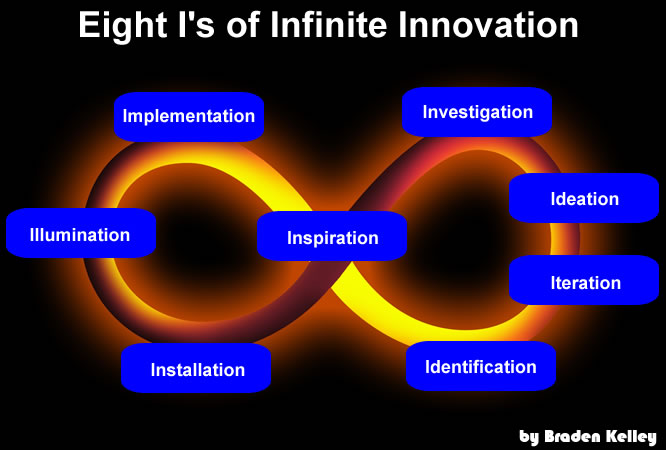
So, if we take a lot of the best practices of innovation excellence and mix them together with a few new ingredients, the result is a simple framework organizations can use to guide their sustainable pursuit of innovation – the Eight I’s of Infinite Innovation. This new framework anchors what is a very collaborative process. Here is the framework and some of the many points organizations must consider during each stage of the continuous process:

1. Inspiration

  • Employees are constantly navigating an ever changing world both in their home context, and as they travel the world for business or pleasure, or even across various web pages in the browser of their PC, tablet, or smartphone.
  • What do they see as they move through the world that inspires them and possibly the innovation efforts of the company?
  • What do they see technology making possible soon that wasn’t possible before?
  • The first time through we are looking for inspiration around what to do, the second time through we are looking to be inspired around how to do it.
  • What inspiration do we find in the ideas that are selected for their implementation, illumination and/or installation?

2. Investigation

  • What can we learn from the various pieces of inspiration that employees come across?
  • How do the isolated elements of inspiration collect and connect? Or do they?
  • What customer insights are hidden in these pieces of inspiration?
  • What jobs-to-be-done are most underserved and are worth digging deeper on?
  • Which unmet customer needs that we see are worth trying to address?
  • Which are the most promising opportunities, and which might be the most profitable?

3. Ideation

  • We don’t want to just get lots of ideas, we want to get lots of good ideas
  • Insights and inspiration from first two stages increase relevance and depth of the ideas
  • We must give people a way of sharing their ideas in a way that feels safe for them
  • How can we best integrate online and offline ideation methods?
  • How well have we communicated the kinds of innovation we seek?
  • Have we trained our employees in a variety of creativity methods?

4. Iteration

  • No idea emerges fully formed, so we must give people a tool that allows them to contribute ideas in a way that others can build on them and help uncover the potential fatal flaws of ideas so that they can be overcome
  • We must prototype ideas and conduct experiments to validate assumptions and test potential stumbling blocks or unknowns to get learnings that we can use to make the idea and its prototype stronger
  • Are we instrumenting for learning as we conduct each experiment?
Eight I's of Infinite Innovation

5. Identification

  • In what ways do we make it difficult for customers to unlock the potential value from this potentially innovative solution?
  • What are the biggest potential barriers to adoption?
  • What changes do we need to make from a financing, marketing, design, or sales perspective to make it easier for customers to access the value of this new solution?
  • Which ideas are we best positioned to develop and bring to market?
  • What resources do we lack to realize the promise of each idea?
  • Based on all of the experiments, data, and markets, which ideas should we select?

You’ll see in the framework that things loop back through inspiration again before proceeding to implementation. There are two main reasons why. First, if employees aren’t inspired by the ideas that you’ve selected to commercialize and some of the potential implementation issues you’ve identified, then you either have selected the wrong ideas or you’ve got the wrong employees. Second, at this intersection you might want to loop back through the first five stages though an implementation lens before actually starting to implement your ideas OR you may unlock a lot of inspiration and input from a wider internal audience to bring into the implementation stage.

6. Implementation

  • What are the most effective and efficient ways to make, market, and sell this new solution?
  • How long will it take us to develop the solution?
  • Do we have access to the resources we will need to produce the solution?
  • Are we strong in the channels of distribution that are most suitable for delivering this solution?

7. Illumination

  • Is the need for the solution obvious to potential customers?
  • Are we launching a new solution into an existing product or service category or are we creating a new category?
  • Does this new solution fit under our existing brand umbrella and represent something that potential customers will trust us to sell to them?
  • How much value translation do we need to do for potential customers to help them understand how this new solution fits into their lives and is a must-have?
  • Do we need to merely explain this potential innovation to customers because it anchors to something that they already understand, or do we need to educate them on the value that it will add to their lives?

8. Installation

  • How do we best make this new solution an accepted part of everyday life for a large number of people?
  • How do we remove access barriers to make it easy as possible for people to adopt this new solution, and even tell their friends about it?
  • How do we instrument for learning during the installation process to feedback new customer learnings back into the process for potential updates to the solution?

Conclusion

The Eight I’s of Infinite Innovation framework is designed to be a continuous learning process, one without end as the outputs of one round become inputs for the next round. It’s also a relatively new guiding framework for organizations to use, so if you have thoughts on how to make it even better, please let me know in the comments. The framework is also ideally suited to power a wave of new organizational transformations that are coming as an increasing number of organizations (including Hallmark) begin to move from a product-centered organizational structure to a customer needs-centered organizational structure. The power of this new approach is that it focuses the organization on delivering the solutions that customers need as their needs continue to change, instead of focusing only on how to make a particular product (or set of products) better.

So, as you move from the project approach that is preventing innovation from ever becoming a way of life in your organization, consider using the Eight I’s of Infinite Innovation to influence your organization’s mindset and to anchor your common language of innovation. The framework is great for guiding conversations, making your innovation outputs that much stronger, and will contribute to your quest for innovation excellence – so give it a try.

Download as a PDF

Haga clic aquí para la versión en Español

Subscribe to Human-Centered Change & Innovation WeeklySign up here to get Human-Centered Change & Innovation Weekly delivered to your inbox every week.

Webinar – Winning the War for Innovation

Webinar - Winning the War for InnovationOn September 12, 2012 I will be presenting a webinar in cooperation with Imaginatik, a leader in the idea management software category.

The webinar is titled ‘Winning the War for Innovation‘ and we’ll be helping you take a look at whether or not you’re ready to accept that innovation has become a top priority.

Innovation has become a key source of competitive advantage, and the companies that thrive are those that innovate on a consistent basis – like Amazon and General Electric. Failing to innovate will put you on a straight, but treacherous path to extinction.

I will explain why innovation is so crucial today, and investigate the importance of building a continuous innovation capacity.

  1. How product cycles have fundamentally changed
  2. How global competition affects innovation
  3. How to build an innovation vision
  4. How to ‘make time’ for innovation

The world’s leading companies commit to embedding innovation deeply into their organizations. It becomes part of their DNA. Developing a consistent ability to innovate distinguishes today’s winners from losers.

Which group do you want your company to be a part of?

So, join me for this exclusive webinar Wednesday, September 12, 2012.

Click to Register for FREE

Subscribe to Human-Centered Change & Innovation WeeklySign up here to get Human-Centered Change & Innovation Weekly delivered to your inbox every week.
Apple Touches on a Potential Innovation Integration

Apple Touches on a Potential Innovation Integration

Recently Apple announced its intention to acquire Authentec, a biometric authentication company. Apple was in a real hurry to complete the acquisition and it makes you wonder whether Authentec’s fingerprint authentication technology will make it into the home button of the iPhone 5 and possibly the iPad Mini in the coming months.

If Apple were to integrate the Authentec technology into the home button on the iPhone 5, the iPad Mini, and eventually the iPad 4, then it would not only create a handy way to make the devices easily personalized for multiple users of the same device (or just a simple password-free login for a single user), but purportedly the technology also has the ability to recognize multiple fingers (allowing for the home button to potentially achieve multiple functions), and to serve as authentication for mobile payments (most likely via NFC – Near Field Communications).

That would mean that Apple would add a lot of new functionality with the integration of this tiny piece of hardware, several software updates, and another tiny piece of hardware for NFC. But more importantly, these tiny pieces of hardware and software could make the computing experience more personal, and more naturally personalized as you move around the environment into different applications.

I know it is only a replacement for what could or can be done with a password, but I would love to be able to have apps like Netflix personalized based on whose finger was used.

This could become a great example of flexible design and innovating for the future present if they launch the iPhone 5 with these technologies. That would show that they started the design process with this as only a possibility but decided AFTER the technology looked ready to actually integrate it into the shipping product, and remained flexible enough to integrate the component near the end of the design process – something that is very hard to do, but very powerful.

Are all of these potential innovations ranging from the minor (login) to the transformative (speeding up mobile payment adoption) likely to make the cut for the iPhone 5?

I guess we will wait and see what happens on September 12th.

Subscribe to Human-Centered Change & Innovation WeeklySign up here to get Human-Centered Change & Innovation Weekly delivered to your inbox every week.

A Refreshing Approach to Product Innovation

A Refreshing Approach to Product InnovationSometimes it is better to be late than never. Starbucks recently announced a new line of energy drinks – Starbucks Refreshers. There are two flavors Cool Lime and Very Berry Hibiscus and instead of copying other energy drinks, and use the same active ingredients as the usual suspects, they instead decided to use something uniquely Starbucks – green coffee extract.

Starbucks Refreshers are coffee drinks that don’t look like or taste like coffee, but provide the caffeine jolt that many of their customers are looking for nonetheless. And as an added bonus, they are coffee drinks that are much lower in calories and fat than many of their traditional hot or iced lattes. Coffee for the lactose intolerant too!

Starbucks has done something else smart, and that is that they have created a self-reinforcing product loop that allows for three different preparations and use cases for the same basic product, all in a single summer product launch:

  1. A customizable cafe preparation with multiple sizes and fresh fruit
  2. A canned, chillable pre-mixed portable preparation
  3. An extremely portable VIA DIY preparation without the water

In addition to being sold in their stores and licensed locations, the can and VIA preparation can be distributed via Starbucks’ existing grocery distribution channels.

Starbucks Refreshers are a great example of taking components of your brand and other organizational assets and leveraging them to create new products that people might not have thought about you creating, but that feel like natural extensions to them instead of a stretch.

Starbucks Refreshers are also a great example of looking at your raw materials in a new way and as a result a new product solution in born.

What might happen if you looked at your raw material inputs in a new way?

Subscribe to Human-Centered Change & Innovation WeeklySign up here to get Human-Centered Change & Innovation Weekly delivered to your inbox every week.