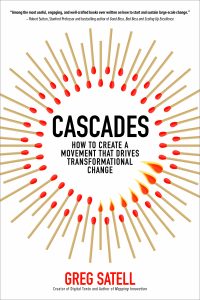
A while ago I had the opportunity to interview Greg Satell, author of the new book Cascades: How to Create a Movement that Drives Transformational Change.
Greg Satell is a bestselling author, speaker and adviser, who frequently contributes here to my blog Human-Centered Change and Innovation, Harvard Business Review, Inc. and other A-list publications. His first book, MAPPING INNOVATION, was chosen as one of the best business books of 2017 by 800-CEO-READ. His latest book, CASCADES, was recently published by McGraw-Hill Education.
Today, he helps leading businesses overcome disruption through impactful programs and powerful tools he developed researching the world’s best innovators and most effective changemakers.
Without further ado, here is the transcript of that interview:
1. People love to tell the story of Netflix disrupting Blockbuster. What do they get wrong?
It’s funny. People so easily assume that Blockbuster just completely ignored the Netflix threat, when actually nothing could be further from the truth. In fact, the leadership came up with an effective strategy to meet that threat, executed it well and began to surpass Netflix in adding new subscribers.
The real reason that Blockbuster failed was that the leadership failed to manage internal networks—particularly franchisees and investors—and the stock price crashed. That attracted the corporate raider Carl Icahn, who had a heavy handed style. Eventually, things came to a head and he initiated a compensation dispute with the CEO, John Antioco., who left in frustration. The new CEO came in and reversed the strategy. Three years later, Blockbuster went bankrupt.
One of the most interesting parts of the story came out when I interviewed Antioco, who was—and is—something of a retail genius. He told me that, throughout his career, anytime he wanted to do something innovative, he always met resistance. He had always succeeded by pushing through that resistance. This time though, it got the better of him.
We tend to think that if we have the right idea and execute it well, we’ll be successful. The real lesson of Blockbuster is that isn’t always true. We also need to manage stakeholder networks.
2. To be efficient at scale, businesses introduce hierarchies as they grow. What weaknesses does this introduce and how should companies manage these?
To be honest, I don’t see anything inherently wrong with hierarchies. They’ve been put in place because they are effective at executing processes efficiently. Every organization needs that. However, hierarchies tend to be rigid and slow to adapt. That can be a real problem when the marketplace changes.
So what I think leaders need to focus on is building strong informal networks to supplement the formal organization. Chris Fussell calls this a “hybrid organization.” That’s what’s really key, to have the formal organization and the informal organization working hand-in-hand.
Unfortunately, there’s been so much emphasis on “breaking down silos,” that business leaders often miss that silos can be very positive things. They are essentially “centers of capability.” So you don’t want to break them up. What you do want to do is to connect silos so that they can adapt and collaborate.
3. Some would say that hierarchies are created to cascade information. How does information cascade differently within networks? How is better?
Well, hierarchies are essentially vertical networks, so information tends to move up and down fairly well, but not so good side to side, which makes it hard for an organization to adapt laterally. The types of networks I write about in Cascades are horizontal, so are much better set up to transfer information between disparate groups.
Clearly, you need both. The problem is that we tend to ignore the informal networks, which is why organizations over time become vertically driven and rigid.
 4. What causes some movements to grow and others to be sidelined at the periphery?
That’s a great and complicated question (in fact, I wrote a whole book about it!). The truth is that, much as Tolstoy said about families, successful movements tend to look very much alike, while unsuccessful movements fail in their own way.
However, if there is one key thing that makes the difference it is to always connect out. Research has shown that the key metric that best determines success is participation. That may seem obvious, but many movements get caught up in idealogical purity and shut out potential allies. If you want to kill a change movement quickly, that’s probably the best way to do it. It’s not the fervor of zealots that brings change about, but when you get everybody else to join in that a true revolution can take place.
A great example of this kind of failure is the Occupy Movement. At first, they gained a lot of sympathy for their “99% vs. the 1%” message. However they were so extreme, and so intent on demonizing anyone who didn’t believe 100% what they believed, that they turned many people off. At one point, the legendary civil rights leader John Lewis asked to speak at a rally and was refused. I mean, John Lewis! Talk about shooting yourself in the foot!
The same is true in the business context. Think about VHS vs. Betamax. Betamax was the better technology, but VHS was more inclusive. VHS won.
Another great example is the Ignaz Semmelweis story. Semmelweis had discovered that hand washing in hospitals greatly reduced infection rates. It was a major discovery. However, rather than working to build a movement around his idea, he railed against anyone who didn’t agree with him. It would take another 20 years for antiseptic practices to gain traction and millions of people died needlessly because of it.
More recently, Jim Allison had a similar challenge with cancer immunotherapy. Pharmaceutical companies didn’t believe it would work and refused to invest in it. I still remember the sound of despair in his voice when he told me the story—and this was 20 years after it happened! But Jim kept pounding the pavement, kept working to bring others in and thousands upon thousands of people are alive today because of Jim.
So again, you have to constantly be connecting out and bringing people in. That’s why Jim Allison won the Nobel Prize last fall instead of dying in an insane asylum like Ignaz Semmelweis.
5. Why do successful movements or revolutions seem to need rules?
I think it’s better to say that movements need values. Values play two important roles: First, they provide constraints and, second, they provide rules for adaptation.
For example, during the Anti-Apartheid movement in South Africa, Nelson Mandela was accused of being an anarchist, a communist and worse. When asked about his beliefs though, he always pointed to the Freedom Charter, which was written way back in 1955. So he could point to something concrete that outlined his values and that of his movement. That commitment to values was crucial for getting support from institutions outside of South Africa and it was the support from those institutions that enabled Mandela and his movement to succeed.
When he got into power those constraints became even more important. Because one of the core values spelled out in the Freedom Charter was that all national groups should have equal rights, he couldn’t infringe upon the rights of white people, even though many urged him to do so. It is because of those self-imposed constraints that we remember Nelson Mandela as a hero and not some tin-pot dictator.
A similar dynamic played out in the “Gerstner Revolution” at IBM in the 1990s. Gerstner famously said that the last thing IBM needed at the time was a vision. But he was very clear that he wanted to shift values, to make IBM more customer focused and more collaborative. That sent important signals to customers, partners and investors and played a big part in Gerstner’s success.
Perhaps even more importantly, the focus on values helped IBM prosper long after he left the company. Irving Wladawsky-Berger, one of Gerstner’s key lieutenants, told me that if the Gerstner Revolution had merely been about strategy and technology, it wouldn’t have survived. But because it was rooted in values, IBM was able to adapt as technology and the marketplace continued to evolve.
Clearly, IBM has had its challenges since Gerstner left in 2002, but it’s still a highly profitable company that continues to be on the forefront of many cutting edge technologies, such as artificial intelligence, blockchain and quantum computing, just to name a few. It’s hard to see how that could have happened if the company was still stuck in a strategy developed in the 90s. That’s the role that values play.
6. How would you contrast the theory behind Cascades with W. Chan Kim and Renée Mauborgne’s Tipping Point Leadership?
I think on the surface they are somewhat similar ideas. However, there are important differences “under the hood.”
First, while “Tipping Point Leadership” implicitly refers to the importance of networks, Cascades is deeply and explicitly rooted in network science. In fact, Duncan Watts and Steven Strogatz, who pioneered modern network theory, have both endorsed the book (although Strogatz has done so more informally). I believe that scientific approach really helps provide a stronger framework to understand how change occurs.
Another important difference is that while Kim and Mauborgne basically built their framework from scratch, Cascades is more of a synthesis of ideas that have already been proven successful in social, political and business contexts.
There has been a lot great thinking about this stuff for a long time, so I saw no reason to try and reinvent the wheel. Rather, I tried to shape already powerful ideas—some of which have been battle-tested for decades—into a coherent framework that people can put to good use. In that way, Cascades is very similar to my previous book, Mapping Innovation.
Of course I’m biased on this point, but I believe the result is a much richer, detailed and useful framework for driving change. When you are driving change in the real world, details matter.
7. What is wrong with the theory of influentials being central to successful change?
Well, first it’s wrong because it’s empirically been shown not to be true. Scientific research has clearly shown, across multiple studies, that you don’t need “influentials” to create a viral cascade or, as Gladwell puts it, a “social epidemic.” I reference many of these studies in the book, so that readers can go check for themselves.
Conceptually, the influentials hypothesis breaks down because you need large chains of influence to create a viral cascade. Somebody may be influential because they are a connector, a maven, or whatever, but unless the people they influence pass on their ideas to others who pass them on to others still, the movement will die out. As I write in the book, it is small groups, loosely connected, but united by a shared purpose that drives transformational change.
The one exception is celebrities like Oprah Winfrey. They can really move the needle if they choose to promote an idea, but not because they have any “rare social gifts.” It’s because what they say is broadcasted by mass media. So there’s nothing really mysterious about it.
 8. What are some of the critical raw materials for fueling a cascade?
The three most important elements are small groups, loose connections and shared purpose.
Small groups engender strong bonds and that’s super important. Creating change is hard. So it’s important to build deep trustful relationships that lead to effective collaboration. That’s at the root of any successful movement. For example, the Otpor Movement in Serbia started with just 11 founders.
However, a small group can’t do much on its own. So it’s important for small groups to connect to other small groups. It’s that continuous linking that creates the conditions upon which a cascade can arise. That’s how Otpor eventually grew to 70,000 members and took down the dictator, Slobodan Milošević. As I explain the book, organizational change movements, such as those in the US Army and at companies like Experian and Wyeth Pharmaceuticals, play out in very much the same way.
Lastly, you need a sense of shared purpose. That’s what ties everything together. It’s also why effective leadership is so important. You need leaders to provide that purpose. As I write in the book, the role of leaders is no longer merely to plan and direct action, but to inspire and empower belief.
9. What’s your view on the phases of a successful change
Generally speaking, change movements have three phases: planning, mobilization and the victory phase.
In the planning phase, you need to formulate your Vision of Tomorrow and your values and also map out the specific constituencies you want to mobilize and the institutions you will need to influence. It’s important to not mobilize too soon, because every revolution inspires a counterrevolution. So by mobilizing too early you run the risk of inspiring opposition as much as you do supporters. This is a very common mistake.
Mobilization is largely about planning and executing tactics and there are a couple of important points to keep in mind. First, you are always mobilizing specific constituencies to influence particular institutions. You are always mobilizing somebody to influence something. You’re never mobilizing just for the sake of mobilizing or to “raise awareness” or anything like that. Everything you do needs to have a strategy in mind.
Another point is that you always want to be mobilizing out and bringing people in. And when you recruit new people you want to immediately train them and get them to act, even if the action is small. It is through action that people take ownership of change, so getting people to act is incredibly important. One of the cases I researched was Experian’s digital transformation. They really focused on this aspect and had enormous success.
The last phase is the victory phase and it’s often the most dangerous. For example, in Ukraine’s Orange Revolution, which I took part in and inspired me to write the book, we thought we had won. As it turned out, we hadn’t and soon the country descended back into chaos, which resulted in a second revolution, the Euromaidan protests in 2013 and 2014.
We’ve seen the same thing happen more recently in Egypt, where they overthrew Mubarak and ended up with el-Sisi, who is very much the same. It’s also common in startups and in corporate transformation, an early surge and then things go awry.
So you need to plan to “survive victory” ahead of time. You do that by focusing on shared values, rather than specific personalities or objectives. You never want to make a change movement about yourself or your organization. It always needs to be about values.
There is a fourth phase and it’s one you want to avoid. It is the failure phase. Almost every movement I researched had a massive early failure. In most cases, it arose from a failure to prepare and build the movement methodically. The successful movements learned from those failures and continued to evolve. The unsuccessful ones didn’t.
10. When it comes to participation and mobilization, what should people keep in mind to accelerate both?
Again, you just want to keep building out and networking the movement. Keep building links. Eventually, you will build critical mass and the movement will accelerate by itself. That’s what a cascade is, when your movement goes viral.
However, before that happens, you want to prepare as much as possible or your movement can spin out of control, if you haven’t invested in building values, training, etc. We’ve seen that happen with Occupy, Black Lives Matter and, to some extent, the modern women’s movement. Values always need to be upfront.
Perhaps most of all, you need to keep in mind that change is always possible. If you looked at Serbia in 1999, what you would have seen was a country ruled by a ruthless dictator with no effective opposition. Occupy only had a few hundred members at the time. A year later, Occupy had grown to 70,000 members and Milošević was out of office. A few years after that, he died in his cell at The Hague.
Very few change efforts have to overcome those kinds of odds, but using the same principle—those that I write about in Cascades—you can bring real change about, whether that change is in your organization, your industry, your community or throughout society as a whole.
FREE BONUS
If you’ve read this far you deserve a free bonus!
Click here to download a FREE excerpt from Greg’s latest book CASCADES
 Sign up here to get Human-Centered Change & Innovation Weekly delivered to your inbox every week.








 Back in 2011 when election season was fast approaching, one thing that you heard repeatedly during election coverage was analysts talking about the importance of the undecided vote. Often in an election it is the undecided who swing the vote for one candidate over another. As a result, there is an incredible amount of focus placed on understanding why people are still undecided between two major candidates (think Obama vs. Romney) and so as a result campaign strategists and speech writers are obsessed with capturing the imagination of the undecided. But, there is a lot of complexity in those undecided numbers, as they include: