Tag Archives: psychological safety

The Power of Psychological Safety

Building Teams Ready for Anything

The Power of Psychological Safety

GUEST POST from Art Inteligencia

For decades, we’ve defined high-performing teams by their collective talent, their competitive drive, or their relentless focus on execution. We’ve believed that success is a matter of gathering the smartest people in a room and demanding excellence. But as a human-centered change and innovation thought leader, I’ve seen time and again that this model is insufficient for the complexity of our modern world. The most resilient, innovative, and successful teams are not defined by individual brilliance, but by a shared sense of trust and vulnerability. Their secret weapon is a concept known as psychological safety, a foundational element that empowers people to take risks, speak up, and learn from mistakes without fear of judgment or reprisal.

Psychological safety is a shared belief held by members of a team that the team is safe for interpersonal risk-taking. In simple terms, it’s the feeling that you can be yourself, ask a “stupid” question, admit a mistake, or propose a wild idea without being shamed, ridiculed, or penalized. This isn’t a “soft” concept; it’s a hard, strategic capability. In a world where change is the only constant, teams must be able to experiment, give and receive honest feedback, and pivot with agility. None of this is possible in a fear-based environment. The human instinct to self-preserve—to avoid looking incompetent—is a powerful force. Without psychological safety, we self-censor, we withhold critical information, and we stick to the known, a sure-fire path to stagnation and irrelevance. Conversely, when psychological safety is high, a team’s collective intelligence soars, and their capacity for innovation becomes limitless.

Cultivating a Culture of Safety: A Leader’s Blueprint

Building psychological safety is a leader’s most important job. It’s not about being “nice”; it’s about being intentional. Here are four essential practices for creating an environment where your team is ready for anything:

  • 1. Frame the Work as a Learning Problem: In a complex world, there is no single right answer. Frame every challenge not just as a task to be executed, but as a hypothesis to be tested. This reframes failure as a source of valuable data and reframes mistakes as essential steps on the path to a solution.
  • 2. Acknowledge Your Own Fallibility: Leaders must go first. When you admit a mistake, say “I don’t know,” or ask for help, you create a powerful permission structure for your team. This vulnerability signals that it’s okay for them to do the same, breaking down the fear of looking incompetent.
  • 3. Practice Inclusive Inquiry: Instead of simply stating your opinion, ask questions. Actively seek out the opinions of quieter team members. Say things like, “What are we missing?” or “I want to hear from someone who disagrees with me.” This signals that diverse perspectives are not just welcome but essential.
  • 4. Respond Constructively to Failure: When a project fails or a mistake is made, your response is everything. Avoid placing blame. Instead, lead with curiosity. Ask, “What did we learn from this?” and “How can we build a system to prevent this from happening again?” This turns a moment of potential crisis into a learning opportunity.

“Talent gets you on the field, but psychological safety is what allows you to win the game.” — Braden Kelley


Case Study 1: Pixar’s “Braintrust” – A Masterclass in Candor

The Challenge:

In the high-stakes world of animated filmmaking, a single creative misstep can lead to a disastrous flop. For Pixar, the challenge was to create a mechanism for frank, honest, and even brutal feedback on films in progress without crushing the creative spirit of the director and their team. A typical corporate review process would be too political and hierarchical for the level of candid feedback needed.

The Psychological Safety Solution:

Pixar’s solution was the Braintrust, an exclusive group of the company’s most accomplished directors and storytellers. This wasn’t a formal committee; it was a culture built on psychological safety. The core rules of the Braintrust are simple yet powerful: a director is never obligated to act on the feedback, and the group’s purpose is to help the film succeed, not to assert power. The feedback is always on the work, never the person. This deep, shared belief that everyone is there to help and that no one is judging personal worth allowed for a level of open, candid criticism that is almost unheard of in other creative industries. Directors could present their half-finished, deeply flawed films and receive honest input without fear of professional harm.

The Result:

The Braintrust is a key reason for Pixar’s long-term, unprecedented creative success. It is a living testament to the power of psychological safety. By building an environment where candor and vulnerability were not just tolerated but celebrated, Pixar created a collective intelligence that consistently elevated the quality of every film. They proved that honest feedback, delivered with a foundation of trust, is the ultimate driver of creative excellence.


Case Study 2: Volkswagen’s “Dieselgate” – The Cost of Silence

The Challenge:

In the years leading up to the “Dieselgate” scandal, Volkswagen was a highly centralized, hierarchical organization with a demanding culture of top-down perfection. Leaders set ambitious, often unrealistic, performance targets. The challenge was to meet a new set of strict emissions standards for their diesel vehicles, a goal that their engineering teams knew was physically impossible to achieve without compromising performance.

The Psychological Safety Failure:

In this fear-based environment, with a rigid emphasis on hierarchy and an intolerance for failure, employees were not psychologically safe to speak up. The engineers knew the emissions targets were unattainable, but they feared professional repercussions—demotion, firing, or public shaming—if they admitted failure. Instead of raising the impossible challenge to senior leadership, they chose to develop and install a “defeat device,” a software program designed to cheat on emissions tests. This was a direct, disastrous consequence of a culture that prioritized looking good over being honest and vulnerable.

The Result:

When the deception was discovered, it led to one of the biggest corporate scandals in history. The financial cost was in the tens of billions of dollars, but the damage to the company’s brand and reputation was incalculable. “Dieselgate” serves as a powerful cautionary tale. It shows that when psychological safety is absent, people will choose silence over speaking the truth, and a single, unaddressed problem can grow into a monumental crisis that threatens the very existence of the organization. It’s proof that a lack of psychological safety is not just a cultural problem; it’s a critical strategic risk.


Conclusion: The Ultimate Foundation for Innovation

Psychological safety is not a “nice-to-have.” It is the ultimate foundation for building teams that are resilient, adaptable, and ready for anything. It is the soil in which innovation grows, where creativity flourishes, and where people are empowered to be their best, most authentic selves. As leaders, our most important job is not to provide all the answers, but to create the environment where our teams feel safe enough to find them together.

In a world of constant change, the ability to learn and evolve is paramount. And learning only happens when we are willing to admit what we don’t know, to experiment without fear of failure, and to speak our minds without fear of judgment. The future belongs to the psychologically safe. Let’s start building it, one conversation and one act of vulnerability at a time.

Extra Extra: Futurology is not fortune telling. Futurists use a scientific approach to create their deliverables, but a methodology and tools like those in FutureHacking™ can empower anyone to engage in futurology themselves.

Image credit: Pexels

Subscribe to Human-Centered Change & Innovation WeeklySign up here to get Human-Centered Change & Innovation Weekly delivered to your inbox every week.

The Role of Psychological Safety in Fostering Innovation

The Role of Psychological Safety in Fostering Innovation

GUEST POST from Art Inteligencia

In the rapidly changing world of business, innovation isn’t just encouraged—it’s essential for survival. Yet, fostering an environment where innovation thrives isn’t merely about investing in the latest technology or having creative job titles. At the foundation of sustained innovation lies a crucial and often overlooked factor: psychological safety.

Psychological safety, a term popularized by Harvard Business School professor Amy Edmondson, refers to a team climate characterized by interpersonal trust and mutual respect, where people are comfortable being themselves. In such an environment, team members feel safe to take risks, voice their ideas, and even fail—all without the fear of repercussion or ridicule. Let’s explore the pivotal role psychological safety plays in enhancing innovation potential within organizations, supported by real-world case studies.

The Science of Psychological Safety

Several studies highlight the profound impact of psychological safety on team performance. When team members feel psychologically safe, they are more likely to engage in learning behaviors—seeking feedback, sharing information, experimenting, and discussing mistakes. These behaviors are the bedrock of an innovative culture, fostering environments where breakthroughs happen and improvements are continuous.

“Innovation is fueled by the ability to connect previously unconnected information and ideas. This happens best when people feel comfortable to express their diverse thoughts without fear.” — Braden Kelley

Case Study 1: Google’s Project Aristotle

Google’s Project Aristotle was a comprehensive research initiative to understand what makes teams effective. After studying over 180 teams, Google discerned that the most successful teams shared a common characteristic—psychological safety.

Teams with high levels of psychological safety were not necessarily composed of all-star players. Instead, their success stemmed from encouraging equal speaking opportunities among team members, empathy towards one another, and valuing diversity of thought. These teams were more innovative and productive. Google now emphasizes psychological safety as a cornerstone of its team-building exercises and leadership training, firmly embedding it into their culture.

Case Study 2: Toyota’s Culture of Continuous Improvement

Toyota is renowned for its continuous improvement methodology, known as Kaizen. A significant contributor to the success of this approach is the cultivation of psychological safety within their teams. Toyota encourages its employees to voice their opinions and suggest improvements without the fear of negative consequences. This approach has led to significant innovations and enhancements in their production processes and has positioned Toyota as a leader in quality and efficiency in the automobile industry.

For example, Toyota’s commitment to psychological safety was evident in their assembly line workers’ empowerment. Workers could stop the production line if they identified a problem, so it could be fixed promptly. This policy not only improved overall quality but also reinforced the value of each worker’s input, thereby driving innovation from all levels of the company.

Creating a Psychologically Safe Environment

Launching into this cultural transformation isn’t merely a top-down directive. It involves cultivating a grass-roots shift and embedding psychological safety into the team’s DNA. Here are several strategies organizations can implement to foster a more psychologically safe environment:

1. Encourage Open Communication

Create an atmosphere where team members feel encouraged to share their ideas and opinions without judgment. Regularly solicit feedback and listen actively to what your team has to say.

2. Demonstrate Vulnerability as a Leader

Leaders should model the behavior they wish to see by admitting their own mistakes and uncertainties. This openness can help set a tone that failing and learning are part of the creative process.

3. Normalize Inclusivity and Diversity

Value and harness the diversity of your team by recognizing the variety of perspectives that members bring. Cultivate an inclusive environment where different viewpoints are appreciated and respected.

4. Provide Constructive Feedback

Deliver feedback that is constructive and focused on improvement rather than personal criticism. Encourage a growth mindset where feedback is viewed as a pathway to better performance and innovation.

5. Encourage Experimentation

Create opportunities for your team to try new ideas in a safe environment. Emphasize learning from what doesn’t work as much as from what does.

Conclusion

In a world where innovation is more critical than ever, creating and nurturing psychologically safe environments has proven to be a key enabler of creative and effective teams. By embracing psychological safety, organizations unlock the full potential of their workforce, allowing for the free exchange of ideas, increased engagement, and transformational innovations. When organizations commit to embedding this principle into their culture, they pave the way for sustainable success and groundbreaking advancements.

Let us champion the charge towards psychological safety and make innovation a cornerstone of our work environments, paving the path towards a brighter, more innovative future.

Extra Extra: Futurology is not fortune telling. Futurists use a scientific approach to create their deliverables, but a methodology and tools like those in FutureHacking™ can empower anyone to engage in futurology themselves.

Image credit: Pixabay

Subscribe to Human-Centered Change & Innovation WeeklySign up here to get Human-Centered Change & Innovation Weekly delivered to your inbox every week.

The Role of Psychological Safety in Innovation

The Role of Psychological Safety in Innovation

GUEST POST from Art Inteligencia

In the rapidly changing world of business, innovation is the lifeblood of sustained success. Harnessing creativity, collaboration, and experimentation is crucial, yet these elements can only thrive in an environment where team members feel psychologically safe. Psychological safety is the belief that one will not be punished or humiliated for speaking up with ideas, questions, concerns, or mistakes. This article explores the vital role of psychological safety in fostering innovation and presents case studies to illustrate its impact in real-world scenarios.

Understanding Psychological Safety

Coined by Harvard Business School professor Amy Edmondson, psychological safety describes a workplace culture where individuals feel secure enough to take interpersonal risks. This concept is critical for innovation because it encourages openness, where employees can freely share ideas, experiment without fear of failure, and embrace creative problem-solving processes.

Benefits of Psychological Safety for Innovation

  • Encourages Idea Generation: Team members are more likely to propose innovative ideas if they are confident they won’t be ridiculed or dismissed.</ li>
  • Facilitates Learning from Mistakes: A psychologically safe environment allows teams to learn and grow from failures, turning setbacks into stepping stones for future success.
  • Enhances Collaboration: When employees feel safe, they are more likely to share knowledge, ask for help, and work together effectively.
  • Increases Employee Engagement: Psychological safety fosters a sense of belonging and motivation, leading to higher levels of engagement and productivity.

Case Studies

Case Study 1: Google’s Project Aristotle

Google embarked on a quest to understand what makes a team effective, which led to Project Aristotle in 2012. Through extensive research, they discovered that psychological safety was the most critical factor in high-performing teams.

Challenges Faced: Google identified that many of their teams struggled with collaboration due to fear of judgment or reproach.

Actions Taken: Google implemented practices to foster psychological safety. This included promoting open dialogue, encouraging risk-taking without penalization, and ensuring every team member’s voice was heard.

Results: Teams that embraced psychological safety showed significant improvements in innovation output, efficiency, and employee satisfaction. The project reinforced that fostering a safe environment for risk-taking and open communications was essential to driving innovation.

Case Study 2: W.L. Gore & Associates

W.L. Gore & Associates, the company behind Gore-Tex, is renowned for its unique organizational culture that emphasizes psychological safety.

Challenges Faced: As a company rooted in innovative product development, ensuring continuous creativity while managing market pressures posed significant challenges.

Actions Taken: W.L. Gore adopted a flat organizational structure and a philosophy called “lattices,” where associates have the freedom to speak up, propose ideas, and lead projects without hierarchical constraints.

Results: This approach led to groundbreaking products and technologies, such as the Gore-Tex fabric. By sustaining an environment where associates felt safe to experiment and potentially fail, Gore consistently maintained a pipeline of innovative products.

Conclusion

Innovation thrives where psychological safety is prioritized. Organizations that nurture an environment of trust and openness not only unlock their employees’ creative potential but also drive sustainable growth and success. Leaders must actively foster psychological safety to build dynamic, innovative teams ready to tackle the challenges of the future.

This article features a thorough examination of the role of psychological safety in innovation, with practical insights conveyed through notable case studies from Google and W.L. Gore & Associates, reinforcing the concept’s critical importance in real-world applications.

Bottom line: Futurology is not fortune telling. Futurists use a scientific approach to create their deliverables, but a methodology and tools like those in FutureHacking™ can empower anyone to engage in futurology themselves.

Image credit: Pixabay

Subscribe to Human-Centered Change & Innovation WeeklySign up here to get Human-Centered Change & Innovation Weekly delivered to your inbox every week.

The Impact of Psychological Safety on Innovation Success

The Impact of Psychological Safety on Innovation Success

GUEST POST from Art Inteligencia

In today’s rapidly changing business environment, the ability to innovate has become a crucial differentiator for organizations. However, one indispensable factor that often goes unnoticed is psychological safety. Teams that feel safe to take risks and voice their ideas without fear of retribution are the ones most likely to succeed in driving innovation. This article explores the profound impact of psychological safety on innovation success, supported by two compelling case studies.

What is Psychological Safety?

Psychological safety is a shared belief held by members of a team that it is safe to take interpersonal risks. It was first introduced by Harvard professor Amy Edmondson, who described it as a climate in which people are comfortable expressing and being themselves. The concept is integral for fostering an innovative culture, as it encourages open dialogue, creativity, and the willingness to challenge the status quo.

The Link Between Psychological Safety and Innovation

Organizations that cultivate psychological safety can expect a more engaged, motivated, and innovative workforce. The freedom to fail without fear of humiliation or punishment leads to higher levels of experimentation and risk-taking, both of which are essential for innovation. Several studies have shown a strong correlation between psychological safety and innovation outcomes, making it a non-negotiable element for organizations aiming to stay ahead of the curve.

Case Studies

Case Study 1: Google’s Project Aristotle

Google conducted an extensive research project, code-named Project Aristotle, to identify what makes an effective team. The study revealed that psychological safety was the most significant factor in determining team success.

  • Findings: Teams with high psychological safety were found to be more innovative and effective.
  • Implementation: Google implemented various strategies to foster psychological safety, including encouraging open communication, setting clear expectations, and creating a supportive environment.
  • Outcome: As a result, teams became more collaborative and productive, leading to numerous successful projects and innovations.

Case Study 2: Microsoft’s Culture Transformation

When Satya Nadella became the CEO of Microsoft, he introduced a culture of openness and psychological safety that significantly contributed to the company’s turnaround and innovation success.

  • Findings: Nadella recognized that fostering a growth mindset and a safe environment for risk-taking were crucial for innovation.
  • Implementation: Microsoft launched several initiatives, such as internal hackathons and the “One Week” experiment, which encouraged employees to pitch and develop new ideas.
  • Outcome: This shift led to a surge in creative solutions and innovative products, helping Microsoft reclaim its position as a leading tech company.

Strategies for Building Psychological Safety

  • Encourage Open Communication: Foster an environment where team members feel comfortable sharing their thoughts and ideas without fear of judgment.
  • Promote a Growth Mindset: Encourage learning from mistakes and view them as opportunities for growth rather than failures.
  • Model Vulnerability: Leaders should demonstrate vulnerability by admitting their own mistakes and showing that it’s okay to not have all the answers.
  • Recognize and Reward: Acknowledge and reward innovative thinking and risk-taking to reinforce the value of psychological safety.

Conclusion

Psychological safety is a foundational element for any organization aiming to foster a culture of innovation. The case studies of Google and Microsoft demonstrate that creating an environment where employees feel safe to take risks, voice their ideas, and learn from failures leads to significant innovation success. By implementing strategies to build psychological safety, organizations can unlock the full potential of their teams and thrive in an ever-evolving business landscape.

Bottom line: Futurology is not fortune telling. Futurists use a scientific approach to create their deliverables, but a methodology and tools like those in FutureHacking™ can empower anyone to engage in futurology themselves.

Image credit: Pixabay

Subscribe to Human-Centered Change & Innovation WeeklySign up here to get Human-Centered Change & Innovation Weekly delivered to your inbox every week.

Building a Change-Ready Culture

Exploring the key elements required to cultivate an organizational culture that embraces and welcomes change

Building a Change-Ready Culture

GUEST POST from Art Inteligencia

In today’s fast-paced, ever-evolving business landscape, organizations must be equipped with the ability to adapt and thrive amidst constant change. However, many companies struggle to adopt a change-ready culture, often leading to resistance, inefficiency, and missed opportunities. Building a culture that embraces and welcomes change is crucial for long-term success. This article will explore two case study examples highlighting the key elements required to cultivate such an organizational culture.

Case Study 1: Google

Google is renowned for its culture of innovation and agility. One significant factor contributing to this is its emphasis on psychological safety. Google understands that for employees to embrace change, they need to feel safe to take risks and share their ideas openly. The company fosters an inclusive environment where individual contributions are valued, encouraging employees to experiment and learn from failures without fear of retribution. By creating a psychological safety net, Google empowers its employees to adapt to changing circumstances and proactively seek innovative solutions.

Another essential element in Google’s change-ready culture is transparency. The company ensures that information flows freely throughout the organization, from top to bottom and horizontally across teams. This transparency helps employees understand the reasons behind changes and their potential impact on the business. By keeping everyone informed, Google minimizes resistance to change and enables employees to rally around shared goals.

Case Study 2: Netflix

Netflix is another organization renowned for its adaptive culture. One crucial element in Netflix’s change-ready culture is its focus on talent development and continuous learning. The company believes that agile organizations require agile minds. To cultivate a culture that embraces change, Netflix invests heavily in providing its employees with opportunities for growth and development. Constant learning and upskilling are seen as essential, not only for personal development but also for the organization’s ability to adapt to change effectively.

Netflix also prioritizes autonomy in decision-making. By empowering its employees to make decisions and take ownership of their projects, the company encourages a sense of accountability. This autonomy fosters agility by enabling employees to respond quickly to changing circumstances, without the delays associated with hierarchical approval processes.

Key Elements for a Change-Ready Culture:

1. Psychological Safety: Creating an environment where employees feel safe to take risks, share ideas, and learn from failures without fear of retribution.

2. Transparency: Ensuring open and clear communication to help employees understand the reasons behind change and foster a sense of shared purpose.

3. Talent Development: Providing employees with opportunities for continuous learning and growth to cultivate agile minds.

4. Autonomy: Empowering employees to make decisions and take ownership of their projects, allowing for quick responses to change.

Conclusion

Building a change-ready culture is crucial for organizations that want to thrive in today’s dynamic business environment. The case studies of Google and Netflix demonstrate the importance of elements such as psychological safety, transparency, talent development, and autonomy in fostering a culture that embraces and welcomes change. By incorporating these elements into their organizational DNA, companies can position themselves for long-term success in an ever-changing world.

Image credit: Pixabay

Subscribe to Human-Centered Change & Innovation WeeklySign up here to get Human-Centered Change & Innovation Weekly delivered to your inbox every week.
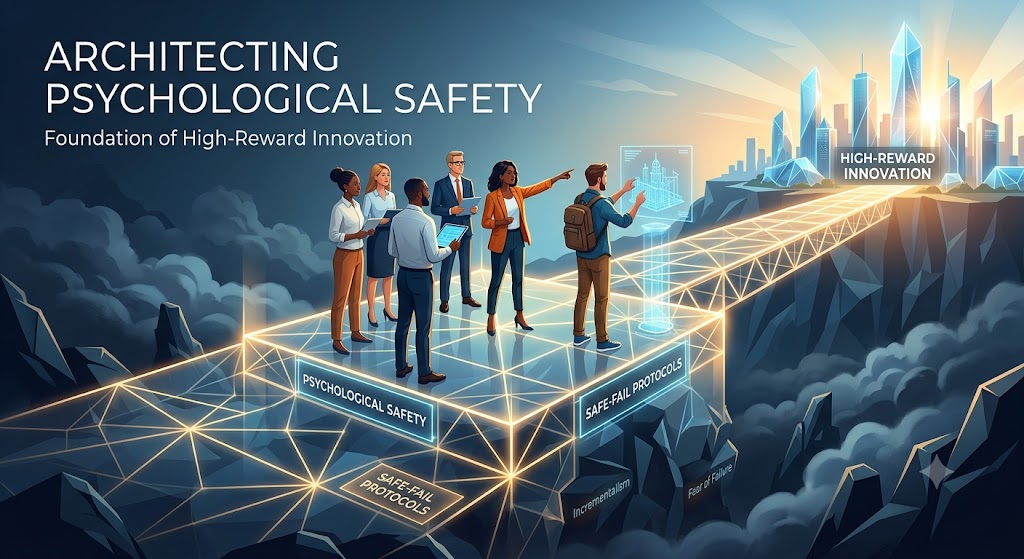
Architecting Psychological Safety

The Foundation of High-Risk, High-Reward Innovation

Architecting Psychological Safety

GUEST POST from Chateau G Pato


Organizations everywhere are demanding moonshots. Leaders stand on stages decreeing that their teams need to think bigger, disrupt industries, and embrace radical change. Yet, behind the scenes, an unspoken friction paralyzes the pipeline. We ask our people to leap across a chasm of high-risk, high-reward innovation, but we build our corporate infrastructure out of concrete and sharp edges. When they look down, all they see is the penalty for falling.

This is the core paradox of modern business: we crave breakthrough outcomes, but we unconsciously design environments that incentivize incremental safety. True innovation requires people to step into extreme ambiguity, challenge legacy assumptions, and risk public failure. If the human experience of that journey is defined by fear—fear of career stagnation, social friction, or executive blowback—people will naturally default to the path of least resistance. They will deliver optimized versions of yesterday’s ideas.

“Psychological safety is not about creating a soft, consequence-free comfort zone where everyone is polite. It is about architecting a high-performance environment where intellectual friction is intentional, and social friction is actively minimized.”

To unlock continuous, game-changing innovation, we must treat psychological safety not as a vague HR initiative, but as a deliberate architectural requirement. Innovation isn’t just a game of generating ideas; it is the discipline of managing the human experience of change. We don’t need braver employees; we need leaders who design ecosystems where bravery isn’t a prerequisite for speaking the truth.

I. The Human-Centered Architecture of Safety

To design an ecosystem where high-risk innovation thrives, we must view the organization through the lens of experience design. Culture is not an accident; it is the sum of every experience an employee has with a system, a process, or a leader. If we map the typical Innovator’s Journey, we quickly uncover the emotional toll of pushing boundaries.

Think about the exact touchpoints when a team member chooses to voice an unconventional idea, challenge a legacy operational model, or admit that a highly funded pilot is failing. In a poorly designed ecosystem, these moments are fraught with anxiety. The innovator must mentally calculate the social cost: “Will I look foolish? Will my manager see this as a distraction? Am I risking my next promotion?” When the perceived tax on vulnerability is too high, great insights are silenced long before they reach an innovation dashboard.

Designing the “Vulnerability Window”

Architecting safety requires us to intentionally design physical, digital, and cultural spaces that act as a Vulnerability Window. These are structured zones—whether a collaborative workshop, a digital innovation pipeline, or a weekly strategy review—where the traditional corporate hierarchy is explicitly paused. By designing low-friction entry points for dissenting opinions, we lower the personal risk of participation, allowing the best ideas to rise to the surface based on merit rather than organizational politics.

Moving from Fear to Structured Curiosity

The final component of this architecture is transforming how we react to the unexpected. When something goes wrong or an idea challenges the norm, the default corporate reflex is defensive. We must replace this fear response with a repeatable framework of structured curiosity.

Instead of demanding to know “Why didn’t you meet the legacy benchmark?”, human-centered leaders ask: “What did this experiment reveal about where the market is moving?” This simple shift in language reframes the entire human experience. It changes the narrative from an individual defending their value to a collaborative team uncovering a strategic signal.

II. Structural Mechanics: Building the Infrastructure for Risk

Cultural shifts mean very little if your organizational structure still punishes deviation from the norm. To turn psychological safety into a sustainable competitive advantage, we must back up our empathy with hard structural mechanics. Leadership cannot simply ask people to take bigger risks; we must build the operational infrastructure that makes risk-taking rational.

The “Safe Fail” Protocol

The first mechanical layer is the implementation of an explicit Safe Fail Protocol. High-risk exploration cannot survive if it is measured by the same rigid operational KPIs used to judge mature, predictable business lines. We must design isolated sandbox environments—both financial and operational—where teams have a mandate to push boundaries. Within these sandboxes, a “failed” experiment is not a compliance breach; it is a successful extraction of market data. By drawing clear, transparent boundaries around where experimentation lives, we protect the core business while freeing innovators from the paralyzing fear of accidental operational fallout.

Redefining Accountability

True psychological safety doesn’t eliminate accountability; it clarifies it. When a high-risk project misses its commercial target, the legacy corporate mechanism searches for a throat to choke. A human-centered innovation architecture pivots the question entirely. We shift the post-mortem from “Who blundered?” to “What did our design or system allow us to discover, and how quickly can we integrate that signal?” Accountability shifts away from guaranteeing a predictable outcome and moves toward guaranteeing rigorous experimentation, velocity of learning, and transparent communication.

The Portfolio Approach to Safety

Just as we balance risk across a product portfolio, leadership must apply a portfolio mindset to psychological safety itself. Different tiers of innovation require different degrees of environmental insulation.

Innovation Tier Risk Level Required Safety Infrastructure
Incremental (Core) Low Standard continuous improvement loops; low structural insulation needed.
Adjacent (Growth) Moderate Cross-functional autonomy; ring-fenced budgets to protect exploration from operational cuts.
Transformational (Moonshots) High Complete Safe Fail Protocols; direct executive air cover; decoupled from standard corporate KPIs.

By aligning your structural safety mechanics with the specific risk profile of the work, you ensure that radical thinkers have the heavy-duty air cover they need to explore the future, while routine optimizations remain crisp, efficient, and accountable.

III. Overcoming the Change Friction

Every time an organization attempts to install psychological safety, the existing corporate ecosystem fights back. This isn’t due to malice; it is the natural resistance of a system designed for predictability. When you introduce the ambiguity required for high-risk innovation, you trigger the organization’s cultural antibodies. To successfully navigate this transition, we must apply deliberate change management mechanics to dissolve this friction before it stalls our progress.

Neutralizing Cultural Antibodies

Cultural antibodies rarely attack out in the open. Instead, they manifest as passive-aggressive alignment, slow-rolling approvals, or the classic weaponization of process: “That’s a fascinating idea, but it doesn’t align with our current compliance framework.” These unspoken rules and systemic delays silently suffocate high-reward ideas before they ever have a chance to be validated. Human-centered leaders must actively hunt for these friction points, calling them out not as personal failures, but as structural barriers that need to be intentionally dismantled.

Empowering Middle Management

The heaviest friction in any transformation almost always concentrates in middle management. Frontline managers are caught in a brutal vice: executives demand radical innovation, yet their day-to-day compensation and performance reviews are tied to flawless operational predictability.

If a manager feels that championing a team member’s volatile, high-reward experiment puts their own career safety at risk, they will quietly kill it. We must equip middle management with specific tools and air cover—translating “risk” into the language of managed portfolios, and explicitly rewarding them for the velocity of insights their teams uncover, regardless of whether every experiment succeeds.

Co-Creating the Shift

The greatest irony of culture change is attempting to deploy psychological safety via a top-down executive mandate. You cannot force people to feel safe on command. True safety is built through Participatory Innovation—co-creating the new behavioral norms alongside the people who will actually live them.

By engaging teams to help define where the boundaries of the “Safe Fail” zones should sit, and inviting them to co-design the protocols for post-project learning, we replace resistance with active contribution. People do not resist change; they resist being changed. When they own the architecture of their own psychological safety, the cultural friction naturally begins to melt away.

Conclusion: The Ultimate Competitive Advantage

At its core, high-risk, high-reward innovation is not a technology problem, a capital problem, or an intellectual property problem. It is entirely a human problem. Algorithms can optimize what already exists, and capital can fund execution, but the cognitive leaps required to invent the future must be volunteered by people. They must come from human beings who feel secure enough to step away from the comfortable consensus and voice an unproven, volatile truth.

When organizations treat psychological safety as a soft, secondary culture metric, they are fundamentally misunderstanding the physics of change. Safety is the load-bearing infrastructure upon which all radical growth is built. Without it, your brilliant corporate strategies and expansive innovation budgets will only ever produce incremental optimizations—because your people will instinctively realize that the personal cost of a bold failure far outweighs the corporate reward of a breakthrough success.

The challenge for future-focused leaders is clear: stop standing at the front of the room asking your teams to be braver, more creative, or more disruptive. That places the burden of risk entirely on the individual. Instead, pivot your energy toward becoming an architect.

Intentionally design your experiences, structure your safe-fail mechanics, and co-create an ecosystem where bravery isn’t a prerequisite for speaking up. When you build a system where the truth is low-friction, high-reward innovation becomes the natural, inevitable output.

Frequently Asked Questions

1. Does psychological safety mean lowering performance standards?

Absolutely not. Psychological safety and high performance standards go hand in hand. It is not about creating a comfortable, consequence-free zone where accountability disappears. Instead, it is about creating an environment where intellectual friction is encouraged, allowing teams to ruthlessly critique ideas and take massive risks without fearing personal or social retaliation.

2. How do you prevent “Safe Fail” zones from draining corporate resources?

By strictly bounding them through fixed operational parameters, timeframes, and capital limits. A “Safe Fail” protocol is not a blank check for endless experimentation; it is a structured sandbox. The goal is to maximize the velocity of learning while capping the financial and operational blast radius, treating the investment as buying an option on future data.

3. What is the fastest way to identify cultural antibodies in our system?

Look closely at your friction points—specifically where projects stall, why ideas are modified to look more conventional, and how middle managers are compensated. When team members default to passive-aggressive alignment or use compliance frameworks as a shield to slow-roll unconventional ideas, your organizational antibodies are actively rejecting the risk.

Put This Into Practice With the Change Planning Toolkit™

The frameworks in this article are part of the Human-Centered Change™ methodology — a visual, collaborative system of 70+ tools built around the Change Planning Canvas™. 26 of the tools come with every copy of Charting Change.

Image credit: Gemini

Subscribe to Human-Centered Change & Innovation WeeklySign up here to get Human-Centered Change & Innovation Weekly delivered to your inbox every week.

The Role of Psychological Safety in Scaling Breakthrough Ideas

The Role of Psychological Safety in Scaling Breakthrough Ideas

GUEST POST from Art Inteligencia

I. Introduction: The Scaling Paradox

Scaling an idea is often more dangerous than inventing one. While the “Eureka!” moment gets the glory, the journey from a successful pilot to organizational integration is where most breakthroughs go to die — usually in silence.

  • The Hidden Barrier: Exploring why 70% of innovations fail during the scaling phase despite having technical merit or proven market demand.
  • Defining the Stakes: Moving beyond the laboratory. Scaling requires more than just capital and cloud credits; it requires a collective leap of faith by the thousands of people who didn’t invent the idea but are now responsible for its life.
  • The Thesis: Psychological safety is not a “soft” HR initiative or a luxury of high-performing teams; it is the hard infrastructure required for risk-taking and organizational agility at scale.

To scale effectively, we must move beyond the “Move Fast and Break Things” mantra and embrace a more sustainable philosophy: Move Fast and Feel Safe.

II. The Anatomy of Fear in the Scaling Process

Fear is the silent killer of momentum. When an organization attempts to take a localized success and expand it across the enterprise, the psychological contract with employees shifts. The ambiguity of “what comes next” often triggers a defensive crouch that can stifle even the most brilliant breakthroughs.

The Middle Management Squeeze

Mid-level leaders are frequently the “frozen middle” of innovation, not because they lack creativity, but because they are incentivized for predictability. Scaling a disruptive idea introduces variance into their carefully optimized systems. Without psychological safety, these managers view a breakthrough as a threat to their operational KPIs and personal reputations.

Loss Aversion and High-Stakes Failure

In a small-scale pilot, failure is a learning opportunity. In a global rollout, failure is seen as a career-ending catastrophe. When the stakes are high, individuals default to loss aversion — they would rather keep things as they are than risk a significant failure. If the culture doesn’t explicitly permit “failing forward” at scale, the team will subconsciously sabotage the growth to stay within their comfort zones.

The “Not Invented Here” Syndrome

Scaling often involves handing a “baby” over to a new team for adoption. If that receiving team doesn’t feel safe to challenge, tweak, or provide honest feedback on the idea, they will never truly own it. This lack of safety leads to passive-aggressive gatekeeping, where the idea is “supported” in meetings but ignored in practice.

“Innovation requires the courage to be wrong; scaling requires the safety to admit when the ‘right’ idea is facing the wrong reality.” — Braden Kelley

III. Psychological Safety as an Innovation Catalyst

Psychological safety is the fuel that transforms a rigid hierarchy into a dynamic learning network. When employees feel safe to take risks, the organization gains the ability to identify and resolve scaling obstacles in real-time, rather than discovering them after a costly collapse.

Voice Over Silence

The greatest risk to scaling is the “silent expert” — the frontline employee who sees a fatal flaw in the plan but chooses not to speak up to avoid being labeled a “troublemaker.” A safe culture actively pulls these insights to the surface, ensuring that friction points are addressed while they are still manageable.

The Power of Intellectual Humility

Scaling is an exercise in navigating the unknown. When leaders model intellectual humility by admitting, “I don’t have all the answers for this phase,” they create a vacuum that invites collaborative problem-solving. This vulnerability signals to the rest of the organization that the goal is the success of the mission, not the ego of the visionary.

The Feedback Loop and Radical Candor

Breakthroughs rarely scale in their original form; they must be adapted to new environments and pressures. This requires a rapid, honest feedback loop. Without psychological safety, feedback is often “sugar-coated” or delayed, leading to the pursuit of flawed strategies. High-safety teams utilize radical candor to pivot quickly, treating every piece of data as a gift that improves the final outcome.

  • Agility: The speed at which a team can admit a mistake determines the speed at which they can fix it.
  • Retention: High-performers gravitate toward environments where their ideas are heard and their psychological well-being is respected.
  • Inclusion: Safety ensures that diverse perspectives are not just present, but integrated into the scaling logic.

IV. Designing Systems for “Safe” Scaling

Psychological safety must be more than a sentiment; it must be engineered into the very frameworks we use to manage growth. To move from a pilot to an enterprise-wide standard, we need structural “safety nets” that encourage people to engage with the complexity of change rather than fear it.

The “Pre-Mortem” Ritual

One of the most effective ways to de-stigmatize failure is the Pre-Mortem. Before the scaling phase begins, the team is asked to imagine a future where the project has failed spectacularly and then work backward to determine the causes. This ritual gives everyone “prospective hindsight” and, more importantly, provides explicit permission to voice concerns that might otherwise be seen as pessimistic.

Permission to Pivot

Traditional scaling often fails because it prioritizes adherence to the original plan over speed of learning. We must shift our metrics toward the Experience Level Measure (XLM), focusing on how the scaling process impacts the people involved. By building in formal “pivot points,” we signal that changing course based on new data is not a sign of failure, but a sign of organizational intelligence.

Equitable Contribution and the “Quiet Experts”

Scaling often creates a “loudest voice” environment where the most enthusiastic proponents drown out the skeptics. True safety ensures that the quiet experts — those who understand the technical or operational nuances of the frontline — have a structured way to contribute. Using collaborative tools like visual canvases allows for non-linear, democratic input where the quality of the idea outweighs the seniority of the speaker.

  • De-risking through Transparency: Shared dashboards that highlight challenges as clearly as successes.
  • Small-Scale Iterations: Breaking the “Grand Rollout” into smaller, digestible phases where the cost of a mistake is contained.
  • Feedback Integration: Moving from “receiving” feedback to “acting” on it within visible timeframes to build trust.

V. The Leadership Shift: From Commander to Architect

In the scaling phase, the role of a leader shifts from being the “solver-in-chief” to the architect of an environment where others feel safe enough to solve problems. Leadership at scale is less about directing traffic and more about removing the roadblocks of fear that prevent talent from performing at their peak.

Modeling Vulnerability

Psychological safety trickles down. When leaders are transparent about their own “scaling scars” — the mistakes made and the lessons learned from previous initiatives — it humanizes the process. This transparency grants the team the “psychological air” they need to be honest about their own challenges without fear of being judged or penalized.

Rewarding the “Red Flag”

To scale breakthrough ideas, we must celebrate the person who identifies a flaw in the logic just as much as the person who celebrates a win. Leaders must actively reward those who raise “red flags” early. This shifts the cultural narrative from “hiding bad news” to “proactive risk management,” ensuring that small cracks don’t become enterprise-wide chasms.

Building a Human-Centered Culture

True innovation leaders recognize that they aren’t just managing resources or workflows; they are managing human potential. By focusing on Human-Centered Change, leaders ensure that the scaling process honors the agency and emotional well-being of the people involved. This means moving beyond top-down mandates and toward a collaborative architecture where every contributor feels like a co-owner of the breakthrough.

“A leader’s job isn’t to be the smartest person in the room; it’s to create a room where everyone is safe enough to be smart.”

VI. Conclusion: The Future of Growth

The true measure of an organization’s innovative capacity isn’t found in its R&D budget or its patent portfolio; it is found in the level of trust shared among its people. As we move further into an era of rapid technological disruption, the ability to scale breakthroughs will depend less on technical superiority and more on psychological resilience.

The Sustainable Breakthrough

Growth without safety is fragile. When we force breakthroughs into a culture of fear, we may see short-term gains, but we create long-term debt in the form of burnout, turnover, and suppressed creativity. The most successful organizations of the future will be those that treat the mental and emotional security of their talent as a strategic asset, ensuring that innovation is not just frequent, but sustainable.

Call to Action: Scale Trust to Scale Ideas

As you look to move your next big idea from a pilot project to a global standard, ask yourself: Have I built a culture that can handle the truth of this transition? Don’t just scale your technology or your operations; scale your trust.

Innovation is a team sport, and psychological safety is the playing field. When you provide the safety to experiment, the permission to pivot, and the courage to be vulnerable, you don’t just scale an idea — you scale the future.


Key Takeaway: If your team is afraid to tell you why an idea won’t work at scale, it is already failing. Build the safety first, and the breakthrough will follow.

Frequently Asked Questions

How does psychological safety specifically impact the “scaling” phase versus the “ideation” phase?

During ideation, safety encourages the birth of diverse ideas. However, during scaling, the stakes are higher and the “cost of failure” perceived by the organization increases. Psychological safety in scaling ensures that those responsible for execution feel safe to highlight operational friction and suggest necessary pivots without being seen as “blockers.”

Can an organization scale breakthroughs without high psychological safety?

It is possible to force a rollout through top-down mandates, but this often leads to “phantom scaling” — where the idea exists on paper but is ignored or bypassed by the workforce. Without safety, you lose the vital feedback loops required to adapt the breakthrough to real-world complexities, leading to eventual failure or high technical debt.

What is the first step a leader should take to build safety during a transition?

The most immediate and impactful step is modeling vulnerability. By publicly discussing a personal past failure or admitting what they don’t know about the current scaling challenge, a leader signals that the environment values truth and learning over the appearance of perfection.


SPECIAL BONUS: Braden Kelley’s Problem Finding Canvas can be a super useful starting point for doing design thinking or human-centered design.

“The Problem Finding Canvas should help you investigate a handful of areas to explore, choose the one most important to you, extract all of the potential challenges and opportunities and choose one to prioritize.”

Image credit: Gemini

Subscribe to Human-Centered Change & Innovation WeeklySign up here to get Human-Centered Change & Innovation Weekly delivered to your inbox every week.

How to Quantify Cultural Resilience During Transformation

LAST UPDATED: April 21, 2026 at 3:53 PM

How to Quantify Cultural Resilience During Transformation

GUEST POST from Chateau G Pato


The Invisible Infrastructure of Change

In the modern landscape of perpetual disruption, transformation is often treated as a series of technical milestones — software deployments, organizational restructuring, or financial re-forecasting. However, these are merely the surface-level mechanics. The true critical path of any successful evolution is the collective psychological capacity of the workforce to absorb, adapt, and innovate under pressure.

The Resilience Gap

We see it time and again: a high-level strategy is flawlessly designed in the boardroom, only to be dismantled by “cultural friction” on the front lines. This gap exists because organizations focus on readiness (the ability to start) rather than resilience (the ability to endure and evolve). When we fail to quantify the human element, we are essentially flying blind through a storm.

Defining Cultural Resilience

True resilience is not a passive state of “bouncing back” to the status quo. In a human-centered innovation framework, resilience is the ability to bounce forward. It is the organizational muscle memory that allows a team to leverage uncertainty as a catalyst for growth, rather than a reason for retreat.

The Quantitative Shift

To lead effectively in a state of flux, we must move beyond qualitative anecdotes and “gut feelings” about company culture. By identifying the right indicators, we can transform culture from a “soft” concept into a hard asset that can be measured, managed, and mastered.

The Four Pillars of Resilient Culture

To effectively quantify resilience, we must deconstruct it into observable, measurable dimensions. By breaking the “cultural black box” into these four pillars, leaders can move from vague observations to targeted interventions.

1. Psychological Safety

Innovation and change require the courage to fail. This pillar measures the collective belief that the workplace is safe for interpersonal risk-taking. In a resilient culture, employees feel empowered to voice concerns or suggest pivots without fear of career repercussions, ensuring that “red flags” are identified long before they become project-ending disasters.

2. Structural Agility

Resilience is often hampered by rigid hierarchies. This dimension examines how quickly information, decision-making, and resources flow through the organization. A resilient structure is one where the “stable spine” of the company supports flexible “tentacles” that can respond to local shifts in real-time without waiting for permission from the top.

3. Shared Purpose (The North Star)

During the chaos of transformation, individual roles can feel disconnected from the larger goal. Shared purpose is the gravitational force that keeps teams aligned. We quantify this by measuring the degree to which employees understand — and believe in — the “Why” behind the change, ensuring that their daily efforts contribute to a meaningful outcome.

4. Adaptive Capacity

Every human has a finite amount of “cognitive bandwidth.” Adaptive capacity measures the existing skill-buffer and mental energy available within the workforce. By monitoring this, we can avoid the “Agentic Paradox,” where over-burdened employees lose their sense of agency and revert to passive compliance rather than active problem-solving.

Quantitative Metrics: Moving Beyond the Annual Survey

Traditional annual engagement surveys are lagging indicators — they tell you how your culture was months ago, not how it is performing now. To quantify resilience during an active transformation, we must shift our focus to leading indicators that provide real-time signals of cultural health.

The Change Saturation Index

Every organization has a “breaking point” where the volume of concurrent initiatives exceeds the capacity of the workforce to process them. By measuring the success rates of past projects against current workloads, we can calculate a saturation score. This allows leaders to pace the transformation effectively, preventing the fatigue that leads to cultural erosion.

Innovation Velocity

In a resilient culture, ideas move fast. We track the time elapsed from a frontline “pivot suggestion” to its appearance as a prototype or pilot project. A decrease in this velocity is often the first quantitative sign that bureaucracy is stifling adaptive capacity and that the “stable spine” has become too rigid.

The “Silence” Metric

Disengagement often manifests as silence. By utilizing Natural Language Processing (NLP) on anonymized internal communication data, we can track the ratio of constructive friction (healthy debate) versus complete withdrawal. A spike in “silence” or purely transactional communication is a high-probability indicator of declining psychological safety.

Decision Latency

How long does it take for a cross-functional team to resolve a conflict or approve a change-related action? Tracking average decision times provides a hard number for structural agility. High latency suggests that the organization is paralyzed by its own governance, preventing the rapid pivots necessary for a successful transformation.

The Human-Centered Scorecard

Data without a framework is just noise. To make cultural resilience visible to the C-suite and project leaders, we must translate these indicators into a Human-Centered Scorecard. This dashboard moves resilience from a “soft skill” conversation into a strategic business metric that sits alongside ROI and technical milestones.

Category Metric Tracking Method
Trust Peer-to-Peer Recognition Frequency Social Recognition Platforms / Intranet Metadata
Agility Role-Flexibility Ratio Internal Mobility Data / Skills Matrix Evolution
Endurance Burnout Proxy (Stability Metric) Metadata on After-Hours Connectivity & Calendar Density
Alignment Vision Clarity Score Bi-weekly Pulse Surveys (Qualitative to Quantitative)

Interpreting the Scorecard

The goal of the Scorecard is to identify experience level measures (XLMs). Unlike traditional SLAs that focus on technical uptime, XLMs focus on the human uptime. If “Trust” is declining while “Innovation Velocity” is increasing, you aren’t seeing sustainable growth; you’re seeing a team sprinting toward a burnout-driven collapse.

The Value of Visibility

When we put these numbers in front of stakeholders, we change the narrative. We are no longer asking for “patience” with the culture; we are demonstrating the Risk & Revenue Leakage that occurs when cultural resilience is ignored. This scorecard becomes the baseline for designing a better, more human-centric transformation experience.

Analyzing the Data: The Resilience Heatmap

Raw data provides the “what,” but a Resilience Heatmap provides the “where” and “why.” By mapping our scorecard metrics across different departments, geographies, or project teams, we can visualize the cultural health of the entire ecosystem in a single glance.

Identifying Pockets of Resistance

Not all resistance is toxic; often, it is a localized symptom of resource depletion or poor communication. The Heatmap allows leaders to pinpoint exactly where resilience is flagging. If the “Product” team shows high alignment but low psychological safety, we know we don’t have a vision problem — we have a leadership or process problem that is stifling their ability to speak up about risks.

Studying the “Bright Spots”

The most powerful use of quantification is identifying positive outliers. In any transformation, there are teams that thrive despite the pressure. By analyzing the data of these “bright spots,” we can uncover the specific micro-behaviors and local rituals that are sustaining their resilience. This isn’t about copying a “best practice” from a textbook; it’s about scaling what is already working within your own unique cultural DNA.

Data as a Diagnostic Tool

The Heatmap serves as an early-warning system. It allows us to transition from reactive crisis management — fixing things once they break — to proactive experience design. When we see a “cooling” trend in resilience metrics, we can intervene with targeted support, training, or resource reallocation before the friction translates into project delays or talent attrition.

Conclusion: Sustaining the Momentum

Quantifying cultural resilience is not an academic exercise; it is a fundamental shift in how we lead in an era of constant change. Data provides the foundation, but the true impact lies in how that data informs our actions and our empathy as leaders.

Data as Dialogue

Numbers should never be used to “police” culture. Instead, use these metrics to start deeper human conversations. When the data shows a dip in resilience, it is an invitation for leaders to step onto the floor, listen to the frontline, and ask, “How can we better support you through this transition?” The goal is to use data to facilitate connection, not to replace it.

The Futurologist Perspective

As we look toward the 2030s, the primary competitive advantage will not be a superior product or a cheaper supply chain — it will be a superior Resilience Quotient (RQ). Organizations that can measure and master the art of “bouncing forward” will outpace their competitors who are still stuck in the “bounce back” mentality. Developing this capability today is an investment in your organization’s future existence.

Final Call to Action

Stop managing the change as a list of tasks. Start designing the experience of the people navigating it. When you quantify resilience, you make the invisible visible, giving you the power to build a culture that is not just change-ready, but change-proof.

“The speed of your transformation will always be limited by the speed of your culture. Measure what matters, and lead with the heart.” — Braden Kelley

Frequently Asked Questions

What is the primary difference between Readiness and Resilience?

Readiness is the ability to start a transformation (having the tools and plan), whereas Resilience is the ability to endure, adapt, and “bounce forward” during the friction of the actual journey.

Why should we use “Silence” as a metric?

Silence often indicates a drop in psychological safety. When employees stop providing constructive friction or feedback, they have likely shifted from active participation to passive compliance, which is a leading indicator of burnout and project failure.

What is an Experience Level Measure (XLM)?

Unlike an SLA (Service Level Agreement) which measures technical uptime, an XLM measures the qualitative “human uptime”—the sentiment, friction, and engagement levels of the people interacting with a new process or system.

Image credit: Google Gemini

Subscribe to Human-Centered Change & Innovation WeeklySign up here to get Human-Centered Change & Innovation Weekly delivered to your inbox every week.
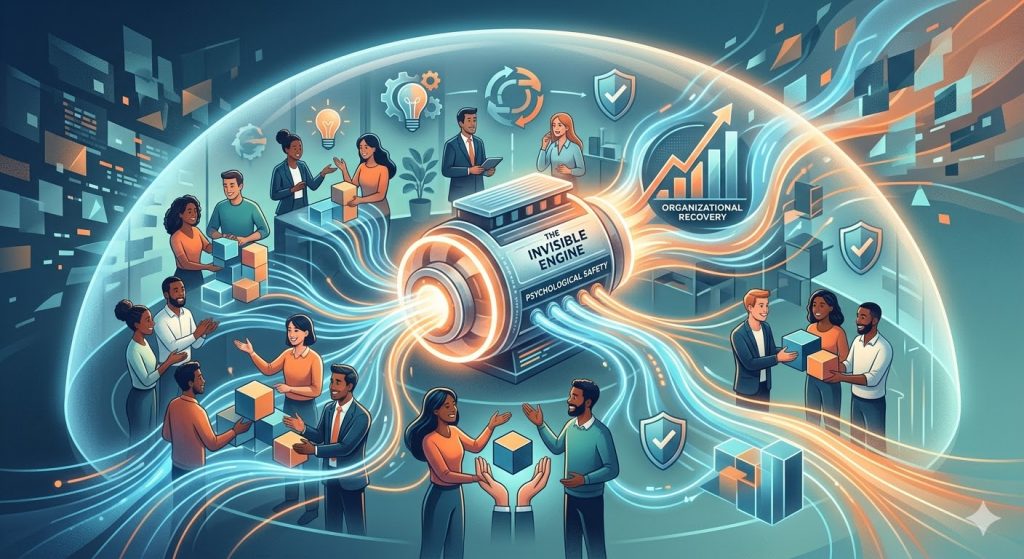
The Invisible Engine

How Psychological Safety Boosts Organizational Recovery

LAST UPDATED: March 25, 2026 at 12:27 PM

The Invisible Engine - How Psychological Safety Boosts Organizational Recovery

GUEST POST from Art Inteligencia


Beyond the Balance Sheet: The Human Core of Recovery

When an organization faces a crisis — whether it’s a market shift, a digital disruption, or a global event — the instinctive reaction of leadership is to tighten the reins. We look at liquidity ratios, supply chain redundancies, and technological “fixes.” However, this traditional recovery model suffers from a Recovery Fallacy: the belief that you can repair a broken system by only fixing the “hard” infrastructure while ignoring the “soft” human infrastructure that actually drives performance.

The Hidden Infrastructure of Resilience

True organizational resilience isn’t just about the ability to bounce back to a previous state; it’s about the ability to leapfrog forward into a new reality. This requires a high-performance environment where psychological safety acts as the primary lubricant for change. Psychological safety is often misunderstood as “being nice” or lowering standards. In reality, it is the exact opposite. It is a rigorous cultural standard where interpersonal risk-taking is not just permitted, but expected.

“Organizational recovery is a collaborative sport. If your team is afraid to point out where the new plan is failing, you aren’t leading a recovery — you’re managing a decline.” — Braden Kelley

The High Cost of Silence

In the wake of a setback, employees naturally move into a “threat” state. Without a deliberate effort to establish safety, the following occurs:

  • Idea Hoarding: People keep “crazy” but potentially transformative ideas to themselves to avoid looking foolish.
  • Error Masking: Small failures are hidden until they become systemic disasters because the cost of admission is too high.
  • Groupthink: Teams align with the leader’s recovery plan — even when they see fatal flaws — simply to maintain a sense of security.

To boost recovery, leaders must shift their focus. We aren’t just balancing books; we are re-engaging the collective intelligence of the workforce. When people feel safe to be vulnerable, they become the most powerful innovation engine an organization possesses.

The Anatomy of a Post-Crisis Organization

In the aftermath of a major organizational setback, the atmosphere is rarely one of immediate renewal. Instead, most companies enter a state of “cultural stasis.” To lead a successful recovery, we must first diagnose the invisible barriers that prevent people from leaning into the future. It’s not a lack of talent that stalls recovery; it’s a lack of certainty in the face of failure.

The ‘Hunker Down’ Instinct

Human biology is hardwired for survival. When an organization experiences trauma — be it a massive market loss, a failed product launch, or a restructuring — the workforce enters a state of defensive silence. This “hunker down” instinct manifests as:

  • Risk Aversion: Choosing the “safe” path even when it leads to stagnation.
  • Silo Protection: Guarding resources and information to ensure individual or departmental survival at the expense of the enterprise.
  • Cognitive Dissonance: Ignoring evidence that a recovery strategy is failing to avoid the emotional weight of another setback.

The Innovation Gap: Silence is a Signal

The most dangerous byproduct of a crisis is the “Innovation Gap.” This occurs when the feedback loop between the front lines and the C-suite is severed by fear. If an employee sees a way to streamline a process but fears that pointing out the current inefficiency will be seen as an attack on leadership, they will remain silent. In a recovery phase, silence is a cost. Every unshared idea is a lost opportunity to accelerate the return to growth.

The Role of Vulnerability in Leadership

Recovery cannot be mandated; it must be modeled. To bridge this gap, leaders must transition from being “the person with all the answers” to “the person with all the questions.” This requires a strategic display of vulnerability:

  • Admitting Uncertainty: Signaling that the path forward is a hypothesis to be tested, not a directive to be followed blindly.
  • Redefining Failure: Distinguishing between “preventable failure” (deviating from known processes) and “intelligent failure” (the inevitable result of experimenting in a new market).
  • The ‘Safe-to-Fail’ Signal: Publicly celebrating a pilot project that didn’t work but provided critical data for the next iteration.

By addressing these anatomical realities, we move from a culture of blame to a culture of inquiry. This shift is the foundational work required before any tactical recovery plan can take root.

Three Pillars of Safety-Driven Recovery

To move beyond theoretical safety and into measurable organizational recovery, we must embed specific structural pillars into the change management process. These pillars ensure that psychological safety isn’t just a “feeling,” but a functional asset that accelerates the speed of learning and adaptation.

1. Open Feedback Loops: From Command to Listen

In a recovery phase, the most valuable data often sits at the edges of the organization — with the customer-facing teams and the individual contributors who see the friction points first. Traditional “Command and Control” structures stifle this data. To boost recovery, we must implement:

  • Blame-Free Retrospectives: Shifting the focus from “Who failed?” to “What happened and how do we prevent it?” This turns every setback into a free masterclass in optimization.
  • The ‘Red-Flag’ Protocol: A formal, protected mechanism for any employee to pause a process if they identify a risk that contradicts the recovery goals.

2. Cognitive Diversity: Crowdsourcing the Cure

Recovery strategies built in a vacuum of executive agreement are prone to blind spots. True resilience requires a mosaic of perspectives. By fostering an environment where dissent is seen as a contribution, we unlock:

  • The Outsider Advantage: Inviting team members from unrelated departments to “audit” a recovery plan. Their lack of “sunk cost” in the current process allows them to see obvious flaws.
  • Inclusive Ideation: Ensuring that the recovery roadmap isn’t just top-down, but reflects the diverse lived experiences of the entire workforce, leading to higher buy-in and smoother implementation.

3. The Permission to Experiment: Safe-to-Fail Zones

Innovation is the only sustainable path out of a crisis, yet innovation requires the possibility of failure. During recovery, the stakes feel too high to miss. We solve this by creating Safe-to-Fail Zones:

  • Micro-Pilots: Breaking large recovery initiatives into small, low-cost experiments. If a micro-pilot fails, the organization learns cheaply and quickly.
  • Iterative Funding: Moving away from massive annual budgets toward “metered funding” based on the evidence generated by these safe experiments.
  • Rewarding the Pivot: Specifically recognizing teams that had the courage to stop a failing project early to redirect resources toward a more promising path.

When these three pillars are in place, psychological safety stops being a HR initiative and starts being the operational backbone of the new, recovered organization.

Measuring What Matters: Safety Metrics for the Boardroom

The greatest challenge in scaling psychological safety is the perception that it is “unmeasurable.” To a Board of Directors or a CFO focused on recovery, if it isn’t on a dashboard, it doesn’t exist. To bridge the gap between culture and capital, we must translate the human experience into Experience Level Measures (XLMs) — qualitative indicators that predict quantitative success.

The ‘Silence’ Metric: Identifying Dangerous Quiet

In a healthy recovery, the volume of constructive dissent should increase, not decrease. We can track the “health of the conversation” by observing:

  • Meeting Participation Variance: Tracking the ratio of speaking time between leadership and individual contributors. A recovery plan dominated by a single voice is a plan at risk.
  • Uninterrupted Dissent: Measuring how often a “contrarian” view is raised in a steering committee and, more importantly, how long that idea is explored before being dismissed or adopted.

Idea Velocity: From Insight to Execution

Recovery is a race against time. The speed at which a front-line observation (e.g., “The customer hates the new portal”) reaches a decision-maker is a direct reflection of psychological safety. We measure this through:

  • The Feedback Lag: The time elapsed between a detected friction point and the initiation of a formal pivot.
  • Cross-Silo Contribution: The percentage of recovery ideas that originate from outside the “official” innovation or strategy departments.

Employee Agency and Cognitive Load

Traditional metrics look at “uptime” or “output.” In a recovery context, we must look at Cognitive Load — the mental effort required for an employee to do their job while navigating organizational fear. High-safety environments reduce this load, freeing up “innovation bandwidth.” We track this via:

  • The ‘Mistake Transparency’ Index: The frequency of self-reported errors versus those discovered by audits. A high rate of self-reporting indicates a high-safety, low-risk environment for the company’s long-term health.
  • Agency Pulse: Regular, micro-surveys asking: “Do you feel you have the authority to change a process that is hindering our recovery?”

By bringing these metrics into the boardroom, we move psychological safety from the “perks and culture” column to the “risk management and growth” column. It becomes an early-warning system for the organization’s most valuable asset: its ability to adapt.

Practical Steps for Today’s Leader: Shifting the Culture

Theory and metrics provide the foundation, but psychological safety is built in the micro-moments of daily interaction. For a leader driving organizational recovery, the goal is to lower the perceived cost of speaking up while raising the perceived cost of silence. This requires a deliberate shift in both behavior and the very language used within the “war room.”

The ‘Check-In’ over the ‘Check-Up’

During a crisis, management tends to obsess over the “Check-Up” — status reports, deadlines, and KPIs. While necessary, these can feel like interrogations. To foster safety, prioritize the “Check-In”:

  • Human-First Inquiry: Start meetings by asking, “What is one thing making your work difficult right now?” rather than “What is the status of project X?”
  • Active Listening: Practice “Level 3” listening — not just hearing the words, but picking up on the emotional subtext and cognitive load your team is carrying.

Rewarding the ‘Early Warning’

In many organizations, the person who brings bad news is treated as a “blocker.” In a recovery context, that person is actually your most valuable asset. Leaders must pivot to:

  • Publicly Celebrating Dissention: When someone identifies a flaw in the recovery roadmap, thank them publicly for “protecting the organization from a blind spot.”
  • The ‘Fail-Forward’ Award: Create a recurring recognition for the team that shared the most impactful lesson learned from a failed experiment. This signals that learning is valued as much as winning.

Language Shifts: From Blame to Inquiry

The words a leader chooses can either open or close the “safety valves” of an organization. Small linguistic tweaks have outsized impacts on cultural trust:

Traditional Language (Blame) Safety-Driven Language (Inquiry)
“Who is responsible for this delay?” “What is the system bottleneck we need to clear together?”
“We need to stick to the plan.” “What is the data telling us about our current hypothesis?”
“Why didn’t you see this coming?” “How can we improve our early-warning signals for next time?”

By implementing these language shifts, you transform the “boss” into a “facilitator of progress.” This reduces the friction of change and allows the organization to move at the speed of trust rather than the speed of permission.

Conclusion: Building the Future-Proof Organization

Organizational recovery is often treated as a finite bridge — a temporary structure to get from a point of crisis back to “business as usual.” However, in a world defined by accelerating digital disruption and shifting human expectations, there is no “usual” to return to. The goal of safety-driven recovery is not just to survive the current storm, but to upgrade the vessel for the oceans ahead. We aren’t just fixing what broke; we are building an Anti-fragile organization that grows stronger through stress.

Recovery as a Catalyst for Transformation

When psychological safety is the foundation of your recovery, the crisis itself becomes a catalyst. It forces the organization to shed legacy behaviors that were already slowing it down. By prioritizing human-centered change during a downturn, you achieve two things simultaneously:

  • Accelerated Problem-Solving: You tap into the collective intelligence of your people, identifying pivots months before your “command-and-control” competitors.
  • Cultural Re-imagination: You move from a culture of “hiring for fit” to “hiring for contribution,” where every voice is a sensor for future opportunities.

The Innovation Mandate

Innovation is not a department or a line item in a recovery budget; it is a direct byproduct of a safe culture. If your people are afraid to fail, they are afraid to innovate. And if they are afraid to innovate, your recovery will be shallow and temporary. The organizations that dominate the next decade will be those that realize that empathy is a strategic advantage and that vulnerability is the precursor to breakthrough value creation.

A Call to Action for Leaders

As you move forward with your recovery roadmap, remember that your primary job is to be the Chief Empathy Officer. Start by making it safe to speak up. Create the “Safe-to-Fail” zones today that will become your growth engines tomorrow. The metrics may live in the spreadsheet, but the recovery lives in the hallway, the Zoom call, and the Slack channel.

“The most resilient organizations don’t just have a plan for the future; they have a culture that is safe enough to invent it.” — Braden Kelley

By embedding psychological safety into the very DNA of your organizational recovery, you don’t just restore what was lost — you create something entirely new, infinitely more capable, and authentically human.

Frequently Asked Questions

Is psychological safety just about being “nice” to employees during a crisis?

No. Psychological safety is about performance, not politeness. It is a cultural rigorousness that allows for candid feedback, the admission of mistakes, and the challenging of the status quo without fear of retribution. In a recovery phase, “being nice” can actually be dangerous if it leads to withholding critical truths that the organization needs to survive.

How does psychological safety specifically accelerate financial recovery?

It reduces the “Information Lag.” When employees feel safe, they report market shifts, customer friction, and internal inefficiencies immediately. This allows leadership to pivot resources toward high-value activities months faster than a fear-based organization, directly impacting the bottom line through reduced waste and faster innovation cycles.

Can psychological safety be measured alongside traditional KPIs?

Absolutely. We use Experience Level Measures (XLMs) to track the health of the human system. By measuring metrics like ‘Idea Velocity’ (how fast an idea moves from front-line to decision-maker) and ‘Mistake Transparency,’ boards can gain a predictive view of organizational resilience that traditional lagging financial indicators miss.

Image credit: Google Gemini

Subscribe to Human-Centered Change & Innovation WeeklySign up here to get Human-Centered Change & Innovation Weekly delivered to your inbox every week.

Co-Creating AI with Frontline Stakeholders

LAST UPDATED: March 14, 2026 at 11:52 AM

Co-Creating AI with Frontline Stakeholders

GUEST POST from Art Inteligencia


I. The “Stable Spine” of Trust: Anchoring AI in Human Safety

To scale any innovation — especially one as disruptive as Agentic AI — an organization must first establish what I call the “Stable Spine.” This is the rigid, dependable core of organizational values, psychological safety, and transparent communication that allows the “Modular Wings” of technological experimentation to flex without breaking the culture.

Establishing Psychological Safety First

The greatest barrier to AI adoption isn’t technical debt; it’s automation anxiety. When frontline stakeholders feel that AI is being “done to” them, they instinctively protect their tribal knowledge. Co-creation flips this script. By involving employees before a single line of code is written, we shift the narrative from replacement to augmentation.

  • The Pre-Mortem Dialogue: Openly discussing “What happens if this works?” and “How does this change your value to the firm?”
  • Vulnerability in Leadership: Admitting that the AI is a “student” and the frontline workers are the “teachers” provides the grounding needed for honest feedback.

Moving from “Black Box” to “Glass Box” Collaboration

Traditional AI implementations often fail because they are opaque. A Human-Centered approach demands a “Glass Box” philosophy where the logic, data inputs, and intent of the AI are visible to those using it. When a Regulatory Compliance Officer understands why an agent flagged a specific document, they transition from a skeptic to a supervisor of the technology.

Defining the Shared Purpose

The “Stable Spine” is reinforced when the AI’s goals are perfectly aligned with the frontline’s daily friction points. We aren’t just implementing AI to “increase efficiency” (a corporate-centric goal); we are implementing it to “remove the soul-crushing administrative burden” (a human-centric goal). Shared Purpose is the glue that keeps stakeholders engaged when the initial novelty of the tech wears off.

“Innovation is not about the technology; it’s about the humans the technology serves. If the spine of trust isn’t straight, the wings of innovation will never lift.” — Braden Kelley

II. Identifying High-Friction “Experience Level Measures” (XLMs)

To move beyond the hype of AI, we must move beyond the vanity of traditional metrics. In a human-centered innovation framework, we don’t just look at Key Performance Indicators (KPIs); we look at Experience Level Measures (XLMs). While a KPI tells you what happened (e.g., “Average Handle Time”), an XLM tells you how it felt for the human involved. This is where the real “Revenue Leakage” and “Engagement Leakage” are hidden.

The CX/EX Audit: Hunting for Friction

Innovation starts by identifying where human potential is being throttled. We conduct a dual audit of the Customer Experience (CX) and the Employee Experience (EX). When frontline stakeholders are forced to perform “swivel-chair” data entry or navigate fragmented legacy systems, their cognitive load is exhausted before they ever reach a high-value task. These are the high-friction zones ripe for AI co-creation.

Mapping the “Soul-Crushing” Journey

By mapping the stakeholder journey, we can pinpoint specific moments where AI agents can act as a “frictionless lubricant.” We look for three specific types of friction:

  • Cognitive Friction: Where a worker must synthesize too much disparate data to make a simple decision.
  • Process Friction: Where “the way we’ve always done it” creates unnecessary loops or wait times.
  • Emotional Friction: Where the task is so repetitive or mundane that it leads to burnout and disengagement.

From SLAs to XLMs: Redefining Value

Traditional Service Level Agreements (SLAs) are often centered on the machine or the process. In a co-created AI environment, we shift the focus to the human outcome. If an AI agent reduces a task from 60 minutes to 10 minutes, the value isn’t just the 50 minutes saved; the value is what the human does with that newly found 50 minutes. Does it go toward deep work, creative problem solving, or building a stronger relationship with the customer?

Traditional Metric (KPI) Human-Centered Metric (XLM) The AI Opportunity
Task Completion Rate Cognitive Ease Score Automating “Low-Value” data synthesis.
Response Time Empathy Availability Freeing up humans for complex emotional labor.
Error Rate Confidence Index Using AI as a “second pair of eyes” to reduce stress.

“Efficiency is doing things right; Effectiveness is doing the right things. XLMs ensure that our AI initiatives are making us more effective, not just faster at being frustrated.” — Braden Kelley

III. The Co-Creation Workshop: Where Art Meets Science

In the world of innovation, we often talk about the “Science” of data and the “Art” of human intuition. The Co-Creation Workshop is the laboratory where these two forces collide. We don’t just ask frontline stakeholders what they want; we observe how they solve problems and then design AI “agents” that mimic their best instincts while automating their worst hurdles.

Empathy-Driven Design and Personas

We begin by building robust Personas for our frontline stakeholders. Whether it’s a Global Supply Chain Manager balancing logistics during a port strike or a Customer Success Lead managing a high-churn account, we need to understand the emotional and contextual landscape they inhabit. This empathy-driven approach ensures the AI is built for the “messy reality” of the job, not a sanitized version of the process manual.

[Image of an Empathy Map for User Experience Design]

Designing “Modular Wings” for Human Agency

A key Braden Kelley principle is that while the organization needs a “Stable Spine,” the frontline needs “Modular Wings.” In our workshop, we identify which parts of the AI system should be rigid (compliance, data integrity) and which should be flexible (UI preferences, decision-making thresholds).

  • The Rigidity: The underlying LLM and the corporate data safety protocols.
  • The Flexibility: The ability for the frontline worker to “tune” the agent’s tone, level of detail, and escalation triggers.

By giving users the “knobs and dials,” we increase their sense of ownership over the final product.

Rapid Prototyping: The Experience Walkthrough

Instead of long development cycles, we use Experience Prototypes. These are low-fidelity simulations — sometimes as simple as a storyboard or a “Wizard of Oz” test — where the human interacts with a “pretend” AI. This allows us to map the Human-AI Handoff:

  1. The Trigger: What event causes the human to turn to the AI?
  2. The Interaction: How does the AI present information? (Is it a suggestion, a summary, or a draft?)
  3. The Judgment: How does the human validate or correct the AI’s output?
  4. The Feedback Loop: How does the AI learn from that correction?

The “Art” of Intuition vs. The “Science” of Automation

The workshop highlights that AI excels at Synthesizing (Science), but humans excel at Contextualizing (Art). We use this session to define the “Escalation Matrix.” If the data is 90% certain but the human “gut feeling” says otherwise, how does the system handle that conflict? Designing for this tension is what makes an AI tool truly innovative rather than just “efficient.”

“Co-creation is the bridge between a tool that is technically impressive and a tool that is actually used. If the frontline doesn’t see their ‘Art’ reflected in the ‘Science’ of the AI, they will find a way to bypass it.” — Braden Kelley

IV. Solving for “Causal AI” and Intent: From Correlation to Context

In the “Science” of standard machine learning, models are often built on correlations — patterns in data that suggest what might happen next. But for a frontline worker in a high-stakes environment, “what” isn’t enough. To truly co-create, we must move toward Causal AI, where the system and the human collaborate to understand the why behind a recommendation. This is where we bridge the gap between algorithmic output and human intent.

Moving Beyond the Correlation Trap

If an AI agent suggests a supply chain reroute or a specific credit adjustment, the frontline stakeholder needs to see the “connective tissue” of that logic. Without causality, the AI is just a black box throwing out guesses. In our co-creation sessions, we design Explainability Interfaces that highlight the primary drivers of a decision.

  • The “Why” Prompt: Every AI suggestion should include a “Show Logic” feature that maps the causal factors (e.g., “Delayed shipment in Suez + Low local inventory + 10% surge in regional demand”).
  • The Counter-Factual: Allowing users to ask, “What if the shipment wasn’t delayed?” to see how the AI’s intent changes.

Context Injection: The Frontline as the “Ground Truth”

Data science often suffers from “Data Silos” — it sees the numbers but misses the Context. A frontline worker knows that a 20% spike in orders might be a one-time anomaly due to a local event, not a permanent trend.

Co-creation allows us to build “Context Injection” points where the human can feed the “Art” of their situational awareness back into the “Science” of the model. This transforms the AI from a static tool into a dynamic partner that respects the Ground Truth of the shop floor or the call center.

Human-in-the-Loop (HITL) 2.0: From Safety Net to Co-Pilot

We are evolving the concept of Human-in-the-Loop. In version 1.0, the human was merely a “kill switch” for when the AI failed. In HITL 2.0, the human is a Co-Pilot. We design the interaction so that:

  1. The AI Proposes: Offering 2–3 paths based on data.
  2. The Human Disposes: Choosing the path that aligns with the current organizational intent (which might shift faster than the data).
  3. The System Learns: Capturing the reasoning behind the human’s choice to refine future causal models.

The Outcome: Cognitive Alignment

When we solve for intent, we achieve Cognitive Alignment. The frontline stakeholder no longer views the AI as a competitor or a mystery, but as an extension of their own expertise. They aren’t just using an app; they are directing an agent that understands their goals, their constraints, and their “Art.”

“An AI that can’t explain its ‘Why’ will eventually be ignored by the people who know ‘How.’ Causal AI is the key to moving from temporary adoption to permanent innovation.”

V. Scaling the Innovation Bonfire: From Pilot to Organizational Agility

The final challenge of any innovation isn’t the spark; it’s the sustainment. Too often, co-creation is treated as a “one-off” workshop. To truly scale, we must take the lessons from our frontline stakeholders and feed them back into the organizational furnace. This is how we move from a single pilot to what I call the “Innovation Bonfire” — a self-sustaining culture of continuous improvement.

Avoiding the “Pilot Trap”

Many AI initiatives die in “Pilot Purgatory” because they fail to account for the Systemic Friction of a full-scale rollout. Scaling requires moving from a specialized co-creation group to a broader “Modular Wings” approach across the enterprise. We must ensure that the insights gained from one department (e.g., Supply Chain) are translated into reusable components for another (e.g., R&D Project Management).

  • Internal Advocacy: Empowering your original co-creators to act as “Innovation Ambassadors.” Their peers are more likely to trust a tool recommended by a colleague than one mandated by IT.
  • Feedback Loops: Implementing automated mechanisms where frontline users can “vote” on AI suggestions or flag hallucinations in real-time.

The Flywheel of Continuous Learning

Innovation is not a destination; it’s a cycle. As the AI handles more of the “Science” (the repetitive, high-rigor tasks), the frontline stakeholders have more bandwidth for the “Art” (the complex, high-empathy tasks). This creates a Flywheel Effect:

  1. Release: The AI releases human capacity by removing friction.
  2. Reinvest: Humans reinvest that capacity into solving higher-order problems.
  3. Refine: Those new solutions provide fresh data and “Ground Truth” to further refine the AI.

Maintaining the “Human-Centered” Spark at Scale

As you scale, the temptation is to “standardize” everything until the “Art” is squeezed out. This is a mistake. Organizational Agility depends on your ability to maintain that Stable Spine of core processes while allowing different teams the autonomy to adapt the AI to their unique workflows.

We must continuously ask: “Is this technology still serving the human, or have we started serving the technology?” Revisiting your Experience Level Measures (XLMs) quarterly ensures that the innovation remains grounded in actual human value rather than just technical efficiency.

The Outcome: An Agentic Organization

An organization that masters co-creation doesn’t just “use AI.” It becomes an Agentic Organization — a living system where humans and machines are seamlessly integrated, each playing to their strengths. The “Science” of the AI provides the scale, but the “Art” of your people provides the competitive advantage. That is how you win in a world of constant change.

“To scale an innovation bonfire, you don’t just need more fuel; you need more oxygen. In an organization, that oxygen is the trust, empathy, and agency of your frontline people.” — Braden Kelley

Conclusion: Leading the Agentic Revolution with Empathy

The journey from top-down implementation to bottom-up co-creation is the defining shift of the current technological era. As we have explored, successfully integrating AI into the fabric of an organization is not merely a technical hurdle — it is a human-centered design challenge. When we balance the Science of algorithmic rigor with the Art of human empathy, we don’t just “deploy software”; we empower a workforce.

The Human-Centered Dividend

By prioritizing the “Stable Spine” of trust and focusing on Experience Level Measures (XLMs), organizations can unlock a level of agility that was previously impossible. The dividend of this approach is twofold:

  • Operational Resilience: Systems built on the “Ground Truth” of frontline expertise are inherently more robust and adaptable to market shifts.
  • Human Flourishing: By removing “soul-crushing” friction, we allow our people to return to the work they were meant to do — creative problem solving, strategic thinking, and high-empathy customer connection.

A Call to Action for Innovation Leaders

The Innovation Bonfire is waiting to be lit, but it requires leaders who are brave enough to share the matches. If you are ready to move beyond the “Black Box” and start co-creating with your most valuable asset — your people — start with these three steps:

  1. Audit the Friction: Use XLMs to find where your frontline is currently being throttled.
  2. Invite the Experts: Bring the people who do the work into the design room before the technology is finalized.
  3. Design for “Why”: Prioritize causal clarity over simple correlation to build a “Glass Box” culture.

Final Thought

In a world increasingly dominated by Agentic AI, the ultimate competitive advantage isn’t the code you own; it’s the Human-AI Synergy you cultivate. Innovation is, and always has been, a team sport. Your most important teammates are already on your payroll, waiting to help you build the future.

“We shape our tools, and thereafter our tools shape us. Let us ensure we shape our AI with enough heart to make the future a place where humans truly belong.” — Braden Kelley

Continue the Conversation

Are you ready to audit your organization’s Customer Experience or develop a Human-Centered AI Strategy? Let’s work together to turn your innovation friction into a scalable bonfire.

Contact: Book an advisory session

Frequently Asked Questions

To help both human readers and search engines better understand the core concepts of co-creating AI, I’ve prepared this brief FAQ. Below the human-readable text, you’ll find the JSON-LD structured data to help “answer engines” index this content accurately.

1. What is the difference between a KPI and an XLM in AI implementation?

While a Key Performance Indicator (KPI) measures the “What” (output, speed, efficiency), an Experience Level Measure (XLM) measures the “How” (the human experience of the process). In AI, XLMs track things like cognitive load and emotional friction to ensure the technology is actually helping people, not just making a broken process faster.

2. Why is “Causal AI” important for frontline stakeholders?

Standard AI often shows correlations, but Causal AI explains the logic or “Why” behind a suggestion. For frontline workers, understanding the intent and cause of an AI recommendation builds trust and allows them to apply their own contextual expertise — the “Art” — to the AI’s “Science.”

3. How does the “Stable Spine” framework assist with AI adoption?

The Stable Spine represents the rigid core of trust, safety, and transparency within an organization. By establishing this foundation first, leaders provide the security employees need to experiment with the “Modular Wings” — the flexible, innovative applications of AI that can change and adapt over time.

Image credit: Google Gemini

Subscribe to Human-Centered Change & Innovation WeeklySign up here to get Human-Centered Change & Innovation Weekly delivered to your inbox every week.
