Tag Archives: engineering

My Advice to Young Design Engineers

My Advice to Young Design Engineers

GUEST POST from Mike Shipulski

If your solution isn’t sold to a customer, you didn’t do your job. Find a friend in Marketing.

If your solution can’t be made by Manufacturing, you didn’t do your job. Find a friend in Manufacturing.

Reuse all you can, then be bold about trying one or two new things.

Broaden your horizons.

Before solving a problem, make sure you’re solving the right one.

Don’t add complexity. Instead, make it easy for your customers.

Learn the difference between renewable and non-renewable resources and learn how to design with the renewable ones.

Learn how to do a Life Cycle Assessment.

Learn to see functional coupling and design it out.

Be afraid but embrace uncertainty.

Learn how to communicate your ideas in simple ways. Jargon is a sign of weakness.

Before you can make sure you’re solving the right problem, you’ve got to know what problem you’re trying to solve.

Learn quickly by defining the tightest learning objective.

Don’t seek credit, seek solutions. Thrive, don’t strive.

Be afraid, and run toward the toughest problems.

Help people. That’s your job.

Image credit: 1 of 950+ FREE quote slides available at <a href=”http://misterinnovation.com” target=”_blank”>http://misterinnovation.com</a>

Subscribe to Human-Centered Change & Innovation WeeklySign up here to join 17,000+ leaders getting Human-Centered Change & Innovation Weekly delivered to their inbox every week.

Innovation or Not – SpinLaunch

Innovation or Not - SpinLaunch

GUEST POST from Art Inteligencia

In the fast-paced world of space exploration, innovation is a driving force that propels new companies and ideas into the spotlight. One such company is SpinLaunch, which is making waves with its novel approach to launching payloads into space. But what sets SpinLaunch apart, and how do we assess whether its approach is truly an innovation or not?

The Concept Behind SpinLaunch

SpinLaunch is taking a radically different approach to space launch by using a kinetic energy-based system rather than traditional rocketry. Their technique involves a high-speed rotating arm that builds up momentum and catapults a payload to the edge of space, drastically reducing the need for fuel and cutting down on costs. This approach is not only cost-effective but also environmentally friendly, addressing two significant pain points in the space industry.

Key Criteria for Innovation Assessment

  • Novelty: Is the concept fresh and previously unexplored?
  • Feasibility: Can the technology be realistically executed?
  • Impact: What benefits does the innovation provide to the industry and society?
  • Scalability: Can the idea grow and adapt to broader applications?

Case Study: Assessing SpinLaunch

Novelty

SpinLaunch undoubtedly introduces a novel approach to space launches. Traditional methods rely heavily on chemical propulsion. In contrast, SpinLaunch’s kinetic system stands out by leveraging physics in a way that hasn’t been commercially applied to space launches before.

Feasibility

The technical feasibility of SpinLaunch’s idea has been demonstrated through successful suborbital launches, proving that their kinetic system can indeed hurl payloads into space. However, the transition from suborbital to orbital flights will be the true test of feasibility. Critical engineering challenges remain, particularly related to the G-forces sustained by payloads during launch.

Impact

SpinLaunch has the potential to revolutionize the space industry by making launches significantly cheaper and more frequent. The environmental benefits of reducing fuel consumption cannot be understated either. If successfully scaled, the impact would reach beyond cost — it could democratize access to space.

Scalability

Currently, SpinLaunch is focused on small to medium-sized payloads. For scalability, the company must expand its capabilities to accommodate larger satellites and potentially human passengers. Adapting the technology for broader applications will be essential.

Conclusion: Is SpinLaunch an Innovation?

SpinLaunch exhibits the hallmarks of a true innovation. By addressing cost, environmental impact, and frequency of launches, it provides substantial benefits to the space industry. However, the road to demonstrating full potential is fraught with engineering and market challenges. Yet, the novelty and promise of their approach cannot be ignored.

Here is a 40 minute documentary that dives deep into the engineering, problem solving and innovation approach:

Opportunities for Expansion

To strengthen the case for SpinLaunch as an innovation, future assessments could involve the impact on related industries such as satellite manufacturing. More real-world data from further launches will offer insights into long-term feasibility and environmental impact. Engaging with regulators and potential partners early will be crucial to addressing scalability challenges.

Revision & Expansion

The ongoing journey of SpinLaunch should be closely monitored. As the company progresses, it should aim to address:

  • Risk Management: How can the company mitigate potential risks associated with high G-force impacts on sensitive equipment?
  • Regulatory Hurdles: Navigating international laws and space treaties will be essential as SpinLaunch aims for global reach.
  • Commercial Partnerships: Collaborations with established aerospace companies could fast-track development and market entry.

The future of SpinLaunch lies in its ability to resolve these emerging challenges while maintaining its innovative edge, positioning the company as a potential leader in transforming space access.

So, what do you think? Innovation or not?

Image credit: SpinLaunch

Subscribe to Human-Centered Change & Innovation WeeklySign up here to get Human-Centered Change & Innovation Weekly delivered to your inbox every week.

We Must Break Free of the Engineering Mindset

We Must Break Free of the Engineering Mindset

GUEST POST from Greg Satell

In 2014, when Silicon Valley was still largely seen as purely a force for good, George Packer wrote in The New Yorker how tech entrepreneurs tended to see politics through the lens of an engineering mindset. Their first instinct was to treat every problem as if it could be reduced down to discrete variables and solved like an equation.

Despite its romantic illusions, the digital zeitgeist merely echoed more than a century of failed attempts to generalize engineering approaches, such as scientific management, financial engineering, six sigma and shareholder value. All showed initial promise and then disappointed, in some cases catastrophically.

Proponents of the engineering mindset tend to blame its failures on poor execution. Surely, logic would suggest that as long as a set of principles are internally consistent, they should be externally relevant. Yet the problem is that reality is not simple and clear-cut, but complex and nonlinear, which is why we need be ready to adapt to the unexpected and nonsensical.

The Rise of the Engineering Mindset

In the 1920s, a group of intellectuals in Berlin and Vienna, much like many of the Silicon Valley digerati today, became enamored with the engineering mindset. By this time electricity and internal combustion had begun to reshape the world and Einstein’s theory of relativity, confirmed in 1919, had reshaped our conception of the universe. It seemed that there was nothing that scientific precision couldn’t achieve.

Yet human affairs were just as messy as always. Just a decade before Europe had blundered its way into the most horrible war in history. Social scientists still seemed no more advanced than voodoo doctors and philosophers were still making essentially the same arguments the ancient Greeks used two thousand years before.

It seemed obvious to them that human endeavors could be built on a more logical basis and saw a savior in Ludwig Wittgenstein and his Tractatus, which described a world made up of “atomic facts” that could be combined to create “states of affairs.” He concluded, famously, that “Whereof one cannot speak, thereof one must remain silent,” meaning that whatever could not be proved logically must be disregarded.

The intellectuals branded their movement logical positivism and based it on the principle of verificationism. Only verifiable propositions would be taken as meaningful. All other statements would be treated as silly talk and gobbledygook. Essentially, if it didn’t fit in an algorithm, it didn’t exist.

A Foundational Crisis

Unfortunately, and again much like Silicon Valley denizens of today, the exuberant confidence of the logical positivists belied serious trouble underfoot. In fact, while the intellectuals in Berlin and Vienna were trying to put social sciences on a more logical footing, logic itself was undergoing a foundational crisis.

At the root of the crisis was a strange paradox, which can be illustrated by the sentence, “The barber shaves every man who does not shave himself.” Notice the problem? If the barber shaves every man who doesn’t shave himself, then who shaves the Barber? If he shaves himself, he violates the statement and if he does not shave himself, he also violates it.

It seems a bit silly, but the Barber’s Paradox is actually a simplified version of Russell’s Paradox involving sets that are members of themselves, which had baffled mathematicians and logicians for decades. Clearly, for a logical system to be valid and verifiable, statements need to be provably true or false. 2+2 for example, needs to always equal four. Yet the paradox exposed a hole that no one seemed able to close.

Eventually, the situation came to a head when David Hilbert, one of the most prominent logical positivists, proposed a program that rested on three pillars. First, mathematics needed to be shown to be complete in that it worked for all statements. Second, mathematics needed to be shown to be consistent, no contradictions or paradoxes allowed. Finally, all statements need to be computable, meaning they yielded a clear answer.

The hope was that the foundational crisis would be resolved, the hole at the center of logic could be closed and the logical positivists could move along with their project.

The System Crashes

Hilbert and his colleagues received and answer faster than most had expected. In 1931, just 11 years after Hilbert proposed his foundational problems, 25-year-old Kurt Gödel published his incompleteness theorems. It wasn’t the answer anyone was expecting. Gödel showed that any logical system could be either complete or consistent, but not both,

Put more simply, Gödel proved that every logical system will always crash. It’s only a matter of time. Logic would remain broken forever and the positivists hopes were dashed. Obviously, you can’t engineer a society based on a logical system that itself is hopelessly flawed. For better or for worse, the world would remain a messy place.

Yet the implications of the downfall of logic turned out to be far different, and far more strange, than anyone had expected. In 1937, building on Gödel’s proof, Alan Turing published his own paper on Hilbert’s computability problem. Much like the Austrian, he found that all problems are not computable, but with a silver lining. As part of his proof, he included a description of a simple machine that could compute every computable number.

Ironically, Turing’s machine would usher in a new era of digital computing. These machines, constructed on the basis that they would all eventually crash, have proven to be incredibly useful, as long as we accept them for what they are — flawed machines. As it turns out, to solve big, important problems, we often need to discard up our illusions first.

We Need to Think Less Like Engineers and More Like Gardeners

The 20th century ushered in a new era of science. We conquered infectious diseases, explored space and unlocked the genetic code. So, it was not at all unreasonable to want to build on that success by applying an engineering mindset to other fields of human endeavor. However, at this point, it should be clear that the approach is far past the point of saving.

It would be nice if the general well-being could be reduced to a single metric like GDP or the success of an enterprise could be fully encapsulated in a stock price. Yet today we live, as Danny Hillis has put it, in an age of the entanglement, where even a limited set of variables can lead to the emergence of a new and unexpected order.

We need to take a more biological view in which we think less like engineers and more like gardeners that grow and nurture ecosystems. The logical positivists had no idea what they were growing, but somehow what emerged from the soil they tilled turned out to be far more wondrous—not to mention exponentially more useful—than what they had originally intended.

As I wrote at the beginning of this crazy year, the time has come to rediscover our humanity. We are, in so many ways, at a crossroads. Technology will not save us. Markets will not save us. We simply need to make better choices.

— Article courtesy of the Digital Tonto blog
— Image credit: Pixabay

Subscribe to Human-Centered Change & Innovation WeeklySign up here to get Human-Centered Change & Innovation Weekly delivered to your inbox every week.
Time Travel Innovation

Time Travel Innovation

Is it really possible to travel back in time? What about traveling into the future, have we finally figured out how to do that? Well, you’ll have to read on to find out…

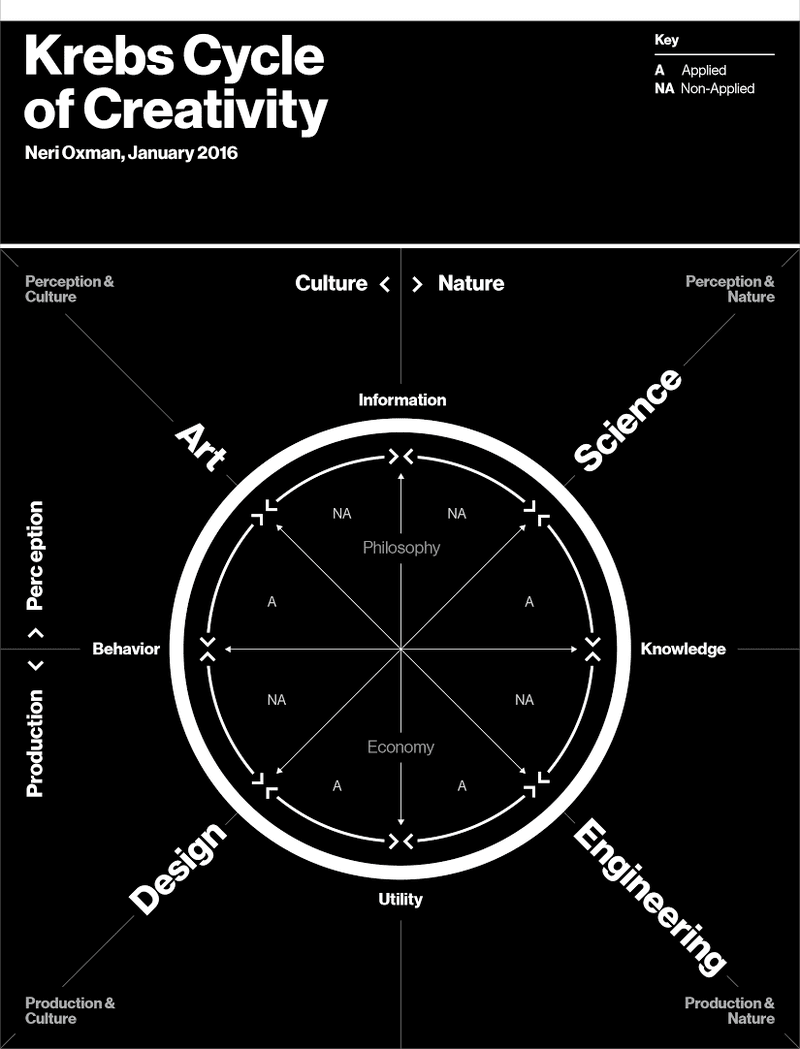
But before we explore whether someone has finally figured out how to successfully time travel and recruit you to join me in investing in their pre-IPO startup, I’d like to introduce one of the most important visualizations from the world of innovation that many of your have probably never seen – Neri Oxman’s Krebs Cycle of Creativity from January 2016.

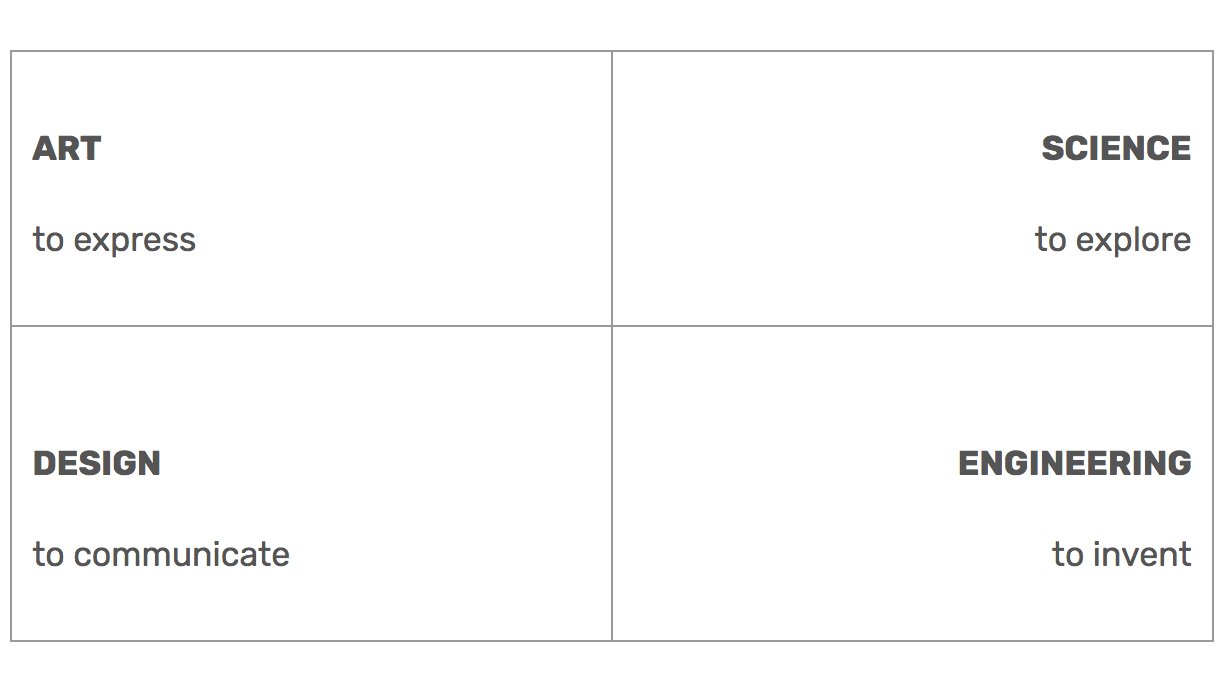
If you’re not familiar with this incredibly important visual artifact from the work of Neri Oxman from MIT’s Media Lab, you should be because it does an amazing job of capturing the interplay between Art, Science, Engineering and Design in the creation of innovation. It builds on John Maeda’s Bermuda Quadrilateral from 2006:

John Maeda Bermuda Quadrilateral

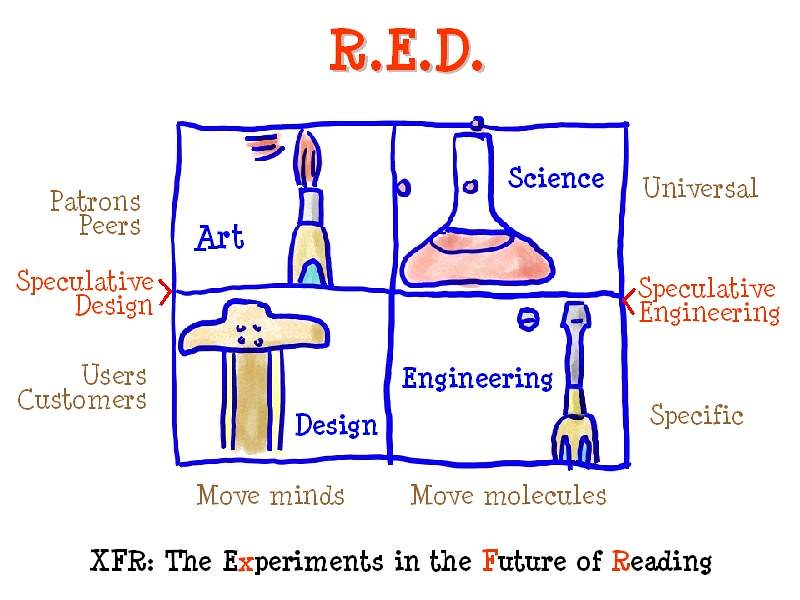
And Rich Gold’s Matrix, also from 2006:

Rich Gold Matrix

While Rich Gold’s visualization builds on the logical bones of John Maeda’s Bermuda Quadrilateral and introduces the concepts of speculative design, speculative engineering, and the contrast between moving minds & moving molecules, it lacks the depth of Neri Oxman’s Krebs Cycle of Creativity visualization. But the Krebs Cycle of Creativity does lose Maeda’s expression of the linkages between science & exploration, engineering & invention, design & communication, and art & expression. But even without these assertions of Maeda, the Krebs Cycle of Creativity still captures a number of other powerful tensions and assertions that can benefit us in our pursuit of innovation.

Time Marches On

The Krebs Cycle of Creativity can be viewed from a number of different perspectives and utilized in a number of different ways. But, one way to look at it is as if it were a watch face. In this context as time moves forward you’re following the typical path, a technology-led innovation approach.

Using the Krebs Cycle of Creativity Canvas in a clockwise direction will help us explore:

  • What information do we have about what might be possible?
  • What knowledge needs to be obtained?
  • What utility does the invention create?
  • What behavior do we need to modify to encourage adoption?

It begins with the invention of a new piece of technology created by the usage of existing information and a new perception of what might be possible within the constraints of our understanding of the natural world, or even by expanding our understanding and knowledge of the natural world using the scientific method.

Neri Oxman Krebs Cycle of Creativity

You’ll see at 3 o’clock in the image above that it at this point in time that most organizations then hand off this new knowledge to their engineers to look at this new understanding of nature through the production lens in order to convert this new knowledge into new utility.

Engineers in most organizations are adept at finding a useful application for a new scientific discovery, and in many organizations this work is done before designers get a peek and begin to imagine how they can present this utility to users in a way that drives behaviors of adoption in a way that the behaviors of using the product or consuming the service feel as natural as possible and as frictionless as possible.

And unfortunately the artists in any organization (or outside via agency relationships) are called in at the eleventh hour to help shape perceptions and to communicate the philosophy behind the solution and the to make the case for it to occupy space in our collective culture.

Pausing at the Innovation Intersection

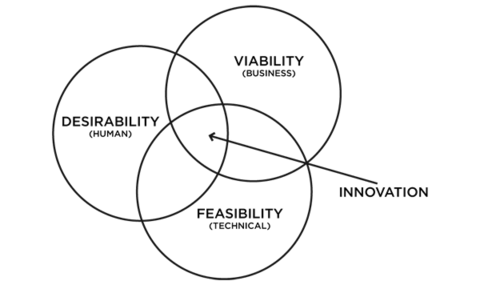
The way that innovation occurs in many organizations is that Science and Engineering collaborate to investigate and confirm feasibility, then Engineering and Design collaborate to inject viability into the equation, and then Design and Art (with elements of marketing and advertising) collaborate to create Desirability at the end. This may be how it works in many organizations, yet it doesn’t mean that it is the best way…

Feasibility Viability Desirability for Innovation

Traveling Back in Time

But as we all know, water can run uphill, the moon can eclipse the sun, and yes time can run in reverse. Viewing the Krebs Cycle of Creativity in a counter clockwise direction and pushing the hands of the watch backwards will have you following a user-led innovation approach instead.

Using the Krebs Cycle of Creativity Canvas in a counter clockwise direction will help us explore:

  • What information do we have about what is needed?
  • What behavior should we observe?
  • What would create utility for customers?
  • What knowledge must we obtain to realize our solution vision?

It begins with the identification of a new insight uncovered by the investigation of existing information and a new perception of what might be needed within the constraints of our understanding of our customers, or even by expanding our understanding and knowledge of our customers by using ethnography, observation, behavioral science and other tools to enter the mind of your customers, employees or partners.

You’ll see at 9 o’clock in the image above that it at this point in time that user-driven organizations after having their business artists use their perception skills to investigate the culture and philosophy underpinning this new understanding of behavior and pass it off for their designers to look at through the production lens in order to convert it into new utility.

Designers in many organizations are adept at finding a useful application for a new behavioral understanding, and in user-driven organizations this work is done before engineers get a peek and begin to imagine how they can build this utility for users in a way that creates new knowledge in a way that will differentiate the products or services of their organization from those of the competition.

And in user-driven organizations scientists are called in as needed to help overcome any barriers engineers encounter in realizing the solution that best satisfies the users’ identified needs, while leveraging new scientific perceptions that help shape our understanding of nature and empower new philosophical beliefs about what’s possible.

Conclusion

While we haven’t torn any worm holes through the fabric of the space-time continuum with this article, hopefully we have expanded your repertoire with some new tools to facilitate conscious choices around whether you are going to pursue technology-led innovation (clockwise) or user-led innovation (counter clockwise).

Hopefully we have also shown you a better way of visualizing where you are in your innovation journey and where the turning points in your innovation pursuits lie as you seek to take a quantum leap and transform your past into a bright, shiny future.

So now it is time to answer the question you had at the beginning of this article… Is time travel possible?

Well, nearly a decade ago NASA ran an experiment that proved elements of Einstein’s theory of relativity, specifically that the fabric of space-time warps around the earth in response to gravity. Read about it here

And yes, time travel is theoretically possible, or at least time is not theoretically constant as described in this NASA article.

Neither of these indicate that it is possible to travel backwards in time (despite what Superman physics says), only to affect how time advances, but if anyone wants to invest a million dollars in my time travel startup, I’ll cash your check. Because who knows, maybe your check is what will finally make time travel possible!

Anyone? Anyone? Bueller?


Image credits: Neri Oxman, MIT Media Lab; Rich Gold; John Maeda; Pixabay

Subscribe to Human-Centered Change & Innovation WeeklySign up here to get Human-Centered Change & Innovation Weekly delivered to your inbox every week.

Engineering Principles Applied to Cultural Change

LAST UPDATED: March 16, 2026 at 11:21 AM

Engineering Principles Applied to Cultural Change

GUEST POST from Art Inteligencia


The Architecture of Human Systems

In the traditional corporate world, culture is often treated as a “soft” variable — something that happens by accident, shaped by the personalities of founders or the unspoken habits of a legacy workforce. When organizations face stagnation, the typical response is “Change Management,” a top-down approach that focuses on persuasive communication and executive mandates.

However, these methods frequently fail because they treat the organization as a collection of individuals who simply need to be “convinced.” In reality, an organization is a complex adaptive system. To influence it effectively, we must stop thinking like psychologists and start thinking like architects and engineers.


The Bridge Between Strategy and Execution

There is a recurring structural failure in modern business: the gap between high-level strategy and boots-on-the-ground execution. This gap is almost always filled by culture. If the structural integrity of your cultural framework is weak, even the most brilliant strategy will collapse under the weight of daily friction, misaligned incentives, and systemic inertia.

Moving from Accidental to Intentional Design

Engineering principles provide us with a vocabulary for precision. Instead of vague notions of “engagement,” we look at:

  • Load Distribution: How vision is carried throughout the hierarchy.
  • Structural Integrity: The resilience of values under market pressure.
  • Friction Points: Where processes slow down human momentum.

“Culture is not just the ‘vibe’ of the office; it is the underlying operating system that dictates every decision, interaction, and innovation.”

The Core Objective

The goal of applying engineering rigor to cultural change is to move away from “fixing people” and toward re-engineering the environment. When you change the environment — the systems, the feedback loops, and the structural supports — the behavior of the people within that environment changes naturally and sustainably.

Section II: Structural Integrity and the “Load-Bearing” Values

In engineering, structural integrity refers to the ability of an object — a bridge, a skyscraper, or a wing — to hold together under a load, including its own weight, without breaking or deforming excessively. When we apply this to organizational culture, we must differentiate between decorative values and load-bearing values.


1. Identifying Load-Bearing vs. Decorative Values

Most companies have values written on their walls (Integrity, Innovation, Collaboration). These are often decorative — they look nice, but they don’t actually support the weight of the organization’s daily operations or difficult decisions.

  • Decorative Values: These are aspirational. They are easily discarded when a deadline is missed or a quarterly target is at risk.
  • Load-Bearing Values: These are the non-negotiables. They are the principles that dictate behavior even when it is expensive, inconvenient, or results in a lost sale. They are the “foundation” that keeps the culture upright during a crisis.

2. Stress Testing Cultural Integrity

Engineers use stress tests to determine the breaking point of a material. Leaders must do the same for their culture. To identify your true load-bearing values, ask:

  • “What is a behavior we have fired a high-performer for?” (This reveals a true boundary.)
  • “What is a project we killed because it violated our core principles, despite its profit potential?”
  • “Where does the system ‘buckle’ when we increase the workload by 20%?”

3. Strengthening the “Beams” (Middle Management)

In a physical structure, the roof (Executive Vision) is only as secure as the beams (Middle Management) supporting it. If there is a disconnect between the vision and the ground floor, the “beams” are likely experiencing shear stress — being pulled in two directions by competing priorities.

To ensure structural integrity, we must provide middle managers with the bracing they need: clear decision rights, consistent incentives, and the psychological safety to uphold values when they conflict with short-term metrics.

“If your values don’t cost you anything, they aren’t load-bearing; they are just wallpaper.”

4. Alignment of Forces

Engineering excellence requires that all forces are aligned to prevent structural failure. If your “Incentive System” is pulling left while your “Innovation Goal” is pulling right, the culture will eventually develop fatigue cracks. True human-centered innovation requires aligning these forces so the structure is self-reinforcing.

Section III: Systems Thinking and Interconnectivity

In engineering, no component exists in isolation. A change in the tension of a single cable on a suspension bridge redistributes forces across the entire structure. Similarly, culture is a dynamic system of interconnected nodes. When leaders attempt to “fix” a cultural issue in a vacuum — such as addressing “lack of innovation” with a single brainstorming workshop — they often fail to account for the systemic torque this creates elsewhere.


1. Mapping the Cultural Ecosystem

To re-engineer a culture, we must first map the nodes and the linkages between them. In a human-centered innovation system, these nodes typically include:

  • Incentives: What behaviors are actually rewarded? (The “Power Source”)
  • Tools & Infrastructure: Do employees have the “equipment” to execute?
  • Narratives: What stories do people tell about “how things get done here”?
  • Governance: Who has the permission to say “yes” or “no”?

If you change the Narrative (e.g., “We are a fail-fast culture”) but leave the Incentive node untouched (e.g., “Failure results in a smaller bonus”), the system will experience internal friction and eventually stall.

2. Root Cause Analysis (RCA) and the “5 Whys”

Engineers don’t just patch a leak; they find out why the pipe burst. When cultural friction arises — such as a sudden drop in collaboration — we apply Root Cause Analysis:

  1. Why are teams not collaborating? (They are focused on siloed KPIs.)
  2. Why are KPIs siloed? (Department heads are measured on individual output.)
  3. Why are they measured that way? (The legacy reporting system doesn’t track cross-functional value.)
  4. Why hasn’t the system been updated? (It’s tied to a 10-year-old software architecture.)
  5. Why is that architecture still in place? (Lack of investment in digital transformation.)

By the fifth “Why,” we realize the “collaboration problem” is actually a technical debt and resource allocation issue, not a personality conflict.

3. The Input vs. Output Equation

In any engineered system, the Output is a direct function of the Inputs and the Process.

$Output = f(Inputs, Environment, Incentives)$

If the output you are getting is “low-risk, incremental ideas,” you cannot simply demand “disruptive innovation.” You must change the inputs (diverse talent, broader data) or the environment (psychological safety, time for exploration) to change the resulting output.

4. Managing “Systemic Torque”

When you introduce a major change — like shifting to a remote-first model — you create torque on the social fabric of the company. Engineering-led change involves identifying where that tension will land. Will it strain the Mentorship node? Will it weaken the Spontaneous Innovation node? By predicting these stresses, we can design “compensators” (like structured virtual watercoolers or hybrid off-sites) before the system breaks.

Section IV: Feedback Loops and Real-Time Calibration

In mechanical and electrical engineering, a feedback loop is a process where the output of a system is circled back and used as an input. This allows for self-regulation and stability. Unfortunately, most corporate cultures operate on “Open-Loop” systems: leadership sets a direction, assumes it is being followed, and only checks the results months later during an annual review. By then, the “engine” may have already overheated.


1. The Thermostat vs. The Thermometer

A thermometer merely measures the temperature; it is a lagging indicator. A thermostat, however, is a real-time regulator. It measures the environment and triggers an immediate corrective action to maintain a desired state.

  • Lagging Indicators (The Thermometer): Annual engagement surveys, turnover rates, and quarterly profit margins. These tell you what happened, but they are too late to influence the current state.
  • Leading Indicators (The Thermostat): Weekly pulse checks, project “post-mortems” performed in real-time, and psychological safety scores. These allow for calibration before a cultural drift becomes a disaster.

2. Dampening vs. Amplifying Loops

Engineers use different types of loops to control system behavior. In a human-centered culture, we must design both:

  • Dampening Loops (Negative Feedback): These are designed to bring a system back to equilibrium. If “Fear of Failure” begins to rise and stall innovation, a dampening loop — such as a “Failure Celebration” or a no-fault retrospective — neutralizes that fear and returns the team to a creative state.
  • Amplifying Loops (Positive Feedback): These create momentum. When a team successfully collaborates across silos, the system should automatically “amplify” that behavior through public recognition, resource allocation, or career advancement. This creates a virtuous cycle of innovation.

3. Iterative Design and the “Cultural MVP”

In software engineering, we don’t release a finished product without testing a Minimum Viable Product (MVP). Cultural change should follow the same logic. Rather than a global rollout of a new “Innovation Framework,” start with Cultural Sprints:

  1. Prototype: Test a new meeting structure or decision-making protocol with one small team.
  2. Measure: Use real-time feedback to see if it reduces friction or improves output.
  3. Iterate: Adjust the protocol based on the data.
  4. Scale: Only once the “code” is stable do you push the update to the rest of the organization.

“A system without a rapid feedback loop isn’t being managed; it’s being left to chance.”

4. Signal vs. Noise

A major engineering challenge is filtering out “noise” to find the true “signal.” In cultural transformation, noise is the grumbling about minor inconveniences (office snacks, parking). The signal is the recurring data point that shows people are afraid to speak up in meetings. Re-engineering culture requires leaders to build filters that prioritize the signals that impact velocity and integrity.

Section V: Eliminating Friction (The Law of Least Resistance)

In physics and engineering, friction is the force resisting the relative motion of solid surfaces, fluid layers, and material elements sliding against each other. It converts kinetic energy into heat — effectively wasting it. In an organizational context, cultural friction is any process, habit, or hierarchy that drains energy away from productive innovation and redirects it into “busy work” or internal politics.


1. Cultural Thermodynamics: Energy Preservation

Every organization has a finite amount of “Cognitive Energy.” If your employees must spend 40% of their energy navigating convoluted approval layers, fighting for budget, or attending redundant meetings, you only have 60% left for actual value creation. Engineering-led change focuses on maximizing efficiency by smoothing the “surfaces” where teams interact.

2. Designing the “Path of Least Resistance”

People generally follow the path that requires the least effort. If your “Innovation Lab” requires a 20-page business case to get $500 for a prototype, but your “Maintenance Budget” allows for immediate spending, people will stick to maintenance. To re-engineer behavior, you must make the desired behavior the easiest behavior.

  • Default Settings: Design systems where the default option is the one that supports the culture. For example, if you want transparency, make all project folders “public by default” rather than “private by default.”
  • Nudge Theory: Small, engineered adjustments to the environment that encourage specific choices without mandates (e.g., placing collaborative tools at the center of the digital dashboard).

3. Identifying and Eliminating “Cultural Debt”

Just as software engineers deal with technical debt (quick fixes that cause long-term problems), organizations accumulate cultural debt. This consists of:

  • Legacy Meetings: Recurring meetings that no longer serve a purpose but continue because “we’ve always done them.”
  • The “Tax Trap”: Adding new layers of reporting every time a mistake is made, which permanently slows down the system to prevent a one-time error.
  • Silo Friction: The “interfacial tension” that occurs when two departments have conflicting protocols for the same task.

“Innovation isn’t always about adding new features; often, it’s about removing the friction that prevents the existing ones from working.”

4. Increasing Organizational Velocity

In engineering, velocity isn’t just speed; it’s speed in a specific direction. By removing friction, you don’t just make people work “faster” — you increase the velocity of ideas. When the resistance between a concept and a prototype is minimized, the organization becomes more agile, allowing it to pivot without the structural “heat” of internal conflict.

Section VI: Scaling and Modularity

In large-scale engineering projects, from software architectures to aerospace design, modularity is the key to managing complexity. A modular system is composed of separate components that can be connected, replaced, or scaled independently. When we attempt to scale a culture across a global organization, we often fail because we try to force a “monolithic” culture — a one-size-fits-all approach that lacks the flexibility to adapt to local realities.


1. The “Micro-Culture” Framework

Just as a microservices architecture allows different software functions to operate independently while sharing a common backbone, a modular culture allows for localized high-performance. A Sales team in Tokyo and an Engineering team in Berlin do not need to behave identically; they need to be interoperable.

  • The Core “Kernel”: The non-negotiable values and protocols (e.g., integrity, data security, customer centricity) that every “module” must run.
  • Localized Plugins: Department-specific or region-specific norms that optimize performance for that specific environment without breaking the system.

2. Cultural “APIs” (Application Programming Interfaces)

In computing, an API defines how different systems talk to each other. In a modular organization, we must define the interfaces between departments. When friction occurs between Marketing and Product, it is often because their “APIs” don’t match — they use different terminology, different success metrics, and different communication cadences.

Engineering-led change focuses on standardizing these hand-offs. By creating clear “contracts” for how information and work move between modules, you reduce the need for constant “re-translation” and manual intervention.

3. Avoiding the “Monolithic Collapse”

A monolithic culture is brittle. If one part of the system becomes toxic, the lack of boundaries allows that toxicity to spread rapidly (a “cascading failure”). Modularity provides fault tolerance. By empowering teams to own their internal sub-cultures within a shared framework, you create a more resilient organization that can contain failures and replicate successes more efficiently.

“Scalability is not about making everyone the same; it’s about making sure everyone can work together while being different.”

4. Interoperability and the “Stable Spine”

To maintain order amidst this modularity, the organization needs a Stable Spine — a set of centralized systems and human-centered principles that provide the necessary “scaffolding” for growth. This spine ensures that as the organization adds more modules (new hires, new departments, or acquisitions), the structural integrity remains intact.

Section VII: Conclusion — From Architect to Gardener

The application of engineering principles to cultural change is not about turning an organization into a cold, mechanical factory. On the contrary, it is about using the rigor of design to protect and empower the human element. By architecting a “Stable Spine” of systems, feedback loops, and friction-free processes, leaders create the necessary structure for human-centered innovation to flourish.


1. The Shift in Leadership Persona

As we move from accidental culture to engineered culture, the role of the leader undergoes a fundamental transformation:

  • From Fixer to Architect: Instead of spending your day putting out individual behavioral “fires,” you focus on designing the systems that prevent those fires from starting in the first place.
  • From Dictator to Gardener: An engineer understands that you cannot “force” a plant to grow; you can only design an irrigation system (incentives), ensure the soil quality (psychological safety), and remove the weeds (friction). The growth itself is a natural output of a well-engineered environment.

2. Cultural Maintenance and Technical Debt

No engineered system is “set and forget.” Just as a bridge requires regular inspections for fatigue and corrosion, a culture requires continuous monitoring. Leaders must be vigilant against “Cultural Debt” — the buildup of outdated rituals and inefficient communication patterns that slowly degrade the system’s velocity over time.

3. Final Call to Action: Start with the Blueprint

If your organization’s culture feels amorphous or resistant to change, stop trying to “change minds” and start mapping the system.

  1. Audit your Load-Bearing Values to ensure they aren’t just wallpaper.
  2. Install Feedback Loops that act as thermostats, not just thermometers.
  3. Identify the Friction Points that are draining your team’s cognitive energy.

“The most successful organizations of the future will not be those with the smartest individuals, but those with the most intentionally engineered cultures — systems designed to make innovation the path of least resistance.”

Summary of the Engineering Framework

By moving through these six principles — Integrity, Systems Thinking, Feedback, Friction Reduction, and Modularity — you move beyond the “softness” of traditional change management. You build a resilient, scalable, and human-centered innovation bonfire that burns brighter, longer, and more efficiently.

BONUS: The Cultural Engineering Audit – A Diagnostic Checklist

To move from theory to execution, leaders must evaluate their organizational “machinery.” This audit is designed to identify where your cultural architecture is sound and where it is suffering from structural fatigue or systemic friction. Use this checklist to pinpoint your highest-priority “re-engineering” tasks.


1. Structural Integrity (The Foundation)

  • Load-Bearing Test: Can you name three instances in the last year where a core value was upheld specifically at the expense of short-term profit or convenience?
  • Shear Stress Assessment: Do middle managers feel “squeezed” between executive innovation goals and rigid operational KPIs?
  • Boundary Clarity: Are there clear, documented “red lines” for behavior that apply equally to top performers and new hires?

2. Systems & Feedback (The Controls)

  • Sensor Accuracy: Do you have at least one “leading indicator” for cultural health (e.g., weekly pulse, psychological safety score) that is reviewed as frequently as financial data?
  • Loop Latency: How long does it take for a “signal” from the front lines (a process failure or a new idea) to reach a decision-maker? (Target: Days, not months).
  • Calibration Capability: Does the organization have a formal “Cultural MVP” process for testing changes in a sandbox environment before scaling?

3. Friction & Thermodynamics (The Efficiency)

  • Path of Least Resistance: Is it easier for an employee to start a small experiment than it is to fill out a grievance report?
  • Cognitive Waste Audit: Have you identified and eliminated at least two “Legacy Meetings” or redundant reporting layers in the last six months?
  • Default Settings: Are your collaboration tools and information repositories “Open by Default”?

4. Modularity & Scaling (The Architecture)

  • Interface Standardization: Are the “hand-offs” between departments (e.g., Sales to Ops) governed by clear, mutually agreed-upon protocols?
  • Fault Tolerance: Can a single department’s failure be contained without disrupting the entire organization’s “Stable Spine”?
  • Local Optimization: Are sub-teams empowered to create their own “Micro-Culture” rituals as long as they remain compatible with the core values?

Engineer’s Note: If you checked fewer than 50% of these boxes, your organization is likely losing significant energy to “Heat” (internal friction and misalignment). Focus your next “Cultural Sprint” on the section with the fewest checks.

Frequently Asked Questions

Does “Engineering” culture mean removing the human element?

Quite the opposite. Engineering principles are used to design environments that actually protect the human element. By removing systemic friction and clarifying structural values, we free people to focus on creative, high-value work rather than navigating bureaucratic hurdles.

What is the difference between a “Thermostat” and a “Thermometer” in culture?

A thermometer (like an annual survey) simply measures the temperature when it’s often too late to change it. A thermostat (like real-time pulse checks) measures the environment and triggers immediate, corrective action to keep the culture aligned with its “set point” or core values.

How do you identify “Cultural Debt”?

Cultural debt is identified by looking for “legacy” processes — meetings, approval layers, or silos — that were created to solve a past problem but now serve only to slow down the current system. If a process creates more “heat” (frustration) than “work” (value), it is likely cultural debt.

Image credit: Google Gemini

Subscribe to Human-Centered Change & Innovation WeeklySign up here to get Human-Centered Change & Innovation Weekly delivered to your inbox every week.

Innovation – Marketing versus Engineering

What are the roadblocks and critical relationships between marketing and engineering in the cause of advancing innovation?

Let me start off by recommending that you watch the movie I’ve embedded, as it does a great job of describing how there is often an engineering solution to a problem and a marketing solution to a problem. This in part explains why there is often a tension between marketing and engineering when it comes to new product development – they see different solutions, assign value differently, and view success in divergent ways. So, please enjoy the video, and my article will continue below it:

So in the future, with the problem at hand, you might want to ask yourself – “Is the problem best solved by changes to the real value, redefining the intrinsic value provided, or a bit of both?”

Of course it is very hard for people to ask these questions honestly as they have a default response, but asking them in a cross-fuctional environment may yield a more holistic and informed response. And after all, many of the barriers that people tend to erect in the achievement of something are often because they didn’t feel involved in the decision-making process.

So, what are some of the barriers that people erect in a sometimes tension-filled environment?

  1. Isolation – You just avoid communicating with the other side as much as possible
  2. Stonewall – You just do what you would do anyways and ignore the input from the other side
  3. Passive Aggression – You consciously choose to behave in a way that will cause the effort to fail, so that ideally you get your way instead
  4. Build a Fortress – You build complex written rules of engagement for your department saying that it has to be this way because you’re too busy and these rules will help you be more organized
  5. Omission – You take the inputs but then you don’t do anything with them (marketing doesn’t promote a feature, or engineering doesn’t fully develop it

Working TogetherThe biggest danger to the cause of advancing innovation when it comes to the engineering and marketing departments is that the relationship develops into one without constructive conflict and without healthy collaboration. For innovation to be repeatable in an organization these two sides must share openly, have their perspectives valued, and contribute to a conversation. Marketing and engineering hear different aspects of the voice of the customer in their interactions with them, and they approach solutions to problems in different ways.
I would even argue that there is probably no more important set of cross-functional relationships than those between marketing and engineering, and that their health will determine the future success or failure of the organization. The executive team should consciously monitoring the health of these relationships, because when they start pulling in opposite directions, the entire organization could be ripped apart.

What directions are these two organizations pulling in your organization?


Build a Common Language of Innovation on your team

Subscribe to Human-Centered Change & Innovation WeeklySign up here to get Human-Centered Change & Innovation Weekly delivered to your inbox every week.