Category Archives: Technology

10 Ways to Prototype Experience Without Building a Product

10 Ways to Prototype Experience Without Building a Product

by Braden Kelley and Art Inteligencia


How Do You Prototype Experience Without Building a Product? (Short Answer)

Ten ways to prototype experience without building a product: (1) concierge delivery, (2) Wizard of Oz, (3) fake-door / offer test, (4) paper or sketch walkthrough, (5) service rehearsal, (6) moment-of-truth enactment, (7) manual-backed facade, (8) pop-up front door, (9) human-scripted conversation, and (10) recovery rehearsal. Soft landings learn the feeling, the job, and the seam before the backlog. Hard landings fund the build and hope the experience shows up later.

Prototype the experience humans will live — not the product you wish you had budget to build.

Why Prototype the Experience Before You Fund the Build?

I keep watching teams schedule a product build to “see if people like it,” polish UI before a behavior hypothesis exists, and treat stakeholder applause at a demo as desirability proof. Those are expensive costumes. Experience prototypes falsify whether people can finish the job with dignity — cheaply.

Cheap evidence sits in the middle between insight and scale — see 6 Stages Most Organizations Skip Between Insight and Scale. Instrument learning with something like The Experiment Canvas™. And do not confuse a clickable demo with learning — prototype-as-finish-line is ceremony in 6 Design Artifacts Worth Keeping — and 6 That Are Ceremony.

Method Falsifies Build can wait until…
1. Concierge Will they hire this job done this way? Demand + behavior proven
2. Wizard of Oz Does the interaction feel trustworthy? Interaction model validated
3. Fake door Will they raise a hand? Interest without theater
4. Paper walkthrough Where does the job break? Flow risks known
5. Service rehearsal Do seams and roles work? Operating model sketched
6. Enactment What does success feel like? Emotional job clear
7. Manual facade Can ops sustain the promise? Promise vs capacity
8. Pop-up Does the channel work in context? Front-door design proven
9. Scripted conversation Does dialogue resolve the job? Conversation design ready
10. Recovery rehearsal Can we make it right when it fails? Trust path designed

If you haven’t felt the experience, you haven’t prototyped it — you’ve only scheduled a build.

1. How Does Concierge Delivery Prototype Experience?

Method: Deliver the end-to-end experience manually for a small set of humans — humans are the system.

Falsifies: Desirability and job fit — will they hire this outcome done this way?

Run lean: Cap at N customers or employees; script the promise; log every step and friction.

Kill/continue: They return, refer, or abandon a workaround — or they ghost after one try.

2. What Is Wizard of Oz Experience Prototyping?

Method: Present an “automated” or agentic experience while a human performs the work unseen.

Falsifies: Interaction trust — clarity, control, and competence feel — before you build the agent.

Run lean: Chat, voice, or UI shell; human operator; record where people hesitate or demand a human.

Kill/continue: They complete with confidence — or trap, retell, or escape the channel. For the trust contract when agents later act for real, see 6 Trust Pillars for Agentic Customer Experience.

3. How Do Fake-Door / Offer Tests Work Without Building?

Method: Offer the experience — landing page, button, email, QR, shelf talker — before it exists; measure intent.

Falsifies: Demand signal without building fulfillment.

Run lean: Clear promise; easy signup; honest “not ready yet” follow-up; no dark patterns.

Kill/continue: Qualified interest above threshold — or curiosity theater with zero follow-through. Fake doors that shame people are trust violations, not prototypes.

4. Why Run a Paper or Sketch Walkthrough?

Method: Walk real users through screens, cards, or paper steps that stand in for the product.

Falsifies: Flow risk — where the job breaks, where language fails, where dignity costs spike.

Run lean: Low fidelity on purpose; one job; watch hands and faces; don’t defend the sketch.

Kill/continue: Time-to-first-success improves — or they invent a workaround mid-walkthrough. Better framing questions before you freeze a build live in 10 Design Questions That Beat a 40-Page Requirements Document.

5. What Is a Service Rehearsal Prototype?

Method: Tabletop, then live rehearsal of the service with real role owners — frontline, backstage, partner.

Falsifies: Operating-model risk — orphan seams, unclear ownership, policy collisions.

Run lean: One journey; timers; “who owns this seam?” cards; stop when a seam has no owner.

Kill/continue: Seams named and staffed — or the rehearsal collapses into “IT will figure it out.”

6. How Does Moment-of-Truth Enactment Prototype Feeling?

Method: Role-play or staged enactment of the critical emotional beat — recovery, consent, first win, bad news.

Falsifies: Emotional job and stakes — what success and betrayal feel like.

Run lean: Real customers or employees if possible; otherwise trained proxies plus later validation; debrief feelings, not features.

Kill/continue: People say “I’d trust that” — or the room goes quiet at the dignity cost.

7. What Is a Manual-Backed Facade?

Method: Ship a thin front — form, chat, page — backed by spreadsheet or ops humans, not a platform.

Falsifies: Promise vs capacity — can you keep the experience promise at small scale?

Run lean: Explicit capacity cap; promises you can keep; log unpaid labor and exception types.

Kill/continue: Ops can sustain with dignity — or heroes burn out keeping the costume alive. Before you fund the bigger pilot, use 11 Questions Before Funding Any Innovation Pilot.

8. How Does a Pop-Up Front Door Prototype Channel Fit?

Method: Stand up a temporary physical or digital front door where the job already happens.

Falsifies: Context and channel fit — will they enter here, not only in your preferred portal?

Run lean: Hours or days, not months; observe wrong-door and escape; capture verbatim jobs.

Kill/continue: Traffic converts to completed jobs — or people walk past to the old path.

9. How Do You Prototype Experience With Human-Scripted Conversation?

Method: Run the conversational experience with a human following — and adapting — a script across SMS, chat, voice, or desk.

Falsifies: Dialogue design — can conversation finish the job without loops or shame?

Run lean: One intent; escalation rules; measure completion and “felt heard.”

Kill/continue: Job done in one conversation — or an escalation storm and retelling tax. Prototyping without a named behavior is a classic design-thinking misuse — see 7 Ways Design Thinking Gets Misused.

10. Why Rehearse Recovery Before You Scale?

Method: Deliberately break or simulate failure; rehearse undo, apology, refund, rebook, and human handoff.

Falsifies: Trust under failure — control, care, and accountability when the happy path dies.

Run lean: One failure mode; powered recovery band; time-to-make-right; named accountable human.

Kill/continue: Recovery restores trust — or “the system decided” leaves nobody askable.

What Should You Ask Before the Next Build Request?

Five questions for experience prototyping:

  1. What named behavior are we falsifying?
  2. Which of these ten methods is the cheapest honest test?
  3. What is the kill/continue date?
  4. Who feels the experience — real humans or stakeholders only?
  5. What must we not build until the experience proves out?

Mantra: Prototype the experience. Build the product only when the feeling and the job survive contact with humans.

FAQ: Prototyping Experience Without Building a Product

How do you prototype an experience without a product?

Prototype an experience without a product by delivering the job manually, running Wizard of Oz interactions, testing offers with fake doors, walking paper flows, rehearsing services and recovery, using manual-backed facades, pop-up front doors, and human-scripted conversations — each with a named behavior and a kill/continue date.

What is a concierge MVP for CX?

A concierge MVP for CX is delivering the end-to-end customer or employee experience by hand for a small set of people — humans are the system — so you learn whether they will hire the outcome before you fund a product build.

What is Wizard of Oz prototyping?

Wizard of Oz prototyping presents an automated or agentic experience while a human performs the work behind the curtain — falsifying whether the interaction feels clear, competent, and controllable before you build the real system.

How do you test a service before building software?

Test a service before building software with service rehearsals, pop-up front doors, manual-backed facades, human-scripted conversations, and recovery rehearsals that prove seams, capacity, dialogue, and make-right — not stakeholder applause at a clickable demo.

When should you stop prototyping and build?

Stop prototyping and build when a named behavior is proven or falsified on a decision date, the experience survives contact with real humans, seams and recovery have owners, and further learning requires scale you cannot fake by hand — not when the demo looks fundable.

Image credits: 1 of 1,550+ FREE quotes for your presentations at http://misterinnovation.com

Content Authenticity Statement: The topic area, key elements to focus on, etc. were decisions made by Braden Kelley, with a little help from Google Gemini and Cursor to clean up the article, add images and create infographics.

Subscribe to Human-Centered Change & Innovation WeeklySign up here to get Human-Centered Change & Innovation Weekly delivered to your inbox every week.

5 Elements of Human-Centered Design That AI Cannot Own

5 Elements of Human-Centered Design That AI Cannot Own

by Braden Kelley and Chateau G Pato


What Elements of Human-Centered Design Can AI Not Own? (Short Answer)

Five elements of human-centered design AI cannot own: lived contact with people doing the job, problem framing before solutions, constraint and tradeoff honesty, behavior falsification (not demo applause), and adoption design for Tuesday. AI can draft personas, journey maps, wireframes, and “How might we…” at volume. It cannot bear dignity costs, name what you are empowered to change, choose under uncertainty with accountability, measure what people do, or own the seam after the workshop.

When generation is cheap, the elements that require a body in the room become the whole design — not the wallpaper around the model.

Why Are Artifacts Cheap and Judgment the Design?

I have watched the same room light up twice — once when sticky notes arrived, and again when the model could generate a persona, a journey map, and a clickable prototype before lunch. The second room felt more advanced. It was often less honest.

AI did not retire human-centered design. It made the human elements more urgent. Models can invent users who never existed, roadmaps that answer the wrong question beautifully, and pilots that prove the demo while the operating model stays frozen. Generation got cheap. Design judgment is still expensive — in the right way: contact, stakes, mandate, falsifiable learning, and adoption.

This is not a list of things to ban. It is a division of design labor. AI can assist each element. Humans must own them — because each requires someone who bears stakes, accountability, and contact with Tuesday.

Element AI can assist Humans must own
1. Lived contact Summarize interviews, cluster themes Field time, dignity costs, reality that contradicts the roadmap
2. Problem framing Explore options inside a human-set frame The question, the mandate, killing the wrong problem
3. Constraint honesty Retrieve policy, model scenarios Tradeoffs, winners and losers, what we stop doing
4. Behavior falsification Generate flows, demos, copy variants What to test, what people do, when to kill the idea
5. Adoption design Draft rollout plans and training outlines Owners, seams, shadow-process kill dates, Tuesday

1. Why Can’t AI Own Lived Contact in Human-Centered Design?

The element: Understanding humans by contact — jobs-to-be-done, friction, dignity costs — in their language and context, before the artifact freezes the story.

AI can assist: Summarize interviews, cluster themes, draft empathy maps after contact. Useful synthesis once reality has entered the room.

The costume: Synthetic users, scraped reviews, generated personas nobody met; empathy theater at machine speed. Fluency mistaken for evidence.

Humans own: Field time, ride-alongs, the awkward conversation where reality contradicts the roadmap. If the insight could have been invented in the building, it is not design. It is decoration.

2. Why Is Problem Framing a Design Element AI Cannot Own?

The element: Naming the right problem, constraints, and stakes before freezing solutions — the frame that makes options meaningful.

AI can assist: Explore options inside a human-set frame; draft scenarios; challenge assumptions once the frame exists.

The costume: Instant roadmaps and solution spam that answer the wrong brief beautifully; “innovation” that skips the question entirely.

Humans own: The mandate to sit with the problem; kill ideas that solve a different problem; sponsor alignment on what is actually being designed. Faster wrong is still wrong — and now it ships faster too.

3. What Design Tradeoffs Must Humans Own That AI Cannot Fake?

The element: Surfacing policy, power, incentives, risk, staffing, and dignity limits that govern what can actually ship — and naming winners and losers.

AI can assist: Retrieve policy, summarize regulations, model scenarios within declared constraints.

The costume: Infinite “yes” in the prototype; designs that assume permission nobody has; surprise policy after “done.”

Humans own: The political work of tradeoffs; what we will stop doing; who loses if this works. Design without constraint honesty is a portfolio piece, not a plan. For sharper framing before specs freeze, see 10 Design Questions That Beat a 40-Page Requirements Document.

4. How Do Humans Own Behavior Falsification When AI Makes Prototypes Cheap?

The element: Prototyping and testing to falsify a named human behavior hypothesis — completion, workaround abandoned, time-to-confidence — not to win a room.

AI can assist: Generate clickable flows, agent demos, copy variants for tests. Speed to artifact, not speed to truth.

The costume: Applause demos; portfolio pieces; A/B theater without a behavior theory. Gorgeous output that teaches nothing about Tuesday.

Humans own: Choosing what to falsify; interpreting what people do; killing the idea when the evidence says kill. A beautiful demo that teaches nothing is still theater — and AI makes theater cheaper every quarter.

5. Who Owns Adoption Design That AI Cannot?

The element: Designing for who operates the journey after the markers dry — owners, handoffs, incentives, retirement of the old path, recovery power at the moment of truth.

AI can assist: Draft rollout plans, comms, training outlines — inside a human-owned adoption frame.

The costume: Workshop output that ends at the wall; maps without operators; “we’ll figure out ownership at scale.”

Humans own: Named workflow owner; seam owners; kill date for shadow process; enablement as practice, not completions. Design that stops at demo day is not human-centered. It is human-decorated. For friction customers feel before any map names it, read 12 Friction Points Customers Feel Before Your Journey Map Does.

How Do You Check the Division of Design Labor Before an AI-Assisted Sprint?

Before the next AI-assisted design sprint, run five go/no-go questions. If you cannot answer them, you are buying artifacts without a design:

  1. Who did we talk to — real humans doing the job, in their words?
  2. What problem are we empowered to change — decide, ship, or stop?
  3. What constraint or tradeoff are we naming out loud — policy, power, dignity, what we stop?
  4. What behavior are we falsifying — not what demo are we showing?
  5. Who owns Tuesday after the workshop — workflow, seams, shadow process retired?

For the broader work humans should keep when glue work shrinks, see 11 Human Endeavors AI Should Free (Not Replace). For habits that protect these elements in innovation practice, read 9 Habits of Human-Centered Innovators That Still Matter in the Age of AI. For method costume that skips them, see 7 Ways Design Thinking Gets Misused.

AI can own the draft. Humans own the design — contact, frame, tradeoffs, behavior, and adoption.

Frequently Asked Questions

What elements of human-centered design can AI not replace?

AI cannot own lived contact with real users, problem framing before solutions, honest constraint and tradeoff work, behavior falsification in testing, or adoption design for Tuesday. It can assist each — drafting, clustering, prototyping — but humans must bear stakes, mandate, accountability, and contact with reality.

Can AI do human-centered design?

AI can accelerate artifacts inside human-centered design — personas, maps, wireframes, copy — but it cannot do the design discipline on its own. Without human-owned contact, framing, tradeoffs, falsification, and adoption, AI produces fluent decoration: faster artifacts, same theater.

What is the difference between AI-assisted design and AI-owned design?

AI-assisted design uses models after humans set the problem frame, gather real evidence, and clarify decision rights — then to explore, draft, and test faster. AI-owned design lets generation substitute for contact, framing, tradeoffs, learning, and adoption — producing impressive artifacts that never land on Tuesday.

Why do AI-generated personas fail in human-centered design?

They often replace lived contact instead of summarizing it. Synthetic personas feel researched because the prose is fluent, but they optimize for a human who never existed — skipping dignity costs, workarounds, and the awkward truth that contradicts the roadmap. Empathy theater at machine speed.

How do you keep design human with AI?

Keep humans owning contact, problem framing, constraint honesty, behavior falsification, and adoption design. Use AI inside that frame for synthesis and speed. Run a division-of-labor check before each sprint: real humans in the evidence, empowered problem, named tradeoffs, falsifiable behavior, and an owner for Tuesday.

Image credits: Gemini

Content Authenticity Statement: The topic area, key elements to focus on, etc. were decisions made by Braden Kelley, with a little help from Google Gemini and Cursor to clean up the article, add images and create infographics.

Subscribe to Human-Centered Change & Innovation WeeklySign up here to get Human-Centered Change & Innovation Weekly delivered to your inbox every week.

The Rise of Ambient Experience Intelligence (AXI)

Beyond the Interface

LAST UPDATED: February 26, 2026 at 8:34 PM

The Rise of Ambient Experience Intelligence (AXI)

GUEST POST from Art Inteligencia


I. Introduction: From Interaction to Indication

Designing Environments for Human Flourishing

For decades, our relationship with technology has been transactional. We command, and the machine responds. We click, type, and swipe, paying an ever-increasing “Cognitive Tax” for every digital efficiency we gain. This constant demand for explicit interaction has led to a plateau of digital fatigue — an expensive noise that often drowns out the very purpose it was meant to serve.

We are now entering a new era: Ambient Experience Intelligence (AXI). These are systems that move beyond the screen. They sense human presence, emotion, and context, responding not to our commands, but to our indications.

“The most profound technologies are those that disappear. They weave themselves into the fabric of everyday life until they are indistinguishable from it.”
— Braden Kelley

AXI represents a fundamental shift in the innovation paradigm. It moves us from building interfaces to cultivating the conditions for human flourishing. By creating environments that adjust information flow, lighting, or collaboration dynamics based on our cognitive load, we allow humans to stay in ‘flow state’ longer and innovate at the edge of their potential.

II. The Architecture of Invisible Intelligence

To move beyond traditional interfaces, we must build an Invisible Architecture. This is not a single piece of software, but an ecosystem of sensors and logic gates designed to interpret the nuances of human behavior without requiring a single keystroke.

Sensing Context vs. Recording Data

The first pillar of AXI is Contextual Awareness. Through computer vision, spatial audio, and thermal sensing, environments can now distinguish between a high-intensity brainstorming session and a moment of quiet reflection. This isn’t about surveillance; it’s about reception.

Key Sensing Modalities:

  • Cognitive Load Detection: Monitoring physiological markers (like pupil dilation or speech patterns) to detect when a team is reaching the point of mental burnout.
  • Biometric Harmony: Adjusting environmental variables — CO2 levels, color temperature, and white noise — to maintain the optimal “biological rhythm” for the task at hand.

Response Frameworks: The Subtle Shift

The final stage is the Actionable Response. In a human-centered AXI system, the response is never jarring. If the system detects high cognitive load, it doesn’t sound an alarm; it subtly shifts the lighting to a warmer hue and filters non-urgent digital notifications. As Braden Kelley often points out, the goal is to create conditions for success, ensuring that the environment becomes a silent partner in the creative process.

III. The Competitive Landscape: Pioneers of Ambient Intelligence

The shift toward Ambient Experience Intelligence (AXI) is being led by a mix of infrastructure giants and specialized innovators. These organizations are moving away from the “App Economy” and toward a “Presence Economy,” where value is created through environmental awareness.

The Infrastructure Giants

  • Google (Soli Radar): Utilizing miniature radar to sense sub-millimeter human movements and intent without cameras.
  • Apple: Leveraging the Neural Engine and spatial audio to create “Environmental Hand-offs” between devices and rooms.

Specialized Innovators

  • Hume AI: Building the “semantic space” for emotion, allowing systems to interpret vocal and facial expressions.
  • Butlr: Using thermal sensors to track spatial utilization and human “dwell time” while maintaining absolute privacy.

The Rise of the “Cognitive Sensing” Startup

Beyond the household names, companies like Smart Eye and Affectiva are pioneering the sensing of cognitive load and fatigue. Originally designed for automotive safety, these technologies are migrating into the workspace. They represent the “edge of human behavior” where innovation meets neurobiology.

“When we evaluate the winners in this space, we shouldn’t look at who has the most data, but who has the highest Integrity of Intent. The leaders will be those who use AXI to protect human focus, not those who exploit it for attention.” — Braden Kelley

IV. AXI in Action: Case Studies in Human Flourishing

Theory only takes us so far. To understand the true power of Ambient Experience Intelligence, we must look at where the “edge of human behavior” meets critical environmental needs. These two scenarios illustrate the shift from reactive tools to proactive conditions.

Case Study A: The Adaptive, Compassionate Hospital Room

The Friction: Traditional recovery rooms are sensory minefields. Alarms, harsh fluorescent lighting, and constant clinical interruptions create a “Stagnant Dream” of recovery, where the environment actually hinders the healing process.

The AXI Solution: By integrating circadian lighting and acoustic sensors, the room “senses” the patient’s sleep state. Non-critical notifications are routed silently to nurse wearables, and lighting shifts to a soft amber when the patient stirs at night.

“This is innovation with purpose. The technology recedes so the body’s natural healing can take center stage.” — Braden Kelley

Case Study B: The Flow-State Cognitive Workspace

The Friction: The modern office is a battleground for attention. Constant interruptions destroy the “momentum” required for deep innovation.

The AXI Solution: Using thermal presence sensors and cognitive load detection, the workspace identifies when a team has entered a “Flow State.” The environment responds by activating directional sound masking and automatically updating “Deep Work” statuses across all digital communication channels — without the team ever having to click a button.

In both cases, the result is the same: the system takes on the burden of context management, leaving the human free to focus on what matters most — healing, creating, and connecting.

V. The Ethics of Presence: Trust and Integrity in AXI

The more an environment understands about us, the more vulnerable we become. As we move toward systems that sense our emotions and cognitive states, we must build upon a Foundation of Absolute Integrity. Without trust, AXI will be rejected as invasive surveillance; with trust, it becomes an essential partner in human flourishing.

The “Creepy” Threshold

Innovation at the edge of human behavior requires a delicate touch. To avoid crossing the “creepy threshold,” AXI systems must prioritize Edge Processing. This means that data — such as thermal maps or vocal tones — should be processed locally within the room or device, ensuring that sensitive raw data never reaches the cloud.

Three Pillars of Ethical AXI:

  • Radical Transparency: Humans must always know *what* is being sensed and *why* the environment is responding.
  • Data Sovereignty: The “script” of the experience must remain under the individual’s control. Opt-out should be the default, not a hidden setting.
  • Purposeful Limitation: Sensing must be mapped to a specific human benefit. If it doesn’t reduce cognitive load or increase safety, it shouldn’t be sensed.

Integrity as a Design Requirement

As Braden Kelley often advises, trust is the currency of the modern enterprise. In an AXI-enabled world, Trust happens at the speed of transparency. When users feel the environment is acting in their best interest — protecting their focus and honoring their privacy — they grant the system the permission it needs to truly innovate.

“Privacy is not the absence of data; it is the presence of agency.”

VI. Conclusion: Designing for the Edge of Human Behavior

The journey into Ambient Experience Intelligence is more than a technical migration; it is a philosophical one. We are moving away from the era of “Silicon-First” design and toward an era where the environment itself acts as a scaffold for human potential. When we remove the friction of the interface, we uncover the true capacity of the individual.

The Goal: Conditions for Flourishing

As we have explored, AXI allows us to build the “Muscle of Foresight” within our physical spaces. An office that anticipates a team’s need for deep work or a hospital that protects a patient’s rest is an organization that has mastered the art of “Invisible Innovation.” This is where the edge of human behavior becomes a comfortable, sustainable center.

“True innovation isn’t loud; it is the quiet, purposeful support that makes the performance of our daily lives possible. By building environments that sense and respond with integrity, we aren’t just making rooms ‘smart’ — we are making humans ‘free’.”

— Braden Kelley

The Path Forward for Leaders

To lead in the age of AXI, you must stop asking, “What can this technology do?” and start asking, “How should this environment feel?” When purpose drives the script, and innovation provides the stage, the result is a performance of value that truly matters.

Are you ready to build a foundation of trust and innovate at the edge of what’s possible?

The Privacy-First AXI Checklist

A Leader’s Guide to Ethical Ambient Innovation

Use this checklist to evaluate AXI vendors and internal projects. If you cannot check every box in a category, your project risks crossing the “creepy threshold.”

1. Data Sovereignty & Agency

  • ✔
    Explicit Opt-In: Do users provide meaningful consent before environmental sensing begins?
  • ✔
    The “Off Switch”: Is there a physical or highly visible digital way for a human to immediately suspend sensing?

2. Technical Integrity

  • ✔
    Edge Processing: Is raw biometric or spatial data processed locally on the device (at the “edge”) rather than sent to the cloud?
  • ✔
    Data Minimization: Does the system collect the *absolute minimum* required (e.g., thermal outlines instead of high-def video)?

3. Purposeful Innovation

  • ✔
    Value-Link: Can you clearly articulate how this sensing reduces cognitive load or improves human well-being?
  • ✔
    Bias Mitigation: Has the sensing algorithm been audited for equity (ensuring it recognizes diverse voices, skin tones, and abilities)?
Braden Kelley’s Pro-Tip: Integrity isn’t a feature you add at the end; it’s the script that makes the performance possible. If the tech feels like surveillance, it’s not AXI — it’s just bad design.

Frequently Asked Questions

What is Ambient Experience Intelligence (AXI)?

AXI represents systems that understand human context—like emotion and presence—to adjust the environment without needing a command. It’s about technology that recedes into the background to support human potential.</

How does AXI drive organizational value?

By sensing cognitive load, AXI can automatically filter distractions and optimize workspace conditions. This prevents burnout and ensures that the “muscle memory” of innovation stays sharp across the workforce.

What is the “Creepy Threshold” in Ambient Intelligence?

This refers to the fine line between helpful anticipation and intrusive surveillance. Successful AXI implementation avoids this by using privacy-first technologies like thermal sensing and edge processing, ensuring the system serves the human rather than just monitoring them.

Disclaimer: This article speculates on the potential future applications of cutting-edge scientific research. While based on current scientific understanding, the practical realization of these concepts may vary in timeline and feasibility and are subject to ongoing research and development.

Image credits: Google Gemini

Subscribe to Human-Centered Change & Innovation WeeklySign up here to get Human-Centered Change & Innovation Weekly delivered to your inbox every week.

How Mature is Your Technology?

How Mature is Your Technology?

GUEST POST from Mike Shipulski

As a technologist it’s important to know the maturity of a technology. Like people, technologies are born, they become children, then adolescents, then adults and then they die. And like with people, the character and behavior of technologies change as they grown and age. A fledgling technology may have a lot of potential, but it can’t pay the mortgage until it matures. To know a technologies level of maturity is to know when it’s premature to invest, to know when it’s time to invest, to know when to ride it for all it’s worth and time to let it go.

Google has a tool called Ngram Viewer that performs keyword searches of a vast library of books and returns a plot of how frequently the word was found in the books. Just type the word in the search line, specify the years (1800-2007) and look at the graph.

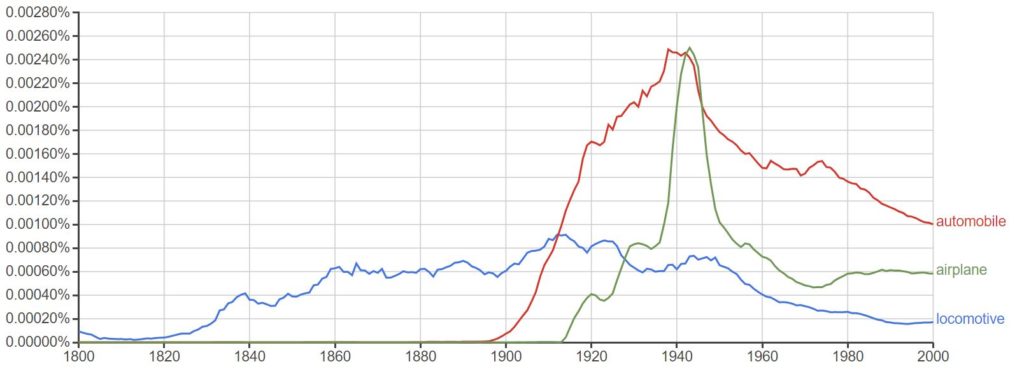
Below is a graph I created for three words: locomotive, automobile and airplane. (Link to graph.) If each word is assumed to represent a technology, the graph makes it clear when authors started to write about the technologies (left is earliest) and how frequently it was used (taller is more prevalent). As a technology, locomotives came first, as they were mentioned in books as early as 1800. Next came the automobile which hit the books just before 1900. And then came the airplane which first showed itself in about 1915.

Google Ngram graph 1

In the 1820s the locomotives were infants. They were slow, inefficient and unreliable. But over time they matured and replaced the Pony Express. In the late 1890s the automobiles were also infants and also slow, inefficient and unreliable. But as they matured, they displaced some of the locomotives. And the airplanes of 1915 were unsafe and barely flight-worthy. But over time they matured and displaced the automobiles for the longest trips.

[Side note – the blip in use of the word in 1940s is probably linked to World War II.]

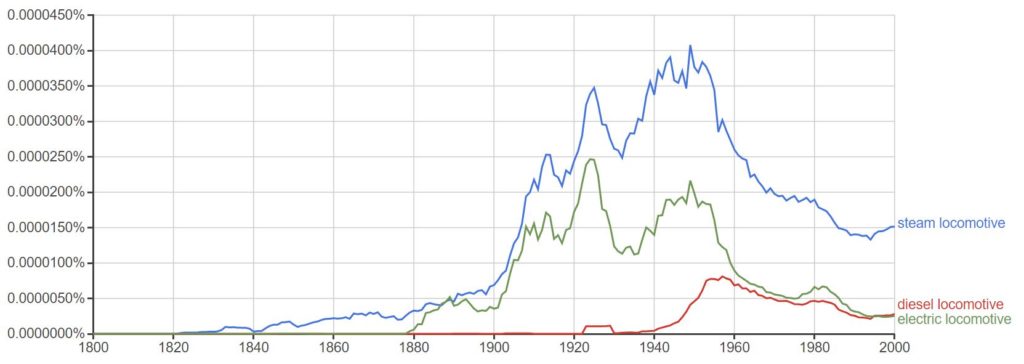
But for the locomotive, there’s a story with a story. Below is a graph I created for: steam locomotive, diesel locomotive and electric locomotive. After it matured in the 1840s and became faster and more efficient, the steam locomotive displaced the wagon trains. But, as technology likes to do, the electric locomotive matured several decades after it’s birth in 1880 and displaced it’s technological parent the steam locomotive. There was no smoke with the electric locomotive (city applications) and it did not need to stop to replenish it’s coal and water. And then, because turn-about is fair play, the diesel locomotive displaced some of the electric locomotives.

Google Ngram graph 2

The Ngram Viewer tool isn’t used for technology development because books are published long after the initial technology development is completed and there is no data after 20o7. But, it provides a good example of how new technologies emerge in society and how they grow and displace each other.

To assess the maturity of the youngest technologies, technologists perform similar time-based analyses but on different data sets. Specialized tools are used to make similar graphs for patents, where infant technologies become public when they’re disclosed in the form of patents. Also, special tools are used to analyze the prevalence of keywords (i.e., locomotives) for scientific publications. The analysis is similar to the Ngram Viewer analysis, but the scientific publications describe the new technologies much sooner after their birth.

To know the maturity of the technology is to know when a technology has legs and when it’s time to invent it’s replacement. There’s nothing worse than trying to improve a mature technology like the diesel locomotive when you should be inventing the next generation Maglev train.

Image credit: Wikimedia Commons, Google Ngram

Subscribe to Human-Centered Change & Innovation WeeklySign up here to join 17,000+ leaders getting Human-Centered Change & Innovation Weekly delivered to their inbox every week.

Neuroadaptive Interfaces

LAST UPDATED: February 22, 2026 at 5:28 PM

Neuroadaptive Interfaces

GUEST POST from Art Inteligencia


I. Introduction: From Interaction to Integration

We are standing at the threshold of the most significant shift in human history: the transition from tools we operate to systems we inhabit.

The End of the Mouse and Keyboard

For decades, the primary bottleneck for human intelligence has been the physical interface. Our thoughts move at the speed of light, yet we are forced to translate them through the “clunky” mechanical latency of typing on a keyboard or clicking a mouse. In 2026, these methods are increasingly viewed as legacy constraints. Neuroadaptive Interfaces (NI) bypass these barriers, allowing for a seamless flow of intent from the mind to the digital canvas.

Defining Neuroadaptivity

Traditional software is reactive — it waits for a command. Neuroadaptive systems are proactive and bidirectional. By monitoring neural oscillations and physiological markers, these interfaces adapt their behavior in real-time. If the system detects you are entering a state of “flow,” it silences distractions; if it detects “cognitive overload,” it simplifies the data density of your environment. It is a system that finally understands the user’s internal context.

The Human-Centered Mandate

As we bridge the gap between biology and silicon, our guiding principle must remain Augmentation, not Replacement. The goal of NI is to amplify the unique creative and empathetic capacities of the human spirit, using machine precision to handle the “cognitive grunt work.” We aren’t building a Borg; we are building a more capable, more focused version of ourselves.

The Braden Kelley Insight: Innovation is the act of removing friction from the human experience. Neuroadaptivity is the ultimate “friction-remover,” turning the boundary between the “self” and the “tool” into a transparent lens.

II. The Mechanics of Symbiosis: How NI Works

Neuroadaptivity isn’t magic; it is the sophisticated orchestration of bio-signal processing and generative UI.

1. The Feedback Loop: Sensing the Invisible

At the core of a neuroadaptive interface is a high-speed feedback loop. Using non-invasive sensors like EEG (electroencephalography) for electrical activity and fNIRS (functional near-infrared spectroscopy) for blood oxygenation, the system monitors “proxy” signals of your mental state. These are translated into a Cognitive Load Index, telling the machine exactly how much “mental bandwidth” you have left.

2. The Flow State Engine

The “killer app” of NI is the ability to protect and prolong the Flow State. When the sensors detect the distinct neural patterns of deep concentration, the interface enters “Deep Work” mode — suppressing notifications, simplifying color palettes, and even adjusting the latency of input to match your cognitive tempo. Conversely, if it detects the theta waves of boredom or the erratic signals of fatigue, it provides “Scaffolding” — contextual hints or automated sub-task completion to keep you on track.

3. Privacy by Design: The Neuro-Ethics Layer

In 2026, the most critical “feature” of any NI system is its Privacy Layer. This is the technical implementation of “Neuro-Ethics.” To maintain stakeholder trust, raw neural data must be processed at the edge (on the device), ensuring that “thought-level” data never hits the cloud. We are moving toward a standard of “Neural Sovereignty,” where the user owns their cognitive signals as a basic human right.

The Braden Kelley Insight: Symbiosis requires transparency. For a human to trust a machine with their neural state, the machine must be predictable, ethical, and entirely under the user’s control. We aren’t building mind-readers; we are building intent-amplifiers.

III. Case Studies: Neuroadaptivity in the Real World

The true value of neuroadaptive interfaces is best seen where human stakes are highest. These real-world applications demonstrate how NI transforms passive tools into intelligent, empathetic partners.

Case Study 1: Precision High-Acuity Healthcare

In complex cardiovascular and neurosurgical procedures, the surgeon’s cognitive load is immense. Traditional monitors provide patient data, but they ignore the surgeon’s mental state. Modern Neuroadaptive Surgical Suites integrate non-invasive EEG sensors into the surgeon’s headgear.

  • The Trigger: If the system detects a spike in cognitive stress or “decision fatigue” signals during a critical grafting phase, it automatically filters the Heads-Up Display (HUD).
  • The Adaptation: Non-essential alerts are silenced, and the most critical patient vitals are enlarged and centered in the visual field to prevent inattentional blindness.
  • The Outcome: A 25% reduction in intraoperative “micro-errors” and significant improvement in surgical team coordination through shared “mental state” awareness.

Case Study 2: Neuroadaptive Learning Ecosystems (EdTech)

The “one-size-fits-all” model of education is being replaced by Agentic AI tutors that use neurofeedback. Platforms like NeuroChat are now being piloted in corporate upskilling and university STEM programs to solve the “frustration wall” problem.

  • The Trigger: The system monitors EEG signals for “engagement” and “comprehension” correlates. If it detects a user is repeatedly attempting a formula with high theta-wave activity (signaling frustration or zoning out), it intervenes.
  • The Adaptation: Instead of offering the same theoretical text, the AI pivots to a practical, gamified simulation or a case study aligned with the user’s specific disciplinary interests.
  • The Outcome: Pilot programs have shown a 40% increase in course completion rates and a 30% faster time-to-mastery for complex technical skills.
The Braden Kelley Insight: These case studies prove that NI is not about “mind control” — it’s about Contextual Harmony. When the machine understands the human’s internal struggle, it can finally provide the right support at the right time.

IV. The Market Landscape: Leading Companies and Disruptors

The Neuroadaptive Interface market has matured into a multi-tiered ecosystem, ranging from medical-grade implants to “lifestyle” neural wearables.

1. The Titans: Infrastructure and Mass Adoption

The major players are leveraging their existing hardware ecosystems to turn neural sensing into a standard feature rather than a peripheral.

  • Neuralink: While famous for their invasive BCI (Brain-Computer Interface), their 2026 focus has shifted toward high-bandwidth recovery for clinical use and refining the “Telepathy” interface for the general market.
  • Meta Reality Labs: By integrating electromyography (EMG) into wrist-based wearables, Meta has effectively turned the nervous system into a “controller,” allowing users to navigate AR/VR environments with intent-based micro-gestures.

2. The Specialized Innovators: Niche Dominance

These companies focus on the “Neuro-Insight” layer—translating raw brainwaves into actionable data for specific industries.

  • Neurable: The leader in consumer-ready “Smart Headphones.” Their technology tracks cognitive load and focus levels, automatically triggering “Do Not Disturb” modes across a user’s entire digital ecosystem.
  • Kernel: Focusing on “Neuroscience-as-a-Service” (NaaS), Kernel provides high-fidelity brain imaging (Flow) for R&D departments, helping brands measure real-world emotional and cognitive responses to products.

3. Startups to Watch: The Next Wave

The edge of innovation is currently moving toward “Silent Speech” and Passive BCI.

Company Core Innovation
Zander Labs Passive BCI that adapts software to user intent without conscious command.
Cognixion Assisted reality glasses that use neural signals to give a “voice” to those with speech impairments.
OpenBCI Building the “Galea” platform — the first open-source hardware integrating EEG, EMG, and EOG sensors.
The Braden Kelley Insight: The market is splitting between invasive clinical and non-invasive lifestyle. For most leaders, the non-invasive “wearable neural” space is where the immediate opportunities for workforce augmentation lie.

V. Operationalizing Neural Insight: The Leader’s Toolkit

Adopting Neuroadaptive Interfaces is not a mere hardware upgrade; it is a fundamental shift in management philosophy. Leaders must transition from managing “time on task” to managing “cognitive energy.”

1. Managing the Augmented Workforce

In an NI-enabled workplace, productivity metrics must evolve. Instead of measuring keystrokes or hours logged, leaders will use anonymized “Flow Metrics.” By understanding when a team is at peak cognitive capacity, managers can schedule high-stakes brainstorming for high-energy windows and administrative tasks for periods of detected cognitive fatigue.

2. The Neuro-Inclusion Index

One of the greatest human-centered opportunities of NI is Neuro-Inclusion. These interfaces can be customized to support different cognitive styles — such as ADHD, dyslexia, or autism — by adapting the UI to the user’s specific neural “signature.” We must measure our success by how well these tools level the playing field for neurodivergent talent.

3. From Prompting to Intent Calibration

The skill of the 2020s was “Prompt Engineering.” In 2026, the skill is Intent Calibration. This involves training both the user and the machine to recognize subtle neural cues. Leaders must help their teams develop “Neuro-Awareness” — the ability to recognize their own mental states so they can better collaborate with their adaptive systems.

The Braden Kelley Insight: Operationalizing NI is about respecting the human brain as the ultimate source of value. If we use this technology to squeeze more “output” at the cost of mental health, we have failed. If we use it to protect the brain’s “prime time” for creativity, we have won.

VI. Conclusion: The Wisdom of the Edge

Neuroadaptive Interfaces represent more than just a breakthrough in hardware; they signify the maturation of human-centered design. By collapsing the distance between a thought and its digital execution, we are finally moving past the era where the human had to learn the language of the machine. Now, the machine is learning the language of the human.

The Symbiotic Future

The organizations that thrive in the coming decade will be those that embrace this symbiosis. These interfaces are the ultimate “Lens” for innovation — bringing human intent into perfect focus while filtering out the noise of our increasingly complex digital lives. When we align machine intelligence with the organic rhythms of the human brain, we don’t just work faster; we work with more purpose, clarity, and well-being.

As leaders, our task is to ensure this technology remains a tool for empowerment. We must guard the privacy of the mind with the same vigor that we pursue its augmentation. The goal is a future where technology feels less like an external intrusion and more like a natural extension of our own creative spirit.

The Final Word: Intent is the New Interface

Innovation has always been about extending the reach of the human spirit. Neuroadaptivity is simply the next step in making that reach infinite.

— Braden Kelley

Neuroadaptive Interfaces FAQ

1. What is a Neuroadaptive Interface (NI)?

Think of it as a tool that listens to your brain. It uses sensors to detect your mental state — like how hard you’re concentrating or how stressed you are — and changes its display or functions to help you perform better without you having to click a single button.

2. How do Neuroadaptive Interfaces protect user privacy?

In the era of “Neural Sovereignty,” these devices use edge computing. Your raw brainwaves never leave the device. The system only shares the “result” — like a request to silence notifications — ensuring your actual thoughts stay entirely within your own head.

3. What is the primary benefit of neuroadaptivity in the workplace?

It’s about Human-Centered Augmentation. By detecting “cognitive load,” the technology helps prevent burnout. It acts as a digital shield, protecting your peak focus hours (Flow State) and providing extra support when your brain starts to feel the fatigue of a long day.

Disclaimer: This article speculates on the potential future applications of cutting-edge scientific research. While based on current scientific understanding, the practical realization of these concepts may vary in timeline and feasibility and are subject to ongoing research and development.

Image credits: Google Gemini

Subscribe to Human-Centered Change & Innovation WeeklySign up here to get Human-Centered Change & Innovation Weekly delivered to your inbox every week.
The End of Static Reality

Leading the Shift to Programmable Matter

LAST UPDATED: February 19, 2026 at 6:48 PM

The End of Static Reality - Programmable Matter

GUEST POST from Art Inteligencia


I. Introduction: The Death of the “Finished” Product

“We are moving from an era of designing objects to an era of designing behaviors.” — Braden Kelley

Beyond the Static Boundary

For centuries, the fundamental constraint of innovation has been the static nature of matter. Once a piece of steel was forged or a plastic mold was set, its physical properties—its stiffness, shape, and conductivity—were locked in time. In 2026, that boundary is evaporating. We are entering the age of Digital-Physical Hybrids, where the physical world is becoming as iterative and agile as the software that controls it.

Defining Programmable Matter

At its core, programmable matter refers to materials or assemblies of components that can change their physical properties based on software instructions or external stimuli. Imagine a world where a car’s body panels adjust their shape for optimal aerodynamics in real-time, or a medical implant that remains soft for insertion but “programs” itself to become rigid once it reaches its destination.

The Braden Kelley Perspective: Pulling the Physical Lever

As I often say, “Innovation is the art of pulling the right lever.” In the context of programmable matter, the “lever” is no longer a mechanical switch; it is a software command. This technology collapses the distance between digital intent and physical experience. When matter becomes programmable, the “product” is never truly finished—it is in a state of perpetual adaptation, designed to meet the changing needs of the human beings who use it.

II. The Three Pillars of Adaptive Materiality

To program the physical world, we must manipulate three fundamental characteristics. In 2026, these are the levers that turn “dumb” objects into intelligent systems.

1. Morphology: Shape-Shifting for Performance

Morphology is no longer a fixed design choice; it is a real-time response. Through the use of shape-memory alloys and 4D-printed polymers, materials can now alter their geometry to optimize for the environment. Whether it’s a drone wing that warps its shape to navigate high winds or footwear that adjusts its arch support based on your gait, morphology is the first pillar of physical agility.

2. Variable Stiffness: The Soft-to-Rigid Spectrum

One of the most profound breakthroughs is the ability to toggle a material’s structural integrity. By using phase-change materials—which can switch between liquid and solid states via thermal or electrical triggers—we can create objects that are flexible when they need to be safe (soft robotics) and rigid when they need to bear weight (emergency infrastructure).

3. Conductive Logic: Reconfigurable Intelligence

The final pillar is the ability to program the “nervous system” of an object. Conductive logic involves materials with internal pathways that can be rerouted on the fly. This allows a single component to switch its function—for instance, a car door panel that reconfigures its internal circuitry from a speaker to a heating element based on occupant preference.

The Braden Kelley Insight: Mastery of these three pillars allows organizations to move away from “mass production” toward “mass adaptation.” We aren’t just making things better; we are making them smarter at the molecular level.

III. Case Study 1: Adaptive Architecture and Urban Resilience

The buildings of the 20th century were cages of steel and glass. In 2026, programmable matter is turning the “built environment” into a living, breathing skin.

The Challenge: The Energy of Stasis

Buildings are responsible for nearly 40% of global energy-related carbon emissions, much of which is wasted fighting the environment—heating against the cold or cooling against the sun. Traditional “smart” buildings rely on mechanical motors and sensors that are prone to failure and require massive power draws to operate.

The Innovation: Biomimetic Material Intelligence

Leading architecture firms are now collaborating with material scientists to deploy hygroscopic and thermomorphic materials. These “programmed” building skins react directly to moisture and heat without a single mechanical motor. Like a pinecone opening when dry to release seeds, a building facade can now “unfurl” to provide shade during peak solar hours and “tighten” to trap heat when the temperature drops.

The Human Shift: Buildings that Empathize

This isn’t just about efficiency; it’s about the human experience. Imagine a workspace where the ceiling lowers its density to improve acoustics as a room fills up, or windows that change their molecular structure to diffuse glare while maintaining a view. Through programmable matter, our architecture stops being a static obstacle and starts being a collaborator in our daily lives.

Braden Kelley’s Reflection: We’ve spent a century trying to control the environment with brute force. Programmable matter allows us to dance with it instead. This is the ultimate expression of Sustainable Innovation—doing more by building something that knows how to adapt.

IV. Case Study 2: Soft Robotics in Minimally Invasive Medicine

The human body is fluid and delicate, yet our medical tools have historically been rigid and intrusive. Programmable matter is changing the geometry of healing.

The Challenge: The Rigidity of Current Surgery

In traditional minimally invasive surgery, surgeons use catheters and endoscopes that possess a fixed stiffness. This creates a “navigation tax”—the risk of damaging delicate vascular walls or organs while trying to reach a deep-seated tumor or blockage. The tool must be stiff enough to push, but soft enough not to pierce.

The Innovation: Phase-Changing Surgical “Tentacles”

In 2026, we are seeing the rise of Programmable Soft Robots. These devices utilize low-melting-point alloys (LMPA) embedded within a silicone matrix. By applying a tiny electrical current, the surgeon can “program” specific segments of the tool to become liquid-soft for navigating tight corners, and then instantly “freeze” them into a rigid state to provide the leverage needed for a biopsy or a stent placement.

The Human Shift: Personalized Internal Navigation

This allows for truly personalized medicine. Because the tool adapts to the patient’s unique anatomy in real-time, the “one-size-fits-all” approach to surgical instruments is dead. We are reducing patient trauma, shortening recovery times, and enabling procedures that were previously considered “inoperable” due to anatomical complexity.

A Braden Kelley Note: This is the ultimate example of Human-Centered Change. We are no longer forcing the human body to adapt to our technology; we are programming our technology to empathize with the human body.

V. The Ecosystem: Leaders and Disruptors in 2026

The transition from static to programmable matter requires a new stack of technology—spanning simulation, generative design, and advanced fabrication. These are the players building that stack.

The Giants: Providing the Infrastructure

  • Autodesk: Their Generative Design tools have evolved into “Behavioral Design” platforms. Designers no longer just draw shapes; they define the intent of the material, and Autodesk’s AI calculates the necessary molecular lattice.
  • Nvidia: Programmable matter is notoriously difficult to predict. Nvidia’s Omniverse provides the high-fidelity physics simulations required to “digital twin” a material’s behavior before a single atom is printed.

The Disruptors: Redefining Fabrication

Company Core Innovation Target Industry
Carbon Dual-Cure Resins with variable elasticity Performance Footwear & Automotive
Voxel8 Integrated conductive circuitry in 3D structures Consumer Electronics & Wearables
Aimi (Emerging) Active textiles that change porosity/warmth Defense & Extreme Sports
Strategic Takeaway: You don’t need to be a material scientist to play in this space. You need to be a collaborator. The winning organizations in 2026 are those that partner across the stack—linking software intent to material reality.

VI. The Strategic Impact: Collapsing the Final Frontier

The strategic value of programmable matter goes far beyond the “wow factor” of a shape-shifting gadget. It represents a fundamental shift in Resource Efficiency. When a single object can be “re-programmed” to serve three different functions throughout its lifecycle, we drastically reduce the need for raw material extraction and landfill waste. This is the ultimate tool for a circular economy.

VII. Conclusion: Programming the Future Today

We are moving from a world of “things” to a world of “behaviors.” In this new era, your competitive advantage won’t just be what you make, but how well your creations can learn and adapt to the human beings they serve.

As you look at your product roadmap for the next five years, stop asking what features you should add. Start asking: “If our product could change its physical soul to better serve our customer tomorrow, what would we tell it to do today?”

“The future is not something that happens to us; it is something we program.”
— Braden Kelley

Transform Your Organization’s Future

Ready to turn uncertainty into a resource? Let’s discuss how these emerging technologies can redefine your industry.

Programmable Matter FAQ

1. How is programmable matter different from traditional 3D printing?

Traditional 3D printing creates static objects with fixed properties. Programmable matter, often referred to as 4D printing, introduces a time and behavior dimension. It uses smart materials that can change their shape, density, or conductivity after the manufacturing process is complete.

2. What are the primary benefits of adaptive materials in industry?

The primary benefits include resource efficiency and personalized performance. By allowing a single material to adapt to its environment (such as a building facade that opens and closes without motors), companies can reduce carbon footprints and create products that evolve with user needs.

3. Is programmable matter ready for commercial use in 2026?

Yes, it is currently in the “Scale-Up” phase. It is already being deployed in high-stakes sectors like aerospace for adaptive surfaces, medical devices for shape-shifting surgical tools, and high-performance athletics for responsive textiles.

Disclaimer: This article speculates on the potential future applications of cutting-edge scientific research. While based on current scientific understanding, the practical realization of these concepts may vary in timeline and feasibility and are subject to ongoing research and development.

Image credits: Google Gemini

Subscribe to Human-Centered Change & Innovation WeeklySign up here to get Human-Centered Change & Innovation Weekly delivered to your inbox every week.
What is the right time horizon for technology development?

What is the right time horizon for technology development?

GUEST POST from Mike Shipulski

Patents are the currency of technology and profits are the currency of business. And as it turns out, if you focus on creating technology you’ll get technology (and patents) and if you focus on profits you’ll get profits. But if no one buys your technology (in the form of the products or services that use it), you’ll go out of business. And if you focus exclusively on profits you won’t create technology and you’ll go out of business. I’m not sure which path is faster or more dangerous, but I don’t think it matters because either way you’re out of business.

It’s easy to measure the number of patents and easier to measure profits. But there’s a problem. Not all patents (technologies) are equal and not all profits are equal. You can have a stockpile of low-level patents that make small improvements to existing products/services and you can have a stockpile of profits generated by short-term business practices, both of which are far less valuable than they appear. If you measure the number of patents without evaluating the level of inventiveness, you’re running your business without a true understanding of how things really are. And if you’re looking at the pile of profits without evaluating the long-term viability of the engine that created them you’re likely living beyond your means.

In both cases, it’s important to be aware of your time horizon. You can create incremental technologies that create short term wins and consume all your resource so you can’t work on the longer-term technologies that reinvent your industry. And you can implement business practices that eliminate costs and squeeze customers for next-quarter sales at the expense of building trust-based engines of growth. It’s all about opportunity cost.

It’s easy to develop technologies and implement business processes for the short term. And it’s equally easy to invest in the long term at the expense of today’s bottom line and payroll. The trick is to balance short against long.

And for patents, to achieve the right balance rate your patents on the level of inventiveness.

Image credit: 1 of 1,050+ FREE quotes for your meetings & presentations at http://misterinnovation.com

Subscribe to Human-Centered Change & Innovation WeeklySign up here to join 17,000+ leaders getting Human-Centered Change & Innovation Weekly delivered to their inbox every week.

Digital Phenotyping and the Future of Preventative Experience Design

The Silent Pulse

LAST UPDATED: February 16, 2026 at 6:01 PM

Digital Phenotyping and the Future of Preventative Experience Design

GUEST POST from Art Inteligencia


I. Introduction: Beyond the Survey

The Death of “Self-Reporting”

For decades, the gold standard for understanding employee well-being or customer satisfaction has been the survey. We ask people how they feel, and they give us an answer filtered through their own biases, current mood, or what they think we want to hear. In the world of innovation, self-reporting is a lagging indicator — and a flawed one at that.

Defining Digital Phenotyping

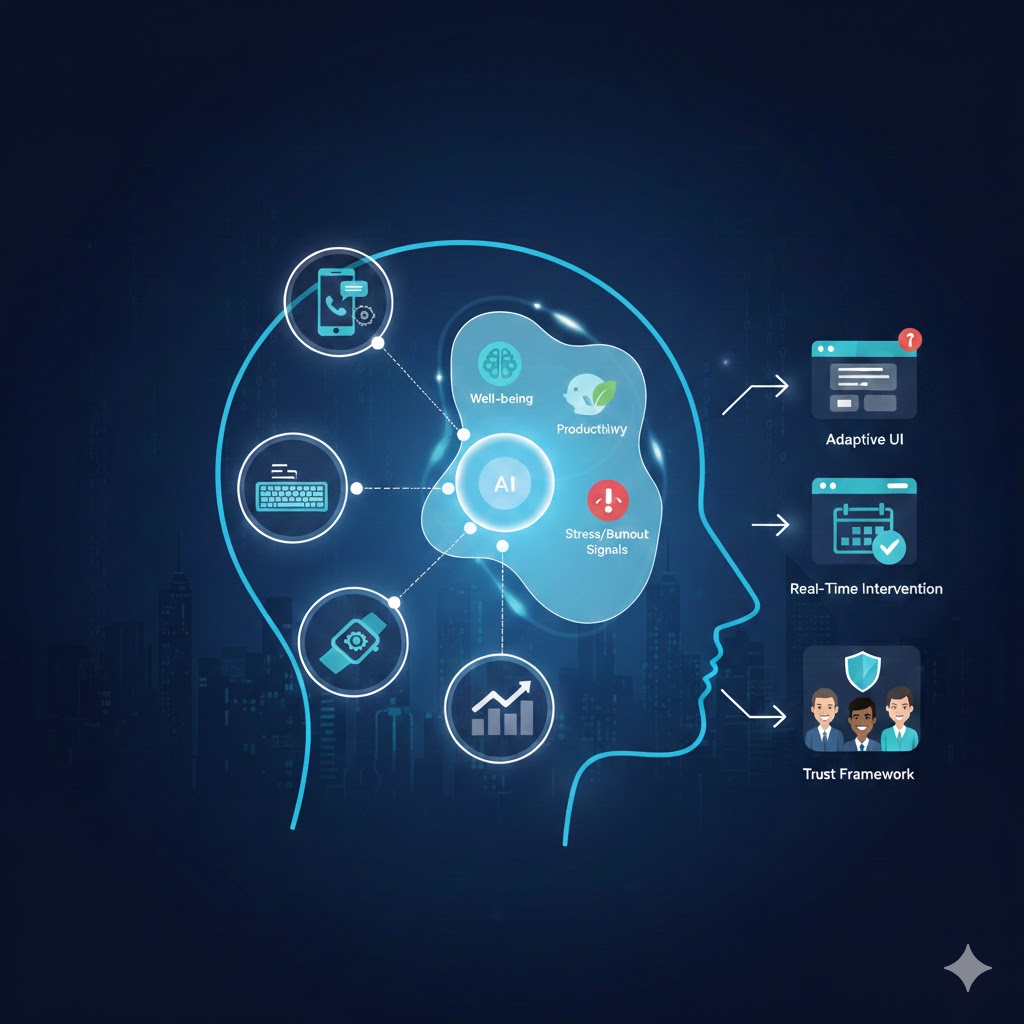
We are entering the era of Digital Phenotyping: the moment-by-moment quantification of the individual-level human phenotype in situ using data from personal digital devices. By analyzing the “digital exhaust” from smartphones and wearables — mobility patterns, social interactions, and even typing rhythm — we can infer behavioral, emotional, and cognitive states with unprecedented accuracy.

The Paradigm Shift: From Reactive to Preventative

The true power of this technology lies in its ability to turn experience design from a reactive fix into a preventative strategy. We no longer have to wait for a “burnout crisis” or a drop in productivity to realize our team is under excessive stress. The signals are there, in real-time, hidden in the cadence of our digital lives.

“Innovation is about solving the problems that people haven’t yet found the words to describe. Digital Phenotyping gives us the ears to hear those unspoken needs.”
— Braden Kelley

As we move beyond the survey, we must lead with a human-centered lens. The goal isn’t to monitor; it’s to support. We are shifting from a world that reacts to failure to a world that senses — and sustains — human flourishing.

II. The Mechanics of Passive Sensing

Digital phenotyping relies on passive data — information collected in the background without requiring any active input from the user. This removes the “friction” of participation and provides a continuous stream of objective reality.

The Three Primary Data Streams

1. Mobility and Physical Activity

Using GPS and accelerometers, we can map “life space.” A sudden constriction in a person’s physical movement — fewer locations visited or reduced steps — can be a powerful proxy for depressive states or social withdrawal. Conversely, erratic movement patterns might signal high levels of anxiety or agitation.

2. Social and Communication Meta-data

This isn’t about what is being said, but how the person is interacting. Call frequency, text latency, and social media engagement patterns reveal shifts in social connectivity. A drop in outbound communication often precedes a burnout phase before the employee even feels “tired.”

3. Human-Computer Interaction (HCI)

The way we interact with our screens is a window into our cognitive health. Typing speed, the frequency of “backspacing,” and scrolling patterns can indicate cognitive overload or a lapse in focus. These “digital biomarkers” are the most immediate indicators of whether a task is designed for human success or human failure.

The Synthesis: From Signals to Insights

The magic happens in the AI synthesis layer. By correlating these streams, machine learning models can identify a “baseline” for an individual. When the data deviates from that baseline, the system identifies a “glitch” — a moment where the human-centered design of the environment is no longer supporting the human within it.

“Data is just a signal; insight is the story. In digital phenotyping, we are learning to read the stories written in the rhythm of our daily digital interactions.”
— Braden Kelley

III. Value Creation: Turning Insight into Action

The true ROI of digital phenotyping isn’t found in the data itself, but in the Experience Design it enables. By moving from reactive to preventative models, we can create environments that adapt to the human state in real-time.

Preventative Experience Design in Practice

Real-Time Burnout Mitigation

Imagine a project management tool that senses cognitive overload through typing patterns and erratic screen switching. Instead of pushing another notification, the system “softens” — delaying non-essential alerts and suggesting a recovery break. This is human-centered design in action: protecting the asset (the person) before the damage occurs.

Adaptive User Interfaces (AUI)

In high-stakes environments like healthcare or emergency response, digital phenotyping allows interfaces to simplify themselves when stress markers are detected. By reducing the “information density” during moments of high stress, we prevent human error and improve outcomes.

The Strategic Advantage of “Wellness as a Service”

Organizations that implement these tools as a benefit rather than a monitor will see a massive shift in retention and engagement. When an employee knows the “system” is looking out for their mental health — flagging potential depression signals or isolation patterns early — the relationship between employer and employee evolves from transactional to collaborative.

“Value in the future of work won’t be measured by output alone, but by the sustainability of the human spirit behind that output.”
— Braden Kelley

By leveraging these insights, we aren’t just innovating products; we are innovating the way we treat people.

IV. The Innovation Ethical Frontier

Digital phenotyping sits at the intersection of extreme utility and extreme vulnerability. As innovators, we must acknowledge that data is a surrogate for intimacy. When we measure a person’s gait or typing rhythm, we are entering their private mental space. Without a robust ethical framework, we risk building a “Digital Panopticon” rather than a supportive ecosystem.

The Three Pillars of Ethical Phenotyping

1. Radical Transparency & Consent

Standard “Terms and Conditions” are insufficient. Consent must be active and ongoing. Users should know exactly what biomarkers are being tracked and have the “Right to Disconnect” without penalty. Transparency isn’t just a legal hurdle; it’s a trust-building feature.

2. Purpose-Driven Data Minimization

The temptation to “collect it all” is the enemy of ethics. We must practice data minimalism: collecting only the specific signals required to provide the promised human-centered value. If a signal doesn’t directly contribute to a preventative intervention, it shouldn’t be gathered.

3. The “Benefit Flow” Guarantee

The value derived from the data must flow primarily back to the individual. If the organization is the only one benefiting (through higher productivity), it’s surveillance. If the individual benefits (through better mental health and reduced stress), it’s empowerment.

Leading with Empathy-Led Ethics

We must move beyond “compliance-based” privacy. In a human-centered organization, we ask: “Would our employees feel cared for or watched if they knew how this worked?” If the answer is “watched,” the innovation is flawed at the architectural level.

“Trust is the only currency that matters in the future of innovation. Once you spend it on surveillance, you can never buy it back.”
— Braden Kelley

By establishing these guardrails early, we ensure that digital phenotyping remains a tool for human flourishing rather than a weapon for corporate control.

V. Leading the Human-Centered Change

Implementing digital phenotyping is not a technical deployment; it is a cultural transformation. If leaders treat this like a software update, they will face immediate resistance. To succeed, we must lead with transparency and a clear focus on the “human” in human-centered innovation.

The Role of the “Architect” in Rollout

Leaders must act as the architects of trust. This means the Chief Innovation Officer and the CHRO must work in lockstep to ensure that the purpose of the data is clearly defined and that those definitions are unshakeable.

Strategies for Successful Integration:

  • The “Opt-In” Mandate: Never make passive sensing mandatory. The power of these tools comes from voluntary participation. When people choose to participate, they become stakeholders in their own well-being.
  • Stakeholder Education: We must educate every level of the organization — especially our “Sensors” (the employees) — on what digital biomarkers are and how they are used to trigger supportive interventions.
  • Feedback Loops: Create a mechanism where employees can provide feedback on the interventions. If a system suggests a “burnout break,” was it helpful or annoying? The human must remain the final authority.

Transparency as a Competitive Feature

In the future, the most successful organizations will be those that are radically transparent about their data practices. By being open about the algorithms and the “why” behind the sensing, we remove the mystery and the fear. Transparency turns a “black box” into a “glass box.”

“Change happens at the speed of trust. If you want to innovate at the edge of human behavior, you must first build a foundation of absolute integrity.”
— Braden Kelley

By focusing on the human-centered change, we ensure that digital phenotyping isn’t something done to people, but something done for them.

VI. Conclusion: Designing a More Intuitive World

The transition from reactive to preventative design represents one of the most significant leaps in the history of Human-Centered Innovation. Digital phenotyping allows us to stop guessing and start knowing — not for the sake of control, but for the sake of care.

The Future is Empathetic

We are moving toward a world where our tools understand our limits as well as we do. Imagine a workplace that recognizes your stress before you have a headache, or a digital assistant that knows you’re cognitively overloaded and helps you prioritize. This is the Intuitive World we are designing.

A Leader’s Final Responsibility

As innovators and leaders, our responsibility is to ensure that as our machines become more “human-literate,” we do not become less human in our leadership. Digital phenotyping is a tool of immense power. Used correctly, it can eradicate burnout, foster deep engagement, and support mental health on a global scale.

“The most advanced technology is the one that makes us feel most human. Our job is to ensure digital phenotyping does exactly that.”
— Braden Kelley

The signals are all around us, pulsing through the devices in our pockets and on our wrists. The question is no longer whether we can hear them, but whether we have the innovation leadership and ethical courage to act on what they are telling us.

Deep Dive: Frequently Asked Questions

Does Digital Phenotyping mean my boss is reading my texts?

Absolutely not. Ethical digital phenotyping focuses on metadata and patterns, not content. It looks at the frequency of communication or the speed of your typing, not the words you say. As an innovation leader, I advocate for systems where the content remains private and encrypted.

Why is this better than a monthly wellness survey?

Surveys are “lagging indicators” — they tell us how you felt in the past. By the time a survey is analyzed, burnout has often already occurred. Digital phenotyping provides real-time signals, allowing for immediate, helpful interventions that can prevent a crisis before it starts.

Can I opt-out of this kind of data collection?

In any human-centered organization, the answer must be yes. Trust is the foundation of innovation. For digital phenotyping to work, it must be an opt-in benefit that employees use because they see the value in their own well-being and professional growth.

Disclaimer: This article speculates on the potential future applications of cutting-edge scientific research. While based on current scientific understanding, the practical realization of these concepts may vary in timeline and feasibility and are subject to ongoing research and development.

Image credits: Google Gemini

Subscribe to Human-Centered Change & Innovation WeeklySign up here to get Human-Centered Change & Innovation Weekly delivered to your inbox every week.

Causal AI

Moving Beyond Prediction to Purpose

LAST UPDATED: February 13, 2026 at 5:13 PM

Causal AI

GUEST POST from Art Inteligencia

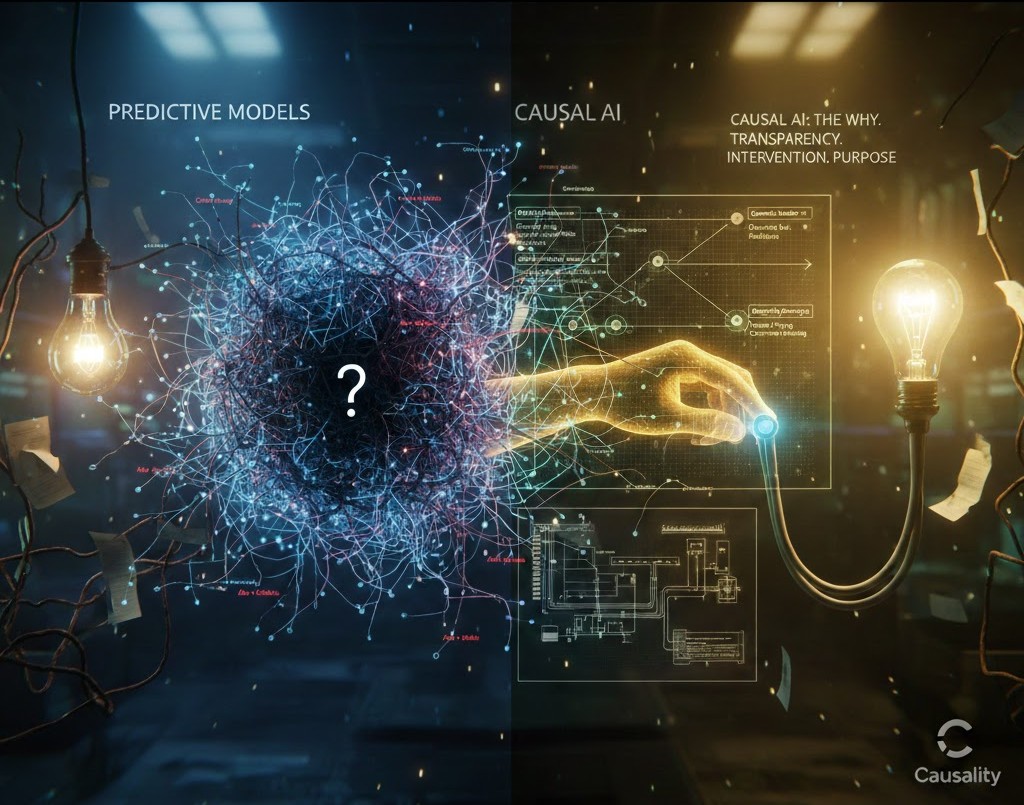
For the last decade, the business world has been obsessed with predictive models. We have spent billions trying to answer the question, “What will happen next?” While these tools have helped us optimize supply chains, they often fail when the world changes. Why? Because prediction is based on correlation, and correlation is not causation. To truly innovate using Human-Centered Innovation™, we must move toward Causal AI.

Causal AI is the next frontier of FutureHacking™. Instead of merely identifying patterns, it seeks to understand the why. It maps the underlying “wiring” of a system to determine how changing one variable will influence another. This shift is vital because innovation isn’t about following a trend; it’s about making a deliberate intervention to create a better future.

“Data can tell you that two things are happening at once, but only Causal AI can tell you which one is the lever and which one is the result. Innovation is the art of pulling the right lever.”
— Braden Kelley

The End of the “Black Box” Strategy

One of the greatest barriers to institutional trust is the “Black Box” nature of traditional machine learning. Causal AI, by its very nature, is explainable. It provides a transparent map of cause and effect, allowing human leaders to maintain autonomy and act as the “gardener” tending to the seeds of technology.

Case Study 1: Personalized Medicine and Healthcare

A leading pharmaceutical institution recently moved beyond predictive patient modeling. By using Causal AI to simulate “What if” scenarios, they identified specific causal drivers for individual patients. This allowed for targeted interventions that actually changed outcomes rather than just predicting a decline. This is the difference between watching a storm and seeding the clouds.

Case Study 2: Retail Pricing and Elasticity

A global retail giant utilized Causal AI to solve why deep discounts led to long-term dips in brand loyalty. Causal models revealed that the discounts were causing a shift in quality perception in specific demographics. By understanding this link, the company pivoted to a human-centered value strategy that maintained price integrity while increasing engagement.

Leading the Causal Frontier

The landscape of Causal AI is rapidly maturing in 2026. causaLens remains a primary pioneer with their Causal AI operating system designed for enterprise decision intelligence. Microsoft Research continues to lead the open-source movement with its DoWhy and EconML libraries, which are now essential tools for data scientists globally. Meanwhile, startups like Geminos Software are revolutionizing industrial intelligence by blending causal reasoning with knowledge graphs to address the high failure rate of traditional models. Causaly is specifically transforming the life sciences sector by mapping over 500 million causal relationships in biomedical data to accelerate drug discovery.

“Causal AI doesn’t just predict the future — it teaches us how to change it.”
— Braden Kelley

From Correlation to Causation

Predictive models operate on correlations. They answer: “Given the patterns in historical data, what will likely happen next?” Causal models ask a deeper question: “If we change this variable, how will the outcome change?” This fundamental difference elevates causal AI from forecasting to strategic influence.

Causal AI leverages counterfactual reasoning — the ability to simulate alternative realities. It makes systems more explainable, robust to context shifts, and aligned with human intentions for impact.

Case Study 3: Healthcare — Reducing Hospital Readmissions

A large health system used predictive analytics to identify patients at high risk of readmission. While accurate, the system did not reveal which interventions would reduce that risk. Nurses and clinicians were left with uncertainty about how to act.

By implementing causal AI techniques, the health system could simulate different combinations of follow-up calls, personalized care plans, and care coordination efforts. The causal model showed which interventions would most reduce readmission likelihood. The organization then prioritized those interventions, achieving a measurable reduction in readmissions and better patient outcomes.

This example illustrates how causal AI moves health leaders from reactive alerts to proactive, evidence-based intervention planning.

Case Study 4: Public Policy — Effective Job Training Programs

A metropolitan region sought to improve employment outcomes through various workforce programs. Traditional analytics identified which neighborhoods had high unemployment, but offered little guidance on which programs would yield the best impact.

Causal AI empowered policymakers to model the effects of expanding job training, childcare support, transportation subsidies, and employer incentives. Rather than piloting each program with limited insight, the city prioritized interventions with the highest projected causal effect. Ultimately, unemployment declined more rapidly than in prior years.

This case demonstrates how causal reasoning can inform public decision-making, directing limited resources toward policies that truly move the needle.

Human-Centered Innovation and Causal AI

Causal AI complements human-centered innovation by prioritizing actionable insight over surface-level pattern recognition. It aligns analytics with stakeholder needs: transparency, explainability, and purpose-driven outcomes.

By embracing causal reasoning, leaders design systems that illuminate why problems occur and how to address them. Instead of deploying technology that automates decisions, causal AI enables decision-makers to retain judgment while accessing deeper insight. This synergy reinforces human agency and enhances trust in AI-driven processes.

Challenges and Ethical Guardrails

Despite its potential, causal AI has challenges. It requires domain expertise to define meaningful variables and valid causal structures. Data quality and context matter. Ethical considerations demand clarity about assumptions, transparency in limitations, and safeguards against misuse.

Causal AI is not a shortcut to certainty. It is a discipline grounded in rigorous reasoning. When applied thoughtfully, it empowers organizations to act with purpose rather than default to correlation-based intuition.

Conclusion: Lead with Causality

In a world of noise, Causal AI provides the signal. It respects human autonomy by providing the evidence needed for a human to make the final call. As you look to your next change management initiative, ask yourself: Are you just predicting the weather, or are you learning how to build a better shelter?

Strategic FAQ

How does Causal AI differ from traditional Machine Learning?

Traditional Machine Learning identifies correlations and patterns in historical data to predict future occurrences. Causal AI identifies the functional relationships between variables, allowing users to understand the impact of specific interventions.

Why is Causal AI better for human-centered innovation?

It provides explainability. Because it maps cause and effect, human leaders can see the logic behind a recommendation, ensuring technology remains a tool for human ingenuity.

Can Causal AI help with bureaucratic corrosion?

Yes. By exposing the “why” behind organizational outcomes, it helps leaders identify which processes (the wiring) are actually producing value and which ones are simply creating friction.

Disclaimer: This article speculates on the potential future applications of cutting-edge scientific research. While based on current scientific understanding, the practical realization of these concepts may vary in timeline and feasibility and are subject to ongoing research and development.

Image credits: Google Gemini

Subscribe to Human-Centered Change & Innovation WeeklySign up here to get Human-Centered Change & Innovation Weekly delivered to your inbox every week.

Why We Love to Hate Chatbots

Why We Love to Hate Chatbots

GUEST POST from Shep Hyken

More and more, brands are starting to get the chatbot “thing” right. AI is improving, and customers are realizing that a chatbot can be a great first stop for getting quick answers or resolving questions. After all, if you have a question, don’t you want it answered now?

In a recent interview, I was asked, “What do you love about chatbots?” That was easy. Then came the follow-up question, “What do you hate about chatbots?” Also easy. The truth is, chatbots can deliver amazing experiences. They can also cause just as much frustration as a very long phone hold. With that in mind, here are five reasons to love (and hate) chatbots:

Why We Love Chatbots

  1. 24/7 Availability: Chatbots are always on. They don’t sleep. Customers can get help at any time, even during holidays.
  2. Fast Response: Instant answers to simple questions, such as hours of operation, order status and basic troubleshooting, can be provided with efficiency and minimal friction.
  3. Customer Service at Scale: Once you set up a chatbot, it can handle many customers at once. Customers won’t have to wait, and human agents can focus on more complicated issues and problems.
  4. Multiple Language Capabilities: The latest chatbots are capable of speaking and typing in many different languages. Whether you need global support or just want to cater to different cultures in a local area, a chatbot has you covered.
  5. Consistent Answers: When programmed properly, a chatbot delivers the same answers every time.

Chatbots Shep Hyken Cartoon

Why We Hate Chatbots

  1. AI Can’t Do Everything, but Some Companies Think It Can: This is what frustrates customers the most. Some companies believe AI and chatbots can do it all. They can’t, and the result is frustrated customers who will eventually move on to the competition.
  2. A Lack of Empathy: AI can do a lot, but it can’t express true emotions. For some customers, care, empathy and understanding are more important than efficiency.
  3. Scripted Retorts Feel Robotic: Chatbots often follow strict guidelines. That’s actually a good thing, unless the answers provided feel overly scripted and generic.
  4. Hard to Get to a Human: One of the biggest complaints about chatbots is, “I just want to talk to a person.” Smart companies make it easy for customers to leave AI and connect to a human.
  5. There’s No Emotional Connection to a Chatbot: You’ll most likely never hear a customer say, “I love my chatbot.” A chatbot won’t win your heart. In customer service, sometimes how you make someone feel is more important than what you say.

Chatbots are powerful tools, but they are not a replacement for human connection. The best companies use AI to enhance support, not replace it. When chatbots handle the routine issues and agents handle the more complex and human moments, that’s when customer experience goes from efficient to … amazing.

Image credits: Unsplash

Subscribe to Human-Centered Change & Innovation WeeklySign up here to join 17,000+ leaders getting Human-Centered Change & Innovation Weekly delivered to their inbox every week.