Category Archives: Technology

Redefining Professional Identity in the Age of AI Orchestration

From Execution to Intent

Redefining Professional Identity in the Age of AI Orchestration

GUEST POST from Art Inteligencia


The Death of the “Doer”

For generations, professional identity has been forged in the fires of execution. We defined our value, our expertise, and our worth by how well, how fast, and how accurately we could perform specific tasks. We were software engineers who wrote clean code, marketers who drafted compelling copy, financial analysts who built complex models, and designers who meticulously laid out presentations. Success meant mastering the mechanics of a craft. The corporate ladder was built to reward the ultimate “doer”—the individual who could execute at scale.

The premium on raw execution is gone. If your value is entirely wrapped up in how you execute a task, you are competing on a playground that technology has already outgrown.

Today, advanced artificial intelligence has fundamentally commoditized the mechanics of execution. The barrier to generating functional code, synthesized research, or polished creative assets has dropped to near zero. Tasks that used to require a decade of specialized training and forty hours of intense focus can now be initiated in seconds. This isn’t just a minor shift in efficiency; it is an existential disruption to the traditional concept of a career.

As AI rapidly masters the how, human value must anchor itself immutably in the why and the what. To thrive in this new landscape, our professional identity must undergo a radical evolution—moving away from Execution (manually doing the work) and stepping boldly into Intent (orchestrating intelligent systems to achieve meaningful, human-centered outcomes).

The Architecture of AI Orchestration

To survive the decline of raw execution, we must understand the environment replacing it. This new landscape is not defined by simple prompt engineering—which remains a tactical, task-level interaction. Instead, we are entering the era of systemic orchestration. An orchestrator does not merely ask an AI for a quick answer; they design, deploy, and manage an interconnected ecosystem of AI agents, automated tools, and human collaborators to solve complex problems.

As deep, hyper-specialized technical execution skills begin to depreciate, an entirely different set of capabilities is skyrocketing in value. The modern professional must cultivate deep systems thinking, strategic foresight, and an unwavering commitment to human-centered design. We are moving away from being masters of a singular tool to becoming architects of comprehensive solutions.

The Three Pillars of Intent

True orchestration requires shifting our cognitive energy from the mechanics of creation to the governance of direction. This governance relies on three critical pillars:

  • Contextual Intelligence: AI excels at processing data within a closed loop, but it lacks the ability to sense organizational culture, political nuance, and the unspoken needs of a community. The human orchestrator brings the vital outside-in perspective, framing the problem so the technology addresses the right cultural and operational realities.
  • Value Alignment: Just because an AI system can generate a specific output or optimize a process does not mean it should. Orchestrators act as the ethical anchors, ensuring that automated actions, algorithmic decisions, and system outputs align perfectly with authentic human needs, organizational values, and broader societal ethics.
  • Critical Evaluation: AI-generated outputs often possess a surface-level perfection that masks underlying flaws, systemic biases, or a distinct lack of human soul. The orchestrator possesses the seasoned judgment required to interrogate the machine’s work, finding the gaps that logic alone cannot see and injecting the emotional resonance required to make it truly impactful.

Orchestration is not about yielding control to technology; it is about elevating human agency. By defining the intent, we ensure technology serves as an amplifier for meaningful progress rather than an automated generator of noise.

The Psychological Crisis of Identity

Transitioning from a doer to an orchestrator is not merely a technical challenge or a matter of upskilling; it is a profound psychological disruption. For decades, our educational institutions and corporate reward structures have conditioned us to tie our self-worth directly to our visible outputs. When an individual spent ten, fifteen, or twenty years mastering a highly specialized technical craft, that mastery became a foundational pillar of who they were.

The “Expertise” Trap

Today, professionals face immense existential friction as they watch a machine execute their deeply specialized skills in a matter of seconds. This creates the “Expertise Trap”—a state of paralysis where individuals cling tightly to their traditional execution tasks because abandoning them feels like abandoning their identity. The immediate, visceral reaction to this displacement is often anxiety, resistance, or a sense of devaluation. If a machine can write the code, draft the contract, or design the layout instantly, the professional is left asking: What am I actually here for?

The greatest hurdle in the AI transition is not teaching people how to use the technology. It is helping them mourn the loss of the identities they built around manual execution so they can step into their true value as strategic thinkers.

Redefining Self-Worth and Metrics of Success

To overcome this crisis, both individuals and organizations must radically redefine what constitutes contribution and success. We must shift our internal and corporate metrics from output volume to strategic impact and directional guidance.

  • Old Metric (Volume): “I wrote five comprehensive research reports today.”
  • New Metric (Direction): “I guided an AI network to uncover the core root cause of a systemic customer pain point and validated the emotional resonance of the solution.”

The Human-Centered Anchor

In this landscape, the anchor of professional identity must shift from cognitive drudgery to uniquely human capacities. While AI can synthesize vast amounts of information and predict patterns based on historical data, it cannot feel empathy, it does not possess authentic curiosity, and it cannot experience emotional resonance.

Human-centered innovation relies on our ability to look beyond the data to understand human suffering, aspiration, and desire. When we anchor our professional identity in our ability to deeply understand and advocate for the human experience, our value becomes unassailable. The shift from execution to intent is not a demotion; it is an invitation to reclaim the most human parts of our work.

Driving Change: How Organizations Must Adapt

The transition from execution to intent cannot rest solely on the shoulders of the individual worker. It requires a fundamental overhaul of corporate infrastructure, cultural norms, and human resources practices. Organizations that continue to measure, manage, and reward people based on legacy execution metrics will find themselves stifled by inertia, while their competitors leverage orchestration to leapfrog ahead.

Rewriting Job Descriptions and Capability Models

The traditional job description is a relic of the execution era, typically structured as a checklist of technical tasks and specific software fluencies. Forward-looking organizations must aggressively retire these models. In their place, we must design capability models centered on problem-framing, systemic collaboration, and strategic foresight.

Instead of hiring for the ability to operate a specific tool or execute a static workflow, companies must recruit and develop individuals who can define clear intent, build cross-functional frameworks, and comfortably navigate ambiguity. The question is no longer, “Can this candidate do the work?” but rather, “Can this candidate architect a system of humans and machines to achieve the desired outcome?”

The Evolution of Experience Design (XD)

This structural shift introduces immense friction, making employee experience (EX) and change management critical battlegrounds. Organizations must intentionally design internal employee experiences that actively mitigate the anxiety of the AI transition.

This requires building psychological safety into the core of the workplace culture. Employees must know that automating their current execution tasks will not lead to their immediate termination, but will instead unlock opportunities for higher-value contribution. Leaders must actively design learning paths, transition programs, and collaborative spaces that allow people to experiment, fail, and successfully transition from hands-on doers to high-level orchestrators.

If your employees fear that driving efficiency through AI orchestration will cost them their livelihood, they will covertly sabotage the transformation. Change requires safety.

The New KPI Matrix

Performance management must undergo a parallel evolution. For decades, productivity was lazily calculated through utilization hours, lines of code written, or pages produced. In an orchestration paradigm, these metrics become entirely meaningless.

Organizations must establish a new Key Performance Indicator (KPI) matrix that measures value rather than volume. Performance evaluation must shift toward tracking:

  • Innovation Velocity: How quickly an orchestrator can take an ambiguous problem from strategic intent to a validated, high-quality solution utilizing intelligent networks.
  • Systemic Outcome Quality: The measurable impact, human desirability, and long-term sustainability of the solutions generated under the orchestrator’s guidance.
  • Ethical Guardrail Stewardship: The efficacy with which an individual identifies and mitigates systemic bias, inaccuracies, and misalignments in automated workflows.

Conclusion: Embracing the Orchestration Era

The transformation of our relationship with technology is not a story of human displacement; it is a narrative of human liberation. For generations, the necessity of manual execution forced brilliant minds to spend the majority of their working hours acting as conduits for cognitive drudgery. We data-entered, we formatted, we cross-referenced, and we compiled. We sacrificed hours of deep thinking to satisfy the unyielding appetite of the corporate execution machine.

The dawn of the orchestration era changes everything. By automating the mechanics of the how, artificial intelligence is effectively handing us back our time, our energy, and our focus. This is not a demotion of the human worker. It is a long-overdue promotion to our rightful role as visionary architects, cultural sensors, and empathetic guides. It frees us to return to what makes us uniquely valuable: deep strategic thinking, authentic creative leaps, and meaningful human connection.

We are not being replaced by machines; we are being called up to lead them. The future belongs not to those who can execute the fastest, but to those who can direct technology with the greatest empathy, clarity, and intent.

The path forward requires courage. It demands that we let go of the comfortable, familiar metrics of task completion and step into the ambiguous, high-leverage space of strategic oversight. We must stop practicing for a world of execution that no longer exists.

It is time to rewrite our professional identity. Start cultivating your capacity for systemic vision. Start mastering the art of problem framing. Anchor yourself in human-centered experience design, and step boldly into your new identity as an orchestrator of intent.

Frequently Asked Questions

What is the difference between an AI executor and an AI orchestrator?

An AI executor focus on task-level execution, such as writing a specific prompt to generate a single email or image. An AI orchestrator works at the system level, designing and managing an interconnected network of multiple AI agents, data sources, and human collaborators to guide an entire strategic workflow from initial intent to final outcome.

How can professionals overcome the anxiety of losing their “execution” identity?

Professionals can overcome this friction by actively decoupling their self-worth from tactical outputs (like hours logged or pages produced) and anchoring it in uniquely human capabilities. Focus on developing high-value skills that technology cannot automate, such as deep empathy, human-centered problem framing, organizational psychology, and strategic foresight.

What steps should leaders take to transition their teams to an orchestration model?

Leaders must first establish psychological safety, ensuring employees know that automation unlocks higher-value strategic roles rather than immediate termination. Next, they must rewrite outdated task-based job descriptions into capability models centered on systems thinking, and replace volume-based metrics with KPIs that reward innovation velocity and systemic outcome quality.


Image credit: Gemini

Subscribe to Human-Centered Change & Innovation WeeklySign up here to get Human-Centered Change & Innovation Weekly delivered to your inbox every week.

Robotics and Automation: A Look at the Potential Benefits and Challenges

Robotics and Automation: A Look at the Potential Benefits and Challenges

GUEST POST from Chateau G Pato

Robotics and automation are two technologies that are transforming many industries and causing drastic changes in the way many tasks are completed. While automation certainly has the potential to bring about substantial improvement in efficiency and quality of work, many potential challenges still remain. In this article, we will take a look at the potential benefits and challenges of robotics and automation, as well as discussing two case studies to provide more insight into how the technologies can be utilized.

First, let’s explore some of the beneficial applications of robotics and automation. One of the primary advantages of automation is the potential to reduce costs and streamline processes. By automating tedious and time-consuming tasks, manufacturers can increase production speeds and increase the accuracy of their work. Automated processes can also reduce errors in operations and help businesses remain compliant with relevant regulations. Automation can also reduce worker fatigue and improve worker safety, leading to improved worker satisfaction. In addition, adding robotics to processes is likely to result in much greater output and innovative solutions than manual processes.

Unfortunately, employing robotics and automation can present some challenges. One major challenge is that automation can sometimes require a large upfront investment in terms of purchasing the necessary machinery and integrating the related systems. Additionally, not all processes or tasks are suitable for automation, so companies must choose carefully which processes to automate and which to retain in a manual form. Exploring new technologies can also be difficult and time-consuming for many companies, and robots can require maintenance and repairs while training staff in the new technology.

Now let’s take a look at two case studies that demonstrate robotics and automation in action.

Case Study 1 – Automotive Industry

The first case study comes from the automotive industry, in which companies have implemented robotics and automation into the car production process. Automation has allowed car companies to produce cars much more quickly than before, while maintaining the same or better levels of quality. Automation has also enabled car companies to achieve additional cost savings due to eliminating steps in the production process.

Case Study 1 – Medicine

The second case study comes from the medical field, in which automation has been used to improve accuracy when performing surgeries. Automation has enabled surgeons to be more precise and has also helped reduce errors and complications during surgeries.

Case Study 1 – Conclusion

Robotics and automation can provide significant improvements in efficiency and output when effectively implemented. However, it is important to recognize the potential challenges associated with implementation, such as upfront costs and difficulty in integrating the technology. By taking a closer look at two case studies, we can gain further insight into how robotics and automation can be used in a variety of industries.

Bottom line: Futurology is not fortune telling. Futurists use a scientific approach to create their deliverables, but a methodology and tools like those in FutureHacking™ can empower anyone to engage in futurology themselves.

Image credit: Pexels

Subscribe to Human-Centered Change & Innovation WeeklySign up here to get Human-Centered Change & Innovation Weekly delivered to your inbox every week.
AI Resistance and How to Address It Humanely

AI Resistance and How to Address It Humanely

GUEST POST from Art Inteligencia


The Ghost in the Organization

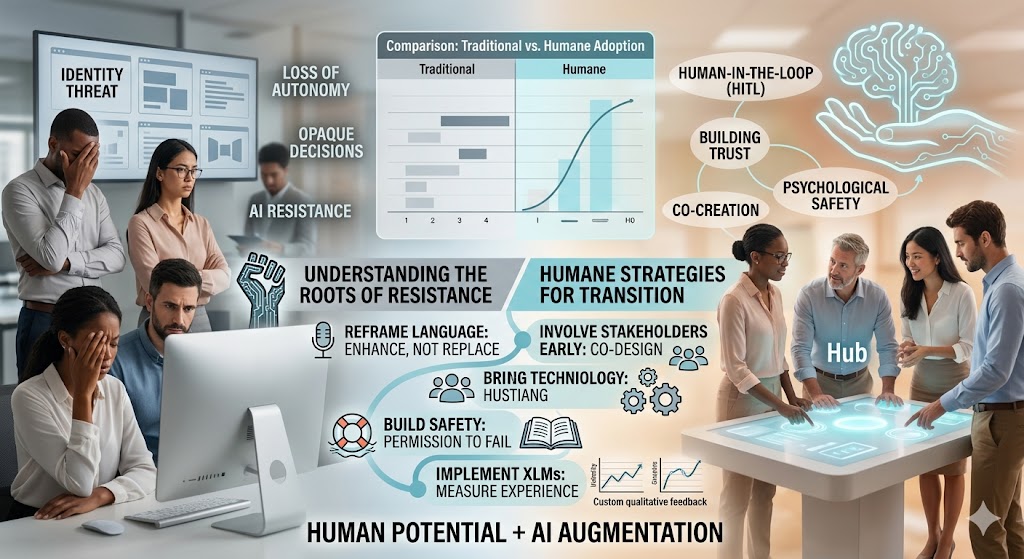
The arrival of generative AI isn’t just another line item in a digital transformation roadmap; it represents a fundamental psychological shift. We are moving from a world where tools follow explicit instructions to one where systems generate cognitive outputs. This transition creates a unique kind of friction — one that cannot be solved with a software patch or a mandatory training session.

Resistance within an organization is rarely about “obstructionism.” Instead, it is a natural defense mechanism against the perceived loss of agency and the blurring of professional identity. When employees push back, they aren’t rejecting efficiency; they are protecting their sense of purpose.

To navigate this era successfully, leaders must pivot from “managing change” to designing transition. Success will not be measured by the sophistication of the LLM integrated into the workflow, but by the level of psychological safety and empathy woven into the culture. We must ensure that as our systems get smarter, our organizations stay human.

Identifying the Four Pillars of AI Fear

Addressing resistance requires us to look beneath the surface of “efficiency” and “optimization” to understand the visceral concerns that keep employees up at night. Resistance to AI generally crystallizes around four distinct pillars.

1. Identity Erosion

For many professionals, their value is tied to their craft — the ability to write, analyze, or design. When an AI can produce a draft in seconds that previously took a human hours, it triggers a crisis of identity: “If a machine can do this, what is my unique value?” We must redefine roles to focus on the human elements of strategy, ethics, and “soul” that machines cannot replicate.

2. The Black Box Problem

Trust is built on transparency. When AI systems make recommendations or automate decisions without a clear “why,” it creates a vacuum of accountability. This lack of legibility leads to a profound loss of trust in the decision-making process, making employees feel like they are passengers in their own workflows.

3. Economic Survival

This fear goes beyond the headline-grabbing “job replacement.” It includes the more subtle anxiety of task de-skilling and wage stagnation. Employees worry that as tasks become automated, their specialized expertise will be commoditized, reducing their bargaining power and long-term career resilience.

4. The Cognitive Load

We are living in a state of “perpetual beta.” The sheer velocity of AI development forces employees into a cycle of constant upskilling. This creates a cumulative cognitive load that leads to burnout. Resistance, in this context, is often a plea for a sustainable pace of change.

Moving Beyond Technical Implementation

The fatal flaw in many AI initiatives is treating the rollout as a technical deployment rather than a human experience. To address resistance, we must apply the principles of experience design to the organizational change itself. It isn’t about how the technology works; it’s about how the people work with the technology.

Experience Design for Change

We must treat the employee journey with the same rigor and empathy we afford the customer journey. This means mapping the emotional highs and lows of the transition — from the initial “fear of the unknown” to the “messy middle” of skill acquisition — and designing interventions that provide support at each critical touchpoint.

The Human-Centered Innovation Framework

True innovation occurs at the intersection of feasibility, viability, and desirability. To make AI desirable, we must utilize a framework that prioritizes human agency:

  • Inquiry over Instruction: Instead of mandating a new tool, start by asking teams: “Where are you currently stuck?” or “What tasks drain your energy?” When AI solves a self-identified pain point, resistance evaporates.
  • Co-creation: The most effective way to eliminate the “us vs. them” mentality is to bring the skeptics into the design process. By involving employees in prompt engineering and workflow redesign, we turn them from passive observers into active architects of their own future.

Strategies for Humane Integration

Humane integration is about creating a bridge between current capabilities and future possibilities without leaving the workforce behind. It requires a shift from viewing AI as a “replacement” to viewing it as a “partner” that respects human dignity.

1. Radical Transparency

Ambiguity is the fuel of anxiety. Leaders must be explicit about the roadmap for AI integration. This involves clearly mapping which tasks are targeted for augmentation (making the human faster/better) versus which are targeted for replacement. When employees understand the “why” and the “where,” they can begin to proactively pivot their skill sets.

2. The “Human-in-the-Loop” Guarantee

To address the fear of losing control, organizations should establish a “Human-in-the-Loop” policy. This ensures that while AI can generate drafts, analyze data, or suggest actions, the final accountability, ethical judgment, and creative “soul” remain a human responsibility. This preserves the employee’s role as the essential curator and decision-maker.

3. Psychological Safety Nets

Learning to work with AI involves a steep and often public learning curve. Organizations should create low-stakes “sandboxes” — environments where employees can experiment with prompts, fail, and learn without these efforts being tied to formal performance reviews. Giving people the “right to be bad” at something new is a prerequisite for them eventually becoming great at it.

4. Redefining Value and KPIs

If we continue to measure success solely by “output volume,” humans will always lose to AI. To address resistance, we must evolve our Key Performance Indicators (KPIs). We should shift our focus toward rewarding strategic insight, relational depth, and complex problem-solving — areas where the human element provides a competitive advantage that technology cannot replicate.

The Role of the Modern Leader

In the age of AI, the definition of leadership is undergoing a radical transformation. It is no longer about having all the answers, but about asking the right questions and fostering an environment where human ingenuity can thrive alongside machine intelligence.

The Vulnerable Leader

The most effective leaders are those willing to admit they don’t have a perfect crystal ball. By modeling vulnerability — acknowledging the uncertainty of the AI landscape and sharing their own learning journey — leaders lower the collective anxiety of the organization. This “in-it-together” mentality replaces top-down mandates with shared exploration.

From Commander to Curator

Traditional leadership focused on directing execution. The modern leader, however, acts as a curator. Their role is to help teams evaluate AI-generated outputs, ensuring they align with the organization’s ethical standards, brand voice, and long-term vision. They shift the team’s focus from the “grind” of production to the “art” of selection and refinement.

Empathy as a Hard Skill

Leaders must develop the ability to distinguish between process friction (technical hurdles) and emotional friction (fear and resistance). Addressing the former requires better tools; addressing the latter requires active listening and radical empathy. In a world of automated logic, empathy becomes the ultimate competitive advantage and a non-negotiable leadership competency.

Conclusion: The Future is Symbiotic

As we stand on the precipice of this new era, we must remember that technology is a mirror of our intentions. If we approach AI with a mindset of pure cost-cutting and replacement, we will harvest a culture of fear and stagnation. If, however, we approach it through the lens of human-centered innovation, we can unlock a level of creativity and problem-solving previously unimaginable.

The Human Advantage

The ultimate goal of humane AI integration is not to make humans act more like machines, but to free humans to be more human. By offloading the routine and the repetitive, we create the space to double down on our unique “Human Advantage” — intuition, ethical judgment, and deep emotional connection. These are the qualities that no algorithm can simulate and the true drivers of long-term value.

The challenge for leaders today is to build a future where technology serves the human spirit, not the other way around. We aren’t just building better tools; we are designing better ways for people to thrive in an increasingly complex world. When we lead with empathy and design with intent, resistance transforms into a shared journey toward a more symbiotic future.

Frequently Asked Questions

How do we distinguish between “change management” and “human-centered transition”?

Traditional change management often focuses on the “what” and the “how” of technical implementation. A human-centered transition focuses on the “who.” It prioritizes the psychological and emotional journey of the employee, ensuring that agency and identity are preserved as workflows evolve.

Will AI eventually replace the need for human intuition in innovation?

No. While AI is exceptional at pattern recognition and data synthesis, it lacks the lived experience, ethical nuance, and “gut feeling” that drive true innovation. The future belongs to the “Magic Maker”—the human who uses AI to amplify their creative vision rather than being replaced by it.

What is the first step for a leader facing high team resistance to AI?

The first step is radical transparency. Open a dialogue that moves beyond corporate talking points to address specific fears regarding job security and identity. By acknowledging the friction and creating a low-stakes environment for experimentation, you begin to rebuild the trust necessary for collaboration.


SPECIAL BONUS: Braden Kelley’s Problem Finding Canvas can be a super useful starting point for doing design thinking or human-centered design.

“The Problem Finding Canvas should help you investigate a handful of areas to explore, choose the one most important to you, extract all of the potential challenges and opportunities and choose one to prioritize.”

Image credit: Gemini

Subscribe to Human-Centered Change & Innovation WeeklySign up here to get Human-Centered Change & Innovation Weekly delivered to your inbox every week.
The Future of Innovation KPIs in the Age of AI

AI’s Impact on Innovation KPIs

The Future of Innovation KPIs in the Age of AI

GUEST POST from Art Inteligencia


I. Introduction: Beyond the Efficiency Trap

For decades, innovation leaders have been obsessed with velocity — how many ideas can we push through the funnel, and how fast? However, as we enter the age of Agentic AI, the traditional “speedometer” of innovation is breaking. When an AI can generate a thousand product concepts in the time it takes to pour a cup of coffee, volume is no longer a competitive advantage; it is a noise problem.

  • The Paradigm Shift: We are moving away from treating innovation as a sporadic “side project” or a series of workshops. In this new era, innovation must be a continuous, AI-integrated capability that functions as the organization’s nervous system.
  • The Trap of Productivity: There is a dangerous temptation to use AI merely to do the wrong things faster. Measuring “output” without measuring “outcome” leads to the Efficiency Trap — where teams become remarkably good at delivering features that nobody actually needs.
  • The Core Thesis: The future of Innovation KPIs isn’t about tracking machine speed; it’s about measuring Human-Machine Synergy. We must redesign our dashboards to focus on how AI augments human intuition to create deeper empathy, higher-fidelity experiences, and sustainable ecosystem impact.

“The goal is no longer to be the fastest to market, but to be the most precise in solving human problems.” — Braden Kelley

II. The Evolution of Traditional Metrics

As AI commoditizes the “generation” phase of innovation, the metrics we once used to measure success are becoming obsolete. To remain relevant, we must shift our focus from tracking activity to measuring strategic movement.

Traditional frameworks like the Innovation Funnel are being compressed. What used to take months of market research can now be synthesized in hours, necessitating a fundamental update to our measurement criteria:

  • From Throughput to Outcomes: In the past, “number of ideas generated” was a common KPI. Today, that metric is a vanity project. AI makes ideas cheap; validation is what remains expensive. We must prioritize metrics that track the quality of problem-solving over the quantity of brainstorming.
  • Reimagining R&D Spend: Instead of viewing R&D as a flat percentage of revenue, we should measure the Speed of Learning. How much does it cost us to fail? By using AI to simulate market conditions, we can lower the “Cost of Experimentation,” allowing us to explore more radical horizons without increasing financial risk.
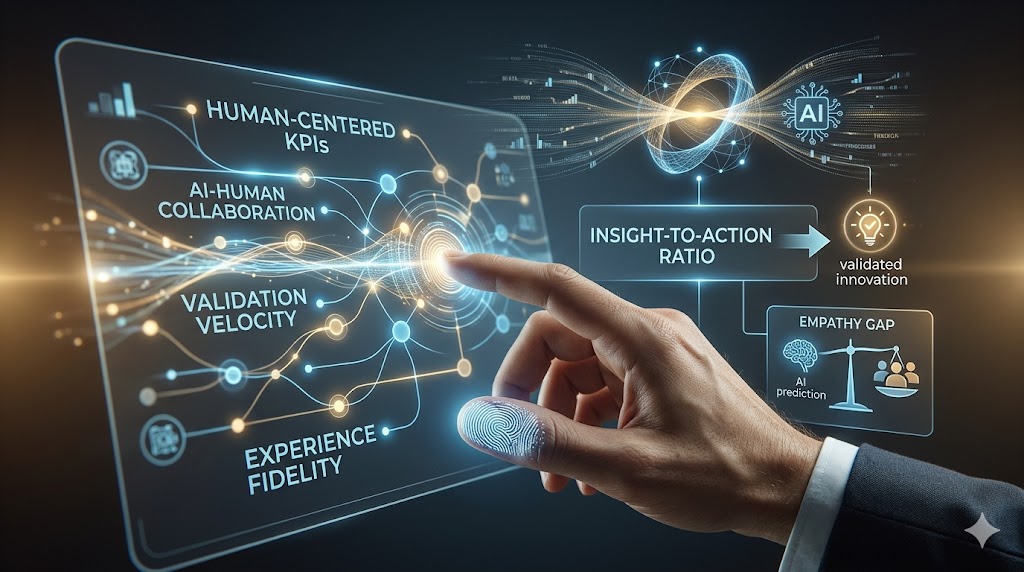
  • Human-Centered Design (HCD) Metrics: As we rely more on synthetic users and AI-driven personas, we risk losing touch with reality. We need to track the “Empathy Gap” — the distance between what an AI predicts a human needs and what a human actually experiences.

The goal is to move from a “Supply-Side” view of innovation (what we produced) to a “Demand-Side” view (the value the customer actually unlocked).

III. New KPIs for the AI Era

To lead in an AI-augmented landscape, we must introduce specialized metrics that go beyond traditional business logic. These “New KPIs” focus on the intersection of data, ethics, and the unique synergy between human creativity and machine intelligence.

1. The Insight-to-Action Ratio

Data is only as valuable as the decisions it informs. This metric measures the temporal distance between an AI-detected market signal (a “weak signal”) and the deployment of a validated, human-vetted prototype. A high ratio suggests an organization that is data-rich but “action-poor.”

2. Data Liquidity & Literacy

Innovation thrives on the fluid movement of information. Data Liquidity tracks how effectively innovation-related insights move across departmental silos to train and refine internal AI models. Combined with Literacy, it measures the organization’s ability to turn raw data into a strategic asset.

3. Collaborative Intelligence (CQ)

The most successful future organizations won’t just have the best AI; they will have the best human-AI teams. The CQ metric evaluates how effectively humans are prompting, refining, and steering AI outputs to achieve results that neither could produce in isolation.

4. Ethical Innovation Index

In the age of AI, guardrails are not obstacles — they are essential KPIs. This index measures bias detection frequency, transparency scores in algorithmic decision-making, and the alignment of new solutions with long-term human agency and societal well-being.

By implementing these measures, we ensure that AI remains a tool for Human-Centered Change, rather than just a driver of automated mediocrity.

IV. Measuring the “Middle of the Funnel”

The “Middle of the Funnel” is traditionally where innovation goes to die — the messy transition from a promising idea to a scalable reality. In the AI era, this stage becomes a high-speed laboratory where Experience Level Measures (XLMs) take precedence over rigid operational quotas.

  • Validation Velocity: We no longer need to wait months for physical market tests. By utilizing AI to simulate complex market conditions and consumer behaviors, we measure how quickly we can “kill” a bad idea. Success is defined by the speed at which we stop investing in the wrong things.
  • Pivot Frequency: In a volatile landscape, staying the course is often a recipe for irrelevance. This KPI tracks the number of strategic shifts informed by real-time AI data analysis. It rewards teams for being agile enough to redirect resources toward higher-value opportunities as they emerge.
  • Experience Fidelity: As we move through development, we must measure how closely the evolving product aligns with the intended Human Experience (HX). This involves using AI to audit journey maps and touchpoints, ensuring that the qualitative essence of the design isn’t lost in the technical execution.

By focusing on these middle-stage metrics, we transform the innovation process from a linear assembly line into a dynamic, iterative cycle of FutureHacking™.

V. Strategic Impact and Futurology

To truly future-proof an organization, Innovation KPIs must look beyond the current fiscal year. In the Age of AI, we must measure our ability to shape the future, not just react to it. This requires a shift toward Ecosystem Thinking and the valuation of intellectual capital.

  • The Ecosystem Health Score: We are moving away from isolated “Product KPIs” toward measures of mutual value. This score evaluates how an innovation strengthens the entire network — including partners, customers, and the environment. In a connected world, an innovation that succeeds at the expense of its ecosystem is a long-term failure.
  • Future-Proofing Index: This metric audits the innovation portfolio against the three horizons of growth. Specifically, it tracks the balance between Horizon 1 (incremental AI improvements to current products) and Horizon 3 (transformational AI applications that could disrupt our own business model).
  • The Return on Intelligence (ROI 2.0): Traditional ROI focuses on immediate financial gains. ROI 2.0 measures the “Knowledge Equity” generated during the innovation process. Even a project that never reaches the market can yield a high ROI if it produces unique data, reusable AI models, or deep customer insights that fuel future breakthroughs.

By shifting our perspective toward these long-term signals, we ensure that our strategic investments are building a sustainable Experience Management Office (XMO) rather than just chasing the latest tech trend.

VI. Conclusion: The Leader’s New Compass

As we navigate the complexities of the Age of AI, our measurement systems must evolve from tools of control to tools of exploration. The metrics we choose to track do more than just report progress — they signal to our organizations what we truly value. If we measure only efficiency, we will get automation; if we measure meaning, we will get innovation.

  • The Shift in Mindset: Modern Innovation KPIs should function like a GPS for exploration rather than a speedometer for production. Their purpose is to help us navigate uncertainty and re-calibrate our path toward long-term value.
  • Empowering the Human Element: In an increasingly automated world, the ultimate differentiators remain human curiosity, intuition, and empathy. Leaders must protect the space for these qualities to flourish, using AI to handle the “predictable” so humans can focus on the “possible.”
  • Final Thought: Innovation has always been about making the world better for people. AI is not the destination; it is the most powerful vehicle we’ve ever had to reach that goal. By aligning our KPIs with human-centered change, we ensure that our technological progress leads to genuine human advancement.

The future isn’t something that happens to us — it’s something we build, one measured step at a time.

Frequently Asked Questions

Will AI eventually replace the need for Innovation KPIs?

No. AI will automate the collection and analysis of data, but it cannot define what “value” looks like for your specific organization or customers. As we move toward Agentic AI, KPIs become even more critical as the steering mechanism that ensures autonomous systems remain aligned with human-centered goals.

How do Experience Level Measures (XLMs) differ from traditional SLAs in innovation?

While SLAs (Service Level Agreements) focus on technical performance and uptime, XLMs measure the qualitative impact of an innovation on the human experience. In the age of AI, technical success is the baseline; true innovation success is measured by how effectively a solution removes friction and empowers the user.

What is the most important “New KPI” for a leadership team to adopt first?

The Insight-to-Action Ratio is the most critical starting point. In an AI-driven landscape, the bottleneck is rarely a lack of insights; it is the organizational inertia that prevents those insights from becoming prototypes. Improving this ratio directly increases your organizational agility.


SPECIAL BONUS: Braden Kelley’s Problem Finding Canvas can be a super useful starting point for doing design thinking or human-centered design.

“The Problem Finding Canvas should help you investigate a handful of areas to explore, choose the one most important to you, extract all of the potential challenges and opportunities and choose one to prioritize.”

Image credit: Gemini

Subscribe to Human-Centered Change & Innovation WeeklySign up here to get Human-Centered Change & Innovation Weekly delivered to your inbox every week.
Accountability Frameworks for Human-AI Teams

LAST UPDATED: May 3, 2026 at 10:10 AM

Accountability Frameworks for Human-AI Teams

GUEST POST from Chateau G Pato


The Death of the “Black Box” Excuse

For years, we have treated Artificial Intelligence as a sophisticated utility — a faster calculator or a more intuitive search engine. But that era is over. We have crossed the threshold into agentic collaboration, where AI is no longer a silent tool but a functional, active teammate. This shift demands more than just a change in workflow; it requires a fundamental redesign of our ethical and operational foundations.

The Growing Responsibility Gap

As human-AI teams begin to co-create, we encounter the “Responsibility Gap.” Traditional organizational structures are ill-equipped to handle outcomes generated through hybrid intelligence. When a process is obscured by algorithmic complexity, and the human “partner” acts only as a rubber stamp, accountability evaporates. If we cannot trace the logic of a decision, we cannot learn from its failure.

A Human-Centered Thesis for Innovation

To unlock the true potential of this partnership, we must stop viewing accountability as a punitive liability and start designing it as a shared, transparent, and human-centered asset. True innovation thrives on trust, and trust is built on the clarity of who owns the intent, who owns the execution, and how we collectively govern the results. We aren’t just building better tools; we are building a more responsible future for work.

Defining the New “Shared Agency”

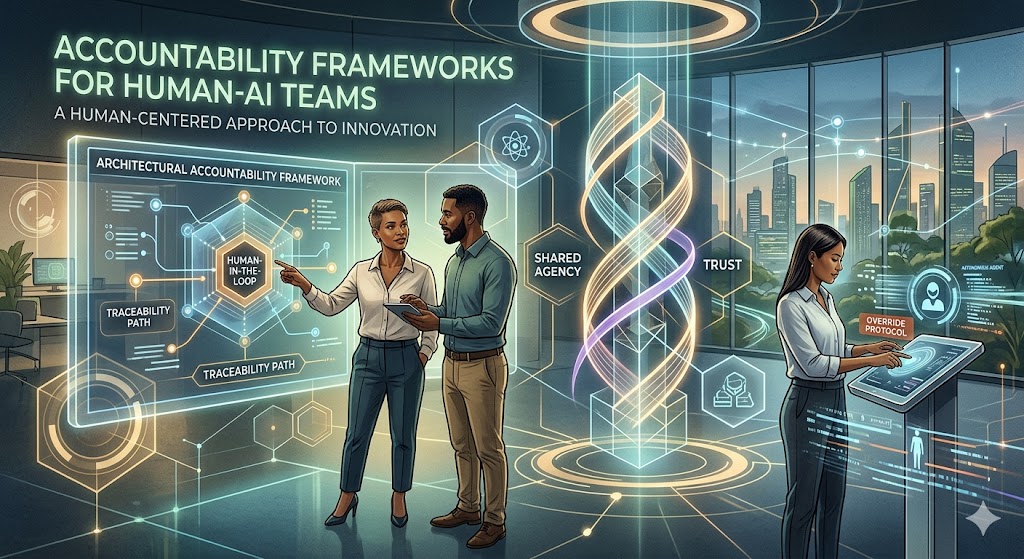
In the landscape of human-centered innovation, we must distinguish between output and outcome. While an AI can generate a high volume of output (data, code, or copy), the human teammate is responsible for the outcome — the real-world impact and the strategic alignment of that work. Agency in this new era is not a zero-sum game; it is a collaborative spectrum.

The “Human-in-the-Loop” Fallacy

Simply placing a human in the workflow to “check the box” is a recipe for catastrophic failure. This “passive oversight” leads to automation bias, where humans become too trusting of the system and lose their critical edge. To maintain true accountability, the human role must shift from supervisor to active collaborator, ensuring that the AI’s speed is always balanced by human judgment and ethical context.

A Taxonomy of Collaboration

Establishing clear boundaries of agency is the first step toward a robust accountability framework. We categorize these interactions into three distinct levels:

  • AI-Driven / Human-Verified: The AI takes the lead on heavy lifting and pattern recognition, while the human provides a rigorous audit and final approval.
  • Human-Driven / AI-Augmented: The human directs the creative and strategic vision, using AI to expand capabilities, brainstorm, or refine specific elements.
  • Autonomous Edge Cases: Pre-defined parameters where the AI operates independently within high-speed, low-risk environments, with humans designing the governance “guardrails.”

By codifying these roles, we move away from accidental collaboration and toward a structured, intentional partnership where every contributor — carbon or silicon — has a defined purpose.

The Architecture of a Modern Accountability Framework

Designing for accountability requires us to move beyond vague notions of “responsibility” and into the granular details of systems design. We must build structures that can withstand the speed of AI while maintaining the integrity of human oversight. This architecture isn’t just about technical constraints; it’s about experience design (XD) for the people who manage these systems.

The RACI Matrix 2.0

The traditional RACI model (Responsible, Accountable, Consulted, Informed) must be re-engineered for the hybrid workforce. In a human-AI team, the AI might be Responsible for the execution of a task, but a human must always remain Accountable for the result. We must clearly define who is “Informed” when an AI drifts from its baseline and who must be “Consulted” when the AI suggests a radical pivot in strategy.

Traceability by Design

Accountability is impossible without transparency. Every output generated by an AI teammate must have a “provenance trail” — a clear map of the data inputs, prompts, and logic used to arrive at a conclusion. By treating traceability as a core design requirement, we ensure that when a system fails, we aren’t looking at a “black box,” but at a documented path that can be audited, understood, and corrected.

The “Kill Switch” and Override Protocols

True leadership in an AI-integrated world means knowing when to pull the plug. A robust framework establishes clear “Kill Switch” protocols:

  • Threshold Alerts: Automated triggers that notify human leads when AI confidence scores drop below a specific percentage.
  • Manual Override Authority: Clearly designated roles with the power to bypass AI-driven decisions without bureaucratic delay.
  • Emergency Rollbacks: The ability to revert to a “last known good” human-validated state when an autonomous agent produces unexpected outcomes.

By building these safeguards directly into the organizational fabric, we empower our teams to innovate boldly, knowing that the safety nets are both visible and functional.

Designing for Transparency and Trust

Trust is the currency of innovation. In a human-AI partnership, trust cannot be blind; it must be earned through transparency. If a team does not understand how their digital counterpart arrives at a conclusion, they will either follow it off a cliff or ignore it entirely — both of which are disastrous for experience design and organizational growth.

Explainability as a Right

We must move toward a standard where “Explainable AI” (XAI) is not a luxury feature but a fundamental right for every employee. “The AI said so” is an unacceptable defense in any business context. Accountability frameworks must mandate that AI outputs include a plain-language rationale, allowing human teammates to evaluate the logic behind the recommendation rather than just the result.

Real-Time Feedback Loops

Accountability is a two-way street. To prevent algorithmic drift and the entrenchment of bias, we must design mechanisms where humans can correct AI outputs in real-time. This isn’t just about fixing an error; it’s about active mentoring. These feedback loops ensure that the AI learns from the human’s nuanced understanding of culture, ethics, and strategy, creating a virtuous cycle of continuous improvement.

Cultivating Psychological Safety

Innovation dies in an environment of fear. For a human-AI team to function, humans must feel psychologically safe to question, challenge, or reject an AI’s suggestion. A robust framework ensures that:

  • Dissent is Valued: Challenging an algorithm is viewed as a form of “quality assurance” rather than an obstacle to efficiency.
  • Bias Reporting: There are clear, non-punitive channels for reporting perceived biases or ethical lapses in the AI’s behavior.
  • Human Agency: The ultimate decision-making power is visibly vested in people, reinforcing that AI is a partner in the process, not the master of it.

By prioritizing these human-centered elements, we transform the AI from a mysterious “black box” into a transparent, reliable, and accountable colleague.

Change Management: Implementing the Framework

The most sophisticated accountability framework in the world is useless if it exists only as a static document. Integrating AI into the team fabric is a cultural transformation, not a software deployment. To move from theory to practice, we must design the transition with as much intentionality as the technology itself.

From Monitoring to Mentoring

We must shift the organizational mindset. Traditional management often views AI oversight as “monitoring” — a defensive posture designed to catch errors. To drive innovation, we must reframe this as “mentoring.” When a human teammate audits an AI’s output, they are not just checking for mistakes; they are training the system on the nuance of the brand, the ethics of the industry, and the complexities of human experience.

Upskilling for Governance

Accountability requires a new set of competencies. It is no longer enough for employees to be “AI literate”; they must be governance-capable. This includes:

  • Critical Prompting: The ability to structure inquiries that minimize bias and maximize transparency.
  • Algorithmic Auditing: Basic skills in identifying “hallucinations” or logical inconsistencies in generative outputs.
  • Ethical Decision-Making: Strengthening the human capacity to make value-based judgments that an AI, by its very nature, cannot replicate.

Iterative Governance: The Living Document

In the world of futurology, we know that the only constant is acceleration. An accountability framework must be a “living document” that evolves alongside the technology. We recommend Quarterly Governance Sprints, where teams reconvene to assess where the framework held firm and where the speed of agentic AI created new, unforeseen “blind spots.”

By treating the implementation as an ongoing journey of experience design, we ensure that our teams remain agile, empowered, and — above all — accountable for the future they are building.

Conclusion: The Futurist’s Perspective

As we look toward the horizon of the next decade, the organizations that thrive won’t just be those with the fastest processors or the largest datasets. They will be the ones that have mastered the social architecture of Human-AI collaboration. Accountability is not a bureaucratic anchor; it is a competitive advantage that provides the psychological safety necessary for radical experimentation.

Accountability as a Catalyst for Speed

There is a common misconception that guardrails slow us down. In reality, a well-designed accountability framework acts like the brakes on a high-performance racing car — it is precisely because you know you can stop that you have the confidence to go faster. When teams understand exactly where the responsibility lies, they can iterate with a level of boldness that “black box” systems simply don’t allow.

The Architect of Intent

Ultimately, the goal of human-centered innovation is to ensure that technology serves humanity, not the other way around. While we will increasingly share our labor with AI, we must never outsource our intent. The future belongs to the leaders who treat AI as a powerful co-author of the work, while remaining the ultimate architects of the mission.

“We are moving from a world of ‘doing the work’ to a world of ‘designing the outcomes.’ In this shift, our accountability is the only thing that keeps our innovation anchored to our values.” — Braden Kelley

The frameworks we build today are the blueprints for the collaborative culture of tomorrow. Let’s design them to be as intelligent, transparent, and resilient as the future we hope to create.

Frequently Asked Questions

Who is ultimately responsible for an AI’s error?

In a human-centered framework, the human lead remains the Accountable party. While the AI is responsible for the execution (the output), the human is responsible for the outcome and must ensure the result aligns with ethical and strategic standards.

Does an accountability framework slow down innovation?

Quite the opposite. By defining clear guardrails and “Kill Switch” protocols, teams gain the psychological safety needed to move faster. Clear boundaries prevent the “analysis paralysis” that often occurs when ethical or operational risks are ambiguous.

What is “Traceability by Design”?

It is the practice of building AI systems that automatically document their logic and data sources. This ensures that every decision can be audited, allowing human teammates to understand the “why” behind an AI’s suggestion.

Bottom line: Futurology is not fortune telling. Futurists use a scientific approach to create their deliverables, but a methodology and tools like those in FutureHacking™ can empower anyone to engage in futurology themselves.

Image credit: Gemini

Subscribe to Human-Centered Change & Innovation WeeklySign up here to get Human-Centered Change & Innovation Weekly delivered to your inbox every week.

AI-Enabled Decision Making: What Are the Benefits?

AI-Enabled Decision Making: What Are the Benefits?

GUEST POST from Chateau G Pato

Artificial intelligence (AI) is quickly emerging as a powerful tool for business decision making. Companies of all sizes are realizing the potential of AI to provide insights and automate manual processes that previously served to hinder the decision-making process. In this article, we’ll take a look at some of the benefits that AI-enabled decision making can bring to a business, as well as some examples of successful implementations.

One of the most significant benefits of AI-enabled decision making is the ability to analyze large data sets and identify patterns that inform decisions. By harnessing powerful algorithms, AI can uncover correlations that are otherwise not visible. This can be especially beneficial in customer and market segmentation, where the application of AI-driven analytics can help uncover new growth opportunities. For example, one company used AI to analyze customer data as part of its product segmentation strategy. This enabled the company to develop personalized recommendations that drove increased customer loyalty and revenue growth.

Case Study 1 – Automating Chargeback Calculations

In addition to analyzing data, AI can automate tedious manual tasks for more efficient and accurate decision-making. For example, a global accounting firm used AI to automate chargeback calculations. By eliminating manual human review, AI enabled the company to process thousands of invoices in a fraction of the time. This reduced the cost of processing while improving accuracy and creating an overall better customer experience.

Case Study 2 – AI-Enabled Predictive Logistics

Finally, AI can be used to create predictive models that anticipate future actions, trends, and outcomes. By using AI to develop predictive models, businesses can get a jumpstart on preparing for potential events ahead of time. For example, a logistics firm developed an AI-enabled predictive model that anticipated customer buying patterns and adjusted its shipping routes accordingly. This enabled the company to save time and money through improved deployment of its assets.

Conclusion

AI-enabled decision making offers a range of potential benefits to businesses of all sizes. By leveraging powerful algorithms to analyze data, automate processes, and create predictive models, companies can improve decision making while creating a competitive edge. Through the use of case studies, this article has highlighted some of the key benefits of AI-enabled decision making that can be applied to a variety of organizational contexts.

Image credit: Pixabay

Subscribe to Human-Centered Change & Innovation WeeklySign up here to get Human-Centered Change & Innovation Weekly delivered to your inbox every week.
The Future of Automation and Artificial Intelligence

The Future of Automation and Artificial Intelligence

GUEST POST from Art Inteligencia

The future of automation and artificial intelligence is highly debated in today’s world. As technology continues to advance, so does the potential for automation and AI to radically transform how we live our lives. From automated robots in factories to smart assistants in our homes, automation and AI are becoming a reality in more and more areas of everyday life. This article will examine the potential of automation and AI, their impact on society, and provide two case study examples of where automation and AI are being applied today.

The potential of automation and AI is vast. Automation can take on mundane tasks, freeing up more time to focus on important and fulfilling work. AI can augment our knowledge, helping us to make better decisions for our businesses, families, and communities. As technology progresses, machines will more and more be used for tasks that have traditionally been done by humans. Automation and AI could soon lead to highly efficient, reliable, and even completely autonomous systems.

However, automation and AI come with their own set of risks. There is a lot of fear that automation and AI will lead to job losses, inequality, and ethical dilemmas, especially as AI becomes increasingly capable of replicating complex decisions and tasks. Though the advancement of these technologies could bring great benefits, it is important to consider potential risks and explore ways to ensure that any automation or AI systems are beneficial for everyone.

To better understand how automation and AI are impacting the world, let us look at two case study examples.

Case Study 1 – Manufacturing

The first example is the story of Foxconn, an electronics manufacturing company based in Taiwan. To increase efficiency, the company started to incorporate robots into their workflow. Recently, they announced that they will be reducing the number of employees by over 50,000 and replacing them with robotic automation. Though this might seem like a benefit to Foxconn, it has had negative impacts on their workers who are losing their jobs.

Case Study 2 – Healthcare

The second example is the application of AI in healthcare. AI is being used in a number of ways in healthcare, from automating simple tasks like medical record keeping to aiding in diagnosis and decisions. For example, a recent study found that AI systems can accurately predict heart attack risks by analyzing CT scans, which could potentially lead to earlier and more effective treatments.

Conclusion

Overall, the future of automation and AI is extremely promising, and their potential could bring tremendous benefits. It is important, however, to consider the risks and ethical implications of these technologies, and to explore ways to ensure that their application is beneficial for everyone.

Bottom line: Futurology is not fortune telling. Futurists use a scientific approach to create their deliverables, but a methodology and tools like those in FutureHacking™ can empower anyone to engage in futurology themselves.

Image credit: Pixabay

Subscribe to Human-Centered Change & Innovation WeeklySign up here to get Human-Centered Change & Innovation Weekly delivered to your inbox every week.
Exploring the Potential of Automated Business Processes

Exploring the Potential of Automated Business Processes

GUEST POST from Art Inteligencia

Business automation is increasingly becoming an important part of enterprise operations and is being used for a wide range of activities from payroll to customer service. Automating business processes is essentially a way for organizations to make their procedures faster, more efficient and reduce cost of operations. With so much potential for cost savings and efficiency, it is understandable why businesses are exploring automated business processes more and more.

By replacing labor-intensive processes with automated systems, businesses are finding cost savings and improved service levels that would have been difficult to achieve before. Additionally, these solutions can offer additional benefits such as better accuracy and optimization of business processes. With these potential benefits in mind, let’s explore some of the potential uses and case study examples of automated business processes.

Case Study 1 – Automated Payroll

One of the most common uses for automated processes is in the areas of employee administration and payroll. Automated systems can handle everything from on-boarding and benefits administration to payroll and taxes. This type of automation can reduce the amount of time and cost spent on administrative tasks while also ensuring that all processes are in compliance with applicable regulations.

For example, Canadian fashion retailer Reitmans recently implemented an automated payroll process that streamlined their processes and introduced cost savings of $50,000. The company was able to achieve this cost saving while still ensuring compliance with the government’s labor standards.

Case Study 1 – Order Processing

Another area where automated processes can be beneficial is order processing. Automated solutions can help manage order processing from taking an order to delivering it, furthering cost savings and faster turnover. Automation can reduce the manual effort to process orders which can lead to more orders being processed without the need to increase staffing.

One such example is from digital retailer Mabel’s Labels. The company is using an automated order processing system to automatically generate orders, check them, and ship them out within 24 hours. This automation has enabled the company to reduce order processing time from seven days to 24 hours.

Conclusion

With so much potential to automate business processes, it appears organizations are just starting to explore the potential of automation. As more organizations become comfortable with automation solutions, it’s likely we’ll see an increasing number of companies taking advantage of these solutions in the near future. Companies interested in taking advantage of automated processes should be sure to fully research the options available before implementing a solution.

SPECIAL BONUS: Braden Kelley’s Problem Finding Canvas can be a super useful starting point for doing design thinking or human-centered design.

“The Problem Finding Canvas should help you investigate a handful of areas to explore, choose the one most important to you, extract all of the potential challenges and opportunities and choose one to prioritize.”

Image credit: Pixabay

Subscribe to Human-Centered Change & Innovation WeeklySign up here to get Human-Centered Change & Innovation Weekly delivered to your inbox every week.
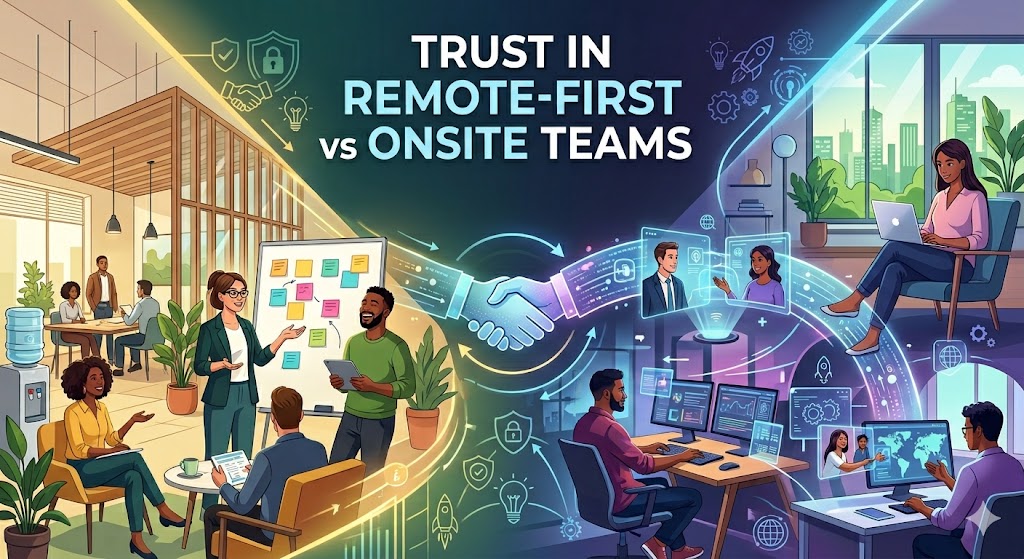
Trust in Remote-First vs. Onsite Teams

LAST UPDATED: April 22, 2026 at 3:39 PM

Trust in Remote-First vs. Onsite Teams

GUEST POST from Chateau G Pato


I. Introduction: The New Currency of Collaboration

In the modern organizational landscape, trust is the invisible infrastructure upon which all innovation is built. Historically, we have relied on physical proximity as a proxy for reliability, but the shift toward decentralized work has exposed a critical flaw in that logic: being “seen” is not the same as being “trusted.”

The Trust Paradox

Many leaders suffer from the illusion that physical presence naturally breeds psychological safety. In reality, onsite environments can often mask a lack of trust through performative busy-ness. The challenge for the modern enterprise is to decouple trust from the visual confirmation of work and reattach it to the delivery of value.

Defining the Shift

We are witnessing a fundamental evolution in leadership philosophy. We are moving away from “management by walking around” — a relic of the industrial age — and toward “leadership by intentional design.” This requires a shift in focus from inputs (hours at a desk) to outcomes (impact on the customer and the team).

The Thesis

Trust is not inherently more difficult to build in remote-first settings; it is simply different. While onsite teams benefit from accidental social friction, remote-first teams must rely on the intentional architecture of transparency and vulnerability. By applying human-centered design to our communication structures, we can build teams that are more resilient and innovative than those bound by four walls.

II. The Anatomy of Trust in the Workplace

To design better organizational experiences, we must first deconstruct what trust actually looks like in a professional context. It isn’t a monolithic sentiment; rather, it functions as a dual-engine system driven by both logic and emotion. When we understand these levers, we can begin to mitigate the biases that often plague hybrid and remote-first environments.

Cognitive Trust: The Head

Cognitive trust is built on reliability and competence. It is the rational assessment of a colleague’s ability to deliver. In a remote-first world, this is the “foundational layer.”

  • The Question: “Is this person capable, and will they do what they say they will do?”
  • The Driver: Consistency in output and transparency in workflow.

Affective Trust: The Heart

Affective trust is rooted in emotional connection and empathy. This is the “relational layer” that allows teams to navigate conflict and uncertainty. It is often the harder of the two to cultivate across digital divides because it requires vulnerability.

  • The Question: “Does this person care about my well-being and the collective success of the team?”
  • The Driver: Shared experiences, active listening, and psychological safety.

The Proximity Bias

As humans, we are evolutionarily wired to favor those within our immediate physical vicinity. This Proximity Bias creates a dangerous “out of sight, out of mind” dynamic where onsite employees may be perceived as more trustworthy or “harder working” simply due to their visibility. To be a truly human-centered leader, one must actively design against this instinct, ensuring that trust is measured by contribution rather than coordinates.

III. Onsite Teams: The Power of Spontaneity

The physical office is more than just a container for desks; it is a high-bandwidth environment for unstructured data exchange. In onsite settings, trust is often the byproduct of “ambient awareness” — the ability to pick up on the moods, challenges, and successes of others through passive observation. However, relying on this “accidental trust” can be a double-edged sword if not managed with intent.

Micro-Moments and Social Friction

The “watercooler effect” isn’t a myth; it’s a manifestation of low-stakes social friction. These micro-interactions — a shared laugh in the hallway or a quick “how was your weekend?” — serve as the building blocks for affective trust. These moments humanize colleagues, making it significantly easier to navigate difficult professional conversations later because a foundation of personal rapport already exists.

Non-Verbal Intelligence

In-person collaboration utilizes the full spectrum of human communication. We process body language, tone, and facial expressions in real-time, which allows for rapid conflict resolution and nuanced brainstorming. When a team is physically “in the room,” the speed of alignment is often accelerated because the feedback loop is instantaneous and multi-sensory.

The Shadow Side: The “Performative Presence” Trap

The greatest risk to trust in the onsite model is the conflation of attendance with achievement. When leaders value “butts in seats” over actual impact, they foster an environment of performative presence. This erodes trust in two ways:

  • It signals to high-performers that their results matter less than their visibility.
  • It creates an “in-group” vs. “out-group” dynamic where those who can’t be physically present (due to caregiving, disability, or commute) feel inherently less trusted.

To maximize the onsite experience, we must shift the office’s purpose from a place where work happens to a place where connection is deepened.

IV. Remote-First Teams: The Power of Intentionality

In a remote-first environment, trust cannot be left to chance. Without the “physical glue” of an office, we must replace accidental interactions with intentional architecture. When done correctly, this doesn’t just replicate onsite trust — it can actually surpass it by grounding the culture in radical clarity and objective contribution.

Asynchronous Transparency

In the absence of a shared physical space, documentation becomes a trust-building exercise. When workflows, decisions, and project statuses are codified and accessible to everyone, cognitive trust flourishes. There is no “hidden information” or “backroom deal.” This transparency ensures that every team member, regardless of their time zone, has the same context, reducing the anxiety of the unknown and fostering a sense of collective ownership.

The Digital Handshake

Because we lose the organic cues of the breakroom, remote leaders must design deliberate rituals to foster affective trust. This isn’t about forced “Zoom fun,” but about creating meaningful spaces for human connection:

  • Virtual Coffee/Office Hours: Creating low-pressure environments for non-work dialogue.
  • Demo Days: Celebrating wins publicly to reinforce competence and shared purpose.
  • Personal READMEs: Encouraging team members to share their working styles and communication preferences.

Outcome-Based Trust

Remote work forces a healthy evolution: the death of “micro-management by observation.” In a remote-first culture, trust is granted through outcome-based accountability. By focusing on what is achieved rather than when or where it happened, we strip away the bias of performative presence. This empowers employees with autonomy, which is one of the highest expressions of trust a leader can offer.

The remote-first model proves that when you stop watching people work and start supporting their success, the bond between the individual and the organization grows stronger.

V. Design Thinking for Trust: A Comparative Analysis

To lead effectively in a hybrid world, we must stop treating onsite and remote work as identical experiences. Each environment has unique trust-building strengths and inherent risks. By applying a design thinking lens, we can map these dynamics to understand which “trust levers” to pull based on our team’s physical distribution.

Trust Feature Onsite Dynamics Remote-First Dynamics
Core Foundation Shared physical space and “ambient awareness” of body language. Shared goals and radical transparency through documentation.
Formation Pace Rapid initial bonding via social friction; harder to scale globally. Slower initial bonding; highly scalable across time zones.
Primary Risk Groupthink and the formation of exclusionary physical cliques. Isolation and “The Void” caused by a lack of informal feedback.
Innovation Style Serendipitous collisions and spontaneous brainstorming. Structured co-creation and uninterrupted “deep work” cycles.

The Design Imperative

The goal is not to choose one over the other, but to design a Stable Spine of trust that supports both. Onsite teams need to guard against the “insider” mentality, while remote-first teams must ensure they aren’t just a collection of individuals working in parallel. We must architect an experience where trust is the constant, regardless of the variable of location.

VI. Strategies for the Future-Ready Leader

In a world of constant flux, leaders must transition from being “task managers” to becoming experience architects. Building trust in a hybrid or remote-first environment requires a shift in focus from control to empowerment. Here are the specific design strategies to ensure your team remains connected and innovative.

Designing for Vulnerability

Trust is a mirror; it is reflected back when it is first given. Leaders must model “showing the messy middle” of their projects. By being open about challenges and “work in progress,” you give your team permission to do the same. This reduces the fear of failure and creates a psychologically safe space where true innovation can breathe.

Empathy as a Service (EaaS)

Utilize Experience Design (EX) principles to ensure that remote employees feel just as “seen” as their onsite counterparts. This means:

  • Equity of Voice: Ensuring digital-first communication during meetings so those in the room don’t dominate the conversation.
  • Proactive Outreach: Scheduling regular 1-on-1s that focus on the human rather than the status update.

The Micro-Feedback Loop

The annual performance review is a relic that often erodes trust through its lag time. Future-ready leaders employ continuous, trust-building micro-feedback. By providing small, frequent, and constructive insights, you eliminate the “guessing game” of performance. This creates a culture of constant growth and reinforces the cognitive trust that the team is moving in the right direction together.

By treating trust as a designed experience rather than a fortunate accident, we can build organizations that are not only more agile but more profoundly human.

VII. Conclusion: Trust is an Innovation Enabler

As we look toward a decentralized future, it becomes clear that trust is the only thing that doesn’t scale without human-centered design. Technology can bridge the distance between us, but it cannot bridge the gap in confidence between a leader and their team. That requires an intentional commitment to the human experience.

The Futurologist’s View

In the coming decade, the most competitive organizations will not be those with the most impressive real estate or the most sophisticated surveillance tools. They will be the ones that have mastered the art of building “distributed psychological safety.” In an era of rapid AI integration and shifting market dynamics, trust is the stabilizer that allows a team to pivot without panicking.

The Call to Action

Stop trying to “recreate the office” online. The goal of remote-first work is not to simulate a 1990s cubicle farm via video calls; it is to design a new way of working that prioritizes autonomy, transparency, and impact. Whether your team meets in a boardroom or a digital workspace, your mission is to design experiences that prioritize people over processes.

Final Thought: Trust is not a destination you reach and then inhabit; it is a continuous co-creation. By architecting for both the head (competence) and the heart (connection), we unlock the true potential of our most valuable asset: our collective human ingenuity.

Frequently Asked Questions

How does trust-building differ between remote and onsite teams?

Onsite teams rely on “accidental proximity” and non-verbal cues to build trust organically. Remote-first teams must use “intentional design,” building trust through radical transparency, clear documentation, and deliberate social rituals.

What is ‘Proximity Bias’ and how does it impact innovation?

Proximity Bias is the tendency to favor and trust those we see physically. In innovation, this is dangerous because it can lead to exclusionary cliques and overlook the valuable contributions of remote experts, ultimately stifling diverse thinking.

Can remote teams be as innovative as onsite teams?

Absolutely. While onsite teams excel at spontaneous “collisions,” remote teams excel at structured co-creation and deep work. Innovation in remote teams is driven by outcome-based accountability rather than performative presence.

Image credit: Google Gemini

Subscribe to Human-Centered Change & Innovation WeeklySign up here to get Human-Centered Change & Innovation Weekly delivered to your inbox every week.
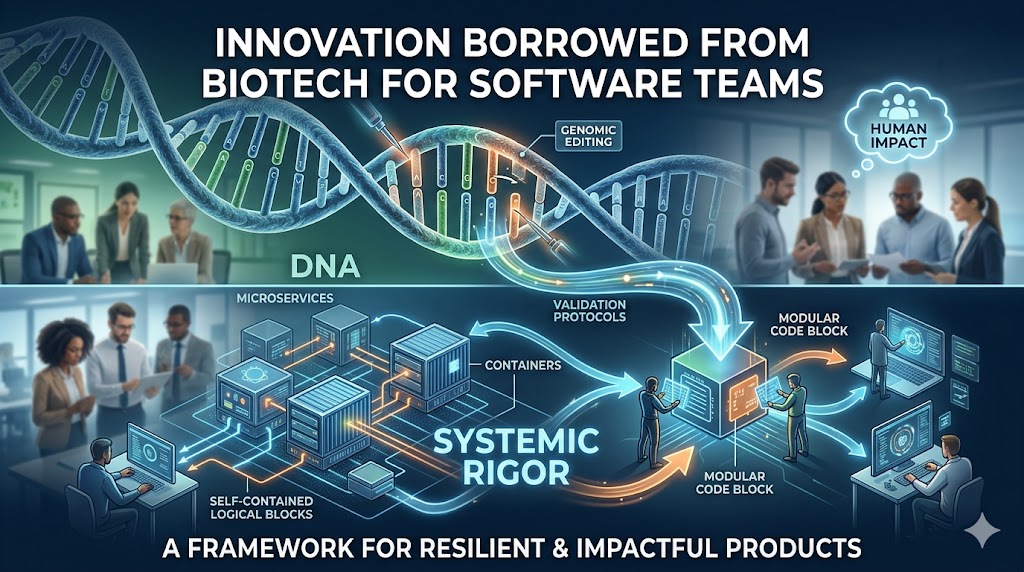
Innovation Borrowed from Biotech for Software Teams

LAST UPDATED: April 25, 2026 at 11:55 AM

Innovation Borrowed from Biotech for Software Teams

GUEST POST from Art Inteligencia


I. Introduction: The Convergence of Code and Cells

The traditional “move fast and break things” mantra of software development is hitting a wall of complexity. As our digital ecosystems become more interconnected, the “breaking” part is no longer a minor inconvenience — it’s a systemic risk.

Meanwhile, biotechnology — a field where “breaking things” can cost billions of dollars or human lives — has spent decades developing rigorous frameworks for managing extreme uncertainty. We are entering an era where software is becoming as complex as biological systems, requiring a shift in how we approach creation.

  • The Paradigm Shift: Moving from “Iterative Tweaking” (minor UI adjustments) to “Discovery-Driven Development” (solving fundamental logic puzzles).
  • The Thesis: To build more resilient and impactful products, software teams must borrow the experimental rigor, ethical frameworks, and architectural patience of biotech.
  • The Human Element: Shifting team mindset from “Feature Factories” focused on output to “Scientific Investigators” focused on outcomes.

II. The “Clinical Trial” Approach to Feature Validation

In software, we often celebrate the “pivot,” but in biotech, a pivot is a failure of the hypothesis. By applying the structure of clinical trials to our development cycles, we can move away from the “throw it at the wall and see what sticks” method and toward a high-fidelity validation process.

Phase I: Safety and Feasibility

Before a drug reaches a human subject, it must prove it isn’t toxic. In software, Phase I is about isolating the core technical assumption. Can the algorithm actually process the data at scale? Does the integration work? This isn’t an MVP with a pretty UI; it is a “lab bench” test to ensure the technical foundation is safe to build upon.

Phase II: Efficacy (The Human Response)

Once we know the code is “safe,” we must prove it works — not just that it runs, but that it solves the human problem. This phase involves controlled testing with a small, specific cohort of users to measure biological impact: changes in behavior, reduction in friction, or true value creation. If the efficacy isn’t there, the feature is “terminated” before further investment is wasted.

Phase III: Scale and Side Effects

A drug might work for ten people but cause systemic issues for ten thousand. In software, Phase III is the rollout strategy where we monitor for “systemic toxicity” — technical debt, performance degradation, or unexpected UX friction that only emerges at scale. We aren’t just looking for bugs; we are looking for negative externalities.

The Protocol Mentality: Every Jira ticket or user story should be treated as a clinical protocol. It must start with a falsifiable hypothesis, a defined “dosage” (the scope), and a clear success metric (the primary endpoint).

III. Modular Architecture: The “CRISPR” of Software

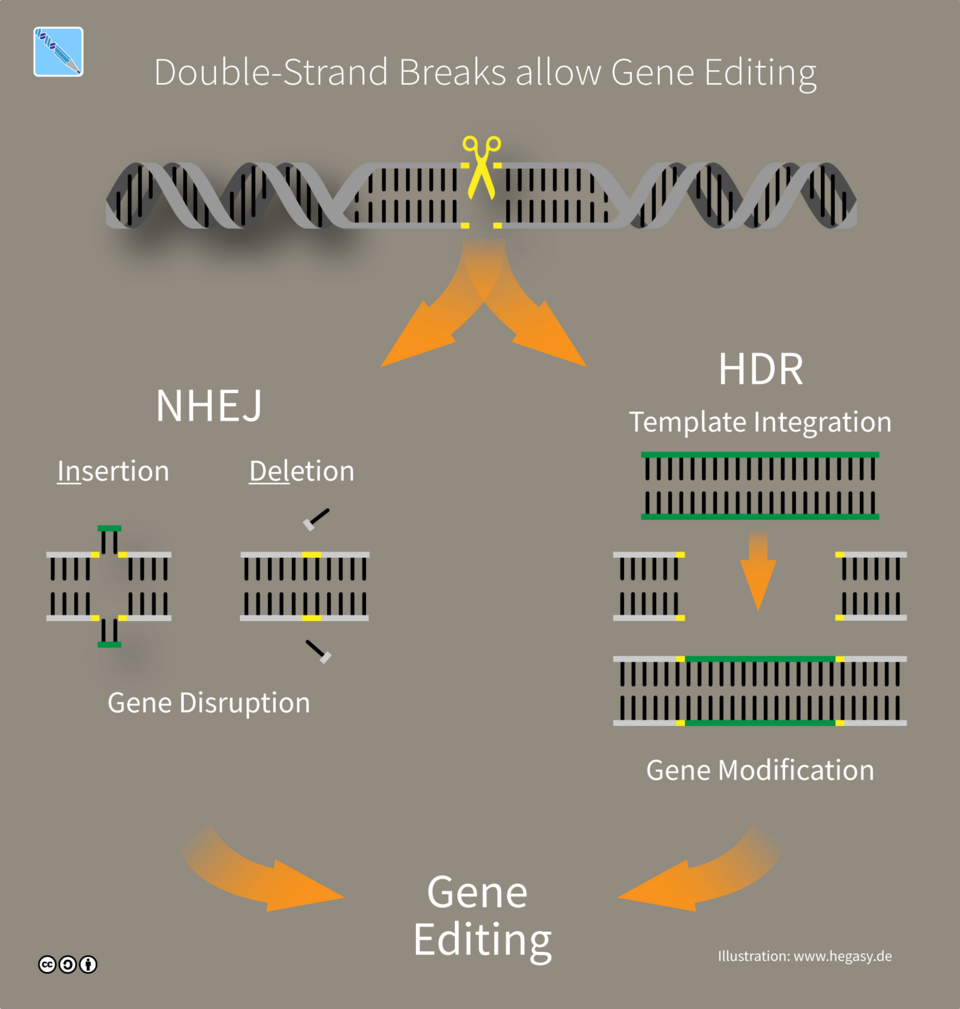
In biotechnology, the breakthrough of CRISPR-Cas9 changed everything by allowing scientists to edit specific strands of DNA with surgical precision. Software architecture often suffers from “monolithic bloat” — where one small change can lead to unforeseen mutations across the entire system. By adopting a “genomic” approach to modularity, we can build software that is both more resilient and easier to evolve.

Precision Engineering and Gene Editing

Borrowing the concept of gene editing, software teams should strive for components that are highly modular and “hot-swappable.” Just as a specific genetic sequence can be targeted without rewriting the entire genome, our microservices and functions should be designed to be updated, replaced, or deleted without destabilizing the organism — the application.

Gene Editing Wikimedia Commons

Bio-mimicry: Self-Healing and Autophagy

Biological systems have evolved incredible ways to maintain health. We can borrow these concepts for our infrastructure:

  • Homeostasis (Self-Healing): Developing systems that automatically detect when they have drifted from a “healthy” state and trigger automated recovery protocols without human intervention.
  • Autophagy (Self-Cleaning): In biology, cells “eat” their own damaged parts to stay healthy. In software, this means building routines that automatically identify and decommission orphaned data, dead code, or underutilized resources to prevent “architectural decay.”

Risk Mitigation and Contamination Control

In a lab, a single drop of “contaminated” material can ruin an entire experiment. Biotech handles this through isolation and containment. Software teams can apply this by shrinking the “blast radius” of updates. By using advanced containerization and strict API contracts, we ensure that if a specific “gene” (feature) fails or is corrupted, the rest of the software organism remains healthy and functional.

IV. Embracing the “Long R&D” Cycle in an Agile World

The tech industry is obsessed with two-week sprints, but biotech understands that some breakthroughs require years of foundational research. To innovate truly, software teams must learn to balance the “Sprint” with the “Study,” creating space for deep research and development that doesn’t fit into a standard ticket cycle.

Deep Innovation vs. Surface Polish

There is a fundamental difference between optimizing a checkout flow and developing a new machine learning model. The former is a sprint; the latter is a “Lab Phase.” Recognizing when a problem is a “discovery” problem rather than a “delivery” problem allows leaders to allocate the right resources and timelines, preventing the burnout that occurs when trying to force breakthrough innovation into a rigid agile framework.

The Failure Lab: Valuing Negative Results

In biotech, a failed experiment is not a waste of time — it is a vital piece of data that prevents the company from spending billions on a dead end. Software culture often stigmatizes “failed” features. We must build “Failure Labs” where teams are rewarded for proving that a product direction was flawed early. A “successful failure” preserves capital and engineering bandwidth for more viable candidates.

Portfolio Management: Generics vs. Blockbusters

A healthy biotech company manages a balanced portfolio. Software teams should do the same:

  • Generics: Maintaining and improving standard, expected features that keep the lights on and the users satisfied.
  • Blockbuster Drugs: High-risk, high-reward “FutureHacking” projects that have the potential to disrupt the market or define a new category.

By categorizing work this way, innovation becomes a repeatable process of investment and discovery rather than a desperate search for the next “big thing.”

V. Ethical Sequencing: Responsibility by Design

In the world of biotech, the question is rarely just “Can we do this?” but rather “Should we do this?” The industry is governed by bioethics and stringent regulatory oversight because the stakes are human health. As software increasingly dictates the flow of labor, information, and even democratic processes, we must adopt a similar ethical sequencing protocol.

Bioethics for Algorithms

Just as medical researchers must adhere to the principle of Primum non nocere (First, do no harm), software architects must evaluate the long-term impact of their code. This means assessing algorithms for bias, addictive patterns, or “toxic” data collection before they are ever deployed. We need to move toward a model where ethical impact is a non-negotiable part of the definition of “Done.”

Informed Consent in UX

Most software “consent” is buried in fifty pages of legal jargon that no human reads. Borrowing from clinical research, we should move toward true Informed Consent. This involves transparent, human-centered design that clearly explains how data will be used, what the risks are, and what the user is “signing up for” in plain language, empowering the user rather than tricking them.

Institutional Review Boards (IRBs) for Tech

In biotech, an IRB must approve a study before it begins. Software teams can implement internal Innovation Review Boards. These cross-functional groups — comprising designers, engineers, and even sociologists — should evaluate major pivots or “FutureHacking” initiatives. Their role is to look past the quarterly ROI and consider the systemic “side effects” the software might have on the user’s life or the economy at large.

The Goal: To ensure that our digital “treatments” improve the human condition without creating a legacy of unintended consequences.

VI. Conclusion: Cultivating a High-Fidelity Future

The future of software development isn’t just about writing more lines of code; it’s about increasing the fidelity of our innovation. As we move into an era dominated by agentic AI and increasingly complex digital organisms, the chaotic “move fast and break things” approach is no longer sustainable.

By looking toward biotechnology, we find a roadmap for a more disciplined, ethical, and resilient way to build. When we treat our backlogs as scientific protocols and our architectures as living systems, we stop being “Feature Factories” and start being true pioneers of the digital frontier.

  • Summary: The most successful software teams of the next decade will look less like assembly lines and more like high-performance research laboratories.
  • The Call to Action: Start treating your next sprint as a series of controlled experiments. Evaluate your codebase for its “biological” health. Most importantly, ensure your innovation is always human-centered by design.

The Braden Kelley Perspective: Innovation isn’t just about the speed of delivery; it’s about the quality of the discovery. By borrowing the discipline of biotech, software teams can stop guessing and start solving for a better tomorrow.

Frequently Asked Questions

What is the primary benefit of applying biotech principles to software development?

The primary benefit is shifting from a “trial and error” approach to a “high-fidelity discovery” model. By using biotech’s rigorous validation phases, software teams can identify “toxic” features or technical debt early, saving significant capital and resources that would otherwise be wasted on non-viable products.

How does the “Clinical Trial” model differ from standard Agile Sprints?

While Sprints focus on rapid delivery and iteration, the Clinical Trial model prioritizes safety, efficacy, and scalability in distinct phases. It requires proving a core hypothesis in a “lab setting” before building out a full user interface, ensuring that the software solves a fundamental human problem rather than just adding surface-level polish.

Can small software teams implement these biotech-inspired strategies?

Absolutely. You don’t need a massive R&D budget to adopt a “Protocol Mentality.” Even small teams can begin by rewriting user stories as falsifiable hypotheses and instituting a “Failure Lab” culture where disproving a feature’s value is celebrated as a strategic win for the product’s long-term health.

Image credit: Google Gemini, Wikimedia Commons

Subscribe to Human-Centered Change & Innovation WeeklySign up here to get Human-Centered Change & Innovation Weekly delivered to your inbox every week.