Monthly Archives: August 2022

Successful Agile Transformations

Case Studies

Successful Agile Transformations

GUEST POST from Art Inteligencia

In a world accelerating at an unprecedented pace, the very notion of how organizations function and deliver value is undergoing a seismic shift. For too long, “Agile” has been bandied about as a mere set of tools or a new project management methodology. But let me be clear: that’s missing the forest for the trees. True Agile transformation is a profoundly human transformation. It’s about dismantling rigid hierarchies, fostering a culture of trust and autonomy, and relentlessly focusing on delivering real value to real people – your customers and your employees.

Many organizations embark on Agile journeys, only to stumble. They hit the inevitable resistance to change, encounter leadership unwilling to cede control, or fail to truly embed the Agile mindset within their cultural DNA. Yet, amidst these challenges, beacons of success shine brightly. These are the organizations that understood that process is important, but people are paramount. They didn’t just *do* Agile; they *became* Agile, from the inside out. Let’s delve into a couple of illuminating case studies that highlight the power of successful, human-centered Agile transformations.

Case Study 1: ING – Banking on Agility and Empowerment

The Challenge: ING, a venerable multinational banking and financial services corporation, faced the classic dilemma of established giants: how to remain competitive and responsive against nimble fintech disruptors in a rapidly digitalizing market. Their traditional waterfall approaches and siloed departments were creating drag, hindering innovation and slowing their ability to deliver new digital products and services quickly. Customer expectations were evolving rapidly, and ING needed to catch up – fast.

The Human-Centered Agile Approach: ING didn’t merely adopt a framework; they engineered a radical organizational redesign centered on people. Drawing inspiration from Silicon Valley’s tech giants, they famously restructured their entire Dutch headquarters into a “tribe and squad” model. This wasn’t just a reshuffle; it was a profound cultural shift.

  • Empowered, End-to-End Ownership: They disbanded traditional functional departments, creating small, cross-functional “squads” (teams of 5-9 people) with complete, end-to-end responsibility for specific products or customer journeys. Each squad was given the autonomy to decide how they would achieve their objectives, fostering an incredible sense of ownership, accountability, and psychological safety. This was a direct investment in the human capital.
  • Relentless Customer-Centricity: The focus moved dramatically from internal processes to external customer value. Squads were organized explicitly around customer needs and journeys, ensuring every effort directly contributed to enhancing the customer experience. Continuous feedback loops, rapid prototyping, and extensive user testing became the norm, allowing ING to truly listen to its customers.
  • Leadership as Facilitators, Not Commanders: Senior leadership transformed from a command-and-control hierarchy to a servant leadership model. Their role became one of removing impediments, empowering teams, coaching, and fostering a culture where experimentation and learning from failure were not just tolerated, but encouraged. They invested heavily in comprehensive training and ongoing coaching for *all* employees, reinforcing the new mindset.

The Results: ING’s transformation is a benchmark for large-scale enterprise agility.

  • Dramatic Speed & Innovation: They significantly reduced time-to-market for new digital services, often by two-thirds. This agility fueled a surge in innovation, leading to a richer array of customer-facing products.
  • Enhanced Customer and Employee Experience: By placing customers at the heart of development, ING saw marked increases in customer satisfaction. Internally, employee engagement and morale soared as individuals felt more empowered, valued, and connected to the impact of their work.
  • Significant Cost Savings: Streamlined processes and increased efficiency led to substantial operational cost reductions.

Key Takeaways from ING:

  1. Go Beyond Process: Agile is a cultural redesign. Real transformation requires fundamentally rethinking organizational structure and leadership roles.
  2. Empower the Edge: Push decision-making authority to the teams closest to the work and the customer. Trust your people.
  3. Leaders Must Serve: Leadership’s role shifts from directing to enabling and fostering a safe, experimental environment.

Case Study 2: Microsoft – Reigniting Innovation Through DevOps and Human Connection

The Challenge: For decades, Microsoft, an undeniable software behemoth, operated under deeply ingrained, lengthy waterfall development cycles. This led to notoriously slow response times to market shifts, often years-long product release cycles, and a growing disconnect between engineering teams and the rapidly evolving needs of their enterprise and consumer customers. As the industry pivoted to cloud computing and continuous delivery, Microsoft’s traditional pace became a critical liability. The scale of change required was staggering.

The Human-Centered Agile Approach: Microsoft’s revitalization, particularly within its Azure cloud services division, stands as a testament to the power of human-centered engineering transformation. It wasn’t just about adopting Scrum; it was about building a culture of rapid feedback and continuous improvement.

  • DevOps as a Cultural Bridge: A cornerstone was the widespread adoption of DevOps practices. This went far beyond automation; it was about fostering deep collaboration and communication between traditionally siloed development and operations teams. This human alignment created shared ownership for the entire software delivery lifecycle, leading to smoother, faster deployments and a significant reduction in blame-games.
  • Small, Autonomous Teams & Direct Customer Connection: They moved from massive, multi-year projects to smaller, highly focused, cross-functional engineering teams. Crucially, these teams were given significant autonomy and were pushed to establish direct, continuous feedback loops with customers. They regularly released minimal viable products (MVPs), gathered immediate user insights, and iterated. This direct connection gave engineers a palpable sense of purpose and impact.
  • Iterative Development and Continuous Delivery: The shift from infrequent, “big bang” releases to continuous integration and continuous delivery (CI/CD) meant delivering value incrementally, reducing risk, and allowing teams to adapt their products in real-time based on actual usage and feedback. This empowered teams to learn and adjust on the fly.
  • Leadership Modeling the Change: Under Satya Nadella’s leadership, there was a profound cultural pivot towards a “growth mindset.” Leadership actively participated in Agile ceremonies, openly discussed challenges, celebrated incremental successes, and championed transparency. This top-down commitment to vulnerability and learning reinforced the new ways of working and built trust across the organization.

The Results: Microsoft’s transformation is widely recognized for reigniting its innovation engine and solidifying its position as a cloud and software leader.

  • Exponential Release Acceleration: The release cadence for Azure, once measured in months or years, accelerated to daily or even hourly deployments for some services, allowing them to compete fiercely and effectively.
  • Superior Product Quality & Relevance: Continuous testing, integration, and rapid feedback loops led to higher quality products that were consistently more aligned with customer needs.
  • Elevated Employee Engagement: Engineers reported vastly improved morale, feeling more connected to the product, the customer, and the impact of their work. The ability to see their code deployed and used quickly was a massive motivator.
  • A Culture of Continuous Learning: Beyond metrics, Microsoft successfully instilled a culture of experimentation, embracing failure as a learning opportunity, and fostering a relentless drive for improvement across its vast engineering organization.

Key Takeaways from Microsoft:

  1. DevOps is More Than Tools: It’s a cultural imperative that bridges development and operations for faster, higher-quality delivery.
  2. Customer Proximity is Power: Direct and continuous customer feedback empowers teams and ensures relevance.
  3. Leadership Must Lead By Example: A growth mindset, transparency, and active participation from the top are non-negotiable for large-scale change.

The Human Element: The True North of Agile Success

What these remarkable case studies unequivocally demonstrate is that successful Agile transformation is never purely about adopting methodologies or implementing new tools. These are merely enablers. The true alchemy happens when organizations embrace the human element – when they empower their people, foster deep psychological safety, build unwavering trust, and cultivate an environment where continuous learning, radical collaboration, and unwavering customer-centricity are not just preached, but deeply ingrained in every interaction.

When you genuinely commit to understanding your employees, listening to your customers, and creating the conditions for people to do their absolute best work, that’s when agility transcends a buzzword and becomes a sustainable, formidable competitive advantage. It’s not just about doing Agile; it’s about being Agile, mind, body, and soul. And that, my friends, is the only transformation worth pursuing in our increasingly complex world.

Extra Extra: Futurology is not fortune telling. Futurists use a scientific approach to create their deliverables, but a methodology and tools like those in FutureHacking™ can empower anyone to engage in futurology themselves.

Image credit: Pexels

Subscribe to Human-Centered Change & Innovation WeeklySign up here to get Human-Centered Change & Innovation Weekly delivered to your inbox every week.

Integrating User Feedback into Your Designs

The Unseen Revolution: Placing the User at the Heart of Innovation

Integrating User Feedback into Your Designs

GUEST POST from Chateau G Pato

In the whirlwind of digital transformation and perpetual innovation, it’s easy for organizations to become entranced by the siren song of cutting-edge technology and brilliant new features. We chase the next big thing, pouring resources into development cycles and marketing campaigns, often with the best intentions. Yet, a fundamental truth, often overlooked, remains: true innovation isn’t born in a vacuum; it’s forged in the crucible of human experience. It’s about solving real problems for real people. And to do that effectively, we must embrace the power of user feedback, integrating it not as an afterthought, but as the very heartbeat of our design process.

As a human-centered change and innovation thought leader, I’m here to tell you that the organizations that truly thrive are those that listen intently, observe diligently, and adapt tirelessly based on the voices of their users. This isn’t just about collecting data; it’s about fostering empathy, building trust, and creating products and services that resonate deeply with the people they are designed to serve. Think of user feedback as the compass that guides your innovation ship, ensuring you navigate towards true user value, not just perceived opportunity.

So, how do we move beyond lip service and genuinely integrate user feedback into our designs? Let’s explore the strategic imperatives and practical methodologies that can transform your approach.

The Business Imperative: Why User Feedback Isn’t Just “Nice to Have”

Beyond the philosophical alignment with human-centered design, there’s a compelling business case for prioritizing user feedback. Neglecting user voices can lead to:

  • Increased Development Costs: Building features no one wants or solving problems that don’t exist is a colossal waste of resources. Iterating based on feedback early on prevents costly reworks down the line.
  • Higher Customer Churn: Products that don’t meet user needs or solve their pain points will inevitably see users migrate to competitors.
  • Stagnated Innovation: Without real-world input, innovation can become insular, leading to solutions that are technologically brilliant but practically irrelevant.
  • Damaged Brand Reputation: A brand perceived as unresponsive or out of touch with its users will struggle to build loyalty and command market respect.

Conversely, a strong feedback loop leads to **increased customer retention, accelerated product-market fit, and a higher return on investment** for your design and development efforts.

Beyond the Survey: Cultivating a Feedback Culture

The first step is to recognize that user feedback isn’t a one-off event; it’s a continuous conversation. Forget the annual, dreaded customer satisfaction survey that gets filed away and forgotten. Instead, cultivate a culture where feedback is actively sought, openly discussed, and systematically acted upon.

This means:

  • Democratizing Feedback Channels: Make it easy for users to provide feedback through multiple touchpoints – in-app prompts, dedicated feedback sections on your website, social media monitoring, and even direct communication with support teams. Think of every interaction as a potential feedback opportunity.
  • Empowering Front-Line Teams: Your customer service representatives, sales teams, and even delivery personnel are often the first point of contact for users. Equip them with the tools and training to capture, categorize, and escalate feedback effectively. They are your eyes and ears on the ground.
  • Celebrating Feedback: Acknowledge and appreciate users who take the time to offer their insights. Show them that their voices matter by publicly demonstrating how their feedback has led to improvements. This reinforces positive behavior and encourages more participation.
  • Leadership Buy-in: Ensure that leadership actively champions the importance of user feedback, dedicating resources and time to its collection and analysis.

From Data to Design: The Iterative Loop

Once you’re collecting feedback systematically, the real work begins: translating those insights into actionable design changes. This requires a robust iterative loop, where feedback informs design, design leads to testing, and testing generates new feedback. It’s a continuous dance of discovery and refinement.

Consider these critical elements and methodologies:

  • Qualitative and Quantitative Harmony: Don’t rely solely on quantitative data (numbers, metrics). While valuable for identifying trends, qualitative data (user interviews, usability testing observations, open-ended survey responses) provides the “why” behind the numbers, revealing pain points, motivations, and unmet needs. Combine the ‘what’ with the ‘why’.
  • Rapid Prototyping and Testing: Once you have an idea for an improvement, don’t wait for a full-scale development cycle. Create low-fidelity prototypes (sketches, wireframes, click-through mocks) and get them in front of users quickly through usability testing. This allows for rapid iteration and minimizes the cost of failure. Fail fast, learn faster.
  • Customer Journey Mapping and Empathy Maps: These powerful tools help visualize the user’s experience with your product or service, identifying touchpoints, pain points, and opportunities for improvement based on collected feedback. They build empathy within the design team.
  • Closed-Loop Feedback: It’s not enough to just collect feedback and make changes. Close the loop by informing users about the changes you’ve made based on their input. This builds trust, encourages continued engagement, and demonstrates that their voice is truly heard.

Case Study 1: The Evolution of Slack’s Notifications

When Slack first launched, its notification system was robust but, for some users, overwhelming. While highly customizable, the sheer volume of notifications could lead to fatigue and missed important messages. Instead of dismissing these concerns, Slack’s product team actively sought feedback.

They conducted extensive user interviews, observed user behavior through analytics, and analyzed data on notification settings. They discovered that users craved more nuanced control and better filtering mechanisms. Based on this feedback, Slack iteratively introduced features like “Do Not Disturb” modes, granular channel-specific notification settings, and intelligent highlighting of direct mentions. They didn’t just add features; they redesigned the notification experience to be less intrusive and more helpful. This continuous refinement, driven by user feedback, transformed a potential pain point into a key strength, reinforcing Slack’s reputation as a productivity tool that respects user focus and reduces cognitive load.

Case Study 2: Netflix’s Recommendation Engine Refinement

Netflix’s recommendation engine is legendary, but it wasn’t built in a day. Early iterations, while functional, sometimes struggled to truly capture the eclectic tastes of its diverse user base. Netflix understood that the success of its platform hinged on users finding content they loved.

They employed a multi-pronged approach to user feedback. A/B testing was central, allowing them to test subtle variations in the recommendation algorithm and measure their impact on watch time and user satisfaction. They also conducted extensive user surveys, focus groups, and analyzed vast amounts of viewing data, gathering qualitative insights into how users perceived the recommendations and what they felt was missing. This feedback led to significant improvements, including the introduction of “Thumbs Up/Down” ratings for more explicit preferences, personalized rows based on specific genres or actors, and even the now-iconic “Skip Intro” button – a brilliant user-driven innovation that addressed a common, minor but pervasive frustration. By continuously learning from user interactions and preferences, Netflix cemented its position as the world’s leading streaming service, demonstrating that even a minor improvement based on feedback can have massive impact.

Overcoming Obstacles: Navigating the Feedback Landscape

While the benefits are clear, integrating user feedback isn’t without its challenges. You might encounter:

  • Conflicting Feedback: Different users have different needs. Prioritize based on impact, frequency, and strategic alignment.
  • Sifting Through Noise: Not all feedback is equally valuable. Develop criteria for filtering and categorizing insights.
  • Organizational Resistance: Some teams may be hesitant to embrace changes based on external input. Demonstrate quick wins and the positive impact of user-driven design.
  • Analysis Paralysis: Don’t get bogged down in endless analysis. Set clear timelines for decision-making and action.

Addressing these challenges requires strong leadership, clear processes, and a commitment to continuous learning.

The Innovation Imperative: Designing for the Human

In a world saturated with choices, the differentiator is no longer just about features or price; it’s about the quality of the human experience. Organizations that embrace user feedback as a core tenet of their design philosophy are not just building better products; they are building stronger relationships, fostering loyalty, and ultimately, creating a more sustainable future. This principle extends beyond digital products into service design, physical goods, and even organizational processes. Every interaction is an opportunity for human-centered improvement.

Remember, innovation isn’t about what you think is best; it’s about understanding what truly resonates with the people you serve. So, open your ears, open your minds, and let the voice of your users guide your journey towards meaningful and impactful design. The revolution isn’t coming; it’s already here, and it’s powered by you, the user, and the organizations brave enough to listen. Start listening today. Your users are waiting.

Extra Extra: Because innovation is all about change, Braden Kelley’s human-centered change methodology and tools are the best way to plan and execute the changes necessary to support your innovation and transformation efforts — all while literally getting everyone all on the same page for change. Find out more about the methodology and tools, including the book Charting Change by following the link. Be sure and download the TEN FREE TOOLS while you’re here.

Image credit: Pexels

Subscribe to Human-Centered Change & Innovation WeeklySign up here to get Human-Centered Change & Innovation Weekly delivered to your inbox every week.

Leveraging Free Resources for Innovation

Leveraging Free Resources for Innovation

GUEST POST from Mike Shipulski

Since resources are expensive, it can be helpful to see the environment around your product as a source of inexpensive resources that can be modified to perform useful functions. Here are some examples.

Gravity is a force you can use to do your bidding. Since gravity is always oriented toward the center of the earth, if you change the orientation of an object, you change the direction gravity exerts itself relative to the object. If you flip the object upside down, gravity will push instead of pull.

And it’s the same for buoyancy but in reverse. If you submerge an object of interest in water and add air (bubbles) from below, the bubbles will rise and push in areas where the bubbles collect. If you flip over the object, the bubbles will collect in different areas and push in the opposite direction relative to the object.

And if you have water and bubbles, you have a delivery system. Add a special substance to the air which will collect at the interface between the water and air and the bubbles will deliver it northward.

If you have motion, you also have wind resistance or drag force (but not in deep space). To create more force, increase speed or increase the area that interacts with the moving air. To change the direction of the force relative to the object, change the orientation of the object relative to the direction of motion.

If you have water, you can also have ice. If you need a solid substance look to the water. Flow water over the surface of interest and pull out heat (cool) where you want the ice to form. With this method, you can create a protective coating that can regrow as it gets worn off.

If you have water, you can make ice to create force. Drill a blind hole in a piece of a brittle material (granite), fill the hole with water, and freeze the water by cooling the granite (or leave it outside in the winter). When the water freezes it will expand, push on the granite and break it.

These are some contrived examples, but I hope they help you see a whole new set of free resources you can use to make your magic.

Thank you, VF.

Image credit: Pixabay

Subscribe to Human-Centered Change & Innovation WeeklySign up here to get Human-Centered Change & Innovation Weekly delivered to your inbox every week.

Feedback Mechanisms for Continuous Improvement

Feedback Mechanisms for Continuous Improvement

GUEST POST from Art Inteligencia

In the dynamic landscape of modern business, the only constant is change. Organizations that thrive are not those that resist this tide, but rather those that embrace it, leveraging agility and adaptability as their core strengths. At the heart of this adaptive capacity lies a robust system of feedback mechanisms – the circulatory system that delivers vital information, enabling continuous improvement, innovation, and sustained growth.

Many organizations understand the theoretical importance of feedback, yet struggle to implement effective, actionable systems. It’s not enough to simply ask for opinions; true continuous improvement requires a deliberate, multi-faceted approach to gathering, analyzing, and acting upon insights from every corner of the enterprise and beyond. This article will delve into the critical role of well-designed feedback mechanisms, explore various types, and provide practical considerations for implementation, illustrated with compelling case studies.

The Imperative of Effective Feedback: Fueling Human-Centered Progress

Why are feedback mechanisms so crucial? Beyond mere data collection, they serve several vital functions that directly impact people and performance:

  • Early Warning System: Identify issues, risks, and emerging problems before they escalate into crises, protecting both operational flow and employee well-being.
  • Innovation Catalyst: Uncover new ideas, unmet needs, and opportunities for product, service, or process enhancement, often bubbling up from frontline insights.
  • Performance Enhancement: Provide data-driven insights for optimizing individual, team, and organizational performance, fostering a culture of learning and growth.
  • Employee Engagement & Empowerment: Foster a culture where employees feel heard, valued, and empowered to contribute to positive change, enhancing psychological safety and ownership.
  • Customer Centricity: Ensure that products and services truly meet customer expectations and evolving demands, leading to stronger loyalty and advocacy.
  • Strategic Alignment: Offer insights into whether current strategies are effective and guide necessary adjustments, ensuring the organization remains on course with its human and business objectives.

Without effective feedback, organizations operate in a vacuum, making decisions based on assumptions rather than reality. This leads to stagnation, declining market relevance, and a workforce that feels disengaged and unvalued.

Diverse Avenues for Feedback: A Holistic View

Effective feedback comes in many forms, both formal and informal. A holistic approach incorporates a blend of mechanisms, tailored to specific objectives, and recognizing that different insights come from different sources:

  • Direct Customer Feedback: Surveys (NPS, CSAT, CES), focus groups, interviews, user testing, online reviews, social media monitoring, customer support interactions – understanding the external pulse.
  • Employee Feedback: Pulse surveys, engagement surveys, 360-degree feedback, skip-level meetings, suggestion boxes (digital and physical), town halls, one-on-one reviews, internal social platforms – empowering the internal voice.
  • Process Feedback: Kaizen events, Gemba walks, A/B testing, process audits, performance metrics, defect tracking, root cause analysis – optimizing the ‘how’.
  • Partner/Supplier Feedback: Regular reviews, performance evaluations, collaborative workshops – strengthening the ecosystem.
  • Market & Competitor Intelligence: Market research reports, competitive analysis, industry trends, analyst briefings – understanding the broader environment.
  • Data Analytics: Web analytics, sales data, operational data, IoT data – interpreting patterns to reveal often hidden, quantitative insights.

The key is not just collecting data, but connecting the dots across these diverse sources to form a comprehensive picture, allowing for more informed, human-centered decisions.

Case Study 1: Adobe’s “Kickbox” for Intrapreneurship

Adobe, a software giant, faced the challenge of fostering internal innovation and combating the “brain drain” of talented employees leaving to start their own ventures. They recognized that traditional top-down innovation processes were too slow and stifling. Their solution was the “Kickbox” program. Each employee who applies and is accepted receives a literal red box containing a pre-paid credit card (worth $1,000), a 6-step innovation guide, and other tools. The idea is to empower employees with a small budget and a structured process to explore their own innovative ideas without layers of approval. The feedback mechanism here is inherent: employees are directly encouraged to develop and test ideas. The results (or lack thereof) from their Kickbox projects provide immediate, actionable feedback on the viability of concepts, and the program itself provides feedback on the company’s ability to foster grassroots innovation. This bottom-up, human-centered approach allows Adobe to tap into a vast pool of creativity and quickly identify promising new directions, fostering a culture of continuous experimentation and improvement driven by direct employee insights and autonomy.

Case Study 2: Toyota’s Andon Cord System

Toyota’s legendary production system is a prime example of continuous improvement fueled by immediate feedback. A cornerstone is the “Andon Cord.” In a Toyota factory, any worker on the assembly line can pull the Andon cord if they spot a defect or an anomaly. When the cord is pulled, the line stops, and supervisors and team members immediately swarm to address the problem. This isn’t just about stopping production; it’s about identifying the root cause of the problem, fixing it, and implementing measures to prevent recurrence. The feedback is instant, visible, and empowers every single employee to act as a quality control agent and problem-solver. This immediate feedback loop ensures that small issues are caught before they become large ones, driving relentless improvement in quality, efficiency, and safety. It reinforces a culture where problems are seen as opportunities for learning, not something to hide, profoundly trusting the human element on the shop floor.

Implementing Effective Feedback Mechanisms: Key Considerations

Simply deploying a survey or installing an Andon cord isn’t enough. For feedback mechanisms to truly drive continuous improvement, especially in a human-centered way, consider the following:

  • Clarity of Purpose: What specific insights are you seeking? How will the feedback be used? Communicate this clearly to build trust and encourage relevant input.
  • Accessibility and Ease of Use: Make it effortless for individuals to provide feedback. Reduce friction points – whether it’s an intuitive digital interface or clear physical drop-off points.
  • Timeliness: Collect feedback frequently and act on it promptly. Stale feedback loses its value and can breed cynicism.
  • Anonymity and Trust: For sensitive topics, ensure mechanisms that protect anonymity to encourage honest input. Crucially, build a culture of psychological safety where feedback is welcomed, not feared.
  • Actionability: This is perhaps the most crucial. Feedback without action is demoralizing. Dedicate resources to analyze feedback and implement tangible changes.
  • Communication Loop Closure: Inform those who provided feedback about what actions were taken as a result. This reinforces the value of their input, builds trust, and encourages future participation.
  • Integration: Connect feedback data across different systems (e.g., CRM, HRIS, project management tools) to gain a holistic view and identify cross-functional insights.
  • Leadership Buy-in & Modeling: Leaders must not only champion the feedback process but also actively model receptive behavior, thanking individuals for input and visibly acting on insights.

Overcoming Common Feedback Challenges

  • Feedback Fatigue: Keep feedback mechanisms concise and targeted. Don’t over-survey. Vary methods.
  • Analysis Paralysis: Prioritize insights. Start with small, actionable changes. Don’t try to fix everything at once.
  • Fear of Reprisal: Emphasize anonymity where appropriate and consistently demonstrate that feedback leads to positive change, not punishment.
  • Lack of Follow-Through: Assign ownership for acting on feedback and clearly communicate progress.

Conclusion

In an era defined by rapid change, the ability to continuously learn and adapt is the ultimate competitive advantage. Feedback mechanisms are not mere administrative tools; they are the strategic enablers of organizational agility, innovation, and resilience. By intentionally designing, implementing, and acting upon diverse feedback streams – with a genuine commitment to the human beings providing and benefiting from that feedback – organizations can cultivate a vibrant culture of continuous improvement. This ensures they not only survive but truly thrive in the face of evolving challenges and opportunities. Stop waiting. Embrace feedback not as a chore, but as the essential oxygen that fuels your organization’s journey of progress and unlocks its full human potential. Your next breakthrough might just be waiting in a piece of uncollected feedback.

Extra Extra: Futurology is not fortune telling. Futurists use a scientific approach to create their deliverables, but a methodology and tools like those in FutureHacking™ can empower anyone to engage in futurology themselves.

Image credit: Unsplash

Subscribe to Human-Centered Change & Innovation WeeklySign up here to get Human-Centered Change & Innovation Weekly delivered to your inbox every week.

The Phoenix Checklist – Strategies for Innovation and Regeneration

The Phoenix Checklist - Strategies for Innovation and Regeneration

GUEST POST from Teresa Spangler

The general who wins the battle makes many calculations in his temple before the battle is fought.”   Sun Tzu

As reference I love using Michael Michalko book, Thinkertoys. It’s been on my shelf since first released in the 1991, especially in the most challenging times. This book has gotten me and my businesses through 2 gulf wars, 9/11/01 economic aftermath, 2008/9 deep recession and even good times where innovation felt no need.

In chapter 14, Phoenix, he shares the CIA’s checklist for dissecting and solving critical problems. BUT don’t just use this for tackling a problem, use it to help you design new business models, new revenue models, innovating a new product… the checklist applies to scenario planning and breaking down opportunities into manageable strategies to execute new ideas, processes and products.

It’s a strategy used and touted by experts over and over again and it works: The Phoenix Checklist Strategy. Challenging your own assumptions every minute of the day is not a bad thing right now. Putting a framework around how best to challenge your team and build stronger more reliable assumptions and plans is a great idea. I am sure there are strategies already at play and that too is a great thing. What more could be done today that you are not already doing? Maybe this is a great basis for the first question you want to answer using the Central Intelligence Agency’s (CIA) trusted Phoenix checklist.

Below is the Phoenix Checklist but broken down in the way we at Plazabridge Group use the tool for innovating new ideas and solving critical issues for our clients.

>Start here: Can you imagine the result if you solve the problem?

Illusion licensed from iStock by PlazaBridge GroupGet those creative juices flowing.

What do you see?

What’s the first thing you see?

What’s the 2nd thing you see?

I. Define the problem– The first stage is to tackle the checklist.

Below are the Typical questions we ask and may have answers for… but go deeper!

  • Why is it necessary to solve the problem?
  • What benefits do you get by solving the problem?
  • What are the unknown factors?
  • Have you encountered this problem before?
  • What data do we have to help us dissect the problem down into smaller pieces?

We often fail to go deeper into defining the challenges to be solved or opportunities to create Go deeper questions:

  • What are you not yet understanding?
  • What information do you have?
  • What is not the problem?
  • Is the information you have sufficient? Insufficient? Superfluous? Contradictory?
  • Can you describe the problem in a chart?
  • Where is the limit for the problem?
  • Can you distinguish the different parts of the problem? Can you write them down? What are the relationships between the different parts of the problem? What is common to the different problem areas?

Then go even deeper exploration:

  • Have you seen this problem in a slightly different form? Do you know a related issue?
  • Try to think of a familiar problem with the same or similar unknown factors.
  • Suppose you find a problem similar to yours that has already been resolved. Can you use it? Can you use the same method?
  • Can you reformulate your problem? How many different ways can you reformulate it? More generally? More specifically? Can the rules change?
  • What are the best, worst and most likely outcomes you can imagine?

Designing the plan checklist:

Our team starts here cutting through most challenges or designing new opportunities we want to tackle.

What will solving this problem do for our company? Answer this question daily for two weeks. See what happens. It’s magical really!   Define, Write, chart, and visualize every step of the way. Assign roles to each member of the team to tackle component outcomes of the exploration.

  • How will you solve the whole problem? Can you break the problem down?
  • How much of the unknown can you influence?
  • Can you deduce something useful from the information you have?
  • Have you used all available information?
  • Have you taken into account all the essential factors in the problem?
  • Can you identify the steps in the problem-solving process? Can you determine the accuracy of each step?
    • Draw these out –
    • Then redraw them
    • And again
  • What creative techniques can you use to generate ideas? How many different techniques?
    • After exploring creative techniques go back to the previous bullet point and draw out the steps again.
    • Then again
    • And yes ONE MORE MAGICAL time

Imagine again the results in the perfect world! What would the results be, look like, feel to everyone in the company, to you and to your customers?

  • Can you imagine the result? How many different types of results can imagine?
  • How many different ways can you try to solve the problem?
  • What have others done?
  • Can you intuitively see the solution? Can you check the result?
  • What should be done? How should it be done?
  • Where, when and by whom should it be done?
  • What do you need to do right now?
  • Who will be responsible for what?

Now what? Can you do more with the plan?

  • Can you use this problem to resolve any other issues?
  • What are the unique qualities that make this problem what it is and nothing else?
  • Which milestones can best highlight your progress?
  • How do you know when you are successful?

This last point is so very important and often left out of processes. There are stages of success. Success doesn’t happen all at once so how will you create your timeline to give any new plan a chance to succeed? Better yet, how will you know if you are not succeeding? The plan was well thought out, a lot of time was invested and possibly a lot of money! Don’t give up but in your scenario planning do know what you are watching for to say, how and where shall we adjust along the way and constantly question how to improve the plan. Give it long enough, give it a fighting chance, put your top minds in the company on these challenges and opportunities.

Create your opportunity team of diverse thinkers! They are your innovators.

Create your action team! They are your executors!

Now you are ready for the next challenge or opportunity. Start at the top and repeat.

Original Article

Image credits: iStockPhoto (purchased by the author)

Subscribe to Human-Centered Change & Innovation WeeklySign up here to get Human-Centered Change & Innovation Weekly delivered to your inbox every week.

Creating Accessible Digital Experiences

Creating Accessible Digital Experiences

GUEST POST from Chateau G Pato

In the relentless pursuit of innovation, organizations often focus on speed, features, and market share. Yet, a fundamental aspect, one that unlocks true human potential and broadens market reach, is frequently overlooked: **accessibility**. For too long, accessibility has been relegated to a compliance checkbox, a burdensome requirement rather than a strategic advantage. I’m here to tell you that creating accessible digital experiences isn’t just about meeting mandates; it’s a profound strategic imperative, a catalyst for deeper customer engagement, enhanced brand loyalty, and genuine social impact. It’s about designing for humanity, not just for the “average” user, and in doing so, unlocking new avenues for growth and competitive differentiation.

The digital world, for all its promise of connectivity and information, can paradoxically create formidable barriers. For individuals with disabilities – visual, auditory, motor, cognitive – an inaccessible website, app, or software platform can be a fortress, not a gateway. When we design with accessibility in mind from the outset, we aren’t just accommodating a minority; we are improving the experience for everyone. Think about the universal design principles seen in the physical world: curb cuts, originally designed for wheelchairs, now benefiting parents with strollers, delivery drivers, and even skateboarders. The same principle applies in the digital realm, yielding universal benefits that improve usability and engagement for all.

The Irrefutable Business Case for Accessibility

Beyond the undeniable ethical responsibility, there’s an increasingly compelling business case for prioritizing accessibility. Leaders who grasp this are positioning their organizations for future success:

  • Expanded Market Reach: According to the World Health Organization, over one billion people, about 15% of the global population, experience some form of disability. This represents a significant, often underserved, market segment with substantial purchasing power – a market you’re currently missing if your experiences aren’t accessible.
  • Enhanced Usability for All: Features like clear navigation, high-contrast text, keyboard operability, and intuitive interfaces don’t just help those with disabilities; they enhance the experience for everyone. Consider a user accessing your app on a small screen in bright sunlight (requiring higher contrast) or a busy professional multitasking (benefiting from clear auditory cues and keyboard shortcuts).
  • Improved SEO & Performance: Many accessibility best practices, such as semantic HTML, proper heading structures, descriptive alt text for images, and well-structured content, directly contribute to better search engine optimization (SEO) and overall site performance. Google rewards well-structured, user-friendly content.
  • Reduced Legal Risk: Non-compliance with accessibility standards (like WCAG – Web Content Accessibility Guidelines, which are increasingly adopted globally) can lead to costly lawsuits, significant fines, and severe reputational damage. Proactive implementation is the most effective risk mitigation strategy.
  • Innovation & Brand Reputation: Companies that champion accessibility are seen as innovative, forward-thinking, and genuinely inclusive. This builds powerful brand loyalty, attracts top talent who value ethical practices, and fosters a culture of true innovation by pushing teams to think more creatively about problem-solving.

The Transformative Shift: From Compliance to Culture

The true breakthrough happens when accessibility transitions from a reactive checklist item mandated by legal teams to an ingrained, proactive part of an organization’s design, development, and content creation culture. This requires a human-centered approach, profound empathy, and a commitment to continuous learning and adaptation.

  1. Embrace Inclusive Design Principles: Design for diversity from day one. Actively involve people with disabilities in the user research, design, and testing processes. Their lived experiences provide invaluable insights that no able-bodied designer can replicate.
  2. Educate and Empower Teams: Provide comprehensive, ongoing training for designers, developers, product managers, quality assurance specialists, and content creators on accessibility standards (WCAG), assistive technologies, and inclusive design methodologies. Foster a shared understanding and collective responsibility.
  3. Integrate Accessibility into Workflows: Make accessibility a standard, non-negotiable requirement in every sprint, every design review, every code commit, and every quality assurance check. It’s not an add-on or a post-launch fix; it’s integral to the definition of “done.”
  4. Utilize Robust Tools & Testing: Leverage automated accessibility checkers for initial scans, but always complement this with manual testing using a variety of assistive technologies (e.g., popular screen readers like JAWS or NVDA, voice control software, keyboard-only navigation). Critically, conduct usability testing with actual users with diverse abilities.
  5. Iterate and Improve Continuously: Accessibility is an ongoing journey, not a static destination. Establish feedback loops, monitor digital experience performance against accessibility metrics, and continuously iterate to enhance the user experience based on real-world usage and evolving standards.

Pioneering Inclusivity: Case Studies in Action

Case Study 1: Microsoft’s Cultural Transformation for Accessibility

Microsoft has undergone a remarkable journey, transforming accessibility from a secondary consideration to a core tenet of its mission: “to empower every person and every organization on the planet to achieve more.” This wasn’t merely about adding features; it was a profound cultural shift. They launched initiatives like the “AI for Accessibility” program, a $25 million five-year grant program leveraging AI to amplify human capabilities for people with disabilities, fostering external innovation. Internally, they’ve deeply integrated accessibility features into Windows, Office 365, and Xbox, from advanced Narrator screen reader improvements to live captions for Teams meetings and the groundbreaking Xbox Adaptive Controller, designed for gamers with limited mobility. This deep commitment extends to their hiring practices, ensuring diverse perspectives are inherent in product development teams, leading to more thoughtful, empathetic, and ultimately, more universally effective solutions.

Case Study 2: Starbucks’ Seamless Inclusive Digital Ordering

Starbucks, a global leader celebrated for its in-store customer experience, recognized the escalating importance of equally accessible digital channels. Their highly utilized mobile app, a primary touchpoint for millions of daily orders, became a focal point for significant accessibility enhancements. Collaborating closely with accessibility experts and, critically, with blind and low-vision users, they embarked on a comprehensive overhaul. This included vastly improving screen reader compatibility, optimizing color contrast ratios, and streamlining the entire navigation flow. The goal was to ensure users relying on assistive technologies could seamlessly browse menus, customize complex orders, apply loyalty points, and complete payments – functionalities absolutely crucial to the personalized Starbucks experience. This strategic investment not only significantly broadened their customer base, tapping into a previously underserved demographic, but also powerfully reinforced their brand image as a progressive, community-focused organization. The holistic improvements ultimately benefited all users by making the app inherently more intuitive, robust, and reliable, underscoring the universal dividends of inclusive design.

The Future is Undeniably Inclusive

As we race towards a future increasingly dominated by sophisticated digital interactions – from augmented reality to hyper-personalized AI and the metaverse – the imperative for accessibility only grows stronger. My perspective on human-centered innovation demands that we place empathy, usability, and inclusivity at the very core of our digital creation process. True innovation isn’t just about what technology can do; it’s about what it enables people to do, regardless of their diverse abilities. By embracing accessibility as a profound strategic advantage and embedding it as a cultural cornerstone, organizations can build not just better products and services, but fundamentally a better, more equitable, and more prosperous digital world for all.

The time for lip service is over. The time to act decisively is now. Let’s design a future where every digital door is truly open to everyone, creating value not just for shareholders, but for humanity.

Extra Extra: Because innovation is all about change, Braden Kelley’s human-centered change methodology and tools are the best way to plan and execute the changes necessary to support your innovation and transformation efforts — all while literally getting everyone all on the same page for change. Find out more about the methodology and tools, including the book Charting Change by following the link. Be sure and download the TEN FREE TOOLS while you’re here.

Image credit: Unsplash

Subscribe to Human-Centered Change & Innovation WeeklySign up here to get Human-Centered Change & Innovation Weekly delivered to your inbox every week.

The Four Secrets of Innovation Implementation

The Four Secrets of Innovation Implementation

GUEST POST from Shilpi Kumar

In today’s context, innovation is a different beast altogether! To stay in the competition, organizations must innovate continuously, which means moving robust ideas through the innovation pipeline faster and more effectively while never losing sight of the context and needs of the customer.

Over the last 15 years, the acquisition of design agencies has undoubtedly accelerated the effort to push in-house innovation capabilities and promote innovation at scale. Organizations have been streamlining their innovation processes for over a decade using Lean Startup, Agile, and Design thinking. While these methods work, we often see new problems cropping up, only to slow down the process. What are these problems? How do they appear? And what do they look like? Even though design talent can be exceptional at imagining ideas for the future, organizations often overlook investing in skills that can effectively help navigate the flow of ideas through the innovation pipeline.

To fully understand this, let’s explore what it means to realize “innovation effectiveness” for your organization.

Innovation effectiveness refers to benefits an organization receives from its implementation of a given innovation (e.g., improvements in profitability, productivity, customer service, and employee morale).

Now, let’s simplify the path to innovation effectiveness in four steps,

First, Go beyond ‘Idea generation’ to ensure effective implementation of ideas.

Innovation Implementation

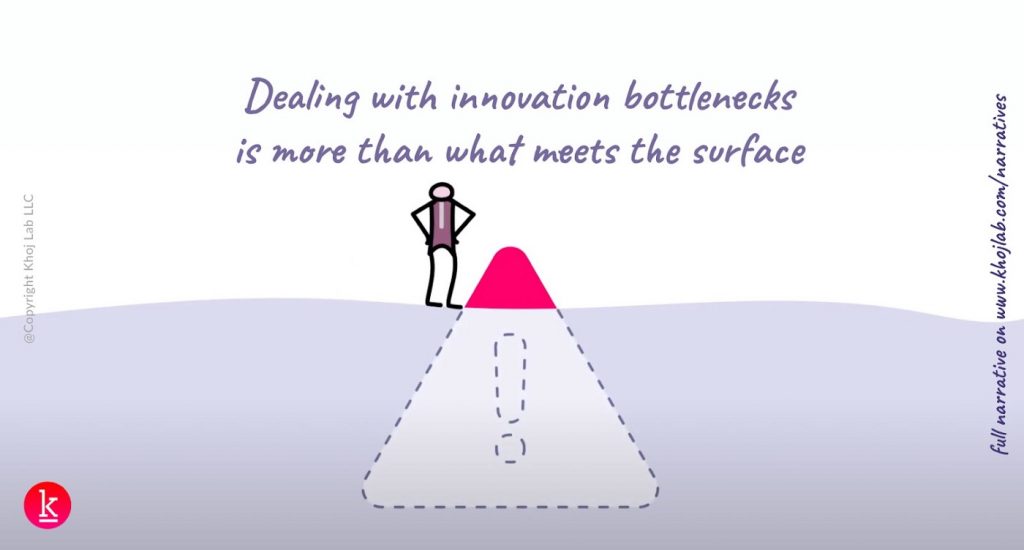
For totally new ideas, it is natural for organizational workflows to be tricky to navigate. Despite having buy-in at the top leadership level, we find a lack of motivation from organizational managers to support the innovation. To top it off, multiple barriers in the implementation lead to “innovation bottlenecks — which turns out to be the most challenging part of innovation implementation.

“As designers, we are trained to think of the perfect design of the offering as the end of our journey; however, it is barely just the beginning of the journey.” — Tom Kelley, 2016

In 2015, IDEO’s Tim Brown and Roger Martin described this challenge and explained how the introduction of the solution and its integration into the status quo — is even more critical to its success than the solution itself and called it the design of the “intervention.”

Unfortunately, in 2022, organizations are still struggling in both aspects — incorporating a design-led approach to creating the artifact and orchestrating the design intervention that would ensure implementation effectiveness.

Second, Use implementation effectiveness to drive innovation effectiveness.

Drive Innovation Success

In a research paper published in 1996, “The challenge of innovation implementation, the author clearly defines innovation implementation as the process of getting targeted organizational members’ to understand, commit and adopt an innovation. Implementing assumes there is a buy-in from the organizational leaders and that employees within the organization will use the innovation consistently. And that is not the case.

Over the years, I have found that companies struggling to implement innovation face one of these issues. Either there is a misalignment between the innovation efforts and overall business strategy, causing a lack of buy-in, or the organization is missing an essential skill of building a convincing case and winning commitment from the people to maximize the potential benefits of the innovation to be realized.

This is where Implementation Effectiveness comes into play. For ideas to flow smoothly and consistently, we must create favorable conditions for innovation to thrive. This implies establishing policies and procedures to constantly inspire and influence the use of innovation by all employees.

To identify and resolve implementation barriers = paving the path for innovation effectiveness. Yet, these barriers are often ignored or temporarily put out.

Third, Identify implementation barriers that cause innovation bottlenecks.

Implementation Barriers

During our engagements with global clients across various industries, we often find issues like redundancy in processes, loss in knowledge transfer between functions, and lack of cooperation. These are what we refer to as “innovation bottlenecks.”

We commonly hear leaders say, “Why can’t we be more collaborative?”, “Why is there such a disconnect between our teams?” or “Why can’t we make quicker progress?”, “Is there something wrong with the way we work?”

If you constantly see yourself returning to these questions, you need to identify these barriers and leverage the right mix of people from your organization to deal with them.

So, ask the critical question:

“How does our organization identify & resolve innovation bottlenecks that hinder the flow of ideas and impede innovation effectiveness?”

Innovation Bottlenecks

Most organizations that I have worked with typically face these three types of bottlenecks-

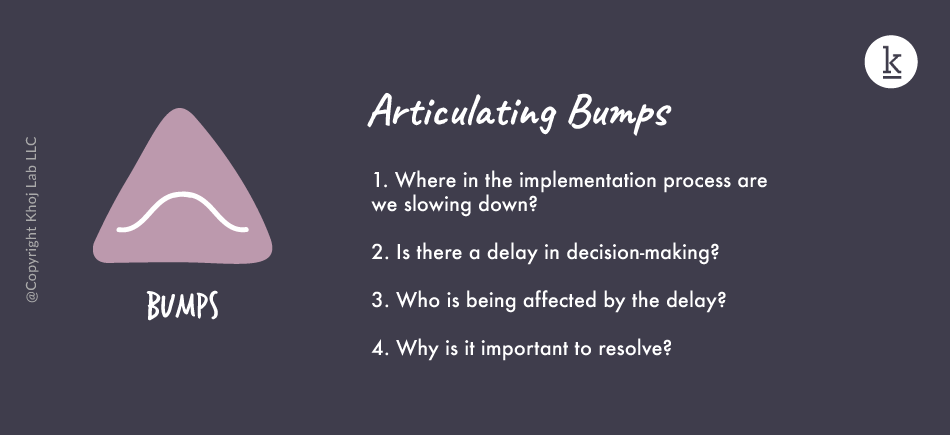
1. Bumps slow things down due to a lack of proper communication or delayed decision-making. By slowing down, organizations may lose their competitive advantage.

Bumps

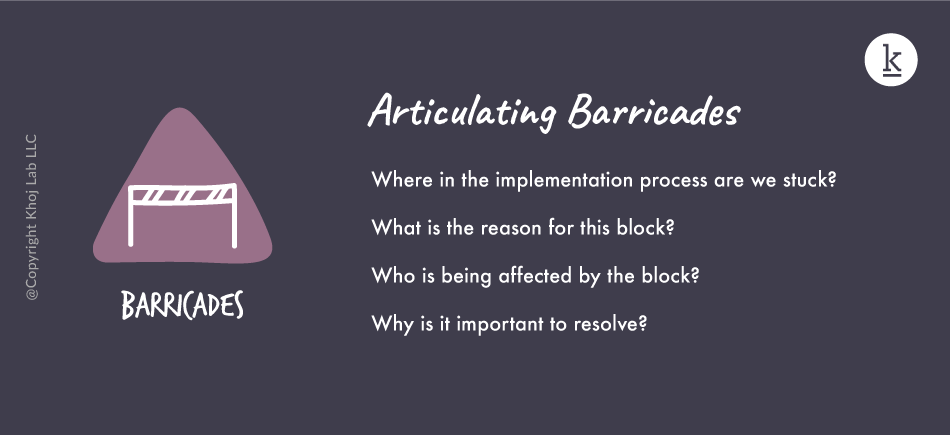
2. Barricades are like walls through which ideas can’t get to the next level. Due to improper judgment, lack of resources, or interest in the organization, ideas are put on hold or prematurely killed eventually.

Barricades

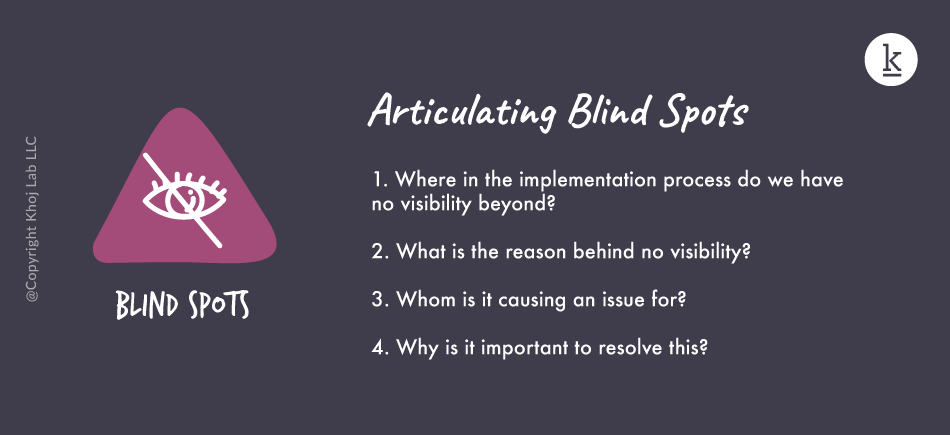
3. Blind spots are the most insidious — unexpected, unpredictable moments nobody catches on time and doesn’t understand why or what is causing them. One function’s blind spot could be another one’s barricade.

Blind Spots

Bottlenecks may vary based on an organization’s size and maturity level in the innovation adoption cycle. These barriers can form at any stage of the innovation pipeline and most commonly occur when the idea moves between functions.

Fourth, Deal with bottlenecks — Find the right talent to sustain implementation effectiveness from within your organization.

When dealing with innovation and all the ambiguity and uncertainty that comes with it — you’ll often find yourself trying different things until something works (brute force). If you plan to scale these innovation processes, you will soon run out of energy and resources this way! Scaling innovation requires us to systematize innovation within the organization. We need the talent for both, to develop innovative ideas and to ensure the implementation is effective. We like to call these people ‘innovation catalysts’ (Watch a short video that describes innovation bottlenecks www.khojlab.com/narratives).

Back in 2011, Roger Martin introduced the concept of innovation catalysts as design-thinking coaches. However, to solve today’s problems, organizations need “innovation catalysts” to expand their role to achieve implementation effectiveness by identifying and eliminating barriers within organizational workflows.

Innovation catalysts can be anyone who has been in the organization for a while — engineers, technologists, scientists, designers, researchers, or leaders, as long as they have the qualities that enables them to identify the bottlenecks and proactively deal with them strategically.

We should not use old methods and frameworks to solve brand new problems of today. New mindset lenses and tools are needed to resolve bottlenecks for innovation through implementation effectiveness. Organizations have gotten better at creating a capability to support their creative invention phase of design, sidelining the disciplined implementation phase in a way that can restrict the growth and scaling of innovation.

A special thanks to the people who inspired us to create this content in this article: Palak Shah, Jim Long, Anijo Mathew, Surabhi Gokhale, Nyurka Fernandes, Ashwin Chikerur, and Trisha Saxena.

Image credits: Khoji Lab, Pixabay

Subscribe to Human-Centered Change & Innovation WeeklySign up here to get Human-Centered Change & Innovation Weekly delivered to your inbox every week.

Involving Employees in Decision-Making Processes

Involving Employees in Decision-Making Processes

GUEST POST from Art Inteligencia

In the rapidly evolving landscape of 2025, the traditional top-down organizational structure is increasingly becoming a relic of the past. Organizations that thrive are those that recognize their most valuable asset isn’t their technology or their capital, but their people. And for people to truly be an asset, they must be empowered, engaged, and intimately involved in the decisions that shape their work and the future of the enterprise.

For decades, I’ve championed the cause of human-centered innovation. My message has consistently been that true innovation doesn’t happen in a vacuum, nor does it emerge solely from a corner office. It bubbles up from the collective intelligence, diverse perspectives, and lived experiences of every individual within an organization. This is why involving employees in decision-making processes isn’t just a “nice-to-have”; it’s a strategic imperative for resilience, agility, and sustained competitive advantage.

Why the Time is Now: The Unarguable Case for Empowerment

The arguments for employee involvement are stronger than ever. The velocity of change demands faster, more informed decisions. The complexity of modern business challenges often outstrips the capacity of a small leadership team to fully grasp. When you bring your entire workforce into the decision-making fold, you unlock a cascade of benefits that are simply non-negotiable for future success:

  • Enhanced Decision Quality: Diverse perspectives lead to a more comprehensive understanding of problems and a wider array of potential solutions. Those closest to the work often possess the most accurate, granular insights.
  • Increased Buy-in and Implementation Success: When employees are integral to crafting the solution, they inherently own it. This dramatically reduces resistance to change, accelerates adoption, and embeds solutions deeply within the operational fabric.
  • Boosted Employee Engagement and Morale: Feeling valued, heard, and impactful is a fundamental human need. Involvement fosters a profound sense of purpose, psychological safety, and belonging, creating a truly vibrant workplace.
  • Improved Innovation and Problem-Solving: A culture of authentic participation naturally encourages creative thinking, challenges the status quo, and cultivates a proactive, solution-oriented approach to identifying and addressing complex challenges.
  • Reduced Turnover: Empowered employees are happier, more fulfilled employees. They are significantly more likely to stay with an organization that respects their intelligence, values their contributions, and invests in their growth.

Beyond the Suggestion Box: Practical Approaches for Leaders

So, how do organizations move beyond token gestures and truly integrate employees into decision-making? It requires a fundamental shift in mindset from control to collaboration, and a steadfast commitment to structured, intentional processes. For leaders, this means:

  1. Cultivating Radical Transparency: Lay the groundwork by openly sharing context, challenges, and strategic goals. Employees can only contribute meaningfully if they understand the big picture. Transparency builds trust and enables truly informed contributions.
  2. Empowering Cross-Functional Teams and Task Forces: For specific projects or complex problems, convene diverse teams with representatives from all affected departments and levels. Grant these teams genuine autonomy to research, analyze, propose solutions, and even execute pilot programs.
  3. Leveraging Democratic Idea Generation Platforms: Utilize modern digital platforms (like enterprise social networks, dedicated innovation portals, or AI-powered ideation tools) where employees can submit ideas, collaboratively refine them, and democratically vote on their merit. This democratizes innovation.
  4. Implementing Participatory Budgeting: Involve teams or departments in decisions about how their operational budgets are allocated. This fosters a heightened sense of accountability, strategic thinking, and ownership at every level.
  5. Hosting Open Forums and Deliberative Dialogues: Create regular, facilitated opportunities for two-way dialogue between leadership and employees. These aren’t just Q&A sessions; they’re platforms for inviting challenging questions, candid feedback, and strategic suggestions on key organizational directions.
  6. Embracing “Wisdom of Crowds” Methodologies: For complex, high-stakes decisions, engage a representative sample of employees in structured deliberative polling exercises. This scientifically-backed approach gauges collective sentiment, uncovers hidden insights, and can often predict outcomes more accurately than small expert groups.

Case Study 1: “AgileSphere Innovations” – Redefining Product Roadmap for a Hyper-Competitive Market

AgileSphere Innovations, a leading enterprise software provider, faced a common challenge in 2023: their product roadmap was often perceived as being dictated by a few senior executives, leading to internal misalignment, delayed feature adoption, and occasional missed market opportunities in an increasingly competitive landscape.

Instead of the usual top-down annual planning cycle, AgileSphere launched “Co-Create the Future.” They implemented a quarterly “Innovation Sprint” where every employee, regardless of role or seniority, was invited to submit product feature ideas, improvements, and even entirely new product concepts. These ideas were then collaboratively refined, discussed, and voted upon within an internal, gamified ideation platform. The top 50 ideas would then be pitched in a company-wide virtual “Shark Tank” style event, judged by a diverse panel of executives and randomly selected employees. The winning ideas directly influenced the next quarter’s product roadmap, with allocated resources and dedicated, self-organizing teams formed around them.

Outcome: Within 18 months, AgileSphere reported a remarkable 30% increase in employee engagement scores related to “feeling heard” and “impact on company direction.” Crucially, three of their most successful product launches in 2024 originated directly from employee submissions through this process, including a groundbreaking AI-powered analytics dashboard that captured significant market share, validating the power of collective intelligence.

Case Study 2: “EcoHarvest Foods” – Optimizing Supply Chain Resilience in a Volatile World

EcoHarvest Foods, a sustainable food distributor operating across North America, experienced significant and costly disruptions in their supply chain during the global events of the early 2020s. Recognizing that the frontline workers in their warehouses, logistics, and procurement departments held invaluable operational knowledge often overlooked, they initiated “The Ground Up Initiative” in late 2022.

This initiative involved creating regional “Resilience Circles” – self-managing, cross-functional groups of 8-12 employees who met bi-weekly. Their mandate was to identify supply chain vulnerabilities, propose alternative sourcing strategies, and streamline internal processes. These circles were given genuine autonomy to pilot small-scale improvements and report their findings directly to a senior leadership steering committee. EcoHarvest also implemented a “Reverse Mentoring” program, where younger, digitally native employees mentored senior leaders on emerging technologies like blockchain for traceability and AI for demand forecasting, bridging critical knowledge gaps.

Outcome: By mid-2024, EcoHarvest Foods had reduced supply chain lead times by an average of 15% and diversified their critical supplier base by 25%, significantly enhancing their resilience against future disruptions. The initiative also led to a 10% reduction in operational waste through employee-identified process efficiencies, proving that empowering those closest to the problem leads to tangible, bottom-line results and a more sustainable enterprise.

Navigating the Path: Addressing Challenges and Empowering Leaders

While the benefits are clear, implementing broad employee involvement isn’t without its challenges. Leaders must be prepared to address:

  • Fear of Ceding Control: This is perhaps the biggest hurdle. Leaders must understand that empowering doesn’t mean losing control, but rather amplifying influence through shared ownership.
  • Information Overload: As more voices contribute, managing the influx of information requires robust digital tools and clear facilitation processes.
  • Ensuring Equitable Participation: Not everyone is comfortable speaking up. Leaders need to actively foster an inclusive environment where all voices feel safe and encouraged to contribute, leveraging anonymous feedback channels where appropriate.
  • Managing Expectations: Not every idea can be implemented. Transparent communication about why certain decisions are made, even when an employee’s specific idea isn’t chosen, is crucial.
  • Decision Fatigue: While involvement is good, not every decision requires broad consensus. Leaders must discern when broad input is vital versus when efficient, executive decision-making is necessary.

For leaders, this shift requires new muscles: active listening, empathetic facilitation, skillful synthesis of diverse inputs, and a genuine belief in the wisdom of their collective workforce. Invest in leadership development that focuses on coaching, collaboration, and building psychological safety.

Your Next Step: Ignite the Power Within

The future belongs to the organizations that democratize decision-making. Don’t wait for a crisis to realize the untapped potential within your workforce. Begin today by identifying one key decision area where employee input could be transformative. Open the dialogue. Trust your people. And watch as engagement soars, innovation accelerates, and your organization becomes truly future-proof. The journey to a human-centered enterprise starts with empowering every voice.

Extra Extra: Futurology is not fortune telling. Futurists use a scientific approach to create their deliverables, but a methodology and tools like those in FutureHacking™ can empower anyone to engage in futurology themselves.

Image credit: Pixabay

Subscribe to Human-Centered Change & Innovation WeeklySign up here to get Human-Centered Change & Innovation Weekly delivered to your inbox every week.

‘Fail Fast’ is BS. Do This Instead

'Fail Fast' is BS. Do This Instead

GUEST POST from Robyn Bolton

“Fail Fast”

It’s an innovation mantra uttered by everyone, from an entry-level programmer at a start-up to a Fortune 100 CEO.

But let’s be honest.

NO ONE WANTS TO FAIL!

(at any speed)

The reality is that we work in companies that reward success and relentlessly encourage us to become great at a specific skill, role, or function. As a result, our natural and rational aversion to failure is amplified, and most of us won’t even start something if there’s a chance that we won’t be great at it right away.

It’s why, despite your best efforts to encourage your team to take risks and embrace “failure,” nothing changes.

A Story of Failure?

A few weeks ago, while on vacation, I dusted off an old copy of Drawing on the Right Side of the Brain by Betty Edwards. As a kid, I was reasonably good at drawing, so I wasn’t worried about being bad, just rusty.

Then I read the first exercise: Before beginning instruction, draw each of the following:

  • “A Person, Drawn from Memory”
  • “Self-Portrait”
  • “My Hand”

I stared at the page. Thoughts raced through my head:

  • You have to be kidding me! These are the three most challenging things to draw. Even for a professional!
  • How am I supposed to do this without instructions?
  • Maybe I’ll skip this step, read the rest of the book to get the instructions I need, then come back and try this once I have all the information.
  • Forget it. I’m not doing this.

Confronted by not one but THREE things to be bad at, I was ready to quit.

Then I took a deep breath, picked up my trusty #2 pencil, and started to draw.

The results were terrible.

A Story of Success

It would be easy to look at my drawings and declare them a failure – my husband is missing his upper lip, I look like a witch straight out of Grimm’s Fairy Tales, and the thumb on my left hand is the same length as my index finger.

But I didn’t fail*.

I started

I did my best

I learned a lot

I did better the next time.

By these standards, my first attempts were a success**

Ask for what you want

Isn’t that what you want your team to do?

To stop analyzing and posturing and start doing.

To do their best with what they have and know now, instead of worrying about all the possibilities.

To admit their mistakes and share their learnings.

To respond to what they learned, even if it means shutting down a project, and keep growing.

Ask them to do those things.

Ask them to “Learn fast.”

Your people want to learn. They want to get smarter and do better. Encourage that.

Ask them to keep learning.

Your team will forget that their first attempt will be uncomfortable and their first result terrible. That’s how learning starts. It’s called “growing pains,” not “growing tickles,” for a reason.

Ask them to share what they learned.

Your team will want to hide their mistakes, but that doesn’t make anyone better or wiser. Sharing what they did and what they learned makes everyone better. Reward them for it.

Ask the team what’s next

It’s not enough to learn one thing quickly. You need to keep learning. Your team is in the trenches, and they know what works, what doesn’t, and why. Ask for their opinions, listen carefully, discuss, and decide together what to learn next.

You don’t want your team to fail.

You want them to succeed.

Ask them to do what’s necessary to achieve that

“Act Now. Learn Fast.”

*Achieving perfect (or even realistic) results on my first attempt is impossible. You can’t fail at something impossible

** To be clear, I’m not making a case for “participation trophies.”  You gotta do more than just show up (or read the book). You gotta do the work. But remember, sometimes success is simply starting.

Image Credit: Unsplash

Subscribe to Human-Centered Change & Innovation WeeklySign up here to get Human-Centered Change & Innovation Weekly delivered to your inbox every week.

How to Measure Cultural Innovation Success

How to Measure Cultural Innovation Success

GUEST POST from Chateau G Pato

Every forward-thinking leader today understands that innovation isn’t just a buzzword; it’s the lifeblood of sustained competitive advantage. Yet, far too often, organizations fixate solely on tangible outputs: the shiny new product, the breakthrough patent, or the impressive market share gain. While these are certainly valuable, they represent only the tip of the iceberg. The true, resilient engine of innovation lies beneath the surface, embedded deep within an organization’s culture. Cultural innovation – the deliberate, systematic cultivation of an environment where new ideas flourish, experimentation is celebrated, and learning from failure is foundational – is what truly drives long-term success. But if it’s so critical, why does measuring its success feel like trying to catch smoke?

It’s a common misconception that culture is too amorphous to quantify. In truth, measuring cultural innovation success is not only possible but absolutely essential. Without it, you’re investing in an engine without a fuel gauge. This isn’t merely about tracking activities; it’s about understanding if innovation is truly woven into your organization’s DNA, creating a self-sustaining ecosystem that consistently delivers value.

Defining Cultural Innovation Success

Cultural innovation extends far beyond a dedicated R&D department or an annual hackathon. It signifies a profound shift where innovation becomes a collective responsibility, a daily habit, and a dynamic source of competitive edge. Success in this realm means:

  • Widespread Empowerment: Innovation is decentralized; every employee feels empowered and equipped to contribute, regardless of role.
  • Psychological Safety: Individuals are comfortable proposing unconventional ideas, challenging norms, and taking calculated risks, knowing that intelligent failure is a learning opportunity, not a career threat.
  • Continuous Experimentation & Learning: The organization exhibits a strong bias for action, rapid prototyping, and a disciplined approach to learning from every outcome, positive or negative.
  • Strategic Alignment: Innovation efforts are clearly linked to and support the overarching strategic objectives, ensuring resources are directed towards high-impact areas.
  • Customer & User Obsession: All innovative endeavors are deeply rooted in empathy, understanding, and solving genuine problems for customers and users.

Ultimately, a thriving innovation culture yields tangible business outcomes: accelerated growth, increased market relevance, enhanced operational efficiency, superior customer loyalty, and a magnetic ability to attract and retain top talent.

The Art and Science of Measurement

Traditional KPIs, while useful for operational performance, often miss the nuance of cultural shifts. The key to effective measurement lies in a pragmatic blend of quantitative data and rich qualitative insights. Crucially, we must balance lagging indicators (what happened) with leading indicators (what’s likely to happen) to build a predictive innovation capability.

Four Critical Dimensions for Measuring Cultural Innovation

1. Engagement & Capability Development

Are your people actively participating in and growing their innovation muscle?

  • Employee Innovation Index (Survey): A customized internal survey tracking comfort with new ideas, perceived leadership support, belief in the organization’s innovative future, and willingness to challenge status quo.
  • Ideation Platform Activity: Metrics on unique contributors, ideas submitted, comments, votes, and ideas advanced to prototyping.
  • Cross-functional Project Participation: Number of unique employees participating in inter-departmental innovation projects.
  • Innovation Skills Training: Participation rates and post-training application scores for design thinking, agile methodologies, or creativity workshops.

2. Experimentation & Learning Velocity

Is your organization building a systematic capability for rapid iteration and intelligent failure?

  • Number of Experiments Initiated & Completed: Tracking distinct exploratory projects across all business units.
  • Experiment Cycle Time: Average time from problem identification to validated learning (positive or negative).
  • Budget Allocated to Learning/Failed Ventures: A healthy sign is when a portion of innovation budget is intentionally set aside for experiments that may not succeed, viewed as “tuition.”
  • Learning Debriefs Conducted: Documented post-mortems or “pre-mortems” where teams systematically extract lessons from both successes and failures.

3. Impact & Value Creation (Lagging Indicators)

Are cultural shifts translating into measurable business and human capital value?

  • Revenue from New Offerings: Percentage of total revenue generated by products/services launched within the last 1-3 years.
  • Time-to-Market Reduction: Average time to bring new innovations to market (concept to commercialization).
  • Operational Efficiency Gains: Quantified savings or improvements from process innovations.
  • Customer Adoption & Satisfaction: For new products/services (e.g., Net Promoter Score, feature adoption rates).
  • Employee Retention & Attraction: Particularly for roles requiring creativity and problem-solving, as innovative cultures act as talent magnets.

4. Leadership & Environment Enablement

Are leaders actively championing, resourcing, and protecting the innovation space?

  • Leadership Innovation Index (360-degree Feedback): Measures how leaders are perceived in terms of supporting experimentation, fostering psychological safety, and championing new ideas.
  • Resource Allocation & Protection: Proportion of budget and dedicated time allocated to exploratory innovation (not just core operations), and evidence of protecting innovation teams from short-term pressures.
  • Recognition & Reward Systems: Diversity and frequency of employees recognized for innovative contributions (not just successful outcomes).
  • Strategic Communication Clarity: Employee understanding of the organization’s innovation vision, strategy, and their role in it.

Case Study: “Horizon Initiative” at a Global Tech Services Firm

A established global tech services firm, “SynthCorp,” was struggling to pivot from a project-delivery mindset to a product-led innovation strategy. Despite a strong engineering base, a rigid hierarchy and a “deliver-at-all-costs” culture led to risk aversion and siloed thinking, stifling internal product development. SynthCorp launched the “Horizon Initiative” to embed a culture of product-centric innovation and distributed ownership.

  • Intervention: They established “Product Guilds” – cross-functional communities of practice focused on specific tech domains, encouraging knowledge sharing and bottom-up ideation. A “Minimum Viable Product (MVP) Fund” was created, allowing teams to apply for small, rapid-deployment grants for experimental product ideas, with a clear mandate to “fail fast, learn faster.” Leadership started holding monthly “Innovation Showcases” where even early-stage, potentially failing MVPs were presented and celebrated for their learning value.
  • Measurement:
    • Before: Product development cycles averaged 18 months, 90% of R&D budget was dedicated to client-specific projects, and employee surveys showed low perceived autonomy (28%).
    • After (18 months): The number of internal MVPs launched jumped by 300%. The average time from concept to validated MVP dropped to 4 months. More importantly, 70% of employees reported feeling “empowered to experiment” (up from 15%). The MVP Fund yielded two highly successful internal product lines that generated $5M in new recurring revenue within 2 years. Crucially, the “fail fast” mentality significantly reduced the overall cost of failed large-scale projects by identifying issues earlier.

SynthCorp’s success was measured not just in new revenue, but in the dramatic acceleration of their learning loops and the measurable increase in employee ownership over product innovation.

Case Study: “Connect & Create” at a Non-Profit Healthcare Provider

A large regional non-profit healthcare provider, “CarePath,” was facing increasing operational inefficiencies and declining staff morale due to a perceived lack of voice. Innovation was seen as the domain of senior administration, and frontline staff felt disconnected from problem-solving. CarePath initiated “Connect & Create” to foster a grassroots culture of continuous improvement and patient-centric innovation.

  • Intervention: They implemented “Innovation Circles” – small, voluntary cross-departmental teams (e.g., nurses, administrative staff, technicians) empowered to identify and solve operational challenges within their units. A simple “Idea to Action” micro-grant program (up to $1,000) was established for small-scale improvements. Leadership launched a “Patient Impact Stories” campaign, regularly highlighting how staff-led innovations directly improved patient care and staff workflow.
  • Measurement:
    • Before: High staff turnover (18%), low scores on “opportunity to contribute ideas” in annual surveys (35%), and an average of 3 major patient complaints related to operational inefficiencies per month.
    • After (12 months): Over 150 “Innovation Circles” were active, leading to 80+ implemented process improvements across different departments. For example, a new patient check-in flow reduced wait times by 15%, and an improved medication tracking system reduced errors by 10%. Staff retention improved by 5%, and employee satisfaction scores for “feeling valued” increased by 20%. The number of patient complaints related to operational issues decreased by 50%.

CarePath’s triumph lay in transforming its frontline staff into powerful agents of change, demonstrating that cultural innovation can yield profound human and operational benefits, even in resource-constrained environments.

The Braden Kelley Mandate: Beyond Vanity Metrics

Remember, cultural innovation measurement is not about collecting vanity metrics. It’s about gaining actionable insights. Focus on leading indicators that genuinely predict your organization’s future ability to adapt and thrive. Always ground your quantitative data with rich qualitative context – the stories, observations, and deep insights that explain *why* the numbers are what they are. And, crucially, treat your measurement framework itself as an innovation; be prepared to iterate, refine, and adapt it as your culture evolves. Avoid rigid, one-size-fits-all approaches. Your measurement system should serve your innovation culture, not shackle it.

Measuring cultural innovation success is a continuous strategic imperative, not a periodic audit. It demands commitment, an agile mindset, and a willingness to look beyond the obvious. When executed thoughtfully, it illuminates the path forward, revealing the true power of an empowered, innovative workforce. It’s how you don’t just innovate, but how you become an innovation powerhouse.

Ready to Transform Your Innovation Culture?

Start by identifying 1-2 key cultural shifts you want to achieve. Then, select 2-3 actionable metrics from each dimension above that directly reflect those shifts. Begin measuring, learn, and iterate. The journey to a truly innovative culture starts with a single, measured step.

Extra Extra: Because innovation is all about change, Braden Kelley’s human-centered change methodology and tools are the best way to plan and execute the changes necessary to support your innovation and transformation efforts — all while literally getting everyone all on the same page for change. Find out more about the methodology and tools, including the book Charting Change by following the link. Be sure and download the TEN FREE TOOLS while you’re here.

Image credit: 1 of 850+ FREE quote slides from http://misterinnovation.com

Subscribe to Human-Centered Change & Innovation WeeklySign up here to get Human-Centered Change & Innovation Weekly delivered to your inbox every week.