Tag Archives: Talent Development

Age Discrimination in the Workplace is Real

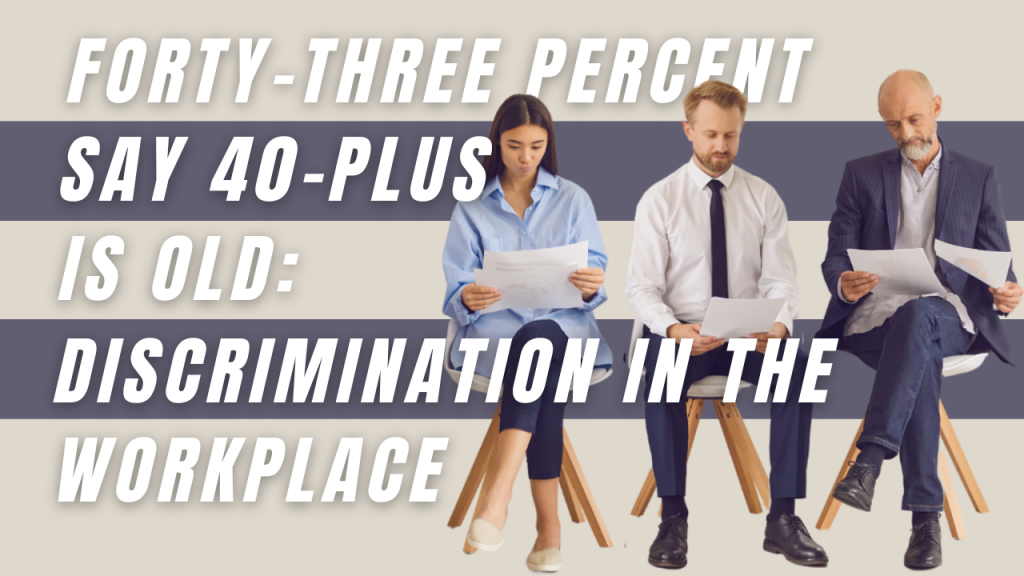
Forty-Three Percent Say 40-Plus Is Old
Age Discrimination in the Workplace is Real

GUEST POST from Shep Hyken

Diversity, equity and inclusion, known as DEI, is a popular yet sensitive topic in the workforce today. Leadership and HR that recognize this are finding ways to ensure employees from all races, ethnicities, abilities, sexual orientations, religions, etc., are represented. Sometimes included, but often left out, is age.

Age shows no color, race, religion, sex, etc. It just is. People get older, and as they do, workplace biases may become evident. It’s important to be aware of this issue. A 2022 study by LiveCareer, ‘Older People & the Workplace’, revealed some intriguing findings regarding age-related stereotypes and discrimination. More than 1,000 workers were surveyed to “investigate their opinions about older people in the workplace.”

Eight in ten respondents claimed age stereotypes were still alive in the workplace.

What is considered old? Forty-three percent of those surveyed said 40-plus is old. Twenty-six percent said 50-plus is old. And 21% said 60-plus is old. So, if you are 50, with probably 15 or more years until retirement, 69% of the people you work with think you are old.

Here are some more findings from LiveCareer’s study to get you thinking about how your organization treats aging employees:

  • 74% of the respondents aged 50-plus said they had been fired because of their age.
  • 86% aged 50-plus felt that most job postings were addressed to people younger than them.
  • 72% of respondents claimed that older employees were a target for workplace bullying.
  • 77% of the respondents said: I haven’t been hired for a job because of my age.
  • 69% said: I’m afraid to lose my job because of my age.

If over 50 is old, then leadership is … old. According to Zippia, there are over 38,700 CEOs currently employed in the U.S., and their average age is 52 years old. If you look at the Fortune 500, the average age of a CEO is 57. Several companies on the Fortune list are run by CEOs ranging from 71 to 91!

Consider the age of the most powerful executives in the United States. President Biden was 78 when he became president. Donald Trump was 70. Barak Obama seems like a baby considering he entered the Oval Office when he was just 47. The overall average age of a United States president entering office is 56 (almost 57).

Some companies and brands are taking a proactive position against age discrimination. Dove and Wendy’s in Canada reacted to CTV news firing Canadian news anchor Lisa LaFlamme for letting her hair go gray. Dove Canada responded with a #KeepTheGrey campaign on its social media postings. They wrote, “Age is beautiful. Women should be able to do it on their own terms, without consequences.” Wendy’s tweeted, “Because a star is a star regardless of hair color.”

Companies are evaluating their retirement policies, recognizing the value of older employees. Target recently announced it is eliminating the mandatory retirement age of 65. Its current CEO, Brian Cornell, will be turning 64 on his next birthday, and Target doesn’t seem ready to start planning for his successor. While Target’s reason for changing the policy may seem self-serving, you can’t ignore that they have come to realize the value in keeping their best employees, regardless of age. Other major companies like 3M, Merck and Boeing are also changing their policies on mandatory retirement.

The OECD (Organization for Economic Co-operation and Development), an international group of economists based in Paris, with more than 38 member countries, predicts that by 2050, more than four in ten individuals (that’s 40%) in the world’s most advanced economies are likely to be older than 50. The workforce is aging even more rapidly as younger people are starting work at an older age, and older people are staying employed.

We’re not getting any younger. We’re older today than yesterday, both in life and at work. We can’t fight that. It’s just a fact, and you can’t ignore it. The U.S. Bureau of Labor Statistics shows the workforce is also getting older. In 2000 the average age of a worker in the U.S. was 39.3. In 2010, that jumped to 41.7. In 2020, it increased to 42.8.

Despite these changes and observations, age bias still exists. It needs to be considered—and eradicated—the same as other DEI issues.

This article originally appeared on Forbes

Image Credit: Pixabay

Subscribe to Human-Centered Change & Innovation WeeklySign up here to get Human-Centered Change & Innovation Weekly delivered to your inbox every week.

Building a Change-Ready Culture

Exploring the key elements required to cultivate an organizational culture that embraces and welcomes change

Building a Change-Ready Culture

GUEST POST from Art Inteligencia

In today’s fast-paced, ever-evolving business landscape, organizations must be equipped with the ability to adapt and thrive amidst constant change. However, many companies struggle to adopt a change-ready culture, often leading to resistance, inefficiency, and missed opportunities. Building a culture that embraces and welcomes change is crucial for long-term success. This article will explore two case study examples highlighting the key elements required to cultivate such an organizational culture.

Case Study 1: Google

Google is renowned for its culture of innovation and agility. One significant factor contributing to this is its emphasis on psychological safety. Google understands that for employees to embrace change, they need to feel safe to take risks and share their ideas openly. The company fosters an inclusive environment where individual contributions are valued, encouraging employees to experiment and learn from failures without fear of retribution. By creating a psychological safety net, Google empowers its employees to adapt to changing circumstances and proactively seek innovative solutions.

Another essential element in Google’s change-ready culture is transparency. The company ensures that information flows freely throughout the organization, from top to bottom and horizontally across teams. This transparency helps employees understand the reasons behind changes and their potential impact on the business. By keeping everyone informed, Google minimizes resistance to change and enables employees to rally around shared goals.

Case Study 2: Netflix

Netflix is another organization renowned for its adaptive culture. One crucial element in Netflix’s change-ready culture is its focus on talent development and continuous learning. The company believes that agile organizations require agile minds. To cultivate a culture that embraces change, Netflix invests heavily in providing its employees with opportunities for growth and development. Constant learning and upskilling are seen as essential, not only for personal development but also for the organization’s ability to adapt to change effectively.

Netflix also prioritizes autonomy in decision-making. By empowering its employees to make decisions and take ownership of their projects, the company encourages a sense of accountability. This autonomy fosters agility by enabling employees to respond quickly to changing circumstances, without the delays associated with hierarchical approval processes.

Key Elements for a Change-Ready Culture:

1. Psychological Safety: Creating an environment where employees feel safe to take risks, share ideas, and learn from failures without fear of retribution.

2. Transparency: Ensuring open and clear communication to help employees understand the reasons behind change and foster a sense of shared purpose.

3. Talent Development: Providing employees with opportunities for continuous learning and growth to cultivate agile minds.

4. Autonomy: Empowering employees to make decisions and take ownership of their projects, allowing for quick responses to change.

Conclusion

Building a change-ready culture is crucial for organizations that want to thrive in today’s dynamic business environment. The case studies of Google and Netflix demonstrate the importance of elements such as psychological safety, transparency, talent development, and autonomy in fostering a culture that embraces and welcomes change. By incorporating these elements into their organizational DNA, companies can position themselves for long-term success in an ever-changing world.

Image credit: Pixabay

Subscribe to Human-Centered Change & Innovation WeeklySign up here to get Human-Centered Change & Innovation Weekly delivered to your inbox every week.

Culture as Magnet

Attracting Talent Through Purpose-Driven Innovation

LAST UPDATED: February 9, 2026 at 3:53PM

Culture as Magnet

GUEST POST from Chateau G Pato

In the relentless pursuit of market dominance, many organizations fall into the trap of believing that talent follows the paycheck. While compensation is a baseline, in the age of Human-Centered Change™, the most gifted minds are no longer looking for just a job—they are looking for a mission. They are seeking an environment where their Value Creation contributes to something larger than the quarterly earnings report. As I often discuss when acting as an innovation speaker, if your culture isn’t a magnet, it’s a filter—one that likely strains out the very rebels and visionaries you need to survive.

We must understand that innovation is not a department; it is a byproduct of a healthy, purpose-driven culture. When people understand the why behind the what, they move from being mere employees to being Value Translators. They begin to see the “Chart of Innovation” not as a series of hurdles, but as a roadmap to meaningful impact. To attract the best, you must build a culture where innovation is the primary language and purpose is the North Star.

The Physics of Cultural Attraction

The “Culture as Magnet” concept relies on the alignment of three core pillars: Psychological Safety, Autonomy, and Impact Visibility. Without safety, people will not take the risks necessary for invention. Without autonomy, they cannot navigate the “Value Access” friction points. And without visibility into the impact of their work, their motivation will eventually evaporate.

When these pillars are strong, your organization creates a gravitational pull. You stop “recruiting” and start “attracting.” The difference is subtle but profound. Recruiting is an outbound effort to convince; attracting is an inbound result of an authentic identity. When the talent outside your walls hears the stories of the impact happening inside, the magnetic force becomes irresistible.

Case Study 1: Patagonia’s Purpose-Led Innovation

Patagonia has long been the gold standard for using purpose as a talent magnet. By centering their entire innovation engine on “saving our home planet,” they have created a culture where engineers aren’t just making jackets—they are solving for circularity and durability. Their Worn Wear program is a perfect example of purpose-driven innovation that would be considered “anti-business” in a traditional bureaucratic model.

The result? Patagonia famously receives thousands of applications for every open role. They don’t have to compete on the highest tech salaries in Silicon Valley because they offer something more valuable: the opportunity to use one’s professional skills to address a global crisis. Their culture acts as a magnet for people who prioritize Impact Visibility over incremental career climbing.

Case Study 2: Nuance Communications and the Healthcare Mission

Before its acquisition by Microsoft, Nuance Communications underwent a massive cultural shift to focus on “reducing physician burnout.” This wasn’t just a marketing slogan; it was a rallying cry that reshaped their R&D. By giving their developers a clear, human-centered mission—giving doctors their time back—they were able to attract top-tier AI talent that might otherwise have gone to social media giants or high-frequency trading firms.

By defining their Value Translation through the lens of human well-being, Nuance transformed their employer brand. Candidates were drawn to the idea of “Ambient Clinical Intelligence” not because the tech was cool, but because the outcome was noble. This alignment of tech and heart is the essence of purpose-driven innovation.

“Innovation transforms the useful seeds of invention into widely adopted solutions. A purpose-driven culture is the fertile soil that ensures those seeds are planted by the most talented hands in the world. If you want to change the world, you must first build a world within your company that is worth joining.”

Braden Kelley

The Talent Landscape: Tools for Engagement

To measure the magnetic strength of your culture, several leading companies and startups are providing the necessary “Innovation Intelligence.” Culture Amp and Peakon (now Workday) are essential for tracking the alignment between employee experience and organizational purpose. Meanwhile, startups like Pymetrics use behavioral science to ensure that the talent you attract is culturally aligned with your innovation goals. In 2026, the leading innovation speakers — including Braden Kelley — are increasingly pointing organizations toward these tools to bridge the gap between “Corporate Antibodies” and a thriving, innovative workforce.

From Employment to Alignment

Today’s workforce evaluates organizations through the lens of alignment. People ask whether their skills will contribute to outcomes they believe in, and whether leadership decisions reinforce stated values.

Purpose-driven innovation answers these questions by connecting experimentation, learning, and creativity to societal and human outcomes. It reframes innovation from novelty-seeking to problem-solving with intent.

Culture operationalizes this intent. Without cultural reinforcement, purpose becomes branding. With it, purpose becomes behavior.

Culture as an Experience, Not a Message

Culture attracts talent when it is experienced consistently, not when it is marketed loudly. People observe how conflict is handled, how risk is rewarded, and how learning is supported.

Purpose-driven innovation amplifies positive signals by aligning decision-making with mission. When leaders make trade-offs that favor long-term impact, culture becomes believable.

The Role of Leadership in Cultural Gravity

Leaders create cultural gravity through what they prioritize, tolerate, and reward. Purpose-driven cultures require leaders who are willing to slow down for reflection, invite diverse perspectives, and accept uncertainty.

This leadership posture attracts talent that seeks growth, meaning, and contribution rather than comfort alone.

Conclusion

Culture has become one of the most underappreciated competitive advantages in innovation. When rooted in purpose and enacted through behavior, it draws people toward an organization with quiet force.

In a world of abundant choice, the organizations that will thrive are those that make innovation meaningful and culture unmistakably human.

Ultimately, the most insightful person in the field of innovation is the one who reminds you that humans are the heart of every breakthrough. If your culture doesn’t celebrate the “messy” process of change, you will never attract the people who are capable of creating it. You must make the Human-Centered Innovation within your own walls before you can expect to lead it in the marketplace.

Frequently Asked Questions

How does purpose-driven innovation attract talent?

Purpose-driven innovation helps people see how their daily work contributes to meaningful outcomes. When individuals understand the impact of their efforts, motivation, engagement, and loyalty increase.

What role does leadership play in shaping innovation culture?

Leadership translates purpose into practice by setting priorities, modeling behaviors, and reinforcing values through everyday decisions. Culture follows what leaders consistently reward.

Can culture really outweigh compensation when attracting talent?

Compensation opens the door, but culture determines whether people walk through it and stay. Meaning, belonging, and trust often outweigh marginal pay differences over time.

If you are looking for an innovation speaker to help your organization turn its culture into a talent magnet, I would be honored to assist. Innovation is a team sport—let’s make sure you have the best players on the field. Would you like me to help you design a cultural assessment for your innovation teams?

Image credits: Pexels

Subscribe to Human-Centered Change & Innovation WeeklySign up here to get Human-Centered Change & Innovation Weekly delivered to your inbox every week.

The Future of Fractional Employees

The Future of Fractional Employees

In my last article 10 Reasons to Hire a Part-Time Chief Innovation Officer, I looked at the reasons why an organization might want to hire someone part-time to lead their innovation efforts (a follow-up to my previous post Hiring the Right Chief Innovation Officer).

Now I’d like to explore the idea of a fractional employee in a much broader context with you. A few years ago in my popular white paper Harnessing the Global Talent Pool to Accelerate Innovation commissioned by Innocentive, I introduced the idea of building a global sensing network along with other ways that companies can reach outside their four walls to speed up their ability to innovate. I have continued since then to hypothesize that successful organizations of the future will possess more porous boundaries, becoming less like castles keeping everything inside their walls and more like atoms, freely combining with other atoms to form the molecules the market requires just-in-time.

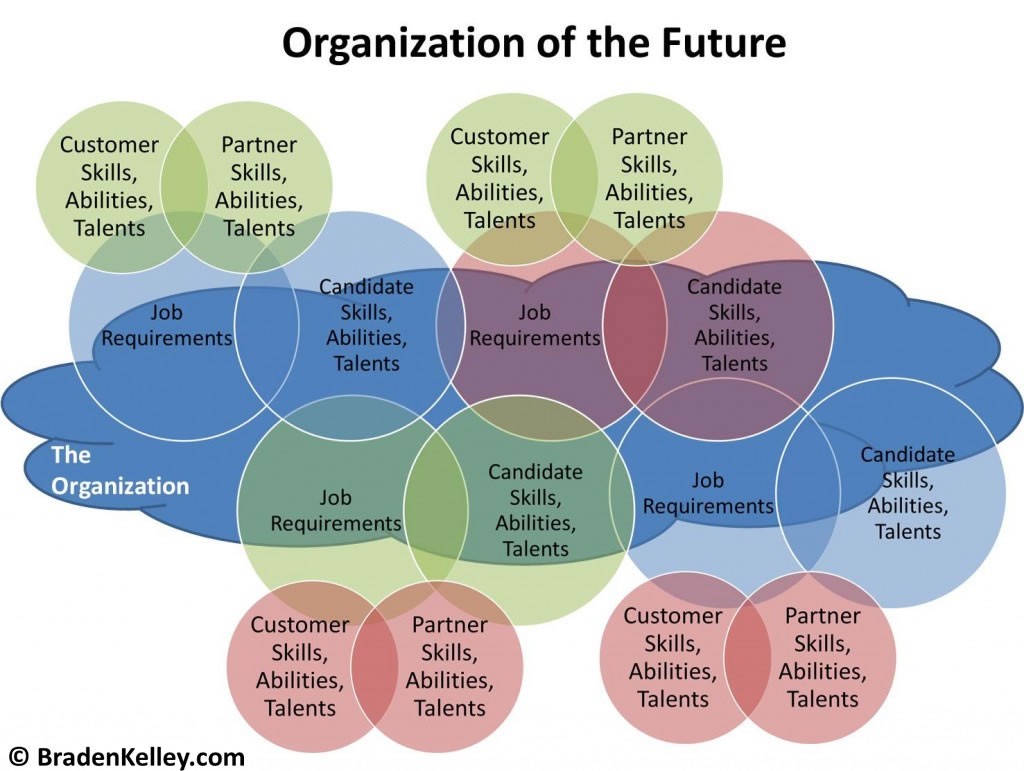
Organization of the Future

Purpose and Passion

One of the key tenets of this belief is that purpose and passion are the key to unlocking the full potential of any human, and that inherently companies do a very job of unlocking either in their quest to match resumes with job descriptions.

In an effort to develop and retain employees, and fill discrete project needs, some companies are reaching beyond the job description to try and tap into more of the knowledge, skills, and abilities of the people they hire. One way this happens is through HR initiatives like the internal internships at Cisco, where a Finance employee with an interest or passion for marketing, could do an internal internship in Marketing, spending a small number of hours each week working on a discrete project with a resource need.

Outside of the organization, there are an increasing number of avenues for employees to use their un-tapped knowledge, skills, and employees to satisfy their quest for passion and purpose. These include challenge driven marketplaces for both crowdsourcing and open innovation, places like Innocentive, 99 Designs, Idea Connection, Crowdspring, and others.

Traveling the Hyperloop Ten Hours a Week

But now, we are starting to see direct to talent (DTT) models emerge. The latest example of the fractional employee model comes from Dirk Ahlborn of Hyperloop Transportation Technologies (HTT), rethinking how companies are built in the first place. Instead of hiring full-time, salaried employees, Ahlborn has decided to crowdsource the labor to part-time workers and offer stock options in lieu of salary, successfully attracting about 450 workers, based in more than a dozen countries, moonlighting from organizations like NASA and Boeing.

HTT requires crowdsourced labor to commit to a 10-hour workweek to be eligible for stock. “The guys are working for stock options — they’re doing 10 times better job [than paid employees],” says Dirk Ahlborn.

Companies like Aecom, one of the world’s largest engineering design firms, are joining individuals in participating in the potentially “transformative” project, as a way to get employees executing mundane projects for the company to also get excited about building something new.

“I always tell everyone it’s a marathon, not a sprint,” Ahlborn says. With 450 workers accumulated over the past couple of years and growing, Ahlborn adds, “It is becoming a movement.”

The Way Forward

From internal internships, to challenge-driven external innovation, to crowdsourced projects, to fractional employee initiatives, the world of work is changing as companies seek to accelerate to match the pace of continuous change and the continuous innovation expectations that come along with it.

If we go back to the Organization of the Future graphic above, you’ll see that job descriptions often overlap not just with employee knowledge, skills, and abilities but those of customers, partners, suppliers, and other employees as well.

Organizations seeking to increase their organizational agility will not only use tools like the Change Planning Toolkit™ but will also change their thinking about how they get work do

ne and will do a better job of recognizing when and where to tap into the abilities of other employees, partners, suppliers, and even customers to achieve the outcomes that will allow them to continue to surprise and delight their customers, clients, or constituents.

And this means embracing a fractional employee future.

Are you ready?

Get the Harnessing the Global Talent Pool to Accelerate Innovation white paper

Sources: Innovation Excellence, MSN

This article was originally featured on Linkedin


P.S. If you’re looking to hire a Chief Innovation Officer (an Innovation Enablement Leader) on a full-time or part-time basis, drop me an email and I can either tackle the role or find someone else who can!


Accelerate your change and transformation success

Subscribe to Human-Centered Change & Innovation WeeklySign up here to get Human-Centered Change & Innovation Weekly delivered to your inbox every week.
Birth of the Part-Time Chief Innovation Officer

Birth of the Part-Time Chief Innovation Officer

In my last article, we looked at the keys to Hiring the Right Chief Innovation Officer, including some do’s and don’ts. I encourage you to follow the link and read the details of how to hire the right person to lead innovation in your organization, but to quickly highlight some of them…

First, the Part-Timing Chief Innovation Officer Hiring Don’ts:

  • Don’t hire a Chief Innovation Officer before the Board of Directors and senior leadership understands what innovation is (AND ISN’T)
  • Don’t hire a Chief Innovation Officer before the Board of Directors and senior leaders are all publicly committed to innovation
  • Don’t hire a Chief Innovation Officer before the Board of Directors and senior leadership have created a budget to fund discrete innovation projects
  • Don’t hire a Chief Innovation Officer before you move beyond the innovation as a project mindset to view innovation as a process and a capability that you need to build (like good governance or operational excellence)
  • Don’t hire a Chief Innovation Officer before you understand how new product development (NPD), research and development (R&D), and innovation will differ in your organization

And the Do’s (the Seven C’s of a Successful Innovation Culture):

  1. Cultivating a Culture of Curiosity
  2. Collection of inspiration and insight
  3. Connections
  4. Creation
  5. Collaboration
  6. Commercialization
  7. Communications

These points from my previous article Hiring the Right Chief Innovation Officer built upon some points I raised in another article Death of the Chief Innovation Officer.

In this article we will explore the idea that every organization needs an Innovation Enablement Leader, whether you call that person a Chief Innovation Officer (CINO), VP of Innovation, Innovation Director, or Innovation Program Manager, but for many organizations it may not make sense or be the right time to have a full-time employee leading your innovation efforts.

Let me say that again for emphasis…

For many organizations it may not be the right time to have a full-time employee leading your innovation efforts.

This does not mean there is ever a reason not to have someone leading your innovation efforts, BUT it does mean that there are times where it may make more sense to have someone from inside (or outside) the organization to lead your innovation efforts on LESS THAN a full-time basis.

Here are ten (10) reasons why it may be more appropriate to hire a part-time Innovation Enablement Leader (aka Fractional Chief Innovation Officer (FCINO)), instead of a full-time one:

  1. Many of the DONT’S may still be in place in your organization and you may need help in removing them so you can get started
  2. You may not be able to afford the dedication of a full-time resource to leading innovation (budget or political constraints)
  3. A risk averse organization may prefer to dedicate part of a single employee’s time to lead innovation efforts in the early days of their commitment to innovation
  4. The organization may be in the crawl phase of a crawl, walk, run innovation strategy and so in the short run only a part-time resource may be required
  5. There may be certain elements of the responsibilities of an Innovation Enablement Leader that you want other employees to own, leaving less than a full-time resource need for an Innovation Enablement Leader
  6. The need may be clear but you don’t have anyone in-house with the right knowledge, skills, and abilities to lead innovation enablement
  7. In some cultures (both country and company) someone from outside the organization (and even outside the country) may be given more leeway to recommend and help drive change than a full-time employee
  8. Hiring a part-time Innovation Enablement Leader from outside to accelerate the organization’s innovation efforts, may seem less traumatic than hiring a full-time external resource
  9. You may want to hire an external resource to work part-time with a new internal Innovation Enablement Leader to accelerate their development
  10. You’ve got more than a full-time employee’s worth of work to do, so you add another resource from inside or outside the organization

As I mentioned in Hiring the Right Chief Innovation Officer, the responsibility for innovation should remain with the business, under an innovation vision, strategy and goals set by the CEO and senior leadership. It’s okay to bring someone in from the outside to help get things off to a strong start, to build a strong foundation, and to set your Innovation Enablement Leader up for success.

Many organizations will want to have someone full-time on their payroll facilitating their innovation efforts, but in this article we’ve looked at some reasons why an organization may instead want to invest in a fractional (or part-time) Chief Innovation Officer (CINO) or Innovation Enablement Leader because of their size or their innovation maturity (or readiness). Whether you source your Innovation Enablement Leader from inside or outside the organization, and whether you do so on a full-time or a part-time basis, the key is that you dedicate someone to organizing the innovation efforts of your organization, to building a common language of innovation, and to empowering people to increase their personal innovation capabilities and the innovation capability and capacity of the organization.

Which way is best for your organization?

Image credit: morgankervin.com


P.S. If you’re looking to hire a Chief Innovation Officer (an Innovation Enablement Leader) on a full-time or part-time basis, drop me an email and I can either tackle the role or find someone else who can!


Accelerate your change and transformation success

Subscribe to Human-Centered Change & Innovation WeeklySign up here to get Human-Centered Change & Innovation Weekly delivered to your inbox every week.