Tag Archives: future thinking

Strategic Foresight: A Practitioner’s Guide to Thinking About the Future

Strategic Foresight: A Practitioner's Guide to Thinking About the Future

by Braden Kelley and Art Inteligencia

Most organizations plan for the future by extrapolating from the past. They look at last year’s revenue, last quarter’s trends, and last decade’s competitive dynamics — and build strategies that assume tomorrow will be a more advanced version of today. For much of the 20th century, this approach worked reasonably well. In an era of accelerating technological disruption, shifting geopolitical structures, and genuinely nonlinear change, it is increasingly insufficient.

Strategic foresight is the discipline that fills the gap between conventional strategic planning and the genuine uncertainty of complex futures. It doesn’t claim to predict what will happen. It builds the organizational capability to think rigorously about what could happen, to prepare for a range of futures rather than a single expected one, and to act with greater confidence and creativity in the present as a result.

After two decades of applying futures thinking inside organizations — and developing the FutureHacking™ methodology specifically to make strategic foresight accessible to business leaders and their teams — I’ve developed a clear view of what strategic foresight actually is, how it differs from adjacent disciplines, and what it takes to make it genuinely useful inside a real organization.

What is Strategic Foresight?

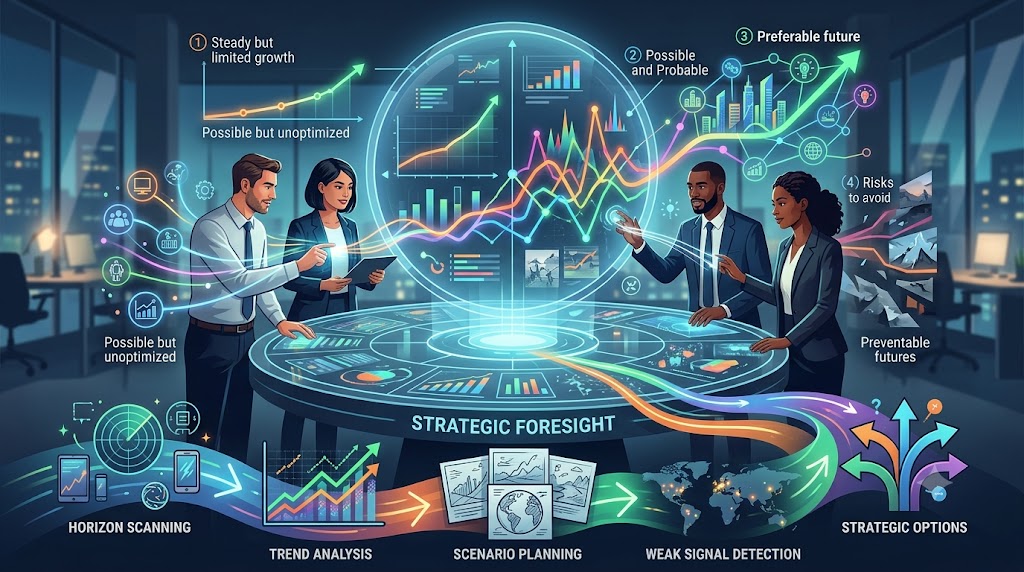
Strategic foresight is the practice of systematically exploring multiple possible futures in order to make better decisions and take more effective actions in the present. It combines methods from futures studies — scenario planning, horizon scanning, weak signal detection, trend analysis — with the strategic management discipline of translating insight into organizational action.

The OECD defines strategic foresight as “a systematic approach to thinking about, debating, and shaping the future.” The key word is systematic. Strategic foresight is not intuition, extrapolation, or speculation — it is a structured methodology for expanding the range of futures an organization prepares for and building the adaptive capacity to navigate uncertainty regardless of how it unfolds.

Strategic foresight answers three questions that conventional strategic planning consistently underserves:

  • What could happen that we are not currently expecting? — surfacing emerging signals, discontinuities, and wild cards that fall outside the normal planning horizon
  • How would we respond if several different futures unfolded? — developing robust strategies that work across multiple scenarios rather than optimizing for a single expected one
  • What actions should we take now to shape the future we want? — identifying the interventions available today that improve the probability of preferred futures and reduce the probability of preventable ones

Strategic Foresight vs Adjacent Disciplines

Strategic foresight sits at the intersection of several related disciplines. Understanding how it differs from each clarifies both what it offers and where its limits lie.

Strategic Foresight vs Strategic Planning

Strategic planning typically takes a known, expected future as its starting point — building a roadmap from current state to a defined desired state. It is inherently backward-looking in its inputs (historical data, current trends) and forward-looking only within a relatively constrained range of expected variation.

Strategic foresight takes the uncertainty of the future as its starting point. Rather than planning for a single expected future, it deliberately explores multiple plausible futures — including ones that are significantly different from today — and builds strategies that are robust across that range. Strategic planning answers “how do we get there from here?” Strategic foresight first asks “where might ‘there’ turn out to be?”

The most effective organizations use both: strategic foresight to understand the landscape of possible futures and identify the most strategically important uncertainties, then strategic planning to build the roadmap for navigating toward the preferred future within that landscape.

Strategic Foresight vs Market Forecasting

Market forecasting uses quantitative methods — trend extrapolation, statistical modeling, regression analysis — to predict future states of specific variables within a defined, relatively stable market context. It works well when the underlying dynamics are understood and relatively stable. It fails systematically when discontinuities, disruptions, or structural shifts occur — precisely the scenarios that matter most for strategic decision-making.

Strategic foresight explicitly addresses the limitations of forecasting by embracing rather than suppressing uncertainty. Rather than attempting to predict a single most-likely future, it builds scenarios that span the range of plausible futures, identifies the signals that indicate which scenario is emerging, and prepares the organization to respond to any of them.

Strategic Foresight vs Scenario Planning

Scenario planning — associated particularly with Shell Oil’s pioneering work in the 1970s and Pierre Wack’s foundational methodology — is one of the core tools within strategic foresight. A full strategic foresight practice is broader: it includes horizon scanning (systematic monitoring of weak signals across multiple domains), environmental scanning, trend analysis, the identification and exploration of wildcards and discontinuities, and the translation of scenario insights into strategic options and organizational learning.

Scenario planning answers “what might the future look like?” Strategic foresight also asks “what signals tell us which scenario is emerging, what should we do about it now, and what capabilities do we need to build regardless of which future unfolds?”

The Core Methods of Strategic Foresight

Horizon Scanning

Systematic monitoring of signals, trends, and emerging developments across multiple domains — technology, society, economy, environment, politics, values — to identify potential drivers of change before they become mainstream. Horizon scanning is the early warning system of strategic foresight: it surfaces the weak signals that indicate emerging disruptions while there is still time to respond proactively rather than reactively.

Effective horizon scanning is not the same as reading the news. It requires deliberate attention to the edges — the fringe technologies, the minority behaviors, the marginal social movements — that are typically invisible in mainstream information channels but often indicate where the mainstream is heading.

Trend Analysis

The systematic identification and analysis of patterns of change across relevant domains. Unlike market forecasting, which uses trend analysis primarily for quantitative prediction, strategic foresight uses it to understand the driving forces shaping the future landscape and to identify where those forces are stable, accelerating, decelerating, or likely to interact with each other in unexpected ways.

Scenario Development

The construction of multiple, internally consistent narratives about plausible futures — typically built around two or three high-uncertainty, high-impact drivers of change that are selected from the trend and scanning analysis. Each scenario describes a different world that could plausibly emerge, the forces that would drive it, and what it would mean for the organization’s markets, customers, competitors, and capabilities.

Good scenarios are not predictions. They are tools for expanding organizational thinking, stress-testing strategies, and developing the adaptive capacity to navigate uncertainty. The value of scenario planning is not in getting the scenario right — no scenario will match exactly what happens. The value is in the strategic conversations it enables and the organizational learning it produces.

Weak Signal Detection

The identification of early indicators that a potentially significant development may be emerging — before there is enough data for conventional analysis to confirm it. Weak signals are inherently ambiguous and easy to dismiss; the skill of strategic foresight is developing the discipline to take them seriously as potential harbingers of structural change rather than dismissing them as anomalies.

Organizations that act on weak signals — that invest in understanding an emerging technology, entering an adjacent market, or building a new capability before competitive pressure makes it obvious — consistently outperform those that wait for strong signals to confirm what’s already happening.

Strategic Options Development

The translation of foresight insights into concrete strategic options — specific actions, investments, or capabilities that the organization could pursue to improve its position across multiple scenarios. The goal is not to produce a single foresight-informed strategy, but to identify the strategic moves that are robust across the range of plausible futures, the bets that are worth taking even under significant uncertainty, and the signals that would indicate when to accelerate or pivot.

The Four Futures Framework: Possible, Probable, Preferable, and Preventable

One of the most useful frameworks in strategic foresight is the distinction between four types of futures that practitioners work with simultaneously:

Possible futures — everything that could conceivably happen given current understanding of how the world works. Possible futures include low-probability developments that would be highly disruptive if they occurred — technologies that could emerge, geopolitical shifts that could unfold, social changes that could accelerate. Working with possible futures expands organizational thinking and surfaces risks and opportunities that conventional planning ignores.

Probable futures — futures that are likely to occur based on current trends, data, and trajectory analysis. These are the futures that conventional strategic planning focuses on. They provide the baseline against which more speculative possibilities can be evaluated. The limitation of focusing only on probable futures is strategic myopia — optimizing for the most likely scenario while remaining blind to the disruptions that are possible but not yet probable.

Preferable futures — futures that align with the organization’s goals, values, and vision. Strategic foresight is not a passive exercise in predicting what will happen; it is an active discipline of understanding what futures are possible and then taking actions to increase the probability of the ones the organization prefers. Identifying preferable futures and reverse-engineering the actions needed to influence their probability is one of the most strategically valuable applications of foresight.

Preventable futures — undesirable outcomes that the organization seeks to avoid. Understanding preventable futures requires the same horizon scanning and scenario work as understanding positive opportunities, but focused on risk: the technologies that could make the current business model obsolete, the regulatory changes that could constrain operations, the competitive moves that could erode market position. Building resilience against preventable futures is as important as building toward preferable ones.

Why Most Organizations Fail at Strategic Foresight

Strategic foresight is widely acknowledged as valuable and consistently underinvested in. Several structural and cultural patterns account for this gap:

Short-term performance pressure crowds out long-term thinking. Quarterly reporting cycles, annual planning processes, and performance management systems that reward near-term results systematically disadvantage the kind of long-term, ambiguous thinking that strategic foresight requires. Organizations know they should invest in understanding the future; they just can’t find the space to do it when the present is so demanding.

Uncertainty is uncomfortable. Strategic planning provides the psychological comfort of a defined roadmap. Strategic foresight explicitly embraces uncertainty — it produces scenarios and options rather than answers, and this ambiguity is genuinely uncomfortable for leadership teams that prefer clarity. Organizations that can tolerate strategic ambiguity are significantly more capable of effective foresight than those that need to convert uncertainty into certainty before they can act.

Foresight is treated as an event rather than a capability. Many organizations engage in scenario planning once — often triggered by a crisis or major disruption — and then return to conventional strategic planning once the immediate uncertainty has passed. Effective strategic foresight is not an event; it is an ongoing organizational capability, built over time through consistent practice, embedded processes, and leadership behavior that treats the future as a legitimate management concern rather than an occasional topic for off-site retreats.

The tools are perceived as inaccessible. Strategic foresight has historically been practiced by specialist consulting firms, government think tanks, and dedicated foresight units at large organizations. The perception that it requires specialist expertise, significant time investment, and resources available only to large organizations has kept it out of reach for most leadership teams — even when they recognize its value.

FutureHacking™: Making Strategic Foresight Accessible

The primary limitation I observed in two decades of helping organizations think about the future was not a lack of interest in strategic foresight — it was a lack of accessible, practical tools that made it possible for normal leadership teams, without specialist foresight expertise, to engage in genuine futures thinking as a regular part of their strategic work.

That limitation is what FutureHacking™ was designed to address. FutureHacking™ is a structured methodology — built around a set of visual, collaborative tools including FutureSignals™, NowBuilder™, and FutureCanvas™ — that makes the core practices of strategic foresight accessible to cross-functional leadership teams without requiring specialist foresight expertise.

The methodology follows four steps:

  1. Scan — systematically identify the weak signals and emerging trends that may indicate significant future change in your environment
  2. Analyze — assess the potential impact and uncertainty of the most significant signals, and identify the driving forces most likely to shape your future landscape
  3. Prototype — build visual representations of multiple plausible futures, exploring what each would mean for your organization, your markets, and your customers
  4. Act — identify the strategic options available now, the actions worth taking regardless of which future emerges, and the signals that would indicate when to accelerate specific bets

The goal is not to turn every leadership team into professional futurists. It is to give them enough structured futures thinking to make materially better strategic decisions — to expand their range of preparation, identify the weak signals that matter before competitors do, and build the adaptive capacity that lets them respond to uncertainty with confidence rather than surprise.

Frequently Asked Questions About Strategic Foresight

What is strategic foresight?

Strategic foresight is the practice of systematically exploring multiple possible futures in order to make better decisions and take more effective actions in the present. It combines methods from futures studies — scenario planning, horizon scanning, weak signal detection, trend analysis — with the strategic management discipline of translating insight into organizational action. Unlike strategic planning, which typically optimizes for a single expected future, strategic foresight explicitly embraces uncertainty, building strategies that are robust across a range of plausible futures rather than brittle to unexpected change.

What is the difference between strategic foresight and scenario planning?

Scenario planning is one of the core tools within strategic foresight, but a full strategic foresight practice is broader. Strategic foresight includes horizon scanning, weak signal detection, trend analysis, the development of strategic options across multiple scenarios, and the ongoing organizational capability to monitor emerging signals and update strategy accordingly. Scenario planning answers “what might the future look like?” Strategic foresight also asks “what signals tell us which scenario is emerging, what should we do now, and what capabilities do we need regardless of which future unfolds?”

How is strategic foresight different from forecasting?

Forecasting uses quantitative methods to predict future states of specific variables — revenue, market share, demand — within a defined, relatively stable context. It works well when underlying dynamics are understood and stable. Strategic foresight explicitly addresses the limitations of forecasting by embracing rather than suppressing uncertainty. Rather than predicting a single most-likely future, it builds scenarios spanning the range of plausible futures, identifies signals of which scenario is emerging, and prepares organizations to respond to any of them. The two are complementary: forecasting for near-term planning within defined parameters, foresight for navigating structural uncertainty and genuine discontinuity.

What are the main methods used in strategic foresight?

The core methods of strategic foresight include horizon scanning (systematic monitoring of weak signals and emerging developments across multiple domains), trend analysis (identifying patterns of change and their driving forces), scenario development (building multiple internally consistent narratives about plausible futures), weak signal detection (identifying early indicators of potentially significant developments before they become mainstream), and strategic options development (translating foresight insights into concrete actions and investments that are robust across multiple scenarios).

How can organizations build strategic foresight capability?

Building strategic foresight capability requires three things: regular practice (treating futures thinking as an ongoing management discipline rather than a one-time event), accessible tools and frameworks that make structured futures thinking possible for leadership teams without specialist expertise, and leadership behavior that treats long-term uncertainty as a legitimate management concern rather than a distraction from near-term execution. FutureHacking™ — Braden Kelley’s structured foresight methodology — is designed specifically to provide the tools and framework that make strategic foresight accessible to cross-functional leadership teams, enabling genuine futures thinking without requiring specialist foresight consultants.

Ready to bring strategic foresight into your organization’s strategy process? Learn more about FutureHacking™ →

FutureHacking™ Is Coming

FutureHacking™ is Braden Kelley’s strategic foresight methodology — and a paid download and training program is launching soon. Register your interest now to be the first to know when it’s available, and get early access pricing.

Image credits: Google Gemini

Content Authenticity Statement: The topic area, key elements to focus on, etc. were decisions made by Braden Kelley, with a little help from Claude and Google Gemini to clean up the article, add images and create infographics.

Subscribe to Human-Centered Change & Innovation WeeklySign up here to get Human-Centered Change & Innovation Weekly delivered to your inbox every week.
Resilient Innovation

Why the Future Belongs to Organizations That Think in Three Dimensions

Why the Future Belongs to Organizations That Think in Three Dimensions

LAST UPDATED: March 11, 2026 at 6:56 PM (SPANISH LANGUAGE VERSION)

by Braden Kelley and Art Inteligencia


I. The Spark: A Venn Diagram That Captures a Powerful Truth

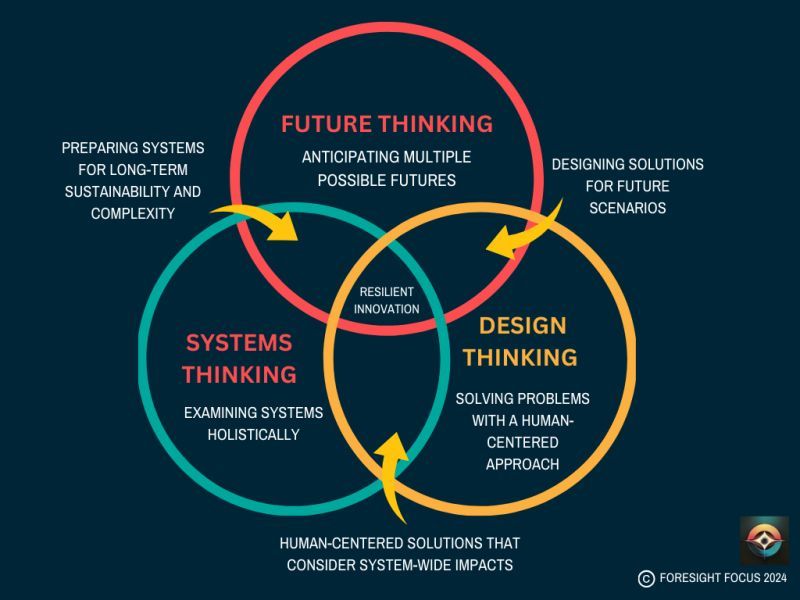
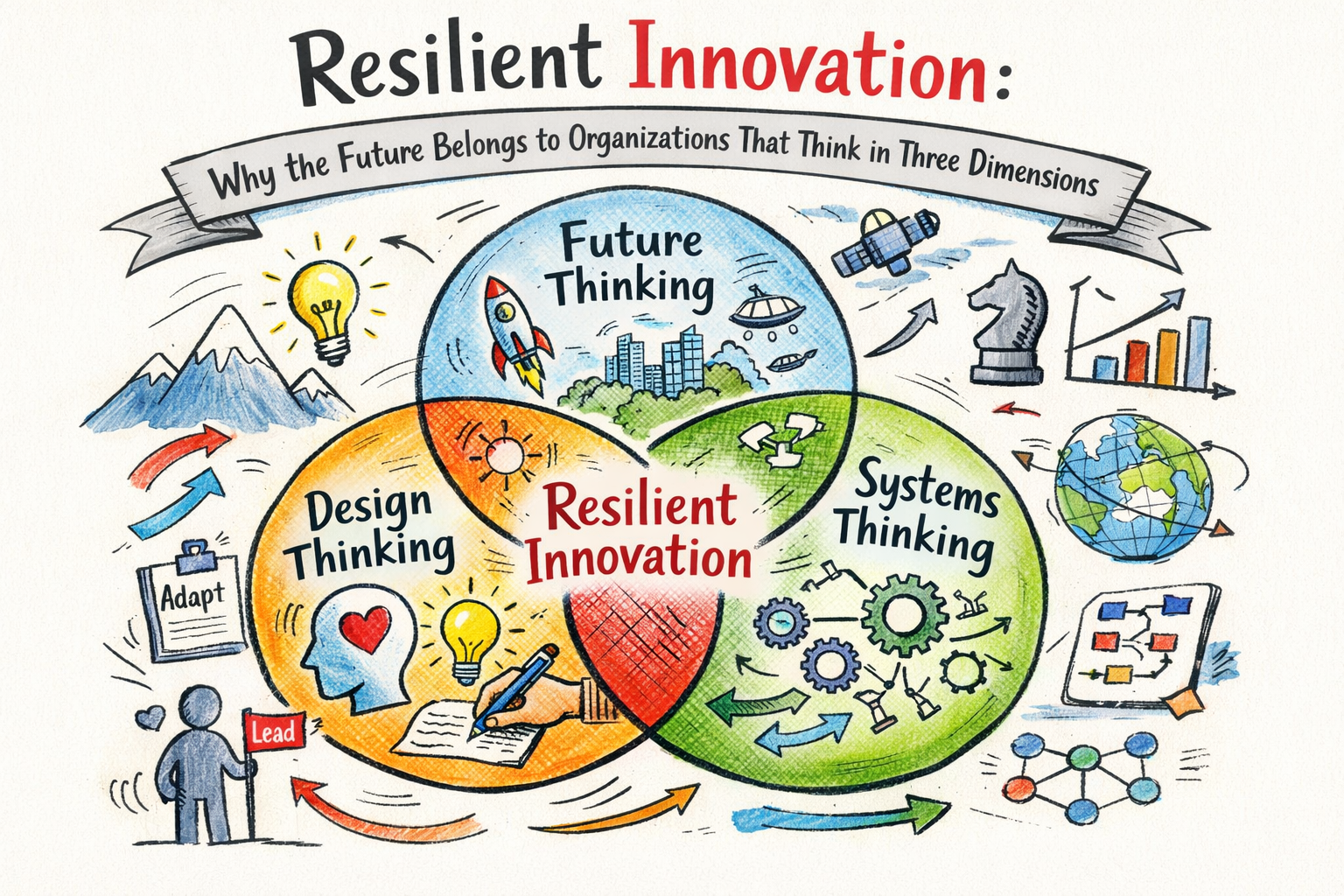
Inspiration for this article came from a simple but powerful visual shared in a recent post by Hugo Gonçalves. The image illustrated the relationship between Future Thinking, Design Thinking, and Systems Thinking using a Venn diagram that placed Resilient Innovation at the center.

At first glance the framework seems obvious. Each discipline is already well established in the innovation world:

  • Future Thinking helps organizations anticipate multiple possible futures.
  • Design Thinking focuses on solving problems through a human-centered approach.
  • Systems Thinking encourages examining systems holistically to understand complexity.

But what makes the diagram compelling is not the individual circles. It is the insight revealed at their intersections. When these disciplines operate together rather than in isolation, they unlock capabilities that are difficult for organizations to achieve otherwise.

At the intersection of Future Thinking and Design Thinking, organizations begin designing solutions for future scenarios rather than merely reacting to present conditions.

Where Design Thinking meets Systems Thinking, innovation becomes both human-centered and system-aware, producing solutions that account for real-world complexity and ripple effects.

And where Future Thinking intersects with Systems Thinking, organizations gain the ability to prepare systems for long-term sustainability and increasing complexity.

Resilient Innovation

When all three perspectives come together, something more powerful emerges: the ability to create innovations that are not only desirable and viable today, but resilient enough to thrive across multiple possible futures.

In a world defined by accelerating change, uncertainty, and interconnected systems, resilient innovation may be the most important capability organizations can develop. And as this simple diagram suggests, it thrives at the intersection of three powerful ways of thinking.

II. The Problem with One-Dimensional Innovation

Most organizations pursue innovation through a single dominant lens. Some lean heavily into design thinking workshops and rapid prototyping. Others invest in strategic foresight to anticipate future disruption. Still others focus on systems analysis to understand complexity and organizational dynamics.

Each of these approaches provides valuable insight. But when used in isolation, each also has significant limitations.

Design thinking, for example, excels at uncovering human needs and translating them into compelling solutions. Yet even the most desirable idea can fail if it ignores the larger systems it must operate within — regulatory structures, supply chains, cultural norms, or organizational incentives.

Future thinking helps organizations explore uncertainty and imagine multiple possible futures. Scenario planning and horizon scanning can expand strategic awareness and reduce surprise. But foresight alone rarely produces solutions that people are ready to adopt.

Systems thinking provides the ability to map complexity, understand feedback loops, and identify leverage points within interconnected environments. However, deep system insight does not automatically translate into solutions that resonate with human users.

When organizations rely on only one of these approaches, innovation often stalls. Ideas may be creative but impractical, visionary but disconnected from human behavior, or analytically sound but difficult to implement.

The challenge is not that these disciplines are flawed. The challenge is that they are incomplete on their own.

Innovation today takes place in environments that are simultaneously human, complex, and uncertain. Addressing only one dimension of that reality inevitably leads to blind spots.

Resilient innovation requires something more: the integration of multiple ways of thinking that together allow organizations to anticipate change, understand complexity, and design solutions people will actually embrace.

III. Future Thinking: Anticipating Multiple Possible Futures

One of the most dangerous assumptions organizations can make is that the future will look largely like the present. History repeatedly shows that markets, technologies, and societal expectations can shift faster than even experienced leaders anticipate.

This is where Future Thinking becomes essential, and the FutureHacking™ methodology helps everyone be their own futurist.

Future thinking is not about predicting a single outcome. Instead, it focuses on exploring a range of plausible futures so organizations can prepare for uncertainty rather than react to it after the fact.

Practitioners of future thinking use tools such as horizon scanning, trend analysis, and scenario planning to identify emerging signals of change and imagine how those signals might combine to shape different future environments.

By examining multiple possible futures, organizations expand their strategic imagination. They begin to see opportunities and risks that would otherwise remain invisible when planning is based solely on past performance or current market conditions.

Future thinking helps leaders ask better questions:

  • What changes on the horizon could reshape our industry?
  • Which emerging technologies or behaviors might disrupt our assumptions?
  • How might our customers’ needs evolve over the next decade?

When organizations incorporate future thinking into their innovation efforts, they gain the ability to design strategies and solutions that remain relevant even as conditions change.

However, foresight alone does not create innovation. Imagining the future is only the beginning. Organizations must also translate those insights into solutions that people value and systems can support.

That is why future thinking becomes far more powerful when combined with other perspectives — particularly the human-centered creativity of design thinking and the holistic understanding provided by systems thinking.

IV. Design Thinking: Solving Problems with a Human-Centered Approach

If future thinking expands our view of what might happen, design thinking helps ensure that the solutions we create actually matter to the people they are intended to serve.

Design thinking is grounded in a deceptively simple premise: innovation succeeds when it begins with a deep understanding of human needs, behaviors, and motivations. Rather than starting with technology or internal capabilities, design thinking begins with empathy.

Practitioners use methods such as observation, interviews, journey mapping, and rapid prototyping to uncover insights about how people experience products, services, and systems in the real world.

Through this process, organizations move beyond assumptions and begin designing solutions that reflect genuine human needs. Ideas are then explored through iterative experimentation, allowing teams to quickly learn what works, what doesn’t, and why.

This approach offers several powerful advantages:

  • It surfaces unmet or unarticulated customer needs.
  • It encourages experimentation and rapid learning.
  • It increases the likelihood that new solutions will be embraced by the people they are designed for.

Design thinking reminds organizations that innovation is not simply about creating something new. It is about creating something people will choose to adopt.

However, even the most human-centered solution can fail if it ignores the broader systems in which it must operate. A beautifully designed product may struggle against regulatory constraints, supply chain limitations, or cultural resistance within organizations.

This is why design thinking alone is not enough. To create innovations that truly endure, organizations must also understand the complex systems surrounding those solutions.

V. Systems Thinking: Seeing the Whole System

While design thinking focuses on people and future thinking explores uncertainty, systems thinking helps organizations understand the complex environments in which innovation must operate.

Modern organizations do not exist in isolation. They function within interconnected systems made up of customers, partners, suppliers, regulators, technologies, cultures, and internal structures. Changes in one part of the system often create ripple effects across many others.

Systems thinking encourages leaders and innovators to step back and examine these relationships holistically rather than focusing only on individual components.

Practitioners use tools such as system maps, causal loop diagrams, and stakeholder ecosystem mapping to identify patterns, dependencies, and feedback loops that influence outcomes over time.

This perspective provides several critical advantages:

  • It reveals hidden interdependencies within complex environments.
  • It helps identify leverage points where small changes can create large impact.
  • It reduces the likelihood of unintended consequences when introducing new solutions.

Many innovations fail not because the idea was flawed, but because the surrounding system was never designed to support it. Incentives may be misaligned. Processes may resist change. Infrastructure may not exist to scale the solution.

Systems thinking helps innovators recognize these structural realities early, allowing them to design solutions that fit within — or intentionally reshape — the systems they operate within.

Yet systems thinking alone can also fall short. Deep analysis of complexity does not automatically produce solutions that resonate with people or anticipate future shifts.

This is why resilient innovation emerges not from any one perspective, but from the intersection of future thinking, design thinking, and systems thinking working together.

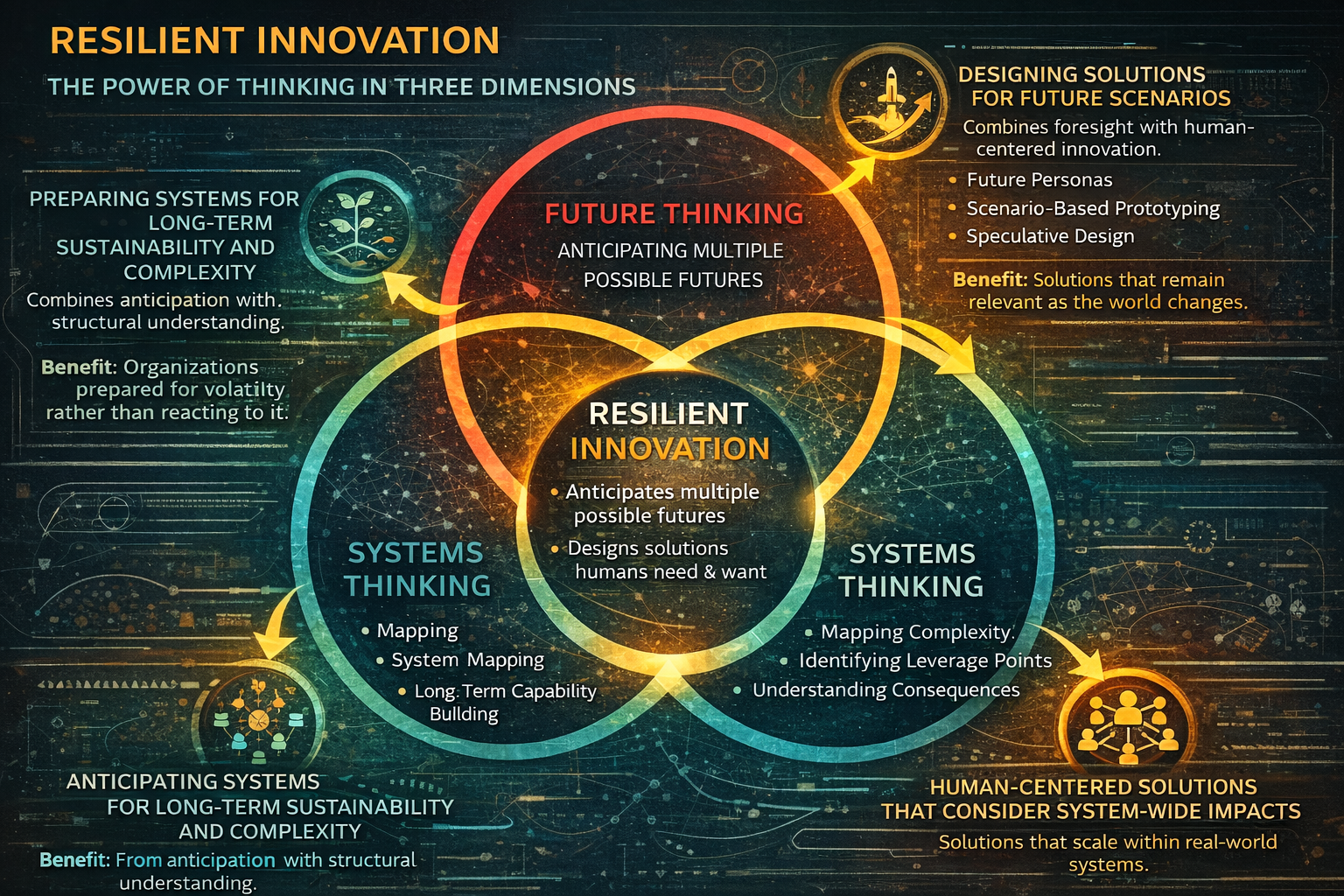
Resilient Innovation Infographic

VI. Future Thinking + Design Thinking: Designing Solutions for Future Scenarios

When future thinking and design thinking come together, innovation shifts from solving today’s problems to designing solutions that remain meaningful in tomorrow’s world.

Future thinking expands the time horizon. It helps organizations explore emerging technologies, evolving social expectations, and potential disruptions that could reshape the environment in which products and services operate.

Design thinking brings the human perspective. It ensures that ideas developed in response to these future possibilities remain grounded in real human needs, motivations, and behaviors.

Together, these disciplines allow organizations to design solutions not just for the present moment, but for multiple possible futures.

Rather than asking only “What do customers need today?” teams begin asking deeper questions:

  • How might customer expectations evolve in the next five to ten years?
  • What new behaviors could emerge as technologies mature?
  • How might shifting social norms reshape what people value?

Several practices emerge from this intersection:

  • Creating future personas that represent how users might behave in different scenarios.
  • Building scenario-based prototypes that test how solutions perform under different future conditions.
  • Using speculative design to explore bold possibilities before they become reality.

This combination helps organizations avoid a common innovation trap: designing solutions perfectly optimized for a present that is already beginning to disappear.

By integrating foresight with human-centered design, organizations create innovations that are better prepared to evolve as the future unfolds.

VII. Design Thinking + Systems Thinking

Human-centered innovation is most powerful when it takes the wider system into account.
Integrating empathy with complexity awareness ensures that solutions are not only desirable but also viable and scalable within real-world systems.

Many well-intentioned innovations fail because they neglect system dynamics—leading to unintended consequences that can undermine adoption, efficiency, or long-term impact.

Example Practices

  • Journey Mapping + System Mapping: Understand the user experience alongside the broader system in which it operates.
  • Stakeholder Ecosystem Analysis: Identify all the players, relationships, and dependencies that influence outcomes.
  • Designing for Policy, Culture, and Infrastructure Simultaneously: Ensure solutions are compatible with the real-world environment, not just ideal scenarios.

Benefit: Solutions that scale effectively and endure within complex systems, reducing risk and maximizing long-term impact.

VIII. Future Thinking + Systems Thinking

Combining anticipation with structural understanding enables organizations to prepare systems for long-term sustainability and complexity. This intersection ensures that strategies and innovations are not just reactive but resilient to change and disruption.

Many organizations fail because they plan for the future without considering system-wide dynamics, leaving them vulnerable when change inevitably occurs.

Example Practices

  • Resilience Mapping: Identify system vulnerabilities and strengths to anticipate risks and opportunities.
  • Adaptive Strategy Design: Develop strategies that can flex and evolve as conditions change.
  • Long-Term Capability Building: Invest in skills, processes, and structures that sustain innovation over time.

Benefit: Organizations become prepared for volatility, able to respond to complex challenges without being derailed by disruption.

IX. The Center of the Venn Diagram: Resilient Innovation

True innovation resilience happens at the intersection of all three disciplines: Future Thinking, Design Thinking, and Systems Thinking. Organizations that operate here anticipate multiple possible futures, design solutions humans actually want, and understand the systems those solutions must survive inside.

This holistic approach moves beyond isolated innovation efforts, ensuring solutions are desirable, viable, and adaptable in a complex world.

Capabilities at the Center

  • Adaptive Innovation Portfolios: Maintain a diverse set of initiatives that can pivot as conditions change.
  • Experimentation Across Future Scenarios: Test solutions against multiple possible futures to validate robustness.
  • Human-Centered System Transformation: Redesign processes, structures, and policies to align with real human needs within systemic constraints.

Benefit: Organizations achieve resilient innovation that can thrive amidst uncertainty, disruption, and complexity, rather than merely surviving it.

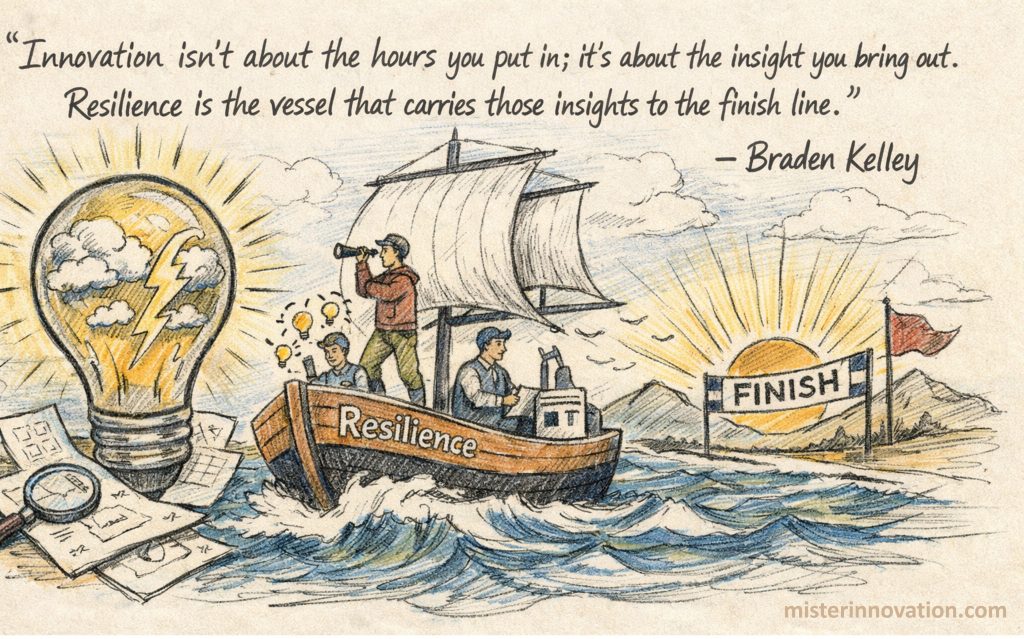
Innovation Resilience Insights Quote

X. What Leaders Must Do to Build This Capability

Building resilient innovation requires leaders to shift their mindset and practices. It’s no longer enough to treat innovation as a siloed department or isolated initiative. Leaders must actively create the conditions that allow foresight, design, and systems thinking to work together.

Practical Leadership Shifts

  • Stop Treating Innovation as a Department: Embed innovation across teams and functions, not just in a single unit.
  • Build Foresight, Design, and Systems Capabilities Together: Develop cross-disciplinary skills that enable three-dimensional thinking.
  • Encourage Cross-Disciplinary Collaboration: Foster communication and shared problem-solving across different expertise areas.
  • Measure Resilience, Not Just Efficiency: Track long-term adaptability, system impact, and future-readiness, not only short-term outputs.
  • Design Organizations That Can Evolve Continuously: Create structures and processes that allow constant learning, adaptation, and iteration.

By adopting these leadership practices, organizations can ensure that their innovation efforts are not only creative but also resilient and scalable within complex systems.

XI. A Simple Test for Your Organization

To evaluate whether your organization is truly building resilient innovation capabilities, ask three critical questions:

  1. Are we designing only for today’s customers, or tomorrow’s realities?
    This question tests whether your innovation anticipates future needs and scenarios.
  2. Do our solutions work only in pilot environments, or within real systems?
    This evaluates whether innovations are scalable and resilient within the complex systems they must operate in.
  3. Are we solving human problems, or just optimizing processes?
    This ensures that your solutions are genuinely human-centered, not just operationally efficient.

If the answer to any of these is “no,” the missing capability likely lies at one of the intersections of Future Thinking, Design Thinking, and Systems Thinking. Addressing these gaps is critical for achieving resilient innovation.

XII. Final Thought: Innovation Is No Longer Linear

The world has become too complex for single-method innovation. Organizations that thrive in the future will be those that operate at the intersection of:

  • Anticipation: Preparing for multiple possible futures.
  • Human Understanding: Designing solutions people actually want and will adopt.
  • System Awareness: Ensuring solutions can survive and scale within real-world systems.

Resilient innovation does not come from seeing the future clearly. It comes from being prepared for many possible futures and designing systems and solutions that can adapt when they arrive. Organizations that master this approach are the ones that will endure, evolve, and thrive.

FAQ: Resilient Innovation

1. What is resilient innovation?

Resilient innovation is the ability of an organization to anticipate multiple possible futures, design solutions humans actually want, and ensure those solutions survive and scale within complex systems. It emerges at the intersection of Future Thinking, Design Thinking, and Systems Thinking.

2. Why do organizations struggle with one-dimensional innovation?

Many organizations rely on a single approach—such as design thinking, systems thinking, or future thinking—without integrating the others. This can lead to solutions that are desirable but not viable, or insightful but not actionable, resulting in innovation that fails to scale or adapt.

3. How can leaders build resilient innovation capabilities?

Leaders can foster resilient innovation by embedding cross-disciplinary collaboration, developing foresight, design, and systems capabilities together, measuring resilience (not just efficiency), and designing organizations that can continuously learn, adapt, and evolve.

p.s. Kristy Lundström posed the question of whether regenerative would be a better adjective than resilient, and I responded that it depends on where you draw the boundaries on the word resilient. I tend to think of it as an active word instead of a passive one, meaning the way that I look at the word incorporates elements of regeneration and making *#&! happen. Keep innovating!

Image credits: ChatGPT, Google Gemini

Content Authenticity Statement: The topic area, key elements to focus on, etc. were decisions made by Braden Kelley, with a little help from ChatGPT to clean up the article and add citations.

Subscribe to Human-Centered Change & Innovation WeeklySign up here to get Human-Centered Change & Innovation Weekly delivered to your inbox every week.