Tag Archives: problem solving

From Problem to Solution: Applying the Design Thinking Process

From Problem to Solution: Applying the Design Thinking Process

GUEST POST from Chateau G Pato

In today’s world, where challenges and problems arise daily, organizations and individuals are constantly seeking effective solutions. The traditional problem-solving methods are no longer enough to tackle complex and ambiguous issues. This is where the design thinking process comes into play.

Design thinking is a human-centered approach to innovation and problem-solving. It focuses on understanding the needs of people in order to create innovative solutions that are both useful and sustainable. By applying a structured and iterative approach, design thinking encourages creativity, collaboration, and empathy to tackle problems from multiple angles. Let’s explore two case study examples that highlight the effectiveness of the design thinking process.

Case Study 1: IDEO’s Success with the Palm V

In the late 1990s, Palm Computing faced a significant challenge. Its early personal digital assistants (PDA) were clunky and unintuitive, failing to gain mass market appeal. Palm turned to the design firm IDEO to lead a design thinking process that would transform their product.

IDEO conducted in-depth interviews and observations to understand user needs. They discovered that people wanted a device that was slim, convenient, and easy to use. By shifting their focus from technology-driven features to user-centric needs, IDEO’s team devised the concept of the Palm V.

Through multiple iterations and constant feedback from users, IDEO crafted a sleek PDA that fit in the palm of the hand. The design thinking process allowed IDEO to transform the PDA into an intuitive and user-friendly device. The Palm V became a tremendous success, revolutionizing the PDA market for years to come.

Case Study 2: Airbnb’s Rapid Growth and Disruption

At its inception in 2008, Airbnb faced a challenging problem. The founders struggled to find a scalable business model and to attract users to their home-sharing platform. In search of a solution, they applied the design thinking process.

The founders immersed themselves in their customers’ experiences, staying in homes listed on their platform and meeting with hosts to understand their pain points. By empathizing with both sides of the marketplace, they identified opportunities for improvement.

Through iterative prototyping and constant feedback loops, Airbnb gradually improved its platform, introducing features such as professional photography, guest reviews, and secure payment systems. These enhancements addressed key user concerns, increased trust, and facilitated bookings.

By applying the principles of design thinking, Airbnb not only solved its immediate problem but also disrupted the entire hospitality industry. Today, Airbnb is a household name with millions of listings worldwide.

Conclusion

These two case studies demonstrate how the design thinking process can lead to innovative and impactful solutions. By shifting the focus to users’ needs, using iterative methods, and fostering collaboration, organizations and individuals can tackle complex problems with creativity and empathy. Whether it’s revolutionizing the PDA industry or disrupting the hospitality market, design thinking provides a framework for turning problems into solutions.

SPECIAL BONUS: Braden Kelley’s Problem Finding Canvas can be a super useful starting point for doing design thinking or human-centered design.

“The Problem Finding Canvas should help you investigate a handful of areas to explore, choose the one most important to you, extract all of the potential challenges and opportunities and choose one to prioritize.”

Image credit: Pixabay

Subscribe to Human-Centered Change & Innovation WeeklySign up here to get Human-Centered Change & Innovation Weekly delivered to your inbox every week.

The Hidden Innovators

Identifying and Protecting Unconventional Problem-Solvers

GUEST POST from Art Inteligencia
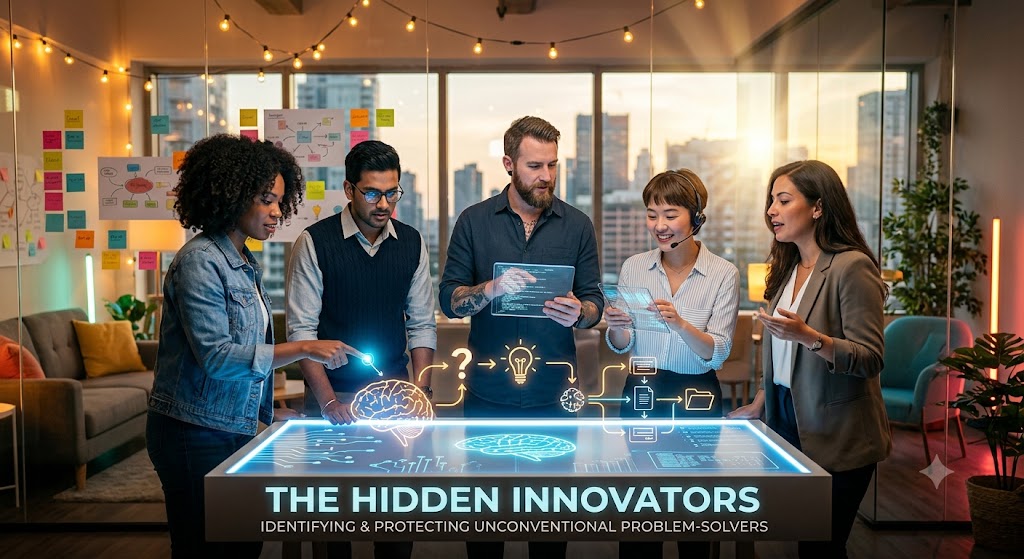
The Hidden Innovators


The Myth of the Elite Innovation Lab

Organizations pour millions into dedicated R&D centers, sleek design studios, and elite innovation labs. Yet, the most elegant, friction-reducing solutions rarely emerge from these highly curated environments. Instead, they are born on the quiet front lines — hatched by the customer service representative who crafts an ingenious workaround to bypass a legacy software glitch, or the floor manager who subtly modifies a physical tool to eliminate a safety hazard.

The core reality is simple: innovation is not a department; it is a distributed, human capability. Unfortunately, traditional corporate structures are organically engineered to act as social antibodies, filtering out unconventional thinkers and neutralizing variance in the name of predictability. To build an enterprise capable of continuous renewal, leaders must look beyond formal titles to actively identify, integrate, and protect these hidden problem-solvers.

“True organizational resilience requires a permanent shift from exclusionary, top-down mandates to an authentic model of Participatory Innovation.”

By shifting our focus toward inclusive co-creation, we don’t just discover better ideas — we fundamentally reduce the systemic friction and organizational resistance that kill brilliant strategies before they can ever take root.

I. Archetypes of the Unconventional Problem-Solver

To find the hidden innovators within an enterprise, leadership must first learn what they actually look like. They rarely match the stereotypical profile of the loud, charismatic “ideation guru” or the polished executive champion. Instead, unconventional problem-solvers manifest through specific behaviors, driven by a deep-seated desire to fix what is broken. They generally fall into one of four distinct archetypes:

The Constructive Rebel

This individual is frequently misunderstood by middle management as a disruptive force. They routinely bypass or bend standard operating procedures — not out of a desire to cause chaos, but because they realize the official process actively prevents them from solving a customer’s real-world pain point. They prioritize the human experience over bureaucratic compliance.

The Boundary Spanner

Innovation thrives at the intersections. The Boundary Spanner is a natural connector who exists horizontally in a vertically siloed world. They possess a rare cross-functional literacy, effortlessly translating insights between departments that rarely speak — such as pairing frontline customer feedback with backend systems architecture to spark a completely new workflow.

The Quiet Optimizer

Often introverted and highly focused on execution, Quiet Optimizers hate waste. They quietly automate their own workflows, write custom scripts, or build informal, localized tools to eliminate everyday friction. They don’t seek corporate validation, trophies, or stages; they simply want to make their immediate operational ecosystem work better.

Mapping to the Nine Innovation Roles

When we look at these archetypes through the lens of formal organizational design, they align perfectly with the Nine Innovation Roles framework. These hidden individuals are your organic Troubleshooters, Connectors, and Magic Makers. The challenge is that they are currently operating entirely outside of your formal innovation mandates — meaning their insights remain localized, isolated, and tragically unscaled.

II. Why Organizations Unknowingly Stifle Hidden Talent

Corporate antibodies are remarkably efficient at neutralizing variance. The tragedy of modern enterprise is that the systems designed to ensure operational stability are often the very mechanisms that silence unconventional thinkers. To unlock hidden innovation, we must diagnose the structural friction points that actively discourage our best minds.

The Tyranny of Traditional Performance Metrics

Standard key performance indicators (KPIs) are calibrated for predictability and optimization, not exploration. When performance evaluations reward incremental execution and flawless adherence to routine, they inherently penalize variance. Because true breakthrough thinking requires experimentation — and the inevitable failures that accompany it — rigid metrics force employees to choose between systemic compliance and human-centered problem-solving. Most choose compliance simply to survive.

The “Not Invented Here” Syndrome

Middle management often acts as a gatekeeper rather than a gateway. Ideas that bubble up from the front lines face an uphill battle against structural ego and institutional inertia. When an elegant solution does not originate from a designated research lab, an executive mandate, or an elite strategy team, it is frequently dismissed as amateurish or irrelevant. This cultural bias shuts down vital participatory loops before insights can ever reach decision-makers.

Psychological Safety vs. Corporate Compliance

Without psychological safety, brilliant ideas remain internal monologues. In highly bureaucratic environments where mistakes are weaponized, hidden innovators quickly learn to camouflage their best work. When the perceived risk of speaking up or trying a new approach outweighs the reward, people stop trying to fix the system. They either internalize their frustration, leading to profound burnout, or they quietly take their creative capital to a competitor who values agile thinking over blind obedience.

III. Active Identification: Spotting the Signals

Finding hidden innovators requires leaders to look past formal job titles, credentials, and organizational hierarchies. Unconventional problem-solvers leave distinct operational footprints. By shifting from passive suggestion boxes to active observation, organizations can accurately map where true organic innovation is happening.

Analyzing Friction Points and “Workarounds”

The best indicator of a future innovation is a current workaround. When employees actively break, bend, or modify an official process, they are rarely trying to sabotage the system — they are attempting to fix a flawed design. Leaders must stop treating process non-compliance purely as a disciplinary issue and start viewing it as data. Every unauthorized tool, unofficial spreadsheet, or localized shortcut is actually a low-fidelity prototype of a better process waiting to be studied and scaled.

Utilizing Experience Level Measures (XLMs)

Traditional operational data (KPIs) can tell you *what* is happening, but they completely miss the human element. To spot hidden problem-solvers, organizations must deploy Experience Level Measures (XLMs). By tracking human sentiment, frustration levels, and friction points across the employee journey, leaders can identify the specific bright spots: the anomalous teams or individuals who are maintaining high experience scores despite broken infrastructure. Where the employee experience thrives against the odds, a hidden innovator is actively closing the gap.

Peer-Nomination and Network Mapping

The formal organizational chart rarely reflects how work actually gets done. To find your true change agents, bypass the hierarchy and tap into the organic employee network. By asking teams simple, targeted questions — such as, “Who do you actually go to when you encounter a truly bizarre, complex problem that the standard manual can’t solve?” — the organization can map informal authority. The names that surface repeatedly are your natural innovation anchors, regardless of their official rank.

IV. The Protective Shield: Safeguarding and Nurturing Unconventional Thinkers

Identification without protection is a recipe for employee burnout and turnover. Once you uncover your hidden innovators, you cannot simply leave them exposed to the same corporate machinery that ignored them in the first place. Leaders must build an intentional, operational buffer around these individuals to safeguard their talent and nurture their ideas.

Establishing an Experience Management Office (XMO) Buffer

To shield unconventional thinkers from bureaucratic inertia, organizations need an institutional champion. This is where an Experience Management Office (XMO) becomes vital. Rather than acting as just another layer of measurement, a mature XMO serves as an operational buffer. It steps in to validate human-centered solutions, clear bureaucratic red tape, and provide the air cover necessary for cross-functional ideas to be tested without being crushed by rigid departmental silos.

Designing “Safe Zones” for Rapid Experimentation

Unconventional problem-solvers don’t need heavy infrastructure; they need permission and space. Organizations should establish structured “safe zones” — such as micro-grants, lightweight governance loops, or small, dedicated blocks of time — where employees can rapidly test hypotheses. By keeping the stakes low and removing standard corporate oversight from the initial discovery phase, you allow hidden innovators to fail fast, learn quickly, and refine ideas into viable, scalable prototypes.

Redefining Fairness and Reward Structures

Traditional corporate recognition often relies on blanket, equal rewards that inadvertently dilute individual contribution. True fairness in a human-centered ecosystem means equitable outcomes where rewards are relative to impact and effort. If your constructive rebels and quiet optimizers are carrying the disproportionate weight of solving complex systemic problems, the reward system must reflect that reality. Aligning incentives with actual value creation ensures that your most impactful change agents feel deeply seen, respected, and motivated to keep pushing boundaries.

Conclusion: Building a Perpetually Innovative Ecosystem

The long-term resilience of an enterprise does not depend on a handful of designated visionaries hidden away in an executive suite or a well-funded technology incubator. It depends entirely on the organization’s capacity to build a highly collaborative network and leverage its latent human capital. Innovation is inherently democratic, organic, and distributed; it belongs to anyone who refuses to accept a broken status quo.

To thrive in an era of continuous disruption, leadership must make a conscious choice to stop looking for change solely through top-down mandates. True competitive advantage is found by looking down, looking outward, and opening the door to authentic participatory frameworks. By intentionally identifying our constructive rebels, quiet optimizers, and boundary spanners—and providing them with the protective air cover they need to experiment — we transform the entire workplace culture.

“When you protect your hidden problem-solvers, you don’t just optimize your processes — you build an adaptable, human-centered organization capable of constant self-renewal.”

The talent you need to solve your most complex future challenges is already sitting in your conference rooms, answering your customer service lines, and managing your supply chains. Stop waiting for external disruptors or corporate miracles. Look closer at the quiet brilliance already operating within your midst, build the protective structures to help it thrive, and let your people co-create the future of the enterprise.

Frequently Asked Questions

To help human readers and automated search engines easily navigate the core concepts of managing hidden innovators, here are the answers to the most common questions about this human-centered approach:

1. What is the difference between a traditional innovator and a “hidden” innovator?

Traditional innovators operate within formal innovation frameworks, such as dedicated R&D departments, product management teams, or corporate strategy groups, and their performance metrics explicitly reward new ideas. A “hidden” innovator is a frontline or operational employee — such as a customer service representative or operations specialist — who invents brilliant, organic workarounds to solve real-world friction, completely outside of formal innovation mandates or job descriptions.

2. How does an Experience Management Office (XMO) help protect unconventional problem-solvers?

An XMO acts as an operational buffer and organizational champion for hidden innovators. Instead of letting a human-centered solution get crushed by rigid departmental silos or traditional middle-management resistance, the XMO steps in to validate the human impact of the idea, clear bureaucratic red tape, and provide the cross-functional air cover needed to safely test and scale the solution.

3. Why does traditional corporate fairness actually harm organic innovation?

Traditional corporate models treat fairness as equal, blanket recognition distributed uniformly across a team, regardless of individual variance in output. In an innovation ecosystem, true fairness means equity — where rewards and recognition are directly relative to a person’s disproportionate effort and human impact. When quiet optimizers or constructive rebels carry the weight of solving complex systemic problems but receive the same blanket acknowledgment as passive compliance followers, they face burnout and eventually stop contributing.


SPECIAL BONUS: Braden Kelley’s Problem Finding Canvas can be a super useful starting point for doing design thinking or human-centered design.

“The Problem Finding Canvas should help you investigate a handful of areas to explore, choose the one most important to you, extract all of the potential challenges and opportunities and choose one to prioritize.”

Image credit: Pexels

Subscribe to Human-Centered Change & Innovation WeeklySign up here to get Human-Centered Change & Innovation Weekly delivered to your inbox every week.

Design Thinking for Non-Designers

How to Approach the Problem Solving Process

GUEST POST from Chateau G Pato

In the world of design, getting started with creative problem solving can feel intimidating if you don’t have a design background. Understanding how to approach a problem from a different perspective is key to success when it comes to finding viable solutions. In this article, we’ll be discussing the basics of design thinking and introducing two case studies that demonstrate how it can be used for both creative and practical problem solving.

What is Design Thinking?

Design thinking is an approach to problem solving that focuses on human-centered solutions. It was popularized by design firm IDEO, which is known for its innovative products, like the now-ubiquitous Apple Mouse and the Segway. Design thinking is based on the idea that creative solutions and useful products can be used to meet pressing needs in any project. When it comes to problem solving, design thinking encourages a multidisciplinary approach that includes ideation, prototyping and iterative testing.

At its core, design thinking is about asking the right questions and understanding what the user needs from a product or service. The process starts with an initial investigation into the problem, followed by brainstorming to find possible solutions. Once potential ideas have been identified, the next step involves prototyping and experimentation to discover the best approach. Iterative testing and user feedback help to identify areas for improvement, while also informing the end result. Ultimately, the design thinking process can identify both creative and practical solutions that address the original problem.

Case Study 1 – McKinsey & Co: Designing an App for the Nonprofit Sector

In 2020, McKinsey & Co partnered with the World Wildlife Fund to design a mobile app that would help the nonprofit sector better organize its data. In order to create a product that could truly serve the needs of the sector, the team began by conducting research on the current state of data management and the pain points among nonprofits. Once they identified the problem, they used design thinking to create a product that would solve it.

The team conducted interviews, ran surveys and observed user behavior in order to gain deeper insight into the nonprofit sector and better understand their goals. This enabled them to develop an app prototype that addressed the identified pain points and provided innovative solutions for the nonprofit sector. After consulting with the target audience and refining the product, the final version of the app was released and it quickly became a success.

Case Study 2 – Zenden: Delivering Smart Energy Solutions

This example highlights how design thinking can be used to create a product that meets current needs. Zenden, an energy-focused startup, wanted to create a smart energy system that would improve the efficiency of renewable energy sources and reduce carbon emissions. The team used the design thinking process to develop a solution that would meet this goal.

The team first conducted research on the current energy landscape and identified challenges stemming from energy availability and sustainability. They then held brainstorming sessions to come up with possible solutions and interviewed energy industry professionals to refine their ideas. After extensive prototyping and testing, the team was able to develop a solution that provided a reliable energy source and drastically reduced energy waste.

Conclusion

Design thinking is an invaluable tool for problem solving that allows creators to understand a problem from a human-centered perspective and come up with creative solutions that meet users’ needs. Both of the cases presented here demonstrate how design thinking can be used to create products that consider the needs of the user and deliver potential solutions. With the right approach, even those without a design background can create products that meet the needs of their audience.

SPECIAL BONUS: Braden Kelley’s Problem Finding Canvas can be a super useful starting point for doing design thinking or human-centered design.

“The Problem Finding Canvas should help you investigate a handful of areas to explore, choose the one most important to you, extract all of the potential challenges and opportunities and choose one to prioritize.”

Image credit: Unsplash

Subscribe to Human-Centered Change & Innovation WeeklySign up here to get Human-Centered Change & Innovation Weekly delivered to your inbox every week.

Applying Design Thinking for Innovation and Problem Solving

Applying Design Thinking for Innovation and Problem Solving

GUEST POST from Art Inteligencia

Applying design thinking as a problem-solving and innovation strategy has become increasingly popular in recent years. Design thinking is a creative and iterative process that encourages people to think differently and find solutions to problems in a more innovative way. It allows people to look at problems from a different perspective, and come up with creative solutions to tackle them.

Design thinking is based on the idea that an organization should focus on the user and their needs, instead of focusing on the technology or features. By understanding the user’s needs and problems, organizations can come up with creative solutions that meet those needs.

Design thinking is a creative process that involves a series of steps to help solve complex problems. It is a form of critical thinking that uses creative processes to identify potential solutions to a problem. This process is often used in business and product design, but it can also be applied to problem solving in any area.

Design thinking begins by taking a step back and looking at the problem from a different angle. This includes gathering data and researching the problem, identifying potential solutions, and brainstorming ideas to solve the problem. It is important to take a holistic approach to problem solving and to consider all angles of the problem. This helps to ensure that all potential solutions are considered and that no stone is left unturned.

Once potential solutions have been identified, the next step is to evaluate the options. This is where design thinking works best, as it encourages creative thinking and allows for exploration of innovative solutions.

Design thinking involves a five-step process:

1. Empathize: The first step of design thinking is to understand the user’s needs, wants, and pain points. This can be done by conducting research, interviews, and surveys, or simply observing and speaking to users.

2. Define: Once the user’s needs and challenges have been identified, the second step is to define the problem and come up with a clear statement of the problem.

3. Ideate: The third step is to brainstorm ideas and solutions to address the problem. This is a creative step, where people can think outside the box to come up with innovative solutions.

4. Prototype: The fourth step is to create a prototype of the solution. This can be done by creating a mockup or a low-fidelity version of the solution.

5. Test: The fifth and final step is to test the prototype with users. This will provide valuable feedback that can be used to further refine the solution.

Design thinking is an invaluable tool for problem solving, and it can help teams identify solutions that are creative, innovative, and effective. It encourages critical thinking and encourages teams to think outside the box. By using a holistic approach to problem solving, teams can ensure that all potential solutions are considered, and that no stone is left unturned.

Design thinking has become an invaluable tool for organizations looking to create innovative solutions to their problems. By taking a user-centric approach, organizations can come up with creative solutions that meet the needs of their users.

Using the design thinking process can help organizations and individuals create innovative products and services that meet their users’ needs. It is an iterative process that involves researching, ideating, prototyping, and testing. It can help generate creative ideas and create solutions that are truly innovative. While there are some challenges associated with design thinking, such as finding the right user demographics and getting feedback, the benefits far outweigh the drawbacks.

SPECIAL BONUS: Braden Kelley’s Problem Finding Canvas can be a super useful starting point for doing design thinking or human-centered design.

“The Problem Finding Canvas should help you investigate a handful of areas to explore, choose the one most important to you, extract all of the potential challenges and opportunities and choose one to prioritize.”

Image credit: Pixabay

Subscribe to Human-Centered Change & Innovation WeeklySign up here to get Human-Centered Change & Innovation Weekly delivered to your inbox every week.

What is Design Thinking?

What is Design Thinking?

GUEST POST from Art Inteligencia

Design thinking is a creative problem-solving approach that emphasizes the importance of understanding user needs and creating solutions that are both innovative and practical. It’s an approach that seeks to understand the user, context, and constraints of a problem and create solutions that are tailored to these needs.

Design thinking is based on the idea that through a combination of creativity, collaboration, and experimentation, it is possible to create solutions to even the most complex problems. This process involves a series of steps that encourage designers to go beyond the surface and consider not only the user’s needs but also the implications of their solution.

The first step of design thinking is to define the problem. This involves getting to the root of the problem, understanding user needs and expectations, and considering the broader context in which the problem exists. Once the problem is defined, the next step is to brainstorm potential solutions. This involves the use of creative methods such as brainstorming and prototyping to generate ideas and solutions that address the problem.

The third step is to test and refine the solutions. This involves testing the solutions with users and further refining them based on feedback. Testing also helps to uncover new insights that can be used to improve the solutions.

Finally, the last step of design thinking is to develop and implement the solutions. This involves taking the ideas, solutions, and insights generated during the process and turning them into tangible products or services.

Design thinking is a powerful and versatile approach to problem-solving that can be applied to a wide range of problems. It focuses on understanding the user’s needs, creating innovative solutions, and testing and refining solutions based on user feedback. By following this process, designers can create solutions that are tailored to the user’s needs and context.

SPECIAL BONUS: Braden Kelley’s Problem Finding Canvas can be a super useful starting point for doing design thinking or human-centered design.

“The Problem Finding Canvas should help you investigate a handful of areas to explore, choose the one most important to you, extract all of the potential challenges and opportunities and choose one to prioritize.”

Image credit: Unsplash

Subscribe to Human-Centered Change & Innovation WeeklySign up here to get Human-Centered Change & Innovation Weekly delivered to your inbox every week.

Innovation Quotes of the Day – June 9, 2012


“The real challenge, therefore, is to turn innovation from a buzzword into a systemic and widely distributed capability. It has to be woven into the everyday fabric of the company just like any other organizational capability, such as quality, or supply chain management, or customer service.”

– Rowan Gibson


“I believe that we underestimate children’s ability to understand the real world and I think that the education system and the business world need each other more than they realize. We need to re-imagine our public-private partnerships and expectations when it comes to education, and we need to start educating today’s young kids for tomorrow’s world.”

– Braden Kelley


“Before you start ideating, you need a set of really novel strategic insights. These are like the raw material out of which exciting innovation breakthroughs are built. If you ask people to innovate in a game-changing way without first building a foundation of novel strategic insights, you find that it’s mostly a waste of time. You get a lot of ideas that are either not new at all, or so crazy that they’re way out in space.”

– Rowan Gibson


“Instead of pursuing the current education mantra of more, better, faster, we need to instead rethink how we educate our children because we need to prepare them for a different world. A world in which flexibility, adaptibility, creativity, and problem solving will be prized ahead of the deep technical knowledge that is fast becoming a commodity and easily available.”

– Braden Kelley


What are some of your favorite innovation quotes?

Add one or more to the comments, listing the quote and who said it, and I’ll share the best of the submissions as future innovation quotes of the day!

Subscribe to Human-Centered Change & Innovation WeeklySign up here to get Human-Centered Change & Innovation Weekly delivered to your inbox every week.