Identifying and Protecting Unconventional Problem-Solvers
GUEST POST from Art Inteligencia
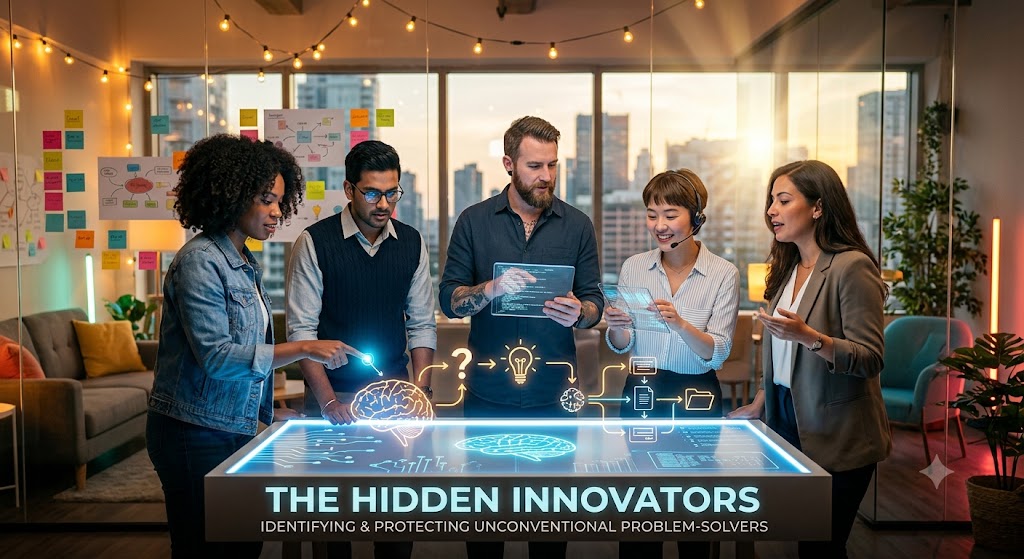
The Myth of the Elite Innovation Lab
Organizations pour millions into dedicated R&D centers, sleek design studios, and elite innovation labs. Yet, the most elegant, friction-reducing solutions rarely emerge from these highly curated environments. Instead, they are born on the quiet front lines — hatched by the customer service representative who crafts an ingenious workaround to bypass a legacy software glitch, or the floor manager who subtly modifies a physical tool to eliminate a safety hazard.
The core reality is simple: innovation is not a department; it is a distributed, human capability. Unfortunately, traditional corporate structures are organically engineered to act as social antibodies, filtering out unconventional thinkers and neutralizing variance in the name of predictability. To build an enterprise capable of continuous renewal, leaders must look beyond formal titles to actively identify, integrate, and protect these hidden problem-solvers.
“True organizational resilience requires a permanent shift from exclusionary, top-down mandates to an authentic model of Participatory Innovation.”
By shifting our focus toward inclusive co-creation, we don’t just discover better ideas — we fundamentally reduce the systemic friction and organizational resistance that kill brilliant strategies before they can ever take root.
I. Archetypes of the Unconventional Problem-Solver
To find the hidden innovators within an enterprise, leadership must first learn what they actually look like. They rarely match the stereotypical profile of the loud, charismatic “ideation guru” or the polished executive champion. Instead, unconventional problem-solvers manifest through specific behaviors, driven by a deep-seated desire to fix what is broken. They generally fall into one of four distinct archetypes:
The Constructive Rebel
This individual is frequently misunderstood by middle management as a disruptive force. They routinely bypass or bend standard operating procedures — not out of a desire to cause chaos, but because they realize the official process actively prevents them from solving a customer’s real-world pain point. They prioritize the human experience over bureaucratic compliance.
The Boundary Spanner
Innovation thrives at the intersections. The Boundary Spanner is a natural connector who exists horizontally in a vertically siloed world. They possess a rare cross-functional literacy, effortlessly translating insights between departments that rarely speak — such as pairing frontline customer feedback with backend systems architecture to spark a completely new workflow.
The Quiet Optimizer
Often introverted and highly focused on execution, Quiet Optimizers hate waste. They quietly automate their own workflows, write custom scripts, or build informal, localized tools to eliminate everyday friction. They don’t seek corporate validation, trophies, or stages; they simply want to make their immediate operational ecosystem work better.
Mapping to the Nine Innovation Roles
When we look at these archetypes through the lens of formal organizational design, they align perfectly with the Nine Innovation Roles framework. These hidden individuals are your organic Troubleshooters, Connectors, and Magic Makers. The challenge is that they are currently operating entirely outside of your formal innovation mandates — meaning their insights remain localized, isolated, and tragically unscaled.
II. Why Organizations Unknowingly Stifle Hidden Talent
Corporate antibodies are remarkably efficient at neutralizing variance. The tragedy of modern enterprise is that the systems designed to ensure operational stability are often the very mechanisms that silence unconventional thinkers. To unlock hidden innovation, we must diagnose the structural friction points that actively discourage our best minds.
The Tyranny of Traditional Performance Metrics
Standard key performance indicators (KPIs) are calibrated for predictability and optimization, not exploration. When performance evaluations reward incremental execution and flawless adherence to routine, they inherently penalize variance. Because true breakthrough thinking requires experimentation — and the inevitable failures that accompany it — rigid metrics force employees to choose between systemic compliance and human-centered problem-solving. Most choose compliance simply to survive.
The “Not Invented Here” Syndrome
Middle management often acts as a gatekeeper rather than a gateway. Ideas that bubble up from the front lines face an uphill battle against structural ego and institutional inertia. When an elegant solution does not originate from a designated research lab, an executive mandate, or an elite strategy team, it is frequently dismissed as amateurish or irrelevant. This cultural bias shuts down vital participatory loops before insights can ever reach decision-makers.
Psychological Safety vs. Corporate Compliance
Without psychological safety, brilliant ideas remain internal monologues. In highly bureaucratic environments where mistakes are weaponized, hidden innovators quickly learn to camouflage their best work. When the perceived risk of speaking up or trying a new approach outweighs the reward, people stop trying to fix the system. They either internalize their frustration, leading to profound burnout, or they quietly take their creative capital to a competitor who values agile thinking over blind obedience.
III. Active Identification: Spotting the Signals
Finding hidden innovators requires leaders to look past formal job titles, credentials, and organizational hierarchies. Unconventional problem-solvers leave distinct operational footprints. By shifting from passive suggestion boxes to active observation, organizations can accurately map where true organic innovation is happening.
Analyzing Friction Points and “Workarounds”
The best indicator of a future innovation is a current workaround. When employees actively break, bend, or modify an official process, they are rarely trying to sabotage the system — they are attempting to fix a flawed design. Leaders must stop treating process non-compliance purely as a disciplinary issue and start viewing it as data. Every unauthorized tool, unofficial spreadsheet, or localized shortcut is actually a low-fidelity prototype of a better process waiting to be studied and scaled.
Utilizing Experience Level Measures (XLMs)
Traditional operational data (KPIs) can tell you *what* is happening, but they completely miss the human element. To spot hidden problem-solvers, organizations must deploy Experience Level Measures (XLMs). By tracking human sentiment, frustration levels, and friction points across the employee journey, leaders can identify the specific bright spots: the anomalous teams or individuals who are maintaining high experience scores despite broken infrastructure. Where the employee experience thrives against the odds, a hidden innovator is actively closing the gap.
Peer-Nomination and Network Mapping
The formal organizational chart rarely reflects how work actually gets done. To find your true change agents, bypass the hierarchy and tap into the organic employee network. By asking teams simple, targeted questions — such as, “Who do you actually go to when you encounter a truly bizarre, complex problem that the standard manual can’t solve?” — the organization can map informal authority. The names that surface repeatedly are your natural innovation anchors, regardless of their official rank.
IV. The Protective Shield: Safeguarding and Nurturing Unconventional Thinkers
Identification without protection is a recipe for employee burnout and turnover. Once you uncover your hidden innovators, you cannot simply leave them exposed to the same corporate machinery that ignored them in the first place. Leaders must build an intentional, operational buffer around these individuals to safeguard their talent and nurture their ideas.
Establishing an Experience Management Office (XMO) Buffer
To shield unconventional thinkers from bureaucratic inertia, organizations need an institutional champion. This is where an Experience Management Office (XMO) becomes vital. Rather than acting as just another layer of measurement, a mature XMO serves as an operational buffer. It steps in to validate human-centered solutions, clear bureaucratic red tape, and provide the air cover necessary for cross-functional ideas to be tested without being crushed by rigid departmental silos.
Designing “Safe Zones” for Rapid Experimentation
Unconventional problem-solvers don’t need heavy infrastructure; they need permission and space. Organizations should establish structured “safe zones” — such as micro-grants, lightweight governance loops, or small, dedicated blocks of time — where employees can rapidly test hypotheses. By keeping the stakes low and removing standard corporate oversight from the initial discovery phase, you allow hidden innovators to fail fast, learn quickly, and refine ideas into viable, scalable prototypes.
Redefining Fairness and Reward Structures
Traditional corporate recognition often relies on blanket, equal rewards that inadvertently dilute individual contribution. True fairness in a human-centered ecosystem means equitable outcomes where rewards are relative to impact and effort. If your constructive rebels and quiet optimizers are carrying the disproportionate weight of solving complex systemic problems, the reward system must reflect that reality. Aligning incentives with actual value creation ensures that your most impactful change agents feel deeply seen, respected, and motivated to keep pushing boundaries.
Conclusion: Building a Perpetually Innovative Ecosystem
The long-term resilience of an enterprise does not depend on a handful of designated visionaries hidden away in an executive suite or a well-funded technology incubator. It depends entirely on the organization’s capacity to build a highly collaborative network and leverage its latent human capital. Innovation is inherently democratic, organic, and distributed; it belongs to anyone who refuses to accept a broken status quo.
To thrive in an era of continuous disruption, leadership must make a conscious choice to stop looking for change solely through top-down mandates. True competitive advantage is found by looking down, looking outward, and opening the door to authentic participatory frameworks. By intentionally identifying our constructive rebels, quiet optimizers, and boundary spanners—and providing them with the protective air cover they need to experiment — we transform the entire workplace culture.
“When you protect your hidden problem-solvers, you don’t just optimize your processes — you build an adaptable, human-centered organization capable of constant self-renewal.”
The talent you need to solve your most complex future challenges is already sitting in your conference rooms, answering your customer service lines, and managing your supply chains. Stop waiting for external disruptors or corporate miracles. Look closer at the quiet brilliance already operating within your midst, build the protective structures to help it thrive, and let your people co-create the future of the enterprise.
Frequently Asked Questions
To help human readers and automated search engines easily navigate the core concepts of managing hidden innovators, here are the answers to the most common questions about this human-centered approach:
1. What is the difference between a traditional innovator and a “hidden” innovator?
Traditional innovators operate within formal innovation frameworks, such as dedicated R&D departments, product management teams, or corporate strategy groups, and their performance metrics explicitly reward new ideas. A “hidden” innovator is a frontline or operational employee — such as a customer service representative or operations specialist — who invents brilliant, organic workarounds to solve real-world friction, completely outside of formal innovation mandates or job descriptions.
2. How does an Experience Management Office (XMO) help protect unconventional problem-solvers?
An XMO acts as an operational buffer and organizational champion for hidden innovators. Instead of letting a human-centered solution get crushed by rigid departmental silos or traditional middle-management resistance, the XMO steps in to validate the human impact of the idea, clear bureaucratic red tape, and provide the cross-functional air cover needed to safely test and scale the solution.
3. Why does traditional corporate fairness actually harm organic innovation?
Traditional corporate models treat fairness as equal, blanket recognition distributed uniformly across a team, regardless of individual variance in output. In an innovation ecosystem, true fairness means equity — where rewards and recognition are directly relative to a person’s disproportionate effort and human impact. When quiet optimizers or constructive rebels carry the weight of solving complex systemic problems but receive the same blanket acknowledgment as passive compliance followers, they face burnout and eventually stop contributing.
SPECIAL BONUS: Braden Kelley’s Problem Finding Canvas can be a super useful starting point for doing design thinking or human-centered design.
“The Problem Finding Canvas should help you investigate a handful of areas to explore, choose the one most important to you, extract all of the potential challenges and opportunities and choose one to prioritize.”
Image credit: Pexels
 Sign up here to get Human-Centered Change & Innovation Weekly delivered to your inbox every week.