Tag Archives: meaning

Focus your Emotional Energy Purposefully

Focus your Emotional Energy Purposefully

GUEST POST from Janet Sernack

When I exited my corporate career more than thirty-five years ago, I was privileged to be regarded and respected as the Fashion Direction Manager for the Grace Bros Department Store group, one of Australia’s most senior women in retail management. This launched my global reputation as a fashion and lifestyle marketing innovator. In this exciting role, I was responsible for designing and implementing a company-wide fashion information system for apparel, accessories, homeware, merchandising, and advertising.  This required me to focus my emotional energy on researching, analyzing, and conceptualizing global fashion and lifestyle trends and adapting them to suit the Australian consumer lifestyle.

It was a dream role before the invention of the Internet, the implosion of the mass media, and the dominance of fast fashion. It required our team to focus their emotional energy on intensively researching different global and diverse media sources, including yarn, textile, couture, designer, ready-to-wear shows, trade journals, magazines, and seasonal sales data. 

Generating creative thinking

Creativity is about connecting things, and in the fashion world, the best designers make the most unlikely connections to produce novel and wondrous creations. As my professional background included graphic and fashion design and marketing, I could further hone my associative (lateral and connective) thinking skills to think creatively and critically in this role. To focus my emotional energy and attention on guiding my intuition, values, and decisions on the needs and wants of buyers, merchandisers, marketers, and customers. To emerge, diverge and converge the key connections and patterns occurring globally in the fashion world and external complex fashion systems. I also learned the importance of being customer-focused and the value and role of being empathic with customers, manufacturers’ value chains and fashion information system users.

It was an incredibly emotional, physical, and stressful role, which required me to travel overseas four times a year to stay current on the different global fashion streams.

This caused my life to melt into being at work, the gym, or the airport.

Stress-induced exhaustion and burnout

This resulted in my first profound encounter with stress-induced exhaustion and burnout, which hit me right in the face one morning when my body refused to move, and I was unable to get out of bed.

I have also noticed that many of my global coaching clients have faced a similar challenge: stress-induced exhaustion and burnout. Fortunately, they can use the coaching partnership to unearth their particular pattern and unresourceful ways of being and learn how to focus their emotional energy to disrupt, dispute, and deviate from it into a more resourceful way of being and acting. However, it has shifted the coach’s role as a healer, making it even more critical in our current environment.

Focusing emotional energy on pursuing mattering, meaning and purposeful work

This ultimately manifests as a crisis and becomes a defining moment. In my case, I made a fundamental choice to focus emotional energy on pursuing meaning, mattering, and purposeful work, which still focuses my full attention and drives me today.

It created a “crack, “or an opening and threshold for making two fundamental choices: to embark on a healing journey to become the kind of person I wanted to be and to find a way to focus my emotional energy on making the difference I wanted to make in the world. 

This enabled me to use my knowledge, experience, and skills to establish Australia’s first design management consultancy.

What is emotional energy?

Emotional energy is the catalyst that fuels creativity, invention, and innovation.

Understanding and harnessing this energy inspires and motivates individuals to explore and embrace creative and critical thinking strategies, now in partnership with AI.

When a person’s emotional energy has contracted, it results in constrained, negative, pessimistic, and even catastrophic thinking habits, which have a toxic impact on the person’s identity and emotional and physical well-being.

This means there is no space, doorway, or threshold to take on anything new, novel, or different. Nor can they imagine what might be possible to evolve, advance, or transform their personal or professional lives in an uncertain future.

Emotional energy catalyses and directs your intrinsic motivation, conviction, hope, positivity, and optimism to approach your world purposefully, meaningfully, and differently.

When you are true to your calling or purpose, you will make extra efforts to be healthier, positively impact your well-being, and improve your resilience.

How does this apply to leadership in uncertain times?

“I think leaders need to remember that they are in the energy management business,” says Halsey. “Their role is to keep people focused, energized, and positive about themselves and their work. They may be unable to change external circumstances, but they can create a safe, nurturing, and empowering work environment. By setting clear goals, diagnosing individual needs, and providing the right leadership style, leaders can help their teams thrive—even in uncertain times.”

People want work to be less of a job and more of a calling.

According to Martin Seligman and Gabriella Rosen Kellerman in their book Tomorrowmind, a US-based research study that included two thousand employees of all ages, industries, tenures, and incomes, revealed that people craved more meaning at work regardless of sector or position. Everyone wanted work to be less of a job and more of a calling and gave their current jobs a rating of 49, which suggests that their “meaning cups” are only half full.

This search for meaning, mattering, and being of service to humanity in a different and value-adding way enables innovators, entrepreneurs and intrapreneurs to cultivate the emotional energy and develop the agility required to drive their creativity, invention and innovation endeavors. 

It is the most critical ingredient that motivates, empowers, enables, fuels and sustains innovators, entrepreneurs, and intrapreneurs to adapt, survive and thrive on the innovation roller coaster.

Channeling emotional energy meaningfully and purposefully

From my leadership training and coaching experience, I have learned that most people desperately want their lives to make sense and be meaningful and to know that who they are and what they do matters. It is possible to link meaning and mattering to being intentionally motivated and directed by your core values to make a difference and a contribution that provides value and significance to someone, a community, or society.  

  • Being purposeful

Being purposeful focuses your emotional energy, guides your life decisions influences your behaviors, shapes your goals, offers a sense of direction, and creates meaning. Rather than engaging in shallow, empty, or pointless activities, it gives you agency.

In our uncertain, volatile and disruptive world, it is crucial to think about your “purpose in life.” Be like an Entrepreneur and link your purpose as a guidepost to help you deal with uncertainty, navigate it better, mitigate the damaging effects of long-term stress, and become psychologically resilient.

People with a strong sense of purpose direct and focus their emotional energy on what really matters to them. They tend to be more agile and adaptive, hardier and resilient, and more able to refocus and recover quickly from adverse and catastrophic events.

According to McKinsey & Co.’s article “Igniting individual purpose in times of crisis,” purposeful people also live longer and healthier lives and are essential to employee experience. This results in higher levels of employee engagement, more substantial organizational commitment, and increased feelings of well-being. Like many entrepreneurs, people who find their purpose congruent with their jobs tend to get more meaning from their roles, making them more productive and more likely to outperform their peers.

How can you add more meaning, mattering and purpose?

Meaning is an outcome of purpose, and many people, due to their experience of the pandemic and hybrid workplace in a chaotic and uncertain world, are seeking to re-engage with their work and workplaces by focusing their emotional energy on improving their well-being and creating more purposeful, balanced, and meaningful lives.

This is a short section from our new book, “Conscious Innovation – Activating the Heart, Mind and Soul of Innovation”, which will be published in 2025.

Please find out more about our work at ImagineNation™.

Please find out about our collective learning products and tools, including The Coach for Innovators, Leaders, and Teams Certified Program, presented by Janet Sernack. It is a collaborative, intimate, and profoundly personalized innovation coaching and learning program supported by a global group of peers over 9-weeks. It can be customized as a bespoke corporate learning program.

It is a blended and transformational change and learning program that will give you a deep understanding of the language, principles, and applications of an ecosystem-focused, human-centric approach and emergent structure (Theory U) to innovation. It will also up-skill people and teams and develop their future fitness within your unique innovation context. Please find out more about our products and tools.

Image Credit: Unsplash

Subscribe to Human-Centered Change & Innovation WeeklySign up here to join 17,000+ leaders getting Human-Centered Change & Innovation Weekly delivered to their inbox every week.


Did You Make a Difference Today?

Did You Make a Difference Today?

GUEST POST from Mike Shipulski

Did you engage today with someone that needed your time and attention, though they didn’t ask?

You had a choice to float above it all or recognize that your time and attention were needed. And then you had a follow-on choice: to keep on truckin’ or engage. If you recognized they needed your help, what caused you to spend the energy needed to do that?

And if you took the further step to engage, why did you do that?

For both questions, I bet the answer is the same – because you care about them, and you care about the work. And I bet they know that, and I bet you made a difference.

Did you alter your schedule today because something important came up?

What caused you to do that?

Was it about the thing that came up or the person(s) impacted by the thing that came up?

I bet it was the latter. And I bet you made a difference.

Did you spend a lot of energy at work today?

If so, why did you do that? Was it because you care about the people you work with?

Was it because you care about your customers?

Was it because you care enough about yourself to live up to your best expectations?

I bet it was all those reasons. And I bet you made a difference.

Image credit: Dr. Matthias Ripp

Subscribe to Human-Centered Change & Innovation WeeklySign up here to get Human-Centered Change & Innovation Weekly delivered to your inbox every week.


Rituals that Sustain Belonging Across Distances

LAST UPDATED: February 27, 2026 at 12:17 PM

Rituals that Sustain Belonging Across Distances

GUEST POST from Art Inteligencia

I. Introduction: The Human Side of Distance

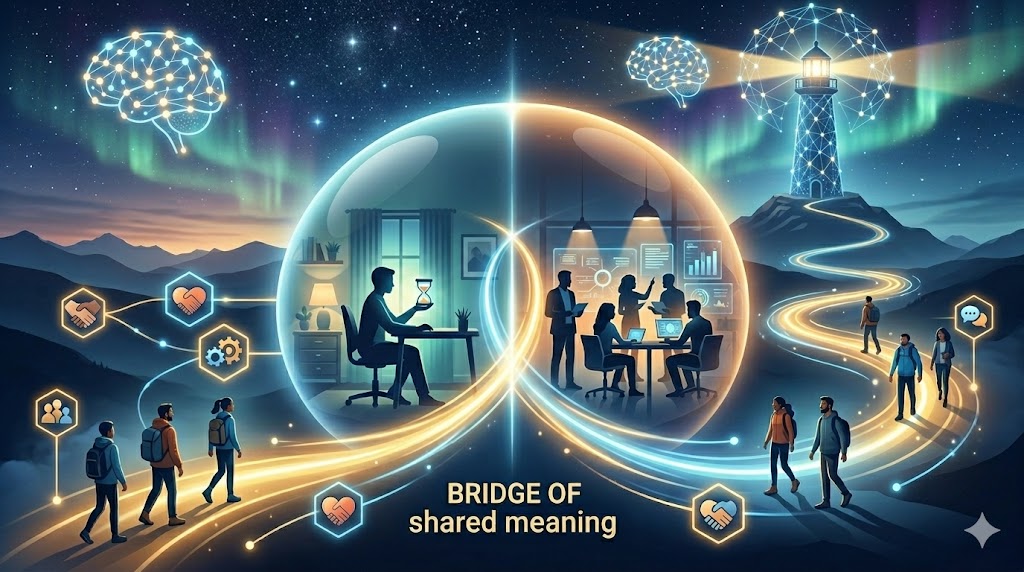
In our rush to optimize for “anywhere work,” we have mastered the logistics of communication but neglected the architecture of belonging. We often mistake a green status icon on Slack for a true human connection. This is the Proximity Paradox: we are more digitally tethered than ever, yet many individuals feel like “satellites” orbiting a core they cannot feel.

Belonging is the psychological certainty that you are part of something meaningful. It serves as the Fixed Anchor in a flexible world. Without it, innovation stalls because people lack the safety to take risks. With it, a team transforms from a collection of distant individuals into a reconfigurable, high-trust enterprise capable of sustained momentum.

“Innovation moves at the speed of trust, and trust is built in the spaces between the tasks. Rituals are the rhythmic anchors that bridge those spaces.” — Braden Kelley

To sustain culture across thousands of miles, we must move from presence-by-proximity to presence-by-ritual. This article explores how to architect these rituals not as “extra work,” but as the essential script that makes the performance of collective innovation possible.

II. The Anatomy of a Transformative Ritual

To architect belonging, we must distinguish between a routine and a ritual. A routine is about efficiency; a ritual is about meaning. When we design for distance, we must be intentional about creating a “Sensory Bridge” that replaces the physical cues of the traditional office.

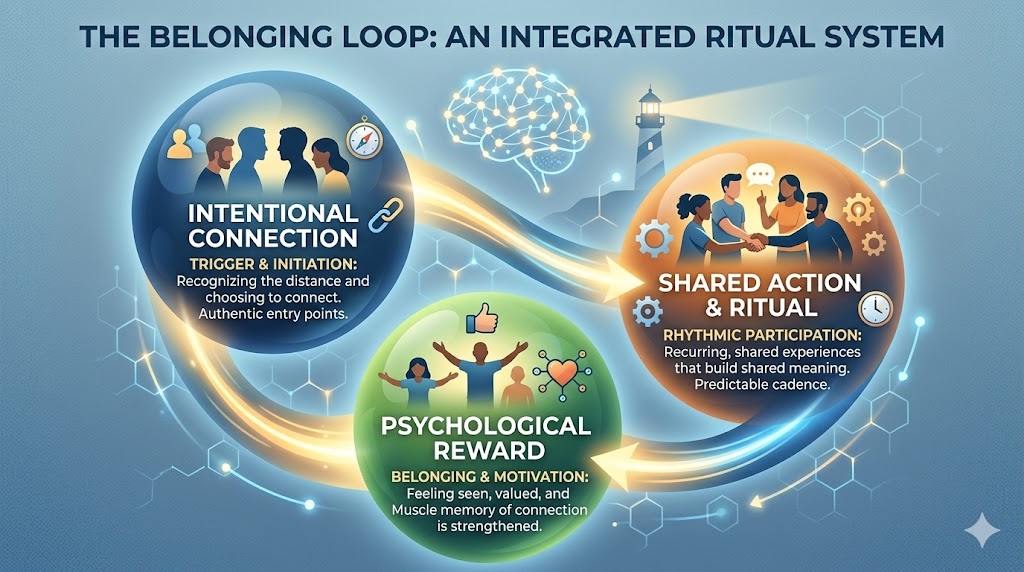
1. The Intentional Trigger

Rituals need a clear entry point. Whether it’s a specific musical cue at the start of a call or a shared digital “check-in” prompt, the trigger signals that the team is shifting from doing mode to belonging mode.

2. The Shared Action

This is the “rhythmic participation” where the group acts in unison. In a distributed setting, this might involve collaborative storytelling or a shared recognition loop that reinforces the team’s identity.

Roles in the Ritual

For a ritual to be transformative, it must allow individuals to show up in their Intrinsic Genius. In Braden Kelley’s work on the Nine Innovation Roles, he highlights that a ritual should create space for the Connector to bridge silos and the Storyteller to frame the team’s momentum.

The Belonging Loop

The Psychological Reward:

The loop closes when the individual feels seen and valued. This reinforcement builds the “muscle memory” of connection, ensuring that even when we are thousands of miles apart, our shared intent remains perfectly aligned.

“If your rituals don’t leave people feeling more capable of tackling the next challenge together, you haven’t built a ritual — you’ve just added another meeting to the calendar.” — Braden Kelley

III. Rituals for the Daily Pulse

To prevent team members from becoming “satellites,” we must establish rhythmic anchors that ground the daily experience. These are not status updates; they are moments of synchronization that prioritize psychological safety and shared intent.

1. The “Emotional Weather” Check-in

Distributed teams often lose the ability to “read the room.” A daily ritual of sharing one’s “weather” — sunny, overcast, or stormy — allows colleagues to understand the emotional context behind a teammate’s performance without requiring a deep dive into personal details. This builds Cognitive Empathy across the distance.

2. Micro-Synchronies (The 10-Minute Huddle)

Long meetings create a “Cognitive Tax.” In contrast, a Micro-Synchrony is a short, high-energy ritual focused on removing blockers and aligning the “Muscle of Foresight.” By keeping it rhythmic and brief, you provide a predictable point of connection that doesn’t disrupt the “Flow State.”

Strategic Outcome:

When daily rituals are designed well, they create a sense of Co-Presence. Even though the team is physically separate, the constant, low-stakes pulse of connection ensures that the foundation of absolute integrity remains intact.

“Frequency beats intensity. A ten-minute daily ritual of genuine connection is more valuable for belonging than a six-hour quarterly offsite.” — Braden Kelley

IV. Rituals for Collective Momentum

While daily rituals ground us, Momentum Rituals are designed to lift the team’s gaze. In a remote environment, “Invisible Friction” — the small, unrecorded struggles of the week — can erode morale. These rituals ensure that effort is seen, lessons are shared, and the team’s “Muscle of Foresight” is collectively strengthened.

The Friday Victory Round

Rather than a dry status report, the Friday Victory Round focuses on Impact and Insight. Team members share one “win” and one “learning from friction.” This ritual normalizes the reality that innovation is messy. By publicizing the struggle as much as the success, you build a culture of Absolute Integrity where people aren’t afraid to be real.

The “Kudos” Narrative

Peer-to-peer recognition shouldn’t be a transaction; it should be a story. A weekly ritual of “passing the torch” of gratitude allows the team to highlight the Invisible Contributions — the person who stayed late to fix a bug or the one who provided moral support during a tough deadline.

The Power of Symbolic Storytelling

I advocate for the use of symbols in these rituals. Whether it’s a digital “badge of honor” or a recurring mention in a team “Hall of Fame,” these markers create a shared history. They turn a series of calendar invites into a legacy of shared achievement.

“Belonging is sustained when we stop counting tasks and start celebrating the trajectory of our collective genius.” — Braden Kelley

V. Strategic Implementation: Guarding the “Creepy Threshold”

The greatest risk to any cultural initiative is inauthenticity. When rituals are handed down as mandates from the boardroom without team input, they often cross what I call the “Creepy Threshold” — that uncomfortable space where “forced fun” feels like surveillance or performative compliance.

To build a Foundation of Absolute Integrity, leaders must transition from being “Commanders of Culture” to “Architects of Agency.” Rituals must be co-created with the people who will actually perform them.

Three Rules for Ethical Rituals:

  • Authenticity Over Mandate: If the team doesn’t find value in the ritual, retire it. Rituals are living tools, not permanent monuments.
  • Respecting the “Internal Clock”: Be mindful of “Zoom fatigue” and time zone equity. A ritual that creates belonging for London but exhaustion for Los Angeles is a failure of design.
  • Radical Transparency: Never use a ritual as a “Trojan Horse” for tracking productivity metrics. The primary ROI of a ritual is trust, not throughput.

The Role of the Trust-Architect

I counsel leaders to listen for the “cultural hum” of the organization. If a ritual feels awkward or forced, it’s a signal that your strategy is out of sync with the human reality. The goal is to create a script where the actors want to take the stage.

“You cannot mandate belonging; you can only design the conditions where it is the natural outcome of shared intent.” — Braden Kelley

VI. Conclusion: Architecting the Future of Presence

The challenge of the distributed era is not one of bandwidth or software, but of meaning. As we have explored, the distance between us is not measured in miles, but in the gaps between our shared experiences. Rituals serve as the structural scaffold that bridges these gaps, transforming a “flexible” workforce into a “fixed” community of intent.

When you master the art of the ritual, you stop being a task-manager and start being a Meaning-Maker. You move beyond the “Silicon-First” obsession with tools and return to the “Human-First” necessity of connection. This is how we build the Muscle of Foresight: by ensuring our teams are so well-aligned and so deeply connected that they can anticipate challenges and pivot in unison, regardless of where they sit.

“Belonging is a perishable asset. It requires the constant, rhythmic nourishment of shared ritual to stay alive. In the future of work, the most successful leaders won’t be those with the best dashboards, but those who create the most meaningful stages for their people to perform upon.”

— Braden Kelley

As you look to the next quarter, audit your connection points. Are they merely routines designed for efficiency, or are they Rituals designed for Belonging? The choice you make will determine whether your organization remains a collection of individuals or becomes a legacy of shared genius.

Are you ready to design the script for your team’s next great performance?

The Ritual Audit Tool

Transitioning from Routine to Ritual

Select a recurring team touchpoint (e.g., Daily Standup, Weekly Sync) and evaluate it against the four pillars of Belonging Design:

Pillar The Diagnostic Question Status
Intentional Trigger Does the meeting start with a clear signal that shifts the team from “task” mode to “human” mode?
Psychological Safety Is there space for “Emotional Weather” or “Lessons from Friction” without fear of judgment?
Shared Agency Does the team own the format, or is it a top-down mandate that crosses the “Creepy Threshold”?
Predictable Reward Do participants leave feeling more “seen” and energized than when they arrived?

Key Insight:

If you checked fewer than three boxes, you are likely running a Routine. To transform it into a Ritual, inject a storytelling element or a peer-recognition loop. Remember: Rituals are the script that makes the performance of collective innovation possible.

Distributed Belonging: Frequently Asked Questions

What is the difference between a routine and a ritual in a remote team?

A routine is focused on efficiency — getting the task done. A ritual is focused on meaning. In a distributed environment, rituals act as “Sensory Bridges” that replace physical proximity, turning a standard meeting into a rhythmic anchor that reinforces shared identity and trust.

How can leaders avoid the “Creepy Threshold” when building culture?

The “Creepy Threshold” is crossed when connection feels like surveillance. To avoid this, move from being a “Commander of Culture” to a Trust-Architect. Ensure rituals are co-created with the team, respect their “internal clocks,” and are never used as a Trojan Horse for tracking productivity metrics.

What is the “Muscle of Foresight” in the context of team belonging?

It is the team’s collective ability to sense shifts and adapt before they become crises. When a team has a strong foundation of belonging, they share “Invisible Friction” more openly. This transparency builds the Muscle of Foresight, allowing the organization to remain proactive rather than reactive.

For more insights on human-centered innovation and change, organizations often look to an innovation speaker like Braden Kelley to bridge the gap between technology and human trust.

Image credit: Google Gemini

Subscribe to Human-Centered Change & Innovation WeeklySign up here to get Human-Centered Change & Innovation Weekly delivered to your inbox every week.