Tag Archives: customer service

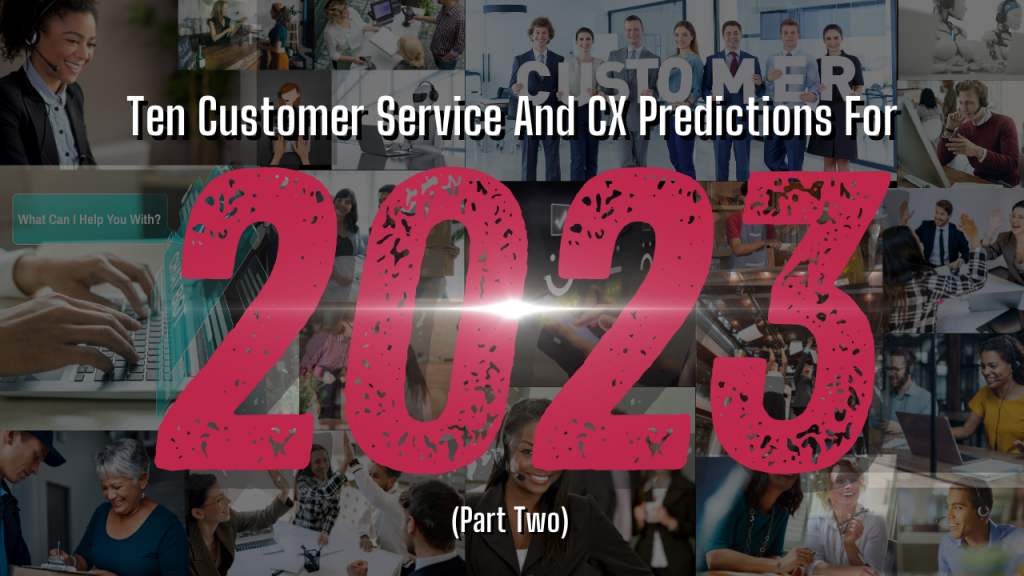
Ten CX and Customer Service Predictions for 2023 – Part Two

Ten CX and Customer Service for 2023 – Part Two

GUEST POST from Shep Hyken

Last week I shared the first five of ten business predictions and trends for 2023. Here the remaining five (plus a bonus). As you look at these predictions, think about how they might impact your company. For example, if self-service customer service options are more popular than ever (No. 7), is your company or brand offering them to your customers?

6. Customer Support on the Phone Is Not Dead

Even with all the self-service solutions becoming more popular, the phone will continue to reign as the most popular way for customers to connect with customer support. Our customer service research (sponsored by Amazon AWS) confirms this as 87% of Baby Boomers (who make up just over 21% of the population of the U.S.) prefer the phone to any other channel, keeping traditional phone support as the No. 1 way customers choose to get their questions answered and their complaints resolved.

7. Self-Service Is More Popular than Ever

Even though the phone continues to be the most popular channel for customers to have their questions and complaints addressed, self-service options are becoming more and more appealing. Just as Boomers drive the phone, the younger generations—Gen-Z and Millennials—are proving that an investment in self-service channels, such as a robust knowledgebase on a website, video tutorials, chatbots and more, is an up-and-coming trend.

8. More Companies and Brands Will Stand for Something Important

Here’s more vital research to consider. Forty-five percent of your customers value a company that supports a social cause that’s important to them, and only 20% feel that a cause is not important enough to sway their buying decision. It’s especially true for Gen-Z and Millennials. Causes can range from climate change to sustainability, local community and charity events, and good old-fashioned values. You’ll start seeing more companies and brands participating in causes that are important to them and their customers. Our customer experience research found that customers are drawn to companies that “give back.”

9. Customers Want to Do Business with Companies and Brands They Can Trust

The old expression says it all. Customers want to do business with people and companies they know, like and trust. The knowing and liking are easy. Trust is harder. It’s an emotional connection between the customer and the company. Customers must know something will absolutely happen, that their experience will always be great and that the company has their best interests in mind. Eighty-one percent of more than 1,000 consumers we surveyed said a great customer experience increases trust. Start with the experience. Work to create an experience that instills confidence and will positively impact your bottom line.

10. The Customer Support Department Becomes the Revenue Generation Department

There have been numerous discussions and debates over the years about the investment into a customer support system. For many years, the department and processes that handle customers’ questions and complaints were seen as a cost. As the importance of customer service continues to grow, leaders are recognizing the revenue generated from the front line that handles customers’ problems and issues. I’ve gone as far as suggesting to clients that they stop referring to this group as the customer support department, but instead call it the revenue generation department. If it is the job of sales and marketing to bring in customers, it is the job of the people who have direct contact with the customer, especially after the sale, to maintain and nurture them for future business. A problem handled well gives the customer confidence to want to come back. When they do, they spend more. Eventually, they may even become loyal. As companies realize this, they will start investing more into the department and process traditionally known as customer support.

BONUS: Robots Will Not Replace People

In our research, we asked more than 1,000 consumers if they thought in the next ten years, robots would start to replace humans in customer service roles. Sixty-four percent said yes. Here’s my prediction. Robots won’t replace humans—at least not 100%. We are already seeing chatbots, voice recognition software, AI-infused conversations (with the computer) and other digital technologies becoming more capable, and therefore more popular. However, they won’t replace customer support agents and frontline employees. What they will do is make their jobs easier. Currently, AI and digital support are really good for basic questions and simple problems. While they will improve, we’ll still need human-to-human interactions when necessary. Certain businesses will excel in the adoption of high-end robotic and AI-infused technologies, but we’re a long way away from computers and robots replacing people. A few years ago I came up with a quote that still holds true today, and I believe will hold true ten years from now: The greatest technology in the world hasn’t replaced the ultimate relationship building tool between a customer and a business: the human touch.

If I had to sum up my predictions for the future of customer service and CX, I might use another old saying: The more things change, the more they stay the same. Yes, you need to provide your customers with modern convenience and technology that they have come to expect and rely on, but the basics are basics for a reason. Customers will always want to be treated well, be treated like individuals, and feel a real human connection.

This article originally appeared on Forbes

Image Credit: Shep Hyken

Subscribe to Human-Centered Change & Innovation WeeklySign up here to get Human-Centered Change & Innovation Weekly delivered to your inbox every week.

Ten CX and Customer Service Predictions for 2023 – Part One

Ten CX and Customer Service for 2023 - Part One

GUEST POST from Shep Hyken

We are in a strange time. For the past two and a half years, we have experienced one hurdle after another. It started with the pandemic, moved into supply-chain problems that merged with employment issues, and to top it all off, we’re experiencing a rough economy. While the difficulties hit some industries harder than others, every company or brand has had to show a level of nimbleness and flexibility to stay ahead, if not just stay in business. Some companies figured it out, and some are still finding their way. Regardless, the following predictions could give you some food for thought in how to navigate the next year and beyond.

1. Customers Will Be Smarter and More Demanding Than Ever

Each year, I start the list with a similar prediction. It seems that our customers are smarter than ever when it comes to customer service and experience. They are getting the type of experience they want from certain companies and brands, and then they expect it from just about anyone they do business with. All of our customers, regardless of our type of business (B2B, B2C, B2B2C) are consumers. Certain B2C rockstar brands are teaching our customers what good service is like, and it’s become the expectation (and hope) of every customer that they will get a similar experience from any type of business.

2. Companies Will Focus as Much – Maybe More – on Employees Than They Do on Customers

What has been termed The Great Resignation wasn’t so much about employees quitting work to retire. They were quitting to move to better jobs. Companies that haven’t been employee-focused have struggled to keep some of their best people. Just as you work to attract and keep your best customers, you want to do the same with your employees. The cost of turnover, hiring and training can be far greater than an increase in salary and benefits. And don’t forget the appreciation factor. Just as you appreciate your customers, you should appreciate your employees. And a powerful byproduct of this effort is the customer experience. What’s happening on the inside of a company is felt on the outside by the customer.

3. Customers’ Expectations of the ‘Basics’ Continue to Rise

The basics of a good customer experience are really simple. Customers want employees who are kind and helpful. They want to easily reach the right customer support person. They expect employees to be knowledgeable about the company’s products and services. They want faster customer support responses from email, messages or text. Yes, these are the basics and they seem so simple, but that doesn’t mean they are easy to execute consistently. Our customer service research (sponsored by Amazon) found that year over year, customers’ expectations of these basics increased. The research also found that 49% of customers had more bad customer service experiences in the past year compared to the year before. Going back to Prediction No. 1, it’s the rockstar companies and brands that are setting the right example and raising the bar—and thereby raising customers’ expectations. The message is clear. Focus on the basics. They are the foundation of your customer service and CX strategies.

4. Personalization Gets More Personal

Up until recently, personalization had been used just to segment customers into several personas. Today, customers are experiencing hyper-personalization, treating them as individuals versus part of a larger group in a company’s database. Perhaps a better term for personalization would be individualization. In our customer service research, 74% of customers we surveyed said a personalized experience is important. A personal or individualized experience will endear the customer to the company, creating a greater chance of repeat business and even customer loyalty.

5. Some Companies Will Make the Mistake of Cutting Expenses in the Wrong Place

As many companies experience the pressures of the economy (and supply chain delays and employee issues), they will begin to make changes. Customers are spending less, and costs are going up. That’s not a good formula but it’s what we are forced to work with, and the result is companies being more careful about how they spend money. As this applies to customer experience, companies will be looking for places to cut costs and save money. The big mistake is if they cut in the areas of customer service and experience, leaving them vulnerable to competition and taking away their market share. Unfortunately, if history repeats itself, and I predict it will, many companies and brands will make this mistake. Hopefully, your company isn’t one of them. One of the worst places to cut is anywhere the customer will notice.

Well, that’s the first five of my ten predictions for 2023. Come back for the remaining five predictions next week.

This article originally appeared on Forbes

Image Credit: Pixabay

Subscribe to Human-Centered Change & Innovation WeeklySign up here to get Human-Centered Change & Innovation Weekly delivered to your inbox every week.

Avoiding An Unamazing Customer Experience

Avoiding An Unamazing Customer Experience

GUEST POST from Shep Hyken

NICE isn’t just the right way to treat people. It’s the name of a software company that specializes in helping businesses improve their customer and agent experience. NICE has analyzed billions of customer interactions to better understand customer behavior. They know what customers like and dislike. They know what frustrates customer support agents and what gets them excited about helping their customers. But often, it’s not an agent experience that gets customers to come back.

A recent study from NICE found that 81% of consumers today start with a digital channel when they have a question, a need or want to buy something. They don’t call the company. They go to a website, YouTube, Google search, etc. They want and expect the companies and brands they do business with to have answers readily available. What they don’t want is to call a company, be placed on hold for what seems like an unreasonable period of time, talk to a rep who transfers them to another rep, etc., etc.

I recently interviewed Laura Bassett, Vice President of Product Marketing at NICE, and had a fascinating conversation about how customers’ expectations are changing. She said many experiences are unamazing. They simply disappoint, which doesn’t give a customer the incentive to come back for more. Bassett said NICE’s mission is to rid the world of unamazing customer experiences. Here are some of the nuggets of wisdom Bassett shared on how to do exactly that.

1. Customer experience is the entire journey.

Many people make the mistake of thinking that customer experience is customer support. It’s much more than that. While customer support is part of the experience, it really starts when a customer initiates a Google search, finds your company and interacts with your website. The service begins with how easy it is to do business with you regardless of where they are in the customer journey.

2. Customer experience involves every person in the business.

Just as customer experience includes the customer’s entire journey—not just when they reach out for customer support—it also involves every employee. If you aren’t dealing directly with a customer, you support someone who is or is part of the process that will impact the experience. Even people behind the scenes, who never interact with the customer, have impact on the experience. Everyone must understand their role and contribution to the customer experience.

3. Proactive communication is essential to the customer experience.

Companies know many of the questions that customers ask. So, why not be proactive about giving customers information before they have to make the effort to get answers? Bassett said, “Companies should understand and predict when they can answer a question before customers even realize they have it.”

4. Walk in your customer’s shoes.

This is an old expression, yet its meaning is timeless. You must understand what the customer is going through at every step of the journey. Then compare it to the experience you would want. When designing an experience that makes customers want to come back, think about what would make you come back. Is the experience your customers receive different than what you want?

5. Agents are consumers too.

Their expectations have accelerated. They compare what they should be able to deliver to what they experience with other businesses. When they have an amazing experience with another company, they want to repeat that experience for their own customers. They must be equipped with the tools to deliver what they consider to be an amazing experience.

6. Make your customer support agents knowledgeable.

This is a great follow-up to No. 5. Help them understand that they don’t have to follow a script when it is unnecessary. They don’t want to feel held back. They don’t want to feel over-managed or under-enabled. After you hire good people and train them well, you should empower them to do their job. Bassett said, “Turn agents into customer service executives who can really own that experience.”

7. Amazing customer service doesn’t need to have fireworks.

Seamless and simple wins every time. This is the perfect concept to close out this article. Nothing shared in this article is rocket science. It’s common sense. It’s what every customer wants. To be amazing, you don’t have to go over the top and WOW the customer with the most incredible service they have ever experienced. Delivering the simple and seamless actually creates the WOW factor so many businesses believe is unattainable. Just be easy. Eliminate friction. Easy and seamless isn’t that hard—and for customers, it’s the opposite of unamazing!

This article originally appeared on Forbes

Image Credit: Shep Hyken

Subscribe to Human-Centered Change & Innovation WeeklySign up here to get Human-Centered Change & Innovation Weekly delivered to your inbox every week.

Top 10 Human-Centered Change & Innovation Articles of July 2022

Top 10 Human-Centered Change & Innovation Articles of July 2022Drum roll please…

At the beginning of each month we will profile the ten articles from the previous month that generated the most traffic to Human-Centered Change & Innovation. Did your favorite make the cut?

But enough delay, here are July’s ten most popular innovation posts:

  1. What Latest Research Reveals About Innovation Management Software — by Jesse Nieminen
  2. Top Five Reasons Customers Don’t Return — by Shep Hyken
  3. Five Myths That Kill Change and Transformation — by Greg Satell
  4. How the Customer in 9C Saved Continental Airlines from Bankruptcy — by Howard Tiersky
  5. Changing Your Innovator’s DNA — by Arlen Meyers, M.D.
  6. Why Stupid Questions Are Important to Innovation — by Greg Satell
  7. We Must Rethink the Future of Technology — by Greg Satell
  8. Creating Employee Connection Innovations in the HR, People & Culture Space — by Chris Rollins
  9. Sickcare AI Field Notes — by Arlen Meyers, M.D.
  10. Cultivate Innovation by Managing with Empathy — by Douglas Ferguson

BONUS – Here are five more strong articles published in June that continue to resonate with people:

If you’re not familiar with Human-Centered Change & Innovation, we publish 4-7 new articles every week built around innovation and transformation insights from our roster of contributing authors and ad hoc submissions from community members. Get the articles right in your Facebook, Twitter or Linkedin feeds too!

Have something to contribute?

Human-Centered Change & Innovation is open to contributions from any and all innovation and transformation professionals out there (practitioners, professors, researchers, consultants, authors, etc.) who have valuable human-centered change and innovation insights to share with everyone for the greater good. If you’d like to contribute, please contact me.

P.S. Here are our Top 40 Innovation Bloggers lists from the last two years:

Subscribe to Human-Centered Change & Innovation WeeklySign up here to get Human-Centered Change & Innovation Weekly delivered to your inbox every week.

Marriott’s Approach to Customer Service

Customer Service the Marriott Way

GUEST POST from Shep Hyken

It was 1927, not quite a century ago, when J. Willard Marriott and his wife, Alice, opened an A&W root beer stand in Washington, D.C. Later that year, the Marriotts added some hot food items to their menu under the name Hot Shoppes. Over the next 30 years, the Marriotts honed their hospitality skills and expanded their restaurant business into food service for airlines. In 1957, they opened their first hotel in Arlington, Virginia. It was run by their son, Bill.

Over the next 25 years, under the leadership of Bill Marriott, the hotel chain expanded across the planet. Today it represents more than 30 brands, from economy-priced lodging to uber-premium brands such as The Ritz-Carlton and St. Regis.

I recently had the opportunity to interview Julius Robinson, Marriott’s chief sales and marketing officer in the U.S. and Canada, on Amazing Business Radio. Robinson started with the Marriott organization 30 years ago in the reservations center. He knows firsthand what it takes to create an amazing customer experience.

Here are six key lessons he shared in our interview:

  1. The Fundamentals of Customer Service Happen One Person at a Time: When Robinson worked at the reservations center for Marriott, he learned the power of individual customer interactions. It’s about taking care of people one interaction at a time. Every customer was a chance to start over and confirm—and even build on—the Marriott reputation.
  2. Understand Your Customers: Understanding starts with listening. A customer who is booking a family vacation has very different needs than someone booking a business trip. The secret is to listen and avoid miscommunication. A complaint from a misunderstanding is one of the worst kinds of complaints. It’s easy to replace a dirty towel in a bathroom. It’s much harder to rebuild confidence after a miscommunication.
  3. Mistakes Handled Well Can Create a Stronger Bond: When there is a problem or a complaint, the way it is handled can make the difference between a customer coming back or not. Just resolving the issue doesn’t mean the customer will come back—it’s the way you do it that can make a big difference. Robinson was excited to share, “If you handle the problem the right way, the customer surveys will often be higher than if the problem had never occurred.” Problems and complaints should be seen as opportunities to prove how good you are.
  4. Embrace the Digital Customer Experience: When Robinson started 30 years ago, there wasn’t an Internet. Today customers may call, but often they make reservations, check-in and check out on a computer. They can even get their keys through a mobile app. According to Robinson, “Technology is an opportunity for the customer to take control over their travel experience.” The modern customer is increasingly enjoying a digital, self-service experience. However, if there is a problem at any point in their journey (no pun intended), the customer must have easy access to someone who can help, be it an agent on the phone or an employee at the front desk.
  5. Employees Must Be Empowered to Take Care of the Customers: Employees must be properly trained to do what is necessary to take care of customers. Robinson shared how, from the very beginning, J.W. Marriott Sr. believed in treating employees the way you want customers to be treated. In other words, leadership and management were the role models, and their behavior showed employees the right way to treat customers. Treat the employees right, and they will treat the customers right, and then the customers will come back.
  6. The Modern Marriott Customer Experience: Every company must grow as customers’ expectations change. During the past two years, we’ve seen customers demanding more. That challenge must be met. Many Marriott customers now expect more than just a place to sleep. The result is Marriott’s shift from simply providing a nice room and restaurant to creating an expanded experience. For example, the hotel staff can help locate hard-to-get tickets to sporting events and concerts. Maybe guests want a unique, once-in-a-lifetime experience. The Marriott team is there to help. Marriott, just like any other company, must meet its customers’ current expectations and be able to anticipate what they will need next.

Throughout the interview, Robinson shared insights into the efforts Marriott is making to get its customers to feel comfortable and confident about returning to pre-pandemic travel habits. It’s not only creating a great customer experience and providing exemplary service, but also taking measures to address customers’ concerns about safety and health. Because without that, nothing much else matters.

This article originally appeared on Forbes

Image Credit: Shep Hyken

Subscribe to Human-Centered Change & Innovation WeeklySign up here to get Human-Centered Change & Innovation Weekly delivered to your inbox every week.

Top Five Reasons Customers Don’t Return

Top Five Reasons Customers Don't Return

GUEST POST from Shep Hyken

Whatever you sell, be it a product or service, your customers expect that it will do what it’s supposed to do. If you sell a car, the car should work. If you sell a service, the outcome should meet expectations. That’s table stakes.

So, let’s assume that whatever your customers are buying from you will meet their expectations. However, that’s not always why the customer buys from you in the first place, let alone comes back to buy more. It’s the customer experience that drives that.

In our 2022 Achieving Customer Amazement research, more than 1,000 American consumers were asked, “How likely would you be to switch companies or leave a brand after experiencing any of the following bad customer service experiences?” They were asked to rate several reasons using a scale that ranged from “not likely” to “very likely.” Here are the top five reasons customers would leave:

1. Rudeness or Apathy From a Company or Brand Employee

This was the No. 1 reason, coming in at 75%. What’s interesting is that in the late 1970s a study was commissioned by the White House Office of Consumer Affairs, and the top reason for customers leaving (over 70%) was the same. It’s hard to believe that the numbers haven’t changed for 40 years, but this continues to be the No. 1 reason customers don’t come back.

2. Inconsistent Information

There is no excuse for inconsistent information. Obviously, this is very frustrating to customers, with 72% saying this would drive them to find someplace else to do business. Have you ever called a company’s customer support number with a question and didn’t like the answer? If you truly believed the answer was incorrect, you may have called back to ask someone else the same question, hoping for a different answer. And it’s amazing how many times you get a different answer.

3. Inability to Connect with Someone From Customer Support

Self-service or digital support is becoming more popular. Customers are learning that it’s often quicker and easier to visit a website, read the frequently asked questions or interact with an AI-fueled chatbot. However, there are times when you want to talk to a human. It should be an easy, seamless transition, but some companies hide behind a wall of digital support and make it difficult for a customer to connect to a live agent. Furthermore, some companies bury their customer support number on their website, making it difficult, if not impossible, to find. This third reason customers leave comes in at 71%, just four percentage points off the No. 1 reason.

4. A Bad Customer Service Experience

I would think this would be at the top of the list, but at 68%, it takes fourth place. A bad customer service experience is exactly that. It’s just bad. But survey participants considered dealing with a rude or apathetic employee worse than an overall bad experience. My interpretation is that you might get a second chance following an overall bad experience. However, if customers are treated with disrespect (rudeness and apathy), it’s more than likely you won’t see them again.

5. Inconsistent Experience

You can’t be great one day, not so great the next day, average another day, etc. Inconsistency erodes confidence. Fifty-nine percent of the customers we surveyed would walk if they didn’t know what to expect. Customers want a consistent and predictable experience. That gives them confidence that they know what to expect every time they do business with you.

Conclusion

As you look at this list, you might think, “I knew that.” Of course, you did. You’re a customer. You don’t want to deal with employees who are rude or apathetic. It bothers you to get inconsistent information, and it’s upsetting when you want to talk with someone from a company but can’t. You get frustrated when you have a bad customer service experience. And you get irritated with an inconsistent experience. Who wouldn’t?

This article originally appeared on Forbes

Image Credit: Shep Hyken

Subscribe to Human-Centered Change & Innovation WeeklySign up here to get Human-Centered Change & Innovation Weekly delivered to your inbox every week.

The Impact of Customer Service on Brand Loyalty

The Impact of Customer Service on Brand Loyalty

GUEST POST from Chateau G Pato

In today’s hyper-competitive market, customer service is no longer just a support function; it is a critical component of brand strategy. Exceptional customer service can transform customers into loyal advocates, while poor service can drive them straight into the arms of competitors. In this article, we will explore the profound impact of customer service on brand loyalty through two compelling case studies.

The Importance of Customer Service

Customer service is the front-line of any business. It is where the brand meets the customer, and first impressions are often lasting. Here are some key reasons why customer service is crucial for brand loyalty:

  • Customer Retention: Satisfied customers are more likely to return and make repeat purchases.
  • Word of Mouth: Happy customers are more likely to recommend your brand to others.
  • Brand Differentiation: Exceptional service can set your brand apart from competitors.
  • Customer Feedback: Direct interactions provide valuable insights for continuous improvement.

Case Study 1: Zappos – The Gold Standard of Customer Service

Zappos, an online shoe and clothing retailer, has built its brand around exceptional customer service. Their approach is simple yet effective: prioritize the customer above all else.

Key Strategies

  • 24/7 Customer Support: Zappos offers round-the-clock customer service, ensuring that help is always available.
  • Free Shipping and Returns: They provide free shipping both ways, making the shopping experience risk-free.
  • Empowered Employees: Customer service representatives are empowered to make decisions that benefit the customer, without needing managerial approval.
  • Customer-Centric Culture: Zappos has ingrained a customer-first mentality into its corporate culture, from top to bottom.

Results

  • High Customer Satisfaction: Zappos consistently ranks high in customer satisfaction surveys.
  • Increased Brand Loyalty: Their customer-first approach has resulted in a loyal customer base that frequently makes repeat purchases.
  • Positive Word of Mouth: Zappos’ exceptional service has led to widespread positive word of mouth, further enhancing their brand reputation.

Case Study 2: Apple – Creating a Seamless Customer Experience

Apple is another brand that has mastered the art of customer service. Their approach focuses on creating a seamless and integrated customer experience across all touch-points.

Key Strategies

  • Genius Bar: Apple Stores feature the Genius Bar, where customers can get personalized technical support and advice.
  • Integrated Ecosystem: Apple products are designed to work seamlessly together, enhancing the overall user experience.
  • Customer Education: Apple offers workshops and tutorials to help customers get the most out of their products.
  • Proactive Support: AppleCare provides proactive support, including regular check-ins and updates.

Results

  • High Customer Satisfaction: Apple consistently receives high marks for customer satisfaction.
  • Brand Loyalty: Apple’s focus on customer experience has resulted in one of the most loyal customer bases in the tech industry.
  • Increased Sales: Loyal customers are more likely to purchase additional Apple products, contributing to the company’s robust sales growth.

Conclusion

Customer service is not just a department; it is a philosophy that should permeate every aspect of a business. Brands like Zappos and Apple have demonstrated that exceptional customer service can lead to high customer satisfaction, increased brand loyalty, and ultimately, greater business success. By prioritizing the customer and creating a seamless, positive experience, brands can build lasting relationships that stand the test of time.

In a world where customers have more choices than ever, exceptional customer service is the key to standing out and building a loyal customer base. Invest in your customer service, and the returns will be immeasurable.

SPECIAL BONUS: The very best change planners use a visual, collaborative approach to create their deliverables. A methodology and tools like those in Change Planning Toolkit™ can empower anyone to become great change planners themselves.

Image credit: Pexels

Subscribe to Human-Centered Change & Innovation WeeklySign up here to get Human-Centered Change & Innovation Weekly delivered to your inbox every week.

Innovation Trends to Watch Out for in the Coming Years

Innovation Trends to Watch Out for in the Coming Years

GUEST POST from Chateau G Pato

As the world becomes more connected and technology continues to advance at a rapid pace, innovation is becoming increasingly crucial for businesses to stay competitive. Companies that fail to embrace new trends and adapt their strategies accordingly risk falling behind and missing out on significant opportunities for growth and success.

In this article, we will explore two key innovation trends that are expected to shape the business landscape in the coming years. These trends, backed by real-world case studies, underscore the immense potential for transformative innovation and offer valuable insights for organizations seeking to stay ahead of the curve.

Trend to watch #1 – Artificial Intelligence (AI) and Machine Learning (ML) in Customer Service

Artificial Intelligence and Machine Learning have revolutionized various industries, and their impact on customer service is undeniable. AI-powered chatbots and virtual assistants are being adopted by businesses to enhance customer experience, streamline operations, and reduce costs.

One prominent case study comes from Amazon, which implemented AI to improve its customer service capabilities. By leveraging machine learning algorithms, Amazon’s AI-powered customer service chatbots are capable of understanding complex customer queries, providing accurate responses, and resolving issues promptly. This has significantly reduced the burden on human support agents while ensuring consistently efficient and personalized customer service.

Another successful application of AI in customer service is seen in the case of Bank of America. The bank launched an AI-powered virtual assistant called Erica. Erica uses natural language processing and predictive analytics to provide personalized financial advice and assist customers with their banking needs. Erica has transformed the customer experience, offering tailored insights and guidance based on individual preferences, driving customer engagement, and increasing customer satisfaction.

Trend to Watch #2 – Sustainable Innovation

As environmental concerns take center stage, sustainable innovation has emerged as a critical trend in recent years. Businesses across industries are increasingly focused on developing eco-friendly solutions and adopting sustainable practices to reduce their carbon footprint and contribute to a greener future.

One inspiring case study is Patagonia, an outdoor clothing and gear company known for its commitment to sustainability. Patagonia has developed innovative ways to reduce waste and promote recycling. Notably, they launched the ‘Worn Wear’ program, offering repairing services to extend the lifecycle of their products. This initiative not only reduces waste but also fosters customer loyalty by encouraging sustainable consumption habits.

Another example is Tesla, the renowned electric vehicle manufacturer. Tesla has revolutionized the automotive industry by developing high-performance electric vehicles that run on renewable energy. By successfully merging technological advancements with sustainability, Tesla has made significant progress in encouraging the widespread adoption of electric vehicles and reducing dependence on fossil fuels.

Conclusion

Staying up-to-date with innovation trends is vital for businesses to stay relevant and thrive in the fast-paced digital era. Artificial Intelligence and Machine Learning are transforming customer service, while sustainability is becoming increasingly essential. Embracing these trends by leveraging case studies like Amazon, Bank of America, Patagonia, and Tesla can inspire organizations to make informed decisions and embrace innovation to drive growth and success in the coming years.

Bottom line: Futurology is not fortune telling. Futurists use a scientific approach to create their deliverables, but a methodology and tools like those in FutureHacking™ can empower anyone to engage in futurology themselves.

Image credit: Pexels

Subscribe to Human-Centered Change & Innovation WeeklySign up here to get Human-Centered Change & Innovation Weekly delivered to your inbox every week.

Building Customer Loyalty through Exceptional Service

Building Customer Loyalty through Exceptional Service

GUEST POST from Chateau G Pato

In today’s highly competitive business landscape, acquiring new customers is becoming increasingly challenging. To maintain a competitive edge, businesses need to focus on building customer loyalty. Customer loyalty is not just about offering a great product or competitive pricing; it is also about providing exceptional service. This article will delve into the importance of exceptional service and provide two case studies that illustrate how companies have successfully built customer loyalty through this approach.

Case Study 1: Zappos – Delivering Happiness

Zappos, the online shoe and clothing retailer, has become synonymous with exceptional customer service. Their commitment to providing the best service possible has become their unique selling proposition. They believe that happier customers lead to more loyal customers, and in turn, increased business success.

Zappos demonstrates this philosophy through their exceptional returns policy. They offer a 365-day return period, allowing customers to try on their purchases and return them hassle-free if they’re not satisfied. Their customer service representatives are available 24/7 and are empowered to solve problems creatively, going above and beyond to exceed customer expectations.

By prioritizing customer satisfaction over short-term gains, Zappos has cultivated a loyal customer base. These customers not only return for repeat purchases but also become brand ambassadors, spreading positive word-of-mouth and recommending Zappos to their friends and family.

Case Study 2: Ritz-Carlton – Personalized Experiences

Ritz-Carlton, a luxury hotel chain, understands that exceptional service is crucial in the hospitality industry. They have built a reputation for providing personalized experiences that leave a lasting impression on their guests.

One remarkable example of their commitment to exceptional service is the “Cleo’s Lemonade Stand” story, which has become legendary in the customer service world. A family staying at the Ritz-Carlton’s Amelia Island location had a child with severe food allergies. The family had forgotten to pack the child’s special lemonade, which they desperately needed to prevent a potentially life-threatening allergic reaction.

Recognizing the urgency, a Ritz-Carlton employee went above and beyond to procure the specific lemonade, driving to six different local stores until he found it. The employee ensured that the child’s stay at the hotel was not only safe but also filled with joy.

This personalized and empathetic approach to customer service has earned Ritz-Carlton a level of loyalty that extends beyond mere satisfaction. Guests not only continue to return to their hotels but also become lifelong advocates, sharing their exceptional experiences with others.

Conclusion

Exceptional service is the key to building customer loyalty, and these case studies underscore the significance of going above and beyond to exceed customer expectations. Zappos and Ritz-Carlton have demonstrated that by prioritizing customer satisfaction and delivering exceptional experiences, businesses can cultivate loyal customers who become organic brand ambassadors. In today’s competitive marketplace, exceptional service should be a top priority for businesses striving to build meaningful connections with their customers and thrive in the long run.

SPECIAL BONUS: Braden Kelley’s Problem Finding Canvas can be a super useful starting point for doing design thinking or human-centered design.

“The Problem Finding Canvas should help you investigate a handful of areas to explore, choose the one most important to you, extract all of the potential challenges and opportunities and choose one to prioritize.”

Image credit: Pexels

Subscribe to Human-Centered Change & Innovation WeeklySign up here to get Human-Centered Change & Innovation Weekly delivered to your inbox every week.

The Role of AI in Shaping the Future of Work

The Role of AI in Shaping the Future of Work

GUEST POST from Chateau G Pato

Artificial Intelligence (AI) is no longer just a concept from science fiction movies – it has become a reality that is reshaping various industries, including the way we work. As AI technologies continue to evolve, they are playing an increasingly significant role in revolutionizing work processes across different sectors. In this article, we will explore how AI is shaping the future of work and discuss two case study examples that demonstrate its potential.

Case Study 1 – Customer Service

One prominent example of AI transforming the workplace is in the field of customer service. Traditionally, customer inquiries were handled by human operators, often resulting in long wait times and limited availability. However, with the advent of AI-powered chatbots, organizations are able to provide 24/7 customer support with minimal wait times. These AI chatbots are capable of understanding and responding to customer queries in real-time, offering personalized assistance and resolving issues efficiently. For instance, leading global e-commerce platform, Amazon, utilizes AI-powered chatbots to assist customers with order inquiries, tracking shipments, and answering frequently asked questions. The implementation of these AI chatbots has not only improved customer satisfaction but also reduced the workload for human customer service agents, allowing them to focus on more complex and specialized tasks.

Case Study 2 – Healthcare

Another example of AI’s impact on work processes can be seen in the healthcare industry. Medical professionals are now leveraging AI technologies to enhance diagnostic accuracy and patient care. AI algorithms can analyze vast amounts of medical data, including patient records, lab results, and medical images, to assist doctors in making more informed decisions. One such case study involves the use of AI in radiology. A study published in Nature found that an AI algorithm developed by Google’s DeepMind outperformed human radiologists in detecting breast cancer from mammogram images. By leveraging AI’s ability to detect subtle patterns and anomalies, this technology has the potential to tremendously improve early diagnosis rates and reduce the burden on radiologists.

Beyond Healthcare and Customer Service

The application of AI in the workplace extends beyond customer service and healthcare. Industries such as finance, manufacturing, and logistics are also witnessing the transformational impact of AI on work processes. Financial institutions are employing AI-powered algorithms to automate repetitive tasks, such as fraud detection and risk assessment, enabling them to operate more efficiently and securely. In manufacturing, AI-powered robots are being utilized for tasks that require precision and repetitive manual labor, resulting in increased productivity and cost savings. Moreover, in logistics and supply chain management, AI technologies are being used to optimize route planning, inventory management, and demand forecasting, reducing operational costs and enhancing delivery efficiency.

As AI continues to evolve, it is evident that its role in shaping the future of work will expand even further. It presents both opportunities and challenges. While the implementation of AI can automate mundane tasks, improve efficiency, and reduce human error, it also raises concerns about job displacement and the need for upskilling. It is important for organizations and individuals to adapt and embrace AI technologies to stay competitive in the evolving job market.

Conclusion

AI is revolutionizing the way we work across various industries. Case studies show that AI-powered chatbots are transforming customer service, ensuring round-the-clock assistance and enhancing customer satisfaction. Additionally, AI algorithms are augmenting the capabilities of healthcare professionals, allowing for more accurate diagnoses and improved patient care. From finance to manufacturing and logistics, AI is impacting work processes and opening up new opportunities for efficiency and innovation. The future of work is undoubtedly intertwined with AI, and embracing its potential will be essential for success in the evolving job market.

Bottom line: Futurology is not fortune telling. Futurists use a scientific approach to create their deliverables, but a methodology and tools like those in FutureHacking™ can empower anyone to engage in futurology themselves.

Image credit: Pixabay

Subscribe to Human-Centered Change & Innovation WeeklySign up here to get Human-Centered Change & Innovation Weekly delivered to your inbox every week.