Tag Archives: Agentic AI

Outcome-Driven Innovation in the Age of Agentic AI

The North Star Shift

LAST UPDATED: January 5, 2026 at 5:29PM

Outcome-Driven Innovation in the Age of Agentic AI

by Braden Kelley

In a world of accelerating change, the rhetoric around Artificial Intelligence often centers on its incredible capacity for optimization. We hear about AI designing new materials, orchestrating complex logistics, and even writing entire software applications. This year, the technology has truly matured into agentic AI, capable of pursuing and achieving defined objectives with unprecedented autonomy. But as a specialist in Human-Centered Innovation™ (which pairs well with Outcome-Driven Innovation), I pose two crucial questions: Who is defining these outcomes, and what impact do they truly have on the human experience?

The real innovation of 2026 will show not just that AI can optimize against defined outcomes, but that we, as leaders, finally have the imperative — and the tools — to master Outcome-Driven Innovation and Outcome-Driven Change. If innovation is change with impact, then our impact is only as profound as the outcomes we choose to pursue. Without thoughtful, human-centered specifications, AI simply becomes the most efficient way to achieve the wrong goals, leading us directly into the Efficiency Trap. This is where organizations must overcome the Corporate Antibody response that resists fundamental shifts in how we measure success.

Revisiting and Applying Outcome-Driven Change in the Age of Agentic AI

As we integrate agentic AI into our organizations, the principles of Outcome-Driven Change (ODC) I first introduced in 2018 are more vital than ever. The core of the ODC framework rests on the alignment of three critical domains: Cognitive (Thinking), Affective (Feeling), and Conative (Doing). Today, AI agents are increasingly assuming the “conative” role, executing tasks and optimizing workflows at superhuman speeds. However, as I have always maintained, true success only arrives when what is being done is in harmony with what the people in the organization and customer base think and feel.
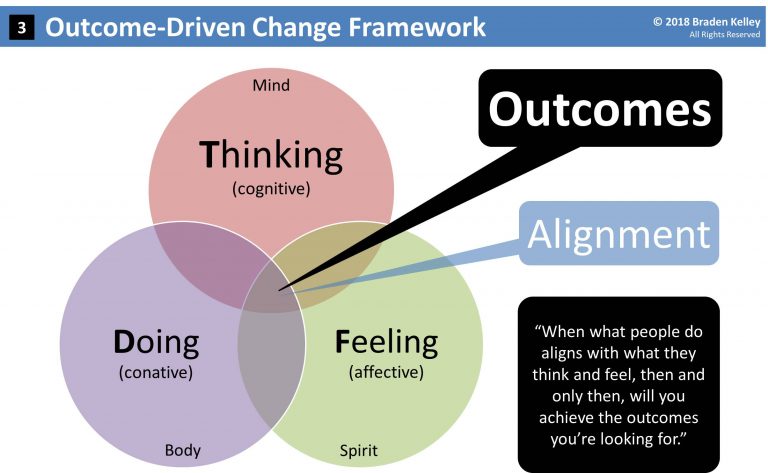
Outcome-Driven Change Framework

If an AI agent’s autonomous actions are misaligned with human psychological readiness or emotional context, it will trigger a Corporate Antibody response that kills innovation. To practice genuine Human-Centered Change™, we must ensure that AI agents are directed to pursue outcomes that are not just numerically efficient, but humanly resonant. When an AI’s “doing” matches the collective thinking and feeling of the workforce, we move beyond the Efficiency Trap and create lasting change with impact.

“In the age of agentic AI, the true scarcity is not computational power; it is the human wisdom to define the right ‘North Star’ outcomes. An AI optimizing for the wrong goal is a digital express train headed in the wrong direction – efficient, but ultimately destructive.” — Braden Kelley

From Feature-Building to Outcome-Harvesting

For decades, many organizations have been stuck in a cycle of “feature-building.” Product teams were rewarded for shipping more features, marketing for launching more campaigns, and R&D for creating more patents. The focus was on output, not ultimate impact. Outcome-Driven Innovation shifts this paradigm. It forces us to ask: What human or business value are we trying to create? What measurable change in behavior or well-being are we seeking?

Agentic AI, when properly directed, becomes an unparalleled accelerant for this shift. Instead of building a new feature and hoping it works, we can now tell an AI agent, “Achieve Outcome X for Persona Y, within Constraints Z,” and it will explore millions of pathways to get there. This frees human teams from the tactical churn and allows them to focus on the truly strategic work: deeply understanding customer needs, identifying ethical guardrails, and defining aspirational outcomes that genuinely drive Human-Centered Innovation™.

Case Study 1: Sustainable Manufacturing and the “Circular Economy” Outcome

The Challenge: A major electronics manufacturer in early 2025 aimed to reduce its carbon footprint but struggled with the complexity of optimizing its global supply chain, product design, and end-of-life recycling simultaneously. Traditional methods led to incremental, siloed improvements.

The Outcome-Driven Approach: They defined a bold outcome: “Achieve a 50% reduction in virgin material usage across all product lines by 2028, while maintaining profitability and product quality.” They then deployed an agentic AI system to explore new material combinations, reverse logistics networks, and redesign possibilities. This AI was explicitly optimized to achieve the circular economy outcome.

The Impact: The AI identified design changes that led to a 35% reduction in material waste within 18 months, far exceeding human predictions. It also found pathways to integrate recycled content into new products without compromising durability. The organization moved from a reactive “greenwashing” approach to proactive, systemic innovation driven by a clear, human-centric environmental outcome.

Case Study 2: Personalized Education and “Mastery Outcomes”

The Challenge: A national education system faced stagnating literacy rates, despite massive investments in new curricula. The focus was on “covering material” rather than ensuring true student understanding and application.

The Outcome-Driven Approach: They shifted their objective to “Ensure 90% of students achieve demonstrable mastery of core literacy skills by age 10.” An AI tutoring system was developed, designed to optimize for individual student mastery outcomes, rather than just quiz scores. The AI dynamically adapted learning paths, identified specific knowledge gaps, and even generated custom exercises based on each child’s learning style.

The Impact: Within two years, participating schools saw a 25% improvement in mastery rates. The AI became a powerful co-pilot for teachers, freeing them from repetitive grading and allowing them to focus on high-touch mentorship. This demonstrated how AI, directed by human-defined learning outcomes, can empower both educators and students, moving beyond the Efficiency Trap of standardized testing.

Leading Companies and Startups to Watch

As 2026 solidifies Outcome-Driven Innovation, several entities are paving the way. Amplitude and Pendo are evolving their product analytics to connect feature usage directly to customer outcomes. In the AI space, Anthropic‘s work on “Constitutional AI” is fascinating, as it seeks to embed human-defined ethical outcomes directly into the AI’s decision-making. Glean and Perplexity AI are creating agentic knowledge systems that help organizations define and track complex outcomes across their internal data. Startups like Metaculus are even democratizing the prediction of outcomes, allowing collective intelligence to forecast the impact of potential innovations, providing invaluable insights for human decision-makers. These players are all contributing to the core goal: helping humans define the right problems for AI to solve.

Conclusion: The Human Art of Defining the Future

The year 2026 is a pivotal moment. Agentic AI gives us unprecedented power to optimize, but with great power comes great responsibility — the responsibility to define truly meaningful outcomes. This is not a technical challenge; it is a human one. It requires deep empathy, strategic foresight, and the courage to challenge old metrics. It demands leaders who understand that the most impactful Human-Centered Innovation™ starts with a clear, ethically grounded North Star.

If you’re an innovation leader trying to navigate this future, remember: the future is not about what AI can do, but about what outcomes we, as humans, choose to pursue with it. Let’s make sure those outcomes serve humanity first.

Frequently Asked Questions

What is “Outcome-Driven Innovation”?

Outcome-Driven Innovation (ODI) is a strategic approach that focuses on defining and achieving specific, measurable human or business outcomes, rather than simply creating new features or products. AI then optimizes for these defined outcomes.

How does agentic AI change the role of human leaders in ODI?

Agentic AI frees human leaders from tactical execution and micro-management, allowing them to focus on the higher-level strategic work of identifying critical problems, understanding human needs, and defining the ethical, impactful outcomes for AI to pursue.

What is the “Efficiency Trap” in the context of AI and outcomes?

The Efficiency Trap occurs when AI is used to optimize for speed or cost without first ensuring that the underlying outcome is meaningful and human-centered. This can lead to highly efficient processes that achieve undesirable or even harmful results, ultimately undermining trust and innovation.

Image credits: Braden Kelley, Google Gemini

Content Authenticity Statement: The topic area, key elements to focus on, etc. were decisions made by Braden Kelley, with a little help from Google Gemini to clean up the article.

Subscribe to Human-Centered Change & Innovation WeeklySign up here to get Human-Centered Change & Innovation Weekly delivered to your inbox every week.

Are You Getting Your Fair Share of $860 Billion?

Are You Getting Your Fair Share of $860 Billion?

GUEST POST from Shep Hyken

According to Qualtrics, there is an estimated $860 billion worth of revenue and cost savings available for companies that figure out how to create an improved Customer Experience (CX) using AI to better understand and serve their customers. (That includes $420 billion for B2B and $440 billion for B2C.) Qualtrics recently released these figures in a report/eBook titled Unlock the Potential through AI-Enabled CX.

I had a chance to interview Isabelle Zdatny, head of thought leadership at Qualtrics Experience Management Institute, for Amazing Business Radio. She shared insights from the report, including ways in which AI is reshaping how organizations measure, understand and improve their relationships with customers. These ideas are what will help you get more customers, keep existing customers and improve your processes, giving you a share of the $860 billion that is up for grabs. Here are some of the top takeaways from our interview.

AI-Enabled CX Represents a Financial Opportunity

The way AI is used in customer experience is much more than just a way to deflect customers’ questions and complaints to an AI-fueled chatbot or other self-service solution. Qualtrics’ report findings show that the value comes through increased employee productivity, process improvement and revenue growth. Zdatny notes a gap between leadership’s recognition of AI’s potential and their readiness to lead and make a change. Early adopters will likely capture “compounding advantages,” as every customer interaction makes their systems smarter and their advantage more difficult for competitors to overcome. My response to this is that if you aren’t on board with AI for the many opportunities it creates, you’re not only going to be playing catch-up with your competitors, but also having to catch up with the market share you’re losing.

Customers Want Convenience

While overall CX quality is improving, thanks to innovation, today’s customers have less tolerance for friction and mistakes. A single bad experience can cause customers to defect. My customer experience research says an average customer will give you two chances. Zdatny says, “Customers are less tolerant of friction these days. … Deliver one bad experience, and that sends the relationship down a bad path more quickly than it used to.”

AI Takes Us Beyond Surveys

Customer satisfaction surveys can frustrate customers. AI collects the data from interactions between customers and the company and analyzes it using natural language processing and sentiment. It can predict churn and tension. It analyzes customer behavior, and while it doesn’t look at a specific customer (although it can), it is able to spot trends in problems, opportunities and more. The company that uses this information the right way can reap huge financial rewards by creating a better customer experience.

Agentic AI

Agentic AI takes customer interactions to a new level. As a customer interacts with AI-fueled self-service support, the system can do more than give customers information and analyze the interaction. It can also take appropriate action. This is a huge opportunity to make it easier on the workforce as AI processes action items that employees might otherwise handle manually. Think about the dollars saved (part of the $860 billion) by having AI support part of the process so people don’t have to.

Customer Loyalty is at Risk

To wrap this up, Zdatny and I talked about the concept of customer loyalty and how vulnerable companies are to losing their most loyal customers. According to Zdatny, a key reason is the number of options available to consumers. (While there may be fewer options in the B2B world, the concern should still be the same.) Switching brands is easy, and customers are more finicky than ever. Our CX research finds that typical customers give you a second chance before they switch. A loyal customer will give you a third chance — but to put it in baseball terms, “Three strikes and you’re out!” Manage the experience right the first time, and keep in mind that whatever interaction you’re having at that moment is the reason customers will come back—or not—to buy whatever you sell.

Image Credits: Pexels

This article was originally published on Forbes.com

Subscribe to Human-Centered Change & Innovation WeeklySign up here to join 17,000+ leaders getting Human-Centered Change & Innovation Weekly delivered to their inbox every week.

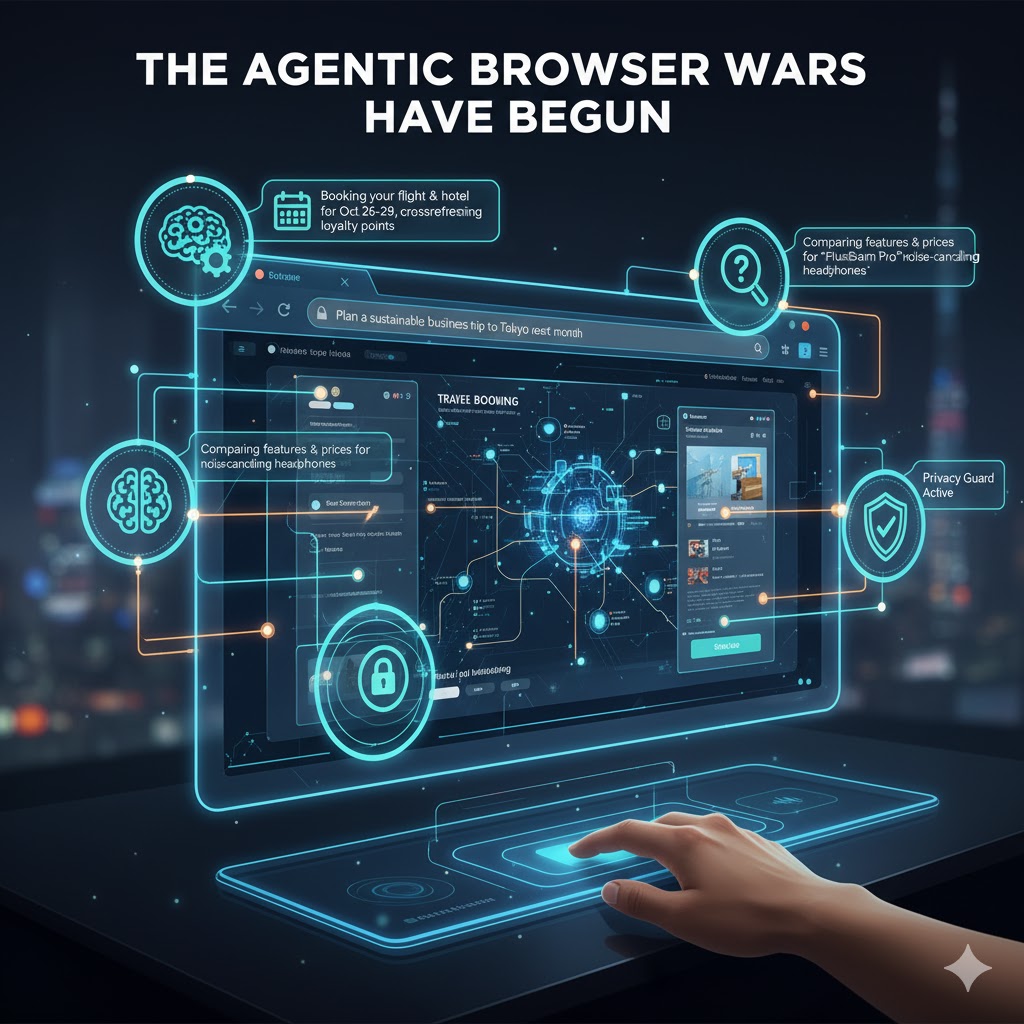
The Agentic Browser Wars Have Begun

LAST UPDATED: October 22, 2025 at 9:11AM

The Agentic Browser Wars Have Begun

GUEST POST from Art Inteligencia

On his way out of town to Nashville for Customer Contact Week (CCW) I managed to catch the ear of Braden Kelley (follow him on LinkedIn) to discuss the news that OpenAI is launching its own “agentic” web browser, something that neither of us saw coming given their multi-billion dollar partnership with Microsoft on Copilot. He had some interesting perspectives to share that prompted me to explore the future of the web browser. I hope you enjoy this article (and its embedded videos) on the growing integration of AI into our browsing experiences!

For decades, the web browser has been our window to the digital world — a passive tool that simply displays information. We, the users, have been the active agents, navigating tabs, clicking links, and manually synthesizing data. But a profound shift is underway. The era of the “Agentic Browser” is dawning, and with it, a new battle for the soul of our digital experience. This isn’t just about faster rendering or new privacy features; it’s about embedding proactive, intelligent agents directly into the browser to fundamentally change how we interact with the internet. As a human-centered change and innovation thought leader, I see this as the most significant evolution of the browser since its inception, with massive implications for productivity, information access, and ultimately, our relationship with technology. The Browser Wars 2.0 aren’t about standards; they’re about autonomy.

The core promise of the Agentic Browser is to move from a pull model (we pull information) to a push model (intelligence pushes relevant actions and insights to us). These AI agents, integrated into the browser’s fabric, can observe our intent, learn our preferences, and execute complex, multi-step tasks across websites autonomously. Imagine a browser that doesn’t just show you flight prices, but books your ideal trip, handling preferences, loyalty points, and calendar integration. This isn’t futuristic fantasy; it’s the new battleground, and the titans of tech are already drawing their lines, vying for control over our digital workflow and attention economy.

The Shift: From Passive Viewer to Active Partner

The Agentic Browser represents a paradigm leap. Traditional browsers operate at the rendering layer; Agentic Browsers will operate at the intent layer. They understand why you are on a page, what you are trying to achieve, and can proactively take steps to help you. This requires:

  • Deep Contextual Understanding: Beyond keywords, the agent understands the semantic meaning of pages and user queries, across tabs and sessions.
  • Multi-Step Task Execution: The ability to automate a sequence of actions across different domains (e.g., finding information on one site, comparing on another, completing a form on a third). This is the leap from macro automation to intelligent workflow orchestration.
  • Personalized Learning: Agents learn from user feedback and preferences, refining their autonomy and effectiveness over time, making them truly personal co-pilots.
  • Ethical and Safety Guardrails: Crucially, these agents must operate with transparent consent, robust safeguards, and clear audit trails to prevent misuse or unintended consequences. This builds the foundational trust architecture.

“The Agentic Browser isn’t just a smarter window; it’s an intelligent co-pilot, transforming the internet from a library into a laboratory where your intentions are actively fulfilled. This is where competitive advantage will be forged.” — Braden Kelley


Case Study 1: OpenAI’s Atlas Browser – A New Frontier, Redefining the Default

The Anticipated Innovation:

While still emerging, reports suggest OpenAI’s foray into the browser space with ‘Atlas‘ (a rumored codename that became real) aims to redefine web interaction. Unlike existing browsers that integrate AI as an add-on, Atlas is expected to have generative AI and autonomous agents at its core. This isn’t just a chatbot in your browser; it’s the browser itself becoming an agent, fundamentally challenging the definition of a web session.

The Agentic Vision:

Atlas could seamlessly perform tasks like:

  • Dynamic Information Synthesis: Instead of listing search results, it could directly answer complex questions by browsing, synthesizing, and summarizing information across multiple sources, presenting a coherent answer — effectively replacing the manual search-and-sift paradigm.
  • Automated Research & Comparison: A user asking “What’s the best noise-canceling headphone for long flights under $300?” wouldn’t get links; they’d get a concise report, comparative table, and perhaps even a personalized recommendation based on their past purchase history and stated preferences, dramatically reducing decision fatigue.
  • Proactive Task Completion: If you’re on a travel site, Atlas might identify your upcoming calendar event and proactively suggest hotels near your conference location, or even manage the booking process with minimal input, turning intent into seamless execution.


The Implications for the Wars:

If successful, Atlas could significantly reduce the cognitive load of web interaction, making information access more efficient and task completion more automated. It pushes the boundaries of how much the browser knows and does on your behalf, potentially challenging the existing search, content consumption, and even advertising models that underpin the current internet economy. This represents a bold, ground-up approach to seizing the future of internet interaction.


Case Study 2: Google Gemini and Chrome – The Incumbent’s Agentic Play

The Incumbent’s Response:

Google, with its dominant Chrome browser and powerful Gemini AI model, is uniquely positioned to integrate agentic capabilities. Their strategy seems to be more iterative, building AI into existing products rather than launching a completely new browser from scratch (though they could). This is a play for ecosystem lock-in and leveraging existing market share.

Current and Emerging Agentic Features:

Google’s approach is visible through features like:

  • Gemini in Workspace Integration: Already, Gemini can draft emails, summarize documents, and generate content within Google Workspace. Extending this capability directly into Chrome means the browser could understand a tab’s content and offer to summarize it, extract key data, or generate follow-up actions (e.g., “Draft an email to this vendor summarizing their pricing proposal”), transforming Chrome into an active productivity hub.
  • Enhanced Shopping & Productivity: Chrome’s existing shopping features, when supercharged with Gemini, could become truly agentic. Imagine asking the browser, “Find me a pair of running shoes like these, but with better arch support, on sale.” Gemini could then browse multiple retailers, apply filters, compare reviews, and present tailored options, potentially even initiating a purchase, fundamentally reshaping e-commerce pathways.
  • Contextual Browsing Assistants: Future iterations could see Gemini acting as a dynamic tutor or research assistant. On a complex technical page, it might offer to explain jargon, find related academic papers, or even help you debug code snippets you’re viewing in a web IDE, creating a personalized learning environment.


The Implications for the Wars:

Google’s strategy is about leveraging its vast ecosystem and existing user base. By making Chrome an agentic hub for Gemini, they can offer seamless, context-aware assistance across search, content consumption, and productivity. The challenge will be balancing powerful automation with user control and data privacy — a tightrope walk for any company dealing with such immense data, and a key battleground for user trust and regulatory scrutiny. Other players like Microsoft (Copilot in Edge) are making similar moves, indicating a clear direction for the entire browser market and intensifying the competitive pressure.


Case Study 3: Microsoft Edge and Copilot – An Incumbent’s Agentic Strategy

The Incumbent’s Response:

Microsoft is not merely a spectator in the nascent Agentic Browser Wars; it’s a significant player, leveraging its robust Copilot AI and the omnipresence of its Edge browser. Their strategy centers on deeply integrating generative AI into the browsing experience, transforming Edge from a content viewer into a dynamic, proactive assistant.


A prime example of this is the “Ask Copilot” feature directly embedded into Edge’s address bar. This isn’t just a search box; it’s an intelligent entry point where users can pose complex queries, ask for summaries of the page they’re currently viewing, compare products from different tabs, or even generate content based on their browsing context. By making Copilot instantly accessible and context-aware, Microsoft aims to make Edge the default browser for intelligent assistance, enabling users to move beyond manual navigation and towards seamless, AI-driven task completion and information synthesis without ever leaving their browser.


The Human-Centered Imperative: Control, Trust, and the Future of Work

As these Agentic Browsers evolve, the human-centered imperative is paramount. We must ensure that users retain control, understand how their data is being used, and can trust the agents acting on their behalf. The future of the internet isn’t just about more intelligence; it’s about more empowered human intelligence. The browser wars of the past were about speed and features. The Agentic Browser Wars will be fought on the battleground of trust, utility, and seamless human-AI collaboration, fundamentally altering our digital workflows and requiring us to adapt.

For businesses, this means rethinking your digital presence: How will your website interact with agents? Are your services agent-friendly? For individuals, it means cultivating a new level of digital literacy: understanding how to delegate tasks, verify agent output, and guard your privacy in an increasingly autonomous online world. The passive web is dead. Long live the agentic web. The question is, are you ready to engage in the fight for its future?

Disclaimer: This article speculates on the potential future applications of cutting-edge scientific research. While based on current scientific understanding, the practical realization of these concepts may vary in timeline and feasibility and are subject to ongoing research and development.

Image credit: Gemini

Subscribe to Human-Centered Change & Innovation WeeklySign up here to get Human-Centered Change & Innovation Weekly delivered to your inbox every week.