Category Archives: Futurology

What is Futurology?

The Complete Guide to Future Studies

What is Futurology?

GUEST POST from Art Inteligencia

Futurology — also called futures studies, futures research, or future studies — is the systematic, interdisciplinary exploration of possible, probable, and preferable futures. Unlike market forecasting, which focuses narrowly on near-term consumer behavior, futurology examines broader patterns across technology, society, economics, politics, and culture to help leaders anticipate and shape what comes next.

The field emerged in the aftermath of World War II, when governments and military institutions began developing rigorous methods for thinking about long-range futures. Today it is practiced by corporate strategists, innovation leaders, policy makers, and independent futurists — including, for the past two decades, by Braden Kelley through his FutureHacking™ methodology.

One thing futurology is not: fortune telling. Futurologists don’t claim to know exactly what will happen. Instead, they build structured ways of thinking about what could happen, what’s likely to happen, and what should happen — and they give organizations the tools to act on those insights before their competitors do.

In this guide you’ll find everything you need to understand futurology: what it is, how it differs from forecasting and foresight, what futurologists actually do, the disciplines the field draws on, and how you can begin applying futurist thinking in your own organization today.

Futurology vs. Forecasting vs. Foresight — What’s the Difference?

People often use futurology, forecasting, and foresight interchangeably. They are related but distinct disciplines, and confusing them leads to the wrong tools for the job.

Futurology Forecasting Strategic Foresight
Time horizon Long-range (10–50+ years) Short to medium-range (1–5 years) Medium to long-range (5–20 years)
Focus Broad societal, technological, and cultural futures Specific metrics — revenue, demand, market size Organizational preparedness and strategic options
Output Scenarios, frameworks, possible futures Projections, models, probability estimates Strategic roadmaps, opportunity maps
Approach Exploratory, interdisciplinary, qualitative and quantitative Data-driven, quantitative, model-based Analytical, participatory, action-oriented
Who uses it Governments, think tanks, innovation leaders, futurists Finance teams, supply chain, marketing Executives, strategy consultants, innovation teams
Attitude to uncertainty Embraces multiple possible futures Seeks to reduce uncertainty to a single prediction Maps uncertainty into strategic options

The key distinction is in how each field treats uncertainty. Forecasting tries to eliminate uncertainty by producing a single best estimate. Futurology embraces uncertainty by mapping out multiple plausible futures and exploring their implications. Strategic foresight sits in between — it uses futurist thinking to produce actionable organizational strategy.

For leaders navigating disruption, all three have a role — but futurology provides the broadest and most durable foundation, because it asks the questions that forecasting models can’t answer: What if the assumptions underlying our business model are wrong? What signals are we missing? What futures should we be preparing for that no spreadsheet would predict?

What Does a Futurologist Do?

A futurologist is a practitioner who applies the methods of futurology to help organizations, governments, or communities prepare for what’s coming. In practice, the terms futurologist and futurist are often used interchangeably, though futurologist tends to emphasize the more academic and methodological dimensions of the work.

Core activities of a futurologist:

  • Horizon scanning — Monitoring signals of change across technology, society, economics, environment, and politics to detect emerging shifts before they become obvious trends.
  • Scenario development — Building multiple plausible stories about how the future could unfold to help organizations stress-test strategies against uncertainty.
  • Trend analysis — Identifying the trajectories of existing forces and extrapolating their likely second- and third-order effects on a given organization or sector.
  • Backcasting — Starting from a desired future state and working backwards to identify what steps need to be taken today to reach it.
  • Expert engagement — Structured consultation designed to surface collective intelligence about future possibilities across a given domain.

Deliverables a futurologist produces typically include scenario reports, trend briefings, strategic foresight workshops, keynote presentations, and innovation roadmaps. The goal is always the same: give decision-makers a wider, more structured view of the future so they can act with greater confidence and creativity today.

Braden Kelley’s FutureHacking™ methodology was developed specifically to make futurist thinking accessible to innovation and change leaders inside organizations — putting the core tools of professional futurology into a practical, repeatable framework that any team can use.

The Core Disciplines of Future Studies

Futurology is inherently interdisciplinary. No single field of knowledge is sufficient to understand the full complexity of how the future unfolds — which is why futurologists draw on a wide range of academic and professional disciplines. The following are the core domains that feed into serious futures work.

Technology foresight — Examining the trajectory of emerging technologies (artificial intelligence, biotechnology, energy systems, materials science, quantum computing) and their likely impact on industries, societies, and human behavior. Technology foresight is perhaps the most active area of futurology today, driven by the accelerating pace of innovation.

Social foresight — Analyzing shifts in demographics, cultural values, social structures, family formation, education, and community. Social foresight asks how human relationships and societal norms are changing, and what those changes mean for organizations and institutions.

Economic foresight — Studying the long-range evolution of economic systems, labor markets, trade patterns, inequality, and financial structures. Economic foresight goes beyond near-term forecasting to ask deeper questions about how wealth is created, distributed, and destroyed across decades.

Environmental foresight — Exploring the long-term trajectory of climate, resource availability, biodiversity, and the relationship between human civilization and natural systems. Environmental foresight has become increasingly central to futurology as the consequences of climate change ripple across every other domain.

Political and geopolitical foresight — Examining shifts in power, governance, international relations, conflict, and the evolution of democratic and authoritarian systems. Organizations operating globally ignore geopolitical foresight at significant risk.

Organizational and business foresight — Applying futurist thinking directly to the strategic challenges of companies and institutions: how industries will evolve, which business models will be disrupted, where new value will be created, and how organizations need to change to remain relevant.

In practice, the most valuable futurology work sits at the intersection of several of these disciplines simultaneously. A futurist advising a healthcare organization, for example, needs to understand technology foresight (AI diagnostics, genomics), social foresight (aging demographics, mental health trends), economic foresight (insurance models, drug pricing), and political foresight (regulatory environments) all at once. This cross-disciplinary fluency is what distinguishes serious futures work from simple trend-spotting.

Key Methods Futurologists Use — In Depth

Each of the core futurology methods deserves closer examination, because the details of how they are applied is what separates rigorous futures work from casual speculation.

Environmental scanning and horizon scanning — The systematic monitoring of information sources — academic journals, news, patents, policy documents, fringe communities, social media — to detect weak signals: small, seemingly peripheral developments that could grow into significant forces. Horizon scanning is the intelligence-gathering foundation of all other futurology methods. The discipline lies not in consuming more information but in knowing what to look for and how to interpret ambiguous early signals before they have obvious meaning.

Scenario planning — The development of three to five plausible, internally consistent stories about how the future could unfold, anchored by the key uncertainties most relevant to a given organization or question. Scenarios are not predictions and should not be treated as such. Their value lies in expanding the range of futures an organization is prepared for, exposing assumptions that would be catastrophic if wrong, and enabling pre-emptive strategic moves rather than reactive ones. Scenario planning was pioneered at Shell Oil in the 1970s — famously helping the company anticipate the 1973 oil crisis when its competitors were blindsided — and remains the most widely used method in professional futurology.

Trend extrapolation — Identifying established trends and projecting their trajectory forward over time. This method is most reliable for slow-moving, well-established forces such as demographic aging, urbanization, or the declining cost of computing. It is least reliable for fast-moving or volatile domains. Good futurologists use trend extrapolation as a starting point, not an endpoint — always asking what could cause a trend to break, accelerate, or interact with other trends in unexpected ways.

Backcasting — The inverse of forecasting. Rather than projecting forward from the present, backcasting starts with a desired or feared future state and works backwards to identify the chain of decisions, events, and conditions that would need to occur to reach it. Backcasting shifts the question from “what will happen?” to “what needs to happen?” — making it particularly powerful for innovation strategy, sustainability planning, and change management, where the goal is to actively shape the future rather than simply anticipate it.

The Delphi method — A structured process for gathering and synthesizing expert opinion across multiple rounds of anonymous consultation. Experts respond to questions, receive anonymized feedback on the group’s collective responses, then revise their answers in light of that feedback. The process continues until stable convergence — or a mapped divergence — emerges. The Delphi method is especially useful for domains where quantitative data is sparse but expert intuition is rich, and for surfacing the genuine range of informed opinion rather than allowing dominant voices to shape the group’s conclusions.

Cross-impact analysis — A method for examining how different trends and events might interact with and influence each other. Rather than treating trends in isolation, cross-impact analysis maps the interdependencies between them — recognizing that the future is shaped by the collision of multiple forces simultaneously, not by any single trend extrapolated on its own.

Wild cards and weak signals analysis — Deliberately seeking out low-probability, high-impact events (wild cards) and early-stage signals that don’t yet fit established patterns (weak signals). This method guards against the most common failure mode in futures work: over-confidence in smooth, linear extrapolations of current trends. History is full of wild cards — events that were theoretically possible and even discussed in futures circles, but dismissed as too unlikely to plan for seriously.

Is Futurology a Real Science or Pseudoscience?

This is one of the most debated questions in the field, and the honest answer is: it depends on how it is practiced.

Critics argue that futurology cannot be a true science because its predictions cannot be reliably tested or falsified. Unlike physics or chemistry, where experiments can be repeated under controlled conditions, the future is a one-time event. You cannot run a controlled trial on a geopolitical scenario or falsify a prediction about 2040 in any rigorous scientific sense. On these grounds, some academics classify futurology as a social science at best, and speculative storytelling at worst.

Defenders of the field make a stronger case than critics typically acknowledge. Serious futurologists do not claim to predict specific events with certainty — they claim to map the probability space of possible futures using systematic, evidence-based methods. In this sense, futurology is closer to epidemiology or climate science than to fortune telling: it works with complex systems, long time horizons, and irreducible uncertainty, but it does so through rigorous data collection, structured analysis, and transparent methodology. The track records of practitioners like Ray Kurzweil — who made dozens of specific, dated technology predictions in 1999 that have since proven largely accurate — demonstrate that disciplined futures work produces better-than-random results.

The key distinction is between rigorous futurology and speculative futurology. Rigorous futurology is transparent about its assumptions, uses structured methods, acknowledges uncertainty explicitly, and invites scrutiny. Speculative futurology makes confident, attention-grabbing predictions without methodological grounding. Most of what appears in popular media under the futurology banner is the latter. Most of what serious practitioners actually do is the former.

The bottom line: futurology is not a hard science, but it is not pseudoscience either. It is a structured, evidence-informed discipline for navigating uncertainty — and when practiced rigorously, it produces genuine strategic value that no amount of gut instinct or conventional planning can replicate.

Famous Futurologists and What We Can Learn from Them

The history of futurology is populated by thinkers who didn’t just predict the future — they shaped how we think about it. Here are five of the most influential, and the key lesson each one offers for practitioners today.

Alvin Toffler — Author of Future Shock (1970) and The Third Wave (1980), Toffler argued decades before it was fashionable that the pace of change itself was becoming a problem — that humans and organizations were being overwhelmed not just by specific changes but by the sheer velocity of change. His core insight: the ability to adapt is more important than any particular strategy. Organizations that build adaptive capacity survive; those that optimize for stability do not. This remains the central argument for investing in change management and innovation capability today.

Peter Drucker — Though primarily known as a management thinker, Drucker was a rigorous futurist who consistently identified major social and economic shifts years before mainstream recognition. He predicted the rise of the knowledge economy, the decline of the industrial corporation, and the growing importance of non-profit and civic organizations decades ahead of his time. His lesson: the most important futures work focuses on people and social structures, not just technology.

Buckminster Fuller — Designer, systems thinker, and author of Operating Manual for Spaceship Earth, Fuller approached futurology as a design challenge. Rather than simply predicting what would happen, he asked what should happen and worked backwards to design it. His lesson: futurology at its best is not passive prediction but active design — shaping preferable futures rather than simply anticipating probable ones.

Ray Kurzweil — Perhaps the most prominent contemporary futurist, Kurzweil is known for applying exponential thinking to technology forecasting, most notably in his law of accelerating returns. His track record of specific technology predictions — made decades in advance — is remarkably strong. His lesson: exponential curves are deeply counterintuitive to human linear thinking, and consistently underestimating technological acceleration is one of the most consequential errors organizations make.

Herman Kahn — A RAND Corporation analyst who pioneered scenario planning in the context of Cold War nuclear strategy, Kahn was the first to systematically apply futures thinking to strategic decision-making under extreme uncertainty. His lesson: the value of scenarios is not in predicting which one will occur, but in forcing decision-makers to confront the full range of futures their strategies must survive.

How Organizations Use Futurology Today

For most of its history, futurology was the domain of governments, think tanks, and large research institutions. That has changed dramatically. Today, the most forward-looking companies and public sector organizations are embedding futures thinking directly into their strategy and innovation processes. Here is how they are doing it.

Scenario planning in strategic cycles — Rather than producing a single strategic plan based on a single view of the future, leading organizations now develop strategy against a set of scenarios. This ensures that strategies are robust across a range of possible futures rather than optimized for only one. Companies like Shell, Unilever, and numerous government agencies use scenario-based strategic planning as standard practice.

Horizon 3 innovation — Geoffrey Moore’s three-horizon framework distinguishes between optimizing the current core business (Horizon 1), building emerging businesses (Horizon 2), and seeding genuinely transformative options for the long-range future (Horizon 3). Futurology is the foundation of Horizon 3 work — identifying where value will be created in 10 to 20 years and building toward it today before the opportunity becomes obvious to competitors.

Trend monitoring and signal detection — Many organizations now maintain dedicated horizon scanning functions — teams or processes that systematically monitor signals of change and feed insights into product development, strategy, and risk management. This is futurology applied at the operational level: continuous, structured attention to the periphery of the current market landscape.

Anticipating disruption — Futurology gives leaders a framework for recognizing disruption before it arrives. By mapping the trajectory of emerging technologies, shifting consumer behaviors, and changing regulatory environments, organizations can identify threats and opportunities years before they become crises or missed chances. The companies most frequently disrupted are those that failed to practice any systematic form of futures thinking.

Change and transformation planning — Perhaps most relevant for readers of this blog, futurology directly informs human-centered change management. Understanding the future context your organization is changing into — not just responding to the present — is essential for designing transformation programs that will still be relevant when they complete. Change initiatives that ignore futures thinking risk solving yesterday’s problems at tomorrow’s expense.

For innovation and change leaders who want to bring futures thinking into their organizations without building a dedicated futurology function, FutureHacking™ provides a structured entry point — a practical methodology for applying the core tools of futurology to real organizational challenges, without requiring academic credentials or a research team.

How to Practice Futurology Yourself — Introduction to FutureHacking™

You do not need a PhD in futures studies to begin practicing futurology. The core skills — horizon scanning, pattern recognition, scenario thinking, and comfort with uncertainty — can be developed by anyone willing to invest attention and apply a structured framework.

The starting point is a shift in orientation: from reacting to change as it arrives to actively monitoring and anticipating it. This means building habits of wide reading across disciplines, paying deliberate attention to signals at the edges of your industry, and regularly asking “what if” questions that your current planning assumptions don’t accommodate.

Beyond individual practice, organizations benefit enormously from embedding futures thinking into their existing strategy and innovation processes. This does not require a dedicated futurology team. It requires structured methods, facilitated conversations, and the discipline to look beyond the next quarter.

Braden Kelley’s FutureHacking™ methodology was developed specifically for this purpose. It gives innovation and change leaders a practical, repeatable framework for applying the core tools of professional futurology — horizon scanning, scenario development, trend analysis, and backcasting — to real organizational challenges. FutureHacking™ is available as a workshop, masterclass, and self-directed toolkit, and can be used by organizations across industries to build genuine futures capability without the cost or complexity of a dedicated research function.

Further Reading on Futurology

This guide covers the foundations of futurology, but the field is deep and continually evolving. The following articles on this site go deeper on specific dimensions of futures thinking:

Frequently Asked Questions About Futurology

What is the difference between a futurist and a futurologist?

The terms are used interchangeably in most contexts, but there is a subtle distinction. Futurologist tends to emphasize the more academic, research-oriented, and methodological dimensions of the work — someone who studies the future as a discipline. Futurist is a broader term that encompasses practitioners, consultants, speakers, and writers who apply futures thinking in a variety of professional contexts. Braden Kelley operates as both: grounding his work in rigorous futurology methodology while applying it practically as an innovation speaker, workshop facilitator, and organizational advisor.

Is futurology the same as forecasting?

No. Forecasting typically refers to the quantitative projection of specific metrics — revenue, demand, population — over a short to medium time horizon. It seeks to reduce uncertainty to a single best estimate. Futurology takes a broader, longer-range view and embraces rather than eliminates uncertainty, mapping multiple possible futures rather than projecting one. Forecasting asks “what will happen?” Futurology asks “what could happen, what is likely to happen, and what should happen?” — and explores the strategic implications of each answer.

What degree or education do you need to become a futurologist?

There is no single required degree. Futurologists come from backgrounds in social science, engineering, economics, philosophy, design, and many other fields. Several universities offer graduate programs in futures studies or strategic foresight, including the University of Houston, Aalto University in Finland, and Regent’s University London. However, many of the most respected practitioners in the field are self-taught or came through adjacent disciplines. What matters most is methodological rigor, intellectual breadth, and the ability to synthesize insights across domains — not a specific credential.

How accurate are futurologists’ predictions?

Accuracy varies enormously depending on the practitioner, the method used, and the time horizon involved. Short-range trend extrapolation (1–5 years) tends to be reasonably reliable for slow-moving forces. Long-range scenario work (10–30 years) is not designed to be “accurate” in the way a weather forecast is — its value lies in expanding the range of futures an organization prepares for, not in predicting a single outcome. The most rigorous practitioners, like Ray Kurzweil, have demonstrated strong track records on specific technology predictions over multi-decade horizons. The field as a whole has a mixed record, largely because popular futurology is often confused with speculative or sensationalist prediction.

How is futurology relevant to business and organizational leadership?

Futurology is directly relevant to any leader responsible for strategy, innovation, or organizational change. It provides the frameworks and methods to anticipate disruption before it arrives, identify where value will be created in the future, stress-test current strategies against a range of possible futures, and design change initiatives that will still be relevant when they complete. As the pace of technological and social change accelerates, the organizations that thrive will be those that have built systematic futures thinking into their strategy and innovation processes — not those that react to change only after it has already arrived.

What is FutureHacking™ and how does it relate to futurology?

FutureHacking™ is a practical futurology methodology developed by Braden Kelley to make professional futures thinking accessible to innovation and change leaders inside organizations. It draws on the core methods of futurology — horizon scanning, scenario planning, trend analysis, and backcasting — and packages them into a structured, facilitated framework that any team can apply to real strategic challenges. FutureHacking™ is available as a workshop, masterclass, and self-directed toolkit, and is designed for organizations that want to build genuine futures capability without the cost of a dedicated research function. Learn more at bradenkelley.com.

Image credit: Pexels

Subscribe to Human-Centered Change & Innovation WeeklySign up here to get Human-Centered Change & Innovation Weekly delivered to your inbox every week.

Climate Change and the Technologies Shaping a Sustainable Future

Climate Change and the Technologies Shaping a Sustainable Future

GUEST POST from Chateau G Pato

Climate change is one of the most urgent and pressing challenges faced by humanity today. The increasing levels of greenhouse gases in the atmosphere are causing rising temperatures, extreme weather events, and significant impacts on ecosystems and human societies. Addressing climate change requires innovative and sustainable solutions that can mitigate the causes and adapt to the consequences. Fortunately, advancements in technology are playing a crucial role in shaping a sustainable future. This article will explore two case study examples of how technology is helping combat climate change.

Case Study 1: Renewable Energy and the Power of Innovation

Renewable energy technologies are transforming the energy landscape and offering a sustainable alternative to fossil fuels. Solar and wind energy have become key players in reducing greenhouse gas emissions and combating climate change.

One remarkable case study is the Tengger Desert Solar Park in China, the largest solar farm in the world. Located in the Tengger Desert, this facility covers an area of over 43 square kilometers, harnessing the abundant sunlight to generate clean electricity. With a capacity of 1.5 GW, it supplies power to millions of households, significantly reducing CO2 emissions. The Tengger Desert Solar Park demonstrates the immense potential of solar energy and highlights the importance of large-scale renewable projects in transitioning to a low-carbon economy.

Another case study is the Block Island Wind Farm, situated off the coast of Rhode Island, USA. This pioneering offshore wind farm was the first of its kind in the country, providing clean energy to the local grid. With only five turbines, it may seem small, but it has a capacity of 30 MW, capable of powering more than 17,000 homes. The Block Island Wind Farm showcases the potential of wind energy to de-carbonize the electricity sector and reduce reliance on fossil fuels.

These case studies demonstrate that renewable energy technologies like solar and wind power can rapidly transform the energy landscape, contributing to a more sustainable future. Continued innovation and investments in renewable energy can bring us closer to achieving a carbon-neutral society and combating climate change effectively.

Case Study 2: Smart Agriculture and Precision Farming

Another area where technology is revolutionizing sustainability is agriculture. The world’s growing population necessitates increased food production while minimizing the environmental impact. Smart agriculture and precision farming techniques have emerged as promising solutions.

Vertical farming, for example, is a technology-driven approach to cultivate crops indoors, utilizing artificial light and efficient water usage. Japan’s Mirai no Toukei Kansai project exemplifies this concept. Located in an urban setting, this vertical farm occupies a small area but produces the equivalent of 10,000 square meters of traditional farmland. By leveraging advanced technologies such as LED lights, hydroponics, and AI-controlled systems, this vertical farm minimizes water usage, reduces pesticide dependence, and eliminates transportation emissions associated with long-distance food delivery. Vertical farming demonstrates the potential of technology to revolutionize traditional agricultural practices and ensure a sustainable food supply.

Similarly, precision farming techniques employ advanced technologies like sensors, drones, and data analytics to optimize agricultural practices. For instance, FarmLogs, a technology platform developed in the United States, collects and analyses data from various sources to provide farmers with real-time insights about their crops. By precisely monitoring crop health and nutrient requirements, farmers can minimize resource wastage while maximizing yields. Precision farming contributes to efficient resource management, reduced fertilization, minimized water use, and ultimately, more sustainable agricultural practices.

Conclusion

Addressing climate change requires a collaborative effort from various stakeholders, and technology plays a critical role in enabling the transition to a more sustainable future. The case studies of the Tengger Desert Solar Park, the Block Island Wind Farm, Mirai no Toukei Kansai vertical farm, and precision farming techniques exemplify the power of innovation and technology in combatting climate change. By continuing to invest in renewable energy, smart agriculture, and other sustainable technologies, we can create a more resilient and sustainable world for future generations. It is essential to embrace and leverage these advancements to ensure a brighter future for our planet.

Bottom line: Futurology is not fortune telling. Futurists use a scientific approach to create their deliverables, but a methodology and tools like those in FutureHacking™ can empower anyone to engage in futurology themselves.

Image credit: Unsplash

Subscribe to Human-Centered Change & Innovation WeeklySign up here to get Human-Centered Change & Innovation Weekly delivered to your inbox every week.

Scenario Planning for Business Success

Scenario Planning for Business Success

GUEST POST from Art Inteligencia

Scenario planning is an important tool for organizations to use in order to prepare for the future. It is a strategic planning process which uses structured techniques to help organizations anticipate the potential impacts of external events and trends on their operations and strategies. The process involves creating a series of alternative scenarios and then using them to explore the consequences of each potential future, allowing organizations to identify opportunities and risks, and develop strategies to create a competitive advantage.

Scenario planning can be used to help organizations anticipate changes in the external environment, such as:

  • new technologies
  • changes in customer preferences
  • or shifts in the competitive landscape

By creating multiple scenarios and considering their consequences, organizations can identify potential risks and opportunities, and develop strategies to capitalize on them. This can help organizations become more resilient and better prepared for the future.

Scenario planning can also help organizations identify new opportunities and develop strategies to capitalize on them. By exploring alternative scenarios and the potential consequences of each, organizations can identify areas of potential advantage and develop strategies to take advantage of them. This can help organizations stay ahead of their competitors and create a competitive advantage.

Scenario planning is often used by organizations to develop strategies that manage risk. By developing scenarios which identify potential risks and their associated consequences, organizations can develop strategies to mitigate or avoid them. This can help organizations become more resilient and better prepared for the potential impacts of external events and trends.

Ultimately, scenario planning is a useful tool for organizations to use in order to prepare for the future. By creating multiple scenarios and considering their consequences, organizations can identify potential risks and opportunities and develop strategies to capitalize on them. This can help organizations stay ahead of their competitors and create a competitive advantage.

Bottom line: Scenario planning is not the same thing as making predictions. Scenario planners use a formal approach to achieve their outcomes, but a methodology and tools like those in FutureHacking™ can empower anyone to do scenario planning faster and cheaper.

Image credit: Pexels

Subscribe to Human-Centered Change & Innovation WeeklySign up here to get Human-Centered Change & Innovation Weekly delivered to your inbox every week.
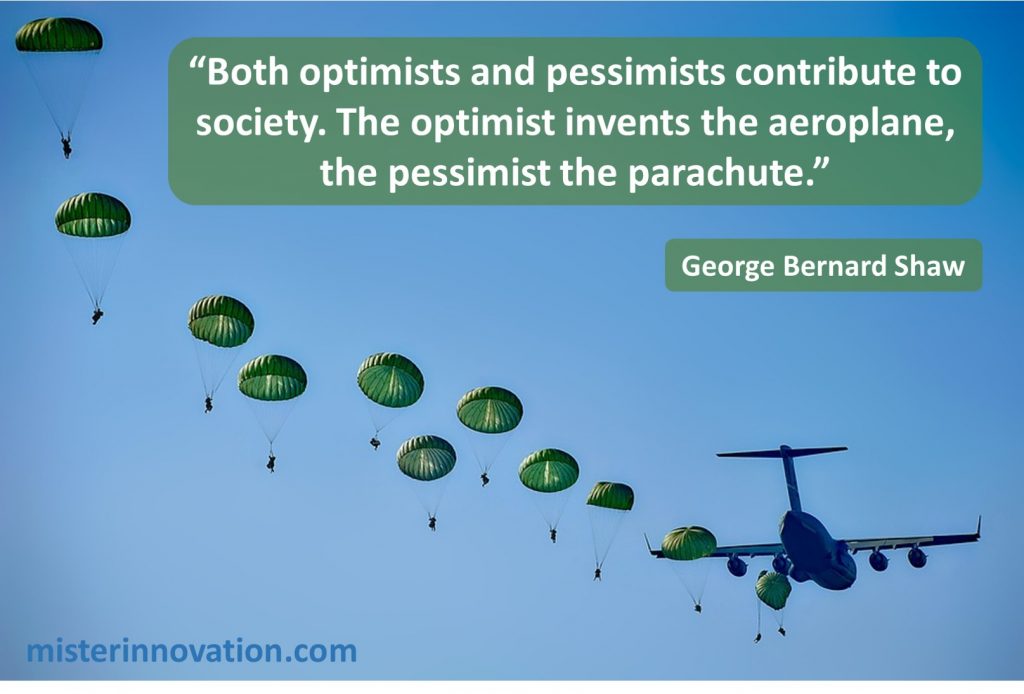
The Case for Optimism in 2021

The Case for Optimism in 2021

GUEST POST from Robert B. Tucker

“How can you be upbeat about a ‘post-pandemic future’ when there’s so much pain and uncertainty right now,” a colleague asked me the other day, as we were ending up another zoom call on the subject.

Good question, I had to admit. Here it is December and things are even worse than in March. How can this be happening? A surge in coronavirus cases on top of a surge in cases. People dying daily by the thousands. Scenes of unspeakable grief. Healthcare workers and hospital systems stressed to the max. The economy in shambles. A defeated American president claiming that he “won big” and refusing to concede.

But there’s also cause for optimism right now, if you know where to look.

For starters, there is less uncertainty in the timeline now. This is different. This is the beginning of the end. “The United States will most likely reach an epidemiological end to the pandemic in Q3 or Q4 of 2021,” McKinsey forecasts. If not sooner.

As vaccines start inoculating millions of people, and a new team assumes leadership in Washington, consider how the mood will begin to brighten. What better time than now to ponder the shape of the post-pandemic world. What better time than now to take stock of what has changed because of the pandemic, and the free and fair election of a new leader. And what better time to look at how you and your organization might capitalize on the upswing.

Pandemics have a way of upsetting the status quo. In the 14th century, the Bubonic Plague decimated half of Europe’s population, and a third of the worlds. When it ended, there was jubilation and dancing in the streets. A labor shortage caused by so many deaths led to the end of feudalism and centuries of unchanging drudgery for the masses. Inventions such as the printing press spurred the spread of knowledge and ideas across distances. This in turn spawned the scientific revolution, the industrial revolution and the birth of a then-radical notion of democracy — the elections of leaders. In short, things got better.

The challenge now, in the midst of this dark winter of our discontent, is to visualize the spring. To exercise our forward-thinking capacity. To marinate in what I call “dreamer mode,” and unleash visions of how we want it to be. In my work with strategic planning teams in government and industry, this is what I help leaders do. To focus beyond present state and present day execution, into “future state.” To think beyond merely rebuilding and restoring (the rule of law, Paris Accords, fired whistleblowers, etc.), but upon the opening that Covid-19 has provided to change the world for the better.

The role of the visionary in society is to inspire. To urge us to see not just what is, but what can be. Forward-thinking leaders help us shake up our thinking. They challenge us to aim higher, to go for moonshots. The world, and the United States in particular, is beset with huge problems right now, beyond even the pandemic. But these problems are ones we created and therefore they are not beyond our reach to solve. What is required though, is that we assault our assumptions.

Many see deep division and American democracy on the verge of collapse. Others, like private equity innovator and political activist Edward McKinley, see things in a different light.

“The last time we had this level of participation in the political process was 120 years ago,” McKinley pointed out in a recent zoom call. “One of the most consequential politicians of our time produced a partisan reaction that drove people to the polls in unprecedented numbers. While many of us believe he tried to undermine the system, what he ended up doing was energizing the system.”

The quickest way to energize any system is to help it dream big about the future.

Back in the ‘80s when I taught in the Writers Program at UCLA, I’d invite my students to design a day in their future. Visualize 10 years out. Describe the view over the breakfast table, I’d challenge them, and write about it. What’s working for you? What are you doing with your life that’s bringing you satisfaction? They found it refreshing, they reported, because they’d never thought that way before.

Take a moment to visualize 10 years out from now, when this period will seem like a bad dream. Imagine the kind of future you want to be living in. Think about a world where the pandemic is history. Where civility is again the norm. Where progress is being made towards solving our biggest problems. Think about a different state of affairs. A different state of mind.

Imagine how you’re going to be encouraged and energized by this new year 2021. Think about what you’ve learned about yourself as a result of living through a global pandemic. Think about what you value now more than ever before because of its absence. Think about what you want to happen.

Such mental exercises are good therapy. They activate the “endorphins of possibility.” And they go a long way to creating the future you want to live in because if you can see it, you might just be able to actualize it.

This article originally appeared in Forbes
Image credit: 1 of 1,250+ FREE quote images available at http://misterinnovation.com

Subscribe to Human-Centered Change & Innovation WeeklySign up here to get Human-Centered Change & Innovation Weekly delivered to your inbox every week.

Space Tourism: A Glimpse Into the Future of Travel

Space Tourism: A Glimpse Into the Future of Travel

GUEST POST from Art Inteligencia

The dream of exploring the vastness of space has enchanted humankind for centuries. What was once a distant and elusive objective is now becoming a tangible reality with the emergence of space tourism. This nascent industry holds the potential to revolutionize the way we experience travel and push the boundaries of human exploration. In this article, we will delve into the concept of space tourism and examine two case study examples that exemplify its potential to transform the future of travel.

Case Study 1: Virgin Galactic’s Suborbital Spaceflights

One of the pioneers in the space tourism sector is Virgin Galactic, founded by entrepreneur Richard Branson. Virgin Galactic aims to make suborbital spaceflights accessible to the general public. Passengers aboard Virgin Galactic’s spaceship, the VSS Unity, will experience zero gravity and witness the breathtaking view of Earth from space. This extraordinary experience will last approximately 90 minutes, opening a wealth of possibilities for aspiring space travelers.

The impact of Virgin Galactic’s endeavors on the future of travel cannot be understated. The success of their operations will pave the way for a new era of tourism, where journeying beyond Earth becomes as routine as boarding a plane. As this industry evolves, costs may decrease, allowing for broader adoption and making space travel a part of mainstream vacation options.

Case Study 2: SpaceX’s Lunar Tourism Mission

Another notable case study in the realm of space tourism is SpaceX’s plan to send tourists on a lunar excursion. In 2018, SpaceX announced that they had signed up their first passenger for a private journey around the Moon using their Starship spacecraft. While this mission has yet to take place, it demonstrates the potential for space tourism to extend beyond Earth’s orbit.

This lunar tourism mission not only represents a tremendous leap forward in terms of technological advancements but also reignites the collective imagination of aspiring space travelers. The opportunity to witness the Moon up close and personal, to venture further into the cosmos, opens up new horizons for exploration and serves as a catalyst for enticing more individuals to consider space tourism in the years to come.

The Future of Travel

Space tourism represents a shift towards a new paradigm in travel, where the boundaries of Earth are no longer seen as constraints. It offers the tantalizing prospect of experiencing zero gravity, witnessing breathtaking views, and attaining a different perspective on life. As the costs associated with space travel decrease and space tourism providers refine their operations, it is not unfathomable to envision a future where vacationers could opt for a suborbital spaceflight or even a lunar excursion as part of their holiday plans.

Space tourism’s impact extends far beyond leisure travel. The advancements made in this sector could also have significant implications for scientific research, allowing for experiments to be carried out in microgravity and opening up avenues for further exploration of celestial bodies. Moreover, the development of space tourism infrastructure could lay the groundwork for the colonization of other planets and the creation of space habitats.

Conclusion

Space tourism is no longer a distant dream confined to science fiction novels. The aforementioned case studies from Virgin Galactic and SpaceX exemplify the tangible steps being taken toward making space travel approachable for the general public. As this industry matures, space tourism holds the potential to not only redefine our travel experiences but also expand our horizons and unlock a new era of exploration and scientific discovery. Brace yourself for a future where the sky is no longer the limit; it is just the beginning.

Bottom line: Futures research is not fortune telling. Futurists use a scientific approach to create their deliverables, but a methodology and tools like those in FutureHacking™ can empower anyone to engage in futures research themselves.

Image credit: Unsplash

Subscribe to Human-Centered Change & Innovation WeeklySign up here to get Human-Centered Change & Innovation Weekly delivered to your inbox every week.

Innovation Trends to Watch Out for in the Coming Years

Innovation Trends to Watch Out for in the Coming Years

GUEST POST from Chateau G Pato

As the world becomes more connected and technology continues to advance at a rapid pace, innovation is becoming increasingly crucial for businesses to stay competitive. Companies that fail to embrace new trends and adapt their strategies accordingly risk falling behind and missing out on significant opportunities for growth and success.

In this article, we will explore two key innovation trends that are expected to shape the business landscape in the coming years. These trends, backed by real-world case studies, underscore the immense potential for transformative innovation and offer valuable insights for organizations seeking to stay ahead of the curve.

Trend to watch #1 – Artificial Intelligence (AI) and Machine Learning (ML) in Customer Service

Artificial Intelligence and Machine Learning have revolutionized various industries, and their impact on customer service is undeniable. AI-powered chatbots and virtual assistants are being adopted by businesses to enhance customer experience, streamline operations, and reduce costs.

One prominent case study comes from Amazon, which implemented AI to improve its customer service capabilities. By leveraging machine learning algorithms, Amazon’s AI-powered customer service chatbots are capable of understanding complex customer queries, providing accurate responses, and resolving issues promptly. This has significantly reduced the burden on human support agents while ensuring consistently efficient and personalized customer service.

Another successful application of AI in customer service is seen in the case of Bank of America. The bank launched an AI-powered virtual assistant called Erica. Erica uses natural language processing and predictive analytics to provide personalized financial advice and assist customers with their banking needs. Erica has transformed the customer experience, offering tailored insights and guidance based on individual preferences, driving customer engagement, and increasing customer satisfaction.

Trend to Watch #2 – Sustainable Innovation

As environmental concerns take center stage, sustainable innovation has emerged as a critical trend in recent years. Businesses across industries are increasingly focused on developing eco-friendly solutions and adopting sustainable practices to reduce their carbon footprint and contribute to a greener future.

One inspiring case study is Patagonia, an outdoor clothing and gear company known for its commitment to sustainability. Patagonia has developed innovative ways to reduce waste and promote recycling. Notably, they launched the ‘Worn Wear’ program, offering repairing services to extend the lifecycle of their products. This initiative not only reduces waste but also fosters customer loyalty by encouraging sustainable consumption habits.

Another example is Tesla, the renowned electric vehicle manufacturer. Tesla has revolutionized the automotive industry by developing high-performance electric vehicles that run on renewable energy. By successfully merging technological advancements with sustainability, Tesla has made significant progress in encouraging the widespread adoption of electric vehicles and reducing dependence on fossil fuels.

Conclusion

Staying up-to-date with innovation trends is vital for businesses to stay relevant and thrive in the fast-paced digital era. Artificial Intelligence and Machine Learning are transforming customer service, while sustainability is becoming increasingly essential. Embracing these trends by leveraging case studies like Amazon, Bank of America, Patagonia, and Tesla can inspire organizations to make informed decisions and embrace innovation to drive growth and success in the coming years.

Bottom line: Futurology is not fortune telling. Futurists use a scientific approach to create their deliverables, but a methodology and tools like those in FutureHacking™ can empower anyone to engage in futurology themselves.

Image credit: Pexels

Subscribe to Human-Centered Change & Innovation WeeklySign up here to get Human-Centered Change & Innovation Weekly delivered to your inbox every week.

What is Impact Assessment?

What is Impact Assessment?

GUEST POST from Art Inteligencia

Impact assessments are an important tool used to analyze the potential effects of a proposed policy, program, or project on the environment, society, and economy. They are used to inform decision-making and prevent negative impacts from occurring. Impact assessments can be used to determine the potential benefits, costs, and risks associated with a project, as well as identify mitigation measures that can be taken to reduce potential impacts.

Impact assessments are used by government agencies, private organizations, and other stakeholders to evaluate the potential impacts of a proposed project or policy. It is important for decision-makers to consider the potential effects of a project on the environment, society, and economy before making a decision. Impact assessments help to identify potential risks and benefits, as well as identify ways to reduce or eliminate potential impacts.

Impact assessments involve collecting and analyzing data from a variety of sources. This data is used to evaluate the potential impacts of a proposed project or policy. Data sources may include public records, interviews with stakeholders, surveys, and scientific studies. The data is then analyzed to determine the potential impacts of the proposed project or policy.

Impact assessments are used in a wide range of areas, including energy, infrastructure, transportation, water resources, and natural resource management. They are also used in the evaluation of urban planning, land use, and public health initiatives. Impact assessments are designed to provide an unbiased and comprehensive evaluation of a proposed project or policy, and can help decision-makers make informed decisions.

Impact assessments are not a one-size-fits-all tool and should be tailored to the specific needs of the project or policy being evaluated. Different types of assessments may be used, such as environmental impact assessments, social impact assessments, and economic impact assessments. It is important to consider the potential impacts of a proposed project or policy on all aspects of society and the environment.

Impact assessments can be a valuable tool for decision-makers to use when evaluating the potential impacts of a proposed project or policy. By collecting and analyzing data from a variety of sources, impact assessments can provide an unbiased and comprehensive evaluation of the potential benefits, costs, and risks associated with a project or policy. By taking the time to evaluate the potential impacts of a proposed project or policy, decision-makers can make informed decisions that protect the environment, society, and economy.

Image credit: Pexels

Subscribe to Human-Centered Change & Innovation WeeklySign up here to get Human-Centered Change & Innovation Weekly delivered to your inbox every week.

The Future of Transportation

Autonomous Vehicles and Beyond

The Future of Transportation: Autonomous Vehicles and Beyond

GUEST POST from Chateau G Pato

Transportation has always been an essential element of human progress and development. From horse-drawn carriages to steam locomotives and automobiles, our journey towards efficient mobility has been nothing short of remarkable. However, the next phase of transportation promises to be truly revolutionary, thanks to the advent of autonomous vehicles. In this article, we will explore the potential of self-driving cars and highlight two intriguing case studies that illustrate the trajectory of this transportation revolution.

Case Study 1: Waymo’s Self-Driving Taxis in Phoenix

A prominent player in the field of autonomous vehicles is Waymo, a subsidiary of Alphabet Inc. (Google’s parent company). Waymo has been steadily forging ahead with its self-driving taxi service in Phoenix, Arizona since December 2018. This ambitious project aims to replace traditional ride-sharing services by providing fully autonomous transport to residents in the Phoenix metropolitan area.

Waymo’s test fleet consists of various autonomous vehicles equipped with an array of sensors, Lidar, radar, and computer vision systems. These technologies enable the cars to perceive their surroundings, navigate complex traffic situations, and interact with pedestrians and other road users safely. As of 2021, Waymo’s taxis have successfully completed over 20 million miles on public roads in autonomous mode, honing their capabilities through machine learning algorithms.

The Phoenix case study showcases the potential of autonomous vehicles to revolutionize daily commuting. By removing the need for human drivers, self-driving taxis can significantly reduce traffic congestion, carbon emissions, and the costs associated with car ownership. Moreover, they offer improved accessibility to transportation for those who are unable to drive, such as the elderly or individuals with disabilities. Waymo’s ongoing success in Phoenix hints at a future where autonomous transportation becomes the primary mode of urban mobility.

Case Study 2: Tesla’s Autopilot and Full Self-Driving Capability

While Waymo focuses on ride-sharing, Tesla, the electric vehicle pioneer, has been at the forefront of enabling autonomous driving for personal vehicles. Tesla’s Autopilot system, a suite of advanced driver-assistance features, has been available in their vehicles since 2014. Over the years, Tesla has continuously refined and expanded its Autopilot capabilities, aiming to eventually achieve full self-driving (FSD) capability.

Tesla’s approach to autonomy revolves around utilizing an ever-increasing fleet of vehicles to collect vast amounts of data. Those data are then used to train machine learning algorithms, which inform the development of autonomous driving software. Through regular over-the-air updates, Tesla’s global fleet’s driving experiences continuously contribute to the improvement of their autonomous technology.

This case study demonstrates the power of leveraging data and machine learning to achieve greater levels of autonomy. Tesla’s wide-reaching network of vehicles, each acting as a data-gathering entity, allows for rapid advancements in autonomous driving capabilities. As Tesla’s FSD technology matures, it has the potential to transform personal transportation, offering individuals the freedom to relax or be more productive during their journeys.

Looking Beyond Autonomous Vehicles

While autonomous vehicles are undoubtedly the future of transportation, the revolution extends beyond cars. Other transportation modes, such as trucks, buses, and drones, are also ripe for autonomous disruption. Self-driving trucks, for instance, have the potential to revolutionize logistics and freight transportation by maximizing efficiency and minimizing the risk of human error. Furthermore, autonomous drones could soon revolutionize last-mile deliveries, bringing packages directly to our doorsteps more efficiently and at lower costs.

Conclusion

The future of transportation lies in autonomous vehicles and beyond. The case studies of Waymo and Tesla illustrate the significant progress being made towards this future, where fully autonomous transportation becomes the norm. As we ride this wave of technological innovation, it is crucial to embrace the opportunities and challenges that autonomous vehicles present. By doing so, we can shape a future of transportation that is safer, more efficient, and more sustainable for us all.

Bottom line: Futurology is not fortune telling. Futurists use a scientific approach to create their deliverables, but a methodology and tools like those in FutureHacking™ can empower anyone to engage in futurology themselves.

Image credit: Pexels

Subscribe to Human-Centered Change & Innovation WeeklySign up here to get Human-Centered Change & Innovation Weekly delivered to your inbox every week.

Six Keys to Successful Futures Research

Six Keys to Successful Futures Research

GUEST POST from Art Inteligencia

Futures research is an essential part of strategic planning and decision-making in a variety of industries. It involves examining the “big picture” to anticipate and prepare for potential trends, events, and opportunities in the future. As such, it requires a deep understanding of current events and the ability to develop creative strategies to capitalize on them. Here are some key tips for doing great futures research.

1. Develop a broad knowledge base. To be successful in futures research, you need to be aware of a wide range of topics and emerging trends. This means staying up to date on current events, industry news, and technological developments. It also means being curious and exploring different ideas and perspectives.

2. Think critically. Great futures research involves not only recognizing current trends, but also predicting how they may change and evolve over time. This requires critical thinking to analyze data and make informed predictions about the future.

3. Look for patterns. Patterns can provide valuable insights into the future. By recognizing patterns in past events, you can gain a better understanding of potential future outcomes.

4. Utilize data. Data is an essential tool for futures research. By utilizing data-driven analytics and modeling, you can gain a better understanding of how current trends may shape the future.

5. Leverage technology. Technology can be a powerful tool for futures research. By leveraging new technologies and tools, such as artificial intelligence and machine learning, you can gain a more detailed view of the future.

6. Be creative. Creative problem solving is essential for great futures research. Think outside the box to identify potential opportunities and develop creative strategies to capitalize on them.

By following these tips, you can become a great futures researcher. With a deep understanding of current events, critical thinking skills, an eye for patterns, a data-driven approach, technological savvy, and creative problem solving, you can gain a unique and valuable perspective on the future.

Bottom line: Futures research is not fortune telling. Futurists use a scientific approach to create their deliverables, but a methodology and tools like those in FutureHacking™ can empower anyone to engage in futures research themselves.

Image credit: Pixabay

Subscribe to Human-Centered Change & Innovation WeeklySign up here to get Human-Centered Change & Innovation Weekly delivered to your inbox every week.

Five Keys to Good Strategic Thinking

Five Keys to Good Strategic Thinking

GUEST POST from Art Inteligencia

Strategic thinking is an invaluable skill in any organization, from large multinationals to small startups. It’s the ability to think through the bigger picture, to envision where the organization should go and how to get there. To be a successful strategic thinker, you need to have certain qualities and use certain techniques. Here are the keys to good strategic thinking.

1. Develop a Vision

You need to have a clear vision of where you want the organization to be in the future. This vision should encompass the organization’s values and goals, and should be communicated to everyone in the organization.

2. Analyze the Situation

Before you can make any decisions, you need to have an understanding of the current state of the organization. This means taking an honest look at the strengths, weaknesses, opportunities, and threats that the organization faces.

3. Set Goals

Once you have a vision and understand the situation, you can start to set goals. These goals should be realistic, achievable, and measurable.

4. Make Plans

After setting goals, you need to create plans that will help you achieve them. These plans should be detailed, actionable, and flexible enough to accommodate changes in the environment.

5. Monitor and Adjust

Even the best plans can’t account for every eventuality. You need to be able to monitor the progress of the plan and adjust it as needed. This means constantly evaluating the situation and making changes when necessary.

By following these five keys to good strategic thinking, you can ensure that your organization is headed in the right direction. It’s not an easy task, but it’s essential for success. With the right vision, analysis, goals, plans, and monitoring, you can ensure that your organization is headed in the right direction.

Image credit: Pexels

Subscribe to Human-Centered Change & Innovation WeeklySign up here to get Human-Centered Change & Innovation Weekly delivered to your inbox every week.