LAST UPDATED: April 30, 2026 at 12:40 PM

GUEST POST from Art Inteligencia
I. Introduction: The Silent Innovation Killer
Innovation is often celebrated as a collaborative sport, but when the “team spirit” curdles into conformity, the very engine of progress stalls. Groupthink doesn’t just kill bad ideas; it suffocates the “crazy” ones that actually change the world. To build truly resilient innovation communities, we must design for constructive friction.
- The Paradox of Collaboration: Exploring why the innate human desire for social harmony is the greatest threat to breakthrough thinking.
- Defining Groupthink in an Innovation Context: Moving beyond social psychology into the realm of missed opportunities and “safe” portfolios.
- The High Cost of Consensus: How cognitive mirrors lead to expensive failures, missed pivots, and eventual market irrelevance.
II. Identifying the Symptoms of a “Stagnant Hive”
Before we can fix a community, we must recognize when it has fallen into the trap of comfortable uniformity. Groupthink often disguises itself as “efficiency” or “alignment,” making it a subtle but lethal presence in innovation hubs.
- The Illusion of Invulnerability: An over-confidence in the community’s “proven” methods or past successes that leads to a dangerous dismissal of external threats or alternative pathways.
- Self-Censorship and the “Loudest Voice” Bias: When members withhold their unique insights to avoid conflict, allowing the most dominant personalities to dictate the direction of innovation.
- Stereotyping Outsiders: The tendency to dismiss external disruptions, customer feedback, or niche competitors that contradict the group’s internal narrative.
- Mindguards: The emergence of self-appointed “protectors” within the group who filter out dissenting data or “problematic” information to maintain a facade of consensus.
III. Designing for Diversity (Beyond the Surface)
True innovation requires more than just a variety of job titles; it demands a deliberate architecture of differing perspectives. To combat groupthink, we must look past demographic checkboxes and focus on the mechanics of how people perceive and solve problems.
- Cognitive Diversity: Intentionally mixing thinking styles—pairing the “visionary” who sees ten years out with the “relentless pragmatist” who understands the immediate friction of the supply chain.
- The Power of the “Naive Expert”: The strategic value of bringing in individuals from entirely unrelated fields. These outsiders ask the “obvious” questions that insiders have long since stopped considering, often revealing hidden assumptions.
- Experience Design for Inclusion: Recognizing that the physical and digital environments of our innovation communities dictate participation. We must design spaces where the psychological barrier to entry is low enough for the most quiet, yet brilliant, voices to be heard.
IV. Strategic Tools to Break the Echo Chamber
Ideation without challenge is merely a self-congratulation loop. To move beyond the surface level of agreement, innovation communities must adopt formal structures that normalize dissent and stress-test every concept before it reaches the investment phase.
- The “Pre-Mortem” Ritual: A powerful shift in perspective where the team imagines a future where the project has already failed. By working backward from a hypothetical disaster, members are given permission to voice concerns without appearing “unsupportive.”
- The Devil’s Advocate vs. The Red Team: Moving beyond informal disagreement by institutionalizing challenge. Whether it is a single designated dissenter or a full “Red Team” dedicated to attacking a strategy, these roles make friction a required part of the workflow.
- Anonymous Brain-Writing: Leveraging digital platforms to collect ideas and critiques before a live discussion occurs. This ensures that the merit of an idea is evaluated independently of the social standing or charisma of its author.
V. Role of the Human-Centered Leader
The culture of an innovation community is rarely a reflection of its mission statement; it is a reflection of its leadership. To dismantle groupthink, leaders must transition from being the primary source of answers to being the primary architect of a safe, questioning environment.
- From Commander to Facilitator: The most effective innovation leaders learn the art of the “strategic pause.” By being the last to speak in a meeting, they prevent their own authority from inadvertently anchoring the group’s consensus.
- Rewarding “Productive Failure”: True growth occurs when the incentive structure shifts from being right to being curious. Leaders must celebrate the rigorous exploration of a dead-end as much as they celebrate a successful launch.
- Cultivating Psychological Safety: Building an atmosphere where challenging the status quo is not viewed as an act of rebellion, but as an essential act of loyalty to the organization’s future. It is the leader’s job to ensure that dissent never carries a social or professional penalty.
VI. Conclusion: The Future of Friction
As we look toward the future of experience design and futurology, it is clear that the most resilient organizations will be those that treat consensus with a healthy dose of suspicion. Innovation is inherently messy, and the absence of conflict is often a sign of stagnation rather than success.
- Innovation is Messy: We must stop fearing the “rough edges” of collaboration. Embracing the discomfort of disagreement is a vital signal of a healthy, high-functioning community.
- The Goal: Our objective is not to build a group that agrees, but a community that explores. True breakthroughs occur at the intersection of conflicting ideas, not in the safety of the middle ground.
- Call to Action: I challenge you to audit your own innovation communities. Look for the “nodding heads” and the comfortable silences. Your next great breakthrough isn’t hiding in the agreement—it’s waiting for the first spark of dissent.
“If everyone in the room is thinking the same thing, then somebody isn’t thinking.” — Braden Kelley
Frequently Asked Questions
How does groupthink specifically hinder the innovation process?
Groupthink creates a psychological pressure for conformity that prioritizes social harmony over critical evaluation. This leads to “safe” incrementalism, the dismissal of disruptive outside data, and the suppression of the unique, diverse perspectives necessary for breakthrough innovation.
What is the most effective way for a leader to prevent groupthink?
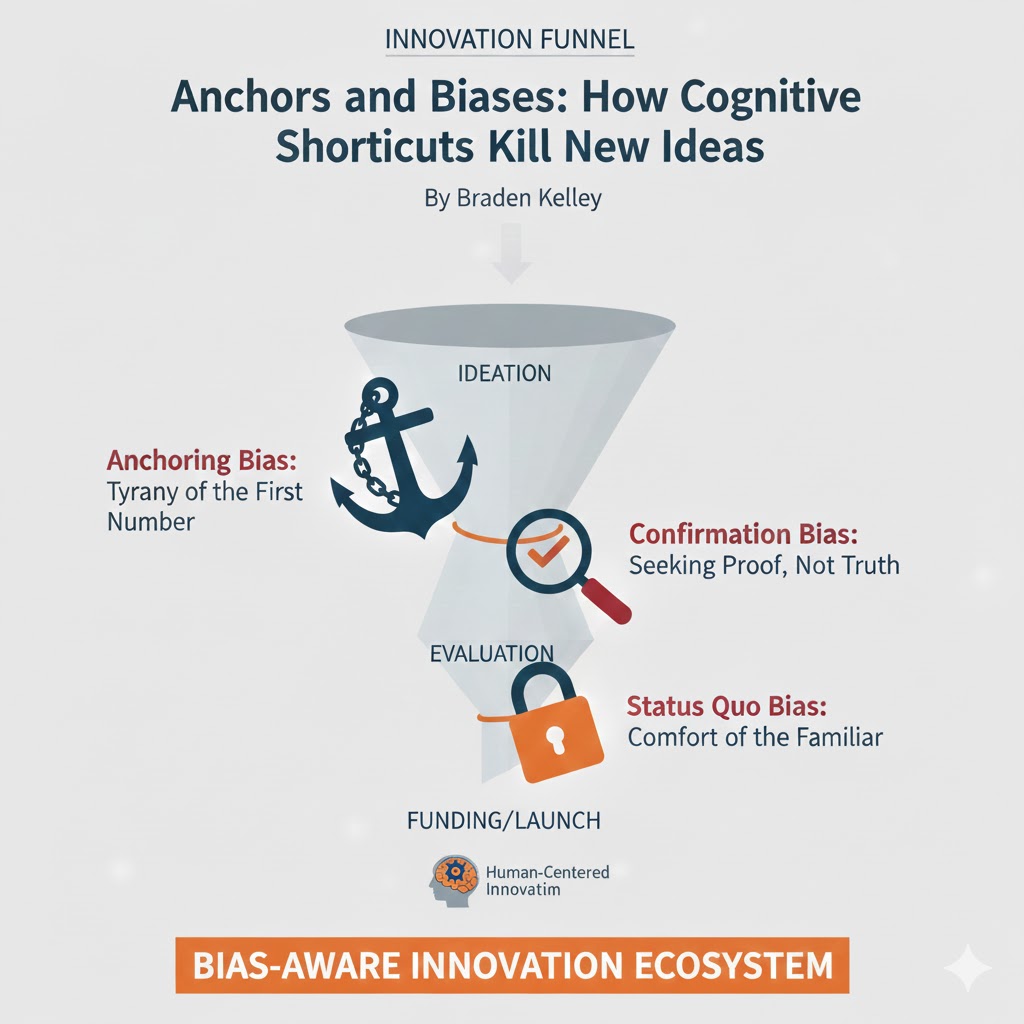
The most impactful action a leader can take is to speak last. By withholding their opinion until others have shared, they prevent “anchoring” the conversation and create the psychological safety required for team members to offer dissenting or unconventional ideas without fear of social or professional penalty.
Can a community be too diverse to innovate?
Innovation thrives on “constructive friction.” While extreme diversity can lead to communication challenges, the risk in innovation communities is almost always too much alignment, not too much dissent. The goal is to design for cognitive diversity and provide the frameworks—like the Pre-Mortem—to channel that friction into productive outcomes.
Image credit: Google Gemini
 Sign up here to get Human-Centered Change & Innovation Weekly delivered to your inbox every week.