Tag Archives: teamwork

Five Challenges All Teams Face

Five Challenges All Teams Face

GUEST POST from David Burkus

Teams face a lot of different challenges. Leading a team involves leading through many challenges. You’re given performance objectives. You map out a plan of execution with your team. But pretty quickly, you will run into challenges—both seen and unseen. And while most of these challenges are unique to the work being done and the team doing that work, some challenges are universal for teams.

These challenges all teams face are less about the work and more about teamwork and collaboration. That’s what makes them so common. But because they’re so common, they can be anticipated—and overcome.

In this article, we’ll outline five challenges all teams face and offer some insight on how to overcome them.

1. Finding Direction

The first challenge all teams face is finding direction. Most teams in most organizations don’t get to decide what specifically they get to work on—it comes with their collective job descriptions. However, they still get to make decisions as a team about what the priorities around all their tasks are, and sometimes even who is going to do which task. This is the initial challenge of finding direction. But keeping direction in a changing environment can be just as challenging as well. Priorities often need to change or be rearranged. New tasks are assigned. New changes in the environment happen. And that could mean slight shifts in the direction need to be made.

As a leader, one of the easiest ways to find and keep direction is through a regular “huddle” or weekly meeting. In that meeting, give the team a chance to review what they’re focused on, what they’ve completed, what potential roadblocks they face, and who needs assistance. These weekly meetings help review the large-scale direction and provide space to make any small-scale shifts in direction as well.

2. Improving Communication

The second challenge all teams face is improving communication. Communication is the lifeblood of any relationship, including the relationships on your team. The challenge of improving communication arises because everyone has slightly different communication preferences. Some people prefer to talk in person, some on the phone, some in email. Some people write short, quick emails, others write five paragraph essays. These differences in communication preferences can lead to a lot of miscommunications as well. Many conflicts on a team happen because one person assumed their preferences were shared by everyone else, and they were not.

As a leader, taking the time to have conversations about communication preferences can go a long way toward improving communication. Outline the communication tools the team has available and discuss when the team would prefer to use each one, for what type of communication, and any best practices the team can think of for that tool. Ideally, this leads to a set of group norms around communication and communication tools. Those norms can be revised from time to time but should be done so collectively. Otherwise, everyone goes back to their typical preferences.

3. Building Trust

The third challenge all teams face is building trust. Trust is a core component of teamwork. We need to trust the competency of our teammates—that they’re going to do what they say they’re going to do. But we also need to trust the character of those teammates—we need to know we can admit failures or request help without being demeaned or ostracized. Teams need a climate of trust so that they can safely disagree with each other and engage in task-focused conflict that ensures the best ideas rise to the top.

Research suggests that trust builds through a reciprocal process. So as a leader, the way to build trust on a team is to step out and signal you trust them. The most powerful way to do this is to be vulnerable. Leaders need to share certain vulnerabilities they have. They need to be willing to admit they don’t have all the answers all of the time, and that they need help from the team as well. Lead with vulnerability and teammates will follow, which over time will lead the team into greater levels of trust.

4. Keeping Diversity

The fourth challenge all teams face is keeping diversity. To be fair, many teams still struggle with finding enough diversity, but most leaders and team recognize that diversity on a team is a worthy goal. That creates a new challenge, keeping diversity. Ideally, diverse teams are formed because people with diverse backgrounds bring a diverse set of experience and perspectives to the team. However, as the team works together over time, they start to share the same experiences and perspectives. Eventually, if a team works together long enough, their ideas and opinions will start to become really similar. They may still look like a diverse team, but they act like a monoculture.

As a leader, this means rotating the roster of your team more often than it might seem necessary. It means being comfortable with the idea that people leaving the team can be a net positive as new members, and new perspectives join. It could also mean looking for small scale additions to diversity such as inviting members of different teams into group discussions or encouraging the team to seek out new cross-functional colleagues or new sources of ideas and inspiration.

5. Maintaining Motivation

The fifth challenge all teams is maintaining motivation. Staying motivated as a team, especially when the work gets difficult is a huge challenge for any team. Motivation and engagement happen when the work people are asked to do challenges them just enough to engage their full skillset—but not so much that it seems impossible. It also requires those challenges to be connected to a broader mission or purpose. People want to do work that matters—and teams want to know why their team matters.

As a leader, this requires looking at motivation both individually and teamwide. Individually, pay attention to the task-load of each member of the team. Ensure that they’re being challenged, but not overwhelmed. This may require moving some assignments around to different people on the team. Teamwide, make sure the team understands how its mission and objectives fit into the larger purpose of the organization. Be ready to draw a clear and connecting line between the work the team is asked to do, and the way that work serves a bigger purpose. Perhaps the best way to convey this purpose is by answering the question “Who is served by the work that we do?” and then building in reminders around that “who.”

These five challenges are ones every team faces eventually. But they aren’t the only challenges teams face. However, teams that proactively work to overcome these challenges work together better—and are better able to overcome those new, specific challenges. All teams face these challenges, but the answers to these challenges are how any team can start to do its best work ever.

Image credit: Pexels

Originally published at https://davidburkus.com on January 23, 2023.

Subscribe to Human-Centered Change & Innovation WeeklySign up here to get Human-Centered Change & Innovation Weekly delivered to your inbox every week.

Top 10 Human-Centered Change & Innovation Articles of January 2023

Top 10 Human-Centered Change & Innovation Articles of January 2023Drum roll please…

At the beginning of each month, we will profile the ten articles from the previous month that generated the most traffic to Human-Centered Change & Innovation. Did your favorite make the cut?

But enough delay, here are January’s ten most popular innovation posts:

  1. Top 40 Innovation Bloggers of 2022 — Curated by Braden Kelley
  2. Back to Basics: The Innovation Alphabet — by Robyn Bolton
  3. 99.7% of Innovation Processes Miss These 3 Essential Steps — by Robyn Bolton
  4. Top 100 Innovation and Transformation Articles of 2022 — Curated by Braden Kelley
  5. Ten Ways to Make Time for Innovation — by Nick Jain
  6. Agility is the 2023 Success Factor — by Soren Kaplan
  7. Five Questions All Leaders Should Always Be Asking — by David Burkus
  8. 23 Ways in 2023 to Create Amazing Experiences — by Shep Hyken
  9. Startups Must Be Where Their Customers Are — by Steve Blank
  10. Will CHATgpt make us more or less innovative? — by Pete Foley

BONUS – Here are five more strong articles published in December that continue to resonate with people:

If you’re not familiar with Human-Centered Change & Innovation, we publish 4-7 new articles every week built around innovation and transformation insights from our roster of contributing authors and ad hoc submissions from community members. Get the articles right in your Facebook, Twitter or Linkedin feeds too!

Have something to contribute?

Human-Centered Change & Innovation is open to contributions from any and all innovation and transformation professionals out there (practitioners, professors, researchers, consultants, authors, etc.) who have valuable human-centered change and innovation insights to share with everyone for the greater good. If you’d like to contribute, please contact me.

P.S. Here are our Top 40 Innovation Bloggers lists from the last three years:

Subscribe to Human-Centered Change & Innovation WeeklySign up here to get Human-Centered Change & Innovation Weekly delivered to your inbox every week.

The Power of Psychological Safety

Building Teams Ready for Anything

The Power of Psychological Safety

GUEST POST from Art Inteligencia

For decades, we’ve defined high-performing teams by their collective talent, their competitive drive, or their relentless focus on execution. We’ve believed that success is a matter of gathering the smartest people in a room and demanding excellence. But as a human-centered change and innovation thought leader, I’ve seen time and again that this model is insufficient for the complexity of our modern world. The most resilient, innovative, and successful teams are not defined by individual brilliance, but by a shared sense of trust and vulnerability. Their secret weapon is a concept known as psychological safety, a foundational element that empowers people to take risks, speak up, and learn from mistakes without fear of judgment or reprisal.

Psychological safety is a shared belief held by members of a team that the team is safe for interpersonal risk-taking. In simple terms, it’s the feeling that you can be yourself, ask a “stupid” question, admit a mistake, or propose a wild idea without being shamed, ridiculed, or penalized. This isn’t a “soft” concept; it’s a hard, strategic capability. In a world where change is the only constant, teams must be able to experiment, give and receive honest feedback, and pivot with agility. None of this is possible in a fear-based environment. The human instinct to self-preserve—to avoid looking incompetent—is a powerful force. Without psychological safety, we self-censor, we withhold critical information, and we stick to the known, a sure-fire path to stagnation and irrelevance. Conversely, when psychological safety is high, a team’s collective intelligence soars, and their capacity for innovation becomes limitless.

Cultivating a Culture of Safety: A Leader’s Blueprint

Building psychological safety is a leader’s most important job. It’s not about being “nice”; it’s about being intentional. Here are four essential practices for creating an environment where your team is ready for anything:

  • 1. Frame the Work as a Learning Problem: In a complex world, there is no single right answer. Frame every challenge not just as a task to be executed, but as a hypothesis to be tested. This reframes failure as a source of valuable data and reframes mistakes as essential steps on the path to a solution.
  • 2. Acknowledge Your Own Fallibility: Leaders must go first. When you admit a mistake, say “I don’t know,” or ask for help, you create a powerful permission structure for your team. This vulnerability signals that it’s okay for them to do the same, breaking down the fear of looking incompetent.
  • 3. Practice Inclusive Inquiry: Instead of simply stating your opinion, ask questions. Actively seek out the opinions of quieter team members. Say things like, “What are we missing?” or “I want to hear from someone who disagrees with me.” This signals that diverse perspectives are not just welcome but essential.
  • 4. Respond Constructively to Failure: When a project fails or a mistake is made, your response is everything. Avoid placing blame. Instead, lead with curiosity. Ask, “What did we learn from this?” and “How can we build a system to prevent this from happening again?” This turns a moment of potential crisis into a learning opportunity.

“Talent gets you on the field, but psychological safety is what allows you to win the game.” — Braden Kelley


Case Study 1: Pixar’s “Braintrust” – A Masterclass in Candor

The Challenge:

In the high-stakes world of animated filmmaking, a single creative misstep can lead to a disastrous flop. For Pixar, the challenge was to create a mechanism for frank, honest, and even brutal feedback on films in progress without crushing the creative spirit of the director and their team. A typical corporate review process would be too political and hierarchical for the level of candid feedback needed.

The Psychological Safety Solution:

Pixar’s solution was the Braintrust, an exclusive group of the company’s most accomplished directors and storytellers. This wasn’t a formal committee; it was a culture built on psychological safety. The core rules of the Braintrust are simple yet powerful: a director is never obligated to act on the feedback, and the group’s purpose is to help the film succeed, not to assert power. The feedback is always on the work, never the person. This deep, shared belief that everyone is there to help and that no one is judging personal worth allowed for a level of open, candid criticism that is almost unheard of in other creative industries. Directors could present their half-finished, deeply flawed films and receive honest input without fear of professional harm.

The Result:

The Braintrust is a key reason for Pixar’s long-term, unprecedented creative success. It is a living testament to the power of psychological safety. By building an environment where candor and vulnerability were not just tolerated but celebrated, Pixar created a collective intelligence that consistently elevated the quality of every film. They proved that honest feedback, delivered with a foundation of trust, is the ultimate driver of creative excellence.


Case Study 2: Volkswagen’s “Dieselgate” – The Cost of Silence

The Challenge:

In the years leading up to the “Dieselgate” scandal, Volkswagen was a highly centralized, hierarchical organization with a demanding culture of top-down perfection. Leaders set ambitious, often unrealistic, performance targets. The challenge was to meet a new set of strict emissions standards for their diesel vehicles, a goal that their engineering teams knew was physically impossible to achieve without compromising performance.

The Psychological Safety Failure:

In this fear-based environment, with a rigid emphasis on hierarchy and an intolerance for failure, employees were not psychologically safe to speak up. The engineers knew the emissions targets were unattainable, but they feared professional repercussions—demotion, firing, or public shaming—if they admitted failure. Instead of raising the impossible challenge to senior leadership, they chose to develop and install a “defeat device,” a software program designed to cheat on emissions tests. This was a direct, disastrous consequence of a culture that prioritized looking good over being honest and vulnerable.

The Result:

When the deception was discovered, it led to one of the biggest corporate scandals in history. The financial cost was in the tens of billions of dollars, but the damage to the company’s brand and reputation was incalculable. “Dieselgate” serves as a powerful cautionary tale. It shows that when psychological safety is absent, people will choose silence over speaking the truth, and a single, unaddressed problem can grow into a monumental crisis that threatens the very existence of the organization. It’s proof that a lack of psychological safety is not just a cultural problem; it’s a critical strategic risk.


Conclusion: The Ultimate Foundation for Innovation

Psychological safety is not a “nice-to-have.” It is the ultimate foundation for building teams that are resilient, adaptable, and ready for anything. It is the soil in which innovation grows, where creativity flourishes, and where people are empowered to be their best, most authentic selves. As leaders, our most important job is not to provide all the answers, but to create the environment where our teams feel safe enough to find them together.

In a world of constant change, the ability to learn and evolve is paramount. And learning only happens when we are willing to admit what we don’t know, to experiment without fear of failure, and to speak our minds without fear of judgment. The future belongs to the psychologically safe. Let’s start building it, one conversation and one act of vulnerability at a time.

Extra Extra: Futurology is not fortune telling. Futurists use a scientific approach to create their deliverables, but a methodology and tools like those in FutureHacking™ can empower anyone to engage in futurology themselves.

Image credit: Pexels

Subscribe to Human-Centered Change & Innovation WeeklySign up here to get Human-Centered Change & Innovation Weekly delivered to your inbox every week.

Building the Right Team for Your Digital Transformation Journey

Building the Right Team for Your Digital Transformation Journey

GUEST POST from Art Inteligencia

Digital transformation has become one of the most critical processes for businesses aiming to stay competitive in today’s fast-paced and interconnected world. However, embarking on this transformative journey is not just about implementing cutting-edge technologies; it also demands assembling the right team of individuals who can effectively navigate this shifting landscape. In this article, we will explore two case studies that highlight the importance of building the right team for a successful digital transformation.

Case Study 1: XYZ Corporation

XYZ Corporation, a mid-sized manufacturing company, recognized the need to adapt to emerging technologies and streamline their processes to enhance efficiency and customer experience. They understood that embracing a digital transformation journey required both technological investments and a competent team to drive the change.

To assemble the right team, XYZ Corporation initiated a rigorous process of identifying the skill sets and expertise required for their transformation goals. They formed a dedicated transformation team, consisting of internal employees with a deep understanding of the company’s operations, as well as external experts in digital technologies and change management. This blended team brought a mix of experience and fresh perspectives, allowing for a holistic approach to digital transformation.

The team’s first task was to conduct an in-depth analysis of the existing processes and systems within the organization. By collaborating with various departments and stakeholders, they identified pain points, bottlenecks, and opportunities for improvement. Using this invaluable information, the team developed a comprehensive roadmap that outlined the steps necessary for successful digital adoption.

Additionally, as part of their team-building strategy, XYZ Corporation invested in upskilling and training programs for their employees. This not only ensured that the workforce remained relevant and adaptable in the digital era but also fostered a culture of continuous learning and growth. By involving their employees in the transformation process and providing them with the necessary tools, XYZ Corporation created a sense of ownership and commitment among its team members.

The result of XYZ Corporation’s holistic team approach was a successful digital transformation. They experienced significant improvements in operational efficiency, enhanced customer satisfaction, and increased market share. Building the right team enabled them to leverage technology effectively, adapt to market demands, and emerge as a digital leader in their industry.

Case Study 2: ABC Bank

Digital transformation is not limited to the manufacturing sector; even traditional industries, such as banking, are undergoing rapid changes. ABC Bank, a well-established financial institution, recognized the need to modernize their operations, adopt digital banking solutions, and deliver a seamless customer experience.

To build the right team, ABC Bank acknowledged the importance of a diverse skill set that encompassed both banking expertise and digital technology knowledge. They formed core teams that consisted of professionals from diverse backgrounds, including banking, technology, design, and customer experience. By combining their cumulative strengths, ABC Bank was able to effectively align their organizational goals with their digital transformation strategy.

One of the major challenges faced by ABC Bank was cultural resistance to change. To address this, the team focused on change management and communication strategies. They fostered a culture of collaboration and transparency, ensuring that employees at all levels felt involved and informed throughout the transformation process. By addressing concerns and emphasizing the benefits of digitalization, they successfully minimized resistance and gained widespread acceptance.

ABC Bank also recognized the significance of partnerships with fintech companies to enhance their digital capabilities. Collaborating with external organizations that possessed expertise in cutting-edge technologies enabled them to accelerate their digital transformation journey. This partnership approach allowed ABC Bank to overcome resource constraints and stay at the forefront of technological innovation.

The outcome of ABC Bank’s team-building efforts was a successful digital transformation that elevated their customer experience and positioned them as a progressive financial institution. By assembling the right team, ABC Bank effectively bridged the gap between traditional banking practices and digital advancements, becoming a customer-centric organization focused on delivering convenient and personalized services.

Conclusion

These case studies highlight the significance of building the right team for a successful digital transformation journey. Assembling a team with a diverse skill set, fostering a culture of collaboration and learning, and leveraging external partnerships can drive effective change within organizations. It is crucial to understand that digital transformation is not solely a technological process, but one that relies on the capabilities, adaptability, and expertise of the team members involved. By investing in the right talent and creating an environment conducive to change, businesses can navigate the complexities of digital transformation and emerge as leaders in their respective industries.

Bottom line: Understanding trends is not quite the same thing as understanding the future, but trends are a component of futurology. Trend hunters use a formal approach to achieve their outcomes, but a methodology and tools like those in FutureHacking™ can empower anyone to be their own futurist and trend hunter.

Image credit: Unsplash

Subscribe to Human-Centered Change & Innovation WeeklySign up here to get Human-Centered Change & Innovation Weekly delivered to your inbox every week.

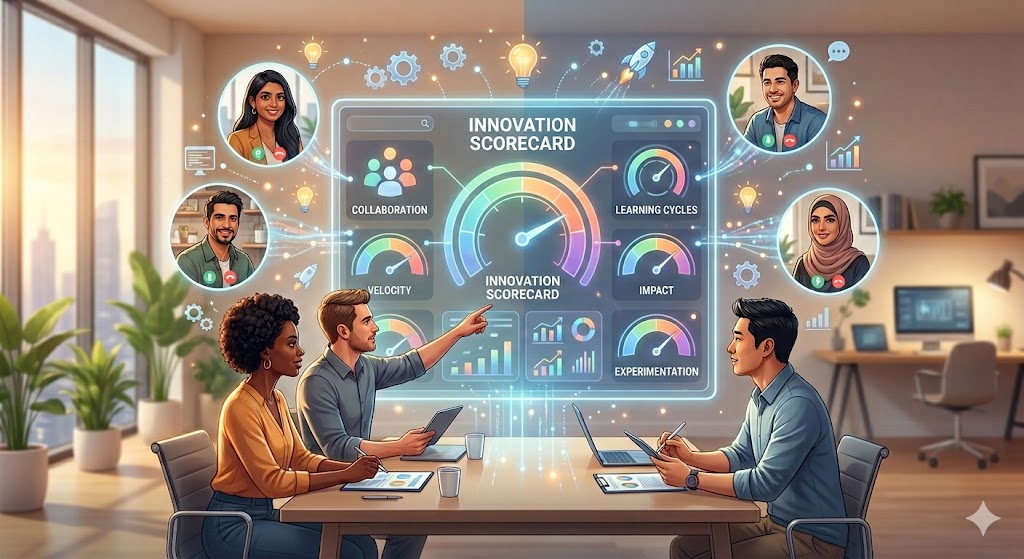
Innovation Scorecards Tailored for Hybrid Work Teams

LAST UPDATED: April 1, 2026 at 11:23 AM

Innovation Scorecards Tailored for Hybrid Work Teams

GUEST POST from Chateau G Pato


The Visibility Gap in Hybrid Innovation

In the transition to distributed work, many organizations have fallen into a dangerous trap: equating presence with productivity. When team members are no longer occupying the same physical space, a visibility gap emerges. Traditional innovation KPIs, which often relied on the serendipity of “water-cooler moments” and the energy of a shared war room, fail to capture the nuanced, asynchronous contributions that drive progress in a hybrid environment.

To bridge this gap, leaders must move away from Management by Walking Around—a model that inherently biases toward those in the office—and toward Management by Design. This requires a scorecard that intentionally tracks the health of the innovation ecosystem across both physical and digital divides.

Our objective is to build a measurement framework that balances individual autonomy with collective organizational agility, ensuring that “out of sight” never translates to “out of the loop” when it comes to high-value creative work.

Pillar 1: Input & Engagement Metrics (The Energy)

In a hybrid model, innovation begins with the “energy” injected into the system. It is no longer enough to track the number of ideas submitted; we must measure the quality and inclusivity of the collaborative process itself. This ensures that the digital divide doesn’t silence valuable voices.

Collaborative Diversity

One of the greatest risks in hybrid work is the emergence of digital echo chambers. We must measure the cross-functional nature of our sessions. Are we seeing a broad distribution of participation across time zones and departments, or is the conversation being dominated by a few individuals in the physical office? Tracking “Share of Voice” in digital meetings helps identify if we are truly leveraging our collective intelligence.

Asynchronous Contribution

Innovation doesn’t always happen in real-time. A robust scorecard tracks the “shelf life” and evolution of ideas within shared digital workspaces. By measuring how ideas are built upon, challenged, and refined asynchronously—outside of scheduled meetings—we validate the work that happens during deep-focus hours, regardless of a team member’s physical location.

Psychological Safety Scores

High-performing hybrid teams rely on psychological safety. Without the benefit of physical proximity to read non-verbal cues, remote members may feel a higher barrier to proposing “wild” or disruptive ideas. Utilizing frequent, anonymous pulse surveys allows us to quantify the level of safety felt across the team, ensuring the cultural foundation is strong enough to support radical experimentation.

Pillar 2: Velocity & Friction Metrics (The Flow)

In a hybrid environment, the speed of innovation is often dictated by the “friction” within our digital and physical handoffs. To maintain a competitive edge, we must measure the flow of ideas and identify where the transition between remote and in-office work creates drag on the creative process.

The Digital Prototype Cycle

We measure velocity by tracking the time elapsed from the initial “back-of-the-napkin” digital sketch to the first low-fidelity experiment. In a distributed team, the ability to rapidly transition from a conceptual discussion to a tangible (even if digital) prototype is the primary indicator of a team’s momentum. Long delays here often signal a lack of clarity in digital toolsets or a breakdown in collaborative handoffs.

Decision Latency

One of the silent killers of hybrid innovation is “decision lag.” This metric identifies bottlenecks in the approval process. We track whether the move to hybrid work has slowed down critical “Yes/No” cycles. If a project stalls because we are waiting for a specific in-person meeting to occur, we have a design flaw in our governance. High-velocity teams empower decentralized decision-making to keep the engine running.

Experimentation Frequency

We must shift our focus from “Successful Projects” to Active Learning Cycles per quarter. In innovation, the goal isn’t just to be right; it’s to learn as quickly as possible. By measuring how many experiments—failed or successful—a hybrid team conducts, we prioritize the process of discovery over the safety of the status quo. This encourages teams to take smaller, more frequent risks that lead to larger breakthroughs.

Pillar 3: Output & Impact Metrics (The Value)

Ultimately, the effectiveness of a hybrid innovation team is measured by the value it delivers to the organization and the customer. In a distributed setting, we must look beyond the final product to measure the durability and relevance of the outcomes produced.

Knowledge Artifacts

In a hybrid world, the “documentation” is as important as the “destination.” We track the creation of knowledge artifacts—reusable frameworks, digital templates, and “learning logs” that capture the why behind our decisions. These artifacts ensure that the insights gained by one sub-team are accessible to the entire organization, preventing the loss of institutional memory that often occurs in siloed, remote environments.

Customer Experience (CX) Alignment

Innovation is only successful if it solves a real human problem. We utilize Experience Level Measures (XLMs) to ensure that every project is tethered to a specific friction point in the customer journey. By measuring how hybrid-led innovations impact these specific experience metrics, we ensure the team remains laser-focused on external value rather than getting lost in internal digital processes.

Incremental vs. Radical Balance

Distributed teams can easily fall into a “maintenance” mindset, focusing on small, tactical fixes that are easier to coordinate over chat. Our scorecard monitors the balance between incremental improvements and radical, disruptive bets. We must ensure that our hybrid workflows still provide the “cognitive space” required for long-term thinking, preventing the team from becoming a high-speed feature factory that loses sight of the big picture.

Pillar 4: Network & Connection Metrics (The Community)

Innovation is a team sport that thrives on the strength of our connections. In a hybrid environment, social capital can erode if not intentionally maintained. We must measure the connectedness of our ecosystem to ensure that geographical distance does not lead to intellectual isolation.

Connectivity Heatmaps

We monitor the strength and frequency of ties between office-based and remote employees. Innovation dies in silos, and hybrid work can inadvertently create “in-groups” and “out-groups.” By analyzing digital interaction patterns—such as cross-functional Slack participation or collaborative document editing—we can identify emerging silos and intervene before they stifle the flow of diverse perspectives.

Mentorship & Shadowing

The informal “apprenticeship” that happens in a physical office is often lost in a digital-first world. We track how often junior or remote staff are integrated into high-level innovation “war rooms” and strategic planning sessions. Measuring the frequency of these mentorship touchpoints ensures that we are intentionally building the next generation of innovators, regardless of where their desk is located.

The Serendipity Quotient

While we can no longer rely solely on chance encounters, we can measure the success of “engineered serendipity.” This metric tracks the outcomes of structured networking events, random coffee chats, or virtual “brown bag” lunches. We look for instances where a connection made in a non-project setting leads to a tangible innovation insight or a new collaborative effort.

Implementation: Making the Scorecard Stick

A scorecard is only as effective as the culture that supports it. To prevent these metrics from becoming “shelfware,” they must be integrated into the daily rhythm of the hybrid team, moving from a static reporting tool to a dynamic driver of behavior.

Transparency by Default

In a distributed environment, information symmetry is vital. The innovation scorecard should not be hidden in a monthly slide deck; it should be a live, shared dashboard accessible to every team member. When everyone can see the same “North Star” metrics in real-time, it fosters a sense of collective ownership and reduces the anxiety often associated with remote performance monitoring.

The “Human-in-the-Loop” Review

Data tells you what is happening, but people tell you why. While we use digital tools to automate the collection of these metrics, we must maintain a regular, human-led “Innovation Retrospective.” These sessions allow teams to interpret the data, discuss the friction points identified in the scorecard, and pivot their approach based on qualitative insights that a dashboard might miss.

Rewarding the Process

To truly drive innovation, we must reward the behaviors we want to see repeated. This means publicly celebrating “intelligent failures”—experiments that were well-designed but didn’t yield the expected result—just as loudly as we celebrate successful launches. By aligning recognition with the metrics in our scorecard, we reinforce a culture of continuous learning and psychological safety across the entire hybrid workforce.

Conclusion: The Modular Future

Innovation in a hybrid world mirrors the very frameworks we use to describe organizational agility: it requires a Stable Spine of clear strategy and consistent measurement, supported by Modular Wings of flexible execution and diverse locations. The scorecard is not a tool for surveillance; it is the wind beneath those wings, providing the data necessary to ensure every team member—regardless of their coordinates—is seen, heard, and valued for their creative contributions.

As we move forward, we must remember that the goal of measurement isn’t just to track output, but to foster a healthy, sustainable innovation ecosystem. By focusing on human-centered metrics, we bridge the gap between the digital screen and the physical office, creating a unified culture that thrives on discovery.

Key Takeaway: We do not need more metrics; we need meaningful metrics that bridge the gap between the screen and the cubicle, ensuring that the future of work is as innovative as the products we create.

Frequently Asked Questions

How do these scorecards prevent bias against remote workers?

By shifting focus from “activity-based” metrics (like being seen in the office) to “contribution-based” metrics (like asynchronous knowledge artifacts and digital prototyping cycles), the scorecard ensures that value is measured by impact rather than physical presence.

Is this scorecard too complex for small teams?

The framework is modular. Small teams should start with one metric per pillar—such as Decision Latency and Collaborative Diversity—to gain immediate visibility into their innovation flow without administrative overhaul.

How often should the metrics be reviewed?

While data should be collected continuously in a live dashboard, a formal human-led review should occur monthly to interpret the qualitative “why” behind the quantitative “what.”

Image credits: Gemini

Subscribe to Human-Centered Change & Innovation WeeklySign up here to join 17,000+ leaders getting Human-Centered Change & Innovation Weekly delivered to their inbox every week.