Tag Archives: personalization

Reimagining Personalization

Reimagining Personalization

GUEST POST from Geoffrey A. Moore

Personalization was one of the leading rationales for companies investing in digitalization. The idea was that you were going to delight your customers by proactively offering them goods and services they were predisposed to want. This would create customer loyalty, increase their lifetime value, spur word-of-mouth endorsement, drive up Net Promoter Scores (NPS), and solve world hunger.

OK, not so much. A decade or more in, it’s time we ask ourselves, what is the real value of personalization, and how should we allocate our future investments in it? This begins with getting ourselves onto the right playing field in the first place. Personalization has different dynamics depending on whether your enterprise is Business to Consumer (B2C), Business to Business (B2B), B2B2C or B2G2C. Here’s how it plays out.

B2C

Let’s face it — as consumers, we are tired of personalization in its current form. It isn’t really personal, it is just an unending barrage of re-targeted advertising that works statistically but not psychologically. Despite all its promises to the contrary, it is not in fact delightful. So, best to take all that language about delighting our customers and throw it in the trashcan.

Instead of looking for delighters, we should be examining our hygiene factors. These are the things that annoy customers most when they go awry — late shipping, lost luggage, long hold times, rejected passwords, tedious surveys — you name it. Getting hygiene right is hard, but doing so consistently drives brand loyalty through the roof — just ask Amazon. We love what they do so much we subscribe to them! The point is, the things we love are not personal, they are institutional. Amazon has invested enormously in systems that set expectations through timely communication, early anomaly detection, instant alerts, and the like. This is not marketing, it’s logistics, but it is personally delivered, and we feel empowered in a highly differentiated way. (BTW, note to Amazon — you are increasingly over-monetizing your landing pages with sponsored ads, thereby eroding your most valuable asset. You need to set limits and stick to them.)

B2B2C

Rethinking personalization creates a whole new wave of innovation for B2B2C companies to pursue. Instead of optimizing for clicks, help your customers better detect signals. To be fair, some of these could be buying signals, and they should be used to drive consumer traffic along existing lines. But machine learning is also extremely effective at monitoring hygiene factors wherever there is log data to exploit. Omniture was an early pioneer in using this technology for website optimization, and now with generative AI you can let your customers’ websites ask visitors what they are interested in seeing instead of playing whack-a-mole with their best guesses.

The point is, no company is happy with their website, ever — and frankly, for good reason. They are just too hard to navigate, too much about themselves, not enough about the customers and prospects they are there to serve. By focusing on hygiene factors rather than delighters, this can be changed.

B2G2C

OK, when it comes to dealing with government services, no one is really thinking about delighters. Nightmares, on the other hand, do come to mind. Once again, it’s all about hygiene factors. The services that are being offered meet real needs. It’s the obstacles that systems and bureaucracies put in the way of citizens seeking those services that drive everyone crazy.

The fastest way to cut through this mess is to embrace the adage Time is money. The goal is to relentlessly optimize for reducing latency while at the same time reducing fraud as well. This requires the very best in ML and AI, but those resources are available today, and there are plenty of socially minded entrepreneurs who are ready to put in the hard work to make them scale. The core metric of success is time to closure, the tracking of which will be no mean feat. One consequence of its success, to be frank, would be a reduction in bureaucratic employment — not just to free up more money for social services but rather to expedite transaction processing throughout the system. My hope would be that impacted agencies could redeploy their workforces into the field where face-to-face personal interaction actually can make a powerful difference in the moment.

B2B

One question that bugs the you-know-what out of CEOs of successful global enterprises is, Why do our customers keep telling us we are hard to do business with? Of course, the answer is because they are. The real question is what can they do about it? Here are some low-hanging-fruit places to start:

  • Disintermediate your salespeople from replenishment transactions. Instead, empower customers to transact on their own behalf through digital self-service portals. And extend the same courtesy to partners who are acting as agents on behalf of their customers.
  • Attack the long tail of your SKUs. Not only do they entangle your salespeople in majoring in minors, they confuse the heck out of your customers.
  • Stop imposing buying risks on your customers and take them upon yourself instead by tokenizing bundles to allow for swapping out unconsumed portions and truing up on overused ones.
  • Invest in customer success initiatives that build relationships higher up in the customer organization, leveraging thought leadership marketing, customer health scoring, and executive sponsors focused on deep listening. Customers can tell you what they really need from you if you’ll let them.

Here as elsewhere, the goal is not to delight the customer. Customers don’t want to be delighted. They want to be served – thoughtfully, reliably, and economically. Remember, it’s not about you. It’s about them.

That’s what I think. What do you think?

Image Credit: Pexels

Subscribe to Human-Centered Change & Innovation WeeklySign up here to join 17,000+ leaders getting Human-Centered Change & Innovation Weekly delivered to their inbox every week.

Doing Personalization Correctly

Doing Personalization Correctly

GUEST POST from Shep Hyken

Companies today face three critical marketing and Customer Experience (CX) challenges:

  1. How can you keep customers coming back?
  2. How can you get your customers’ attention so they don’t consider switching to the competition?
  3. How do you create an experience that makes price less relevant?

These questions and others can be answered in one word: Personalization.

It used to be that personalization was a marketing tactic. Simply using the customer’s name in the salutation of an email or letter, such as “Dear Shep,” was personalization in its most basic form. Include a reference in the body of the message, for example, what city the customer lives in, and you had what many considered to be a more sophisticated personalization program.

Today, the concept of personalization has blended into part of the customer experience. Using a name is barely a personalized experience. Using information about the customer that feels like the company or brand knows them takes marketing from promotional to customer experience.

For example, if I call a company that I’ve done business with and have questions about a new product I’m interested in purchasing or a customer service question, the company representative should have enough information about me to know how long I’ve done business with them, what products or services I’ve purchased, what problems, questions, or complaints I’ve called about and more. Using that information the right way is the beginning of a more powerful personalized experience. Customers like it when you know them.

And this concept goes beyond live interactions between a customer and an employee. A modern-day personalization messaging campaign is powerful and turns traditional email or text message marketing into a highly personalized experience.

This same experience can be used in email or text messages, either as part of customer support when customers “write in” with a question or for marketing when you want to push a message to the customer. Used the right way, you’re showing your customers that you know them.

On a recent Amazing Business Radio episode, I interviewed Ronn Nicolli, chief marketing officer of Resorts World Las Vegas. He talked about how storytelling can hit an emotional chord with a customer, helping to create and maintain an image that customers embrace and look forward to. And when the customer can relate to the story—or maybe they are part of the story—you connect at a different level. A higher level.

Nicolli said, “Ten years ago, email marketing was like fishing with dynamite. Throw the dynamite in the water—in the form of a big email campaign—and see what floats to the surface.” It was a mass marketing campaign, and the extent of personalization was the customer’s name. Today, because of advances in technology, Nicolli says, “AI gives us the ability to market in mass, but on a one-to-one basis.”

What you’re selling may be the same for everyone, but the message is highly personalized by merging the customer’s name, dates they did business, comments they made and more into the message. Nicolli referred to the AI program as an intelligent learning program.

Curating personalized messaging and visuals in mass that speak to each individual is going to resonate far better than a general message with no personalization other than the customer’s name. Nicolli shared that he can send out a million emails, and the messages are all re-curated to ensure they are meaningful and speak directly to the customer. For example, the resort may want to promote a seasonal package to its database. A message to a customer/guest who comes in with a group of friends for college basketball’s March Madness tournament weekend will receive a different email than a customer who frequents the hotel with a spouse or loved one for the occasional romantic weekend—even if the promotion is asking for the same call to action.

So, whether you’re personalizing the experience for customer support or a marketing message, it’s now all part of the customer experience. Our latest customer experience research finds that eight out of 10 customers prefer a personalized experience. They will even pay more for it, making price less relevant. They want to do business with or go to the place, like the title of the theme song from the hit 1980s TV sitcom Cheers implies, ‘Where Everybody Knows Your Name’.

This is what your customers want and expect. So, take your customer experience efforts to the next level with a personalization strategy that creates an emotional connection and gets customers to say, “I’ll be back.”

Image Credit: Shep Hyken, Pexels

This article was originally published on Forbes.com

Subscribe to Human-Centered Change & Innovation WeeklySign up here to join 17,000+ leaders getting Human-Centered Change & Innovation Weekly delivered to their inbox every week.

Five Keys to Personalizing the Customer Experience

Five Keys to Personalizing the Customer Experience

GUEST POST from Shep Hyken

Earlier this year, we surveyed more than 1,000 consumers in the U.S. for our 2024 State of Customer Service and Customer Experience (CX) Study. We asked about the importance of a personalized experience. We found that 81% of customers prefer companies that offer a personalized experience, and 70% say a personalized experience in which the employee knows who they are and their history with the company (past purchases, buying patterns, support calls and more) is important. They also want the experience to go beyond people and include the platforms where they prefer to do business.

For a recent episode of Amazing Business Radio, I talked with Elizabeth Tobey, head of Marketing, Digital & AI of NICE, which helps companies apply AI to manage customer experience. The focus of the discussion was personalization. Here are some of the highlights from the interview:

1. Channel of Choice: This is where the modern-day concept of personalization begins. Tobey said, “In a world where people carry computers in their pockets (also known as mobile phones), it’s important to meet your customers when and where they want to be met.” Customers used to have two main choices when communicating with a brand. They could either walk into a store or call on the phone. Today, there are multiple channels and platforms. They can still visit in person or call, but they can also go to a website with self-service options, visit a social channel like Facebook, conduct business using an app, communicate with a brand’s chatbot and more. Customers want convenience, and part of that is being able to connect with a brand the way they want to connect. Some companies and brands do that better than others. The ones that get it right have educated customers on what they should expect, in effect raising the bar for all others who haven’t yet recognized the importance of communication.

2. Communicate on the Customer’s Terms: Tobey shared a frustrating personal experience that illustrated how some customers like to communicate but a brand falls short. Tobey was getting home late from an event. She contacted a company through its support channel on its website and was communicating with a customer support agent via chat. It was late, and she said, “I have to go to sleep,” expecting she could continue the chat the next morning with another agent. But, when she went to resume the conversation, she was forced to restart the process. She logged back into the website and repeated the authentication process, which was expected, but what she didn’t expect was having to start over with a new agent, repeating her conversation from the beginning as if she had never called before. Tobey made a case for technology that allows for asynchronous conversations on the customer’s timeline, eliminating the need for “over-authentication” and forcing the customer to start over, wasting time and creating an experience marred with friction.

3. Eliminate Friction: How could an interview with an executive at a technology company like NICE not bring up the topic of AI? In the story Tobey told about having to start over with a new agent, going through the authentication process again and repeating her issue, there is a clear message, which is to eliminate unnecessary steps. I shared an experience about visiting a doctor’s office where I had to fill out numerous forms with repeat information: name, address, date of birth, etc. Why should any patient have to fill in the same information more than once? The answer to the question, according to Tobey, is AI. She says, “Take all data that’s coming in from a customer journey and feed it into our AI so that the engine is continuously learning, growing and getting smarter. That means for every customer interaction, the automation and self-service can evolve.” In other words, once AI has the customer’s information, it should be used appropriately to eliminate needless steps (also known as friction) to give the customer the easiest and most convenient experience.

4. It’s Not Just About the Customer: In addition to AI supporting the customer’s self-service and automated experience, any data that is picked up in the customer’s journey can be fed to customer support agents, supervisors and CX leaders, changing how they work and making them more agile with the ability to make decisions faster. Agents get information about the customer, enabling them to provide the personalized experience customers desire. Tobey says, “Agents get a co-pilot or collaborator who listens to every interaction, offers them the best information they need and gives them suggestions.” For supervisors and CX leaders, they get information that makes them more agile and helps them make decisions faster.

5. Knowledge Management: To wrap up our interview, Tobey said, “AI management is knowledge management. Your AI is only as good as your data and knowledge. If you put garbage in, you might get garbage out.” AI should constantly learn and communicate the best information and data, allowing customers, agents and CX leaders to access the right information quickly and create a better and more efficient experience for all.

This article originally appeared on Forbes.com

Image Credits: Unsplash

Subscribe to Human-Centered Change & Innovation WeeklySign up here to join 17,000+ leaders getting Human-Centered Change & Innovation Weekly delivered to their inbox every week.

The Personal Touch Should Not Be Faked

The Personal Touch Should Not Be Faked

GUEST POST from Shep Hyken

One of the most powerful customer service and CX tactics is personalization. We interviewed more than 1,000 consumers for our CX research, and 71% said a personalized experience is important to them. When personalization is used correctly, customers feel as if you recognize them. Using their name, remembering their past purchases, their buying patterns and more can build confidence and trust.

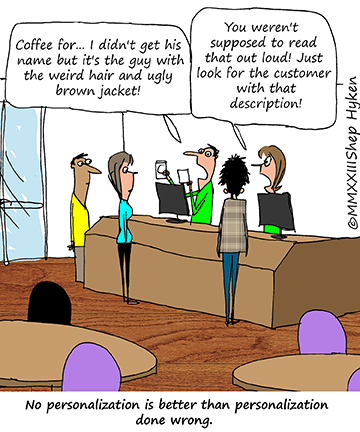
While personalization is nice, it is not required, and if you decide to do it, there are some mistakes you must avoid. For example, if you’ve ever talked to a customer service agent who uses your name repeatedly to the point that it seems disingenuous, the effort to personalize fails. Another example came in the form of an email I recently received from a sales rep. It started out like this:

Dear <NOT PROVIDED>,

I hope this email finds you well. I wanted to discuss upgrading your current technology …

Obviously, my name is not “Not Provided.” I could tell the mail-merge field didn’t work. It took about two seconds for me to delete the email.

What made it worse was the next day, I received a phone call from the salesperson who sent the email. He didn’t ask for me by name. He asked for “the person in charge of technology.” So, this guy has my phone number and email address, but can’t get my name? His “personalization” strategy failed. As always, I’m polite to every salesperson who calls, but the conversation and relationship were over in less than a minute.

Shep Hyken Personalization Cartoon

There are some pretty easy ways to create a personalized experience. Here are three of many to consider:

  1. Use the Customer’s Name – As already mentioned, be sure to use it correctly.
  2. Know the Customer’s Buying History – With the right software, you can track what the customer bought, how often and more.
  3. Make Appropriate Recommendations – Knowing your customer’s buying history can give you insights into up-sell and cross-sell opportunities. This isn’t a traditional sales pitch. It’s based on what you know about the customer. And if you know a customer can use something and don’t tell them about it, that is actually bad customer service.

While there are many more ideas, let’s wrap up with this. Personalization is about connecting with your customer. Be sure to do it right, whether it is as simple as using the customer’s name or as sophisticated as using data to understand your customer’s needs. No personalization is better than personalization done wrong.

Image Credits: Shep Hyken, Pexels

Subscribe to Human-Centered Change & Innovation WeeklySign up here to join 17,000+ leaders getting Human-Centered Change & Innovation Weekly delivered to their inbox every week.


10 Ways to Rock the Customer Experience In 2023

10 Ways to Rock the Customer Experience In 2023

GUEST POST from Shep Hyken

As of today, 2022 is behind us. It was quite a year. Some businesses are still recovering from the impact of the pandemic, and then came employment issues, supply-chain problems and a shaky economy. All that makes for a company’s leaders having to use every skill they ever learned in their careers.

Our CX research indicated that 2022 was worse for customer service than the prior year. So we don’t continue that trend in 2023, I’ve created a list of tactics to help you. And while these may seem basic, they are essential to your organization’s success. With that in mind, here are ten ways that you can rock the customer experience in 2023:

1. Manage First and Last Impressions

There may not be anything more basic than this. Start with a strong first impression—and not just the first time a customer interacts with you. It could be the 500th time. First impressions set the tone for whatever is to follow, be it the first interaction or the 500th. As for last impressions, be sure to end strong. Last impressions create lasting impressions.

2. Give Back

Customers gravitate toward companies and brands that give back. Forty-five percent of the customers we surveyed in our annual customer experience research said that a company that gives back to the community or stands for a social cause is important to them. That’s almost half of your customers.

3. Be Customer-Focused

My definition of customer-focused is more than just delivering a good customer service experience. In addition to paying attention to customer service and CX, every decision you make keeps the customer in mind. Even if you are considering a change that will negatively impact the customer, you think it through, understand the ramifications and strategize how to overcome or handle the decision’s impact.

4. Empower Your Employees

If you want to keep your best employees and want them to take care of your customers, you need to hire good people, train them to do their job and then let them do it. Customers become frustrated when they encounter employees who aren’t able to make smart decisions. By the way, employees become frustrated as well, and that’s not good for the culture.

5. Practice Proactive Customer Service

This how you create customer confidence. Reach out to them proactively if you know of a problem. For example, the cable company that reaches out to its customers to let them know about an outage before they turn on their TV or computer. Or the retailer that emails, texts or calls a customer to let them know their purchase is delayed. While nobody likes bad news, knowing in advance gives the customer a sense of control and knowledge that the company is working on the problem.

6. Make It Personal

Find ways to personalize the experience. Customers like to be recognized and remembered. Make your customers feel as if you know them.

7. Have an Abundance Mindset, Especially When It Comes to Time

Zig Ziglar used to say, “You will get all you want in life if you help other people get what they want.” In this case, help customers get the most out of their experience with you and your products. That may mean spending a little more time selling, supporting and relationship-building with your customers. One of the big “loyalty killers” in business is when employees rush a customer to get to the next customer. Customers know it, feel it and don’t like it. An extra minute or two can be the difference between a customer coming back—or not.

8. Be Convenient

Eliminate anything (or at least as much as you can) that causes friction. Don’t make customers wait, don’t make them go through extra steps or do anything that is in the least bit inconvenient. Seventy percent of the customers we surveyed said they would pay more for convenience, and 68% said a convenient experience alone will make them come back.

9. Practice the “Employee Golden Rule”

My Employee Golden Rule goes like this: Do unto employees as you want done unto your customers. In other words, treat the people you work with as well (if not better) than your customers. That sets the tone from the inside and is felt by the customer on the outside.

10. Be Helpful

Ace Hardware is known as “The Helpful Hardware Place.” That’s their secret sauce. It separates them from their direct competitors (Home Depot, Menards, Walmart, etc.). I was interviewing an Ace executive for one of my customer service books, and he said, “Our competition has friendly customer service. So do we, but we also provide helpful service.” Think about how to help your customers be more successful when they buy whatever it is you sell.

BONUS: Show Appreciation

Don’t ever forget to say, “Thank you.” It doesn’t matter if it’s in person, on the phone, a text or an old-fashioned, hand-written note. Customers must always know you appreciate them for their business.

Some of these ideas may seem basic—even common sense. Maybe they are, but they are also essential to delivering the experience that gets customers to say, “I’ll be back!”

This article was originally published on Forbes.com.

Image Credit: Unsplash

Subscribe to Human-Centered Change & Innovation WeeklySign up here to get Human-Centered Change & Innovation Weekly delivered to your inbox every week.

Tailoring Experiences at Scale

The Power of Personalization

Tailoring Experiences at Scale

GUEST POST from Chateau G Pato

For decades, the dominant logic in business was mass production and mass consumption. The goal was simple: optimize for the average customer. But in today’s hyper-connected, hyper-competitive marketplace, the average customer no longer exists. They are individuals demanding recognition, relevance, and respect for their unique context. As a human-centered change and innovation thought leader, I argue that the future of competitive advantage lies in mastering The Power of Personalization — the ability to deliver tailored, meaningful experiences to millions of people, simultaneously and seamlessly. This is the ultimate convergence of human-centered design and technological scale: using data and intelligence to make every single customer feel profoundly understood. Innovation must move beyond simple segmentation to anticipatory intimacy.

Personalization is not just about slapping a name on an email. True personalization is a strategic innovation challenge that addresses the fundamental human need for relevance. When a product, service, or communication is relevant, it eliminates friction, conserves the user’s valuable time, and builds trust. Conversely, irrelevant experiences create “digital noise,” foster annoyance, and actively erode loyalty. The challenge for leaders is to establish the infrastructure—both technical and human—that allows the organization to perceive, remember, and respond to the unique needs and behaviors of its individual customers, moving from a transaction-based relationship to a personalized partnership.

The Three Dimensions of Human-Centered Personalization

Effective personalization at scale requires a deliberate strategic focus across three integrated dimensions, ensuring that technology serves human purpose:

  • 1. Contextual Intelligence (The When and Where): Personalization fails when it is delivered out of context. This dimension involves using real-time behavioral data, location, time, and device context to deliver the right message at the exact moment of need. It’s about being helpful, not just interruptive. For example, offering a specific type of coffee to a regular when they step within range of their usual store, not hours later at home.
  • 2. Behavioral Prediction (The Anticipatory Insight): Moving beyond “what they bought” to “what they are about to need.” This requires deep data analytics to model future behavior and latent needs. The innovation here is in creating proactive experiences—solving a problem the customer hasn’t even fully articulated yet. This is the difference between recommending a product and recommending a solution to a future pain point.
  • 3. Ethical Transparency (The Trust Equation): The more personal your service, the higher the need for trust. Personalization must be built on a foundation of ethical consent and clarity. Customers must understand what data is being used, why it benefits them, and have meaningful control over it. Lack of transparency transforms personalization from helpful to “creepy,” immediately destroying the human relationship you were trying to build.

“The best personalization doesn’t guess the customer’s mind; it anticipates their next human need.”


Case Study 1: Netflix – Personalizing the Discovery Experience

The Challenge:

With thousands of titles in its library, Netflix faced a monumental human-centered challenge: choice overload. An average customer who spends too long searching often quits out of frustration, leading to churn. The vastness of the library became a liability rather than an asset.

The Personalization Solution:

Netflix innovated by turning its entire platform into a hyper-personalized discovery engine. Their personalization extends far beyond basic recommendation rows. They use data to:

  • Personalize Artwork: Displaying different title images for the same movie based on the viewer’s previous habits (e.g., showing a romantic image to a romance watcher, or an action scene to a thriller fan).
  • Personalize Rows: Creating unique rows that reflect highly specific taste segments (e.g., “Visually Stunning Sci-Fi Movies with a Strong Female Lead”).
  • Behavioral Prediction: Using complex algorithms to anticipate the titles most likely to be watched next, drastically reducing the cognitive effort required to choose.

The result is a service where the entire interface is tailored to the individual, solving the human problem of choice overload.

The Human-Centered Result:

By investing in personalization as its core product strategy, Netflix dramatically increased customer engagement and reduced churn. The experience feels curated and intimate, creating a strong sense of value. It proved that in the digital age, relevance is the killer feature, and the best way to innovate around a huge catalog is to make it feel small and tailored to each person.


Case Study 2: Spotify – Tailoring the Moment of Discovery

The Challenge:

The music world is characterized by an infinite library of new content. For Spotify, the challenge was helping users feel connected to new artists and music they would love, without relying solely on manual searching or static genre lists. The innovation needed to capture the highly personal, emotional nature of music discovery.

The Personalization Solution:

Spotify’s innovation, particularly the Discover Weekly playlist, is a masterclass in anticipatory personalization. The system uses a complex blend of collaborative filtering (what similar users like) and natural language processing (analyzing articles and blogs about music) to create a wholly unique, algorithmically-generated playlist for each user, delivered every Monday.

  • Contextual Delivery: The timing (Monday morning) positions the playlist as a fresh start and a soundtrack for the week.
  • Ethical Partnership: The playlist format feels like a gift from a trustworthy, knowledgeable friend, minimizing the “creepy” factor because the value exchange is clear: “We observe your taste, and in return, we give you this high-quality, personalized content.”

This system essentially turns data analysis into an act of creative, personalized curation.

The Human-Centered Result:

Discover Weekly became one of Spotify’s most successful features, driving massive engagement. It demonstrated that personalization can be an act of generosity, giving the user a valuable, curated product that is better than anything they could have created themselves. It solidified Spotify’s role not just as a music player, but as a trusted curator and partner in the user’s emotional relationship with music.


Conclusion: The Future of Business is Individual

The Power of Personalization is the core strategic challenge of our time. It requires leaders to embrace a fundamental truth: human connection scales. You don’t need to choose between mass market reach and intimate relationships; technology has finally allowed us to achieve both.

To succeed, organizations must move from seeing personalization as a marketing tactic to recognizing it as a holistic innovation imperative — a guiding principle for product design, service delivery, and ethical governance. By leveraging contextual intelligence and behavioral prediction with unwavering ethical transparency, we can create a future where every customer feels understood, valued, and served with a precision that delights. The most profitable innovations will be those that master the art of the individual experience, delivered on a global stage.

Extra Extra: Because innovation is all about change, Braden Kelley’s human-centered change methodology and tools are the best way to plan and execute the changes necessary to support your innovation and transformation efforts — all while literally getting everyone all on the same page for change. Find out more about the methodology and tools, including the book Charting Change by following the link. Be sure and download the TEN FREE TOOLS while you’re here.

Image credit: Pexels

Subscribe to Human-Centered Change & Innovation WeeklySign up here to get Human-Centered Change & Innovation Weekly delivered to your inbox every week.

Navigating the Customer Experience Dilemma

Personalization vs. Privacy

Navigating the Customer Experience Dilemma

GUEST POST from Chateau G Pato

As businesses strive to deliver exceptional customer experiences in an increasingly digital world, they face a significant conundrum: how to balance personalization with privacy. Today’s consumers expect, and often welcome, personalized interactions that cater to their needs and preferences. However, they are also becoming increasingly aware of and concerned about their privacy and how their personal data is being used.

This article explores the intricate balance between personalization and privacy, examines the benefits and challenges of both, and offers insights into how businesses can navigate this complex landscape effectively.

The Promise of Personalization

Personalization is a powerful tool for enhancing the customer experience. By tailoring products, services, and communications to individual preferences, businesses can increase engagement, customer satisfaction, and loyalty. Advances in digital technology have made it possible to deliver highly personalized experiences at scale, from custom product recommendations to targeted marketing messages.

Research indicates that consumers are more likely to do business with companies that offer personalized experiences. By collecting and analyzing customer data, businesses can gain insights into purchasing behavior, preferences, and needs, enabling them to deliver more relevant and timely content.

The Growing Concern for Privacy

While personalization offers numerous benefits, it also raises important privacy concerns. As businesses collect more data about their customers, questions arise about how this data is used, stored, and protected. High-profile data breaches and scandals involving misuse of personal data have heightened consumers’ awareness and anxiety about privacy.

The introduction of regulations such as the General Data Protection Regulation (GDPR) and the California Consumer Privacy Act (CCPA) underscores the importance of protecting consumer data and respecting privacy. These regulations impose strict guidelines on data collection and usage, granting consumers greater control over their personal information.

Case Study 1: Netflix’s Personalized Experience

Personalization Approach

Netflix stands out as a prime example of leveraging personalization to enhance customer experience. By utilizing sophisticated algorithms, Netflix offers personalized content recommendations based on user viewing history and preferences. This personalization strategy helps retain and attract subscribers by providing them with engaging and relevant content.

Privacy Measures

To address privacy concerns, Netflix takes a transparent approach to data usage and permissions. The company offers explicit privacy notices and provides users with settings to control their data sharing preferences. By prioritizing data security and adhering to privacy regulations, Netflix successfully maintains user trust.

Case Study 2: Apple’s Privacy-First Strategy

Privacy-Centric Approach

Apple has distinguished itself as a champion of user privacy. The company emphasizes security and privacy as key components of its products and services. Apple’s approach involves minimizing data collection, processing data on devices rather than in the cloud, and offering robust privacy controls for users.

Balancing Personalization

Despite its focus on privacy, Apple also taps into personalization through services like Siri and custom app recommendations, all while maintaining strong user privacy standards. By ensuring transparency and user consent, Apple achieves a delicate balance between personalization and privacy, fostering customer loyalty and trust.

Best Practices for Balancing Personalization and Privacy

To successfully navigate the personalization-privacy dilemma, businesses need to adopt strategies that respect user privacy while delivering meaningful and personalized experiences. Here are some best practices:

  • Transparency: Clearly communicate data collection and usage practices. Offer concise privacy policies and ensure users understand how their data will be utilized.
  • User Control: Provide users with the ability to control their data preferences. Allow them to opt in or opt out of data sharing and personalize their settings.
  • Data Minimization: Collect only the essential data needed for personalization. Avoid the accumulation of unnecessary or sensitive information.
  • Security Measures: Implement robust security protocols to protect user data from breaches and unauthorized access.
  • Compliance: Stay informed of privacy regulations and ensure compliance to avoid legal complications and maintain customer trust.

By thoughtfully considering both personalization and privacy, businesses can enhance the customer experience while safeguarding consumer trust. As technology continues to evolve, achieving the ideal balance will remain a crucial factor in successful customer engagement.

Extra Extra: Because innovation is all about change, Braden Kelley’s human-centered change methodology and tools are the best way to plan and execute the changes necessary to support your innovation and transformation efforts — all while literally getting everyone all on the same page for change. Find out more about the methodology and tools, including the book Charting Change by following the link. Be sure and download the TEN FREE TOOLS while you’re here.

Image credit: Pixabay

Subscribe to Human-Centered Change & Innovation WeeklySign up here to get Human-Centered Change & Innovation Weekly delivered to your inbox every week.

The Importance of Personalization in Customer Experience

The Importance of Personalization in Customer Experience

GUEST POST from Chateau G Pato

In today’s highly competitive business landscape, providing a personalized customer experience is more important than ever. Personalization in customer experience goes beyond just addressing customers by their first name in an email; it involves understanding each customer’s unique preferences, needs, and behaviors to deliver customized interactions that demonstrate genuine care and empathy.

Personalization can take many forms, from tailored product recommendations based on past purchase history to personalized marketing messages based on browsing behavior. The goal is to create a meaningful connection with customers that makes them feel understood, valued, and appreciated. Research has shown that personalized experiences lead to greater customer satisfaction, loyalty, and ultimately, increased revenue.

Two companies that have successfully embraced the power of personalization in customer experience are Amazon and Netflix. Amazon’s recommendation engine is a prime example of how personalization can drive sales and customer loyalty. By analyzing customers’ browsing history, purchase patterns, and demographic information, Amazon is able to deliver highly targeted product recommendations that are relevant to the individual.

Similarly, Netflix utilizes sophisticated algorithms to personalize the content recommendations for each user. By tracking users’ viewing habits, ratings, and preferences, Netflix is able to suggest movies and TV shows that match their interests. This level of personalization not only enhances the user experience but also increases engagement and retention rates.

Conclusion

The importance of personalization in customer experience cannot be overstated. By investing in technologies and strategies that enable personalized interactions, businesses can create meaningful connections with customers that drive loyalty, satisfaction, and revenue growth. Companies that fail to prioritize personalization risk falling behind in today’s customer-centric market. It’s time to put customers at the center of your business strategy and deliver experiences that are truly personalized and unforgettable.

SPECIAL BONUS: Futurology is not fortune telling. Futurists use a scientific approach to create their deliverables, but a methodology and tools like those in FutureHacking™ can empower anyone to engage in futurology themselves.

Image credit: Unsplash

Subscribe to Human-Centered Change & Innovation WeeklySign up here to get Human-Centered Change & Innovation Weekly delivered to your inbox every week.

The Power of Personalization

Leveraging Consumer Behavior for Innovation Success

The Power of Personalization

GUEST POST from Chateau G Pato

In today’s fast-paced and highly competitive business landscape, the ability to understand and cater to consumer behavior is crucial for innovation success. One of the most powerful tools at a company’s disposal for achieving this is personalization. By tailoring products, services, and marketing efforts to individual preferences and behaviors, businesses can create a more engaging and fulfilling experience for their customers, ultimately driving growth and success.

Personalization is not a new concept, but advances in technology and data analytics have made it easier and more effective than ever before. By leveraging customer data and insights, companies can create highly targeted and relevant experiences that resonate with consumers on a personal level. This not only increases customer satisfaction and loyalty, but also drives higher levels of engagement and conversion.

Case Study 1: Ecommerce

One industry that has successfully harnessed the power of personalization is e-commerce. Companies like Amazon and Netflix have built their entire business models around personalized recommendations, using algorithms to analyze customer preferences and behavior to suggest products or content that are likely to resonate with individual users. This not only enhances the customer experience by making it easier for consumers to find relevant products, but also drives increased sales and customer retention.

A recent study by McKinsey & Company found that companies that successfully personalize their marketing communications see an average of 10-30% uplift in revenue. For example, clothing retailer Stitch Fix uses a combination of algorithms and human stylists to curate personalized clothing collections for customers, leading to higher levels of customer satisfaction and repeat purchases.

Case Study 2: Starbucks

Another compelling case study of the power of personalization comes from Starbucks. The coffee giant uses its popular mobile app to collect data on customer preferences and behaviors, allowing it to offer personalized promotions and rewards to individual customers. This not only incentivizes repeat visits, but also drives higher levels of customer engagement and loyalty.

Conclusion

The power of personalization cannot be overstated. By leveraging consumer behavior for innovation success, companies can create more engaging and fulfilling experiences for their customers, ultimately driving growth and success. With the right tools and strategies in place, businesses can harness the power of personalization to drive increased revenue, customer loyalty, and competitive advantage in today’s dynamic marketplace.

SPECIAL BONUS: Futurology is not fortune telling. Futurists use a scientific approach to create their deliverables, but a methodology and tools like those in FutureHacking™ can empower anyone to engage in futurology themselves.

Image credit: Unsplash

Subscribe to Human-Centered Change & Innovation WeeklySign up here to get Human-Centered Change & Innovation Weekly delivered to your inbox every week.

The Future of Retail

E-commerce, Augmented Reality, and Personalized Experiences

The Future of Retail: E-commerce, Augmented Reality, and Personalized Experiences

GUEST POST from Art Inteligencia

The retail industry has seen significant transformations in recent years, and these changes are only going to accelerate in the future. As consumers increasingly turn to online shopping, retailers are finding new ways to engage their audience, provide enhanced experiences, and stay relevant in a digital age. Two case studies highlight the impact of e-commerce, augmented reality, and personalized experiences on the future of retail.

Case Study 1: Amazon Go

In 2018, e-commerce giant Amazon introduced Amazon Go, a cashier-less grocery store. This innovative concept allows customers to simply walk in, grab the items they need, and leave. Powered by a combination of computer vision, machine learning, and sensor technology, Amazon Go tracks customers’ selections and automatically charges their account, eliminating the need for cash registers or checkouts.

The introduction of Amazon Go showcases the potential of e-commerce to revolutionize the retail experience. By removing friction points in traditional shopping, such as waiting in line, Amazon Go provides customers with convenience and saves them precious time. Moreover, the technology-driven store gathers valuable data on customer behavior, enabling Amazon to further personalize its offerings and enhance the shopping experience.

Case Study 2: Warby Parker

Warby Parker, an online eyewear retailer, has successfully integrated augmented reality (AR) into its business model. Using AR technology, customers can virtually try on glasses using their smartphone or computer camera. This innovative approach eliminates the need for physical try-ons and allows customers to see how the glasses fit and look on their face in real-time.

The introduction of AR in the retail industry demonstrates the power of virtual experiences to bridge the gap between online and offline shopping. By leveraging AR, Warby Parker provides customers with a personalized and interactive shopping experience. This technology-driven approach not only enhances customer satisfaction and confidence in their purchase decisions but also reduces return rates, resulting in cost savings for the retailer.

Looking Ahead

The future of retail lies in the seamless integration of e-commerce, augmented reality, and personalized experiences. With the rise of technologies like artificial intelligence, virtual reality, and Internet of Things, the possibilities in retail are endless. Here are a few predictions for what lies ahead:

1. Personalized Product Recommendations: As retailers gather more data on customer preferences and behaviors, they will be able to offer personalized product recommendations, increasing customer satisfaction and loyalty.

2. Enhanced In-Store Experiences: Physical stores will leverage AR and VR technologies to create immersive experiences, enabling customers to interact with products in new and exciting ways.

3. Voice Commerce: With the proliferation of voice assistants like Amazon Alexa and Google Assistant, voice commerce will become more prevalent. Customers will be able to make purchases, ask for recommendations, and receive personalized offers using voice commands.

Conclusion

The future of retail is undoubtedly evolving towards e-commerce, augmented reality, and personalized experiences. Retailers who embrace these technologies stand to gain a competitive advantage by providing enhanced convenience, personalization, and engagement to their customers. By examining successful case studies like Amazon Go and Warby Parker, we can see the immense potential and exciting possibilities that lie ahead for the retail industry.

Bottom line: Futures research is not fortune telling. Futurists use a scientific approach to create their deliverables, but a methodology and tools like those in FutureHacking™ can empower anyone to engage in futures research themselves.

Image credit: Unsplash

Subscribe to Human-Centered Change & Innovation WeeklySign up here to get Human-Centered Change & Innovation Weekly delivered to your inbox every week.