Tag Archives: inventions

The Greatest Inventor You’ve Never Heard of

Meet the Invisible Man of Innovation
The Greatest Inventor You've Never Heard of

GUEST POST from John Bessant

There’s a famous test, originally developed by psychologist J.P. Guilford, to give an idea of how ‘creative’ a person is. Ask them to think of as many uses as possible for an everyday object – a brick, a glass, a shoe, etc. The idea is that the more ideas you come up with (fluency) plus the number of different categories of idea (flexibility) gives an indication of your ability to think creatively.

If we tried the test with the simple safety pin it would certainly trigger some of the usual suspects – a nappy (diaper) pin, a clothes fastener, a medical device or an item of jewellery. Not so frequent a visitor to many peoples’ lists might be ‘a weightlifting aid’ – yet arguably that has been its most glorious moment so far. For one very good reason.

A $15 debt isn’t a big deal, even if it is incurred in 1849; its value would be around $600 in today’s money. An annoyance but not likely to bring on imminent bankruptcy if it remained unpaid. But for Walter Hunt there was a principle involved (he was, by all accounts a very moral man) and also the practical consideration that his relationship with his creditor (one J. R. Chapin) mattered. Chapin had helped him with a number of other projects as a draughtsman, providing the technical drawings needed for his patent applications. So Walter duly worried about how to repay the debt.

A period of hand wringing and fiddling which lasted about three hours, during some of which he picked up a piece of wire to keep his hands busy. And came up with the basic and still powerful principle behind the mechanism of the safety pin. Most pins up to that point were either simple and sharp with a point at the end or loops which came undone easily. These hadn’t changed much since the days when Roman legionaries pinned their cloaks with a fibula, a kind of simple brooch clasp pin.

By coiling the wire on itself he created a simple spring mechanism and by providing a catch at one end he was able to make the safe closure mechanism which we have come to know and love.

Quite a lot of us, in fact; estimates put the number of safety pins produced and sold per year around the world at around one billion, with specialised machines capable of turning out millions per day.

Walter Hunt was not a fool; he recognized that this idea could have value. And he was not inexperienced; he already had a healthy track record of successful innovation behind him and knew how to work the patent system. So he duly filed and was awarded patent number US6281A; he then offered this (and the accompanying rights it conferred) to the W R Grace company who snapped it up (excuse the pun), paying Hunt $400, enough to enable him to settle his debt and have some spare capital. And to lift a small but annoying weight from his shoulders…

It turned out to be a good deal for them; on an initial outlay of $15,000 in today’s money they secured profits running into millions over the next years.
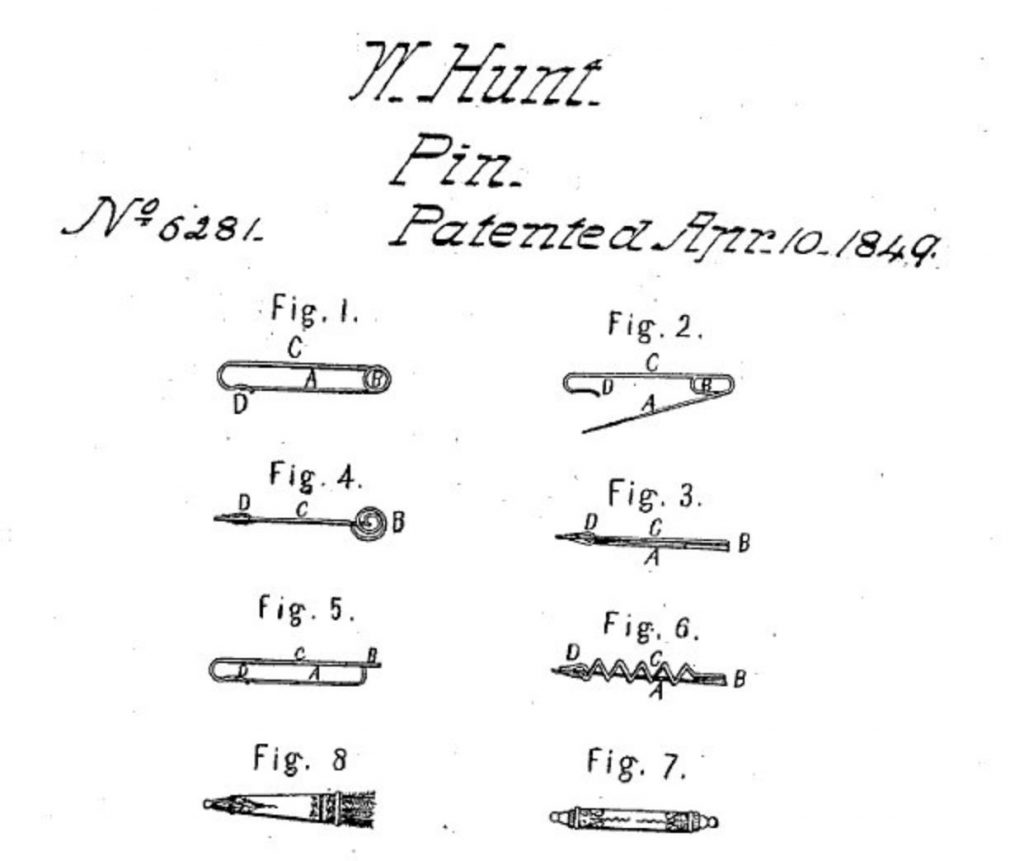
Safety Pins

Image: U.S. Patent Office, public domain via Wikimedia

This kind of thing was second nature to him; he had a gift for seeing and solving problems in a practical way. By 1849 he’d already built a legacy of (mostly) useful items which he had (mostly) patented and had a growing reputation as an inventor. Though not necessarily an innovator – as in someone who can create value from their ideas. Hunt seems to have had a second ‘gift’; in addition to being a visionary inventor he seems to have been cursed with the inability to profit from his inventions.

The man who was labelled a ‘Yankee mechanical genius’ was born in 1796 in Lewis County, New York to a Quaker family. The eldest of thirteen children he was lucky to receive an education and went on to earn a master’s degree in masonry at the age of twenty-one. Although a practical skill much needed in a rural farming community masonry also involves a way of thinking which is much more than simply piling stones on top of each other. Arguably his understanding of interdependence and systems derived in part from this early experience – and enabled him to approach widely differing problems with a sense of their underlying similarities.

Yet if you look back at his track record of inventions he rapidly emerges as a serious contender for being the greatest inventor you’ve never heard of.

For example:

The repeater rifle, in 1848 – up there as a symbol of ‘how the West was won’ in a thousand cowboy movies and the undoubted making of the Winchester Repeating Arms Company with their Winchester rifle. Hunt not only developed the original idea for a ‘volition repeating rifle’ but also the ammunition it might use (his ‘rocket ball’) which was revolutionary in putting the powder charge in the bullet’s base. His designs weren’t very workable and he sold the patents; these changed hands a number of times in the growing armaments industry before being bought by Messrs Smith and Wesson who used them as the basis for a new company. The biggest investor in the new Volcanic Repeating Arms Company was one Oliver Winchester….

Think fountain pens and writing implements and the transition from goose quills to refillable devices and you may well think of the companies which made their name with the innovation. But whilst companies like Parker Pen created the market the foundations were laid by, amongst others, Walter Hunt who predated their work by decades. In 1847, he patented a fountain pen (U.S. Patent 4,927) combining inkstand and pen into one unit, “convenient for the pocket.”

Knife sharpening ? Nail making? Rope making? Castors to help move furniture around? Disposable paper collars? A coal burning stive which would radiate heat in all directions? A saw for cutting down trees? A flexible spring attachment for belts and braces? An attachment for boats to cut through ice? An inkstand? A non-explosive safety lamp? Bottle stoppers? Hunt turned his hand and imagination to hundreds of challenges across an almost impossibly wide spectrum. Leonardo da Vinci would have been proud of him, not least in his ability to draw together ideas and inspirations from many different fields.

His first patented invention was for an improved flax spinning machine in 1826. He worked as a farmer in a region dominated by textile milling and most of his family and friends were in the business of spinning wool and cotton. Faced with rising costs and falling product prices the local mill owner, Willis Hoskins, wanted to reduce wages; Hunt persuaded him to hold off and offered instead to develop a more efficient flax spinning machine. He patented this on June 22, 1826 and its contribution to improving productivity saved the jobs.

His motivation was often underpinned by a social concern. Another early invention (1827) was for a coach alarm system. Visiting New York to try and raise funds for developing the falx spinning machine further he witnessed an accident where a horse-drawn carriage ran over a child. The driver, his hands fully occupied with the reins of the team, had been unable to sound a warning horn in time. Hunt was shaken by this and the fact that this was not a rare occurrence; he began thinking of ways to help prevent these accidents. He came up with the idea of a metal gong with a hammer that could be operated by foot; his “Coach Alarm” was patented on July 30, 1827. Facing an uphill struggle he sold the rights to the stagecoach operators Kipp and Brown; the invention became a standard feature on streetcars across the United States, saving countless lives.

Late in life, Hunt addressed the laundry problem. In 1854 a crisp white collar was a mark of status, but keeping linen white required constant starching and ironing. Hunt invented the ‘paper shirt collar’ (U.S. Patent 11,376) which offered the advantage of looking like linen but being disposable after use.

Some of his ideas were, shall we say, a little fanciful though the prototypes proved their point. Inspired by the way flies negotiated ceilings his ‘antipodean apparatus’ was designed to help circus performers (and anyone else mad enough) to walk upside down. Although this one wasn’t patented it was still in use by performers a hundred years later!
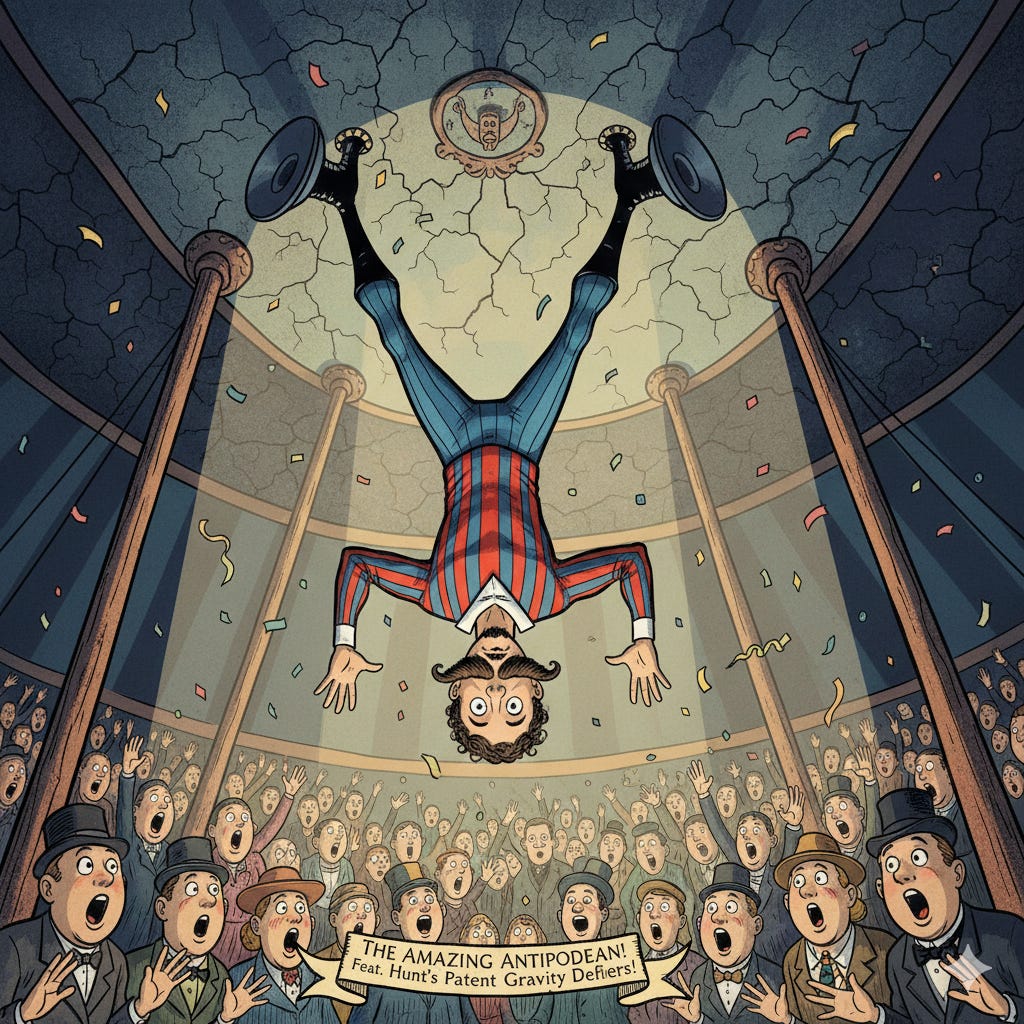
antipodean apparatus

Altogether he was responsible for hundreds of patents and about two dozen of Hunt’s inventions are still used in the form in which he created them over one hundred years ago.

Including, of course, the really big one that got away – the sewing machine. The mid 19th century saw a flurry of inventive activity around trying to enable it, eventually converging on a dominant design which combined different elements for feeding, sewing with a lockstitch, holding the fabric, powering the feed, etc. Isaac Singer walked away with the prize in 1851 after a long and bitter battle with Elias Howe whose patent he liberally borrowed from and which predated his machine by several years.

What’s not always mentioned is that Howe’s idea wasn’t original; he’d based his 1846 machine on something he’d seen more than a decade before. In fact this ‘prior art’ was what Singer tried to use in his defence only to have the judge throw it out because the original idea, though clearly the core design for a working sewing machine, had never actually been patented.

The man who’d let this incredible opportunity slip through his fingers? Our very own Walter Hunt.
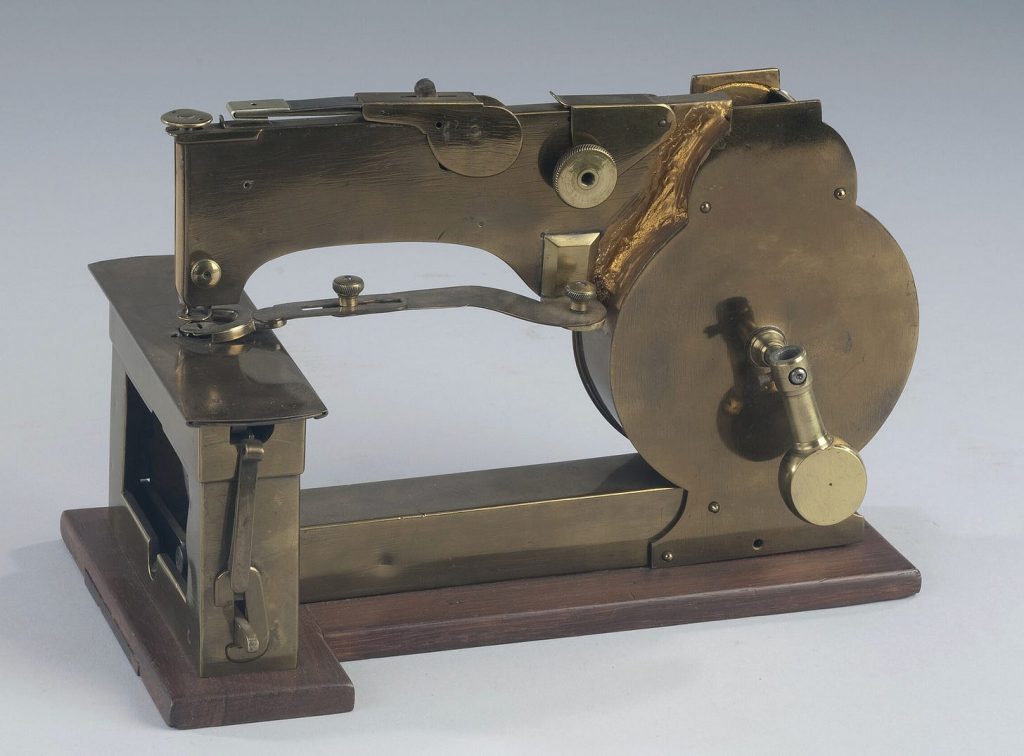
Sewing Machine

Image: National Museum of American History, public domain

In 1830, Barthelemy Thimonnier in France had patented a machine that used a hooked needle to make a chain stitch, but it was slow and fragile. Hunt’s experiments in the early 1830s led him to a new approach; he realized that a machine didn’t need to mimic a manual seamstress and in particular it didn’t need to pass the needle all the way through. Instead he designed a curved needle with the eye at the point; the needle would pierce the cloth, carrying a loop of thread with it and then a shuttle would pass a second thread through the loop formed by the needle. When the needle retracted, the two threads would lock together – lockstitch.

He kept it in the family, employing one of his many brothers, Adoniram, to improve on his wooden prototype by making a machine out of iron. It worked well, sewing straight seams with a durability and uniformity that manual sewing could not touch. By 1834 – twelve years before Elias Howe – Hunt had a working machine that could have made him one of the richest men in the world. But he held back from patenting it.

Not for want of experience or vision; he’d seen the possibilities which is why he’d been working on the idea. But his vision was partly shaped by his strong-willed and socially conscious daughter who saw it not as a labour-saving device but as a labour killer, threatening the livelihoods of women who worked as seamstresses to establish themselves and find a measure of financial independence. She persuaded Hunt to hold back from registering his patent though he had the working design ready a full twenty years before Singer’s successful entry.

Instead he allowed his invention to ‘slumber’, existing but not being patented or commercialised. He sold the rights to the prototype to George Arrowsmith, but Arrowsmith, the lack of a patent, also failed to commercialize it.

In the infamous ‘Sewing Machine Wars’ of the early 1850s the two big antagonists were Howe and Singer; as part of his campaign Singer discovered Hunt’s ideas and pressed him to search for any evidence of the earlier machine which might help invalidate Howe’s lockstitch-based patent. Eventually they found the rusty remnants of the 1834 machine and Hunt rebuilt it to working status, enabling Singer to argue that Howe was not the first inventor.

In 1854, Patent Commissioner Charles Mason issued a ruling that became a cornerstone of patent law; he acknowledged that Hunt had indeed invented the machine first. However, he ruled against Hunt based on the doctrine of laches (abandonment), writing that “…. When the first inventor allows his discovery to slumber for eighteen years, with no probability of its ever being brought into useful activity, and when its only resurrected to supplant and strangle an invention which has been given to the public… all reasonable presumption should be in favour of the inventor who has been the means of conferring the real benefit upon the world”.

The ruling forced Singer and other sewing machine manufacturers to settle their differences and operate a patent pool with each paying relevant royalties to the others for use of particular intellectual property. Hunt received a small payment from Singer for his testimony, but he missed out on the royalties that built the fortunes which came to Singer and Howe.

He was granted a patent for another improvement to the sewing machine dealing with feeding of material into the machine without jamming it. Singer eventually agreed in 1858 to pay Hunt $50,000 for this design – but Hunt didn’t live long enough to collect his due.

He died on June 8, 1859 of pneumonia in his workshop in New York City. His grave in Green-Wood Cemetery is marked by a modest granite shaft, a stark contrast to the massive monuments of other ‘Gilded Age’ entrepreneurs.

Although Hunt died without a fortune to his name he was no fool. His name might be missing from the pantheon of great inventors who changed the world through steel and steam – creating the products and the markets which defined a new industrial age. Yet anyone who could twist a piece of wire into a global success in three hours in order to settle a debt deserves a closer look.

His life reveals a complex man of high principles – a ‘benevolent Quaker’ – and possessed of an internal motivation owing much more to a fascination with solving problems and puzzles than the inspiration of a possible fortune. Someone who found joy in the quest rather than the goal, the ultimate ideas man.

An obituary published in the New York Tribune on June 13th, 1859 captured a little of this restless spirit. “For more than forty years, he has been known as an experiment in the arts. Whether in mechanical movements, chemistry, electricity or metallic compositions, he was always at home: and, probably in all, he has tried more experiments than any other inventor.”

Sometimes the quest is more exciting than the destination, sometimes the act of creating something new is its own reward.


You can find my podcast here and my videos here

And if you’d like to learn with me take a look at my online courses here

And subscribe to my (free) newsletter here

All images generated by Google Nanobanana or Substack AI unless otherwise indicated

Subscribe to Human-Centered Change & Innovation WeeklySign up here to join 17,000+ leaders getting Human-Centered Change & Innovation Weekly delivered to their inbox every week.


We Change the World with Ecosystems Not Inventions

We Change the World with Ecosystems Not Inventions

GUEST POST from Greg Satell

Imagine yourself as the CEO of a Dow component company in 1919. You are fully aware of the technological forces that would shape much of the 20th century, electricity and internal combustion. You may have even be an early adopter of these technologies. Still, everything seems like business as usual.

What you don’t see, however, is that these inventions are merely the start. Secondary technologies, such as home appliances, radio, highways and shopping malls, would reshape the economy in ways that no one could have predicted. Your company has a roughly 50% chance of remaining on the Dow a decade later.

We are at a similar point today. New inventions, such as quantum computing, neuromorphic chips, synthetic biology and advancements in materials science already exist. It is not those inventions, however, but the ecosystems they spawn that will shape the decades to come. We’re all going to have to learn how to compete in a new era of innovation.

A 50-Year Boom In Productivity

By 1919, electricity was already a 40-year old technology. In 1882, just three years after he had almost literally shocked the world with his revolutionary electric light bulb, Thomas Edison opened his Pearl Street Station, the first commercial electrical distribution plant in the United States. By 1884 it was already servicing over 500 homes.

Yet although electricity and electric lighting were already widespread in 1919, they didn’t have a measurable effect on productivity and a paper by the economist Paul David helps explain why. It took time for manufacturers to adapt their factories to electricity and learn to design workflow to leverage the flexibility that the new technology offered. It was the improved workflow, more than the technology itself, that drove productivity forward.

Automobiles saw a similar evolution. It took time for infrastructure, such as roads and gas stations, to be built. Improved logistics reshaped supply chains and factories moved from cities in the north — close to customers — to small towns in the south, where labor and land were cheaper. That improved the economics of manufacturing further.

Yet all of that was just prelude to the massive changes that would come. Electricity spawned secondary innovations, such as household appliances and radios. Improved logistics reshaped the retail industry, shifting it from corner stores to supermarkets and shopping malls. As Robert Gordon explains in The Rise and Fall of American Growth, these changes resulted in a 50-year boom in productivity between 1920 and 1970.

The Digital Revolution

In 1984, Steve Jobs and Apple launched the Macintosh, which heralded a new era of computing. Based on technology developed for the Xerox Alto in the early 1970s, with a bitmapped screen, a graphical user interface and a mouse, it made computing far more accessible to regular consumers.

Before long, personal computers were everywhere. Kids would use them to write term papers and play video games. Lotus 1-2-3 spreadsheet software became a staple for small businesses and entrepreneurs. Desktop publishing helped democratize the flow of information. The computer age had begun in earnest.

Yet much like electricity and internal combustion earlier in the century, the effect on productivity was negligible, causing the Nobel Prize winning economist Robert Solow to quip, “You can see the computer age everywhere but in the productivity statistics.” In fact, it wouldn’t be till the late 90s that we saw a measurable impact from computers.

Once again, it wasn’t any particular invention that made the difference, but an ecosystem that built up over years. The Internet paved the way for open-source software. Hordes of application developers created industry specific tools to automate almost every imaginable business process. Computers converged with phones to create the mobile era.

The 30 Years Rule

Look back at the two major eras of technology in the 20th century and a consistent theme begins to emerge. An initial discovery of a new phenomenon, such as electricity and internal combustion, is eventually used to create a new invention, like the light bulb or the automobile. This creates some excitement, and builds the fortunes of a few entrepreneurs, but has little impact on society as a whole.

Yet slowly, an ecosystem begins to emerge. Roads and gas stations are built. Household appliances and personal computers are invented. Secondary inventions, such as shopping malls, home appliances, the Internet and application software help create new business models. Those business models create new value and drive productivity.

The truth is that innovation is never a single event, but a process of discovery, engineering and transformation. As a general rule of thumb, it takes about 30 years for all of this to take place, because thousands, if not millions of people need to change their behavior, coordinate their activity and start new businesses.

That’s why the future will always surprise us. It is not any one great event that tips the scales, but some hardly noticeable connection that completes the network. Network scientists call this type of thing an ‘instantaneous phase transition’ and there’s really no way to predict exactly when it will happen, but if you learn to look for telltale signs, you can see one coming.

A New Era Of Innovation

Today, we appear to be in a very similar situation to what those executives faced in 1919. We have decoded the human genome. Artificial intelligence has become a reality that everyone, for the most part, accepts. New computing architectures, such as quantum computers and neuromorphic chips, are in late stages of development by a variety of companies.

Yet once again, the impact has been negligible and it’s not hard to see why. While these inventions, in some cases at least, are relatively mature, they have yet to create the ecosystems that can drive a true transformation. Today, however, we can clearly see those ecosystems being created.

In fact, in artificial intelligence we can already see a fairly well developed ecosystem emerging already. In synthetic biology and genomics we can begin to see one as well, although it is still nascent. IBM has created a Q Network of major companies, research labs and startups to support quantum computing.

Here’s what’s important to know: We can’t predict exactly when the system will tip, but it’s a good bet it will happen in the next decade. It is also likely that the impact will be equal to or greater than the 50 year boom that began in the 1920s. Finally, it won’t be driven by any particular invention, but by ecosystems. You need to start figuring out how you will connect.

— Article courtesy of the Digital Tonto blog and an earlier version appeared on Inc.com
— Image credit: Pixabay

Subscribe to Human-Centered Change & Innovation WeeklySign up here to join 17,000+ leaders getting Human-Centered Change & Innovation Weekly delivered to their inbox every week.







What Pundits Always Get Wrong About the Future

What Pundits Always Get Wrong About the Future

GUEST POST from Greg Satell

Peter Thiel likes to point out that we wanted flying cars, but got 140 characters instead. He’s only partly right. For decades futuristic visions showed everyday families zipping around in flying cars and it’s true that even today we’re still stuck on the ground. Yet that’s not because we’re unable to build one. In fact the first was invented in 1934.

The problem is not so much with engineering, but economics, safety and convenience. We could build a flying car if we wanted to, but to make one that can compete with regular cars is another matter entirely. Besides, in many ways, 140 characters are better than a flying car. Cars only let us travel around town, the Internet helps us span the globe.

That has created far more value than a flying car ever could. We often fail to predict the future accurately because we don’t account for our capacity to surprise ourselves, to see new possibilities and take new directions. We interact with each other, collaborate and change our priorities. The future that we predict is never as exciting as the one we eventually create.

1. The Future Will Not Look Like The Past

We tend to predict the future by extrapolating from the present. So if we invent a car and then an airplane, it only seems natural that we can combine the two. If family has a car, then having one that flies can seem like a logical next step. We don’t look at a car and dream up, say, a computer. So in 1934, we dreamed of flying cars, but not computers.

It’s not just optimists that fall prey to this fundamental error, but pessimists too. In Homo Deus, author and historian Yuval Noah Harari points to several studies that show that human jobs are being replaced by machines. He then paints a dystopian picture. “Humans might become militarily and economically useless,” he writes. Yeesh!

Yet the picture is not as dark as it may seem. Consider the retail apocalypse. Over the past few years, we’ve seen an unprecedented number of retail store closings. Those jobs are gone and they’re not coming back. You can imagine thousands of retail employees sitting at home, wondering how to pay their bills, just as Harari predicts.

Yet economist Michael Mandel argues that the data tell a very different story. First, he shows that the jobs gained from e-commerce far outstrip those lost from traditional retail. Second, he points out that the total e-commerce sector, including lower-wage fulfillment centers, has an average wage of $21.13 per hour, which is 27 percent higher than the $16.65 that the average worker in traditional retail earns.

So not only are more people working, they are taking home more money too. Not only is the retail apocalypse not a tragedy, it’s somewhat of a blessing.

2. The Next Big Thing Always Starts Out Looking Like Nothing At All

Every technology eventually hits theoretical limits. Buy a computer today and you’ll find that the technical specifications are much like they were five years ago. When a new generation of iPhones comes out these days, reviewers tout the camera rather than the processor speed. The truth is that Moore’s law is effectively over.

That seems tragic, because our ability to exponentially increase the number of transistors that we can squeeze onto a silicon wafer has driven technological advancement over the past few decades. Every 18 months or so, a new generation of chips has come out and opened up new possibilities that entrepreneurs have turned into exciting new businesses.

What will we do now?

Yet there’s no real need to worry. There is no 11th commandment that says, “Thou shalt compute with ones and zeros” and the end of Moore’s law will give way to newer, more powerful technologies, like quantum and neuromorphic computing. These are still in their nascent stage and may not have an impact for at least five to ten years, but will likely power the future for decades to come.

The truth is that the next big thing always starts out looking like nothing at all. Einstein never thought that his work would have a practical impact during his lifetime. When Alexander Fleming first discovered penicillin, nobody noticed. In much the same way, the future is not digital. So what? It will be even better!

3. It’s Ecosystems, Not Inventions, That Drive The Future

When the first automobiles came to market, they were called “horseless carriages” because that’s what everyone knew and was familiar with. So it seemed logical that people would use them much like they used horses, to take the occasional trip into town and to work in the fields. Yet it didn’t turn out that way, because driving a car is nothing like riding a horse.

So first people started taking “Sunday drives” to relax and see family and friends, something that would be too tiring to do regularly on a horse. Gas stations and paved roads changed how products were distributed and factories moved from cities in the north, close to customers, to small towns in the south, where land and labor were cheaper.

As the ability to travel increased, people started moving out of cities and into suburbs. When consumers could easily load a week’s worth of groceries into their cars, corner stores gave way to supermarkets and, eventually, shopping malls. The automobile changed a lot more than simply how we got from place to place. It changed our way of life in ways that were impossible to predict.

Look at other significant technologies, such as electricity and computers, and you find a similar story. It’s ecosystems, rather than inventions, that drive the future.

4. We Can Only Validate Patterns Going Forward

G. H. Hardy once wrote that, “a mathematician, like a painter or poet, is a maker of patterns. If his patterns are more permanent than theirs, it is because they are made with ideas.” Futurists often work the same way, identifying patterns in the past and present, then extrapolating them into the future. Yet there is a substantive difference between patterns that we consider to be preordained and those that are to be discovered.

Think about Steve Jobs and Apple for a minute and you will probably recognize the pattern and assume I misspelled the name of his iconic company by forgetting to include the “e” at the end. But I could have just have easily been about to describe an “Applet” he designed for the iPhone or some connection between Jobs and Appleton WI, a small town outside Green Bay.

The point is that we can only validate patterns going forward, never backward. That, in essence, is what Steve Blank means when he says that business plans rarely survive first contact with customers and why his ideas about lean startups are changing the world. We need to be careful about the patterns we think we see. Some are meaningful. Others are not.

The problem with patterns is that future is something we create, not some preordained plan that we are beholden to. The things we create often become inflection points and change our course. That may frustrate the futurists, but it’s what makes life exciting for the rest of us.

— Article courtesy of the Digital Tonto blog and previously appeared on Inc.com
— Image credit: Pixabay

Subscribe to Human-Centered Change & Innovation WeeklySign up here to join 17,000+ leaders getting Human-Centered Change & Innovation Weekly delivered to their inbox every week.



The Eureka Moment Fallacy

The Eureka Moment Fallacy

GUEST POST from Greg Satell

In 1928, Alexander Fleming arrived at his lab to find that a mysterious mold had contaminated his Petri dishes and was eradicating the bacteria colonies he was trying to grow. Intrigued, he decided to study the mold. That’s how Fleming came to be known as the discoverer of penicillin.

Fleming’s story is one that is told and retold because it reinforces so much about what we love about innovation. A brilliant mind meets a pivotal moment of epiphany and — Eureka! — the world is forever changed. Unfortunately, that’s not really how things work. It wasn’t true in Fleming’s case and it won’t work for you.

The truth is that innovation is never a single event, but a process of discovery, engineering and transformation, which is why penicillin didn’t become commercially available until 1945 (and the drug was actually a different strain of the mold than Fleming had discovered). We need to stop searching for Eureka moments and get busy with the real work of innovating.

Learning To Recognize And Define Problems

Before Fleming, there was Ignaz Semmelweis and to understand Fleming’s story it helps to understand that of his predecessor. Much like Fleming, Semmelweis was a bright young man of science who had a moment of epiphany. In Semmelweis’s case, he was one of the first to realize that infections could spread from doctor to patient.

That simple insight led him to institute a strict regime of hand washing at Vienna General Hospital. Almost immediately, the incidence of deadly childbed fever dropped precipitously. Yet his ideas were not accepted at the time and Semmelweis didn’t do himself any favors by refusing to format his data properly or to work collaboratively to build support for his ideas. Instead, he angrily railed against the medical establishment he saw as undermining his work.

Semmelweis would die in an insane asylum, ironically from an infection he contracted under care, and never got to see the germ theory of disease emerge from the work of people like Louis Pasteur and Robert Koch. That’s what led to the study of bacteriology, sepsis and Alexander Fleming growing those cultures that were contaminated by the mysterious mold.

When Fleming walked into his lab on that morning in 1928, he was bringing a wealth of experiences to the problem. During World War I, he had witnessed many soldiers die from sepsis and how applying antiseptic agents to the wound often made the problem worse. Later, he found that nasal secretions inhibited bacterial growth.

So when the chance discovery of penicillin happened, it was far from a single moment, but rather a “happy accident” that he had spent years preparing for.

Combining Domains

Today, we remember Fleming’s discovery of penicillin as a historic breakthrough, but it wasn’t considered to be so at the time. In fact, when it was first published in the British Journal of Experimental Pathology, nobody really noticed. The truth is that what Fleming discovered couldn’t have cured anybody. It was just a mold secretion that killed bacteria in a Petri dish.

Perhaps even more importantly, Fleming was ill-equipped to transform penicillin into something useful. He was a pathologist that largely worked alone. To transform his discovery into an actual cure, he would need chemists and other scientists, as well as experts in fermentation, manufacturing, logistics and many other things. To go from milliliters in the lab to metric tons in the real world is no trivial thing.

So Fleming’s paper lay buried in a scientific journal for ten years before it was rediscovered by a team led by Howard Florey and Ernst Chain at the University of Oxford. Chain, a world-class biochemist, was able to stabilize the penicillin compound and another member of the team, Norman Heatley, developed a fermentation process to produce it in greater quantities.

Because Florey and Chain led a larger team in a bigger lab they were also had the staff and equipment to perform experiments on mice, which showed that penicillin was effective in treating infections. However, when they tried to cure a human, they found that they were not able to produce enough of the drug. They simply didn’t have the capacity.

Driving A Transformation

By the time Florey and Chain had established the potential of penicillin it was already 1941 and England was at war, which made it difficult to find funding to scale up their work. Luckily, Florey had done a Rhodes Scholarship in the United States and was able to secure a grant to travel to America and continue the development of penicillin with US-based labs.

That collaboration produced two more important breakthroughs. First, they were able to identify a more powerful strain of the penicillin mold. Second, they developed a fermentation process utilizing corn steep liquor as a medium. Corn steep liquor was common in the American Midwest, but virtually unheard of back in England.

Still, they needed to figure out a way to scale up production and that was far beyond the abilities of research scientists. However, the Office of Scientific Research and Development (OSRD), a government agency in charge of wartime research, understood the potential of penicillin for the war effort and initiated an aggressive program, involving two dozen pharmaceutical companies, to overcome the challenges.

Working feverishly, they were able to produce enough penicillin to deploy the drug for D-Day in 1944 and saved untold thousands of lives. After the war was over, in 1945, penicillin was made commercially available, which touched off a “golden age” of antibiotic research and new drugs were discovered almost every year between 1950 and 1970.

Innovation Is Never A Single Event

The story of Fleming’s Eureka! moment is romantic and inspiring, but also incredibly misleading. It wasn’t one person and one moment that changed the world, but the work of many over decades that made an impact. As I explain in my book, Cascades, it is small groups, loosely connected, but united by a shared purpose that drive transformational change.

In fact, the development of penicillin involved not one, but a series of epiphanies. First, Fleming discovered penicillin. Then, Florey and Chain rediscovered Fleming’s work. Chain stabilized the compound, Heatley developed the fermentation process, other scientists identified the more powerful strain and corn steep liquor as a fermentation medium. Surely, there were many other breakthroughs involving production, logistics and treatment that are lost to history.

This is not the exception, but the rule. The truth is that the next big thing always starts out looking like nothing at all. For example, Jim Allison, who recently won the Nobel Prize for his development of cancer immunotherapy, had his idea rejected by pharmaceutical companies, much like the medical establishment dismissed Semmelweis back in the 1850s.

Yet Allison kept at it. He continued to pound the pavement, connect and collaborate with others and that’s why today he his hailed as a pioneer and a hero. That’s why we need to focus less on inventions and more on ecosystems. It’s never a single moment of Eureka! that truly changes the world, but many of them.

— Article courtesy of the Digital Tonto blog
— Image credit: Pexels

Subscribe to Human-Centered Change & Innovation WeeklySign up here to join 17,000+ leaders getting Human-Centered Change & Innovation Weekly delivered to their inbox every week.



How marketable is your invention?

How marketable is your invention?

GUEST POST from Arlen Meyers, M.D.

Marketability may apply to things i.e. goods or services or people. When it applies to people, we are talking about making them attractive to potential employers or clients. People may study for a degree to improve their marketability. This means that they believe that getting a degree improves their chances of getting either a job or a better job.

Are you looking for a non-clinical career job? Here is how to make yourself more marketable by building your personal brand.

When it applies to things, we are talking about their ability to be marketed or sold. If you are selling your house, you might improve its marketability if you convert the loft into a living area. In other words, converting the loft will make it easier to sell the house.

If you have invented a new medical device, how likely are the multiple stakeholders likely to buy, use or prescribe it? Will they choose it, use it or just lose interest in it? Is your product just another brown cow or is it a purple cow?  Is your new product sufficiently better than the standard of care for doctors to go to bat with administration to change vendors?

SmallBusiness.Chron.com has the following definition of the term:

“Marketability is a measure of whether a product will appeal to buyers and sell at a certain price range to generate a profit.”

The business model canvas is a way to validate your hypotheses about the desirability, feasibility, viability and adaptability of your idea.

But, how marketable is your product and how do you determine marketability in advance? Of course, there are no guarantees the dog will eat the food, but here are some things to consider:

  1. Early on, startups must identify the market type in which they plan to operate. In The Four Steps to the Epiphany, Steven G. Blank describes four different types of market:
  • Existing market
  • New market
  • Re-segmentation of an existing market as a low-cost player
  • Re-segmentation of existing market by employing a niche strategy

Winning in some markets is harder than others. For example, entering a “never been done before at scale”, like electric cars, is expensive and takes lot of convincing the early majority to buy it. On the other hand, the upside potential is enormous.

2. In markets where there are lots of stakeholders, personas and members of the buying group, like sickcare, you have to satisfy the jobs, pains and gains or each with a somewhat different value proposition for each one.

3. A “marketability evaluation” is what all inventors should have completed prior to attempting to market their invention. A marketability evaluation basically considers whether the invention is “marketable” within the current and future market. This is extremely important to you since a manufacturer will not license your patent rights for an invention that may be “really neat” but is not competitive with the other products currently on the market.

Here is a quick 20 Factor Invention Evaluation Form that you can complete yourself or have a friend complete. Remember, this form is only effective if you or your friend are honest with the scoring.

4. While you may have determined that your invention has a high marketability, the results are in the execution of your go to market strategy by your sales and marketing team.

5. Marketability exists in a particular moment in time and can easily change by competitive entries, and other threats.

6. The VUCA (volatile, uncertain, complex, ambiguous) world demands that you constantly test your ideas and explore and exploit new business models and products and their marketability.

7. Complacency erodes marketability.

8. Markets constantly change. The modern marketplace is unlike anything seen before in human history. For example, eCommerce allows anyone to order practically anything from anywhere in the world with virtual currency, often with the help of a virtual assistant that personalizes its recommendations so that each person’s buying journey is unique. In this new age, previously reigning marketing paradigms like the 4Ps of marketing are also undergoing a transformation. Welcome to the age of the 4Es instead.

The “4Es” of Marketing are “Experience”, “Everyplace”, “Exchange” and “Evangelism”. Anyone familiar with Marketing theory will recognize that the 4Es draw their basic wisdom from the famous “4P” mnemonic in modern marketing theory.

9. Many startup founders have low marketing IQs

10. Different business models require different marketing strategies and tactics, e.g. direct to patient marketing v B2B v B2B2C

11. Dissemination and implementation among healthcare professionals is a complicated and often unpredictable process. It often takes many years.

12. Successful social media marketing involves finding the right influencers and “sneezers” to help your idea go viral.

If you are a physician entrepreneur looking for investors, or an academic entrepreneur trying to commercialize your idea with your technology transfer office, then the first three questions you will have to answer are:

  1. What is your intellectual property and other barriers to entry?
  2. What is the technical and commercial feasibility of your product?
  3. What is the marketability of your product?

If you fail to convincingly answer these questions, it is likely that you will not pass GO and collect $200. But, given the dismal track record of investor’s and inventor’s new product success and portfolio returns, the exercise might all be marketability theater and just a Wild Ass Guess, that, ultimately, will be tested in the marketplace.

Image credit: Pixabay

Subscribe to Human-Centered Change & Innovation WeeklySign up here to get Human-Centered Change & Innovation Weekly delivered to your inbox every week.


Healthcare Jugaad Innovation of a 17-Year-Old

Healthcare Jugaad Innovation of a 17-Year-Old

Jugaad Innovation is an innovation subspecialty focused on designing inventions that are intentionally frugal and flexible in order to be more accessible to the entire world. As a result, a lot of jugaad innovation occurs in the developing world. Some of these inventions become innovations and spread from the developing world to the developed world.

I came across a story recently highlighting the potential healthcare jugaad innovation of 17-year-old Dasia Taylor of Iowa, who found that beets provide the perfect dye for her invention of sutures that change color when a surgical wound becomes infected (from bright red to dark purple).

According to Smithsonian magazine:

The 17-year-old student at Iowa City West High School in Iowa City, Iowa, began working on the project in October 2019, after her chemistry teacher shared information about state-wide science fairs with the class. As she developed her sutures, she nabbed awards at several regional science fairs, before advancing to the national stage. This January, Taylor was named one of 40 finalists in the Regeneron Science Talent Search, the country’s oldest and most prestigious science and math competition for high school seniors.

There is still commercialization work to do (more testing, clinical trials, etc.), but the approach shows promise and is far cheaper than high-tech sutures that require a smartphone to sense changes in electrical resistance as an indicator of infection.

Congratulations Dasia!

The great thing about this jugaad innovation approach is that not only could it be a practical solution for developing countries, but national health services and insurance companies are always looking for effective but inexpensive solutions as well.

Good luck with the rest of your research, and keep innovating!


Accelerate your change and transformation success

Subscribe to Human-Centered Change & Innovation WeeklySign up here to get Human-Centered Change & Innovation Weekly delivered to your inbox every week.


Rise of the Green Goblin?

Rise of the Green Goblin?

For those of you out there who are comic book aficionados, you might be familiar with a super villain from the Spiderman series called the Green Goblin. One of the trademarks of the Green Goblin in addition to hand grenades that he liked to throw at people was a personal flying machine that he stood on and zoomed around the city.

Recently I came across a flying machine designed by a man from a France that very much realizes the promise of the flying machine utilized by the Green Goblin in the comic strip. The Frenchman has been hard at work on this flying machine for at least a couple of years. His name is Franky Zapata and he is a jet ski racer turned inventor.

He first started experimenting with a board that used water under pressure to elevate itself above the surface of the water (kind of building on the concept of the Jet Ski) and then decided to swap out the water being forced downwards for air forced being forced downwards with four jet turbines. He debuted an early prototype on France’s Got Talent a couple of years ago, which you can see here:

This tethered prototype quickly gave way to an untethered prototype you can see here:

He has since evolved his prototypes to make them easier to ride, with more redundancy, and thus potentially more consumer friendly, which you can see here:

And finally you can see Franky Zapata talking about the Flyboard Air here:

Lots of legal and regulatory hurdles before it is ready for prime time, but it sure looks like fun!

So what do you think, innovation or not?


Accelerate your change and transformation success

Subscribe to Human-Centered Change & Innovation WeeklySign up here to get Human-Centered Change & Innovation Weekly delivered to your inbox every week.


Innovation vs. Invention vs. Creativity

Innovation vs. Invention vs. Creativity

by Braden Kelley

There is so much talk about innovation these days, it’s hard to sometimes distinguish the signal from the noise.

In fact, the word innovation gets thrown around so much that it leaves people wondering:

What’s really innovative?

Well, most of the time that people talk about something being innovative, what they describe isn’t innovative, but instead inventive or creative. These three are all very different. Here is how I like to distinguish the differences between creativity, invention and innovation:

  1. Creativity – creates something interesting
  2. Invention – creates something useful
  3. Innovation – creates something so valuable that it is widely adopted, replacing the existing solution in a majority of appropriate use cases

Very few creative sparks result in an invention and very few inventions become innovations.

And the painful truth is that many great inventions take 20-30 years to be realized. Timing your investment is the key to whether you waste a big wad of cash, or still have it to spend when the optimal time to invest in a potential innovation comes.

If you look at most technology-based innovations, whether it’s the mp3 or the VCR, they were invented 20-30 years before they reached wide adoption in the marketplace, and for Gorilla Glass we’re talking more like 50 years.

To further emphasize the importance of timing…

Look at Webvan vs. Amazon Fresh

Look at Pets.com vs. Chewy.com (acquired by Petsmart)

Now these aren’t innovations, but you get my point. You have to know where you are on the commercialization timeline…

And most importantly, sometimes you have to look BACKWARDS before you look forwards, so you know where on the commercialization timeline you are.

If you’re working on a potential innovation now, are you sure it’s a potential innovation?

Are you sure now is the time to go big?

Read more about Premature Innovation

You might also enjoy Are You Innovating for the Past or the Future?

Image credit: Pexels

Innovation Audit from Braden Kelley

Subscribe to Human-Centered Change & Innovation WeeklySign up here to get Human-Centered Change & Innovation Weekly delivered to your inbox every week.


Are Coca-Cola and Green Mountain Late to the Personalization Party?

Are Coca-Cola and Green Mountain Late to the Personalization Party?Recently I came across an announcement that Coca-Cola is partnering with Green Mountain Coffee Roasters to sell Coke products as part of Green Mountain’s new home beverage system slated for a release later this year. For those of you who aren’t familiar with Green Mountain, they make the popular Keurig in-home single-serving coffee machine (which became a popular home and office item after Nespresso’s patents expired). Now they want to expand their in-home beverage machine product line to include cold beverages. What is not clear in the press release is which of Coke’s products will be available with this new beverage system.

Will it only be beverages like Minute Maid juices, Powerade, Vitaminwater and non-carbonated beverages in their portfolio?

Or will it include the Coca-Cola crown jewels – Coke, Diet Coke, Sprite, etc.?

The only thing that is mentioned is that the system will not contain a carbon dioxide cylinder that needs to be changed periodically (something the Sodastream system requires).

So, what is driving Coca Cola to pursue this $1.25 Billion investment in Green Mountain Coffee Roasters in search of innovation?

Well, there are many different reasons why companies seek to innovate.

In Level 1 of the Global Innovation Certification we refer to this as Innovation Intent, and I am currently recording the fifth video module from two full days of live certification training materials for the Level 1 Innovation Certification eLearning, and this video module happens to be about innovation intent.

Some of the reasons that companies look to innovate can of course include:

  1. An ambitious leader
  2. A changing regulatory environment
  3. A changing competitive environment
  4. A desire for new growth opportunities
  5. Faltering company financials (burning platform)
  6. A need for competitive response
  7. Requests from customers
  8. Recognized new supplier capabilities
  9. Demands from shareholders
  10. Requests from passionate employees
  11. INSERT YOUR REASON HERE

Coca Cola FreestyleSo what is going on here for Coca-Cola?

Well, competitor Sodastream recently splashed out $4 million for a Super Bowl advertisement (during a game that our local Seattle Seahawks won) and has been growing steadily (while still small compared to Coca-Cola). But it does have a market cap of $780 Million and a growing fan base. But, at the same time, Coca-Cola is investing $1.25 Billion for 10% of Green Mountain Coffee Roasters. Why are they investing more than $1 Billion in this interesting, but still comparatively small segment of the beverage business?

Is this a smokescreen move, announcing a product that may never see the light of day, in order to dent the growth of an emerging competitor?

Is it a competitive response, a hedge, with a me-too product in case the home soda bottling movement continues to grow?

Is it just a logical doubling down for Coca-Cola in a belief that the beverage personalization trend has not exhausted itself yet, and building upon the success of the Coca-Cola Freestyle and the groundwork that Sodastream has done to seed the market for Coke?

Or has Green Mountain Coffee Roasters, with its massive distribution channels (in comparison to Sodastream), brought Coca-Cola something that truly represents an innovation in the beverage system market versus the Sodastream offering that might result in people switching and both gaining back market share for Coke in their core markets, while also potentially representing an opportunity for some of their less successful brands to gain traction in a space where they don’t have competition from Pepsi?

This of course would be the more interesting of the strategic undertones, and the one in which Pepsi, not Sodastream should be the most worried.

Because after all, in the minds of Coca-Cola executives, it is Pepsi that they are always most worried about, not someone like Sodastream, and anything that allows them to potentially steal market share from Pepsi, makes them very happy indeed.

What are the motivations behind this move and partnership, which direction will all of it go, and is there any real innovation happening here?

And what will Pepsi do?

I guess we will have to wait and see.

Meanwhile, ask yourself what your innovation intent is, and…

Keep innovating!


Build a common language of innovation on your team

Subscribe to Human-Centered Change & Innovation WeeklySign up here to get Human-Centered Change & Innovation Weekly delivered to your inbox every week.


Innovation Goes to the Dogs?

Innovation Going to the Dogs?

In case you missed it, a team from Scandinavia thinks that they’ve nearly cracked no, not the human-computer interface, but the dog-computer interface, so that some day soon we might in fact be able to understand man’s best friend.

What does the dog say?

Well, this question begs another question, do we really care? Or do we really want to hear it all of the time?

They’ve launched an IndieGoGo campaign and have already exceeded their campaign funding goal, so I guess they’ll be moving their research and product development on to the next stage.

So, what do you think, if they push the product to the finish line, will it be an invention or an innovation?


Build a common language of innovation on your team

Subscribe to Human-Centered Change & Innovation WeeklySign up here to get Human-Centered Change & Innovation Weekly delivered to your inbox every week.