 I was reading with interest some of Linkedin’s recent #HowIHire series and in doing so it was interesting to see how many people are still operating under the old, broken hiring paradigm when it comes to the labor market.
The best of the bunch that I read was Beth Comstock’s You’re Hired. Now What which has more to do with what she thinks people should do after she gives them a job rather than how she hires, which I thought was a good angle to take.
My day job was recently eliminated in a budget reallocation, so I’m out there in the market looking for my next new challenge. Throughout this process (and my consulting work over the years), I’ve observed a number of different challenges that companies face with hiring, and identified some opportunities for companies to increase their return on human capital:
Challenge #1:
Scanning resumes and online applications for keywords is a very bad way to find talent. It’s very good however at finding people who at least know how to spell the keywords.
Challenge #2:
The way most organizations handle human resources is very much a product of the industrial age. Hiring new employees is still a very bureaucratic affair, a far cry from reflecting an Internet Age approach, and farther still from what’s needed in the era of Social Business and Digital Transformation. Having an outdated, bureaucratic hiring approach prevents many organizations from growing (or changing) as fast as they may need to maximize revenue and profits.
Challenge #3:
Building on Challenge #2, the hiring process is incredibly slow. It can take weeks or months to finalize and post job descriptions. It can take weeks to source candidates. It can take weeks or months for a hiring manager to get around to interviewing anyone because they are too busy. This can result in the loss of the best candidates, can lead to the loss of current employees picking up the slack (leading to more job openings), and impacts the financial performance of the organization.
Challenge #4:
With the exception of professional sports franchises, companies are so risk averse that they would rather hire someone with a lot of experience doing something in a mediocre way than someone with limited experience but a higher upside (higher capacity and capability). Following this analogy, most companies would never have hired a high school kid like Lebron James.
Challenge #5:
Automated and recruiter-led screening systems are better at identifying people that fit the job description than they are at identifying people that will thrive in the company culture and be a productive team member. You can’t train people to be a good cultural fit, but you can train smart people to do just about anything.
Opportunity #1:
Every company whether it likes it or not, is a technology company. So, if you’re running a technology company, and ideally a social business, shouldn’t you want to hire people who know how to use technology (or at least how to build a Linkedin profile)? And if they have a Linkedin profile, why wouldn’t you use that instead of asking them to create another profile on your careers site?
Opportunity #2:
Things are changing at an increasing rate. Hire people who embrace change and like to learn, because you’re always going to be asking people to learn something new as the world continues to change around you.
Opportunity #3:
Looking around the landscape, it seems like we’ve created more ways to help people find the ideal new romantic partner than the ideal new employee. Are there things that the recruiting industry could learn for the romance industry?
Opportunity #4:
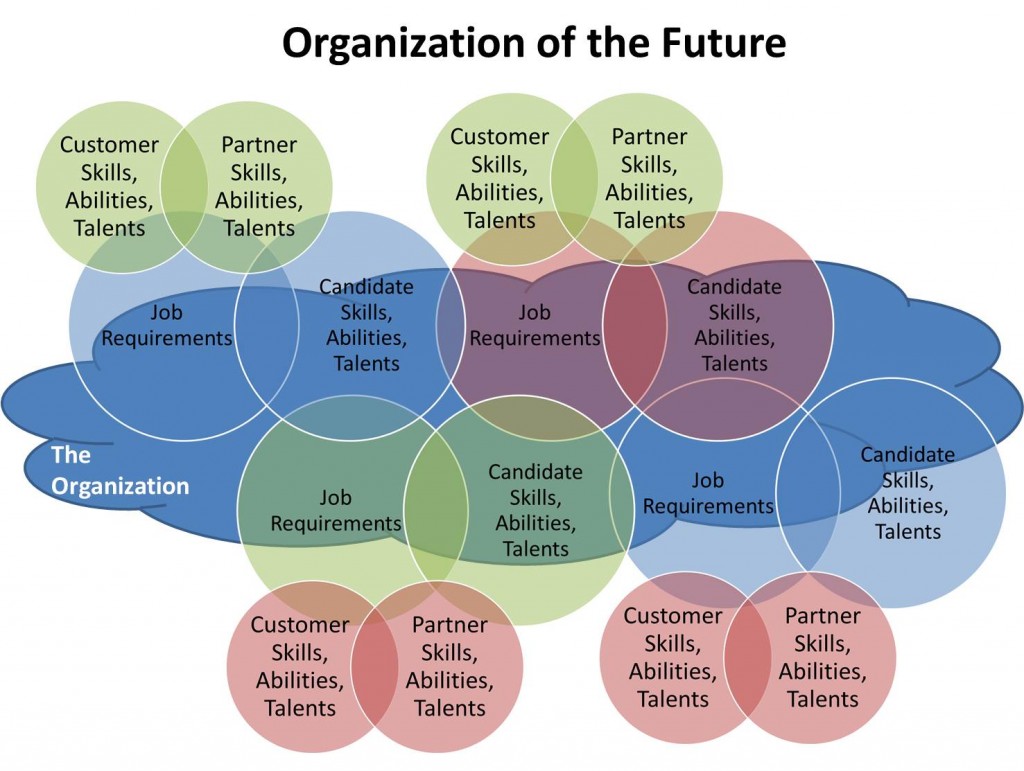
There is more to an employee than their intersection with the job description. In fact employees often have knowledge, skills and abilities that intersect with multiple job descriptions. Below you’ll find a visual depiction of this and of the increasingly less well-defined organizational boundaries:
Opportunity #5:
As the boundaries of the organization become less well-defined (see above) and as business makes increasing use of open innovation, partnerships, and co-opetition, hiring managers should consider not just matching the job description but also consider their ability to build and leverage external networks, and investigate the scope and quality of their existing networks.
Conclusion
Of course there are many more challenges and opportunities than I have space to list here, but I find these to be an interesting start to a conversation. What challenges or opportunities would you like to add to the conversation?
Image credit: businessnewsdaily.com

 Sign up here to get Human-Centered Change & Innovation Weekly delivered to your inbox every week.
 I’ve been thinking a lot lately about personal branding, in part because several people have told me that I seem to do it pretty well, in spite of the fact that I would never call myself a personal branding expert or endeavor to make my living as a personal branding consultant.
 The old way of winning the talent wars was to search for and hire the very best talent and keep them inside your own four walls by offering them competitive compensation, benefits, and perks. Your hope was that your talent is better than your competitors’ talent. But over the last couple of decades, companies have increasingly found that employees who pursue what they do with passion will outperform an employee with a gun to their head every time. Circuit City learned very publicly that people are not commodities and went out of business from treating them as if they were. At the same time, we know that diversity is very important and hard to foster internally. And so it is to get to this diversity of thought in order to accelerate product launch and innovation timelines that companies must open up – it is a global economy with a global talent pool.
 When looking for a new job, it seems like 95% of the time people will only hire you to do the job you just did, and the other 5% of the time will provide an equal mix of once in a lifetime opportunities and jobs you shouldn’t take.
 For example, a restaurant will hire a waiter who has been a waiter before, even if the only reason he is available is that he was a crap waiter every other place he worked. In our hiring system, someone who has experience almost always gets the job, regardless of ability and capacity for growth. Meanwhile the gal who dreams of being a waitress, whose passion for the profession would make her an amazing waitress as she strives to create the perfect customer experience, never gets hired. Where does this leave the person with amazing potential but no direct experience in the position they seek?
 Usually this person is doomed to remain an unhappy accountant, potentially seeking an MBA that may or may not successfully allow them to transition over to the world of marketing.